
A Better Sample Job Description for Chief Operating Officer
A great sample job description for a chief operating officer is so much more than a list of duties—it's a strategic document. This is your first, and maybe most important, pitch to a leader who won't just manage operations but will completely transform them. You're looking for a true partner to the CEO, an integrator who can turn your vision into reality.
But what if you're not ready for a full-time, half-million-dollar executive hire? Many growing businesses face this exact problem. This guide will not only provide a best-in-class template but also explore how fractional leadership can deliver the operational expertise you need, right now.
What a COO Job Description Really Accomplishes

Let's be honest: most job descriptions are boring. They list responsibilities but fail to capture the soul of the role. An effective Chief Operating Officer job description is different. It's a powerful tool for both alignment and attraction, framing the position as a strategic partnership with the CEO.
This document does more than just help you fill a seat. It forces you, as a founder, to get crystal clear on what operational excellence actually looks like for your business. It also becomes a magnet for top-tier candidates by painting a compelling vision. When potential COOs see a chance to build and scale—not just maintain—they get excited.
From Task List to Strategic Pitch
To elevate your job description from a simple task list to a compelling pitch, you have to nail the "why" behind the "what." Instead of just listing duties, talk about the business pain points the COO will solve.
- Define the Partnership: Be upfront about how the COO will complement the CEO. Is the CEO the visionary, and the COO the integrator who makes it happen? Spell out that dynamic.
- Articulate the Mission: Connect every responsibility directly to the company's core mission. Show them exactly how their work will move the needle.
- Highlight the Opportunity: Frame the role as a career-defining chance to build scalable systems, mentor leaders, and drive massive business growth.
For many scaling companies, the need for this executive is obvious, but the budget for a full-time hire isn't. This is where a modern approach, like hiring a fractional COO, becomes a game-changer. It gives you access to elite operational expertise without the full-time price tag, bridging the gap between where you are and where you want to be.
A great job description doesn't just describe a role; it sells a vision. It makes the right candidate feel that this isn't just another job, but the specific challenge they've been waiting for.
By focusing on impact, you turn a standard HR document into a strategic asset. If you're ready to find a leader who can turn your vision into reality, exploring flexible executive talent is your smartest next move.
Defining the Core Responsibilities and Impact
A COO job description that says “oversee daily operations” is a waste of space. Top-tier candidates will scroll right past it. They aren't looking for a to-do list; they're hunting for a chance to make a real, measurable impact on your business's pain points.
Your job is to translate vague duties into tangible, outcome-driven responsibilities. Think less about tasks and more about results. For example, "manage budgets" is a task. A real COO's role is to "drive profitability through meticulous P&L ownership and strategic resource allocation." See the difference? That simple shift elevates the role from a manager to a strategic leader.
From Strategy to Execution
Imagine the CEO is the architect designing a skyscraper. The COO is the master builder who reads the blueprints, organizes the crews, and actually builds the structure, floor by floor. They are the critical link between the grand vision and day-to-day reality.
Your job description has to capture this pivotal function. The COO doesn't just manage the "now"; they translate the CEO’s vision for "next" into an actionable operational plan. They typically lead key departments like HR, finance, and logistics, ensuring every team is aligned and marching in the same direction. A huge part of this is developing the key performance indicators (KPIs) that drive productivity and foster a culture of continuous improvement.
A world-class COO doesn’t just run the machine; they redesign the machine for greater speed, efficiency, and scale. They are the architects of your company's operational engine.
Mentorship and Scalable Leadership
Beyond systems, an exceptional COO is a mentor. They build up other leaders in the organization. They don’t just manage department heads; they empower them to own their functions and drive their teams forward. This is a non-negotiable part of the role.
You need to clearly state this expectation. Try phrasing it like this:
- Mentor and develop a high-performing leadership team, fostering a culture of accountability, collaboration, and professional growth.
- Implement scalable management frameworks that empower department heads to achieve their goals with autonomy and clear direction.
Detailing these deeper duties helps you zero in on the exact kind of leader you're looking for. For a more exhaustive look at what to include, check out our guide on Chief Operating Officer duties and responsibilities. When you frame the role this way, you attract not just system-builders, but people-builders—and that’s a game-changer.
Defining the Right Skills and Qualifications
Figuring out the right qualifications for a COO is a balancing act. You want a high bar, but you don't want a rigid checklist that scares away incredible candidates who don't fit a specific mold.
The secret is to thoughtfully separate the absolute must-haves from the nice-to-haves.
For instance, a non-negotiable might be "15+ years in senior operational leadership." This ensures candidates have managed complex, growing teams. On the other hand, an MBA could be listed as "preferred." This distinction keeps your standards high while opening the door to a wider talent pool.
Going Beyond the Resume
A great COO isn’t just defined by their credentials; intangible soft skills separate a competent manager from a transformational leader. Be specific about the qualities you need.
- Data-Driven Decision-Making: We're not talking about just looking at dashboards. A top-tier COO has a proven history of using metrics to guide strategy and make tough, objective calls.
- Servant Leadership: The best operators don't just command; they empower. They mentor department heads, foster a culture of accountability, and build people up.
- Cross-Functional Influence: A COO must be a master diplomat, aligning departments with competing priorities—from finance to marketing—around a single, unified operational plan.
The infographic below nails down the core pillars of a COO's impact.
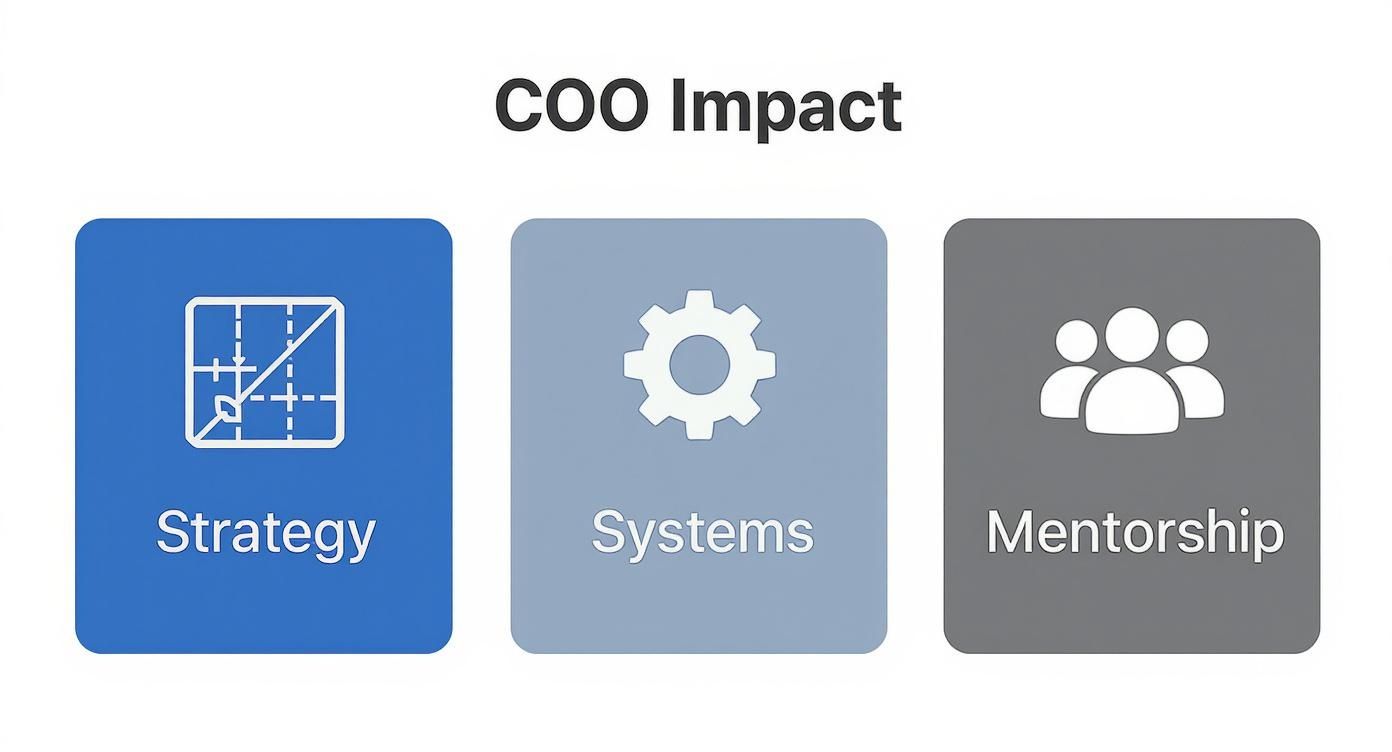
As you can see, their role goes far beyond managing systems; it’s about shaping strategy and developing future leaders.
Essential vs. Preferred COO Qualifications
To get crystal clear on what matters most, map out your qualifications. This exercise forces you to prioritize what is truly mission-critical.
| Qualification Category | Must-Have Requirements | Preferred Attributes |
|---|---|---|
| Leadership Experience | 15+ years in operational roles, with 5+ years in a senior leadership position (e.g., VP of Ops, Director). | Experience as a COO or in a #2 executive role at a similar-sized company. |
| Industry Background | Proven success in a related industry (e.g., SaaS, Manufacturing, Healthcare). | Direct experience within our specific niche. |
| Technical Skills | Mastery of project management methodologies and financial literacy (P&L, budgeting). | Advanced data analysis skills; experience with our specific tech stack (e.g., Salesforce, NetSuite). |
| Education | Bachelor's degree in Business, Finance, or a related field. | MBA or other advanced degree; relevant certifications (PMP, Six Sigma). |
| Soft Skills | Demonstrated servant leadership, cross-functional communication, and data-driven decision-making. | Public speaking experience; a history of mentoring high-potential employees. |
This table isn't just for the job description; it's a powerful internal tool to align your hiring team.
Of course, industry experience is a huge factor. The skills needed to scale a SaaS company are worlds apart from those required to optimize a manufacturing supply chain. In fact, manufacturing consistently ranks as one of the highest-paying sectors for COOs, which speaks to the critical nature of the role in complex production environments. You can dig into more COO demographic data over at Zippia.com.
A truly great COO possesses the unique ability to see both the 30,000-foot strategic view and the ground-level details needed to execute flawlessly. Your qualifications section must test for both.
Ultimately, getting this section right is the first step in conducting an effective executive skills assessment. The goal isn't just to fill a seat, but to find an operational partner—whether full-time or fractional—who has the exact blend of experience and leadership your business needs.
Your Go-To COO Job Description Template
Alright, let's put everything into a practical, ready-to-use format. Below is a complete sample job description for a chief operating officer that you can adapt for your search.
Think of this less as a rigid template and more as a strategic starting point. I've built it to cover all the crucial areas, from a hook-worthy summary to responsibilities that focus on real impact.
Swap in your specific details in the placeholders like [Your Company Name] and [Key Operational Challenge]. This is your tool to attract the operational leader who will truly be your second-in-command.
Job Title: Chief Operating Officer (COO)
Reports to: Chief Executive Officer (CEO)
Location: [City, State or Remote/Hybrid]
About Us
[Your Company Name] is a [Briefly describe your company, e.g., fast-growing SaaS provider, established manufacturing firm] on a mission to [State your company's core mission or vision]. We've hit an exciting inflection point and now we’re looking for a visionary COO to help us build the operational engine that will power our next phase of growth.
The Role
We’re looking for a results-driven Chief Operating Officer to join our executive leadership. As the COO, you'll be the CEO’s right hand, turning our strategic vision into operational reality. You will own all internal operations, build systems that scale, and mentor a team of high-performing leaders. Your core mission is to solve [Key Operational Challenge, e.g., our scalability issues] by driving excellence, efficiency, and profitability across the entire organization.
Key Responsibilities
- Strategic Execution: Work shoulder-to-shoulder with the CEO to translate the company’s strategic plan into an actionable operational roadmap.
- Process Optimization: Analyze and improve organizational processes to boost productivity, cut costs, and prepare the company to scale smoothly.
- Leadership and Mentorship: Lead, mentor, and develop the heads of
[List 2-3 key departments, e.g., Operations, Finance, HR], fostering a culture of accountability and continuous improvement. - Performance Management: Establish, track, and own the key performance indicators (KPIs) across all departments, using data to drive performance and ensure strategic targets are met.
- Financial Oversight: Oversee company budgeting, P&L management, and resource allocation to ensure financial targets are achieved.
Qualifications and Skills
- 15+ years of experience in progressively senior operational leadership roles.
- A proven track record of scaling operations within a
[Your Industry, e.g., tech, manufacturing]company. - Deep expertise in data-driven decision-making and managing by the numbers (KPIs).
- Exceptional leadership and communication skills, with a talent for inspiring and aligning cross-functional teams.
- Bachelor’s degree in Business Administration or a related field; an MBA is preferred.
The Fractional COO: A Smart Alternative for Growth
What if your business is screaming for C-suite operational leadership, but your budget isn't ready for that full-time commitment? It’s a classic scaling dilemma. The good news is, there's a modern solution that's gaining serious traction: the fractional COO.
A fractional Chief Operating Officer brings the strategic vision, process discipline, and leadership you need, but on a part-time, flexible basis. It’s a model that delivers incredible value without the massive price tag.
Think of it like hiring a world-class architect. You bring them in to design the blueprint and oversee critical construction phases—you don't pay them to be on-site every day just to watch the paint dry.
The Financial and Strategic Advantage
Let's be real: hiring a full-time COO is a major financial undertaking. In complex industries like financial services and energy, about 48% of companies have a COO on the payroll. This role is critical, and the compensation reflects that, with median annual salaries hitting nearly $490,000 plus hefty bonuses and equity.
A fractional model gives you access to that same caliber of talent without the full-time overhead. It's a perfect fit for a startup trying to build scalable systems or an established business tackling an operational overhaul.
A fractional COO isn’t a temporary fix; it's a strategic injection of top-tier expertise precisely when and where your business needs it most. It allows you to punch above your weight class in operational leadership.
This approach delivers serious benefits:
- Cost Efficiency: You get elite executive talent without the burden of a full-time C-suite salary, benefits, and equity package.
- Targeted Expertise: You can bring in a specialist to solve a particular challenge, like prepping for a new funding round or building processes to triple your output.
- Flexibility to Scale: The engagement can be scaled up or down as your needs change. It’s leadership that grows with you.
For a deeper dive, check out our complete guide to hiring a fractional COO for strategic success. If your business is ready for that next level of operational guidance but not the full-time cost, bringing in a fractional leader might be your single best move.
Common Questions About Hiring a COO
Bringing on a Chief Operating Officer is a massive step, and it's natural to have questions. Founders often wrestle with the timing, the cost, and what a COO is really supposed to do. Let's break down some of the most common questions to give you clarity.
What Is the Real Difference Between a CEO and a COO?
This is the most frequent question. Many leaders find themselves doing both jobs for a while.
The simplest analogy: The CEO is the architect, and the COO is the master builder.
- The CEO is focused on the "where" and "why." They are thinking about long-term vision, market position, and big-picture strategy. They're outward-facing.
- The COO is all about the "how" and "when." They take that grand vision and make it real. They build the internal systems and ensure the team can execute. They're inward-facing.
Essentially, the CEO dreams it up, and the COO gets it done.
When Is the Right Time to Hire Our First COO?
Timing is everything. Hire a COO too early, and you're burning cash. Wait too long, and you risk grinding the company to a halt.
The tipping point is usually when the CEO becomes the primary bottleneck. If you, as the founder, are spending more time putting out internal fires than you are on strategy, sales, or fundraising… that's your sign. A great COO steps in to professionalize the business, freeing you up to get back to steering the ship.
How Should We Measure a New COO's Success?
You can't manage what you don't measure. Success for a new COO must be tied to tangible, operational improvements within their first 6-12 months.
The ultimate measure is simple: Does the business run more smoothly, predictably, and profitably with them than it did without them? Their impact should be felt on the bottom line.
Focus on specific KPIs that show a healthier, more efficient business:
- Increased gross margins through cost optimization.
- Reduced customer acquisition cost (CAC) by tightening operations.
- Improved employee retention due to better processes.
- Hitting product or service delivery deadlines consistently.
Should I Hire a Full-Time or Fractional COO?
This is a huge question, and the answer depends entirely on your company's stage and immediate needs. A full-time COO makes sense for a well-funded, complex business that requires daily, hands-on leadership.
But for many growth-stage companies, a fractional COO is a much smarter move. It gives you access to elite operational talent to solve specific challenges—like prepping for a funding round, overhauling your supply chain, or building scalable processes—without taking on a massive executive salary. Think of it as getting A-list expertise on a startup-friendly budget.
Finding the right operational partner is one of the most pivotal decisions you'll make. At Shiny, we specialize in connecting businesses like yours with our network of over 3,000 vetted fractional executives. These leaders provide the strategic guidance you need to scale without the full-time cost. Schedule a consultation today to explore how the right fractional leader can help you achieve your goals, faster.