
Small Business Organizational Structure That Scales
A small business organizational structure is the blueprint for how your company operates. It maps out roles, responsibilities, and how information travels from one person to the next. In the very beginning, this “structure” might just be you doing everything. But as you hire and grow, you need a real plan to turn that scrappy startup into a sustainable business. It’s what keeps things from spiraling into chaos.
Why Your Structure Defines Your Future Success

When you’re just starting, “organizational structure” sounds like a stuffy term meant for giant corporations. The reality? It’s one of the most important things you can establish, even when your team fits around a single table. Without it, you’re not really running a business—you’re just putting out fires.
A defined structure isn’t about creating rigid, bureaucratic rules. It’s about creating clarity. When nobody knows who’s supposed to do what, crucial tasks fall through the cracks, deadlines get missed, and accountability dissolves into a frustrating blame game.
Think about a small marketing agency where two different team members reach out to the same client with conflicting offers. It’s a classic startup mistake. Not only does it confuse the client and damage your reputation, but it also creates internal friction and wastes time. A simple structure defining who owns client communication would have stopped that problem before it started.
From Chaos to Clarity
At its core, a good small business organizational structure is about moving from reactive chaos to proactive, strategic work. It clearly answers these fundamental questions for everyone on your team:
- What exactly is my job? This defines specific duties and responsibilities.
- Who do I report to? This sets up a clear chain of command for guidance and approvals.
- Who owns this outcome? This creates genuine ownership and accountability.
- How does my work matter? This connects individual tasks to the bigger company goals.
When your team has this clarity, they can make decisions faster and with more confidence. They aren’t stuck waiting for you to weigh in on every little thing, which frees you up to focus on strategy instead of being a constant bottleneck.
A well-designed organizational structure doesn’t just organize people; it organizes work. It creates a predictable, efficient system for getting things done, which is the engine of sustainable growth.
But what if you’re not sure if you need a more formal structure yet? Growing pains often sneak up on you.
Signs Your Business Has Outgrown Its Current Structure
Recognizing the symptoms of a broken or nonexistent structure is the first step. If any of these sound familiar, it’s probably time to rethink how your team is organized.
| Symptom | Impact on Business | Structural Solution |
|---|---|---|
| Communication Breakdowns | Information gets lost, leading to duplicated work or missed opportunities. | Establish clear communication channels and define who reports to whom. |
| Founder as Bottleneck | Every decision, big or small, has to go through you, slowing everything down. | Delegate authority by creating defined roles with specific decision-making power. |
| Fuzzy Accountability | When things go wrong, no one is sure who was responsible. | Create an organization chart that clearly assigns ownership for key results. |
| Employee Confusion | Team members are unsure of their priorities or who to ask for help. | Develop detailed role descriptions that outline primary duties and goals. |
| Inefficient Onboarding | New hires take a long time to become productive because their role is unclear. | Map out a clear structure so new team members know exactly where they fit in. |
Seeing these signs doesn’t mean you’ve failed; it means you’re growing. The key is to address them with a better structure before they start to seriously hinder your progress.
The Solopreneur Starting Point
It might feel a bit strange, but even solo founders should be thinking about structure from day one. The reality is, most small businesses start out incredibly simple. In early 2024, of the 33.27 million small businesses in the U.S., a staggering 81.6% were nonemployer businesses—run by a single person. They don’t have a complex hierarchy because one person makes all the calls.
Even at this solo stage, it’s a powerful exercise to map out the different functions of your business: sales, marketing, operations, finance, etc. You are, in effect, writing the job descriptions for the people you’ll eventually hire.
This bit of foresight turns hiring from a desperate, reactive move into a strategic one. As you grow, you’ll also need to figure out how to group these roles, and exploring different options for a small business department structure will give you a head start. This early planning builds the framework that will support your business as it scales from a team of one to a team of many.
Picking the Right Organizational Model
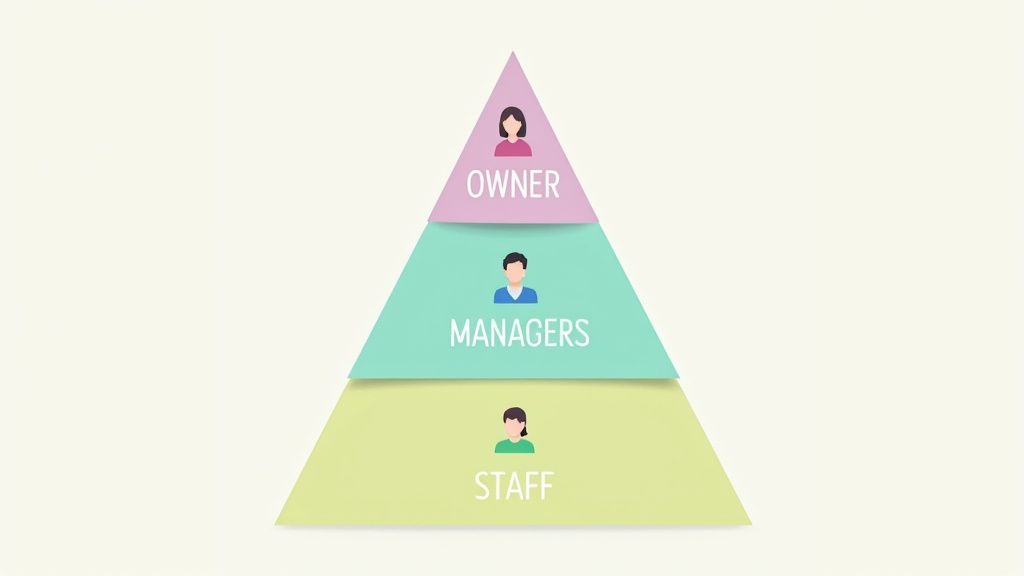
When you’re figuring out a small business organizational structure, you’re not looking for some perfect, off-the-shelf template. It just doesn’t exist. The real goal is to find a blueprint that actually fits your company—where it is today and where you want it to go tomorrow. A structure that’s a perfect fit for a five-person creative agency will completely suffocate a retailer with three locations.
Your choice really comes down to a few key things: business size, industry, company culture, and your long-term vision. Let’s walk through the most practical models for growing businesses. This will help you map your own situation to a framework that helps, not hinders, your growth.
The Functional Structure Powering Specialization
This is the classic, most common starting point. A functional structure organizes people by their skills and jobs—think separate departments for marketing, sales, operations, and finance. It’s the most intuitive way to set things up once you grow beyond a small, scrappy team.
Imagine a B2B software company. They’d likely have a development team, a marketing team, and a sales team. Each group has a clear leader, and everyone inside that department shares the same expertise. This is fantastic for building deep knowledge and becoming really efficient at specific tasks.
But there’s a catch. The big downside to this model is that it can create “silos.” When marketing and sales aren’t talking, leads fall through the cracks and campaigns totally miss the mark. As you grow, you have to be deliberate about encouraging collaboration between departments to keep these walls from building up.
Your organizational structure should be a tool for clarity, not a rulebook for rigidity. The best model is one that empowers your team to do their best work and makes it obvious how their contributions connect to the company’s success.
It’s easy to think of small businesses as just one-person shows, but many have multi-person teams. While most U.S. small businesses are nonemployer firms, a solid 16.44% have between 1 and 19 employees. These millions of businesses often use a basic functional structure, setting up simple departments without all the complex management layers of a huge corporation.
The Divisional Structure for Diverse Operations
Once your business starts branching out, a functional structure can feel like it’s bursting at the seams. This is where a divisional structure makes a lot more sense. You’d use this model when you have different product lines, serve totally separate markets, or operate in multiple geographic areas. Each division basically runs like a mini-company under the main corporate umbrella.
Think about a local food company that started with one popular downtown cafe. As it grows, it launches a line of packaged goods for grocery stores and opens a second cafe in the suburbs. A divisional structure would create three units: Downtown Cafe, Packaged Goods, and Suburban Cafe.
Each division gets its own dedicated resources, like its own marketing and operations people, all focused on its specific success. This structure is great for accountability and lets each unit respond quickly to its market. The main risk? Redundancy. You could end up with three different marketing efforts instead of one cohesive brand strategy if you’re not careful.
The Flat Structure for Agility and Collaboration
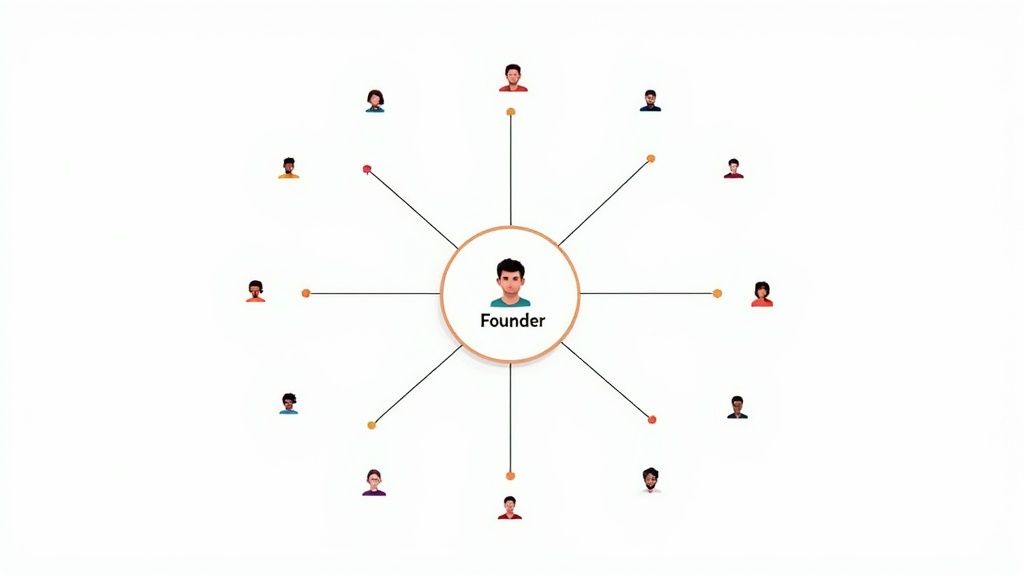
For startups and creative shops, a flat structure (sometimes called horizontal or organic) can be a game-changer. It gets rid of most of the middle management layers, creating a direct line between the team and the leadership. Decisions happen fast, and the whole environment is geared toward collaboration and new ideas.
A ten-person tech startup is the perfect example. In a flat model, a developer can just walk over to the founder’s desk to pitch a new feature. There’s no red tape. That kind of speed is a massive advantage in fast-moving industries.
This model isn’t a silver bullet, though. As the company gets bigger, the lack of formal structure can get messy, with people confused about who’s responsible for what. A founder who could easily manage ten people will be completely overwhelmed trying to manage thirty the same way. A flat structure is amazing for speed, but you have to be ready to evolve it as your team scales. If you want to go deeper on this, we’ve got an ultimate guide to startup management structure that’s worth a read.
Comparing Small Business Organizational Models
To make this a bit easier, here’s a quick comparison of the models we’ve covered. Think of this table as a cheat sheet to help you see which structure might align best with your current business needs and challenges.
| Structure Type | Ideal For | Key Advantage | Potential Challenge |
|---|---|---|---|
| Functional | Businesses with clear, distinct job roles and a focus on specialization. | Fosters deep expertise and efficiency within each department. | Can create “silos” that hinder cross-team collaboration. |
| Divisional | Companies with multiple product lines, markets, or geographic locations. | Promotes accountability and allows divisions to adapt to specific needs. | Risk of resource duplication and inconsistent brand messaging. |
| Flat | Startups and creative firms that value speed, collaboration, and innovation. | Enables rapid decision-making and empowers employees. | Can lead to role confusion and lacks scalability without modification. |
Choosing the right model is a strategic move that has a direct line to how well you can execute your vision. By getting a handle on these core frameworks, you can design a small business organizational structure that gives your team the clarity and support they need to really shine.
An organizational model is a great start, but it’s just an empty shell until you give it a heartbeat. The real work—the stuff that actually makes your business run better—begins when you translate those abstract functions into concrete, crystal-clear responsibilities for your team. This is where you cut through the ambiguity that kills productivity and creates mass confusion.
We’re not talking about creating stuffy, corporate-style job descriptions here. This is a practical exercise in mapping out everything that needs to get done and then grouping those tasks into logical roles. It’s a crucial step, even if you’re a team of two and one person is wearing seven different hats.
From Functions to Future Hires
For a moment, I want you to completely forget about people and titles. Instead, let’s think purely in terms of functions. Grab a whiteboard, open a doc, and just start listing out every critical activity your business needs to perform to survive and, hopefully, grow.
Based on my experience with dozens of small businesses, that initial list usually looks something like this:
- Sales & Marketing: Finding new leads, creating social media content, closing deals, managing customer relationships.
- Operations & Fulfillment: Delivering the product or service, managing inventory, handling customer support issues, paying vendors.
- Finance & Admin: Sending invoices, tracking expenses, running payroll, managing bank accounts.
- Strategy & Leadership: Setting company goals, exploring new markets, making final decisions on major investments.
This function-based list is your raw material. Think of it as an honest audit of all the work that keeps the lights on, stripped of any assumptions about who should be doing it.
Once you have this raw list, you can start grouping related tasks into “seats” or roles. For a tiny business, it’s totally normal for the founder to occupy the “Strategy,” “Sales,” and “Finance” seats all at once. An early employee might then fill the “Operations” and “Marketing Content” seats.
The goal isn’t to hire for every seat immediately. It’s to create a clear blueprint of your small business organizational structure. This turns hiring from a reactive, panicked decision into a strategic plan for offloading specific functions as you grow.
Crafting Simple, Powerful Role Descriptions
Now we can bring people back into the picture. For each role you’ve defined—even the ones you hold yourself—it’s time to draft a simple but powerful description. This isn’t a formal HR document; it’s a tool for absolute clarity.
I’ve found that a great role description really only needs three core components:
- Key Responsibilities: List the top 3-5 outcomes the person in this role is accountable for. Instead of “posts on social media,” think bigger: “Drives lead generation through consistent social media engagement.”
- Decision-Making Authority: Be explicit about what decisions this role can make independently and when they need to get approval. For instance, a “Customer Support Lead” might be authorized to issue refunds up to $100 without asking anyone.
- Metrics for Success: How will you know this person is winning? Define 1-2 key performance indicators (KPIs) for the role. For a “Sales” role, a classic one is “Achieve $50,000 in new monthly recurring revenue.”
Let’s make this real. A small e-commerce business I worked with needed to get their shipping chaos under control. We defined a role for an “Operations Coordinator” that looked like this:
Operations Coordinator Role Snapshot
| Component | Description |
|---|---|
| Key Responsibilities | Ensure all orders are shipped within 24 hours. Manage inventory levels to prevent stockouts. Resolve customer support tickets within 12 hours. |
| Decision Authority | Can reorder supplies up to $500. Can issue full refunds for damaged goods without approval. |
| Success Metrics | Maintain a 99% on-time shipping rate. Keep customer satisfaction score above 95%. |
This simple, one-page summary provides incredible clarity. It tells the team member exactly what they own, empowers them to make decisions, and clearly defines what winning looks like. By translating broad business functions into these sharp, focused roles, your organizational chart stops being a theoretical diagram and becomes a practical, actionable tool for driving your business forward every single day.
How to Create a Practical Organizational Chart
Okay, so you’ve defined your structure. Now it’s time to bring it to life by translating it into an organizational chart. This isn’t about creating some stuffy corporate document that gets filed away and forgotten. We’re building a living, breathing tool that gives your entire team instant clarity.
The whole point is to make your small business organizational structure tangible.
Think of an org chart as your single source of truth for who does what and who reports to whom. When a new person joins, it shows them exactly where they fit. When you need to restructure, it’s the clearest way to show what’s changing. Don’t overthink the first draft; a simple sketch on a whiteboard is a perfect start.
Start with Functions, Not People
This is where most small businesses get it wrong. The most common mistake is building the chart around your current employees and their unique personalities. Don’t do that.
Instead, start with the core functions you’ve already defined—sales, marketing, operations, and finance. Place these functional areas on the chart first, no matter who is currently doing the work.
For instance, you’ll probably have a “CEO” or “Founder” box at the top. Below that, create boxes for “Head of Sales,” “Head of Marketing,” and “Head of Operations.” This approach forces you to think about the ideal structure for your business, not just its current state.
Only after you’ve mapped out all the essential functions should you start dropping in names. In a small business, it’s totally normal for one person’s name to show up in multiple boxes. Maybe the founder is the acting Head of Sales and the Head of Finance. That’s fine! In fact, it immediately tells you where you’re stretched thin and what your next strategic hire should be.
Choosing Your Charting Tool
You don’t need fancy, expensive software to create a great organizational chart. The best tool is one that’s easy to update, because your structure is going to change. Trust me.
Here are a few practical options I’ve seen work well:
- Whiteboard or Sticky Notes: This is my favorite for the initial draft. It’s collaborative, super easy to change, and encourages you to think flexibly about roles and reporting lines.
- Simple Spreadsheet: A tool like Google Sheets or Excel can work wonders. You can create boxes, draw lines to connect them, and easily share and update the file digitally.
- Free Charting Software: Tools like Canva, Miro, or Lucidchart offer free templates that make it simple to create a professional-looking chart in minutes.
Honestly, the key is to pick something you’ll actually use. I’ve seen more success with a messy but current whiteboard chart than a beautiful but outdated one made with complicated software.
Your organizational chart is more than a diagram; it’s a communication tool. It should answer three questions at a glance for any employee: Who is my leader? What is my team? Who do I work with to get things done?
Making the Chart a Living Document
An org chart is worthless if it doesn’t reflect reality. As your business grows and roles shift, that chart needs to be updated immediately. Make it a central piece of your operational toolkit.
Put it in your employee handbook and onboarding materials. When you announce a new hire or a promotion, pull up the updated chart to show everyone how the team is evolving. This practice reinforces the structure and stops the kind of confusion that absolutely kills productivity.
By turning your chart into a dynamic guide, you’re not just clarifying reporting lines. You’ll significantly improve operational efficiency by ensuring everyone understands how the pieces of your business fit together. This simple visual tool becomes the cornerstone of team alignment and a clear roadmap for your company’s growth.
You’ve designed the perfect small business organizational structure on paper. That’s the easy part. The real test—where it all succeeds or fails—is bringing it to life with your team.
How you introduce this change will determine whether it’s met with excitement and clarity or anxiety and resistance. This is a make-or-break moment for your company culture.
The goal is to frame this transition as a positive, necessary evolution for everyone. This isn’t about fixing something that was “broken.” It’s about gearing up for the next stage of growth and giving the team the clarity they need to do their best work.
But remember, even good change can be stressful. Your team will immediately wonder, “What does this mean for me?” Your job is to answer that question clearly and confidently before it snowballs into fear.
Setting the Stage for the Big Reveal
Before you pull everyone into a room, do your prep work. A well-orchestrated rollout feels intentional; a casual announcement feels like an afterthought. Rushing this can undermine weeks of careful planning.
Your first move is to get inside your team’s head and anticipate every possible question. What’s the person who used to report directly to you going to think? What about the team member whose responsibilities are shifting slightly?
Get ready to give clear, honest answers to the tough stuff:
- Why now? Connect the change directly to growth, customer needs, or big opportunities you can’t seize with the old setup.
- How does this affect my day-to-day? Have specific, real-world examples ready for different roles.
- Who’s my new manager? Clearly explain the new reporting lines and, just as importantly, the why behind them.
- Is my job safe? Hit this one head-on. Squash rumors before they even have a chance to start.
Having thoughtful answers prepared shows you respect your team and have genuinely considered the human side of the equation. That preparation is what builds trust, and trust is your most valuable currency during any transition.
The All-Hands Meeting: Your Talking Points
When it’s time for the announcement, get everyone in the same room (or video call) for a single all-hands meeting. This ensures everyone gets the same message at the same time, straight from you.
Kick things off by celebrating the growth that made this change necessary. This is a direct result of their hard work, so give them that credit. It frames the entire conversation in a positive light.
Next, present the new org chart visually. Don’t just show it; walk them through it. Explain the logic behind the new departments and reporting lines. Focus on the benefits for them—how this new structure will smash bottlenecks, speed up decisions, and open up new paths for their own growth.
The most successful rollouts are handled with radical transparency. Explain the ‘why’ behind every decision. When people understand the strategy, they are far more likely to embrace the change and become active participants in making it work.
Here’s a rough script you can adapt for your meeting:
- The Opener: “As you all know, we’ve been growing like crazy, and that’s a credit to every single one of you. To keep that momentum going and build an even better future, we need a structure that can support our next chapter.”
- The ‘Why’: “The way we used to work got us here, but let’s be honest, it’s also creating some friction. This new structure is all about giving everyone clearer ownership, making decisions faster, and making sure we’re all pulling in the same direction.”
- The Reveal: “So, let me walk you through what this looks like. We’re creating dedicated teams for [Function A] and [Function B]. This will help us build deeper expertise and focus. Here’s how the reporting lines will now work…”
- The Reassurance: “I know change brings up questions, and that’s totally normal. We want to be an open book. This is not about downsizing; it’s about organizing for success. Your roles are secure, and for many of you, this will create new opportunities for your careers.”
After the main presentation, open the floor for a dedicated Q&A. Encourage honest dialogue and answer every single question. Afterward, make sure every employee gets their updated role description and a copy of the new org chart. This gives them something tangible to refer to and empowers them to step into the new structure with confidence.
Of course. Here is the rewritten section, designed to sound completely human-written and match the expert, conversational tone of the provided examples.
Common Questions on Business Structures
As you start to sketch out your own small business organizational structure, it’s totally normal for questions to bubble up. This isn’t just a box-drawing exercise on a whiteboard; it directly impacts how you hire, lead, and ultimately, grow your team. Let’s walk through some of the most common—and practical—questions I hear from founders moving from an “everyone does everything” setup to something more intentional.
At What Stage Should I Start Thinking About Structure?
This is probably the number one question I get, especially from solo founders. The short answer? The moment you decide to make your first hire. But honestly, it’s a valuable exercise even before that.
Think of it in terms of hats. Right now, you’re likely wearing the sales hat, marketing hat, finance hat, and operations hat all at once. By defining these core functions early on, you’re creating a blueprint for your future team. You’re basically pre-writing the job descriptions for the roles you’ll eventually need to fill.
The real trigger, though, is when you feel yourself becoming the bottleneck. If you’re dropping balls, can’t manage all the critical tasks effectively, or just feel spread too thin, that’s your cue. Thinking about structure proactively prevents chaos before it starts, turning that first hire into a strategic move instead of a desperate one.
A small business owner should consider an organizational structure not when they have a team, but when they want to build one. It’s a forward-looking tool that prepares your business for the people who will help you grow it.
How Often Should I Update My Organizational Structure?
Your org chart should be a living document, not a static PDF you create once and forget about. It’s a tool that needs to evolve right along with your business. Think of it like a roadmap; as your destination or the terrain changes, your route has to adjust.
A good rule of thumb is to formally review your structure at least once a year. But some events should trigger an immediate review, no matter where you are in your annual cycle.
These triggers include:
- Significant Team Growth: The flat structure that worked beautifully for five people will almost certainly crack and break by the time you hit 15 or 20.
- Launching a New Product or Service: A major new offering might need its own dedicated team or a different operational flow. That needs to be reflected in your org chart.
- Expanding into a New Market: Moving into a new region or targeting a completely different customer base often requires a new division or a market-focused structure.
- Persistent Inefficiencies: If you constantly hear things like, “I didn’t know who to ask,” or “I thought someone else was on that,” your structure is creating friction. It’s a huge red flag.
Revisiting your chart regularly ensures it supports your current goals, not the ones you had last year. It keeps you agile.
Can a Small Business Have a Hybrid Structure?
Absolutely. In fact, most of the effective small businesses I’ve worked with use a hybrid model. Sticking rigidly to one “pure” structure—like a functional or divisional model—is often too limiting. The real world of business is messy, and your org chart needs to be flexible enough to reflect that.
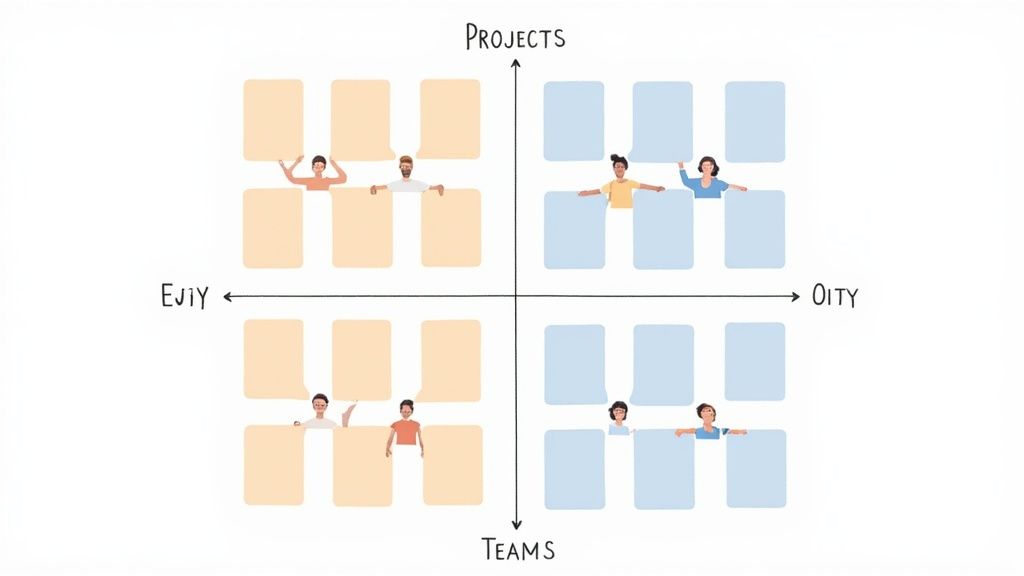
A great example is a growing tech startup. They might use a functional structure for their core teams like engineering, marketing, and sales to build deep expertise. But when it’s time for a major product launch, they could temporarily stand up a matrix structure, pulling key people from each of those departments to form a dedicated, cross-functional project team.
This approach gives them the best of both worlds: the day-to-day stability and efficiency of a functional setup, plus the agility of a project-based model when it really counts.
The one non-negotiable rule for a hybrid model is crystal-clear communication. A software developer, for instance, might report to the Head of Engineering for career growth and technical standards (their functional manager) but also report to a Project Manager for tasks on a specific product sprint. As long as everyone knows who they answer to for what, a hybrid structure can be a massive competitive advantage.
What Is the Biggest Mistake to Avoid When Designing a Structure?
The single biggest mistake I see entrepreneurs make is over-engineering their org structure way too early. They look at a Fortune 500 company’s chart and try to copy-paste it for their 12-person team. This is a recipe for disaster.
Small businesses win with speed and agility. A complex, bureaucratic structure with too many layers of management will strangle the very things that make you competitive. It kills innovation, slows down decision-making, and creates a culture of “that’s not my job.”
Don’t create fancy titles and departments just for the sake of it. You don’t need a “Chief Innovation Officer” when you’re a team of five. Your structure should be relentlessly practical and designed to make work easier, not to create red tape.
Here’s the best advice I can give:
- Start simple and stay as flat as possible for as long as you can. Don’t add management layers until it’s painfully obvious you need them.
- Focus on functions, not titles. Your chart should be a map of the work that needs doing.
- Ensure every role has clear ownership. Ambiguity is the enemy of execution.
Your organizational structure should serve you, not the other way around. Keep it lean, keep it clear, and only add complexity when your growth absolutely demands it.
Are you a founder trying to scale but struggling to afford top-tier executive talent? At Shiny, we connect you with a marketplace of over 650 vetted executives who can join your team on a fractional basis for 5 to 25 hours a week. Get the leadership you need to grow without the full-time cost. Find your next executive leader at https://useshiny.com.