
Effective Startup Growth Strategy for Rapid Success
Navigating Today’s Startup Growth Landscape

The startup world is dynamic and constantly evolving. A strong startup growth strategy is essential for not only surviving but thriving. Traditional approaches often fail to address current market conditions, requiring founders to adapt and understand the changing landscape. This allows them to build a sustainable engine for growth. Relying solely on outdated advice could mean missing key opportunities or allocating resources inefficiently.
Understanding the Shifting Startup Ecosystem
Market conditions are always in motion, impacting how startups grow and compete. Factors like funding availability and competitive intensity shape growth trajectories. This constant change means some startups will flourish while others struggle, even with similar funding levels. Understanding these dynamics offers a significant competitive edge.
To optimize startup growth, prioritize data-driven decision making. This approach bases decisions on current data and market trends.
Analyzing the startup ecosystem is a key element in developing effective growth strategies. The Global Startup Ecosystem Report (GSER) by Startup Genome offers comprehensive insights into leading startup ecosystems globally. The 2025 GSER reveals a decline in the total value of global startup ecosystems due to fewer major exits and IPOs. However, Asian ecosystems experienced a resurgence fueled by increased funding and large-scale exits.
This shift highlights the importance of adapting strategies to regional markets. While AI-driven innovation continues to attract significant investment, its impact on exits has been limited, primarily benefiting large corporations. Understanding these trends is critical for startups aiming to expand in a competitive environment.
Adapting to Real-Time Signals
Successful founders remain agile and responsive. They continually adjust their strategies based on real-time market signals and recognize the risks of clinging to outdated approaches.
They also prioritize continuous learning and experimentation. This helps them quickly discern effective strategies from ineffective ones, allowing for real-time optimization. This adaptability is essential in a landscape that is constantly changing.
One example of this adaptability is Shiny, a platform connecting startups with fractional executives. This model offers scalable expertise tailored to a startup’s specific needs, providing a strategic response to talent acquisition and cost management challenges.
Crafting Your Custom Growth Strategy Framework
Generic growth advice rarely works. Successful founders create growth strategies specific to their business model and target market. This means identifying your growth levers, choosing the right metrics, and setting realistic timelines.
Identifying Your Unique Growth Levers
Different business models need different startup growth strategies. A marketplace startup has different challenges than a SaaS company or a consumer product business. Marketplaces need both buyers and sellers, creating a two-sided network effect. SaaS companies often focus on recurring revenue and customer lifetime value. Consumer product businesses prioritize brand building and distribution. Check out this helpful guide: How to Master Startup Growth Strategies.
For example, a meal-kit delivery service might partner with local farmers. This improves product quality and creates a marketing narrative around sustainability. Targeted advertising on social media frequented by their ideal customer is another potential lever.
Selecting the Right Metrics
Choosing the right metrics is vital. Focusing on vanity metrics like website traffic without considering revenue or customer acquisition is a common mistake. Instead, find your north star metric: the single most important metric reflecting your business success. This could be customer lifetime value, monthly recurring revenue, or average order value.
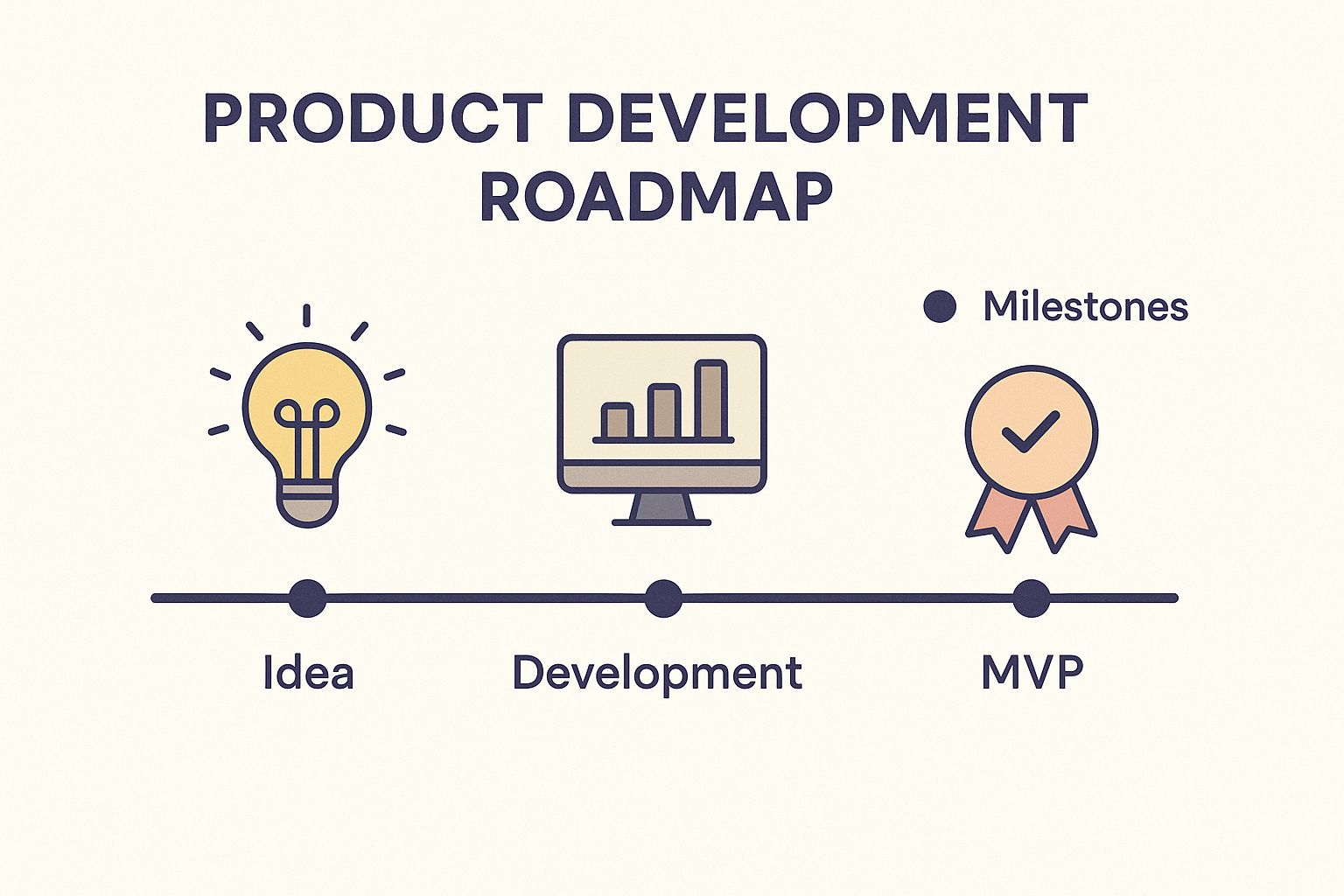
This infographic shows a product development roadmap, from idea to Minimum Viable Product (MVP). It highlights the iterative nature of product development and the importance of a quick MVP. Focusing on essential features and rapid iteration helps startups validate product-market fit and adjust their growth strategy.
Establishing Realistic Timelines
Ambitious goals are good, but unrealistic timelines lead to burnout. Break down your strategy into smaller milestones with deadlines. This allows incremental progress and adjustments based on feedback. For example, to double your customer base in a year, set quarterly acquisition targets and track your progress.
Building Accountability Systems
A good strategy needs consistent implementation. Establish clear roles and responsibilities, and track progress. Regular meetings, reports, and reviews ensure everyone is aligned. Rewarding achievements fosters a positive environment. See more here: How to Master Startup Growth Strategies. This creates a culture of accountability.
To help visualize effective strategies for various startup types, the following table provides a framework comparison.
The table below, “Growth Strategy Frameworks by Startup Type”, compares appropriate growth frameworks based on a startup’s business model and stage. It highlights key differences and similarities in their focus, metrics, and potential pitfalls.
| Startup Type | Early Stage Focus | Growth Stage Focus | Key Metrics | Common Pitfalls |
|---|---|---|---|---|
| Marketplace | Two-sided network effects, attracting both buyers and sellers | Scaling network effects, managing supply and demand | Customer acquisition cost (CAC) for both sides, transaction volume | Chicken-and-egg problem, imbalanced supply and demand |
| SaaS | Product-market fit, acquiring early adopters | Recurring revenue growth, customer retention | Monthly Recurring Revenue (MRR), Customer Lifetime Value (CLTV) | Churn, high CAC |
| Consumer Product | Brand awareness, initial traction | Scaling distribution, building customer loyalty | Customer acquisition cost (CAC), Average Order Value (AOV) | Inventory management, competition |
This table demonstrates how different types of startups prioritize different aspects of growth. Marketplaces focus on network effects, SaaS companies on recurring revenue, and consumer product businesses on brand building and distribution. Understanding these differences is crucial for tailoring your growth strategy.
Product-Market Fit: The Non-Negotiable Growth Foundation

No amount of marketing genius can save a product no one wants. This highlights the crucial importance of product-market fit, the foundation of any successful startup growth strategy. Founders often rush past this vital step, eager to scale before truly understanding their target audience. This section explores the importance of product-market fit and offers practical frameworks for achieving it.
Many startups fail. Studies show up to 90% don’t make it, with 10% failing within the first year. This stark reality underscores the importance of prioritizing product-market fit and marketing from the start. A lack of product-market fit accounts for 34% of small business failures, while 22% fail due to poor marketing. Focusing on these key areas dramatically increases a startup’s chances of success. These numbers emphasize strategic planning and deep knowledge of consumer needs.
Validating Product-Market Fit Before Scaling
Achieving product-market fit is a systematic process, not a lucky break. It requires careful analysis of both qualitative signals (what customers do) and quantitative benchmarks (hard data). These metrics offer vital insights into whether your product resonates with the target audience and if the market is primed for growth.
High customer churn, for example, could signal a product-market fit problem. Strong organic growth and positive user reviews, however, suggest a receptive market ready for expansion.
Customer Discovery and Iterative Product Development
At the heart of product-market fit lies effective customer discovery. This involves actively engaging with potential customers to understand their pain points and unmet needs. It’s not a one-time activity but an ongoing dialogue.
This feedback fuels iterative product development, a continuous cycle of refinement based on real user behavior and preferences. This ensures the product evolves to meet the market’s ever-changing needs and remains relevant.
Market Validation Techniques
Beyond customer discovery and product development, effective market validation is critical. These techniques help avoid premature scaling, a common startup pitfall. It involves testing various marketing channels, analyzing conversion rates, and assessing the overall market response.
Consider a company like Shiny, which provides fractional executive services. They can validate their market fit by tracking client engagement success and gathering feedback on the impact of fractional executives on startup growth. This direct feedback informs their product-market fit strategy.
Frameworks for Actionable Product-Market Fit
Product-market fit can seem abstract. However, practical frameworks make it tangible and actionable. One framework involves defining your ideal customer profile, identifying key value propositions, and setting measurable success metrics.
These frameworks provide a structured approach to evaluating and improving product-market fit. This ensures growth efforts are rooted in a deep understanding of your audience and market dynamics. Focusing on these elements allows startups to create resonant products and establish a strong base for sustainable, confident scaling.
Building Your Technology-Powered Growth Engine
Technology isn’t just a feature anymore; it’s the engine of growth for successful startups. By looking at technology-driven startups that have shaken up existing markets, we can learn how to use new technologies to build a real competitive edge. This means strategically using AI and automation to create systems that deliver exponential growth, even when resources are tight.
Leveraging Emerging Technologies for Competitive Advantage
Scaling a startup successfully often means taking advantage of the latest technologies and trends. Take Perplexity AI, founded in 2022, as a prime example. They created a generative AI-powered conversational search engine and experienced a staggering 7,200% increase in search growth over five years, reaching 123.6 million monthly website visits. Their substantial $915 million Series C funding further accelerates their expansion. This demonstrates how combining technological innovation with strategic investment can rapidly propel a startup forward. This success story highlights the importance of identifying the right technologies for your specific business model and developing the unique capabilities that set you apart.
Building Scalable Growth Systems with AI and Automation
Effective automation is the cornerstone of scalable growth. By automating repetitive tasks, startups free up their teams to concentrate on strategic initiatives that generate significant results. This approach optimizes resource allocation and maximizes output, allowing small teams to achieve big things.
AI can supercharge this process. AI-powered tools, such as those offered by HubSpot, can personalize the customer experience, optimize marketing campaigns, and provide valuable data-driven insights. This level of automation and data analysis empowers startups to do more with less, shifting from linear progress to exponential growth.
Making Smart Build-vs-Buy Decisions
As your startup scales, so does your technology stack. The decision of whether to build solutions in-house or buy existing ones is a constant challenge. Building offers complete customization but demands significant development time and resources. Buying solutions can be quicker and more cost-effective but may not include all the specialized features you need. Making smart choices involves balancing the need for customization with the demands of speed and cost, all while preventing engineer burnout and maximizing your ROI.
Frameworks for Assessing Technology Investments
Not every technology investment is equal. Startups need frameworks to assess which technologies offer the best return on investment. This means carefully analyzing the potential impact of each technology on key metrics like customer acquisition cost (CAC), customer lifetime value (CLTV), and revenue growth. This data-driven approach helps prioritize investments that align with your overall growth strategy.
The table below, “Technology Growth Enablers by Industry,” provides a snapshot of the key technologies propelling startup growth across various sectors. It also details the implementation complexity, typical ROI timeline, and required investment levels.
| Industry | Key Technologies | Implementation Complexity | Typical ROI Timeline | Required Investment |
|---|---|---|---|---|
| E-commerce | AI-powered personalization, automated inventory management, chatbots | Moderate | 6-12 months | Moderate |
| SaaS | Cloud computing, data analytics, automation platforms | Moderate | 12-18 months | High |
| Healthcare | Telemedicine, AI-driven diagnostics, wearable technology | High | 18-24 months | High |
| Fintech | Blockchain, mobile payments, AI-powered fraud detection | High | 12-24 months | High |
This table highlights the diverse technology needs across different industries. It emphasizes the importance of understanding the complexities and timelines associated with implementing new technologies. A thorough grasp of these factors is crucial for making smart investment decisions and fine-tuning the technology-powered growth engine for your industry and startup stage.
Strategic Capital Allocation For Exponential Growth
Raising capital is a significant milestone, but deploying it wisely is what truly sets your startup’s trajectory. This section explores frameworks for strategic capital allocation, maximizing your runway and fueling meaningful growth. We’ll examine how successful startups find a balance between short-term needs and long-term investments, avoid common funding pitfalls, and maintain financial discipline even as they rapidly scale.
Balancing Short-Term Needs And Long-Term Investments
One of the most significant challenges in capital allocation is balancing the immediate needs of customer acquisition with critical infrastructure investments for future growth. It’s similar to building a house: attracting residents (customers) is essential, but neglecting the foundation (infrastructure) will create instability down the line. A well-defined startup growth strategy involves careful planning and resource distribution. This means prioritizing investments that deliver both short-term wins and long-term stability to ensure sustainable expansion.
For example, investing in robust Customer Relationship Management (CRM) software might initially seem expensive. However, it can significantly improve customer retention and lifetime value over time. Similarly, investing in employee training programs can boost productivity and minimize costly turnover. Interested in learning more? Check out this article: How to master startup scaling challenges. This balanced approach builds a solid foundation for sustainable growth.
Avoiding Common Funding Allocation Mistakes
Many startups overspend on marketing and sales while underinvesting in crucial areas like product development and customer support. This can create a surge in initial customers followed by a rapid decline due to a subpar product or a poor customer experience. Another frequent mistake is prematurely scaling operations before achieving product-market fit, leading to wasted resources and a cash crunch. Successfully scaled startups recognize that sustainable growth requires strategic allocation across all departments.
Developing Capital-Efficient Customer Acquisition Models
Customer acquisition is vital, but it shouldn’t deplete your funds. Successfully scaled startups prioritize capital-efficient acquisition models. This involves diligently tracking customer acquisition cost (CAC), pinpointing the most effective channels, and optimizing campaigns for maximum ROI. These startups also focus on building organic growth channels like content marketing and search engine optimization (SEO), generating leads more cost-effectively than paid advertising.
Data-Driven Decisions On Team Expansion Vs. Automation
As your startup expands, deciding between team expansion and automation becomes crucial. Hiring increases payroll expenses, while automation tools require upfront investment but can reduce long-term costs. Data-driven decision-making is essential. Analyze your current workflows, identify bottlenecks, and calculate the potential return on investment for both options.
Implementing Budgeting Processes For High-Impact Growth
Financial discipline is essential for startups, particularly during rapid growth. Implementing robust budgeting processes ensures capital is allocated to high-impact activities that directly contribute to sustainable outcomes. This involves setting clear budget targets for each department, tracking spending against these targets, and regularly reviewing performance. Successfully scaled startups foster a culture of cost-consciousness, empowering all team members to identify and eliminate wasteful spending. This focus on efficiency ensures every dollar fuels meaningful growth.
Customer Acquisition Channel Mastery
Dependency on a single customer acquisition channel is a risky proposition for any startup. If that one source dries up, your growth stagnates. This section explores how successful startups diversify their acquisition strategies, effectively leveraging multiple channels without spreading resources too thin. We’ll examine frameworks for identifying and testing promising channels, methods for assessing viability without large investments, and strategies for efficiently scaling winning channels.
Identifying and Testing Potential Channels
A robust startup growth strategy necessitates exploring a variety of customer acquisition channels. These might include paid advertising, social media marketing, content marketing, email marketing, search engine optimization (SEO), and strategic partnerships. The key is to rapidly identify and test these channels to see which ones connect with your target demographic.
For example, a B2B SaaS startup might discover that LinkedIn ads and industry events are effective at generating high-quality leads, while a B2C e-commerce company might see stronger results from Instagram influencers and Facebook ads. Testing provides crucial insights for allocating your budget wisely.
Determining Channel Viability Without Major Investment
Effective testing doesn’t necessitate a huge upfront investment. Start with small-scale experiments. Consider running targeted Facebook ads with a modest budget to gauge performance before committing significant funds. Similarly, you could partner with a micro-influencer for an initial campaign before engaging with those with larger followings.
This measured approach allows you to collect data and validate channel viability without overspending. You can then prioritize those channels that demonstrate potential. This controlled experimentation optimizes your budget allocation.
Scaling Successful Channels Without Diminishing Returns
Once you’ve pinpointed your most successful channels, the next step is strategic scaling. Simply increasing your budget on a winning channel isn’t a guaranteed path to continued growth. You must consistently analyze performance, optimize campaigns, and explore new tactics to sustain progress.
For example, if your Facebook ad campaigns begin to plateau, you might A/B test different ad creatives, explore new audience segments, or try various ad formats. Ongoing optimization is crucial to maintain channel effectiveness as your investment grows.
Calculating True Customer Acquisition Costs
Understanding your Customer Acquisition Cost (CAC) is fundamental to any startup growth strategy. Many startups make the error of focusing solely on direct costs like ad spend. However, true CAC encompasses other expenses such as team time dedicated to campaign management, the cost of tools and software, and general overhead. Accurately calculating your CAC provides a realistic understanding of channel profitability. A key factor in effective startup growth strategy is understanding your Customer Acquisition Cost (CAC).
Understanding Lifetime Value Implications
Different channels often attract different types of customers, and some might bring in customers with a higher lifetime value (LTV) than others. For instance, customers acquired through organic search might demonstrate higher LTV than those acquired via paid advertising.
Understanding the LTV implications of each channel helps you prioritize your acquisition efforts and optimize profitability. It ensures you’re not just chasing short-term wins, but also building for long-term growth. This strategic focus helps you select the acquisition channels that most positively impact your bottom line. Shiny can assist startups with fractional CFOs to support informed financial decisions and effective strategies.
Building Efficient Acquisition Systems
The ultimate goal is to develop a scalable acquisition system. This involves automating tasks, streamlining processes, and adopting data-driven decision-making. Successful startups leverage tools and technologies to track campaign performance, analyze user behavior, and optimize ad spend.
This systematic approach helps maintain acquisition efficiency even as spending increases. It fosters steady growth and allows your startup to effectively capitalize on market opportunities. By implementing efficient systems, startups position themselves for sustainable, scalable growth.
Growth Metrics That Drive Meaningful Action
The metrics a startup chooses significantly influence its path. Selecting the right metrics, tracking them diligently, and acting on the resulting insights are vital for any successful startup growth strategy. This means creating dashboards that highlight important information, conducting regular reviews that lead to action, and nurturing a data-driven company culture.
Building Effective Growth Dashboards
Effective dashboards don’t just present data; they tell a story. They showcase the Key Performance Indicators (KPIs) that truly matter for your specific business model and stage of development. For a Software as a Service (SaaS) business, this might involve Monthly Recurring Revenue (MRR), Customer Churn Rate, and Customer Lifetime Value (CLTV). For an e-commerce startup, essential metrics could include Average Order Value (AOV), Conversion Rate, and Customer Acquisition Cost (CAC). Understanding your CAC is a critical element of a successful startup growth strategy. For a deeper dive into CAC, explore this helpful article: Customer Acquisition Cost (CAC). Prioritizing these KPIs helps filter out less important data and provides a sharp focus on growth drivers.
Implementing Action-Oriented Analytics Reviews
Regular analytics reviews are crucial, but they shouldn’t result in analysis paralysis. The objective is to gain actionable insights that shape strategic decisions, not to get lost in endless number-crunching. Successful startups establish a regular rhythm for these reviews, perhaps weekly or monthly, and ensure they produce concrete action items assigned to specific teams. This consistent review process maintains momentum and keeps the startup adaptable. For further reading on measuring business growth, take a look at: How to measure business growth.
Creating a Data-Informed Culture
A truly data-informed culture empowers everyone within the organization to base decisions on data. It’s not enough for only leadership to be data-driven; the whole company needs to adopt this mindset. This means offering training on data interpretation, ensuring easy access to data, and promoting data-driven conversations. For instance, marketing teams can use data to optimize campaigns, sales teams can personalize outreach, and product teams can prioritize feature development. This widespread use of data in decision-making ensures alignment and progress towards shared objectives.
Avoiding Common Analytics Pitfalls
One frequent trap is the emphasis on vanity metrics. These are metrics that appear impressive but don’t necessarily reflect true business health. A high website traffic number, for example, is useless if those visitors aren’t becoming paying customers. Another pitfall is confusing correlation with causation. Just because two metrics move together doesn’t mean one directly causes changes in the other. Successful startups are careful to pinpoint actual growth drivers and avoid surface-level interpretations. They understand the importance of detailed analysis to uncover the true cause-and-effect relationships that drive their key metrics.
Connecting Metrics to Team Actions
Connecting metrics to specific team actions is essential. If your CAC is excessive, the marketing team might investigate more cost-effective advertising channels. If your churn rate rises, the customer success team might introduce new onboarding processes or proactive communication strategies. This clear link between metrics and action promotes accountability and ensures everyone understands their contribution to growth.
Practical Guidance on Analytics Tools
Selecting appropriate analytics tools is another key consideration. A wide range of tools exists, from free options like Google Analytics to more specialized enterprise solutions. The best approach is to select tools that fit your budget and needs, provide accurate data, and integrate well with your current systems. Thoughtful tool selection streamlines data collection and analysis, enabling you to gather valuable insights and optimize your startup growth strategy.
Shiny offers fractional CFOs to help manage these intricacies, ensuring you have the expertise to establish growth metrics, build dashboards, and make informed, data-driven decisions. Visit Shiny today to learn more and connect with seasoned professionals who can contribute to your startup’s success.