
7 Startup Org Structure Types to Consider in 2025
Building Your Dream Team: Choosing the Right Startup Org Structure
Choosing the right startup org structure is crucial for success. This listicle provides seven common startup org structure types to help you build a solid foundation for growth. Learn how each structure functions, understand the pros and cons, and determine which best aligns with your startup’s goals. Whether you’re a SaaS, FinTech, or HealthTech company, understanding these core organizational structures is vital for efficient operations and scaling your business. We’ll cover flat, functional, product-based, matrix, squad-based, remote-first, and growth team structures, giving you the insights you need to optimize your team for maximum impact.
1. Flat Organizational Structure
For startups navigating the choppy waters of early development, a flat organizational structure is often the most effective way to steer the ship. This structure minimizes hierarchical layers, creating a direct line of communication between executives and employees. It’s a common default for new ventures with smaller teams where a rigid division of responsibilities isn’t yet critical. This streamlined approach fosters a collaborative environment and empowers employees to take ownership, contributing directly to the startup’s agility and rapid growth potential, making it a key consideration when defining your startup org structure.
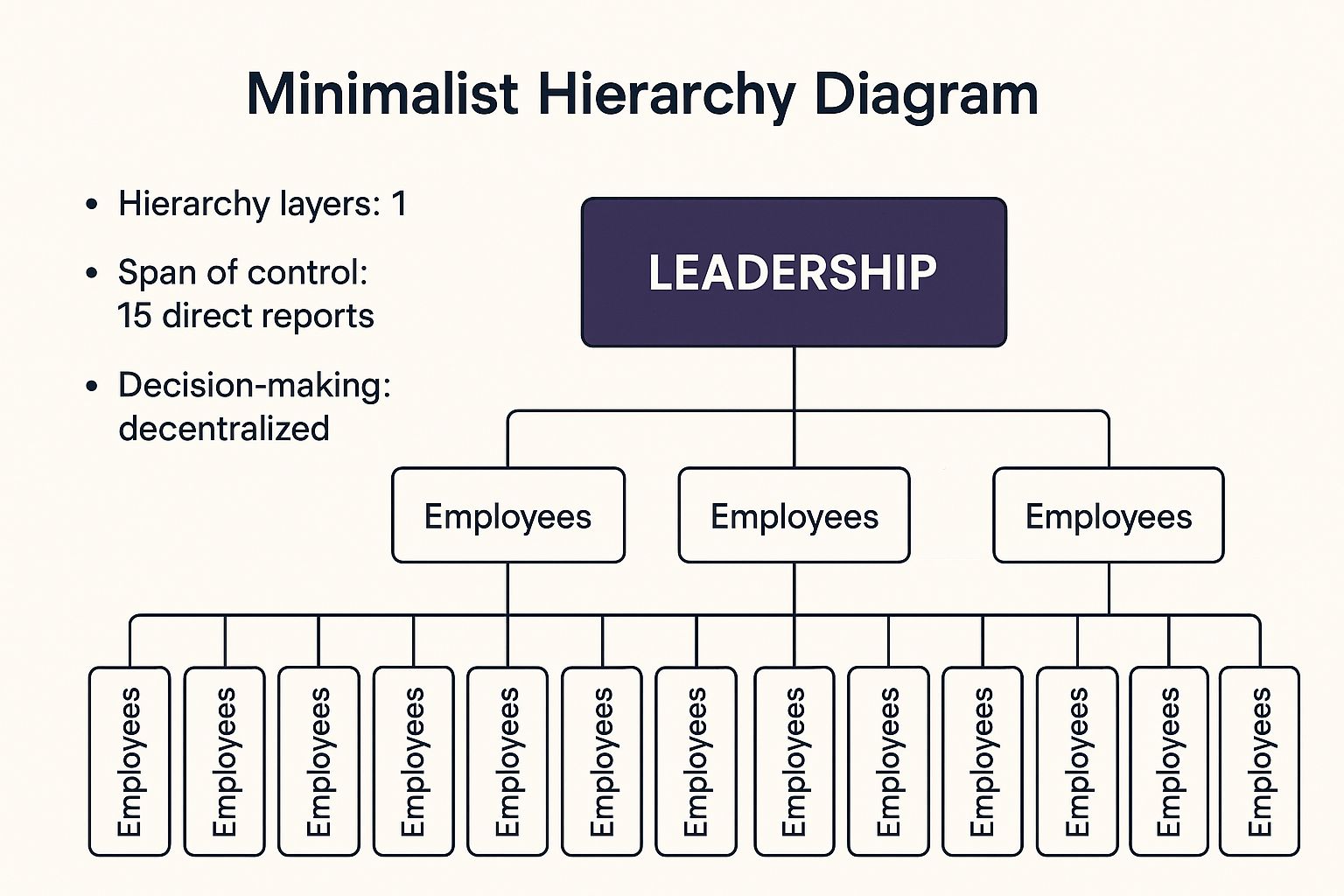
This infographic visualizes the hierarchical relationships within a flat organization. It demonstrates the minimal layers between the executive level (CEO/Founder) and the employees, highlighting the broad span of control the executive has. The absence of middle management is the defining characteristic of this structure.
A flat startup org structure boasts several advantages. Faster decision-making is a key benefit, eliminating the bottlenecks often associated with multi-layered approval processes. This structure also facilitates improved communication efficiency; information flows freely between leadership and employees, minimizing distortions and promoting transparency. Moreover, it fosters greater employee autonomy and empowerment, encouraging initiative and innovation. The lean nature of a flat structure translates to lower overhead costs due to fewer management salaries, a crucial factor for budget-conscious startups. Finally, it allows for increased agility and adaptability, enabling the company to respond quickly to market changes and customer needs.
However, this approach isn’t without its drawbacks. Scalability becomes a concern as the company grows. The limited number of management layers can lead to executive overload and hinder effective oversight as the team expands. Ambiguous reporting relationships can also emerge, creating confusion and impacting productivity. The lack of specialized management expertise might become a bottleneck as the business requires more specialized roles. Finally, inconsistent employee experiences can occur due to variations in management styles and a lack of standardized processes.
Successful examples of companies that leveraged the flat structure in their early stages include Buffer (social media management platform), Zappos (in its early years), GitHub (before Microsoft acquisition), and Valve Corporation. These companies demonstrate the effectiveness of this model for fostering innovation and rapid growth in the startup phase.
To effectively implement a flat startup org structure, consider these actionable tips: Implement clear communication channels to compensate for the lack of formal hierarchy. Document processes early to prevent chaos as the company scales. Consider transitioning to another structure once the team exceeds approximately 20-30 employees. Use collaboration tools to maintain transparency, and establish regular all-hands meetings to ensure alignment and address any emerging challenges. Learn more about Flat Organizational Structure
While a flat organizational structure isn’t a one-size-fits-all solution, it provides a powerful foundation for many startups. Its simplicity and emphasis on direct communication can be invaluable in the early stages, fostering a dynamic and responsive environment conducive to innovation and growth. Understanding its features, benefits, and limitations is crucial for startup founders seeking to build a robust and scalable organization.
2. Functional Organizational Structure
As your startup blossoms beyond its initial founding team and begins to experience rapid growth, a more structured approach to organization becomes crucial. This is where the Functional Organizational Structure often comes into play, earning its place as a popular choice for scaling startups. This structure offers a clear pathway to organize your burgeoning team and resources, facilitating efficient specialization and streamlined operations. This organizational model is highly relevant to startup org structure, as it provides a framework for managing increasing complexity as the company scales.
The Functional Organizational Structure, in its essence, divides a startup into different departments based on specialized functions. Think engineering, marketing, sales, customer service, and human resources. Each department operates as its own unit, focusing on its specific area of expertise. This specialization allows individuals within each department to hone their skills and become highly proficient in their respective roles. Each department is led by a functional leader (e.g., Head of Marketing, VP of Engineering), who reports directly to the CEO, creating a clear hierarchical reporting structure.
How it Works:
Imagine a well-oiled machine with interconnected parts. Each department represents a crucial component, contributing its specialized function to the overall operation. The engineering team builds the product, the marketing team promotes it, the sales team closes deals, and customer service supports users. This clear division of labor ensures everyone understands their role and responsibilities, contributing to increased efficiency and productivity.
Features of a Functional Structure:
- Grouped by functional expertise: Teams are assembled based on skill set and specialization.
- Clear departmental boundaries: Responsibilities and areas of focus are well-defined for each department.
- Hierarchical reporting within functions: A clear chain of command exists within each department, leading up to the functional leader.
- Specialized leadership roles: Leaders possess deep expertise within their functional area.
- Centralized decision-making: Key decisions are typically made by the CEO and executive team.
Pros:
- Clear career paths for employees: Employees can see a clear progression within their chosen function.
- Development of deep functional expertise: Specialization fosters skill development and mastery within specific areas.
- Efficiency through specialization: Focused teams can work more efficiently on their dedicated tasks.
- Clear reporting structure: Simplified communication and accountability within departments.
- Easier resource allocation: Resources can be allocated strategically to each department based on needs.
Cons:
- Potential for silos between departments: Departments can become isolated, hindering communication and collaboration.
- Slower cross-functional collaboration: Projects requiring input from multiple departments can be slowed down by bureaucratic processes.
- May reduce innovation that requires cross-functional perspective: Lack of communication can stifle creative problem-solving and limit innovative ideas.
- Product development can become fragmented: A lack of cohesive vision can lead to disjointed product development.
- Less customer-centric than product-based structures: Focus on internal functions can sometimes overshadow customer needs.
Examples of Successful Implementation:
Companies like Airbnb (during its growth phase), HubSpot (early organizational structure), Dropbox (as it scaled), and Square (in its early growth phases) utilized functional structures effectively during critical stages of their development. This demonstrates the applicability of this structure for startups navigating rapid growth and increasing complexity.
Actionable Tips for Implementation:
- Implement cross-functional projects and teams: Break down silos by encouraging collaboration across departments on specific projects.
- Hold regular inter-department meetings: Facilitate communication and information sharing between departments.
- Create clear processes for collaboration between functions: Establish clear guidelines and procedures for how departments interact and work together.
- Consider functional structure for startups with 20-100 employees: This structure is often most effective for startups in this size range.
- Ensure executive team maintains unified company vision: A strong, cohesive vision from leadership helps align different departments and prevents fragmentation.
When and Why to Use this Approach:
The functional organizational structure is best suited for startups experiencing growth and needing to specialize in different areas. It provides a framework for managing increasing complexity, promoting efficiency, and establishing clear reporting lines. However, it’s important to be mindful of the potential drawbacks and implement strategies to mitigate them, such as fostering cross-functional collaboration. This approach is particularly valuable for startups in the 20-100 employee range and those operating within clearly defined industries, benefiting from the deep functional expertise it cultivates. The structure’s roots in traditional management theory, influenced by figures like Frederick Winslow Taylor and Henry Ford’s early manufacturing approach, highlights its enduring relevance in organizational design.
3. Product-Based Organizational Structure
As your startup grows and diversifies its product offerings, a functional startup org structure can become a bottleneck. A product-based organizational structure offers a compelling alternative, aligning teams around specific products or product lines rather than traditional business functions like marketing or engineering. This approach fosters a deep product focus and empowers teams to operate with greater autonomy. Each product team becomes a self-contained unit, typically comprising cross-functional members such as engineers, designers, marketers, and product managers, all working collaboratively towards the success of their designated product. This structure is particularly valuable when startups expand beyond a single product and need to manage multiple offerings simultaneously.

This structure earns its place in the list of essential startup org structures due to its ability to drive product innovation and accelerate growth in multi-product environments. It enables faster iteration cycles by empowering dedicated product teams to make decisions quickly and efficiently. This decentralized decision-making, with product managers often acting as “mini-CEOs” for their respective products, promotes ownership and accountability for product success. The cross-functional nature of the teams ensures a holistic approach to product development, from conception and design to marketing and customer support, leading to greater customer-centricity. Key features of a product-based startup org structure include:
- Teams organized around specific products: This creates focus and specialization within each team.
- Cross-functional composition within teams: This fosters collaboration and eliminates silos.
- Decentralized decision-making at the product level: This speeds up innovation cycles.
- Product managers as mini-CEOs: This empowers product ownership and accountability.
- End-to-end ownership of product success: This aligns team goals with overall business objectives.
Pros:
- Strong product focus and specialization: Leading to deeper product expertise and better product development.
- Faster innovation cycles for each product: Enabling quicker response to market changes and customer needs.
- Clearer accountability for product success: Facilitating performance tracking and optimization.
- Greater customer-centricity: As teams focus on the specific needs of their product’s users.
- More autonomous teams: Boosting team morale and productivity.
Cons:
- Potential duplication of resources across product teams: This can lead to inefficiencies if not managed carefully.
- Challenge maintaining consistent company culture: As individual product teams develop their own micro-cultures.
- Coordination challenges between product teams: Requiring effective communication and collaboration mechanisms.
- Risk of inconsistent processes and standards: Necessitating clear guidelines and governance.
- Can be resource-intensive for smaller startups: Making it more suitable for companies with established product lines.
Examples: Several successful companies have embraced product-based structures, including Spotify with its “squad model,” Google’s product-focused divisions, Atlassian’s product teams, and Amazon’s “two-pizza teams” philosophy.
Tips for Implementation:
- Implement shared services for efficiency where appropriate: Centralize functions like HR or legal to avoid duplication.
- Create clear product roadmaps and prioritization frameworks: Ensure alignment across product teams.
- Establish cross-product governance and coordination: Maintain consistency and prevent fragmentation.
- Define clear metrics for product team success: Track progress and identify areas for improvement.
- Consider this structure once you have multiple distinct products: It’s less effective for single-product startups.
Popularized By: Marty Cagan (product management expert), Henrik Kniberg (Spotify model), and Jeff Bezos (Amazon’s team structure philosophy) have all contributed to the popularity and understanding of product-based organizational structures. This approach provides a robust framework for scaling your startup and managing multiple products effectively, making it an essential consideration for growing businesses.
4. Matrix Organizational Structure
For startups experiencing rapid growth and working on multiple complex projects, a traditional hierarchical startup org structure can become a bottleneck. The Matrix Organizational Structure offers a compelling alternative that deserves its place on this list because of its ability to foster collaboration and efficient resource allocation. This structure skillfully balances functional expertise with a focused product/project approach, making it an ideal choice for scaling startups.
In a matrix structure, employees report to two managers: a functional manager (e.g., Head of Engineering) and a project/product manager. This dual reporting structure enables individuals to contribute their specialized skills to different projects while still benefiting from the guidance and support of their functional leader. This cross-functional collaboration is inherent in the matrix design, promoting knowledge sharing and breaking down silos. Resources, including talent and equipment, are then shared strategically across projects, maximizing efficiency.
For example, a software engineer might report to the Engineering Manager for performance reviews and technical guidance, while simultaneously reporting to the Product Manager of a specific software application for day-to-day task assignments related to that project. This facilitates the engineer’s development of a broad skill set and understanding of the product lifecycle.
Several well-known companies have successfully implemented matrix structures, including project management platform Asana, the scaling phase of Salesforce, certain divisions within Adobe, and innovative technology giant Philips. These examples demonstrate the versatility of the matrix model across different industries and stages of growth.
Features of a Matrix Structure:
- Dual reporting relationships: Employees report to both functional and project/product managers.
- Balance between functional and project orientation: Maintains deep expertise while ensuring project goals are met.
- Cross-functional collaboration by design: Fosters communication and knowledge sharing.
- Shared resources across projects: Optimizes resource utilization and reduces redundancies.
- Complex but flexible structure: Adapts well to evolving project needs and market shifts.
Pros:
- Efficient resource utilization: Talents are deployed where they are most needed.
- Enhanced information flow: Cross-functional teams facilitate faster communication.
- Balance of functional expertise and product focus: Supports both specialized skills and project deliverables.
- Adaptability to changing market conditions: Flexibility to shift resources and priorities quickly.
- Development of well-rounded employees with multiple skill sets: Provides broader experience and growth opportunities.
Cons:
- Potential confusion over reporting and priorities: Clear communication and role definition are crucial.
- Complex decision-making processes: Requires effective collaboration and conflict resolution mechanisms.
- Conflicts between functional and project managers: Shared responsibility can sometimes lead to disagreements.
- Higher management overhead: Managing dual reporting lines requires more coordination.
- Requires sophisticated management skills: Leaders need to be adept at navigating complex relationships and priorities.
Tips for Implementing a Matrix Structure:
- Clearly define roles and responsibilities: Minimize confusion by documenting reporting lines and individual contributions.
- Establish conflict resolution processes for competing priorities: Provide a framework for addressing conflicts proactively.
- Invest in communication and collaboration tools: Facilitate seamless communication within and between teams.
- Provide training on working effectively in a matrix environment: Prepare employees for the unique dynamics of dual reporting.
- Consider this structure for startups with 100+ employees: The complexity of the matrix structure is often best suited for larger organizations.
Learn more about Matrix Organizational Structure as it applies to cross-functional team management. This approach, popularized by Stanley Davis and Paul Lawrence of Harvard Business School and notably implemented by IBM in the 1970s, becomes increasingly relevant as a startup grows and diversifies its product/project portfolio. Implementing a successful matrix startup org structure requires thoughtful planning, clear communication, and a commitment to fostering a collaborative environment.
5. Squad-Based Organizational Structure
For startups experiencing rapid growth and aiming for both agility and scalability, a squad-based organizational structure can be a powerful approach. This model, popularized by Spotify, offers a unique way to structure teams around specific product features or capabilities, fostering a sense of ownership and driving faster iteration. This makes it a worthy contender in our list of effective startup org structures.
What is it and How Does it Work?
The squad-based model centers around small, autonomous, and cross-functional teams called “squads.” These squads operate much like mini-startups, possessing all the necessary skills (design, development, testing, etc.) to deliver value independently. Squads are then grouped into “tribes” based on related product areas, preventing them from becoming isolated. To maintain functional excellence and avoid knowledge silos, “chapters” are formed, consisting of members from different squads who share the same functional expertise (e.g., all the iOS developers across various squads). Finally, “guilds” act as communities of interest, enabling knowledge sharing and collaboration across the entire organization on specific topics or technologies. Agile methodologies are inherently woven into this structure, promoting iterative development and rapid feedback loops.
Features and Benefits:
- Small, Autonomous Cross-functional Teams (Squads): This fosters ownership, reduces dependencies, and accelerates decision-making.
- Tribes: Grouping squads into tribes working on related areas ensures alignment and facilitates collaboration on larger product initiatives.
- Chapters: These maintain functional excellence and provide opportunities for skill development within specialized areas.
- Guilds: These encourage knowledge sharing, foster innovation, and create a sense of community across the organization.
- Agile Methodology: The structure intrinsically supports agile principles, enabling rapid iteration and adaptation to change.
Pros:
- High team autonomy and ownership
- Rapid iteration and product development
- Balanced focus on product delivery and functional expertise
- Scalable while maintaining a startup culture
- Customer-centric approach due to focused product teams
Cons:
- Complex to implement correctly, requiring careful planning and execution.
- Requires a strong engineering and product culture to thrive.
- Coordination challenges can arise between tribes, necessitating clear communication and alignment strategies.
- Potential for inconsistency in practices across squads if not properly managed.
- Needs mature leadership that can empower teams and support autonomy effectively.
Examples of Successful Implementation:
- Spotify: The originator of the model, demonstrating its effectiveness in a fast-paced, innovative environment.
- ING Bank: Adapted the model to fit a larger, more traditional organization, proving its adaptability.
- Revolut: This fintech company utilizes a squad-based structure to drive rapid product development and innovation.
- Klarna: Another payment solutions provider leveraging the model for its flexibility and scalability.
Tips for Implementation:
- Start with pilot squads: Don’t try to implement the model across the entire organization at once. Start with a few pilot squads to learn and adapt.
- Prioritize cultural alignment: Autonomous teams require a culture of trust, empowerment, and accountability.
- Invest in strong product ownership capability: Empowered product owners are crucial for the success of this model.
- Implement clear alignment frameworks (OKRs recommended): Ensure everyone is working towards the same goals and objectives.
- Consider partial implementation: You don’t need to adopt every aspect of the model immediately. Start with the elements that best suit your needs.
When and Why to Use This Approach:
The squad-based structure is particularly well-suited for startups experiencing rapid growth in dynamic markets. It’s ideal for companies that prioritize speed, innovation, and customer-centricity. If your startup is struggling with slow development cycles, siloed teams, or a lack of ownership, this structure might be the solution. However, it’s crucial to assess your company culture and leadership maturity before embarking on a full-scale implementation. This structure thrives in environments that embrace agile principles and empower their teams.
While complex to implement, the potential benefits of a well-executed squad-based organizational structure can significantly impact a startup’s growth trajectory, justifying its place as a valuable option for structuring your organization.
6. Remote-First Organizational Structure
A remote-first organizational structure is a crucial consideration for modern startups, particularly those seeking a scalable and flexible startup org structure. Unlike traditional office-centric models, a remote-first structure is designed from the ground up to support distributed teams working across different locations and time zones. This structure prioritizes asynchronous communication, robust documentation, and digital collaboration tools. It has gained significant popularity since 2020, with many startups now built as remote-first from day one, offering significant advantages in talent acquisition and cost management.

This approach inherently fosters a culture of documentation, which improves knowledge sharing and reduces reliance on synchronous meetings. Performance is measured based on results and deliverables rather than physical presence, promoting autonomy and accountability. Flexible working hours are a cornerstone of this model, empowering employees to manage their time effectively and contributing to a better work-life balance. This flexibility is particularly attractive to today’s talent pool, especially within the SaaS, FinTech, and HealthTech sectors where skilled individuals are often seeking greater autonomy.
Features of a Remote-First Startup Org Structure:
- Distributed workforce: Employees are located across various geographies, expanding the potential talent pool.
- Asynchronous communication: Tools like Slack, email, and project management software are prioritized over real-time meetings.
- Emphasis on documentation: Processes, decisions, and knowledge are meticulously documented for easy access and reference.
- Digital-first collaboration: Cloud-based tools are essential for communication, project management, and file sharing.
- Results-based performance: Employee success is evaluated on outputs and achievements, not hours worked.
- Flexible working hours: Employees have greater control over their schedules, fostering work-life balance.
Pros:
- Access to global talent pool: Recruit the best talent regardless of location.
- Reduced office space costs: Significant savings on rent, utilities, and other office-related expenses.
- Greater employee flexibility and satisfaction: Improved work-life balance leading to higher retention rates.
- Forced documentation improves knowledge sharing: Easier onboarding and knowledge transfer within the organization.
- Diverse perspectives from different locations: A richer pool of ideas and insights from a globally distributed team.
- Often higher productivity: Employees can work when they are most productive, leading to improved output.
Cons:
- Potential for isolation and reduced team cohesion: Requires deliberate efforts to build relationships and foster connection.
- Communication challenges across time zones: Careful planning and coordination are necessary for effective communication.
- Difficulty building company culture remotely: Intentional strategies are needed to cultivate a strong remote culture.
- Onboarding complexity for new employees: Requires robust onboarding processes to integrate new team members effectively.
- Management challenges with no physical oversight: Shifting from traditional management styles to focus on outcomes and trust.
Examples of Successful Remote-First Companies:
- GitLab (fully remote since founding)
- Automattic (WordPress parent company)
- Zapier (remote from day one)
- Doist (creators of Todoist)
- Buffer (transparent remote company)
Tips for Implementing a Remote-First Startup Org Structure:
- Invest in proper remote work tools (asynchronous communication, video conferencing).
- Establish clear documentation practices from day one.
- Plan regular virtual team-building activities.
- Consider occasional in-person retreats for team bonding and strategic alignment.
- Create a dedicated budget for home office setups to ensure employees have the necessary resources.
- Implement clear work/life boundaries to prevent burnout.
When and Why to Use a Remote-First Approach:
This startup org structure is ideal for businesses that prioritize agility, cost-effectiveness, and access to a global talent pool. It’s particularly well-suited for startups in digitally-driven industries, offering a competitive edge in attracting and retaining top talent. If your business model allows for distributed work, a remote-first approach can significantly contribute to long-term success.
Learn more about Remote-First Organizational Structure This structure, popularized by companies like GitLab and influenced by thought leaders such as GitLab CEO Sid Sijbrandij and Automattic CEO Matt Mullenweg, has been further accelerated by the COVID-19 pandemic. This shift towards remote work has proven that distributed teams can be highly effective and productive, making the remote-first model a valuable option for startups looking to build a scalable and future-proof organization.
7. Growth Team Structure
For startups focused on rapid scaling and user acquisition, a growth team structure can be a powerful tool. This organizational approach deviates from traditional departmental silos and creates a dedicated cross-functional team laser-focused on driving growth metrics. This model deserves its place in the list of startup org structures because it directly addresses the critical need for rapid, sustainable growth, particularly after achieving product-market fit. It offers a structured approach to scaling user acquisition, activation, retention, and ultimately, revenue. This structure is highly relevant for startups navigating the challenges of expansion and seeking a data-driven approach to achieving their goals.
How a Growth Team Works:
A growth team operates as a self-contained unit, embedding members from product, engineering, marketing, and data science. This cross-functional composition enables rapid iteration and experimentation, as all necessary skillsets are readily available within the team. Instead of sequential handoffs between departments, the growth team works collaboratively on growth experiments, analyzing data, and optimizing strategies in a tight feedback loop. This structure facilitates data-driven decision making and empowers the team to optimize across traditional functional boundaries, often operating outside the standard organizational hierarchy. They have specific ownership of key growth metrics and are responsible for driving improvement in those areas.
Key Features:
- Cross-functional Composition: Includes product managers, engineers, marketers, and data scientists.
- Rapid Experimentation Methodology: Focuses on running A/B tests and other experiments to optimize growth levers.
- Data-driven Decision Making: Relies heavily on data analysis to inform strategies and prioritize initiatives.
- Specific Growth Metrics Ownership: Directly responsible for improving key metrics like user acquisition cost, conversion rates, and customer lifetime value.
- Autonomy: Operates with a high degree of autonomy to optimize across traditional departmental boundaries.
Pros:
- Focused Attention on Key Growth Levers: Concentrated effort on driving user acquisition, activation, retention, and revenue.
- Rapid Iteration and Experimentation: Streamlined process for testing and implementing growth strategies.
- Breaks Down Silos Between Marketing and Product: Fosters collaboration and shared ownership of growth goals.
- Clear Ownership of Growth Metrics: Ensures accountability and focus on measurable results.
- Combines Technical and Marketing Expertise: Leverages both technical and marketing skills to achieve optimal outcomes.
Cons:
- Potential Tension with Core Product Teams: Possible conflicts over resources, priorities, and product roadmap.
- Risk of Sacrificing Long-Term Product Quality for Short-term Growth: Overemphasis on rapid growth can sometimes compromise long-term product vision.
- Resource Allocation Challenges: Requires dedicated resources, which can be difficult for early-stage startups.
- Difficulty Measuring True Impact vs. Other Factors: Isolating the impact of growth team initiatives can be challenging.
- May Create Internal Competition for Resources: Competition for budget, personnel, and other resources can arise.
Successful Implementations:
- Facebook: Pioneered the growth team concept, using it to scale user acquisition and engagement.
- Uber: Leveraged a growth team to drive global expansion and market penetration.
- Slack: Focused its growth team on user activation and retention, driving rapid adoption of the platform.
- Pinterest: An early adopter of the dedicated growth team structure, contributing to its significant user growth.
Actionable Tips for Implementation:
- Start Small: Begin with a small, focused team before scaling up.
- Clear Metrics & KPIs: Define specific, measurable growth metrics and key performance indicators (KPIs).
- Experimentation Framework: Implement a robust experimentation framework for A/B testing and data analysis.
- Define Handoff Processes: Establish clear handoff processes between the growth team and core product teams.
- Prioritize Data Infrastructure: Ensure you have a solid data infrastructure in place before launching a growth team.
- Balance Short-Term and Long-Term Goals: Maintain a balance between achieving short-term growth and ensuring long-term product health and sustainability.
Key Figures & Influencers:
- Sean Ellis: Coined the term “growth hacking.”
- Andrew Chen: Former Uber growth leader, now a general partner at Andreessen Horowitz (a16z).
- Chamath Palihapitiya: Instrumental in building Facebook’s growth team.
- Brian Balfour: Former HubSpot growth VP, known for his expertise in growth marketing.
By implementing a growth team structure strategically, startups can optimize their efforts to scale rapidly and achieve sustainable growth. However, careful consideration of the potential challenges and a commitment to data-driven decision-making are crucial for success. This structure is especially well-suited for startups that have achieved product-market fit and are ready to invest in aggressive growth strategies.
Startup Org Structure Comparison Guide
| Organizational Structure | Implementation Complexity 🔄 | Resource Requirements ⚡ | Expected Outcomes 📊 | Ideal Use Cases 💡 | Key Advantages ⭐ |
|---|---|---|---|---|---|
| Flat Organizational Structure | Low 🔄 | Low ⚡ | Faster decisions, direct communication 📊 | Early-stage startups, pre-seed to early startup 💡 | Agility, low overhead, employee empowerment ⭐ |
| Functional Organizational Structure | Medium 🔄 | Moderate ⚡ | Deep expertise, clear career paths 📊 | Startups scaling to 20-100 employees, Series A-B 💡 | Specialization, clear structure ⭐ |
| Product-Based Organizational Structure | Medium-High 🔄 | High ⚡ | Strong product focus, faster innovation 📊 | Startups with multiple products, Series B-C, growth 💡 | Product accountability, customer-centric ⭐ |
| Matrix Organizational Structure | High 🔄 | High ⚡ | Balanced expertise and product focus 📊 | Large startups 100+ employees, Series C-pre-IPO 💡 | Resource efficiency, adaptability ⭐ |
| Squad-Based Organizational Structure | High 🔄 | High ⚡ | Autonomy, rapid iteration, scalable culture 📊 | Growth to scale-up phase, Series B-C 💡 | Team autonomy, balanced focus ⭐ |
| Remote-First Organizational Structure | Medium 🔄 | Moderate ⚡ | Global talent access, productivity 📊 | All stages, especially early startups with limited capital 💡 | Flexibility, cost savings, diverse teams ⭐ |
| Growth Team Structure | Medium 🔄 | Moderate to High ⚡ | Focused user growth, rapid experimentation 📊 | Post-product-market fit, Series A+, scaling startups 💡 | Growth focus, cross-functional collaboration ⭐ |
Scaling for Success: Making Your Startup Org Structure Work for You
Choosing the right startup org structure is paramount to your success. From the flat structure’s agile nature to the specialized focus of a functional or product-based organization, and the collaborative potential of matrix, squad-based, and remote-first models, each structure offers unique advantages and disadvantages. Even implementing a growth team structure can significantly impact your trajectory. Before settling on a specific structure, it’s crucial to validate your startup idea and ensure there’s a market fit. A great tool to help you with this process is a startup idea validator from AnotherWrapper. This resource can provide valuable insights to refine your strategy and ensure your chosen startup org structure aligns with market demands.
This article explored seven key startup org structures, highlighting how each can support different stages of growth and business objectives. The most important takeaway is that your startup org structure isn’t static. As your team expands and your goals evolve, your structure should adapt accordingly. Mastering these concepts enables you to build a responsive, scalable organization, positioning you for sustained growth and success in the ever-changing market landscape.
Remember, finding the optimal startup org structure is an iterative process. By thoughtfully considering these models and continually evaluating their effectiveness, you’ll build a strong foundation for your company’s future. Ready to build your dream team and optimize your startup org structure with top-tier talent? Shiny connects you with experienced executives across various industries for 5-25 hours a week, providing the flexible leadership your startup needs to thrive. Explore how Shiny can help you scale effectively today.