User Experience Analytics for Startup Growth
Most startup advice about user experience analytics starts with the same prescription: install better tracking, collect more events, and build a smarter dashboard. That advice is incomplete. A company can record every click and still lose customers because nobody senior enough is turning those signals into product decisions.
The advantage isn't having more data. It's knowing which user behavior predicts value, which friction deserves engineering time, and who has the authority to make the trade-off. For many startups, the missing capability is an experienced product leader who can connect analytics to retention, revenue, and a focused roadmap.
The Dashboard Illusion in Modern Product Teams
A dashboard doesn't make a company data-driven. It only makes data visible.
Many startups track page views, clicks, sessions, feature usage, and support events across several tools. Yet the product team still can't answer basic questions: Where do valuable users abandon the journey? Which failure is costing revenue? Should engineering fix a broken onboarding step or ship the feature sales is requesting?
Those questions require judgment, not another tracking script.
The market reflects how strongly companies believe dedicated measurement can solve this problem. The global UX research and analytics ecosystem is projected to reach $1.24 billion by 2034, growing at an 11.6% CAGR, as organizations move beyond basic web metrics toward behavior and usability platforms, according to Fortune Business Insights' UX research software market analysis. The investment is substantial, but software doesn't decide what matters.
Visibility isn't the same as understanding
A heatmap can show that users click a non-clickable element. A funnel can show that users leave during onboarding. A session replay can reveal a form that fails on mobile. None of those findings automatically produce a business outcome.
Someone still has to decide whether the problem is:
- A usability defect: The interface makes the next action unclear.
- A technical defect: A JavaScript error or slow response prevents completion.
- A product strategy problem: The user doesn't understand the value of continuing.
- A prioritization problem: The team is fixing low-value friction while high-value journeys deteriorate.
That person also has to align design, engineering, marketing, and customer success around one interpretation. Without senior ownership, every department reads the same dashboard through its own incentives. Marketing sees a conversion problem, engineering sees a bug, and product sees a roadmap request.
Practical rule: Buy a UX analytics platform only when a named leader owns the decisions it will inform.
From passive observation to active decisions
Strong teams define a small set of user milestones before they configure events. A milestone might be completing a first purchase, inviting a teammate, or generating a first report. The team then investigates which actions correlate with users reaching that milestone and continuing to use the product.
That approach changes the operating question from “What happened on the site?” to “What should we change this week to improve the user journey?” It also exposes the leadership gap quickly. If nobody can turn a finding into a prioritized experiment, the problem isn't instrumentation.
Founders should treat analytics as a management system, not a reporting layer. A fractional product executive can establish the decision framework, challenge attractive but irrelevant metrics, and force the team to connect behavior with commercial outcomes before adding more tools.
Core Metrics That Actually Drive Product Decisions
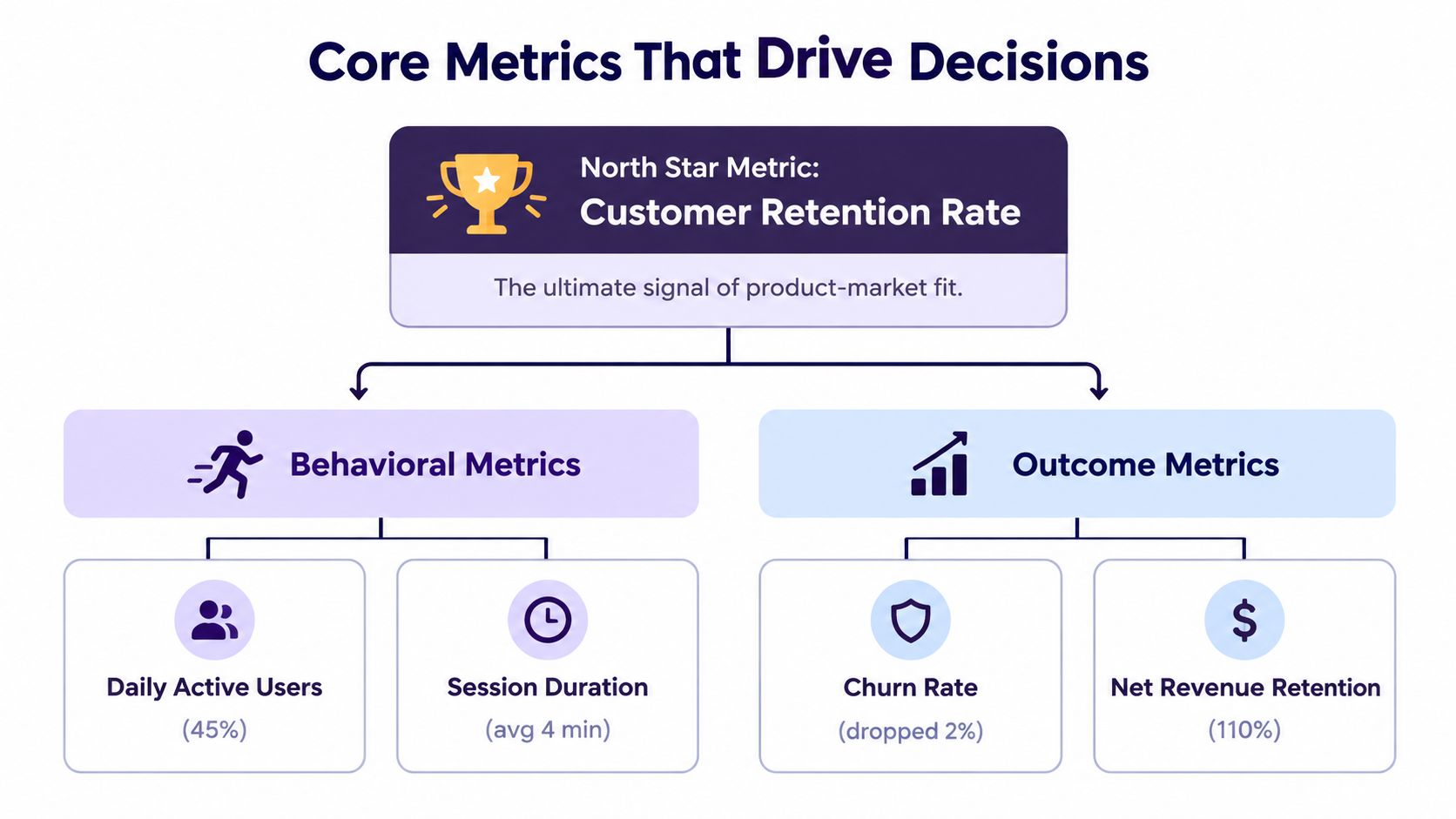
Page views and total sessions tell you that activity exists. They rarely tell you whether users are succeeding.
A useful UX analytics review starts with the user task, then measures where that task succeeds, slows down, or fails. Task completion rate is the most direct success measure, while rising time-on-task can signal growing friction even when completion hasn't declined, as explained in Inspectlet's guide to user experience analytics.
Start with task success
Put these measures on the weekly product review:
- Task completion rate: Track whether users complete the action that creates value, such as submitting an application, finishing setup, or publishing a report.
- Funnel step drop-off: Identify the exact stage where abandonment concentrates. A funnel becomes useful when the team can move from the aggregate drop-off to the sessions behind it.
- Time-on-task: Treat a rise as a warning, not automatically as engagement. Users may spend longer because they're learning, or because the interface is confusing.
- Error rate: Monitor JavaScript errors and failed requests alongside behavioral events. A user who encounters a silent frontend failure may disappear without contacting support.
- Scroll depth and interaction quality: Use these signals to understand whether users reach important content, but don't confuse scrolling with progress.
The right metric depends on the job users hired your product to do. A reading experience may value content completion. A SaaS application may care about a completed workflow and subsequent return usage. An ecommerce journey may depend on successful product discovery and checkout.
Make the review operational
Don't bring every metric into every meeting. Assign each one a decision.
| Signal | Decision it should support |
|---|---|
| Task completion | Is the workflow delivering its intended outcome? |
| Funnel drop-off | Which step deserves investigation first? |
| Time-on-task | Is the experience becoming harder to use? |
| JavaScript errors | Is technical quality blocking behavior? |
| Retention behavior | Do successful users continue receiving value? |
The product leader's job is to connect the signals. A drop in completion after a release should be compared with error telemetry, device type, browser context, and session-level traces. A funnel isn't just a marketing report. It can reveal an interaction defect, a frontend failure, or a misleading promise.
Ignore metrics that don't change a decision. If a number never causes the team to investigate, experiment, stop a release, or redirect engineering capacity, it belongs in a secondary report.
Measurement Methods and Privacy-First Tooling
Useful measurement doesn't require unrestricted surveillance. It requires deliberate collection.
Start by mapping the journey you need to improve. Define the user milestone, the steps that lead to it, and the failure signals that indicate friction. Then choose the lightest method that can answer the question.
Build the measurement layer carefully
Use event tracking for explicit actions, such as starting onboarding, completing a form, inviting a teammate, or exporting a report. Use funnels to compare completion across stages. Heatmaps can reveal ignored content, misplaced controls, or interaction clusters. Session replay can help explain an anomaly, but configure masking and exclusion before collecting sensitive fields.
Micro-surveys add context that behavior alone can't provide. Ask a focused question after a meaningful action or abandonment point, rather than interrupting every visitor. A short explanation of why you're collecting feedback usually produces better cooperation than an unexplained prompt.
Segment every important view by device class and journey stage. Mobile and desktop users can encounter different layouts, performance constraints, and interaction patterns. Aggregate averages hide those differences. Large-scale digital experience benchmarks analyzed billions of sessions across thousands of websites and organizations, reinforcing the need to compare behavior by device and event type rather than trusting one blended average, as shown in the Contentsquare benchmark explorer.
Make consent part of the product
Privacy isn't a compliance checkbox added after implementation. It shapes what data you can trust.
Use transparent notices, explicit consent where required, granular choices, data minimization, and anonymous or cookieless collection where those methods answer the question. Mask sensitive inputs in replay tools and limit access to raw session data. Store only the information that supports a defined product decision.
Privacy-first UX analytics guidance from Swetrix notes that brands explaining data use clearly and offering granular consent options see materially higher opt-in rates and willingness to buy. Trust improves the quality of the dataset because users understand the exchange.
For founders building a broader reporting system, business intelligence for startups offers useful context on bringing operational data into decision-making. Keep the stack understandable, document event definitions, and review whether each data source still has a purpose.
The best privacy strategy is not “collect everything and anonymize it later.” Collect less, collect it transparently, and make the remaining signals useful enough to guide action.
Connecting Surface Friction to Revenue Impact
The board doesn't fund a heatmap. It funds growth, retention, and a reliable customer journey.
A product team proves the value of UX analytics by showing how a specific behavior affects a valuable outcome. That means connecting an abandoned onboarding step to activation, a failed checkout interaction to lost orders, or a slow workflow to reduced repeat usage.
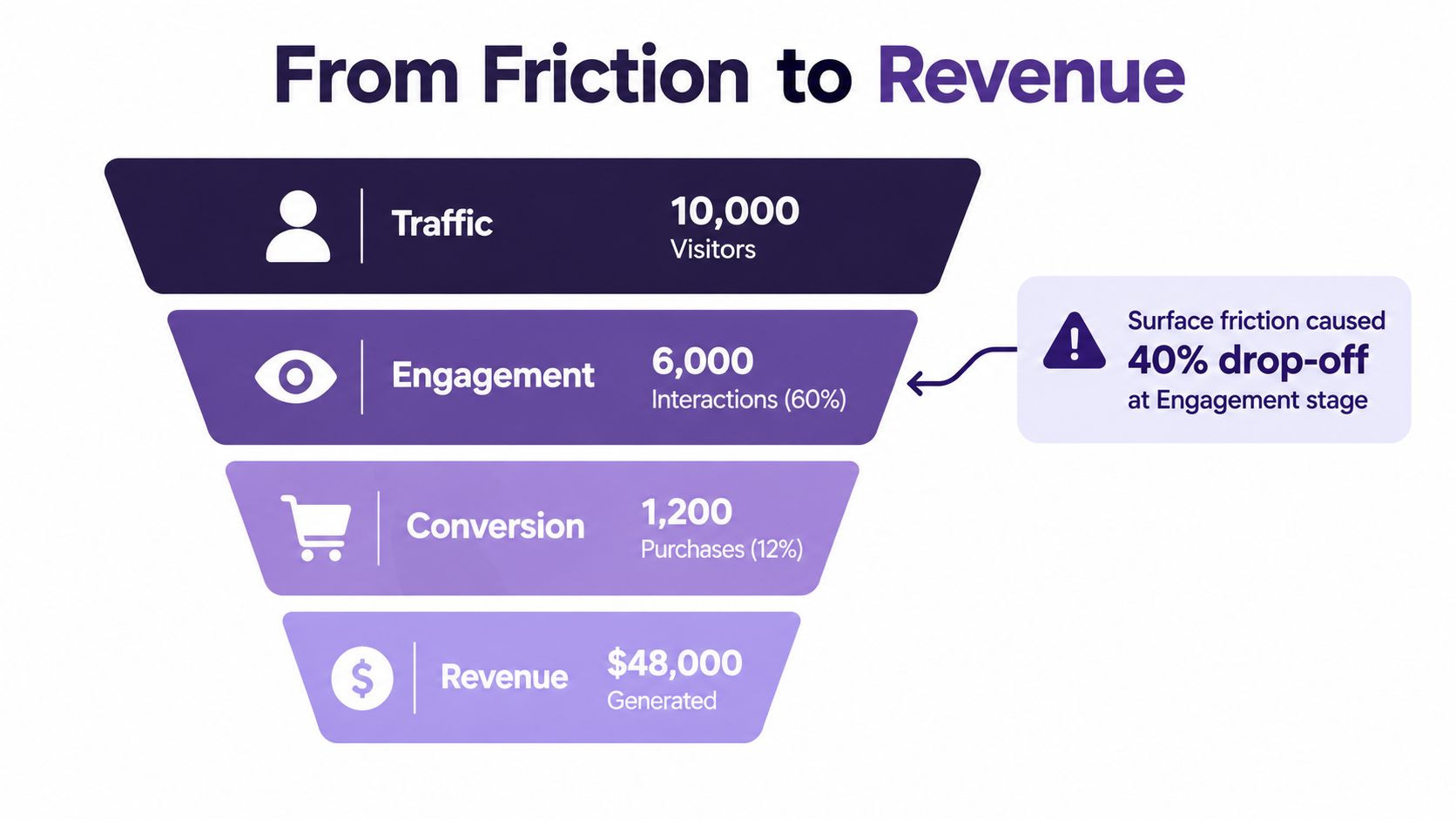
Diagnose before you calculate
Conventional monitoring often misses what users experience. The central problem usually isn't a shortage of data, but the inability to connect findings to revenue. Traditional surveys may reveal dissatisfaction, but they can't reliably explain whether churn followed a broken form, a confusing flow, or an application error, as discussed in Conviva's State of Digital Experience report.
Use a practical chain of evidence:
- Locate the behavior: Find the journey stage with unusual abandonment, delay, or error concentration.
- Inspect the experience: Review sessions, device segments, error traces, and user feedback for the same path.
- Define the commercial exposure: Identify whether the affected flow supports activation, purchase, expansion, or renewal.
- Fix one cause: Give engineering a specific defect or hypothesis, not a general instruction to improve UX.
- Measure the outcome: Compare the relevant business metric after the change, while checking that the affected segment received the update.
This process prevents teams from treating every friction signal as equally valuable. A minor issue on a low-value page may matter less than a smaller defect in a renewal or onboarding flow.
Turn findings into an executive case
A useful product review should state:
- What users attempted
- Where they failed or slowed down
- Which technical or design cause explains the behavior
- Which business outcome the journey supports
- What the team will change
- How leadership will judge the result
Machine-assisted detection can help surface anomalies and summarize recurring friction, but it doesn't replace prioritization. The executive still has to decide whether the fix is worth delaying another initiative and whether the evidence supports a product, design, or engineering response.
Teams that need help translating behavioral findings into commercial priorities can also explore conversion optimisation experts. The key is to leave the meeting with an accountable owner and a testable decision, not another dashboard.
The Leadership Gap in Data Interpretation
A startup doesn't need a full-time executive for every function on its first day. It does need executive judgment when product complexity starts outrunning the founder's attention.
A senior product leader interprets conflicting evidence, sets priorities, and makes trade-offs that a tool can't make. They know when a funnel problem requires a redesign, when it requires a bug fix, and when the measured journey isn't connected to a meaningful customer outcome.
Why fractional leadership fits the problem
Hiring a full-time Chief Product Officer or Head of UX can be premature for a growing company. Waiting until the organization can justify that hire creates a different risk. The team may spend months collecting data without a coherent product strategy, while founders become the bottleneck for every decision.
A fractional leader supplies focused senior capacity without requiring a permanent executive commitment. They can establish the analytics model, coach the product manager, review the roadmap, and create an operating cadence that the internal team can continue.
The model is expanding beyond a niche staffing choice. The global fractional executive market is estimated at $5.7 billion in 2025 and is growing at roughly 14% annually, driven by SMEs and startups seeking senior expertise without the burden of a full-time hire, according to MacGregor Black's fractional leadership analysis.
Hire for decisions, not dashboard ownership
The wrong brief asks for someone who knows a particular analytics platform. The right brief asks for someone who can:
- Define product milestones: Translate the value proposition into observable user actions.
- Challenge the metric set: Remove signals that don't support a product or commercial decision.
- Lead cross-functional diagnosis: Bring design, engineering, marketing, and support into one interpretation.
- Prioritize financial impact: Rank friction by its effect on activation, conversion, retention, or expansion.
- Build internal capability: Teach the team how to investigate and act without permanent dependence.
A fractional executive should leave behind clearer ownership, better event definitions, and a repeatable review process. If they only produce reports, you've hired an analyst for a leadership problem.
How Fractional Leaders Transform UX Workflows
Consider a startup whose onboarding completion has weakened, while the team argues about the cause. Marketing blames lower-intent traffic. Design wants to simplify the form. Engineering sees no increase in support tickets and assumes the flow is healthy.
A fractional Head of Product starts by refusing to debate opinions. They audit the milestone definition, event taxonomy, device segments, session evidence, and error telemetry. The first finding isn't a new feature opportunity. It's a cluster of silent JavaScript failures affecting users on a mobile path.
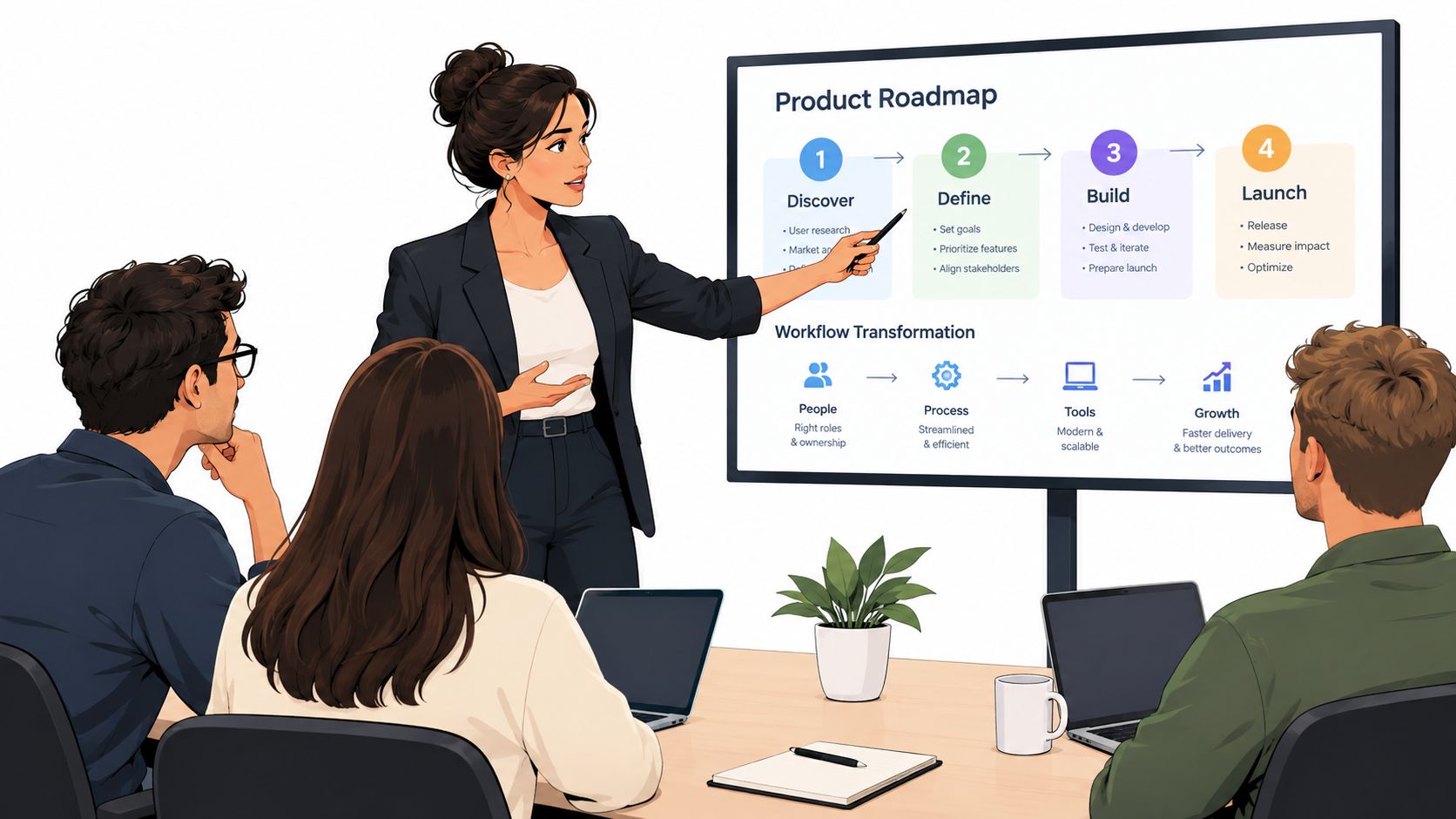
From anomaly to sprint
The executive restructures the investigation around the onboarding milestone:
- Rebuild the event path: Track the start, critical form actions, validation response, completion, and first value moment.
- Separate device behavior: Compare mobile and desktop journeys instead of relying on an overall completion view.
- Connect errors to sessions: Identify whether the users who abandon encounter the same frontend failure.
- Review the interaction: Use replay and heatmap evidence to distinguish a broken control from confusing copy or layout.
- Set the sprint outcome: Give engineering one defined problem and one business-linked success measure.
The team fixes the frontend failure, clarifies the form interaction, and reviews the resulting behavior through the same milestone framework. This is a realistic operating example, not a promised performance result. The value comes from replacing a broad argument with a disciplined diagnosis.
Independent research finds that fractional leaders are commonly hired for deep leadership experience and specialized skills, allowing growing startups to gain senior expertise and strategic impact without a full-time commitment, as documented in research on the fractional C-suite.
A founder who needs this kind of product judgment can also evaluate a UX design consultant when the immediate need centers on interaction quality. The distinction matters: design execution improves the interface, while product leadership decides which interface problem deserves priority and how success will be measured.
Your Action Plan for Analytics and Hiring
Start with a short audit, not a platform migration. Your goal is to identify whether the current system can answer the product questions that matter.
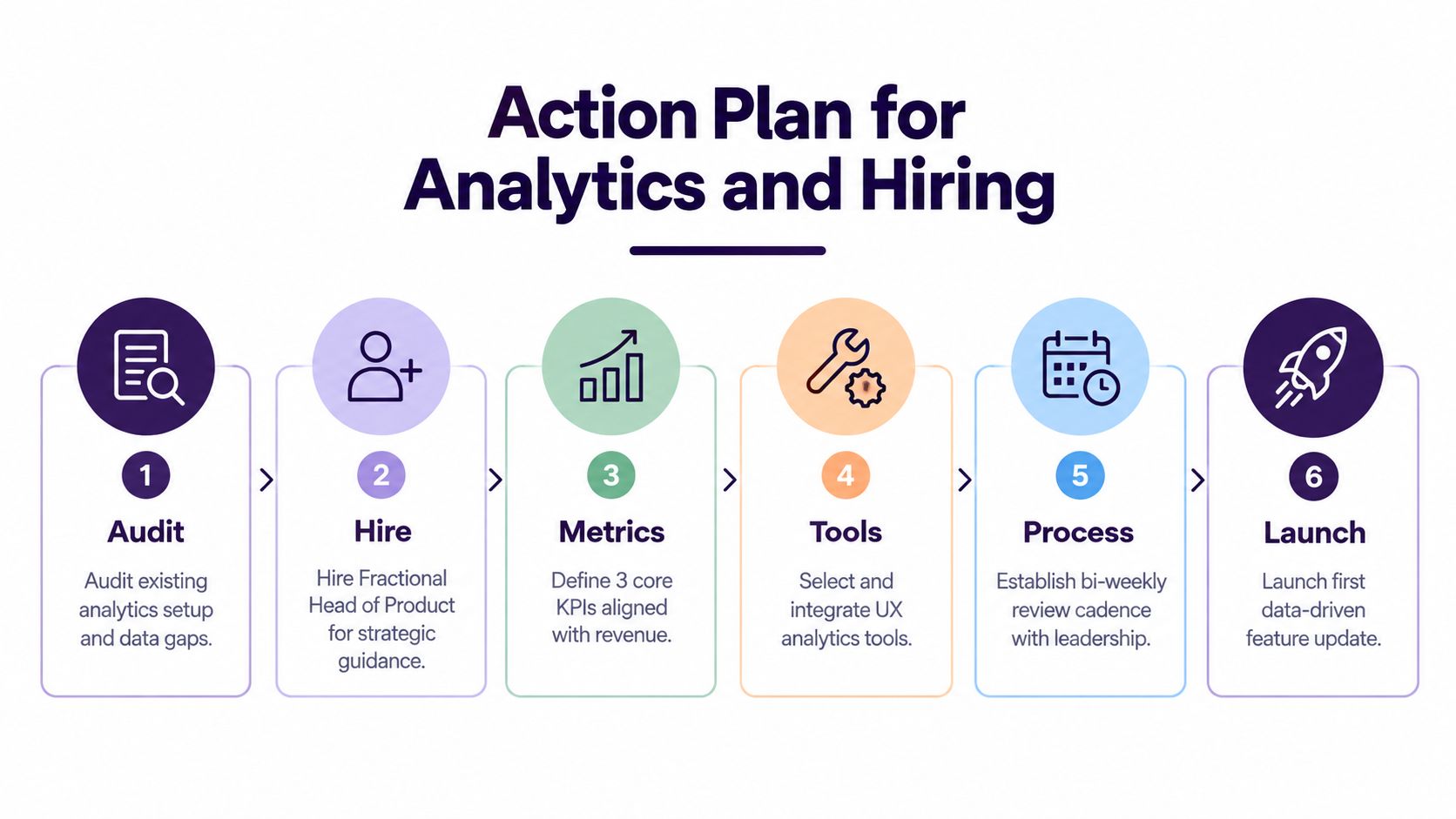
Audit the system
- Name the value milestones. Write down the user actions that indicate activation, successful use, purchase, expansion, or renewal.
- Trace the evidence. Check whether events, funnels, replay, feedback, and error telemetry describe those milestones consistently.
- Segment the journey. Review device class, new versus returning users, and the stages where users abandon.
- Remove distractions. Move vanity metrics out of the executive review unless they support a clear decision.
- Check privacy controls. Confirm that consent, masking, retention, access, and data minimization match your obligations and customer expectations.
- Assign ownership. Put one product leader in charge of turning findings into experiments, fixes, and roadmap decisions.
Know when leadership is missing
Bring in fractional product or UX leadership when the team has plenty of reports but no shared interpretation, when founders approve every product trade-off, or when engineering keeps fixing symptoms instead of causes. The need is also clear when a critical journey remains poorly instrumented, customer feedback contradicts behavioral data, or product priorities change with every loud internal opinion.
The market is moving in this direction. Revelio Labs reports that 24 out of every 1,000 newly advertised executive positions were fractional in 2026, up from 9 per 1,000 five years earlier, indicating that flexible executive talent is becoming a material part of executive recruiting, as detailed in its analysis of fractional executive roles.
Ask candidates to show how they've diagnosed a product problem, not just which tools they know. Test whether they can explain the difference between a symptom and a cause, connect a behavioral signal to a business outcome, and create a process your existing team can own.
Use the first engagement to produce a decision framework, a clean milestone model, and a prioritized set of product actions. That gives you a practical test of leadership value before you consider a longer commitment.
Shiny connects startups with experienced fractional executives who can bring product strategy, UX judgment, and analytics discipline into the same operating rhythm. Visit Shiny to explore flexible executive support or schedule a consultation about turning user experience analytics into clearer product decisions.