Vice President of Engineering Role Explained
A vice president of engineering turns business strategy into a reliable delivery system covering engineering policy, staffing, and predictable shipping, not the company's most senior coder. That includes tracking the five DORA delivery metrics while making sure managers and engineers can sustain the work.
Your team may already be shipping software, yet every hiring decision, production incident, and disputed priority still lands on your desk. The missing capability isn't necessarily another developer. It may be an executive who makes engineering work as an organization, with clear ownership, useful measures, and a workload people can carry.
What a Vice President of Engineering Owns
The release goes out, but the founder has spent the afternoon settling a hiring disagreement, approving an infrastructure bill, and answering a customer escalation. Nobody owns the connections between those decisions. A vice president of engineering should.
This is a strategic operating role, not a reward for being the strongest programmer. NC State's description of the position assigns responsibility for planning and directing engineering policies, objectives, and initiatives, with adequate resources to support operational plans.
The operating responsibility scorecard
Start with policy: what standards must work meet, who accepts it, and how do priorities become commitments? Then address organizational design, including management layers, reasonable spans of control, and explicit decision rights.
Staffing follows that structure. The VP determines which capabilities the company needs, whether managers can absorb new hires, and how candidates will be assessed. Resource allocation then makes tradeoffs visible instead of letting urgent requests consume every available engineer.
Vice president of engineering responsibility scorecard
| Operating area | What the VP owns | Sign it is covered |
|---|---|---|
| Engineering policy | Policies, objectives, planning cadence, and how work is accepted | Written standards teams actually follow |
| Organizational design | Manager layers, spans of control, and decision rights | Managers have a clear remit and aren't buried in direct reports |
| Staffing | Hiring capacity, role scorecards, and leadership pipeline | Roles fill to a plan instead of endless open requisitions |
| Resource allocation | Split of time across features, reliability, and debt | Capacity is reserved deliberately, not awarded to whoever shouts loudest |
| Delivery performance | Predictable shipping, quality, and execution risk | Lead time and failure rates are reviewed, not guessed |
| Business alignment | Coordination with product, finance, sales, and customers | Roadmap, cost, and retention stay tied to company goals |
Delivery performance means credible commitments, not impressive ticket totals. Business alignment means discussing launch dates with product, infrastructure spending with finance, and customer promises with sales before engineers inherit incompatible expectations.
Where the VP sits
Between the CEO and engineering managers, the VP establishes priorities, develops directors and managers, and watches execution risks. Think of an air-traffic controller: the value comes from routing the system safely, not personally flying a plane.
For a practical starting point, SpecStory, Inc.’s templates for startup heads of engineering can help turn informal expectations into written operating documents.
Mark every scorecard row that lacks an accountable owner. Each unowned row is a VP-shaped gap, even if nobody currently has that title.
How the Role Differs from a CTO
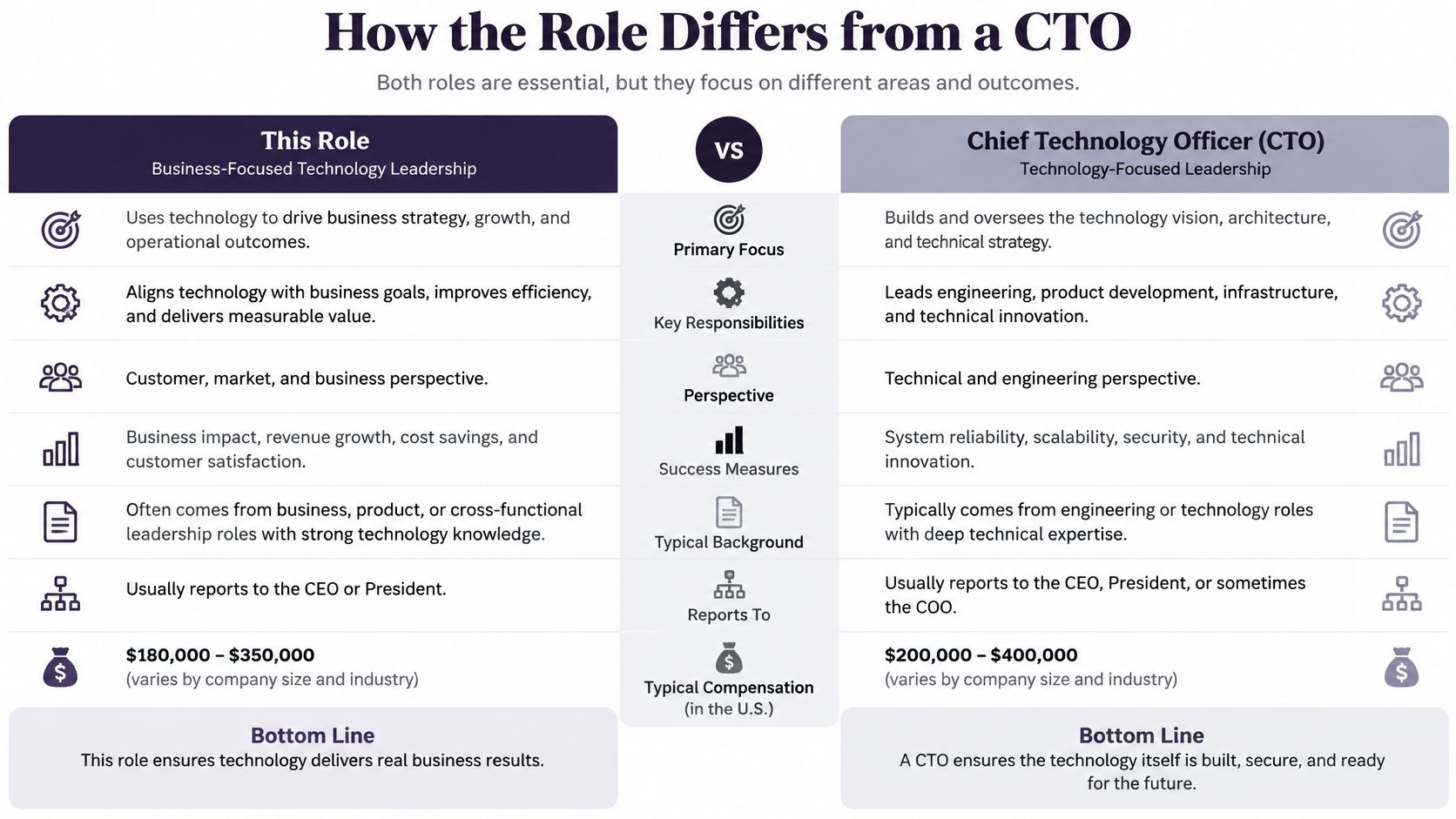
A CTO typically asks, “What technology should we build our business on?” A vice president of engineering asks, “Can our organization deliver it reliably?” The distinction is organizational, not a universal law.
In many growing companies, the CTO owns technology direction, major architecture bets, and the technical story presented to investors or outside partners. The VP owns execution through people, management, and operating practices. Hire for the missing responsibility, not the more impressive title.
VP of Engineering versus CTO
| Question | Vice president of engineering | Chief technology officer |
|---|---|---|
| Primary focus | Execution, people, process, and predictable delivery | Technology direction and external technical strategy |
| Typical partners | Engineering managers, product, finance, and customer teams | CEO, board, product, and outside technical stakeholders |
| Success signal | Hiring plans met, incidents managed, releases predictable | Architecture choices and technical strategy hold up in market |
| Wrong measure | Lines of code or personal commit count | Slide-level vision with no operating follow-through |
| When one person holds both | Only while strategy and the weekly operating system still fit one calendar | Same constraint; split the seats when either side is starving |
The practical distinction is easier to recognize when the responsibilities sit side by side.
When combining the jobs stops working
A technical co-founder might comfortably hold both responsibilities early on. The arrangement becomes fragile when architecture reviews compete with manager coaching, recruiting, and operational escalations.
Look at what keeps getting postponed. If technical strategy receives attention but managers can't get decisions, the execution side needs an owner. If releases are orderly but nobody can explain the platform's long-term direction, the strategic side needs strengthening.
The guide to CTO duties and responsibilities offers a useful companion when defining that boundary. Write down who owns architecture approval, delivery commitments, technical hiring, and production risk rather than assuming the titles settle those questions.
Why experienced candidates are hard to find
Russell Reynolds Associates' analysis of 138 CTOs and senior engineering leaders in Europe and North America found that leaders changed roles roughly every three years, 32% were promoted internally, 68% entered through external appointments, and 64% originated in the technology sector.
Those findings describe a mobile, externally recruited executive pool. They don't mean internal promotion can't work. They do explain why founders shouldn't assume a capable engineering manager already has experience building management layers or allocating capacity across an entire organization.
When assessing a manager's readiness, StoryCV's engineering manager resume strategies provide a useful lens for examining how candidates describe scope and impact. Ask for the underlying decisions and outcomes, not just the polished summary.
Hiring test: If the gap is vision and architecture, seek CTO strength. If it's managers, hiring, and release reliability, seek VP strength.
Skills and the Metrics That Prove Them
A credible vice president of engineering can coach managers, judge hiring needs, run planning conversations, and take responsibility during incidents. They can also explain an engineering investment to product and finance without hiding behind technical language.
Test those skills through decisions. Ask a candidate how they handled an unreliable release process, what they changed, and how they knew the change helped. Strong answers connect a management intervention to an observable result.
Pair delivery speed with stability
DORA's delivery metrics guide identifies five outcome metrics, grouping change lead time, deployment frequency, and failed deployment recovery time as throughput measures, with change fail rate and deployment rework rate measuring instability.
DORA metrics a VP should review monthly
| Metric | What it counts | Group | How to misuse it |
|---|---|---|---|
| Change lead time | Time from commit to production | Throughput | Cutting review so the number drops while defects rise |
| Deployment frequency | How often changes reach production | Throughput | Shipping more often with a climbing fail rate |
| Failed deployment recovery time | Time to restore after a failed deploy | Throughput | Hiding slow recovery behind a low deploy count |
| Change fail rate | Share of changes that cause a failure | Instability | Blaming a team instead of examining the release system |
| Deployment rework rate | Rework required after a deployment | Instability | Treating rework as heroics rather than waste |
Establish a baseline by service or product area, then review trends monthly. Don't celebrate faster deployments if failures and recovery time rise alongside them.
Assign ownership to engineering leaders and connect source control, CI/CD, and incident records so the dashboard reflects actual work. Fund the bottleneck: automated tests, smaller batches, progressive delivery, or observability. The software development KPI guide can help connect these signals to a broader executive review.
Measure the experience of doing the work
A study of 622 developers across three companies, described by Google Research's software engineering team, found that self-rated productivity correlated most strongly with nontechnical factors including job enthusiasm, peer support for new ideas, and useful performance feedback; task variety and remote-work capability were also more relevant for developers than other knowledge workers.
That's correlation, not proof that a feedback program alone will improve delivery. It does mean tooling can't tell the whole story.
Use quarterly developer-experience surveys, structured individual conversations, and SPACE-style checks covering satisfaction, performance, activity, communication, collaboration, and efficiency. Compare those findings with delivery outcomes to distinguish technical friction from organizational friction.
Don't rank engineers by commits or hours. Those measures can't tell you whether someone prevented an incident, helped a colleague, or removed unnecessary work.
The VP's job is to remove friction while preserving autonomy and technical quality.
How the Role Shows Up in Growing Companies
A company can have capable builders without anyone owning the factory. The gap becomes visible differently depending on its stage, customers, and founders.
These hypothetical situations show what a VP engagement should change. Each starts with an operating problem and ends with evidence that the company no longer depends on improvisation.
The founder who still reviews everything
Say a seed-to-Series A product company has eight engineers, and the founder still reviews every pull request. Hiring discussions happen between customer calls, while developers start work whenever a request sounds urgent.
The VP intervention isn't to become the replacement approval bottleneck. It's to establish a hiring scorecard, a weekly planning cadence, and a clear rule for declining work that doesn't support the current product objective.
- Problem: The founder's availability determines when work can move.
- Intervention: Delegate technical review and make priority decisions explicit.
- Measurable exit: A written hiring plan and an accepted delivery plan exist without the founder reconstructing them.
The scale-up with enterprise promises
Consider a scale-up serving its first enterprise customers. Deployments happen regularly, but only a veteran engineer knows how to recover when a release fails.
A VP assigns incident ownership, creates usable recovery documentation, establishes a monthly delivery review, and reserves capacity for reliability work. Sales and product then have a concrete basis for discussing commitments rather than assuming the team can absorb every promise.
The exit condition is a documented recovery-time baseline and recovery procedures that another qualified engineer can follow. Frequent shipping alone wouldn't demonstrate that improvement.
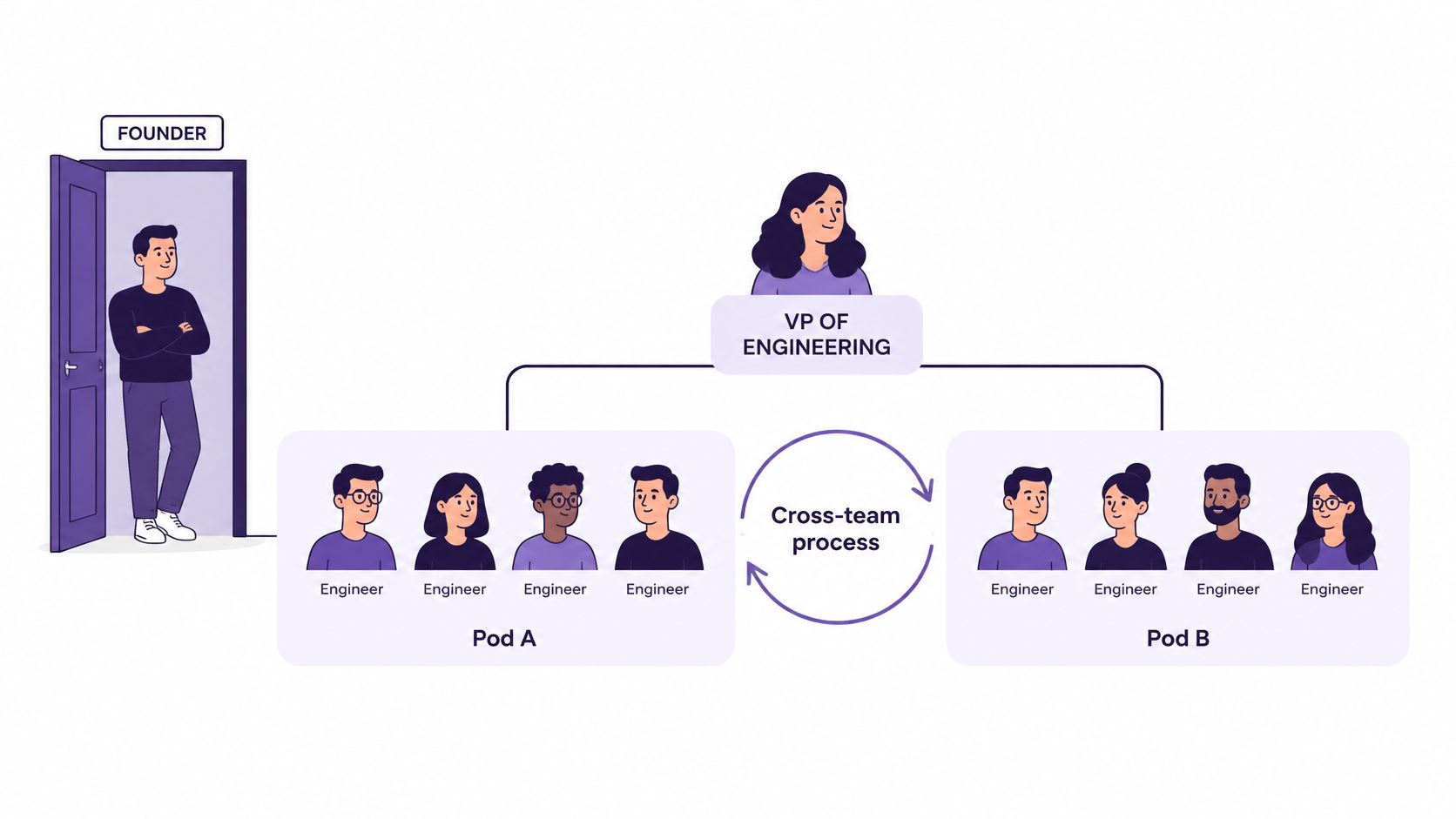
A clear reporting structure helps these responsibilities reach the teams doing the work.
The architect exhausted by management
A technical co-founder may love architecture but dread the growing queue of performance conversations and staffing disputes. Avoiding those conversations doesn't make them disappear; it leaves new managers without support.
A full-time or fractional VP can coach those managers while the co-founder concentrates on technical direction. The assignment should include observing management routines, clarifying escalation boundaries, and helping managers give useful feedback.
The measurable exit is managers who run their own individual check-ins, address performance concerns, and make routine team decisions without the founder's intervention.
Before writing a job description, match your company to the closest situation. Identify the operating problem you need solved, then describe what independence would look like when the engagement succeeds.
Burnout and Team Design the VP Must Fix
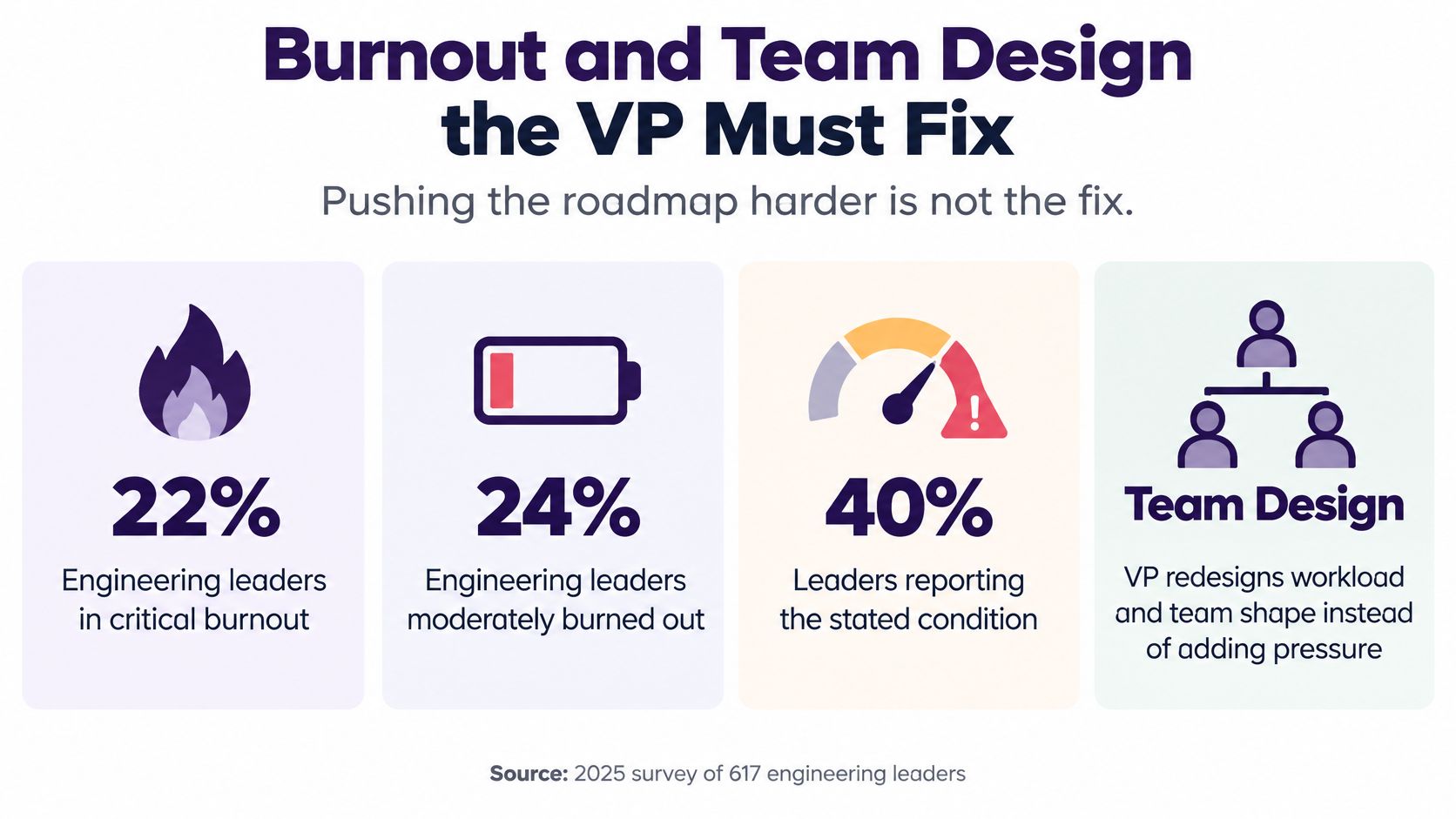
In LeadDev's 2025 survey of 617 engineering leaders, 22% faced critical burnout, 24% were moderately burned out, 40% believed their teams were less motivated than 12 months earlier, and 38% were working longer hours.
A strong VP doesn't respond to that situation by pushing the roadmap harder. When managers already lack capacity, extra approvals and status meetings can consume the time they need to resolve the underlying problems.
The workforce-health challenge is an organizational-design responsibility, not just a personal resilience issue.
Diagnose the load before changing targets
Ask the VP to examine leading indicators before proposing another reorganization or a more aggressive set of objectives.
- Manager span of control: Who has more direct reports than they can meaningfully coach?
- Incident load: Who repeatedly absorbs interruptions, recovery work, and follow-up?
- After-hours work: Which responsibilities regularly spill beyond the agreed working day?
- Attrition risk: Where are people reporting exhaustion, disengagement, or a lack of support?
- Decision latency: Which decisions remain unresolved because approval routes are unclear?
Individual awareness still matters. Acheloa Wellness's guide to signs of burnout among professional women can support conversations about recognizing strain, but it shouldn't substitute for changing the conditions that create overload.
Put structural fixes first
Start with a sustainable planning rhythm and explicit decision rights. Protect focus time, make on-call expectations bounded, and coach managers who are still expected to write most of the code.
Don't begin with a wellness stipend while incident coverage remains unlimited. Don't add a status meeting when a written update and a clear decision owner would accomplish the same purpose.
A smaller company doesn't need a large people-operations department to make these changes. It needs someone with authority to stop conflicting work, redistribute responsibility, and hold executives to agreed priorities.
That's why a part-time VP who redesigns the week can be more useful than a heroic full-time hire who accepts the same overload. The advantage comes from changing the operating conditions, not from the employment model itself.
Order of operations: Measure load, shorten decision delays, then raise delivery targets.
Career Outlook and Hiring Signals
In 2024, the U.S. Bureau of Labor Statistics projected 4% employment growth from 2024 to 2034 for architectural and engineering managers, a category that includes vice presidents of engineering, with approximately 14,500 openings per year, as reported by Salary.com.
That's a broad management category, not a forecast specifically for software VP positions. For founders, the useful lesson is to define the assignment carefully rather than treating the title as a sufficient hiring specification.
Turn missing ownership into a job description
- List the empty scorecard rows. Separate work nobody owns from work someone owns but performs poorly.
- Translate each gap into an outcome. Examples include a hiring plan filled to target or a functioning monthly delivery review.
- Define the first ninety days. Name the documents, decisions, and management routines the executive should establish.
- Choose the engagement model. Decide whether the workload requires permanent daily leadership or a bounded fractional assignment.
A common career path runs from senior engineering manager to director of engineering to VP. Each step adds broader ownership: from team execution to multiple managers, then to company-level resource allocation and executive tradeoffs.
Interview for the scope ahead
Ask candidates to explain what they personally owned, what managers owned beneath them, and what changed after their intervention. A director from a complex organization may have more relevant operating experience than a VP whose title covered a much smaller remit.
Match candidates to the scorecard rows they'll own. Don't assume that a familiar title proves readiness for your company's next stage.
When Fractional Leadership Fits Growth
A growing engineering team may need a better operating system before it needs a permanent VP: clear decision rights, consistent delivery routines, and managers who can handle day-to-day leadership. The cost comparison can help founders decide whether to build that system with a full-time executive or a fractional engagement.
Adnova Group's fractional leadership cost analysis estimates $250,000–$400,000 annually in total compensation for a full-time Series A or B CTO, recruiting fees of 20%–30% of first-year salary, and a three- to six-month search. It models a fractional CTO at $15,000 per month, or $180,000 per year.
These are CTO-market estimates, not a VP of Engineering salary benchmark or a Shiny quote. Use them to compare the full commitment, including search costs and how much leadership time the company needs.
Full-time versus fractional senior engineering leadership
| Model | Annual cost | Time to start | Fits when |
|---|---|---|---|
| Full-time Series A or B CTO-level leader | $250,000–$400,000 total compensation, plus recruiting fees of 20%–30% of first-year salary | Three to six months for the search, plus recruiting time | The operating system needs a full working week and a permanent owner |
| Fractional senior engineering leader | $180,000 per year in the fractional CTO model | Set after availability, scope, and hours are confirmed | Architecture, hiring standards, and delivery governance are needed without a full week |
Buy an operating outcome, not discounted availability
Fractional leadership fits when the company needs executive judgment but not 40 hours of executive attention each week. A defined assignment might establish hiring standards, resolve architecture decisions, or introduce delivery governance.
Set the working agreement before interviews:
- Hours per week: Specify scheduled availability and how urgent issues reach the executive.
- Decision rights: State what the VP can approve, what managers decide, and what requires CEO agreement.
- Deliverables: Name tangible outputs, such as a hiring plan, incident process, or management-development plan.
- Transition milestone: Define when the company should hire a permanent leader and what the handoff must contain.
The guide to hiring a fractional CTO can help clarify assignments that combine technical strategy with engineering operations. Keep responsibilities explicit so a strategy engagement does not become an unlimited management role.
Make part-time leadership workable
Written decision logs, a standing product-engineering meeting, and office-hour windows give managers predictable ways to get guidance. They also clarify which decisions should proceed without waiting for the executive.
Fractional leadership is a poor fit when the company expects a full-time manager of managers. If managers need daily direction or the executive must continuously coordinate production emergencies, a permanent role may better match the workload.
A practical screening rule is to consider a fractional start when three or more responsibility areas lack ownership and a permanent executive commitment would strain revenue. Treat the count as a prompt for discussion, not a universal threshold. The urgency and complexity of the gaps matter more.
Match experience to the assignment
For either hiring path, ask candidates to explain how they led a company at a comparable stage. Set success measures around operating outcomes, and require a written handoff so decisions, relationships, and routines remain with the team when the engagement ends.
Shiny connects startups with experienced executives for 5 to 25 hours a week. Executives go through a multi-step application process, over 60% have 20 or more years of experience, and Shiny automatically matches a job posting with up to 15 executives.
Use those matches to assess fit, not just seniority. Ask how each candidate would address the unowned responsibilities, what authority they would need, and how they would leave managers better equipped to run the system.
Shiny helps startups connect with vetted fractional executives who can establish engineering leadership before a full-time hire is justified. Map the responsibilities that lack ownership, then visit Shiny to explore executive matches.