Web Designer Work Description: A Guide for Startups
Your startup site is live. It looks fine. Your team sends prospects to it every day.
But the site isn't helping enough. Leads don't convert. The homepage feels vague. Mobile pages are clunky. You ask one simple question, then hit a wall. Do you need a web designer, a developer, a UX specialist, or all three?
Founders get stuck here all the time. The title sounds simple, but the role often isn't. A weak web designer work description attracts people who can make pages look polished. A strong one attracts someone who can shape how customers move, decide, and trust your business online.
That difference matters early. If you're hiring for a startup or SMB, you usually don't need "more design." You need the right level of design thinking for your stage, budget, and growth goals.
Why Your Business Needs More Than Just a Website
A founder I once advised had what many teams call a "done" website. It had a clean logo, product screenshots, pricing, and a contact form. On paper, nothing was missing.
In practice, visitors landed on the site and hesitated. They couldn't tell who the product was for. The navigation forced too many choices. Mobile users had to pinch and zoom through a key page. Sales blamed marketing. Marketing blamed the site. The founder wasn't sure whether to hire a designer or a developer.
That confusion makes sense. A developer builds the functionality. A web designer shapes how people experience that functionality. A UX-minded designer goes one step further and asks why visitors are dropping off, what they need to trust you, and how the interface should guide them toward action.
The business issue isn't "we need nicer pages." It's "our digital experience isn't helping buyers move forward."
A website isn't just an online brochure. It's often your first salesperson, first impression, and first proof that your company is credible.
That changes how you should think about hiring. A web designer isn't only a production resource. The right person improves clarity, brand trust, usability, and the path to conversion.
The role also sits in a healthy market. The U.S. Bureau of Labor Statistics projects 7 percent growth from 2024 to 2034 for web developers and digital designers, with about 14,500 annual openings over the decade, reflecting sustained demand tied to e-commerce and mobile-friendly experiences. The same BLS data lists a median annual wage of $90,930 for web developers and $98,090 for web and digital interface designers in May 2024 (BLS occupational outlook for web developers and digital designers).
If demand is strong, sloppy hiring gets expensive fast. A vague hire can leave you with attractive mockups and no business lift. A precise hire can help your site work harder without forcing you into a bigger team than you need.
What a Web Designer Actually Does for Your Business
A founder hires a web designer, approves a polished homepage, launches the site, and then wonders why demos still are not coming in. The problem is rarely "the design looked bad." The problem is that the site did not guide the right visitor toward the right action.
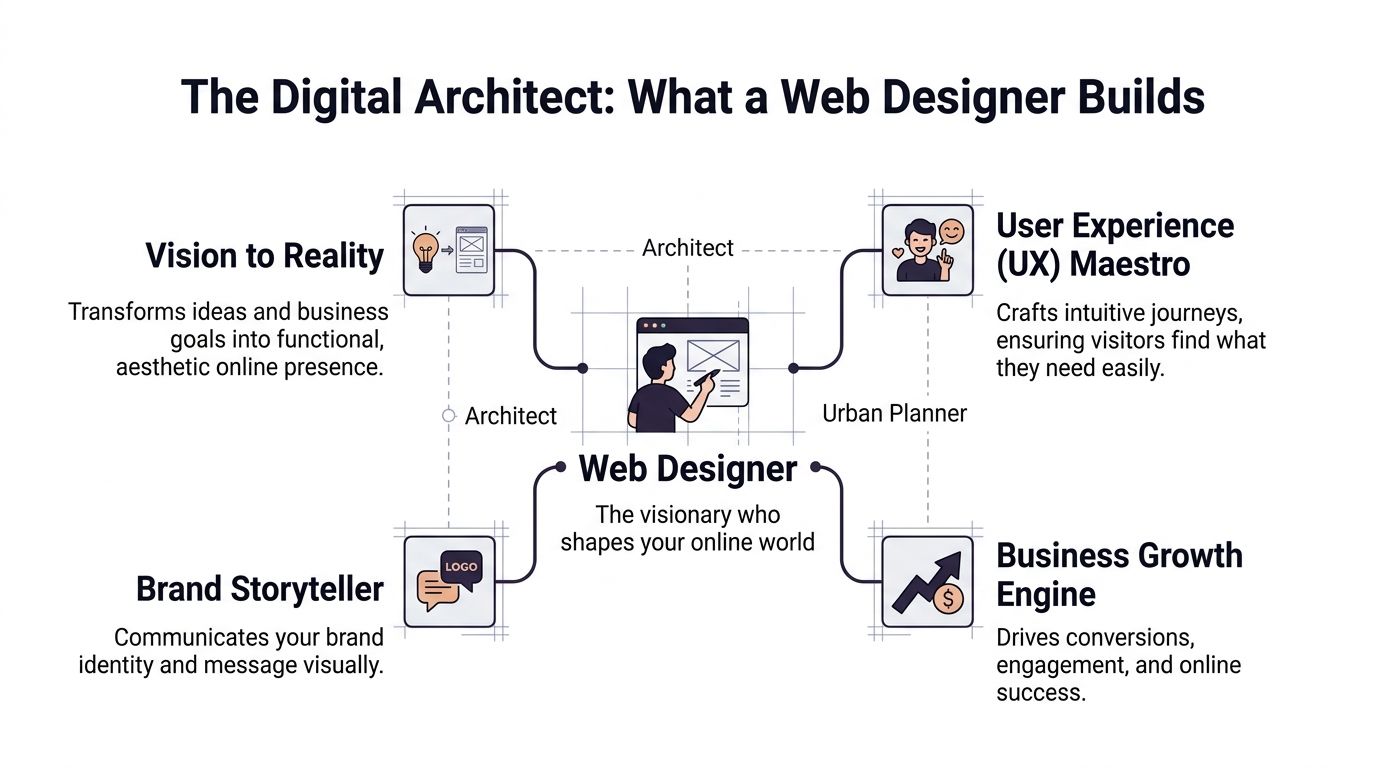
A web designer shapes the customer-facing part of your business online. They decide how information is organized, what people notice first, how trust is built, and whether a visitor can move from interest to action without friction. Developers handle the code and system behavior. Designers shape the experience people see and use across desktop, tablet, and mobile.
For a startup or SMB, that distinction matters. If you hire for visual polish alone, you may get attractive screens that do not help sales, recruiting, onboarding, or lead generation. If you hire for business fit, you get someone who can connect design choices to outcomes.
The role in plain English
A strong web designer work description should describe the role as a translator between business goals and customer behavior. Your designer turns brand positioning, product value, and user questions into pages people can understand quickly.
In practice, the work often includes:
- Clarifying your offer so a first-time visitor understands what you sell, who it is for, and why it matters.
- Structuring decision paths so key actions such as booking a demo, requesting a quote, applying, or purchasing feel clear.
- Designing responsive experiences so the site works well across screen sizes and common browsing conditions.
- Reducing friction in forms, navigation, page hierarchy, and calls to action.
- Strengthening credibility through consistent visual choices, readable layouts, and thoughtful interaction patterns.
That is why the role can overlap with UX and conversion work. A capable designer does not stop at "Does this page look good?" They ask "Can the visitor understand this in five seconds?" and "What might stop them from taking the next step?" If conversion improvement is a near-term priority, it also helps to understand how conversion optimisation experts approach testing, user flow, and page performance.
Where design affects results
Design influences business performance in small decisions that stack up. A weak headline, a crowded layout, a hard-to-find CTA, or a mobile menu that hides key pages can lower response without anyone noticing the source of the problem.
This is why experienced founders separate three hiring questions. Do we need a brand-led visual designer? Do we need a UX-minded designer who can improve flows and reduce drop-off? Or do we need a hybrid who can work with AI tools, generate faster variations, and support a lean team with broader output?
Your stage often answers that for you.
An early-stage startup may not need a full-time designer yet. A fractional designer can help shape the core site, tighten messaging, and create reusable patterns without adding permanent headcount. A freelance specialist can be the right fit for a launch, redesign, or short conversion project. A full-time hire makes more sense when design needs are constant across product, marketing, and growth.
Practical rule: Hire the designer your business stage needs, not the title you have seen on another company's org chart.
A good web designer also helps different teams stay aligned. Founders speak in goals. Marketers speak in campaigns. Developers speak in requirements. Designers turn those inputs into an experience customers can follow with confidence.
Core Responsibilities and Daily Tasks
If the previous section defines the role, this one shows what the week looks like. A useful web designer work description should make day-to-day expectations concrete enough that you can manage the role well.
Visual design and interface work
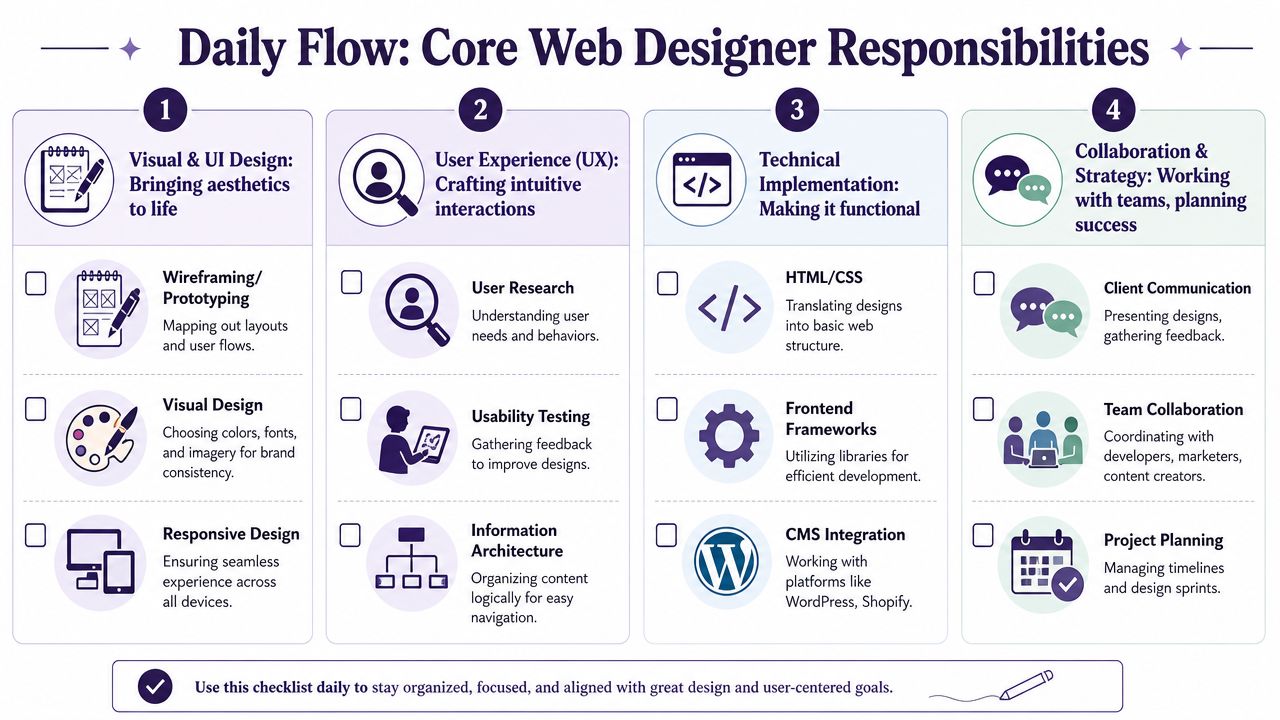
A designer usually starts by turning rough ideas into structure. That work often includes wireframes, page layouts, navigation concepts, and higher-fidelity mockups in tools such as Figma or Adobe XD.
Common deliverables include:
- Wireframes that map content and page hierarchy before visual polish starts.
- Mockups that apply typography, color, imagery, spacing, and button styles.
- Responsive layouts that show how the same page behaves on smaller and larger screens.
- Component designs for repeating UI elements such as cards, forms, menus, and CTAs.
This work matters because teams move faster when repeated choices become reusable standards. Organizations that let web designers create and enforce design systems with style guides and component libraries achieve 40 percent faster development cycles and 35 percent fewer design-related errors during implementation (Randstad's web designer role overview).
Prototyping and usability work
A polished screen isn't the same as a usable experience. Strong designers create clickable prototypes so stakeholders can test flow before code is written.
That work often includes:
- Interactive prototypes for key journeys such as signup, checkout, or quote requests
- Usability feedback sessions to watch where users hesitate or misread options
- Information architecture decisions about menus, subpages, and content grouping
- Iteration rounds based on observed friction, not just internal opinions
If your business is focused on turning traffic into action, it helps to think about design alongside conversion work. Teams often pair design reviews with broader conversion optimisation expertise so layout choices support measurable business goals.
The best design reviews don't start with "Do we like this?" They start with "Can the user complete the task without confusion?"
Collaboration and handoff
Designers rarely work in isolation, especially in startups. They spend a meaningful part of their time aligning with people who affect the final experience.
Expect collaboration with:
- Founders, to align pages with business priorities and messaging
- Marketing teams, to support campaigns, landing pages, and brand consistency
- Developers, to make sure designs are feasible and implementation details are clear
- Content teams, to fit real copy into real layouts rather than placeholder text
A mature handoff usually includes annotated files, component states, mobile views, and notes on behaviors such as hover states or form validation. Without that, developers fill gaps themselves, and the shipped experience drifts.
Essential Skills Tools and Portfolio Examples
A founder hires a designer because the homepage looks polished in Figma. Six weeks later, the site is live, but leads still drop off and the mobile version feels cramped. The problem was not the file. It was the hiring brief.
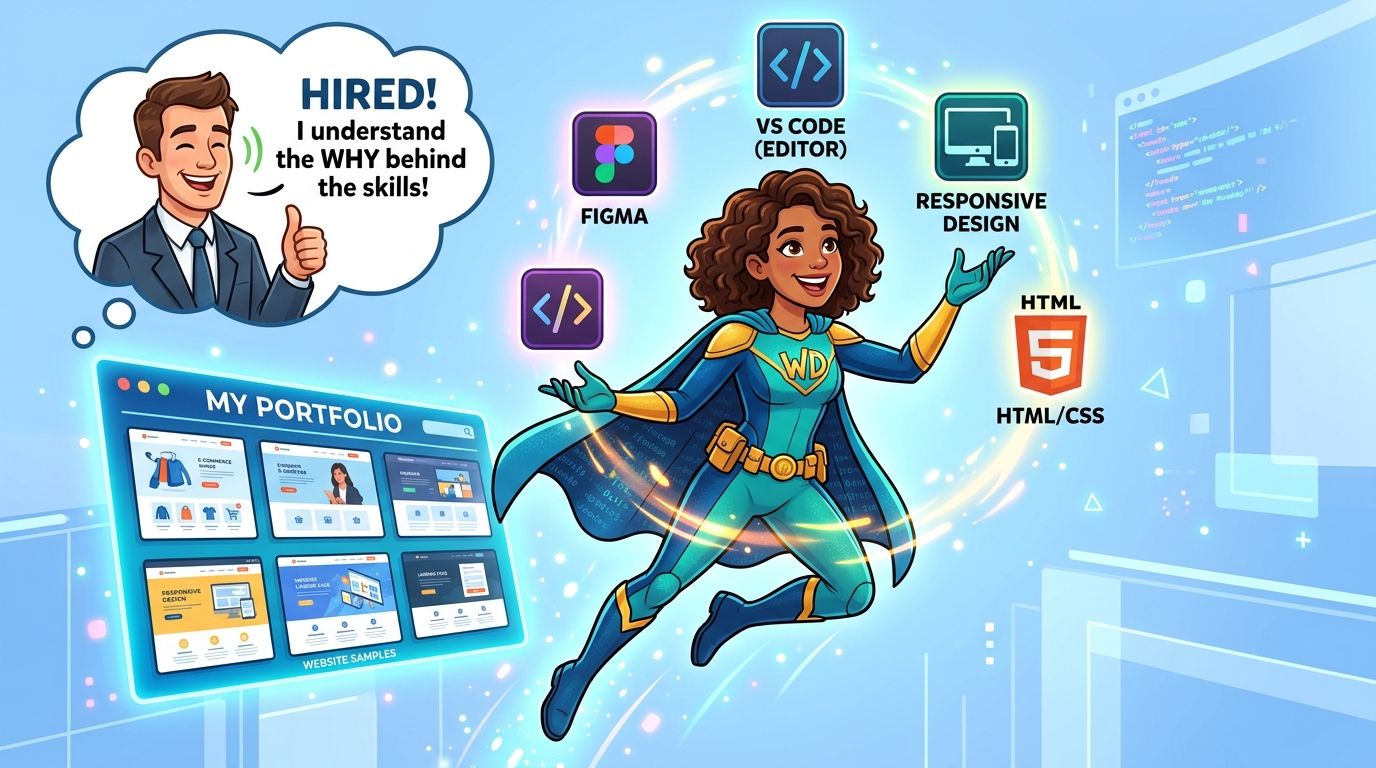
The right designer uses tools the way a skilled contractor uses equipment. The saw matters, but you are hiring for the judgment to build the right structure. For startups and SMBs, that distinction matters because an early hire often shapes not just how the site looks, but how clearly the business presents its offer, captures demand, and supports growth experiments.
Skills worth screening for first
Start with the skills that affect execution and business outcomes.
- UI design fluency. They should understand layout, spacing, hierarchy, typography, contrast, and consistency across pages.
- Responsive design judgment. Ask how they would adapt a pricing page, signup flow, or feature grid for smaller screens.
- Front-end awareness. Familiarity with HTML, CSS, and JavaScript helps them create designs developers can build without avoidable rework. MDN Web Docs offers a useful reference for the core web technologies designers regularly work alongside: HTML, CSS, and JavaScript documentation.
- Design tool proficiency. Figma is common because it supports collaboration, component systems, and handoff. Some teams still use Photoshop or Illustrator for specific asset needs.
- CMS familiarity. Experience with WordPress, Shopify, Webflow, or another platform shortens the gap between approved design and published page.
A good screen tests applied thinking, not software trivia. Ask for a walkthrough of one project and listen for how the candidate handled constraints such as developer limits, template restrictions, or competing stakeholder requests.
Skills that create outsized value in smaller teams
Many generic job descriptions stop too early. Early-stage companies often need a designer who can do more than produce clean mockups.
Useful strengths include:
- UX research habits such as quick usability checks, interview synthesis, or testing a prototype before development
- Analytics comfort so they can read behavior patterns and spot where design changes may help
- SEO awareness because heading structure, page clarity, and content layout influence discoverability
- AI-assisted workflows for faster wireframing, content support, pattern exploration, or asset preparation with human review
- Cross-functional communication with founders, marketers, and engineers
If your website includes onboarding, self-serve signup, account setup, or other product-like flows, the role starts to overlap with UX work in a meaningful way. This broader consultant perspective on UX design hiring helps clarify whether you need a traditional web designer, a UX-leaning designer, or a more flexible fractional setup while the business is still finding fit.
AI skills deserve special attention. You do not need someone who chases every new tool. You want someone who can use AI to speed up drafts and pattern exploration without lowering quality, creating generic pages, or introducing brand inconsistencies. Used well, AI shortens iteration cycles. Used poorly, it produces polished noise.
What the tool stack should tell you
Tools are signals, not proof.
Figma usually signals modern collaboration habits. Webflow may signal comfort with fast marketing execution. Shopify experience can matter if revenue depends on merchandising and conversion paths. WordPress experience matters if your team publishes often and needs flexible content management.
Choose tools based on your operating model. A full-time in-house designer may need deeper system thinking and closer engineering collaboration. A freelance designer may be perfect for a focused site refresh. A fractional designer can make sense when you need senior judgment to set direction, review work, and improve key pages without carrying a full-time salary.
What a strong portfolio actually shows
A portfolio should read like evidence, not decoration.
Look for case studies that answer practical questions:
- What problem was the business trying to solve?
- Who was the target user or customer segment?
- What constraints shaped the final design?
- How did the designer choose one direction over another?
- What changed after launch, testing, or stakeholder feedback?
The strongest portfolios show process in plain language. You should be able to follow the chain from problem, to decision, to outcome. Even if the candidate cannot share hard metrics, they should be able to explain tradeoffs clearly and show how the work served a goal beyond appearance.
Be careful with portfolios that only show landing page mockups, mood boards, and style tiles. Those can be useful artifacts, but they do not tell you whether the designer can simplify a messy sitemap, improve a weak signup path, or work within the limits of your CMS and team. For a growing business, those practical abilities usually matter more than visual flair alone.
Web Designer Seniority Levels Explained
A founder hires a senior web designer for a simple marketing site refresh. Six months later, the site looks better, but the company paid for strategy it never used. Another founder hires a junior designer to fix a weak conversion path and confusing navigation. The pages ship on time, but the bigger problem stays in place because no one on the team can define what should change.
That is why seniority matters. You are not just buying design hours. You are choosing how much direction, judgment, and business thinking the role needs to carry.
The simplest way to size the role is to ask one question: does your company already know what needs to be built, or do you need the designer to help figure that out? If the work is clear and repeatable, a junior or mid-level hire can be a good fit. If your website has unclear messaging, weak user flows, or competing stakeholder opinions, you need someone who can handle ambiguity and make sound decisions.
How the levels differ in real work
A junior designer usually does best with a defined brief, reference examples, and regular feedback. They can be productive in a startup that already has a clear brand, page structure, and someone senior reviewing the work.
A mid-level designer often works like a reliable project owner. They can take a page or feature from kickoff to delivery, coordinate with marketing and development, and make solid decisions within an existing direction.
A senior designer works more like a translator between business goals, user behavior, and execution. They are often the right choice when your company needs to clarify what the site should do better, where users are getting stuck, or how design should support growth. That is also where UX skill matters most. A senior designer with strong UX judgment can improve not only how the site looks, but how it converts, guides, and reduces friction.
For many startups, the question isn't senior versus junior. It is whether you need that senior judgment full-time. If your business needs strategic direction, design review, and occasional hands-on work, a fractional designer can cover the gap without adding a full-time salary. If you need steady production across many pages, campaigns, and experiments, an in-house hire may make more sense.
| Attribute | Junior Designer (0 to 2 years) | Mid-Level Designer (2 to 5 years) | Senior Designer (5+ years) |
|---|---|---|---|
| Core contribution | Executes defined tasks | Owns standard projects with moderate guidance | Sets direction, prioritizes work, and resolves ambiguity |
| Day-to-day fit | Page updates, asset production, simple layouts | End-to-end page design, stakeholder coordination, cleaner handoff | Site strategy, UX problem-solving, redesign leadership |
| Autonomy | Needs frequent review | Works independently on familiar work | Makes decisions in unclear situations |
| UX judgment | Applies patterns already chosen | Improves flows within existing goals | Identifies user friction and recommends what to change |
| Collaboration style | Responds to feedback | Coordinates across functions | Influences founders, marketers, developers, and contractors |
| Best use case | Production support | Ongoing execution with some ownership | Repositioning, conversion improvement, or growth-critical initiatives |
One more practical filter helps here. AI tools are changing execution speed, especially for wireframing, content drafting, and pattern exploration. That makes pure production skill easier to find. Judgment is still harder to hire. A designer who can use AI well, ask good UX questions, and tie decisions to business goals will usually create more value than someone who only produces polished screens.
A simple hiring rule
Hire junior or mid-level if the brief is clear, the priorities are stable, and someone on your team can give direction.
Hire senior, full-time or fractional, if the website needs diagnosis before design work starts.
How to Write a Job Description That Attracts Top Talent
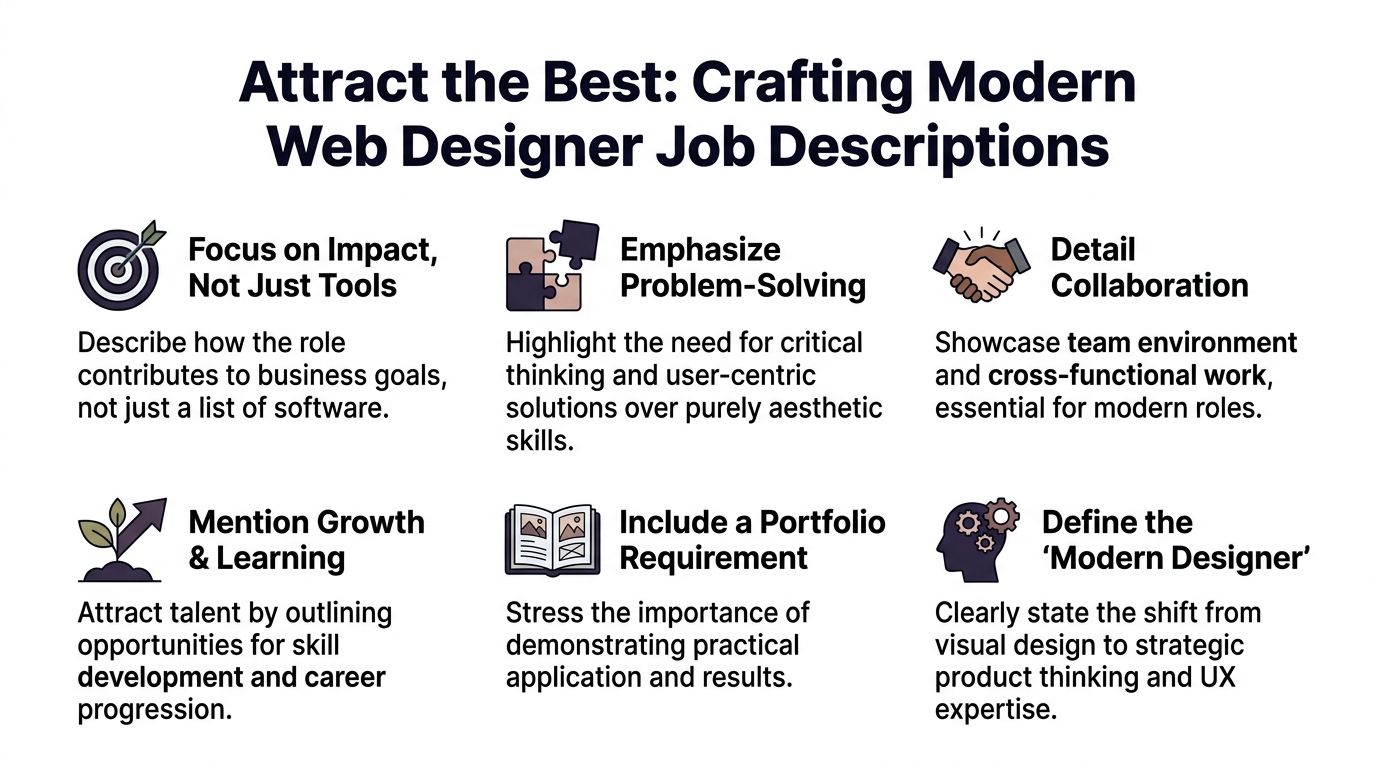
Most weak job posts read like software shopping lists. "Must know Figma, Adobe, CSS, wireframes, mockups." That attracts people who match keywords. It doesn't always attract people who can improve outcomes.
A better web designer work description tells candidates what business problem they're joining to solve. It also reflects how the role has changed.
What modern candidates want to see
There's a real mismatch in the market. 78 percent of hiring managers prioritize UX and AI skills, while 62 percent of entry-level job posts fail to mention them. The same gap affects pay and positioning, since candidates with UX-savvy profiles can earn 35 percent more. If your post talks only about mockups and CSS, you may filter out the strategic people you want.
That doesn't mean every startup needs a design futurist. It does mean your description should reflect current expectations around UX thinking, data-informed decisions, and comfort with modern workflows.
What to include in the post
A useful job description usually covers these elements:
- Business context so candidates know what stage the company is in and what the website must accomplish
- Core outcomes such as improving clarity, supporting lead generation, or redesigning critical journeys
- Expected responsibilities that include research, testing, collaboration, and handoff, not just visuals
- Tool environment with relevant platforms like Figma, WordPress, Shopify, or front-end basics
- Working model so candidates know whether the role is full-time, part-time, freelance, or project-based
- Portfolio expectations with a preference for case studies that explain process and decisions
A practical template
You don't need corporate language. You need precision.
We're hiring a web designer to improve how prospects understand, trust, and act on our website. This role will own page design, responsive layouts, design systems, and collaborative work with marketing and development. We value strong UI craft, UX judgment, and comfort using feedback or data to refine decisions. Please share portfolio examples that show the problem, your process, and the final solution.
One more point matters. If the role needs strategic oversight but not forty hours a week of production, say that clearly. Some of the best candidates won't apply to a full-time posting because their strength is leadership, not endless ticket execution.
Hiring Your Web Designer Interviewing and Making the Right Choice
Interviewing for design gets easier when you stop asking only about tools. Most candidates can tell you what they used. Fewer can tell you why they made a choice, what failed, and how they adjusted.
Ask questions that reveal thinking under uncertainty.
Interview questions that expose real ability
Try a mix like this:
- Walk me through a project where the first design wasn't working. What told you it was off?
- How do you balance brand goals with usability?
- Describe a time a developer pushed back on your design. How did you resolve it?
- If our homepage had high traffic but weak conversion, how would you investigate the problem?
- What do you want to see in analytics, feedback, or user behavior before changing a page?
You aren't looking for perfect answers. You're looking for how the person frames tradeoffs, handles feedback, and thinks beyond aesthetics.
Good designers defend decisions. Great designers can also revise them without ego.
Full-time, freelance, or fractional
This is the decision most hiring guides skip. Yet for startups, it's often the biggest one.
Full-time makes sense when you have ongoing design volume, multiple initiatives, and enough internal clarity to keep someone productive every week.
Freelance works well for defined projects, quick production bursts, or specialized execution. The tradeoff is that freelancers often focus on delivery, and many businesses underestimate how much management and context-setting they must provide.
Fractional is often the smart middle ground when you need senior guidance but don't need a permanent executive-level hire. That's one reason flexible expertise keeps gaining traction. The global fractional executive market has topped $5.7 billion and is growing at 14 percent annually, showing how many businesses now use part-time senior leadership as a scalable model (fractional executive market growth data).
For a startup, that can look like a senior design leader who works part-time, sharpens your web strategy, guides redesign priorities, mentors a junior designer or agency, and helps you avoid expensive misfires. If your broader plan also includes build support, this view on outsourcing website development projects can help you split design leadership from technical execution.
The key is matching the hiring model to the problem. Don't buy full-time overhead when you only need periodic senior judgment. Don't hire a freelancer and expect them to act like a strategic design lead if the role wasn't scoped that way.
If your company needs senior talent without the weight of a full-time executive hire, Shiny is worth a look. It connects startups and growing businesses with experienced fractional leaders who can step in quickly, help define roles clearly, and bring the level of judgment that turns a vague hiring need into a smart growth decision.