What Is a CIO and Why Does Your Business Need One?
A Chief Information Officer (CIO) is the strategic architect of your company's technology ecosystem. Their job is to align every piece of IT infrastructure and all digital projects with your core business goals. They go way beyond simple IT management, ensuring technology actively drives growth, efficiency, and gives you a real competitive edge. A CIO’s focus is always on the big picture—how information and systems can create value across the entire organization.
The Modern CIO Explained Beyond the Job Title

Let's cut through the corporate jargon. A CIO isn't just your top IT person; they are a key member of the executive team. While a traditional IT manager works to keep the lights on, the modern CIO designs the entire power grid to fuel sustainable business growth.
Think of them as a city planner for your company’s technology. They don't just patch potholes on existing roads by maintaining legacy systems. Instead, they build the highways, bridges, and public transit systems—your digital strategy—that allow the business to operate efficiently, innovate faster, and outmaneuver competitors.
From Technician to Strategist
The CIO role has evolved dramatically. It once centered on overseeing internal IT infrastructure and just keeping servers running. Today, it’s a strategic leadership position focused on spearheading digital projects, managing complex cybersecurity risks, and directly contributing to the bottom line.
Despite this shift, a major perception gap remains. According to a 2025 analysis, over half of tech leaders report that senior leadership often doesn't fully get the CIO's role. Nearly a quarter of CIOs feel pressured just to justify IT's value to their own companies. You can dive deeper into this redefined CIO role with more insights from Vantedge Search.
A great CIO does more than manage technology; they translate business problems into technology solutions. They are the critical link ensuring that every dollar spent on IT delivers a measurable return on investment and pushes the company closer to its strategic objectives.
This transformation means a CIO’s success is no longer measured by system uptime alone. It’s measured by their ability to use technology to solve pressing business pain points, from improving operational efficiency to creating new revenue streams.
A Quick Look At Core CIO Functions
A modern CIO oversees several key domains, bridging the gap between your technology and business strategy.
- IT Strategy & Governance: Defines the technology roadmap, policies, and standards to ensure tech investments directly support long-term business goals.
- Infrastructure & Operations: Oversees all hardware, software, networks, and data centers, ensuring the company’s digital backbone is reliable, scalable, and secure.
- Cybersecurity & Risk Management: Develops and implements security protocols to protect company data and assets, mitigating digital threats and ensuring regulatory compliance.
- Business Process Improvement: Uses technology to automate workflows and enhance operational efficiency, freeing up teams to focus on high-value work.
- Data Analytics & Business Intelligence: Turns raw data into actionable insights for better decision-making across departments.
- Vendor & Budget Management: Negotiates with tech vendors and manages the IT budget to optimize spending and maximize value.
Connecting with the right fractional executive allows your business to access this strategic vision without the commitment of a full-time hire, turning technology from a cost center into a competitive advantage.
So, What Does a CIO Actually Do?
Let's get past the theory. What does a Chief Information Officer do day-to-day? Their role is defined by concrete duties that directly impact the business's bottom line. A CIO’s responsibilities go way beyond managing servers; they are accountable for how technology performs as a business asset.
Ultimately, their job is to craft and execute a complete IT strategy that aligns with the company's vision. This means they own the technology budget, oversee massive projects like a new CRM implementation, and ensure the IT infrastructure is secure, reliable, and ready to scale.
From Governance to Growth
A CIO’s work directly affects whether the company can operate efficiently and expand successfully. A huge part of their job is establishing the rules and frameworks for how technology is used across the organization.
- IT Governance: This isn't just about making rules. It’s about minimizing compliance risks that could lead to millions in fines and ensuring the company adheres to data privacy laws.
- Cybersecurity Strategy: A CIO develops a proactive plan to shield the company's data—and by extension, its reputation—from the constant barrage of digital threats.
- Vendor Management: They negotiate contracts with software and hardware providers, making sure the company gets the best possible value from its technology partners.
This expanding scope means CIOs are constantly weighing which technology bets will deliver the biggest payoff. Over 80% of CIOs are planning major investments in foundational tech like cybersecurity, Generative AI, and business intelligence. Cybersecurity is almost always the top priority, which makes sense given how critical it is to protect our increasingly interconnected operations. You can learn more about the top priorities for CIOs in 2025.
Measuring a CIO's Impact
So how do you know if your CIO is delivering value? Their success is measured by straightforward Key Performance Indicators (KPIs) that tie IT performance directly to the health of the business.
A high-performing CIO demonstrates their value not through technical jargon, but through measurable improvements in efficiency, security, and profitability. Their goal is to turn the IT department from a cost center into a strategic growth engine.
Key metrics to watch include:
- System Uptime: Are critical business systems consistently available when you need them?
- Project Delivery: Are technology projects completed on time and within budget?
- ROI on Tech Investments: Is the new technology generating a positive financial return?
- Security Incident Reduction: Are data breaches and security vulnerabilities decreasing over time?
CIO vs CTO: Clarifying Key Tech Leadership Roles
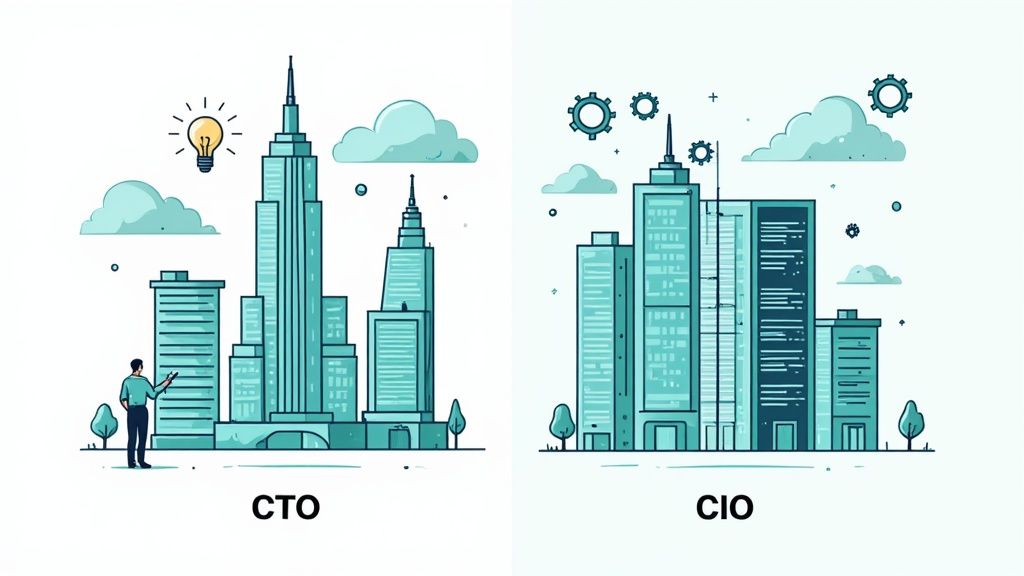
It’s one of the most common points of confusion in the C-suite: what’s the real difference between a Chief Information Officer (CIO) and a Chief Technology Officer (CTO)? While they both live and breathe technology, their focus and function are very different.
Think of your business as a cutting-edge factory. The CTO is the chief engineer designing the revolutionary new product that you'll sell to the world. They're obsessed with innovation and building something the market has never seen before.
The CIO, on the other hand, is the master of the factory floor. They make sure the assembly lines, robotics, supply chain software, and internal communication systems are all running at peak performance. Their world is all about efficiency, stability, and empowering the team inside the factory walls.
Differentiating Focus and Function
One leader builds the product; the other builds the business. A CTO's success is often customer-facing—it shows up in the app, the software, or the service you sell. A CIO's success is felt by every employee through seamless workflows, secure access to data, and reliable tools that just work.
A CTO asks, "What new technology can we create to win the market?" A CIO asks, "What technology can we adopt to run our business better, faster, and more securely?"
This difference in perspective shapes everything they do. While a CTO is exploring emerging tech to gain a competitive edge in the product, a CIO is implementing proven technologies to optimize the company's internal operations. If you want to dive deeper into the CTO role, check out our guide on CTO duties and responsibilities.
CIO vs CTO: A Quick Comparison
Here’s a simple breakdown of how these two critical roles stack up against each other.
| Aspect | Chief Information Officer (CIO) | Chief Technology Officer (CTO) |
|---|---|---|
| Primary Focus | Internal Processes & Operations | External Product & Innovation |
| Main Goal | Improve business efficiency and stability | Drive product development and revenue growth |
| Key Metrics | System uptime, ROI, security posture | Product performance, market share, user adoption |
Critical Signs Your Business Needs a CIO
When is it time to bring in a CIO? It's not about a magic revenue number or a specific headcount. It's about complexity. Most companies realize they need strategic IT leadership after a dozen small tech headaches have merged into one giant operational migraine.
Catching the signs early can save you a world of hurt. If your team spends more time battling IT gremlins than doing their actual jobs, that's your first major clue. You’ve probably outgrown your initial setup, and the duct-tape-and-a-prayer approach just isn't cutting it anymore.
Your Technology Is Actively Slowing You Down
Are your internal systems causing more friction than they solve? When your tech stack feels like an anchor instead of a propeller, it’s a clear sign you need a strategic mind at the helm.
Look for these classic growing pains:
- Software that doesn’t talk: Your sales, marketing, and ops teams use different tools that are basically strangers to each other. This creates maddening data silos and forces your people into hours of manual work.
- Constant firefighting mode: Your entire IT "strategy" is reactive. You're forever patching leaks and putting out fires instead of proactively building a tech roadmap that supports where the business is headed.
- Productivity is tanking: You keep hearing complaints that the tools are slow, clunky, or just plain confusing to use. Even a 10% drop in productivity from wrestling with bad tech can carve a massive hole in your bottom line.
If your technology feels like a tangled mess of cables that no one dares to unplug, you're experiencing a classic symptom of strategic neglect. A CIO’s first job is to untangle that mess and create a clear, scalable infrastructure.
These aren't just minor inconveniences; they're symptoms of a serious gap between your business ambitions and your IT reality. Letting them fester will stall your growth. Bringing in a CIO, even a fractional one, gives you the strategic oversight to turn your technology from a liability into your most powerful asset.
Choosing Your Hiring Model Full-Time vs Fractional CIO
Once you realize you need strategic IT leadership, the next big question is how to get it. Most companies weigh two main options: hiring a full-time, in-house CIO or bringing on a fractional one. The right call comes down to your budget, immediate needs, and long-term goals.
A full-time CIO is a dedicated member of your C-suite, completely immersed in your company culture. This gives you constant oversight, but it’s a massive financial commitment, including salary, benefits, bonuses, and equity. For most small and medium-sized businesses, that kind of overhead just isn't realistic.
The Rise of Fractional Leadership
This is exactly why the fractional CIO model has become such a powerful alternative. A fractional exec gives you the same top-tier strategic thinking but on a part-time basis. For startups and SMBs, this is a total game-changer.
You get access to elite, experienced talent that would otherwise be out of reach. Instead of a full-time salary, you get a seasoned expert for a specific number of hours each week or month, laser-focused on high-impact initiatives. You can get a much deeper look at the benefits and responsibilities in our guide on the fractional chief information officer.
This decision tree shows some of the common pain points that push businesses to look for a CIO in the first place.
If you're dealing with tech chaos, glaring security holes, or have no real IT strategy, it's a clear sign that you're missing that crucial strategic leadership.
And the need for this kind of insight is only growing. In fact, 65% of organizations expect their IT budgets to climb in 2025, which shows just how central the CIO role has become. The problem? A serious talent gap makes finding a great full-time leader incredibly difficult. This is pushing more companies to find flexible solutions, as detailed in Foundry's State of the CIO report.
By engaging a fractional CIO, you get the strategic horsepower you need to solve complex problems without the full-time cost. It’s about paying for targeted results, not just headcount.
Ultimately, the fractional model is the perfect bridge, letting you turn technology from a headache into a real competitive advantage. Finding a vetted fractional executive through a trusted partner can guide your business and start making a difference right away.
Finding the Right CIO for Your Company
Hiring the right CIO isn't just about finding a technical expert; it's about finding a strategic partner. The ideal candidate is someone who sees beyond servers and software, blending deep business acumen with a clear vision for how technology can give you a real competitive edge. They have to be able to translate complex tech talk into measurable business outcomes that the rest of the C-suite can get behind.
Finding this unique mix of skills on your own can be a slog. Founders and hiring managers often find themselves buried in résumés, struggling to find a leader who genuinely gets their specific business challenges. It’s a frustrating and incredibly time-consuming process.
The Smarter Way to Hire Executive Talent
Instead of casting a wide net and hoping for the best, what if you could connect directly with a leader who already has the right expertise? This is exactly where working with a trusted partner shines, giving you access to a pre-vetted network of seasoned executives.
We understand this pain point because we solve it every day. Our platform connects businesses with proven fractional CIOs who are ready to step in and make an immediate impact.
This approach saves you a massive amount of time and resources. You get to skip the lengthy, drawn-out recruitment cycle and quickly find a strategic partner ready to turn your technology into a powerful engine for growth. For a complete step-by-step framework, check out our detailed guide on how to hire executives.
Let us connect you with the strategic partner you need.
Still Have Questions About the CIO Role?
Even after breaking down the role, a few common questions always seem to pop up. Let's tackle some of the most frequent ones we hear from founders and business leaders.
What Is the Typical Salary for a CIO?
A full-time CIO's salary can be a serious line item, often pushing well into six figures plus bonuses, depending on the company's size, industry, and location. For many businesses, that's a massive investment.
This is exactly why the fractional CIO model is so appealing. It gives you access to the same caliber of executive expertise but at a fraction of the cost of a full-time hire.
Does a CIO Need a Purely Technical Background?
While most CIOs come from a tech background, the modern role is much more about business acumen and leadership than it is about coding. The best CIOs are translators—they bridge the gap between the IT department and the rest of the C-suite.
Their real talent lies in converting complex technical jargon into measurable business value that everyone from the CFO to the CEO can understand and get behind.
How Does a CIO Impact Company Culture?
A great CIO is a culture-shaper, plain and simple. By rolling out user-friendly tech and pushing for data-driven decisions, they empower everyone to work smarter, not harder.
They also help build a culture of security awareness, turning cybersecurity into a shared responsibility instead of just "an IT problem." This simple shift can transform technology from a frustrating barrier into a genuine catalyst for success.
A CIO's first 90 days should be all about listening and learning. Their immediate goal is to build a strategic roadmap that ties technology initiatives directly to the company's core business objectives. This means assessing the current tech stack and sitting down with department heads to truly understand their pain points.
By focusing on assessment before action, a new CIO ensures their strategy solves real problems and delivers immediate value. It's the key to turning technology from a cost center into a true growth engine for the business.
Ready to find the strategic IT leadership that can transform your business? Shiny connects you with a network of over 3,000 vetted fractional executives ready to make an immediate impact. Schedule a consultation today to find the right CIO for your team.