What Is a Fraction Model Explained With Clear Examples
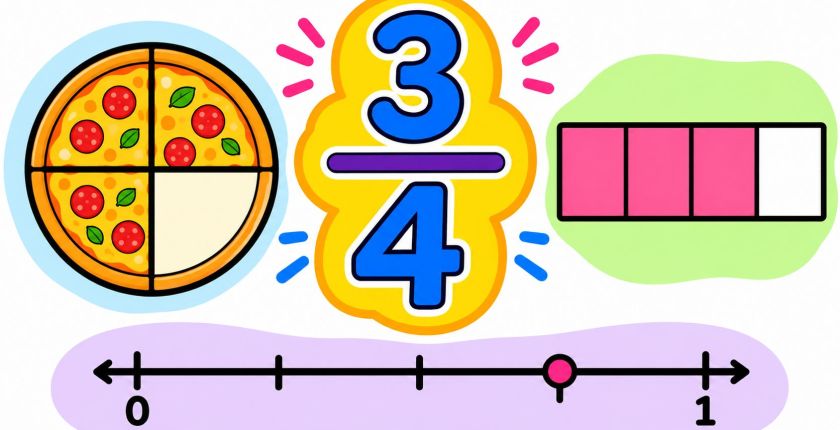
A fraction model is a visual way to understand a fraction in action. You take a whole, split it into equal parts, and highlight a share.
Think of a pizza cut into eight even slices with five topped with pepperoni. That is five-eighths. You just read a fraction model without a textbook.
The denominator tells you how many equal parts make the whole. The numerator tells you how many of those parts you are counting.
That two-part logic unlocks every other model.

The Three Core Fraction Models at a Glance
Fraction models are not one-size-fits-all. Each type fits a different situation.
Here is the quick overview:
| Model Type | How It Works | Example |
|---|---|---|
| Area model | Divides a continuous shape into equal sections | A rectangle split into four parts with three shaded |
| Set model | Counts separate objects as parts of a group | Three red marbles out of eight total marbles |
| Number-line model | Places fractions as points between whole numbers | Marking two-thirds between zero and one |
Same idea, three visual languages. We unpack each below.
A Tool Older Than the Classroom
Fractions did not start in school. Around 1800 BC, Egyptians used unit fractions to trade grain, measure land, and divide work.
Fractions were invented for fairness. People needed a practical way to split real assets, not just pass tests.
The Bridge to Business
Here is where it matters for founders. That same pizza math powers fractional leadership.
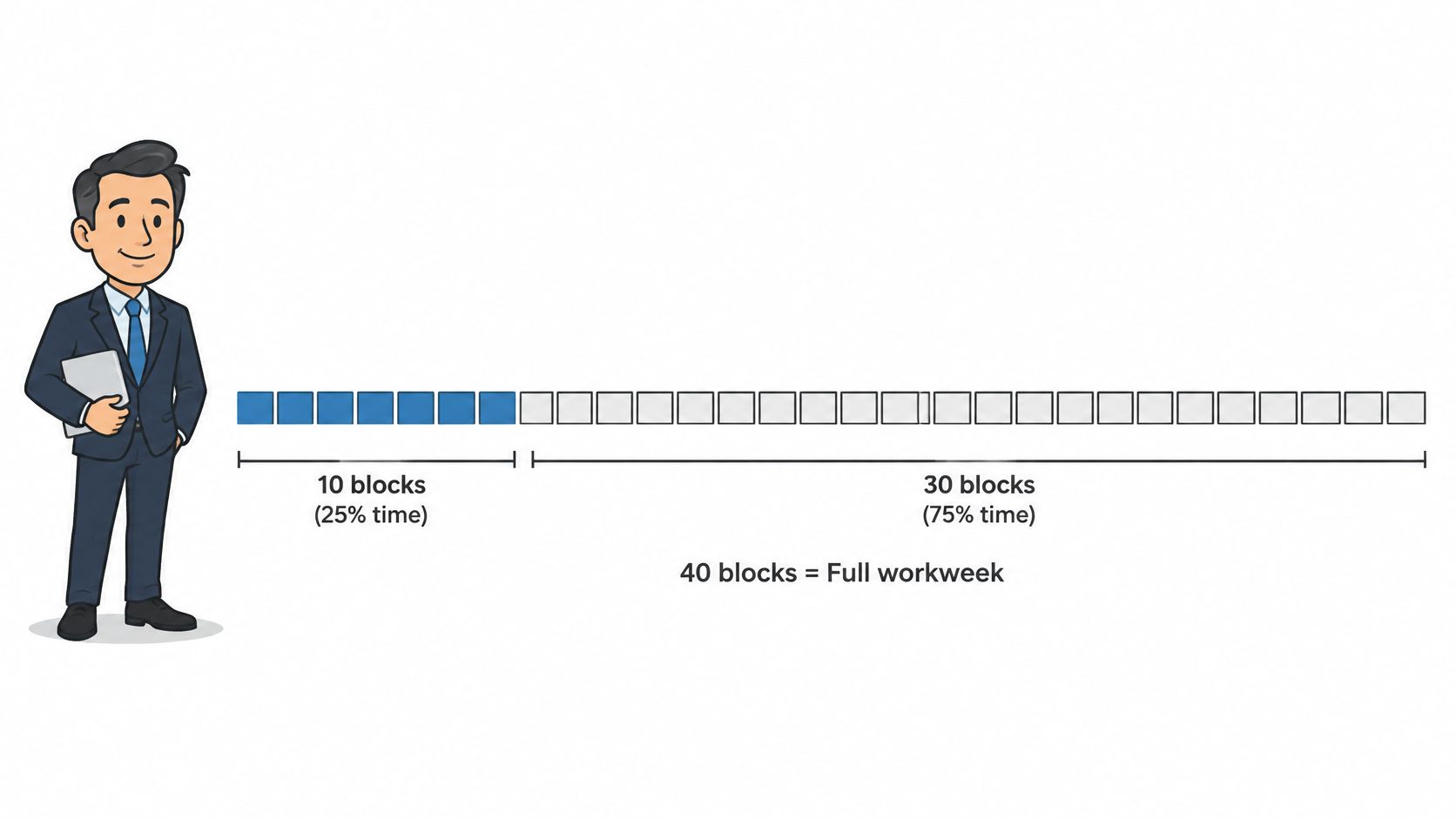
Say an executive works ten hours of a forty-hour week. That is 10/40, or one-quarter of full-time. You buy a clear slice of senior experience, not the whole pie.
That is how growth-stage companies get CFO-level judgment without the full-time salary. The math you learned at eight helps you right-size your team today.
Once you grasp the basics, see the three main types side by side.
Each shows the same math in a different visual language. Each is handy in a different situation.
Check the overview below — sliced shapes, counted objects, and a marked-up ruler in one place.
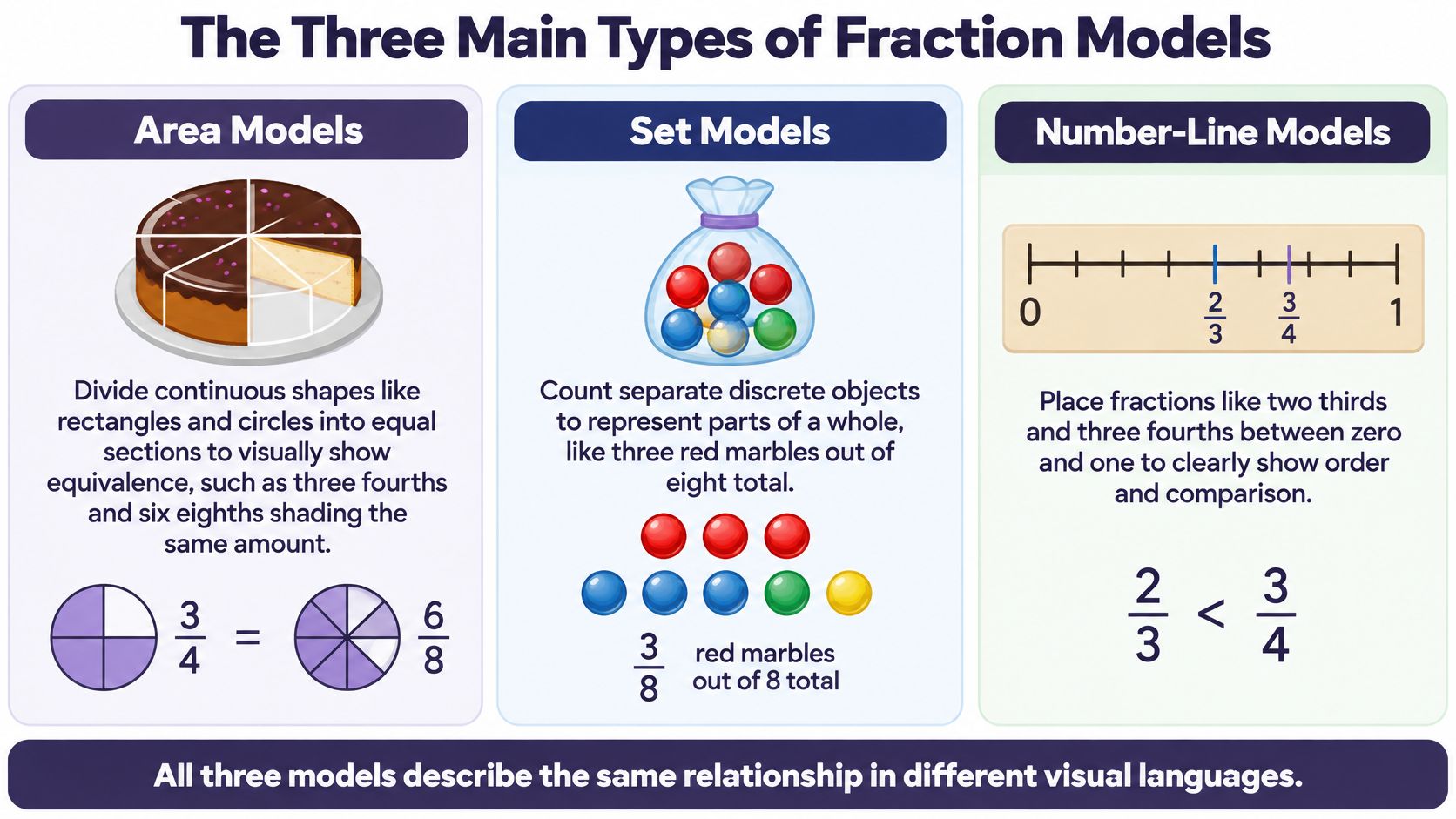
Same idea in all three: a part of a whole. That flexibility makes fraction models so useful.
Area Models and Slicing Shapes
An area model takes a solid shape — rectangle or circle — and splits it into equal parts.
Like cutting a cake into even slices and shading your share.
Shade three-fourths of a rectangle, then redraw it as six-eighths. The shaded area looks identical.
Because it is identical. You can see equivalent fractions instead of memorizing a rule.
Set Models and Counting Real Things
A set model uses countable objects.
If three red marbles sit in a bag of eight total marbles, reds are three-eighths of the set.
It is like sorting candy into piles. Same math, tied to things you can hold.
This clicks for counters. Inventory, headcount, and survey results all live here.
Number-Line Models and Settling Comparisons
A number-line model places fractions as points between whole numbers. Think ruler with marks.
Drop two-thirds and three-fourths between zero and one. Intuition may mislead you.
The line clears it up fast.
Three-fourths sits farther to the right. Position beats gut feeling every time.
When Each Model Works Best
No single model does it all:
- Area models shine for equivalence, because shading makes equal values obvious
- Set models shine for discrete quantities you count one by one
- Number-line models shine for order and comparison, because position never lies
Match the model to the question.
Checking equivalence? Slice a shape. Counting part of a group? Sort objects. Deciding which is bigger? Draw the line.
Master all three and you have a full visual toolkit. Next, take that toolkit into decisions that move a business forward.
A fraction model stops being abstract when the shaded part means sales, spend, or hours.
How Fraction Models Power Real-World Decisions
Start with a fair die. Landing on one face is 1/6, or about 16.7%. Draw six equal outcomes and highlight one to see that chance.
Roll it twice in a row and the odds drop to 1/36, or about 2.8%. A six-by-six grid shows all 36 outcomes, with one matching square.
Make the whole visible before judging the share.
When a founder hears "eighteen customers signed," they still need total qualified leads to judge conversion.
- Show the numerator to highlight selected outcomes
- Show the denominator to define the comparison group
- Label the whole so no one confuses leads with customers
Turn Business Metrics Into Visible Shares
Say 18 of 60 qualified leads become customers. That is 18/60, or 3/10, or 30%.
For a board meeting, plot 60 dots and highlight 18. The conversion story lands without a spreadsheet walkthrough.
Take a $100,000 budget with $25,000 for marketing. That share is 25/100, or 1/4, or 25%.
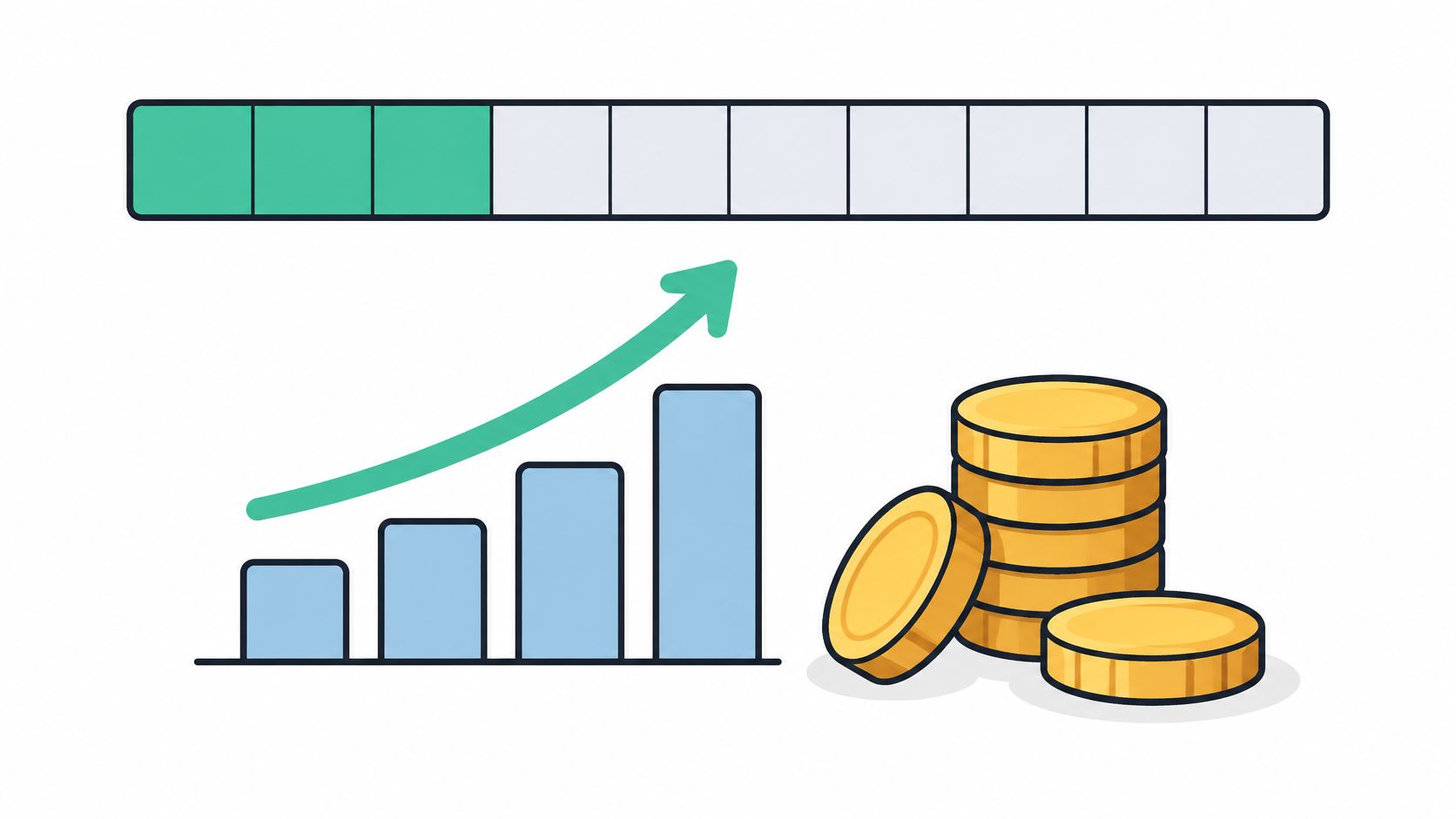
A bar split into four pieces makes the tradeoff clear. Shade one for marketing, then check if the other three cover the rest.
For staffing, 15 hours in a 40-hour baseline is 15/40, or 3/8, or 37.5% of full-time. Mark 15 blocks on a 40-block grid and capacity is visible.
Fraction Models in Action Across Business Scenarios
The same logic shows up everywhere:
| Scenario | Fraction | Simplified | Percentage |
|---|---|---|---|
| Lead Conversions | 18/60 | 3/10 | 30% |
| Budget Allocation | 25/100 | 1/4 | 25% |
| Weekly Staffing | 15/40 | 3/8 | 37.5% |
Each row follows the same pattern with different units. Compare proportions while keeping real numbers in view.
Connect the Picture to Leadership Capacity
So what is a fraction model doing in hiring? It turns time commitment into something you can see.
Run this sequence before an executive engagement:
- List decisions needing senior attention
- Estimate weekly hours those tasks require
- Compare against your full-time baseline
For budgeting, explore our guide to startup financial modeling before you lock spend.
Thinking in portions lets you buy a defined share of senior leadership instead of the whole role. Explore Shiny's services to match that share to your needs.
For founders, the question is not just "What is a fraction model?" It is how that visual helps you buy only the leadership you need.
Connecting Fraction Thinking to Fractional Leadership
Companies doing $1 million to $50 million in revenue hit the same wall. They need senior judgment, but cannot justify a full-time executive salary.
Common pain points we hear:
- Cash runway is tight, yet finance decisions are getting complex
- Marketing needs strategy, not just execution
- Operations break as headcount grows past 20
That is where fraction thinking helps.
A fraction model shows a piece of a whole. Fractional leadership applies it to executive time. You get a defined slice of a full-time role.
Fractional does not mean partial expertise. It means right-sized commitment.
Picture a rectangle cut into forty equal blocks. Each block is one hour. Bring on a fractional CFO for ten hours weekly and you shade ten blocks, or one-quarter of the rectangle.
That picture shows time, not output. You still align on priorities and success metrics.
Match Executive Hours to Changing Needs
Through Shiny's fractional leadership model, bring on executives for two to forty hours per week, with no minimum number of hours. Ramp up or down as work shifts.
Rates run from $100 to $600 per hour, by role and experience. Time and rate are separate decisions.
Consider a real-world example: a SaaS startup heading into planning season needs forecast review and board-ready financials, but only for six weeks. Instead of hiring full-time, they define a 10-hour weekly slice for a fractional CFO, then scale back to four hours for monthly oversight.
- Define the assignment, like forecasts and board prep
- Agree on capacity, covering meetings and analysis
- Revisit allocation when priorities shift
| Planning Question | What to Clarify |
|---|---|
| Which work matters most? | Executive responsibilities |
| How much time is needed? | Weekly capacity |
| What changes next? | Reasons to adjust hours |
Keep Expertise Separate From Time
A fractional CFO service like Shiny can perform any task a traditional CFO handles. The fraction describes time, not watered-down leadership.
Still, fewer hours require focus. You cannot fit 40 hours of work into ten.
- Prioritize judgment on decisions needing an executive eye
- Set boundaries so deliverables and ownership are clear
Shiny's marketplace includes more than 3,000 vetted executives across SaaS, FinTech, HealthTech, AI, Manufacturing, and more.
As a trusted partner, we help you weigh tradeoffs and select the right background and hours. Explore Shiny's services to discuss your priorities with our team.
Misreading a fraction leads to bad hiring, since "fractional" sounds like "less than." When you ask What Is a Fraction Model?, separate math from assumptions about skill or commitment.
Common Misconceptions About Fractions and Fractional Roles
Bigger bottom number, smaller piece. Most people flip this at first.
- Myth: a larger denominator means a larger fraction. Reality: with the same numerator, more pieces means smaller pieces. One-eighth is smaller than one-fourth, like one slice from 8 cake slices versus 4.
- Myth: different numbers must mean different amounts. Reality: three-fourths and six-eighths are equal. Cut each quarter in half and you change count, not cake.
- Myth: fraction models are only for kids. Reality: they guide probability, finance, and capacity planning. A founder splitting budget by department uses the same thinking as a student shading a rectangle.
A smaller share of time does not mean a smaller share of expertise.
Separate Executive Independence From Commitment
This is where the math analogy helps hiring.
- Myth: fractional executives are less committed. Reality: judge by experience, scope, and follow-through, not contracted hours.
- Myth: contractors need employee-style direction. Reality: fractional hires are independent contractors who choose projects, control how they work, and set rates. You get a specialist focused on your problem.
- Myth: flexible work means unpredictable availability. Reality: strong executives set shared hours, and fractional work doesn't require a fixed schedule. Clarify meeting windows and urgent coverage upfront.
- Myth: senior hiring always takes months. Reality: you can find and hire a fractional executive in days, not months. Read Shiny's guide to fractional work before interviewing.
Test fit in interviews:
- Describe the problem and ask for their approach
- Confirm availability around key decision points
- Agree on evidence showing the engagement works
Bring one leadership challenge to the conversation so you focus on the right executive, not just hours.
Knowing what a fraction model is gives you more than math. You can spot area, set, and number-line models, see proportions in daily choices, and apply that thinking to hiring.
Taking the Next Step With Proportional Thinking
Start with work you actually need instead of assuming every gap needs full-time hire. Define the whole first, then choose the slice.
Buy the leadership capacity your priorities require.
Use this checklist:
- Name the function needing help — finance, marketing, operations, or product
- Estimate weekly hours, including prep and follow-through. Those hours are your numerator
- Use 40 hours as the denominator, your full-time baseline
- Check budget against Shiny's $100 to $600 hourly range
For example, eight hours weekly is 8/40, or one-fifth. Ensure responsibilities fit those hours before talking to candidates.
Put Your Hiring Plan Into Practice
Keep costs open from day one. Shiny collects a 10% markup on the total fees invoiced for the contract term, so factor that in.
The hiring path is straightforward:
- Job posting to outline the assignment
- Automatic candidate matching to surface fits
- Interviews to align on experience
- Onboarding to launch the engagement
For financial analysis, the Hire Financial Analysts resource offers another staffing option.
Fractional hiring lets startups grow without overspending before they are ready. When ready, explore Shiny's marketplace or schedule a consultation to find an executive whose background and commitment fit your next challenge.
These visuals make math practical. They tie fractions to capacity, scope, and hiring timing.
How Do Area and Set Models Differ?
An area model splits one whole into equal pieces. Think slicing a single pie.
A set model counts separate items. Think picking apples from a basket.
- Shade 2 of 6 sections in a garden to show 2/6 as area
- Pick 2 of 6 plant pots to show 2/6 as a set
So when someone asks, "What is a fraction model?" start with what you measure. Continuous space, or countable objects?
Can Fraction Models Help Determine Executive Hours?
Yes. Start with weekly need as a fraction of 40 hours, then check if work fits.
For example, 12 hours is 12/40, or 30% of full-time. Shiny’s fractional leadership options run from two to 40 hours weekly, and you can adjust as needs shift.
- Scope the work first
- Lock hours with candidates
Use the fraction to plan. It will not predict output alone.
Are Fractional Executives as Effective as Full-Time Hires?
They can be. It comes down to experience, clear scope, and enough hours. A fractional CFO can handle any task a traditional CFO handles — fewer hours does not mean lighter skills.
The fraction describes time, not expertise.
In interviews, ask how they would prioritize urgent needs inside your hours. Then compare that plan to outcomes you must hit.
How Quickly Can You Hire Through Shiny?
You can find and hire an executive in days, not months. Shiny covers posting, automatic matching, interviews, and onboarding.
To move fast, define your top priority, weekly commitment, and interview windows. Confirm start date directly.
Explore Shiny to talk through your leadership gap and schedule a consultation to find the right executive fit.