

What Is a Fractional COO and How Can One Scale Your Business?
So, what exactly is a fractional COO?
Think of them as a seasoned, on-demand operations executive you hire on a part-time contract to tackle your biggest growth headaches. They bring C-suite expertise to get your business running like a well-oiled machine, but without the six-figure salary and long-term commitment of a full-time hire.
A fractional COO doesn’t just hand you a playbook and walk away. They embed within your team, roll up their sleeves, and help execute the strategic initiatives needed to build scalable systems.
Decoding the Fractional COO Role

Most growing businesses hit a wall. It’s that painful point where the passion and hustle that got you off the ground are no longer enough to scale. The very processes that brought your first wins start to crack under pressure, leading to chaotic workflows, missed deadlines, and a founder constantly drowning in operational fires.
This is precisely the problem a fractional chief operating officer is designed to solve.
Imagine your business is a promising ship that has successfully navigated the harbor but now faces the wild, open sea of scaling up. A fractional COO is like hiring a seasoned sea captain for a critical leg of the journey. They don't take over the vessel forever; they jump aboard to navigate through storms, get the crew working in sync, and chart the most efficient course to your next destination.
For a quick overview, here's a snapshot of what defines the role.
Fractional COO at a Glance
| Attribute | Description |
|---|---|
| Employment Type | Part-time, contract-based (1099) |
| Commitment | Flexible, often 10-20 hours per week |
| Focus | Hands-on execution and systems building |
| Ideal For | Startups & SMBs needing senior expertise without the full-time cost |
| Key Function | Translates the CEO's vision into an actionable, operational plan |
This table captures the essence of the role: strategic leadership delivered on a flexible, cost-effective basis.
Strategic Leadership On a Flexible Basis
A consultant might deliver a beautiful strategic plan and then disappear, leaving you to figure out the hard part. A fractional COO is different. They become a genuine, integrated part of your leadership team, responsible for turning your vision into a real, actionable plan—and then making sure it actually gets done.
Their part-time structure makes this level of expertise accessible for companies that desperately need operational leadership but can’t yet justify a full-time executive salary.
The immediate benefits are clear:
- Expert Execution: They aren’t learning on your dime. They bring years of experience scaling companies, ready to implement proven systems and processes that eliminate your biggest operational bottlenecks.
- Cost-Effectiveness: You get top-tier executive talent for a fraction of what a full-time hire would cost. Forget the six-figure salary, benefits package, and equity discussions for now.
- An Objective Perspective: Because they’re not caught up in the day-to-day internal politics, they bring a fresh, unbiased view. This allows them to spot problems and opportunities that insiders might be too close to see.
This model is a cornerstone of the modern approach to building a leadership team. To see how this fits into the bigger picture, check out our complete guide to the fractional C-suite advantage. By engaging a proven expert for a specific timeframe, you ensure your business has the right leadership at the right time—propelling growth without overextending resources.
The Core Responsibilities of a Fractional Operations Leader
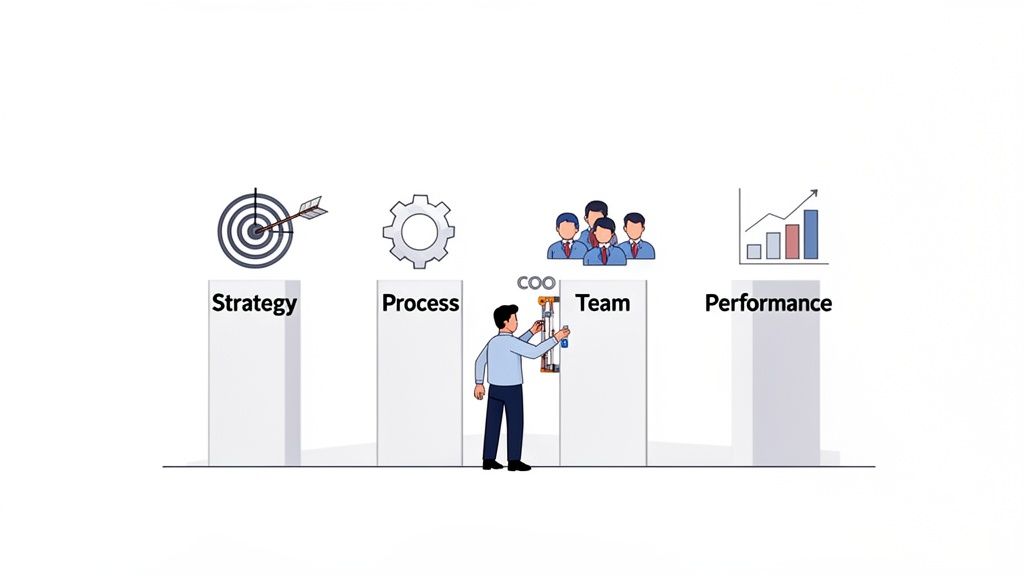
So, we know what a fractional COO is, but what do they actually do? Their work centers on four critical pillars that every scalable company needs: strategy, process, team, and performance. Think of these as the four legs of a table—if one is wobbly, the whole thing is unstable.
A fractional COO's job is to make sure each one is solid, turning operational chaos into an engine for growth.
Strategic Execution: From Vision to Action
A founder's vision is the "what" and the "why." A fractional COO is the master of "how." They take those big, ambitious goals and translate them into a concrete, step-by-step plan the whole team can follow. This isn't about creating a static document; it’s about building a living, breathing operational roadmap.
Here’s what that looks like in practice:
- Developing Annual and Quarterly Goals: They work with leadership to set clear, measurable objectives (like OKRs) that get every department rowing in the same direction.
- Implementing Project Management Systems: They standardize tools like Asana, Monday, or Jira to ensure projects stay on track, on time, and on budget. No more guessing games.
- Resource Planning: They make sure you have the right people, tools, and budget aimed at your most important projects, preventing team burnout and wasted cash.
Process Optimization and System Building
Bad processes are the silent killers of profit and morale. A great fractional COO is a professional "bottleneck hunter." They systematically find and eliminate the friction that slows your company down, re-engineering workflows for speed and reliability.
For instance, they might automate a clunky manual sales process, streamline a chaotic customer onboarding experience, or create standard operating procedures (SOPs) for repeatable tasks. Every improvement saves time, cuts down on errors, and frees up your team to do more important work.
Team Enablement and Mentorship
A company can only scale as fast as its people. A fractional COO often acts as a mentor, especially for department heads and mid-level managers who are brilliant at their craft but new to leading a team. They provide practical guidance to build strong, accountable teams.
By coaching your existing talent, they help create a culture of ownership and high performance. This hands-on leadership development is often one of the most lasting impacts they can have. For a more comprehensive look, you can explore the complete list of Chief Operating Officer duties and responsibilities in our detailed guide.
How a Part-Time Executive Delivers Full-Time Impact

The idea of a fractional COO sounds great in theory, but the real magic happens when you see their impact in practice. They are operators, diving into the messy, high-stakes problems holding your business back and delivering full-time results on a part-time schedule.
Let's move past the abstract definition of what is a fractional coo and look at how one actually solves the exact pain points keeping you up at night.
Real-World Example: The SaaS Turnaround
Picture a fast-growing SaaS company that hit a brick wall. Great product, but the customer experience was a disaster. Support tickets were piling up, onboarding was confusing, and churn was climbing. The CEO was completely swamped, unable to fix the operational cracks that were turning into chasms.
In comes a fractional COO for just 15 hours a week.
Within 90 days, the results were impossible to ignore. The fractional COO helped them roll out:
- An Automated Onboarding Sequence: This immediately took a huge load off the support team and ensured every new user had a consistent, positive first impression.
- A Tiered Support System: By sorting customer issues, they could route tickets more effectively, slashing response times for critical problems.
- Proactive Customer Health Monitoring: They implemented systems to flag at-risk accounts, which meant the team could step in and help before a customer thought about canceling.
The outcome? The company cut its churn rate by 30% in six months and saw a massive jump in customer satisfaction. That's the power of focused, expert execution.
Real-World Example: The E-commerce Overhaul
It’s not just software companies. We worked with a bustling e-commerce startup doing $5 million in revenue, but supply chain headaches were destroying their profit margins. They brought in a fractional COO for 15 hours a week to get things under control.
This operations wizard implemented data-driven inventory tools that cut stock errors by 40%, renegotiated with vendors to lower costs, and automated clunky workflows. The payoff was huge: a 35% drop in operational costs and a 25% increase in on-time deliveries within six months. They turned a profit-bleeding operation into a lean, mean growth machine.
You can dive deeper into why small businesses need a fractional COO to see more scenarios like this.
These stories all point to the same thing: a skilled fractional leader can step into a complex mess, pinpoint the real problem, and execute a solution that delivers a serious return on investment.
Is Your Business Ready for a Fractional COO?
Hiring a fractional executive is all about timing. Bring one in too early, and you strain precious resources. But wait too long, and you'll spend all your time putting out fires instead of building the future.
The sweet spot is usually after you've nailed product-market fit but just before operational chaos grinds your growth to a halt. This is the stage where things start to feel clunky. You know you need scalable systems, but you're not even sure where to begin.
Common Red Flags Signalling You Need Help
If you're nodding your head while reading the following, it's a strong sign you've outgrown your current operational setup. These aren't just minor headaches; they are genuine threats to your momentum and team morale.
- The CEO is the primary firefighter: Are you, the founder, constantly being pulled into day-to-day problems instead of focusing on big-picture strategy, sales, or fundraising?
- Projects are consistently late or over budget: Key initiatives stall out, deadlines fly by, and nobody seems to have clear ownership.
- Team morale is dropping: When roles are fuzzy and processes are frustrating, even your best people get discouraged. Burnout starts creeping in.
- Profitability is suffering from inefficiency: Are you leaking money through wasted time, duplicated work, or sloppy vendor management?
Recognizing these issues is the first step. They’re symptoms of a much deeper problem: your company lacks the systems and processes required to support its next stage of growth.
The Ideal Company Profile
The sweet spot for a fractional COO is a business with solid momentum that is getting tripped up on execution. We typically see this in companies with $1M to $50M in annual revenue that are scaling fast.
They have a fantastic product or service, but they're hitting an operational ceiling. The founder’s vision is clear, but the path to executing it is cluttered with internal friction. If this sounds like your company, a fractional COO isn't a luxury—it's a strategic investment in sustainable growth.
Fractional COO vs Full-Time COO vs Consultant
Choosing the right operations leader is a high-stakes decision. Do you need the all-in commitment of a full-time executive? The laser-focus of a project-based consultant? Or the flexible, senior expertise of a fractional COO?
Each role serves a very different purpose, and knowing the nuances is key to making the smartest investment for your business.
A consultant, for example, is typically brought in to diagnose a problem and hand you a strategic plan. After that, they're gone. On the other hand, both full-time and fractional COOs are integrated members of your leadership team, responsible for rolling up their sleeves and actually executing the plan. The real difference between them comes down to commitment, cost, and scope.
The Strategic Trade-Offs
A full-time COO is deeply immersed in your company's culture for the long haul. But that deep integration comes with a significant price tag—often a $250,000+ salary plus benefits and equity. For most growing businesses, that's an expense that's tough to justify, especially when the risk of a bad hire is so high.
Without this operational leadership, many founders find themselves stuck in a cycle of constant firefighting, watching projects get delayed, and seeing team morale take a hit.
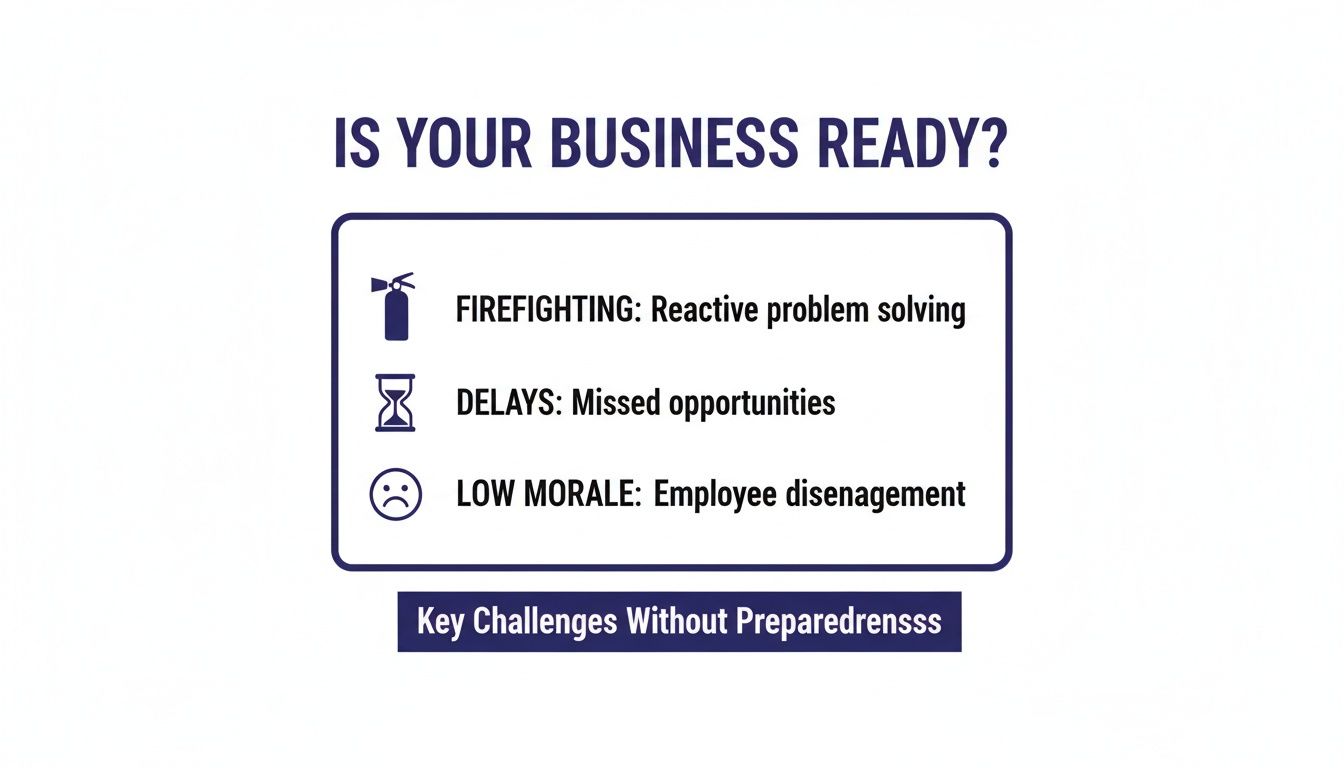
These pain points almost always stem from the same root cause: a lack of executive-level operational oversight. It's a gap a fractional COO is perfectly designed to fill, bringing in seasoned expertise to solve these exact problems without the massive overhead.
The fractional model is especially effective for small to mid-sized businesses. It turns out, 73.2% of fractional gigs target scale-ups, making it a go-to solution for growth-stage companies trying to level up their operations. You can explore more data on the rise of fractional work to see just how common this approach has become.
Choosing Your Operations Leader: A Comparison
To help you decide, here is a direct comparison of each operational leadership model.
| Aspect | Fractional COO | Full-Time COO | Consultant |
|---|---|---|---|
| Involvement | Embedded team member driving execution | Fully integrated leader managing daily ops | External advisor providing recommendations |
| Commitment | Part-time, flexible (5-25 hrs/week) | Full-time, long-term employee | Project-based, temporary engagement |
| Cost Structure | Monthly retainer, predictable cost | Full salary, benefits, equity | Project fee or hourly rate |
| Best For | Scaling businesses needing expert systems | Mature companies needing permanent leadership | Businesses needing a specific problem solved |
Here's another way to think about it:
A consultant gives you a map. A full-time COO captains the ship every single day. A fractional COO comes aboard to navigate the storm, chart a new course, and train your crew, then departs when you reach clear waters.
Ultimately, the right choice boils down to your company’s current stage, budget, and most pressing needs. If you need expert operational execution to get over growth hurdles—without the massive financial commitment of a permanent executive—a fractional COO offers a powerful, balanced solution.
How to Find and Hire the Right Fractional Executive
Finding the right fractional COO isn’t like hiring a typical employee—it’s bringing on a strategic partner. The engagement hinges on finding an executive whose experience is a perfect match for your most pressing operational headaches.
First, get crystal clear on the problem you need to solve. Are your project deadlines always a moving target? Is customer onboarding a mess? Pinpoint the one or two biggest pain points holding you back. This clarity allows you to write a hyper-focused role description that attracts operators who have a proven history of fixing exactly these kinds of issues.
Identifying Key Traits and Asking the Right Questions
Once you have candidates, look past the resume. The best fractional executives are hands-on operators with a track record of getting in the weeds to build and implement systems at companies just like yours.
Your interview process should focus on real-world problem-solving. Use questions designed to test their execution mindset:
- Scenario-Based Questions: "Describe a time you had to fix a broken process with barely any resources. What were your first three steps?"
- Strategic Thinking: "From what you know about our business, what’s the one operational weak spot you'd tackle first, and why?"
- Cultural Fit: "How do you build trust and drive change with an established team when you’re coming in as an outside leader?"
These questions tell you far more than a simple list of past accomplishments. Traditional recruiting can be slow, and it often surfaces candidates who don't have the specific, in-the-trenches experience a fractional role demands. For a deeper dive, check out our complete guide on hiring a fractional COO for strategic success.
Answering Your Top Questions About Fractional COOs
If you're considering a fractional COO, you probably have a few practical questions. It’s a big decision, so let’s break down the most common ones we hear from founders.
How Much Does a Fractional COO Cost?
The cost depends on their experience, your industry, and the scope of work. Most fractional COOs operate on a monthly retainer, which typically lands between $5,000 to $15,000 per month. This gives you executive-level operational muscle for a fraction of what a full-time COO would cost, which can easily top $250,000 a year with salary and benefits.
What’s the Typical Time Commitment?
Fractional roles are all about flexibility. Most engagements fall in the 10 to 20 hours per week range, dialed in to what your company needs right now. This means you’re investing purely in strategic execution, not paying for downtime.
How Do I Measure ROI?
The return on your investment shouldn't be a mystery; it should show up in your key business metrics. You’ll see their impact in tangible ways:
- Process Efficiency: Are key tasks getting done faster with less friction?
- Cost Savings: Are you seeing measurable drops in operational waste or better terms with vendors?
- Team Productivity: Is your team shipping more work? Are you seeing a dip in employee turnover?
- Strategic Goals: Are you making real progress on the quarterly objectives you hired them to drive?
Can a Fractional COO Really Be Effective Remotely?
Absolutely. The modern fractional executive model was built for remote work. The best fractional COOs are masters of asynchronous communication and digital collaboration. They know how to plug into a distributed team and provide steady leadership, no matter where everyone is located.
Ready to stop putting out fires and start building a business that can truly scale? We connect companies with a network of vetted fractional executives who have the exact experience you need. Find the right operational leader to solve your biggest challenges and unlock your company’s full potential.
