
What Is a Growth Stage Company and How Do You Scale It
So, you've survived the startup trenches. You've found that magical thing called product-market fit. Customers aren't just using your product; they love it. Now what?
Welcome to the growth stage. This is where a business shifts gears from simply staying alive to focusing on rapid, repeatable expansion. It’s no longer about survival; it’s about scale. You’ve likely secured a Series A or B funding round, and the pressure is on to turn that investment into aggressive, market-capturing growth. This is the moment a promising idea starts to look and feel like a real market contender.
Defining the Growth Stage: From Survival to Scale
What does the growth stage actually feel like? Think of it this way: you started with a single food truck, testing recipes and figuring out what people wanted. Now, there’s a line around the block every day. The question is no longer "Will people buy my tacos?" but "How do I open ten more food trucks without the quality dropping an inch?"
That's the core of it. The primary goal flips from discovery to execution. You stop asking, "Do people want this?" and start obsessing over, "How do we sell this to a lot more people, efficiently and predictably?"
The New Obsession: Predictable Revenue
At this stage, your company's focus narrows with laser-like intensity on one thing: building a repeatable growth engine. The scrappy, all-hands-on-deck hustle that landed your first 100 customers simply won’t work for the next 10,000.
Success now hinges on creating predictable revenue streams. This isn't about one-off wins anymore; it's about building a machine. That means investing heavily in:
- Formalized Sales Processes: It's time to build a real sales team with defined quotas, playbooks, and a CRM that actually gets used.
- Scalable Marketing Funnels: One-off viral posts are great, but now you need data-driven marketing that reliably generates qualified leads, month after month.
- Customer Success Infrastructure: You need systems to keep customers happy and reduce churn as your user base explodes.
This shift in strategy forces a change in how the business is built, too. The days of everyone wearing multiple hats are numbered. You start needing defined roles, departments, and clearer lines of communication. If you're navigating this, it's worth understanding the common types of startup organizational structure to see what's next.
A company hits the growth stage when its main problems are no longer about the product, but about the complexities of expansion. You’re building a machine, not just a product.
This phase isn't defined by how old your company is or how many people you have on payroll. It's about strategic intent. The mission is to pour gasoline on a fire that’s already burning bright, which sets the stage for a whole new set of operational and leadership challenges.
Navigating the Path From Startup to Scale Up
To really get what a growth-stage company is, you have to see it as part of a journey. Think of it as the critical bridge between the raw, scrappy energy of an early-stage startup and the market-dominating force of a scale-up.
Each phase has its own mission, its own risks, and its own set of priorities that should drive every single decision.
An early-stage startup is all about discovery. The only goal that matters is finding product-market fit—proving you've built something that a real group of people desperately wants and is willing to pay for. This phase is messy, full of experiments, and run by a tiny team where everyone wears multiple hats. The biggest risk? Building something nobody cares about.
Once you’ve validated that core idea, you enter the growth stage. The focus shifts dramatically from discovery to relentless execution. You're no longer trying to find a repeatable business model; you're building a well-oiled machine around the one that works.
This is when the team starts to specialize, processes get written down (for the first time, probably), and funding typically comes from Series A or B rounds. The primary risk is no longer the product itself, but whether the company can handle the pressure of scaling without everything breaking.
The infographic below perfectly illustrates this evolution, showing how a company's focus shifts from just trying to survive to achieving massive scale.
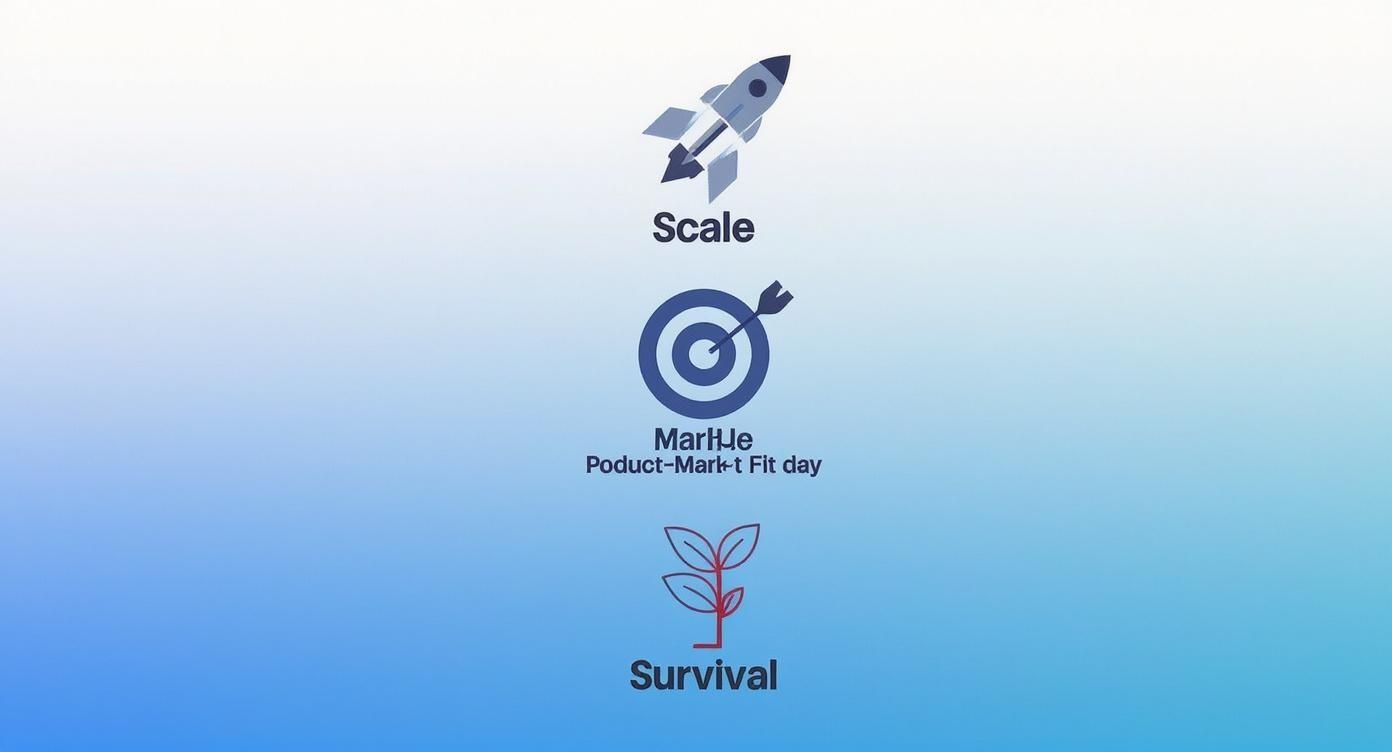
This visual makes it clear: the growth stage is defined by its strategic mission to build a repeatable engine for expansion.
Comparing the Stages of Business Growth
Finally, there’s the scale-up stage. This is all about achieving market leadership and hitting peak operational efficiency. The company isn't just growing anymore; it's optimizing for profitability, expanding its competitive moat, and cementing its position.
Funding now comes from later-stage rounds (Series C and beyond) or, ideally, from its own profits. The primary risks change again, shifting to market saturation, fending off competitors, and the challenge of maintaining efficiency as a large organization.
To help you pinpoint exactly where your company stands, the table below breaks down the key differences across these three distinct phases.
Key Differences Between Early Stage, Growth Stage, and Scale Up
This table compares the defining characteristics of each business stage to help leaders identify their current phase and prepare for what's next.
| Characteristic | Early Stage | Growth Stage | Scale Up Stage |
|---|---|---|---|
| Primary Focus | Finding product-market fit and validating the core idea. | Building a repeatable and scalable sales and marketing engine. | Capturing market share, optimizing for profitability, and dominating the industry. |
| Funding Source | Seed funding, angel investors, friends and family. | Series A and Series B venture capital. | Series C+ funding, private equity, or internal profits. |
| Team Dynamics | Small, agile teams of generalists; everyone wears multiple hats. | Specialized roles emerge; departments are formed. | Complex organizational structures with established hierarchies and processes. |
| Biggest Risk | Building a product nobody wants or needs. | Failing to execute on scale; operational breakdowns. | Becoming inefficient, losing to competitors, or market saturation. |
Understanding which stage you're in isn't just an academic exercise. It dictates who you hire, what you measure, and where you focus your energy as a leader. Getting it wrong can mean stalling out right when you should be hitting the accelerator.
The Metrics That Tell You It's Time to Scale
Data is the language of the growth stage. While gut feelings and founder vision get you through the early days, investors and your board need hard numbers to justify pouring more fuel on the fire.
These key performance indicators (KPIs) are your dashboard. They don't just tell you if you're growing, but how sustainably. They are the proof that your business model is truly built to last, moving you from discovery to pure execution. Vanity metrics like website traffic or social media followers take a backseat to numbers that directly reflect the health of your business engine.

Revenue and Growth Rate
The most obvious signal of a growth-stage company is, of course, growth. But it needs to be rapid and consistent. For SaaS companies, Annual Recurring Revenue (ARR) is the North Star, with benchmarks often starting around $1 million to $2 million to be considered in the growth phase.
Beyond a static number, investors are looking for a steep trajectory. This phase is all about rapid expansion. For example, high-growth startups often project revenue increases of 522% in their first year of this stage, followed by 236% and 136% in the following years. Numbers like that show serious market traction. You can find more of these startup growth benchmarks at Equidam.com.
Your revenue growth shouldn't just be happening; it needs to be predictable. Can you confidently forecast next quarter's revenue based on your current sales and marketing efforts? If the answer is yes, you're on the right track.
Unit Economics and Customer Health
Hyper-growth is useless if every new customer costs you more than they're worth. This is where your unit economics become non-negotiable. Healthy scaling requires a deep, almost obsessive, understanding of how much a customer is worth and what it costs to get them.
Here are the metrics you need to have dialed in:
- LTV to CAC Ratio: The Lifetime Value (LTV) of a customer absolutely must be higher than the Customer Acquisition Cost (CAC). A healthy ratio is widely considered to be 3:1 or higher, proving your acquisition strategy is actually profitable.
- CAC Payback Period: How many months does it take to earn back the money spent to get a new customer? Investors want to see this as short as possible—ideally under 12 months—to ensure capital is being recycled efficiently back into growth.
- Customer Churn Rate: You can't outrun a leaky bucket forever. Low monthly or annual churn (typically below 2% monthly for B2B SaaS) indicates you have a sticky product and a strong customer success function.
Mastering these figures is essential. To go deeper, check out our guide on the most important key performance indicators for startups. Tracking these numbers isn't just about reporting; it's about making the smart decisions that drive sustainable expansion.
Navigating the Predictable Crises of Rapid Growth
Hyper-growth feels amazing, but it breaks things. As a growth-stage company starts hitting its stride, the very systems, people, and culture that got it off the ground begin to buckle under the pressure. These aren’t red flags signaling failure; they are the entirely predictable side effects of success.
The scrappy, "all-hands-on-deck" hustle that was once a superpower quickly turns into a major bottleneck. All of a sudden, the CEO is still approving marketing copy, the CTO is fixing minor bugs, and the founding team is so buried in daily firefighting they can't see the forest for the trees. This chaos is a giant flashing sign that the company has outgrown its first operating model.
When Processes Can't Keep Up
In the early days, informal chats and ad-hoc processes work perfectly. A quick conversation in the hallway or a shared Google Sheet is all you need to keep everyone on the same page. But as the team doubles and then triples, that informal structure implodes.
What worked for a team of 15 is pure chaos for a team of 50. This operational strain shows up in a few classic ways:
- Communication Silos: Departments start to form their own bubbles, and information stops flowing freely. The sales team has no idea what marketing is launching, and the engineering team is totally disconnected from customer feedback.
- An Inconsistent Customer Experience: Without standard playbooks, every new hire delivers a slightly different version of your service. This leads to unpredictable quality and, inevitably, customer churn.
- Wasted Time and Money: Teams end up duplicating work or spending hours reinventing processes that should have been locked down months ago, burning through precious capital and runway.
These are the operational gaps where growth stalls out. The company’s momentum is powerful, but its internal infrastructure is acting like a speed governor, holding it back from its true potential.
“The skills that got you here are not the same skills that will get you to the next level. Success creates new problems, and the leadership team has to evolve to solve them.”
The Founder’s Dilemma
At the center of this storm is the founding team. They are brilliant visionaries and product people, but they are often first-time managers trying to learn how to lead at scale. This creates a critical leadership gap—a void between the company's current abilities and what it needs for the next phase of growth.
The hard truth is, the skills required to build a $50 million company are fundamentally different from those needed to build a $5 million one.
This isn't a personal failure; it's a structural reality of scaling. Simply recognizing this gap is the first and most important step. The next is to find the right specialized, experienced leaders who can navigate this new complexity and build the systems that will carry you forward. When this pain becomes acute, exploring fractional leadership with a trusted partner can be the smartest move a founder can make.
How Fractional Leadership Solves the Growth Puzzle
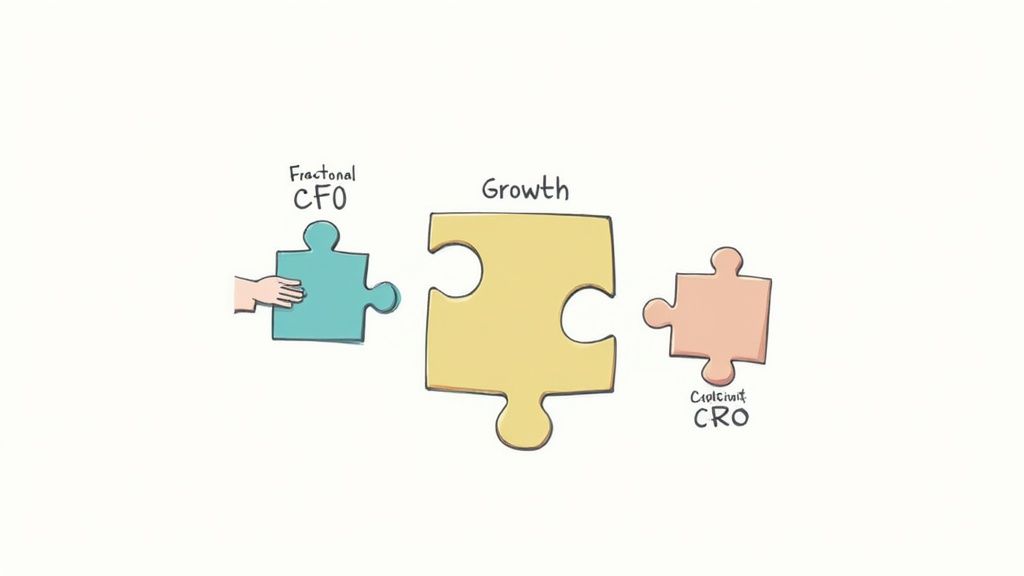
As you scale, you don't just need more hands—you need more experienced minds. But hiring a full-time, C-level executive is a massive commitment of both time and capital. This is where fractional leadership becomes a strategic superpower for growth-stage companies.
Fractional executives are seasoned, on-demand leaders who bring C-suite expertise to your company without the C-suite price tag. Think of them as a strategic partner who can parachute in, solve a critical problem, build a scalable system, and then transition out, leaving your team stronger and more capable.
For example, a fractional CMO can build a repeatable marketing engine in a few months, while a fractional CFO can prepare your company for a successful Series B round. This approach provides immediate impact exactly where you need it most.
Key Benefits of Fractional Leadership
- Cost-Effective Expertise: Access top-tier executive talent for a fraction of a full-time salary, preserving your cash runway for other growth initiatives.
- Immediate Impact: Fractional leaders are veterans of the growth stage. They don't need hand-holding and can start delivering value from day one.
- Flexibility and Scalability: Engage an executive for a specific project or a set number of hours per week, scaling their involvement up or down as your needs change.
- Mentorship and Team Development: A great fractional leader doesn't just do the work—they mentor your existing team, upskilling your internal talent and preparing them for future leadership roles.
This agile approach to leadership is a game-changer for navigating the complexities of the growth stage. It allows you to fill critical gaps with proven expertise, ensuring your company has the strategic guidance it needs to continue its upward trajectory. You can see more about this model in this report on venture capital trends at IBISWorld.com.
Learn more about fractional leadership in our detailed guide on how Shiny’s marketplace connects you with top talent.
Knowing When to Hire Your First Fractional Leader
Making the right leadership hire at the right time is a game-changer. For a growth-stage company, it's the difference between scaling smoothly and hitting a wall. Founders often feel the strain long before they pinpoint the problem, chalking up the operational drag to normal "growing pains."
But they aren't just growing pains. Specific triggers are clear signals that the leadership team that got you here isn't equipped to get you to the next level. Recognizing these signs is the first step. The right fractional leader can turn that chaos into a well-oiled, scalable system, prepping your company for its next major milestone.
The Signals You Need Fractional Help
Do any of these sound painfully familiar? If so, it might be time to bring in senior expertise without the full-time price tag.
- Your Revenue Has Plateaued: The growth curve has flattened out, and the sales and marketing tactics that used to work just aren't cutting it anymore. A fractional CRO or CMO can diagnose the real issue and build a new, scalable growth engine from the ground up.
- The CEO Is the Bottleneck: Is every marketing decision, sales contract, or financial projection still waiting for your final approval? If so, you're slowing down growth. A fractional leader takes ownership of their function, freeing you up to focus on the big picture—vision, strategy, and culture.
- You're Gearing Up for a Funding Round: Investors want to see institutional-grade financial models and a rock-solid growth story. A fractional CFO can build the forecasts that instill confidence, which is critical when average Series B deals are hovering around $25 million. You can dig deeper into venture capital insights from coinlaw.io.
When your problems shift from "how do we find customers?" to "how do we manage all this complexity?" you've hit the leadership gap. This is precisely when a fractional executive delivers the most value, bridging the gap between your current capabilities and your future needs.
These triggers are a sign that the skills that got you to this point aren't the same ones that will get you to the next. Don't wait for a crisis to force your hand. Proactively addressing these gaps with experienced, specialized leadership is one of the most powerful levers you can pull.
From there, the process is pretty straightforward. You start by defining clear, measurable goals—like reducing customer acquisition costs by 15% or getting a Series B data room prepped and ready. This sets your new executive up for immediate impact. When you spot these signs in your own company, it’s the perfect time to explore how a network of proven executives can help.
Common Questions About the Growth Stage
Navigating the growth stage can feel like you've been handed a map to a new continent, but the details are fuzzy. As founders shift from survival mode to aggressive scaling, a few common questions always pop up. Let's tackle them head-on.
How Long Does the Growth Stage Last?
There's no stopwatch on this phase, but it's often tied to funding cycles and how fast your market is maturing. Most companies live in the growth stage between their Series A and Series C rounds, which typically shakes out to somewhere between three to five years.
But the goal isn't to stay here forever. This is the period where you build the repeatable, scalable systems that get you ready for the next chapter as a true scale-up.
What’s the Biggest Mistake Founders Make?
Easy. Hiring for the problems you had yesterday instead of the scale you need tomorrow.
It's tempting to hire people who were brilliant in the scrappy, early-stage hustle. But that's a trap. The skills that get a company off the ground often don't translate to building formal processes for a team of 100. This creates a critical leadership gap that stalls momentum just when you should be hitting the accelerator.
The most successful founders recognize that the skills that got them to product-market fit are not the same skills needed to build a repeatable, multi-million-dollar revenue engine.
Which Fractional Role Should I Hire First?
This isn't a one-size-fits-all answer. You need to prioritize the role that solves your biggest, most painful growth bottleneck right now. Let your primary challenge guide the decision:
- Is your lead generation pipeline looking dry? A fractional CMO can jump in and build a marketing funnel that actually scales.
- Are your financials a mess, or is a fundraise on the horizon? A fractional CFO will bring in the discipline and investor confidence you desperately need.
- Struggling with inconsistent sales performance? A fractional CRO can professionalize your entire sales process, from playbook to people.
Navigating the growth stage requires the right expertise at the right time. If you're ready to bridge your leadership gap and accelerate your company’s trajectory, exploring fractional leadership might be your next best move. Find the right leader for your stage today and discover how our network of vetted executives can help you scale with confidence.