What Is Market Segmentation And How It Drives Growth
At its core, what is market segmentation? It's the practice of dividing a broad audience into smaller, focused groups based on shared characteristics—be it their needs, habits, or personal traits. Think of it as moving from shouting at a faceless crowd to having a real conversation with the right people.
It’s about making sure your message actually lands and resonates.
Why Segmentation Is Your Growth Compass
Ever tried selling snow boots in the desert? It sounds absurd, but that’s what businesses without clear market segmentation do every day. They burn through money and time crafting messages that fall on deaf ears, simply because they’re talking to the wrong crowd.
For startups and growing businesses, this isn't just a marketing tactic—it's a survival strategy. With a tight budget and a lean team, every dollar and hour has to count. When you try to target everyone, you end up connecting with no one.
Market segmentation ensures your resources are aimed at the customers who will listen, engage, and ultimately buy. It transforms your marketing from a speculative gamble into a calculated investment.
From Broad Concepts to Tangible Results
Breaking your market into distinct groups lets you hit critical business goals that fuel real growth. Without that clarity, you’re just making decisions based on guesswork instead of data.
With a solid segmentation strategy, you can:
- Prevent Wasted Ad Spend: Stop throwing money at channels and messages that don’t work. Instead, focus your budget on high-potential customer groups to improve ROI.
- Guide Product Development: Build features that solve actual problems for your most valuable customers, boosting satisfaction and long-term loyalty.
- Sharpen Your Go-to-Market Strategy: Craft value propositions and pricing perfectly tuned to what each segment needs and is willing to pay. See how this fits into a bigger picture with our go-to-market strategy framework in our guide.
- Make Smarter Leadership Decisions: Pinpoint the exact executive expertise you need to capture a target segment. If your goal is to land enterprise clients, you’ll know you need a fractional sales leader with a proven track record in that specific arena.
Ultimately, market segmentation is the strategic map you need to navigate a competitive landscape. It points you toward your most profitable opportunities and shows you the exact path to get there.
The Core Types Of Market Segmentation
To truly understand market segmentation, you need to know your options. Think of these different types as lenses you can use to view your market. Each one reveals a unique perspective, helping you move from fuzzy assumptions to sharp, actionable insights.
This visual breaks down the basic idea: you start with a massive, undefined audience and distill it into specific, manageable segments that drive growth.
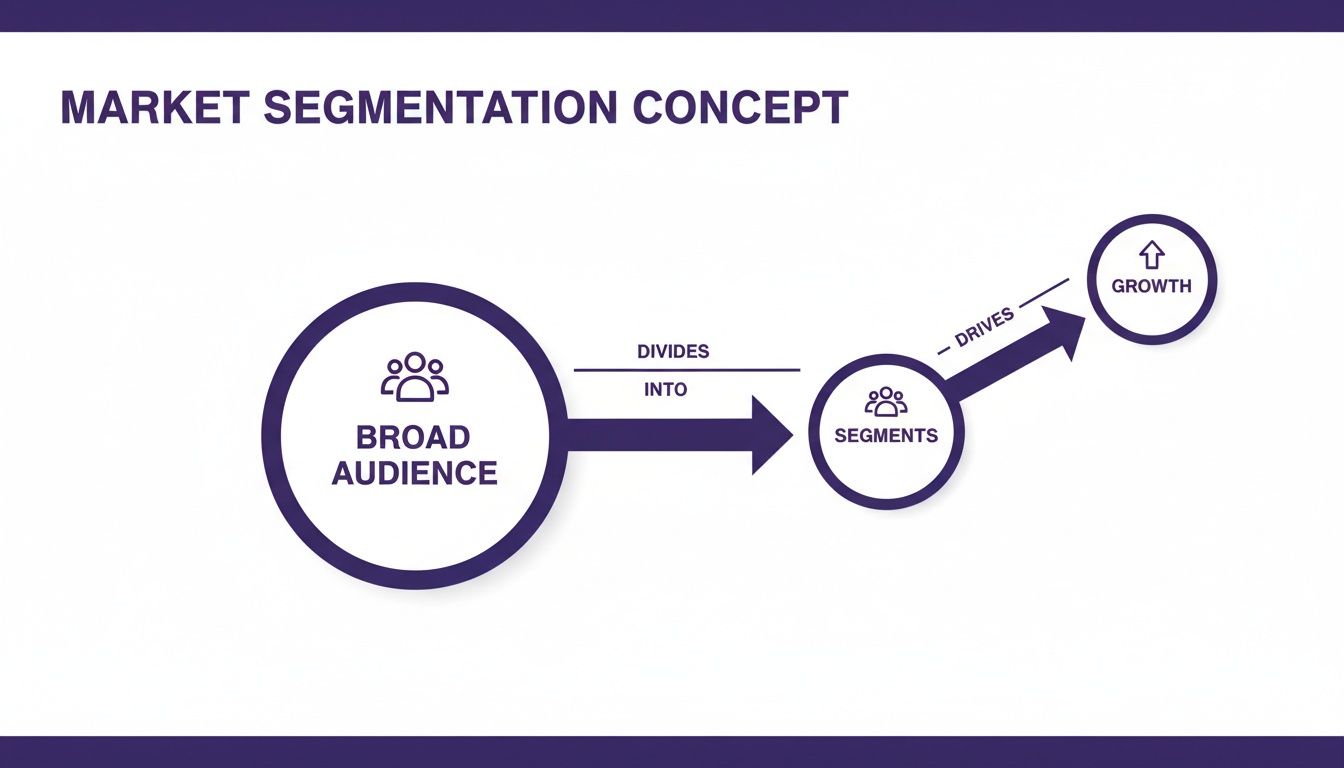
The big takeaway is that growth isn't about shouting your message to everyone. It's about systematically finding and engaging the right groups with precision. Let's walk through the core segmentation types.
Overview Of Market Segmentation Types
| Segmentation Type | What It Measures | Key Question It Answers |
|---|---|---|
| Demographic | Objective, statistical traits like age, gender, and income. | Who are my customers? |
| Psychographic | Internal attributes like values, attitudes, and lifestyle. | Why do they make certain choices? |
| Behavioral | Observable actions, such as purchase history and product usage. | How do they interact with my brand? |
| Geographic | Physical location, from country down to neighborhood. | Where are they located? |
| Firmographic | Company-specific attributes like industry, size, and revenue. | Which organizations are my ideal customers? (For B2B) |
This table gives you a high-level view, but the real magic happens when you combine these lenses to get a complete picture of your ideal customer. Let's dive in.
Demographic Segmentation: The Who
This is often the first stop on the segmentation train. Demographic segmentation groups people based on objective, quantifiable data points—the "who" of your audience.
It's usually the easiest data to access and provides a foundational picture of who you're talking to.
Common demographic variables include:
- Age and Generation: You wouldn't market to Gen Z the same way you would to Baby Boomers.
- Gender: A skincare brand creating distinct product lines and messaging for men versus women.
- Income Level: Luxury car brands focus on high-income households, while a dollar store targets budget-conscious shoppers.
- Education and Occupation: A platform selling professional development courses would tailor offerings based on a user's career stage.
Psychographic Segmentation: The Why
Demographics tell you who is in your audience, but psychographics tell you why they might buy from you. This is where you dig into the psychological traits that drive behavior.
By understanding the values, attitudes, and lifestyles of your audience, you can craft messaging that resonates on an emotional level. This is how you build true brand loyalty.
For instance, a sustainable fashion brand isn't just selling clothes; it's selling a belief system to a segment that values ethical production. Similarly, a FinTech app might target users with a high-risk tolerance and an adventurous mindset for its crypto trading features.
Behavioral Segmentation: The How
Behavioral segmentation is all about action. It groups customers based on their direct interactions with your company—what they click, buy, and how often they log in.
This is one of the most powerful types because it's based on what people do, not just what they say.
Key behavioral data points include:
- Purchase History: Are they frequent, high-value buyers or one-time discount shoppers?
- Product Usage: Differentiating between "power users" and casual users.
- Brand Loyalty: Rewarding long-term customers who consistently choose you over the competition.
Geographic Segmentation: The Where
This one is straightforward: geographic segmentation groups customers based on their physical location, from a continent down to a zip code. Needs often change based on where people live and work.
This approach has been a marketing staple for decades. The entire field moved away from one-size-fits-all mass marketing in the mid-20th century. A key step was macro-segmentation in the 70s and 80s, where businesses would group entire countries by variables like population size or GNP to inform their international strategy. You can read more on the evolution of the business information market on Fortune Business Insights.
Firmographic Segmentation: The B2B Who
For B2B companies, firmographic segmentation is the direct equivalent of demographics. Instead of looking at individual consumers, you're grouping entire organizations based on their attributes.
This is essential for any B2B sales and marketing team. For example, a SaaS provider might use firmographics to target tech companies with 50-250 employees in North America that have just closed a Series A round.
Understanding these firmographic segments is also critical for knowing when to bring in specialized leadership—like a fractional Head of Sales who has deep experience selling into that exact industry and company size. Finding that precise expertise is exactly what we help founders do.
Your Step-By-Step Guide To Building Market Segments
Knowing the types of segmentation is one thing, but putting it to work is where the magic happens. Building a segmentation model doesn't have to be a massive project reserved for Fortune 500s. A practical, step-by-step approach can bring immediate clarity and focus.
This is a repeatable framework designed for founders and leaders who need to make smart, data-informed decisions.
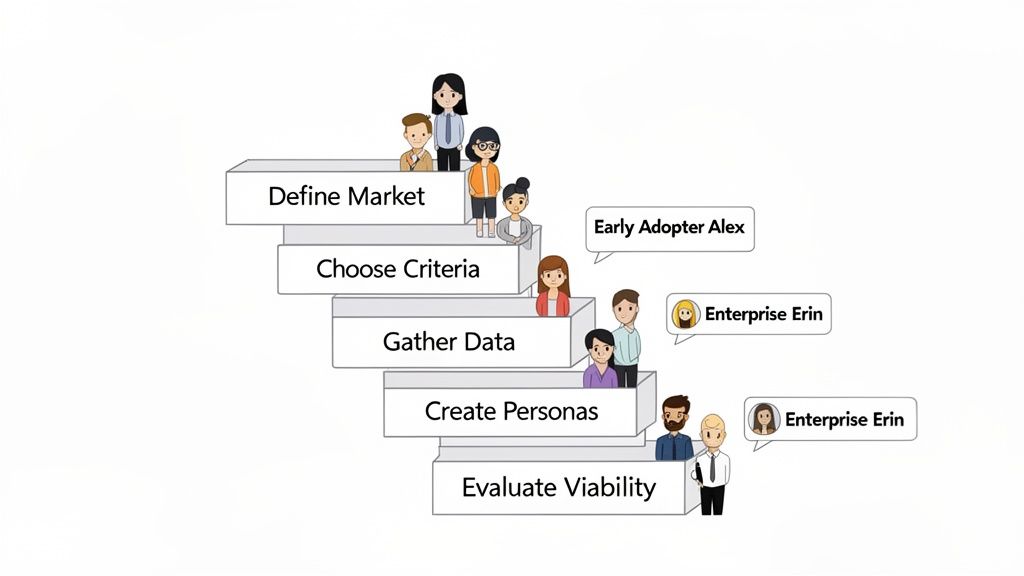
Step 1: Define Your Total Market
Before you can slice the pie, you need to know how big the whole pie is. This first step is about defining the entire universe of your potential customers—your Total Addressable Market (TAM). This is everyone you could possibly sell to.
Start broad. If you’re a B2B SaaS company, your TAM might be every business in a specific industry. Running a D2C brand? It could be every consumer in a target age bracket across North America. This sets the boundaries for the entire exercise.
Step 2: Select Your Segmentation Criteria
With your total market mapped out, it's time to decide how you're going to divide it. Go back to those core segmentation types and pick the criteria that actually matter for your business.
The key here is to keep it simple. Don't try to segment based on a dozen different variables at once. Start with a handful of criteria you believe have the strongest connection to why people buy from you.
- For a B2B Software Company: You might start with firmographic data like company size and industry, then layer on behavioral data like technology adoption speed.
- For a FinTech App: A great combo would be demographic data like income level mixed with psychographic data like risk tolerance.
- For a HealthTech Platform: A mix of geographic location and behavioral data (like primary wellness goals) would be incredibly powerful.
Your goal is to find criteria that expose real differences in needs and values.
Step 3: Gather And Analyze Your Data
This is where the rubber meets the road. It’s time to collect the information needed to create your segments. The good news? You're probably already sitting on a goldmine of data.
Here are a few places to start digging:
- Your CRM: It's packed with demographic, firmographic, and behavioral data on existing customers.
- Website and Product Analytics: Tools like Google Analytics can tell you where people are from and how they behave on your site.
- Customer Surveys: Sometimes, the easiest way to get an answer is just to ask. A simple survey can fill in critical psychographic gaps.
- Talk to Your Team: Your sales and customer support teams have invaluable qualitative insights into customer pain points, motivations, and frustrations.
Once you have the data, look for clusters and patterns.
Step 4: Create Detailed Segment Profiles
Data analysis shows you patterns, but profiles bring those patterns to life. This is where you graduate from spreadsheets to storytelling. Create rich, detailed personas for each of your key segments. Give them names, jobs, and specific goals.
A well-crafted segment profile transforms a faceless group of data points into a relatable human story. It allows your teams to develop genuine empathy for the people they are trying to serve.
For instance, instead of a boring label like "SMEs in the tech industry," you create a profile for "Scaling-Stage Sarah." You know she's the COO of a 75-person tech company, her biggest pain point is operational inefficiency, and she’s looking for solutions with a fast ROI. Suddenly, it's much easier to write copy and build features that will connect with her.
Step 5: Evaluate Each Segment's Viability
Not all segments are created equal. Before you pour time and money into targeting a new group, you need to make sure it’s a viable business opportunity.
A quick gut check works wonders:
- Is it Measurable? Can you realistically determine its size and purchasing power?
- Is it Accessible? Do you have a practical way to reach these people?
- Is it Substantial? Is the segment large and profitable enough to be worth the effort?
- Is it Actionable? Do you have the internal capabilities to serve this specific group?
If a segment fails these tests, it’s probably a distraction. Often, identifying a high-potential segment you aren't equipped to serve is the perfect signal that it’s time to find a fractional executive who has already mastered that market.
Market Segmentation In Action Across Leading Industries
Theory is one thing, but seeing market segmentation play out in the real world is where its power really clicks. Let’s look at how leading companies use segmentation to carve out a competitive edge. These examples make it clear: no matter what you sell, knowing your customer is how you win.
Analogy: A Tailored Suit vs. Off-the-Rack
Imagine trying to sell the same off-the-rack suit to every person who walks into a store. It might fit a few people okay, but it won't fit anyone perfectly.
Market segmentation is like being a master tailor. You take precise measurements (data), understand the client's specific needs (psychographics), and craft a suit that fits them perfectly. The result? A much happier customer who feels understood and valued.
SaaS Companies And Behavioral Segmentation
For Software-as-a-Service (SaaS) businesses, behavioral segmentation is everything. Their entire business model hinges on user engagement. The classic example is the freemium model.
They group users based on how they interact with the software:
- Freemium Users: This segment uses the basic, free features. The goal is nurturing them with content that highlights the benefits of premium features.
- Power Users: These are the die-hards who use the product daily. The focus here flips to retention, upselling, and turning them into brand evangelists.
By watching what users do, SaaS companies can trigger targeted upgrade campaigns at the exact moment a user hits a limitation in the free plan.
FinTech Firms And Needs-Based Segmentation
The financial technology (FinTech) world provides a powerful case for blending demographic and psychographic data to segment customers based on financial needs.
A robo-advisor platform, for example, might build out segments like these:
- The Novice Investor: Typically younger, with less disposable income and low risk tolerance. This segment gets educational content and simple user interfaces.
- The Seasoned Trader: Usually older, with a higher net worth and a solid grasp of the market. This group gets access to advanced analytical tools and more sophisticated commentary.
This tailored approach builds trust and positions the FinTech firm as a credible partner.
HealthTech And Personalized Patient Goals
In HealthTech, segmentation is essential for personalizing care and improving patient outcomes. A digital health platform for managing chronic conditions can't treat everyone the same.
A patient newly diagnosed with diabetes has vastly different needs than someone who has been managing the condition for a decade. Effective segmentation allows a HealthTech platform to deliver personalized meal plans, reminders, and resources relevant to the individual's stage and goals.
This level of personalization is the new standard for effective digital healthcare.
A Macro Example: The Global Smartphone Market
The smartphone market is a masterclass in using psychographic and behavioral segmentation. At a high level, the market is a duopoly dominated by Google's Android and Apple's iOS, which together command nearly 100% of the market. You can dig into the numbers with this global mobile OS market share data from Statista.
- Apple laser-focuses on a psychographic segment that prioritizes design, user experience, and security.
- Google's Android goes after a segment that values customization, open-source flexibility, and a wider array of price points.
These aren't just product decisions; they are deeply rooted segmentation strategies that shape every part of their business. Identifying your key segments clarifies your product roadmap, sharpens your marketing, and pinpoints the exact leadership expertise needed to win.
How To Use Segments To Fuel Business Growth
So you've created your market segments. That's a huge step, but it's only half the battle. The real magic happens when you use those insights to make smarter business decisions. This is where your understanding of what is market segmentation becomes a powerful growth engine.
Activating your segments is all about connecting customer profiles to tangible business results. It should guide how you build your product, talk to your customers, and even who you hire to lead your teams.
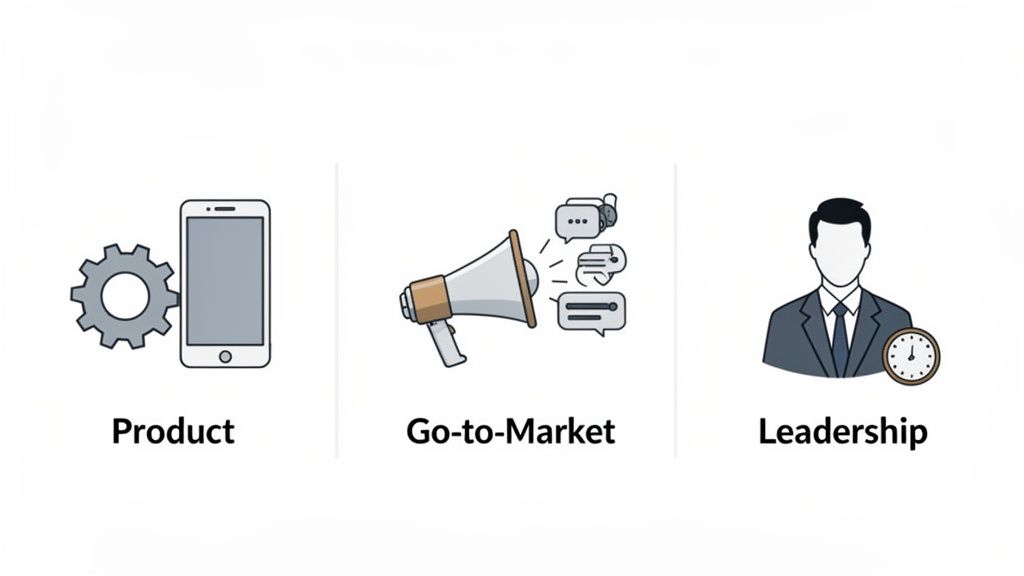
Let's break down how to drive real results in three critical areas.
Prioritize Your Product Development
Your segment profiles are a direct line into the minds of your most valuable customers. They tell you what problems keep them up at night and what features they’d happily pay for.
Instead of building features based on hunches, you can now prioritize based on what specific segments truly need. If your "Enterprise Erin" segment consistently asks for advanced security protocols, that feature should jump to the top of your list.
Sharpen Your Go-To-Market Strategy
A generic go-to-market strategy is a recipe for burning cash. With clearly defined segments, you can tailor every element of your marketing and sales efforts for maximum impact.
This is where you get tactical:
- Tailored Messaging: Craft value propositions that speak directly to the unique pain points of each segment. "Startup Steve" needs to hear about speed and affordability; "Enterprise Erin" needs to hear about scalability and compliance.
- Channel Selection: Go where your segments hang out. If data shows a group is highly active on LinkedIn, concentrate your ad spend there.
- Strategic Pricing: Develop pricing tiers that align with what each segment values and is willing to pay.
This is where micro-segmentation shines. While large enterprises historically dominated by investing heavily in analytics, SMBs are now surging by adopting cloud-based tools for cost-effective insights. You can learn more by exploring the full business information market research from Grandview Research.
Make Strategic Leadership Hires
This might be the most overlooked—and most powerful—application of segmentation. As you analyze your segments, you’ll often spot a high-potential group that your current team isn't equipped to capture. That insight is a massive red flag signaling a leadership gap.
Imagine your analysis uncovers a huge opportunity with mid-market manufacturing firms. The problem? Your entire sales team comes from a SaaS background. This isn't just a challenge; it's a clear mandate to bring in new expertise.
This is the perfect moment to consider fractional leadership. Instead of the high cost and risk of a full-time hire, you can bring in a part-time Head of Sales who has a proven track record in the manufacturing sector. This expert can build a targeted growth plan and establish a foothold in that lucrative new segment—all for a fraction of the cost. You can learn more about how this model works by checking out our guide on what is fractional marketing.
Measuring Success And Avoiding Common Pitfalls
An effective segmentation strategy isn't a "set it and forget it" project. It must be a living part of how you run your business. That means you need to measure its impact and adapt as you learn. Knowing what’s working is how you turn a good plan into a great one.
Key Metrics To Track
To see how well your segmentation is performing, you need to look at metrics that reveal the health and profitability of each customer group. Drill down into the performance of each segment.
- Customer Acquisition Cost (CAC) per Segment: How much does it cost to win a new customer from a specific group? A dramatically lower CAC signals your targeting is hitting the mark. Learn more in our complete guide to Customer Acquisition Cost calculation.
- Lifetime Value (LTV) per Segment: This tracks the total revenue you can expect from a customer in a particular segment. A high LTV means you've found a loyal, high-value group worth doubling down on.
- Conversion Rate per Segment: Keep a close eye on how effectively each segment moves through your sales funnel. Are certain groups converting at a much higher rate? That points to strong product-market fit.
Common Pitfalls And How To Avoid Them
Even the best segmentation strategies can get tripped up by a few common mistakes. Just being aware of these challenges is the first step to sidestepping them.
The goal of segmentation is clarity, not complexity. A strategy that is too complicated to implement is just as ineffective as having no strategy at all.
Here are three frequent mistakes and how to fix them:
Creating Too Many Segments: It’s tempting to slice your market into dozens of tiny micro-groups, but creating unique experiences for each one quickly becomes impossible.
- Solution: Start with 3-5 core segments. Master your approach to these groups before adding more.
Relying on Flawed or Outdated Data: Your segmentation model is only as good as the data it’s built on. Using old information or assumptions is a recipe for targeting the wrong people with the wrong message.
- Solution: Refresh your data regularly. Run annual customer surveys, watch your analytics, and gather constant feedback from your front-line teams.
Failing to Adapt: Markets change, customer needs evolve, and new competitors emerge. A strategy that was perfect last year might be obsolete today.
- Solution: Treat your segmentation model as a dynamic tool. Schedule a formal review at least once a year—or after any major market shift—to ensure it still reflects reality.
Steering clear of these pitfalls ensures your segmentation remains a powerful tool for growth. This process is often accelerated by seasoned leadership—like a fractional executive who knows which metrics matter most and how to act on them to drive results.
Common Questions About Market Segmentation
As founders start putting these ideas into practice, a few key questions always pop up. Let's get straight to the practical answers you need to move forward with confidence.
How Often Should We Update Market Segments?
Think of your market segments as a living part of your strategy. A good rule of thumb is to do a full review at least annually. You’ll also want to revisit them anytime there’s a major market shift, like a new competitor or a change in technology that alters customer behavior.
What Are Some Low-Cost Tools For Startups?
You do not need a pricey tech stack to get started. Begin with the data you already have.
- Google Analytics: A fantastic free resource for digging into geographic and behavioral data.
- Your CRM: Your customer relationship management system is a goldmine for firmographic details and purchase history.
- Simple Survey Tools: Platforms like SurveyMonkey or Typeform are brilliant for gathering psychographic insights. Just ask your audience directly!
Should We Target One Niche Or Several?
For most startups, the fastest path to traction is to master one niche segment first. Pouring your limited resources into dominating a specific corner of the market helps you build a strong brand reputation and nail product-market fit much faster. Once you have a solid foothold, you can strategically expand.
Trying to be everything to everyone is one of the most common early-stage mistakes. Winning a small, dedicated audience is far more valuable than being a forgotten player in a crowded field.
How Does Segmentation Influence Hiring Decisions?
Clear segmentation acts like a compass for your hiring strategy—it points directly to the expertise you need to win.
If your analysis reveals your most profitable segment is mid-market B2B SaaS companies, your hiring criteria become crystal clear. You know you need a leader with a proven track record of selling into that specific arena. This is the perfect time to bring in a fractional sales executive who has already perfected that go-to-market motion and can deliver results from day one.
Understanding your market segments is the first critical step. The next is ensuring you have the right leadership to capture that opportunity. If you've identified a key segment but lack the executive firepower to pursue it, we can help. Shiny connects you with a network of vetted, part-time executives who bring the precise expertise you need to scale. Schedule a consultation today to find the perfect fractional leader for your top segment.