What is Organizational Design? A Practical Guide to Building a High-Performing Company
If your company were a race car, your strategy would be the destination. Your organizational design would be the engine, chassis, and aerodynamics—everything engineered to work in sync to win the race. It’s the intentional framework that connects every moving part.
Without a deliberate design, even the most brilliant strategy can stall. You end up with operational drag, miscommunication, and internal silos that kill momentum.
So, What is Organizational Design Anyway?
Organizational design is the deliberate process of shaping how your company is structured and how it operates to achieve its goals. It’s the blueprint that dictates how information flows, who makes which decisions, and how work actually gets done.
It's much more than a simple org chart. Think of it as your company's central nervous system. A good design creates clarity, empowering people to succeed. A poor one leads to confusion, bottlenecks, and a whole lot of friction.
The Foundation of Effective Operations
At its heart, organizational design answers critical questions about how your business functions. It’s the framework that lets you execute your strategy and scale without everything falling apart.
To get there, you must be intentional about the core components of your business. Here’s a look at the fundamental building blocks.
Core Components of Organizational Design
| Component | Its Purpose in the Business |
|---|---|
| Structure | Defines how teams are grouped—by function (marketing, sales), product, or geography. |
| Roles & Responsibilities | Clarifies who is accountable for what, preventing overlap and ensuring nothing falls through the cracks. |
| Processes & Workflows | Maps out how work moves through the organization to deliver value to customers. |
| Decision-Making | Determines where authority lies—is it centralized at the top or distributed among empowered teams? |
| Information Flow | Governs how communication and data are shared across the company to keep everyone aligned. |
Each of these pieces must work together. If your structure encourages collaboration but your information flow is siloed, you’ll constantly fight against your own design.
The idea of structuring work isn't new. Early concepts like scientific management were about finding the "one best way" to perform a task. While we've moved past that rigid thinking, the core goal of aligning work with outcomes remains. You can get a great snapshot of the evolution of organization theory to see how far we've come.
Beyond the Org Chart
One of the biggest mistakes founders make is treating organizational design as a one-time exercise focused only on drawing a hierarchy. But it’s not static. It’s a dynamic process that has to evolve as your company grows and the market shifts.
A well-designed organization doesn't just look good on paper; it feels right in practice. It reduces friction and empowers employees, making it easier for everyone to do their best work.
Neglect it, and you’ll run into predictable growing pains—stalled projects, employee burnout, and an inability to innovate. This is precisely where fractional leadership provides a solution. An experienced executive can step in to architect a structure built for where you’re going, not just where you are today.
Why Organizational Design is a Strategic Advantage
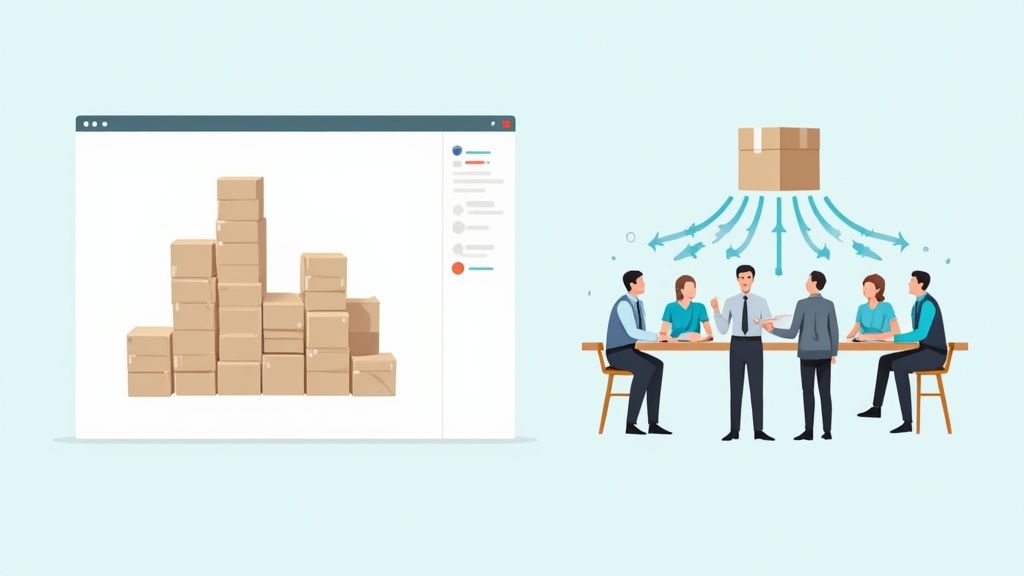
Too many leaders view organizational design as a chore—something you only deal with when the org chart becomes a mess. But that misses the point. A well-thought-out structure isn't just about reporting lines; it's a powerful tool that directly fuels your growth and profitability.
Imagine two companies aiming for the same goal. One is plagued by overlapping roles, siloed departments, and unclear decision-making. The other has crystal-clear accountability, seamless communication, and empowered teams that move fast.
Which one wins?
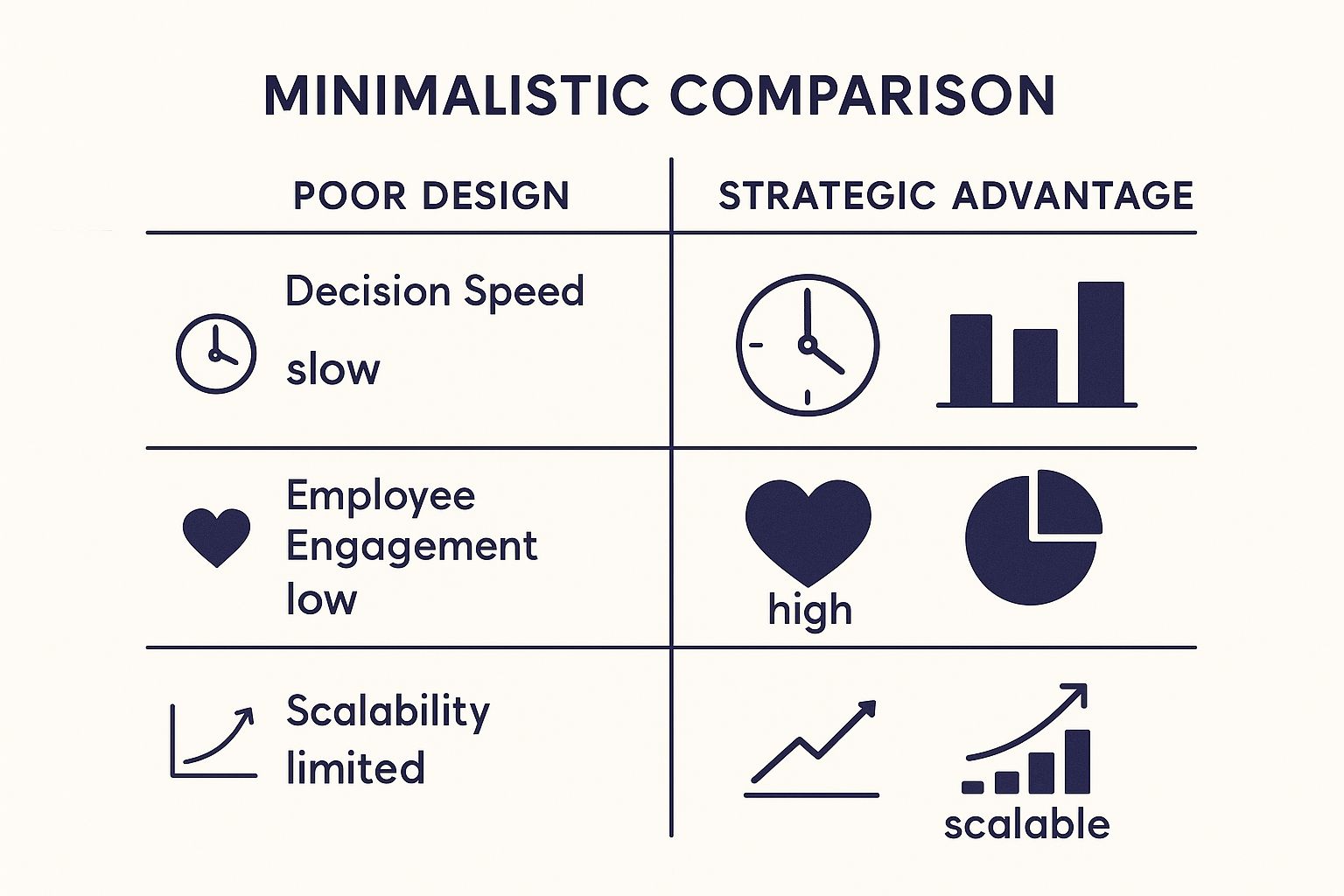
Bad design creates internal friction. It’s an anchor dragging behind your company, slowing everything down. It shows up as bottlenecks, high employee turnover, and strategic plans that never get off the ground.
From Operational Drag to Competitive Edge
Intentional organizational design turns your company’s structure into a genuine competitive advantage. It’s the mechanism that translates high-level strategy into a day-to-day operational reality where everyone pulls in the same direction.
The benefits are tangible and hit your bottom line:
- Faster Decision-Making: When roles are clear, teams can make confident calls without getting stuck in endless meetings. This accelerates your speed to market.
- Increased Agility: A flexible structure allows your business to pivot quickly when the market shifts, instead of being trapped in a rigid hierarchy.
- Higher Employee Engagement: Clarity crushes frustration. When people understand their role and see how their work contributes, their engagement and productivity skyrocket.
- Improved Scalability: A solid design creates a stable foundation for growth. It lets you add people and teams without creating chaos.
This isn’t just about putting out fires. It’s about proactively building a more resilient, high-performing company from the inside out.
Unlock Your Company's True Potential
Ultimately, the goal of organizational design is to create an environment where your strategy can come to life. It’s about ensuring your people, processes, and structure are perfectly aligned to hit your most ambitious goals.
Your organizational design isn't a support function; it's the engine of execution. It determines whether your strategy remains a document on a shelf or becomes a reality.
For growing businesses, navigating a redesign can feel overwhelming. This is where the value of fractional leadership shines. A fractional executive provides the experienced, objective guidance needed to architect a structure that fixes today’s pain points and prepares you for tomorrow’s opportunities.
Finding the Right Organizational Design Model
Picking an organizational design model isn't about chasing trends. It’s about finding the blueprint that supports your strategy. There’s no one-size-fits-all solution.
What works for a huge manufacturing company would crush a fast-moving tech startup. The key is to match your structure to your specific goals, culture, and operational realities.
For example, a Functional Structure is like a well-organized library. You have specialized departments—history, science, fiction—where experts stick together. This model is great for building deep expertise but often creates silos that slow down cross-departmental projects.
A Matrix Structure, on the other hand, is more like a film crew. A director (project manager) pulls specialists—a cinematographer, sound engineer, editor—from their departments to collaborate on a single film (project). It’s flexible for complex projects but can be confusing when employees report to both a department head and a project manager.
Comparing Key Organizational Design Models
To help you visualize the options, let's break down the most common models. Each has its own sweet spot, pros, and cons.
| Model Type | Best For | Advantages | Disadvantages |
|---|---|---|---|
| Functional | Stable companies focused on efficiency and deep specialization. | Builds deep expertise; clear career paths; efficient operations. | Creates departmental silos; slow cross-functional communication. |
| Divisional | Large companies with diverse product lines or geographic markets. | High accountability; focus on specific markets; faster responses. | Can create resource duplication; potential for internal competition. |
| Matrix | Complex, project-based environments needing cross-functional work. | Flexible resource allocation; better for complex decision-making. | Can cause confusion with dual reporting; potential for conflict. |
| Flat | Startups and small companies that prioritize speed and collaboration. | Fast communication; high employee autonomy; quick decisions. | Can become chaotic as the company scales; unclear career paths. |
| Agile Teams | Dynamic environments where rapid iteration and customer feedback are key. | Highly adaptive; customer-focused; empowers employees. | Requires significant cultural shift; can be difficult to scale. |
Ultimately, the best model depends on your context—where you are today and where you're trying to go.
A Framework for Holistic Design
Powerful frameworks can help you think beyond just the org chart. One of the most influential is Jay Galbraith’s STAR Model, which argues that an organization's key elements must be in sync.
The STAR Model connects strategy, structure, processes, rewards, and people. It shows that if you change one element—like your structure—without considering the others, you'll create misalignment and friction.
This isn't just a "nice-to-have." Studies show that companies where design and strategy are tightly linked can outperform their peers. It's a powerful reminder to treat organizational design as a core business strategy, not an afterthought. You can learn more about the history of these influential frameworks and their impact.
Navigating these models to find the perfect fit can be tough. An experienced fractional leader brings a valuable outside perspective, helping you spot misalignments and design a structure that truly powers your growth.
A Practical Guide to Putting Your Design into Action
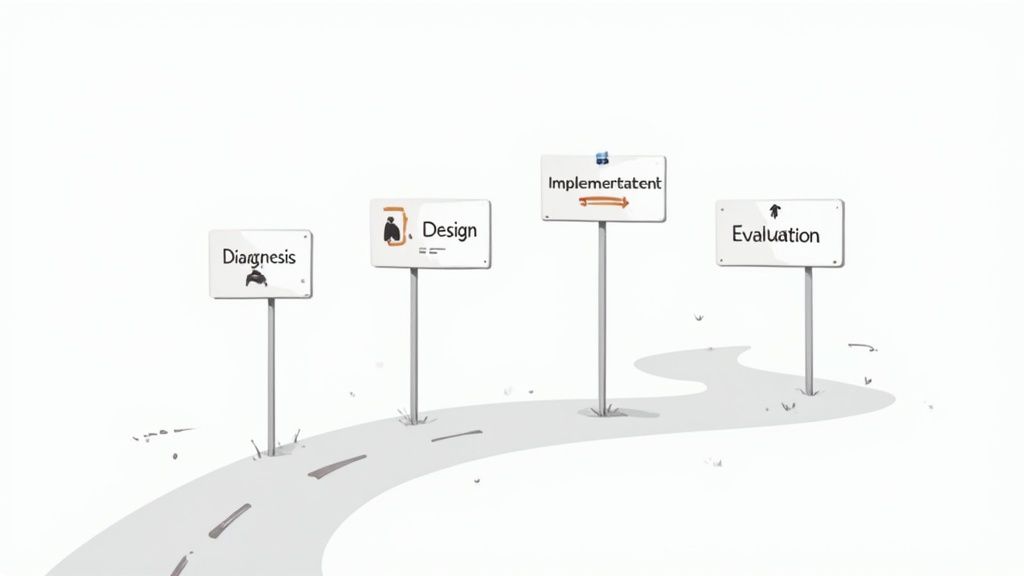
Choosing a model is just the beginning. The real test is bringing that new organizational design to life—a process that demands thoughtful planning, clear communication, and a grasp of the human side of change.
Leading a redesign isn't a single project to check off a list. It’s a journey. Rushing it or skipping steps is a recipe for disaster, leading to confusion, resistance, and a new structure that doesn't work.
Diagnosis: Know Where You're Starting
Before you can draw a new blueprint, you have to understand the current one. The diagnosis phase is about holding your existing organization up against your strategic goals to figure out what’s working, what isn’t, and why.
This is where you hunt down the real pain points. Are decisions bottlenecked? Are teams working in silos? Is it unclear who’s responsible for what? To get honest answers, you need to talk to the people on the ground through interviews, surveys, and workshops.
A classic mistake is designing the new structure in a vacuum. If you don't get input from the people doing the work, you risk creating a model that looks perfect in a slide deck but is impossible to implement.
Design and Implementation: The Blueprint and The Build
Once you have a clear picture of the problems, you can start sketching the new design. Map out new reporting lines, clarify roles, and rethink how work gets done, always keeping your strategic goals as your North Star.
With the blueprint ready, it's time to build. This stage is less about org charts and more about people. Success hinges on a rock-solid communication plan that explains the “why” behind the changes, not just the “what.”
The transition requires careful handling. You'll need to address concerns head-on and provide the right training and support. For a deeper dive, our guide on change management best practices offers practical strategies for a smoother rollout.
Here’s a simplified roadmap:
- Secure Executive Alignment: The leadership team must be unified in their vision and commitment.
- Engage Key Stakeholders: Get managers and influential team members involved early. Their feedback is crucial.
- Communicate Transparently: Craft a clear story about why the change is happening and what the future looks like.
- Roll Out in Phases: A gradual rollout can minimize disruption and allow for adjustments.
- Provide Robust Support: Offer training, share resources, and create clear channels for feedback.
Evaluation: The Feedback Loop
The work isn't over once the new structure is in place. The evaluation phase is a continuous feedback loop to measure success and make improvements. Are you seeing the boost in decision speed you hoped for? Use clear metrics to track progress and don't be afraid to tweak things. An organizational design is a living system.
This entire process benefits from an objective, experienced perspective. A seasoned fractional leader can act as a neutral guide, navigating internal politics and ensuring your new design drives the results you need.
Future-Proofing Your Organizational Structure
The world of work looks nothing like it did five years ago. Trends like remote teams, AI integration, and the rise of specialized contractors are rewriting the rules.
In this environment, a rigid, traditional hierarchy is a liability. Organizational design is no longer a one-time project; it's an ongoing, strategic capability. The most competitive companies treat their structure like a living system, making continuous tweaks to stay ahead.
Embracing Continuous Adaptation
The most resilient organizations are built for change. Instead of seeing a re-org as a massive, disruptive event, they make small, continuous adjustments to stay aligned with their strategy.
We're seeing a few key shifts in future-ready organizations:
- From Hierarchy to Networks: Top-down control is giving way to networks of empowered, cross-functional teams.
- From Fixed Roles to Dynamic Skills: The focus is shifting from rigid job titles to the specific skills needed to solve a problem.
- From Silos to Systems: The priority is designing for seamless information flow and collaboration across the entire business.
The goal isn’t to build a perfect, permanent structure anymore. It’s to build a resilient organization with the capacity to adapt to whatever comes next.
Getting your company ready for these shifts requires strategic foresight. For leaders planning ahead, our guide on leadership succession planning offers powerful insights.
Navigating this new landscape is a huge challenge. An experienced fractional executive can provide the strategic guidance needed to build an organization that’s not just ready for today, but designed for tomorrow.
Common Questions About Organizational Design
As you consider what organizational design means for your company, a few questions usually pop up. Let's tackle them head-on.
Design vs. Development: What’s the Difference?
It’s easy to mix these two up, but they handle different parts of your business.
- Organizational Design is the blueprint for your company. It’s the architecture: the structure, roles, and systems that define how work gets done. It’s the "hardware" of your business.
- Organizational Development is about improving the people and processes within that blueprint. It’s the "software"—your culture, team dynamics, communication, and leadership skills. You need both to succeed.
When Should a Startup Begin This Process?
The principles of good design matter from day one. The first real time to get serious about a formal structure is when a startup hits 15-25 employees.
At this stage, informal, "everyone-talks-to-everyone" communication starts to break down. Roles get fuzzy and decisions slow down. Proactively addressing your structure here stops these growing pains from becoming serious roadblocks.
How Often Should We Review Our Design?
Resist the urge to constantly tinker with your structure, as it creates instability. A comprehensive review every 2-3 years is a good rule of thumb.
Of course, a major strategic pivot, a big shift in the market, or a merger should also trigger an immediate redesign. The goal is to create strategic alignment and stability, not an endless cycle of reorganization.
Building a high-performing organization is a complex journey, but you don't have to navigate it alone. At Shiny, we connect you with vetted fractional executives who bring the strategic expertise needed to design a resilient, high-growth company.
If you’re ready to align your structure with your ambition, explore our network to find the right leadership to accelerate your success. Learn more at https://useshiny.com or schedule a consultation to discuss your specific needs.