What Is Top Line Revenue and Why It Drives Growth
When you hear someone talk about top line revenue, they're talking about the total, unfiltered amount of money a business brings in from its sales. It’s every single dollar that flows into the company from customers buying products or services, before a single penny is taken out for expenses.
Imagine your business is a lemonade stand. Top line revenue is the total cash in your jar at the end of the day from selling lemonade. It doesn't factor in what you spent on lemons, sugar, or cups. It's the purest measure of sales performance and market demand.
Understanding Top Line Revenue in Simple Terms
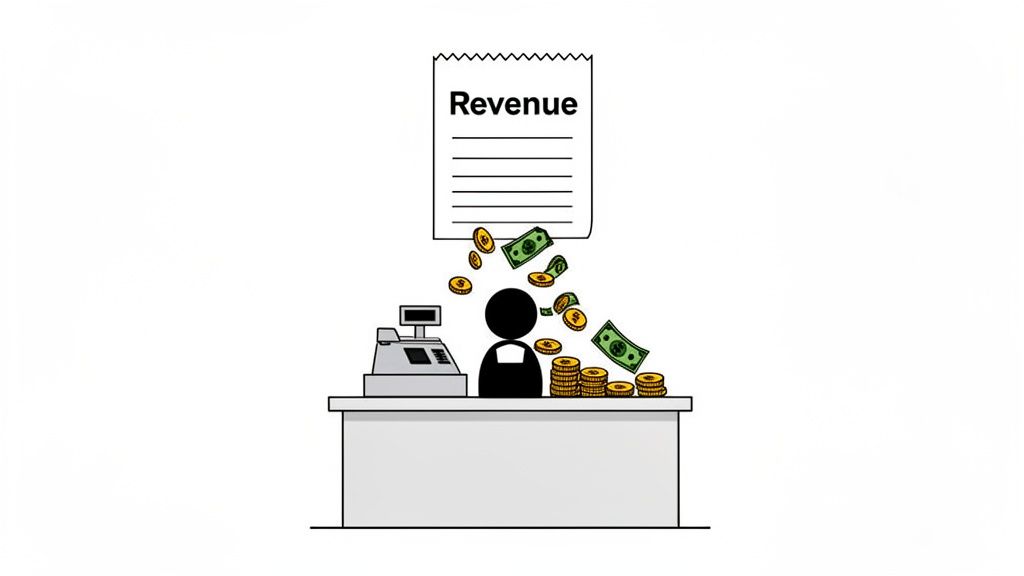
You'll also hear top line revenue called gross sales or just sales. The name "top line" comes from its position on a company's income statement—it's literally the first number you see right at the very top. This figure is all about the raw power of your company's ability to sell.
The math behind it is refreshingly simple.
Top Line Revenue = Sales Price × Number of Units Sold
Let's say a startup sells 50 subscriptions to its software at $100 a pop. Their top line revenue is a clean $5,000. That number tells you nothing about the cost of marketing or paying their developers, but it tells you everything about their market's appetite for what they're building.
What Top Line Revenue Reveals
For any founder or investor, this metric is the starting point for understanding a company's health. A climbing top line is a strong signal that your product is hitting the mark and your sales efforts are paying off. It's a foundational metric you have to track when you measure business growth.
Here's a quick summary of what top line revenue is all about.
Top Line Revenue at a Glance
| Aspect | Description |
|---|---|
| Definition | The total revenue generated from sales before any expenses are deducted. |
| Also Known As | Gross sales, sales revenue. |
| Formula | Sales Price × Number of Units Sold |
| Location | The very first line item on an income statement. |
| What It Shows | Market demand, sales effectiveness, and the overall scale of the business. |
| Key Takeaway | It’s a pure measure of a company's ability to generate sales. |
Ultimately, a strong top line is the first sign of a healthy, growing business with a product that people actually want.
- Market Demand: It's a direct reflection of what customers are willing to spend on your solution.
- Sales Effectiveness: It shows you how well your sales and marketing machine is working.
- Company Scale: A bigger top line usually points to a company with a larger footprint and more market presence.
- Growth Potential: For startups, this number is often the most important indicator of scalability and future success.
Why Investors Focus on Top Line Growth
When an investor looks at a business, particularly a startup, their eyes almost always jump to one number first: top-line revenue. While profit is the ultimate goal, consistent, early-stage growth tells a much more exciting story about a company’s future.
Think of it as a powerful sign of market validation. A rapidly growing top line proves you’ve found a real problem people care about and, more importantly, are willing to pay you to solve it. It’s the clearest signal of strong product-market fit and shows your business model can actually scale. This is why everyone from VCs to private equity firms treats it as the primary yardstick for traction.
The Link Between Growth and Valuation
Strong revenue growth doesn't just look good; it directly pumps up your company's valuation. In fact, top-line revenue is the single most-cited indicator of a company’s market traction and scale, which in turn drives valuation multiples.
For example, public SaaS companies in 2024–2025 reporting year-over-year growth of 50% or more consistently earned much higher revenue multiples than their peers growing at a slower 10%–20% pace. You can dig into more insights on how growth rates impact valuations at Boston Brand Media.
For founders, this is everything during fundraising. A killer growth story, backed by solid numbers, translates directly into better terms and a higher valuation.
Strong, predictable revenue growth is the clearest evidence that a company has a scalable engine. It shifts the conversation from "if" the business can grow to "how fast" it can grow.
This obsession with growth is especially true for companies that aren't profitable yet. Investors are more than willing to overlook early losses if the top line is skyrocketing, because it strongly suggests profitability is just a matter of time and market share.
At the end of the day, a healthy top line is the foundation. It’s what you build future profitability and long-term success on.
Top Line vs. Bottom Line: What Founders Really Need to Know
A soaring top line is exciting—it signals strong market demand and that you're making sales. But that's only half the story. To get a real grip on your company's financial health, you have to look at the bottom line, which is the profit you actually get to keep.
It’s the classic difference between what you make and what you spend.
Think of your top line revenue as the total amount of rainfall your company collects in a giant barrel. It's everything you've captured from sales, full stop. But before you can use that water, some of it inevitably leaks out through various holes—those are your expenses.
The water left in the barrel at the very end? That’s your bottom line, or net profit. It's what remains after every single cost has been subtracted from your initial revenue haul.
From Gross Sales to Net Profit
The journey from the top of your income statement to the bottom involves a few key deductions. For any founder aiming for sustainable success, understanding this flow is crucial because it shows you exactly where your money is going.
Here are the key things subtracted along the way:
- Cost of Goods Sold (COGS): These are the direct costs tied to creating your product or delivering your service. Think raw materials or direct labor.
- Operating Expenses (OpEx): This covers everything else you need to run the business—salaries, rent, marketing spend, you name it.
- Interest and Taxes: Finally, you have to pay any lenders and, of course, the government.
This process highlights how an investor’s focus might shift depending on a company's maturity. Early on, they want to see that top line climb, but as you grow, they'll want to see you manage these costs effectively to improve the bottom line.
A strong top line is what gets you in the door with investors. It demonstrates you have a product people want, which builds market traction and ultimately justifies a higher valuation.
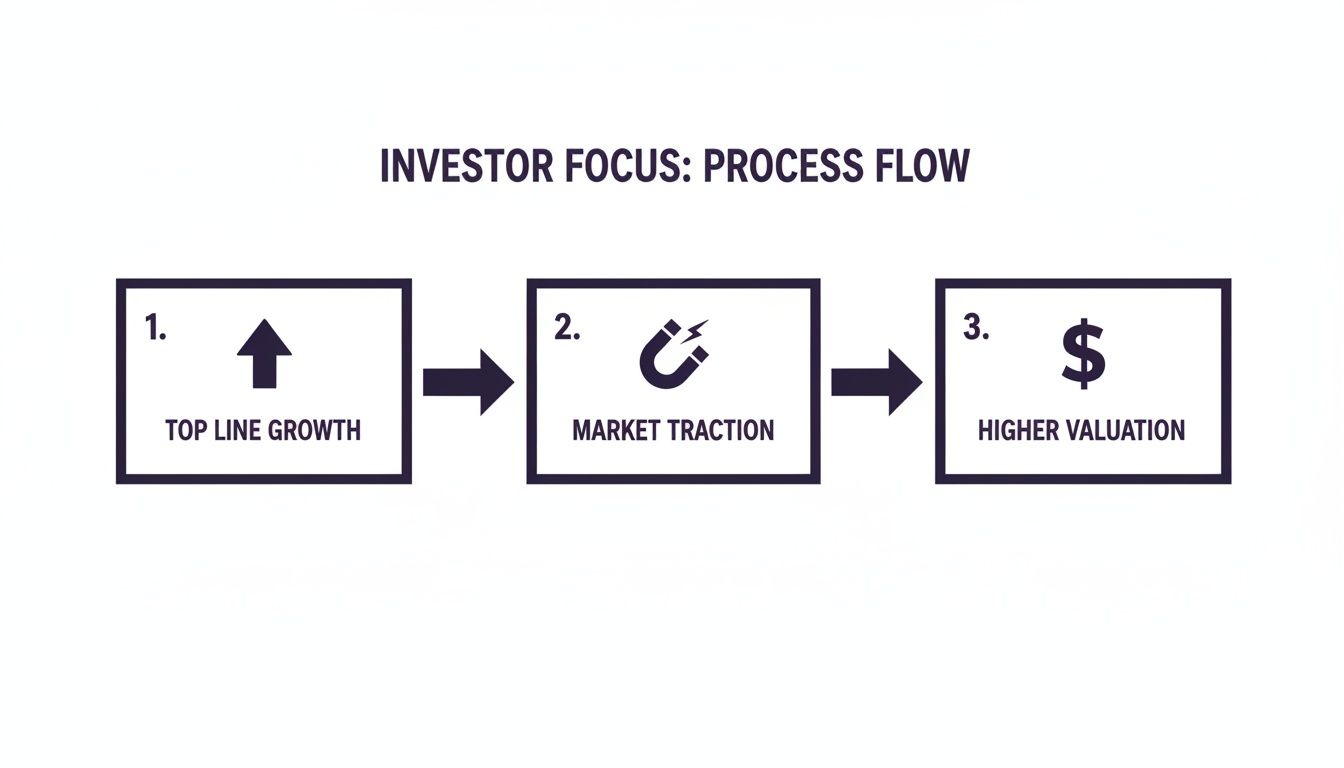
As this shows, proving that initial top line growth is absolutely essential for early-stage companies. It's your ticket to proving market acceptance and unlocking those critical investment opportunities.
To make this crystal clear, let's break down the key differences in a simple table.
Top Line Revenue vs Bottom Line Profit
| Metric | Top Line Revenue | Bottom Line (Net Income) |
|---|---|---|
| What It Shows | The total sales generated before any expenses are deducted. | The final profit remaining after all expenses are subtracted. |
| Location | The very first line of the income statement. | The final, or "bottom," line of the income statement. |
| Purpose | Measures sales performance and market demand. | Measures overall profitability and operational efficiency. |
| Calculation | (Price of Product) x (Number of Units Sold) | Top Line Revenue – All Expenses (COGS, OpEx, Interest, Taxes) |
| What It Tells You | "How much money did we bring in?" | "How much money did we actually keep?" |
Ultimately, both metrics are vital. Your top line shows your potential for growth, while your bottom line shows your ability to turn that growth into real, sustainable profit. A healthy business needs both.
Building a Healthier Top Line with Recurring Revenue
Not all revenue is created equal, especially in the eyes of an investor. While a big top line number always looks good, one built on recurring revenue is the undisputed gold standard. This is the predictable income you get from subscriptions or long-term contracts, and it's infinitely more valuable than one-off sales.
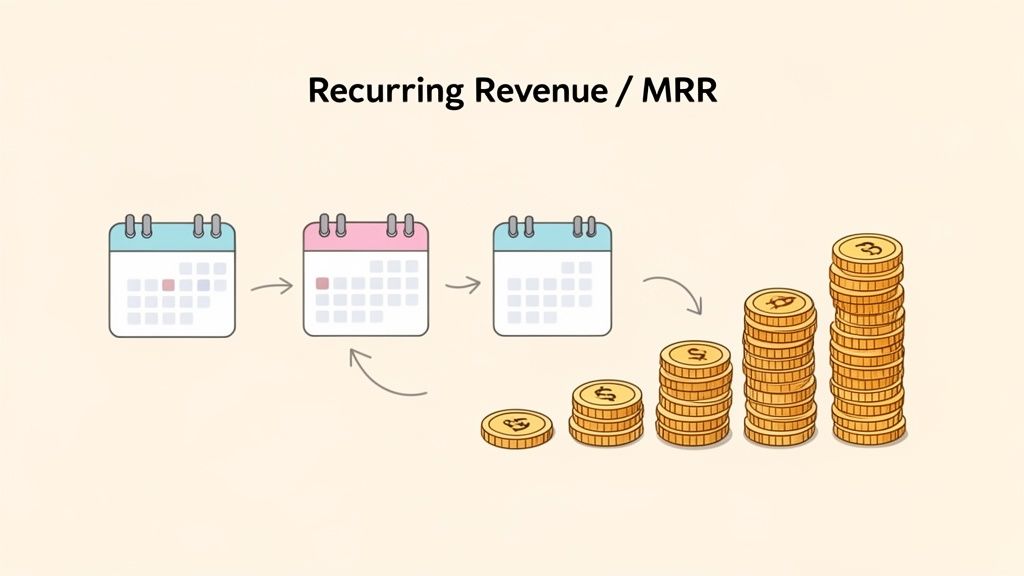
Here’s a simple way to think about it: a one-time sale is like catching a fish to eat for a day. It solves an immediate need. But recurring revenue? That’s like building a fish farm that produces a steady, predictable supply of fish, month after month. That kind of stability is a complete game-changer.
Why Predictability Commands a Premium
Predictable income streams, often tracked as Monthly Recurring Revenue (MRR) or Annual Recurring Revenue (ARR), create a rock-solid foundation for growth. They make your financial forecasting sharper and your business planning far more accurate. For an investor, that reliability dramatically lowers the risk profile of your company.
The market data backs this up. Companies with over 70% recurring revenue often trade at a 20%–60% premium on their valuation multiples compared to businesses stuck on the non-recurring sales treadmill.
A strong base of recurring revenue transforms your top line from a simple sales figure into a predictable, scalable asset. It's one of the most critical key performance indicators for startups you can possibly track.
By focusing on customer retention and long-term value, you create a compounding effect. Each retained customer adds to a growing, predictable revenue base, making your business fundamentally more stable and valuable.
Shifting your focus from just acquiring new customers to retaining the ones you have brings some powerful benefits:
- Creates Stability: It smooths out the scary peaks and valleys you see with seasonal or project-based sales.
- Improves Forecasting: You can predict future cash flow and revenue with much greater confidence.
- Boosts Valuation: It commands significantly higher multiples from investors and potential buyers.
- Drives Scalable Growth: You're building a compounding revenue engine that gets more powerful over time.
For any founder, building a strong recurring revenue model is one of the most effective ways to create a resilient and highly valuable company.
How to Efficiently Accelerate Top Line Growth
So you understand top line revenue and why it matters. But actually growing it? That’s a whole different ball game. Many founders face the challenge of needing C-suite expertise to drive growth but lacking the resources for a full-time executive salary.
The knee-jerk reaction for most founders is to just spend more. Crank up the marketing budget, hire more salespeople, and hope for the best. But throwing money at the problem without a solid strategy is a fast way to burn through your cash, wreck your bottom line, and shorten your runway.
Efficient growth isn’t about brute force; it’s about smart, strategic leadership. An experienced executive knows which levers to pull to drive revenue without just setting a pile of cash on fire. They look at the entire revenue engine, not just one piece of it.
It’s About More Than Just Spending More
Real revenue growth comes from a deep, sophisticated understanding of your business and your market. It means asking tougher questions and finding smarter answers.
- Optimizing Your Pricing: Are you leaving money on the table? A seasoned leader will dig into customer value, what your competitors are doing, and where the market is headed to find that pricing sweet spot.
- Refining Your Sales Process: Is your sales cycle clunky and inefficient? An expert can spot the bottlenecks, clean up your lead qualification, and put systems in place that help your team close more deals, faster.
- Unlocking New Markets: Are there untapped customer segments or new regions you could be going after? Expanding strategically takes careful research and flawless execution—precisely where executive experience pays for itself.
Sustained top line growth is the product of smart decisions, not just a bigger budget. It requires a leader who sees the whole chessboard and makes calculated moves to improve sales effectiveness and penetrate the market.
This is the kind of strategic oversight that’s often missing in growing companies, mainly because hiring a full-time, C-suite executive is just too expensive.
The Fractional Leadership Advantage
For a lot of businesses, simply growing the top line doesn’t mean you’re profitable. In fact, it’s common for companies to reinvest 20%–40% of their revenue straight back into sales and marketing just to keep the growth engine running.
And for businesses in the $1M–$50M range, adding a full-time senior executive can jack up fixed costs by an estimated 30%–60% compared to a fractional hire, according to recent startup economics reports from Mercury.
This is where fractional leadership becomes a game-changer. By bringing on a part-time Chief Revenue Officer or VP of Sales, you get C-suite-level strategy and execution without the full-time salary. It’s the perfect model to drive top line growth with an expert at the helm, all while protecting your bottom line. You get the leadership you need to scale intelligently, right when you need it.
Find the Right Leadership to Drive Your Top Line
Knowing what top line revenue is and actually growing it are two completely different things. As a founder, you just can't be an expert in everything. Your time is far better spent on the big picture—vision, product, and strategy—not getting bogged down in the nitty-gritty of sales funnels or go-to-market plans.
This is where bringing in the right leadership becomes your biggest lever for growth. But let's be real: the long, expensive, and risky process of hiring a full-time executive is often out of reach for a startup.
Access C-Suite Talent on Your Terms
Instead of that high-stakes hunt for a full-time hire, you can tap into a marketplace of vetted, experienced executives who are ready to jump in and make an impact from day one.
Imagine bringing on a seasoned leader who has already scaled companies just like yours. They've been there, done that. They can immediately start refining your sales process, building a marketing engine that actually works, and implementing retention strategies to create a much healthier top line.
This fractional leadership model gives you the strategic firepower you need without the massive financial commitment of a full-time salary. You get precisely the right expertise to solve your specific revenue challenges, right when you need it.
For example, if you're looking for someone to own the entire revenue engine, a fractional hire can step in immediately. Our guide on crafting a Chief Revenue Officer job description breaks down the high-impact skills these kinds of leaders bring to the table.
Connecting with the right executive gives you the strategic advantage needed to hit your growth targets and build a more valuable company. Explore our network of fractional leaders to find the perfect partner to accelerate your journey.
Got Questions About Top Line Revenue? We've Got Answers.
We’ve walked through the fundamentals, but let's be honest—a few questions always pop up when founders start digging into their own numbers. Here are some quick answers to the most common ones we hear.
Can a Company Have High Top Line Revenue But Be Unprofitable?
Absolutely. This is a classic high-growth startup scenario.
You see it all the time with companies pouring money into marketing, R&D, and snapping up top talent. Their sales (the top line) are skyrocketing, but their expenses are even higher, leading to a net loss on the bottom line. Investors are often perfectly fine with this, as long as that top-line growth signals strong market demand and a clear path to future profitability.
What Is the Difference Between Revenue and Gross Profit?
Think of it like this: top line revenue is every single dollar your customers paid you. It's the grand total before any costs are taken out.
Gross profit, on the other hand, is what's left after you subtract the Cost of Goods Sold (COGS)—the direct costs tied to creating your product or delivering your service. It's the first major checkpoint on your income statement as you work your way down from the top line to the bottom line.
How Often Should I Track My Top Line?
For most businesses, the right cadence is monthly, quarterly, and annually.
Monthly tracking gives you a real-time pulse on your sales performance and helps you react quickly. Quarterly and annual views are crucial for spotting bigger trends, measuring against your goals, and making smart strategic decisions for the long haul.
Driving your top line requires more than just knowledge—it demands expert leadership. Shiny connects you with a marketplace of vetted fractional executives who can build and execute a winning revenue strategy, helping you scale efficiently. Schedule a consultation to find the right leader for your team.