What Is Working Capital Management Your Guide to Startup Cash Flow
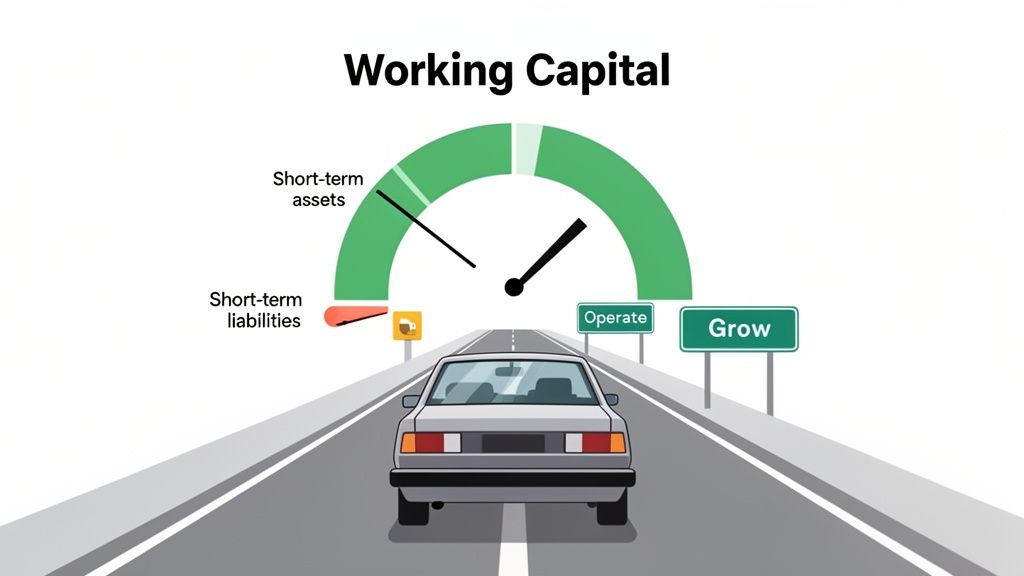
If your business were a car, your long-term assets—like machinery and property—would be the engine. Your profits? That's the destination.
But working capital is the fuel in the tank. It's the essential resource that keeps you moving every single day. Without enough fuel, even the most powerful engine won’t get you very far.
This is exactly what working capital management is all about: making sure you always have enough fuel to operate, accelerate when you need to, and navigate any unexpected detours along the way.
The Lifeblood of Your Operations
Working capital is far more than just some dry accounting term; it’s the financial lifeblood of your company. It represents the simple difference between your short-term assets (what you own that will turn into cash within a year) and your short-term liabilities (what you owe within a year).
Getting this balance right is non-negotiable for survival and growth. When it's managed poorly, even a profitable company on paper can find itself in a sudden "cash crunch," unable to pay its bills or make payroll.
The Core Components of Working Capital
To really get a grip on working capital management, you need to understand its moving parts. These are the levers you can actually pull to improve your company's financial health day-to-day. A great starting point is learning how to manage cash flow, since cash sits at the heart of this entire process.
Let's break down the two main pillars—Current Assets and Current Liabilities—into their essential components. Think of these as the dials and gauges you'll be watching on your financial dashboard.
Core Components of Working Capital at a Glance
| Category | Component | Description & Business Impact |
|---|---|---|
| Current Assets | Cash & Equivalents | The most liquid asset, used for immediate expenses like payroll and rent. Low cash levels can halt operations. |
| Current Assets | Accounts Receivable | Money owed to you by customers. Collecting this faster directly improves your cash position. |
| Current Assets | Inventory | Raw materials and finished goods. While an asset, too much unsold inventory ties up cash that could be used elsewhere. |
| Current Liabilities | Accounts Payable | Money you owe to suppliers and vendors. Extending payment terms can temporarily preserve your cash. |
| Current Liabilities | Short-Term Debt | Any loans or obligations due within one year. Managing these payments is crucial for maintaining good credit and liquidity. |
Each of these elements plays a crucial role. Cash is what you use to pay the bills today. Accounts receivable is the cash you're waiting on from customers. Inventory is cash tied up in products on your shelves. On the other side, accounts payable is money you owe, and paying it slower keeps cash in your bank account a little longer. Mastering the interplay between them is the core of effective working capital strategy.
Why Working Capital Is Your Business’s Secret Weapon
Understanding working capital is one thing, but actually mastering it is what separates the businesses that just survive from the ones that truly thrive. This isn’t some boring financial chore to hand off to the accountants; it’s a powerful strategic advantage that directly fuels your ability to operate, grow, and build a resilient company.
Think of it this way: proactive management is the difference between being able to jump on a golden opportunity and being forced to watch it pass you by.
Consider a fast-growing startup crushing its sales goals. From the outside, they look unstoppable. Internally, though, they're in a panic, scrambling to make payroll because their clients are slow to pay. This is a classic, and painfully common, case of poor working capital management—where amazing success on paper doesn't translate to cash in the bank.
From Defense to Offense
When you get working capital right, you flip your entire financial operation from a defensive game of "just staying afloat" into an offensive tool for growth. Once your cash flow is dialed in, you unlock the freedom to make strategic moves that give you a serious competitive edge.
This newfound agility means your business can:
- Negotiate better terms: With cash ready to go, you can snag bulk discounts from suppliers, instantly lowering your cost of goods sold and boosting your margins.
- Invest in key talent: You can confidently hire that A-player you desperately need to scale a department, without worrying if you’ll have the cash for their salary in three months.
- Weather market surprises: An unexpected supply chain mess or a sudden dip in sales won't trigger a full-blown crisis because you have the liquidity to adapt and pivot.
For founders, this is about more than just paying bills. It's about gaining financial independence and cutting down the need for dilutive funding rounds just to cover operational shortfalls.
The Growing Importance of Smart Capital Management
The business world is finally catching on. No longer a dusty, back-office task, working capital management has moved to the forefront for companies trying to build shock-proof operations. You can even see its importance in market trends; the global working capital management market was valued at USD 3.28 billion in 2023 and is expected to rocket to USD 9.15 billion by 2032. You can dig into the numbers in this detailed market analysis.
Ultimately, mastering your working capital gives you one thing: control. It lets you fund your own growth, respond to challenges with confidence, and build a business that lasts. This isn't just about financial health; it’s about strategic freedom. When you're not constantly chasing cash, you can finally focus on what really matters: building your vision.
Decoding Your Key Working Capital Metrics
If you want to manage your working capital, you have to measure it first. Think of key performance indicators (KPIs) as the financial dashboard for your business—they turn a mess of data into simple, actionable numbers that tell you exactly where your cash is and how fast it’s moving. Flying blind is not a strategy.
These metrics aren't just for your accountant. They're vital for any founder who wants to make smart, data-driven decisions. By getting a handle on a few core formulas, you can diagnose the health of your cash flow and see exactly where you need to focus.
The Three Pillars of Cash Flow Speed
Three core metrics work together to show how quickly cash is cycling through your operations. Each one gives you a clear view into a critical piece of your working capital puzzle.
- Days Sales Outstanding (DSO): This tells you, on average, how many days it takes for customers to pay you after you make a sale. A high DSO means your cash is stuck in unpaid invoices. A low DSO means you're collecting that revenue fast.
- Days Inventory Outstanding (DIO): This measures how long your inventory sits on the shelf before it's sold. A high DIO is a big red flag that your cash is tied up in products that aren't moving, signaling potential overstocking or weak sales.
- Days Payable Outstanding (DPO): This reveals how long you take to pay your own suppliers. A higher DPO means you’re using your suppliers' credit to your advantage, keeping cash in your business for longer.
When you put these three together, you get a real-time snapshot of your company's operational efficiency. A rising DSO, for example, is a direct warning that your cash is getting tight, even if your sales numbers look fantastic on paper.
Tying It All Together With the Cash Conversion Cycle
The real magic happens when you combine these metrics into the Cash Conversion Cycle (CCC). The CCC is easily one of the most important indicators of how well you're managing working capital.
Think of it like this: the CCC measures the time it takes for a dollar you spend on inventory to make its full journey through the business and land back in your bank account as cash from a customer. The formula is refreshingly simple:
CCC = DIO + DSO – DPO
A shorter CCC is almost always the goal. It means your company is a lean, efficient cash-generating machine, turning its investments back into available cash quickly. A longer CCC, on the other hand, signals that your cash is locked up for way too long, which can starve your business of the liquidity it needs to survive, let alone grow.
This infographic shows how getting a grip on these financial levers is what allows a business to move from just surviving to truly operating and, eventually, growing.
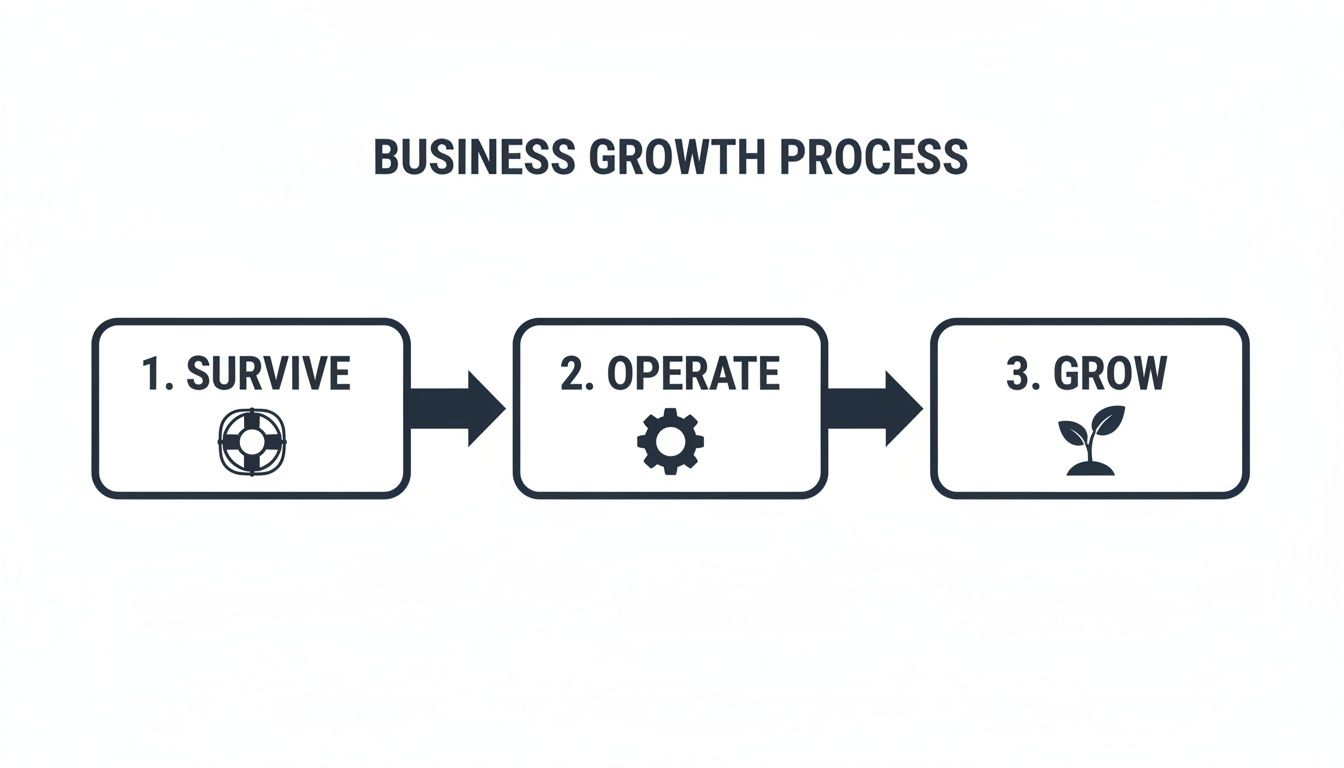
Mastering these operational metrics is the bridge between just staying afloat and actually scaling with confidence. When you actively monitor and improve these KPIs, you build the financial stability you need to make your next big move.
Actionable Strategies to Optimize Working Capital
Knowing your key metrics is just the first step. The real magic happens when you start pulling the right levers to improve them.
Effective working capital management isn't about one big, dramatic move. It’s about making small, consistent adjustments across your operations that unlock serious cash flow over time. Think of this as your playbook for turning theory into action.
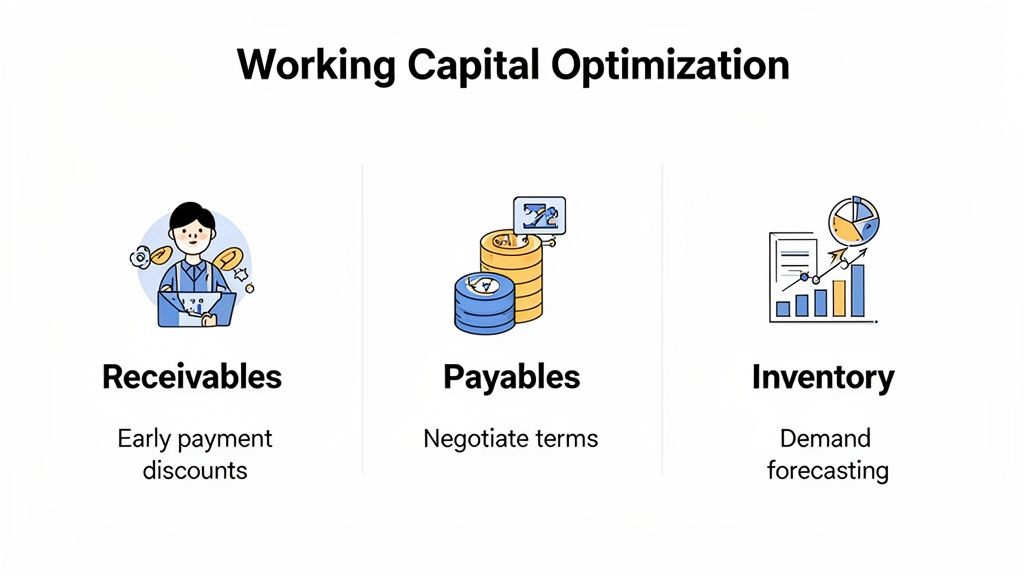
Below are concrete strategies organized around the three core pillars of working capital: receivables, payables, and inventory. For a growing business, these aren't just suggestions—they are practical steps you can implement today to build a more resilient financial foundation.
Speed Up Your Inbound Cash
The faster you can turn sales into cash in the bank, the healthier your business will be. The goal here is simple: shorten your Days Sales Outstanding (DSO) without alienating your customers.
- Offer Early Payment Discounts: A small discount, like 2% off if an invoice is paid in 10 days instead of 30 (often written as "2/10, n/30"), can be a powerful motivator. It pulls cash into your business weeks earlier than it would have otherwise.
- Refine Your Credit Policies: Not every client deserves the same payment terms. Run credit checks on new, larger clients and set stricter terms for those with a shaky payment history. It's about minimizing your risk.
- Automate Your Invoicing: Late invoices mean late payments. An automated system ensures invoices go out the moment a job is done, starting the payment clock immediately. For more ideas, check out our guide on how to automate your startup’s receivables management.
Strategically Manage Your Outbound Cash
While paying bills on time is essential, paying them too early can needlessly drain your cash reserves. Extending your Days Payable Outstanding (DPO) gives you more breathing room to use that cash for other needs.
The key is to negotiate longer payment terms without damaging your supplier relationships. Strong, open communication is crucial; you want to be seen as a strategic partner, not a difficult customer.
This isn't just theory. A PwC study of 17,000 corporations found that a 2.5% improvement in net working capital unlocked €1.5 trillion in excess cash globally, partly driven by optimizing payment cycles. You can explore the findings of PwC's global study on their website.
Keep Your Inventory Lean and Productive
Inventory is a notorious cash trap. Every product sitting on your shelf represents money you can't use for payroll, marketing, or growth. The goal is to lower your Days Inventory Outstanding (DIO) by holding just enough stock to meet demand.
- Implement Just-In-Time (JIT): Where it makes sense, order materials so they arrive just as they are needed for production or sale. This move drastically reduces warehousing costs and the risk of getting stuck with obsolete stock.
- Improve Demand Forecasting: Use historical sales data and market trends to predict future demand more accurately. This stops you from over-ordering based on guesswork and ensures your cash isn't tied up in slow-moving products.
These strategies empower you to take control. When implemented systematically with a seasoned financial expert, these optimizations can transform your working capital from a source of stress into a powerful engine for growth.
Common Mistakes That Trap Startup Cash Flow
Even a profitable startup can run out of cash. This paradox usually isn't caused by one big disaster, but by a series of small, seemingly harmless habits that slowly bleed a company dry. Spotting these common working capital mistakes is the first step toward avoiding them entirely.
Plenty of founders fall into the trap of overly optimistic sales forecasting. They go all-in on inventory, betting on a massive sales spike that never quite shows up. All of a sudden, their cash isn't in the bank for payroll or rent; it's collecting dust on a warehouse shelf.
This isn't just a startup problem, either. Inefficiency ties up staggering amounts of money at every level. Recent reports show S&P 1500 companies have a whopping $707 billion in trapped liquidity—a 40% jump from before the pandemic. You can discover more about these working capital trends from J.P. Morgan.
Extending Overly Lenient Payment Terms
Another classic pitfall is being too generous with your payment terms. To land a big client or just to be accommodating, a startup might offer Net 60 or even Net 90 terms without thinking through the consequences. You’ve just handed your customer an interest-free loan, while your own bills keep coming due.
That single decision can stretch your cash conversion cycle to a breaking point, creating a huge gap between when you spend money and when you actually get paid. A healthy accounts receivable process isn't about being aggressive. It's about being clear, consistent, and disciplined. Your survival depends on turning hard-earned revenue into usable cash as quickly as you can.
Scaling Headcount Prematurely
Hiring is exciting—it feels like proof of growth. But bringing on new team members before your cash flow can truly support them is one of the fastest ways to get into trouble. Every new hire adds fixed costs like salaries and benefits that you have to pay on time, every time, no matter how your sales are fluctuating.
Imagine a founder sees a promising pipeline and hires three new developers, only for those deals to close 60 days later than expected. Now they're staring down multiple payroll cycles without the cash to back them up, sending them scrambling for emergency funding or forcing them to make painful cuts.
Avoiding these mistakes comes down to discipline and foresight. A seasoned financial leader, even on a fractional basis, can put the right systems in place to sidestep these cash traps and build a resilient operation that’s actually ready for sustainable growth.
When to Partner with a Fractional Finance Executive
As your business scales, managing working capital stops being a simple task and quickly becomes a complex, strategic function. The scrappy methods that got you off the ground can suddenly start holding you back, creating friction where you need smooth, predictable operations.
This is usually the point where founders feel the pinch.
Maybe you’re profitable on paper but constantly sweating payroll. Or perhaps you’re spending more of your week wrestling with spreadsheets than you are actually growing the company. These are telltale signs that your financial complexity has outgrown your current systems.
Recognizing the Need for Expert Guidance
When you don’t have clear visibility into your key financial metrics, you’re flying blind. You can't possibly optimize what you can't measure. An experienced financial leader brings the strategic oversight you need to navigate these exact challenges.
But the right move isn’t always hiring a full-time, six-figure CFO. For most growing companies, this is where fractional leadership delivers a massive advantage—giving you C-suite expertise without the C-suite overhead.
A fractional finance executive doesn’t just offer advice; they roll up their sleeves and build the robust financial systems and forecasting models that turn raw data into smart decisions. They implement the very strategies we've discussed in this guide, providing the strategic foresight needed to scale your operations effectively and sustainably. If you're new to the concept, our guide on the meaning of a fractional CFO offers a deeper look into their impact.
Bringing on this level of expertise is the logical next step for any founder who is serious about building a financially resilient company. It’s an investment in stability, control, and long-term growth.
Ready to stop guessing and start building a stronger financial foundation? Schedule a consultation today and see how an expert fractional executive can fuel your next stage of growth.
Frequently Asked Questions
When founders dig into working capital management, a few common questions always pop up. Let's tackle them head-on.
What Is a Good Working Capital Ratio for a Startup?
The textbook answer is a ratio between 1.5 and 2.0. That range usually means you have plenty of short-term assets to cover your short-term debts with room to spare.
But for a new startup, that's often a fantasy. The real goal is just to get—and stay—above 1.0. A positive ratio is your first major milestone. If you dip below 1.0, it can signal serious cash flow trouble on the horizon.
On the flip side, a ratio that’s way too high might look safe, but it could mean your cash is just sitting there instead of being put to work growing the business.
How Can I Improve My Cash Conversion Cycle Quickly?
To make a real dent in your Cash Conversion Cycle (CCC) fast, you need to pull all three levers at once. No single tweak will do it.
- Get Paid Faster: Don't wait to send invoices. The moment the work is done or the product is delivered, send the bill. A small discount for early payment can also work wonders to shorten your DSO.
- Slim Down Inventory: Get smarter with your demand forecasting. Overstocking is just cash sitting on a shelf, so reducing how long goods are warehoused is key to lowering your DIO.
- Pay Suppliers Smarter: See if you can negotiate slightly longer payment terms with your key suppliers. Extending your DPO, even by a few days, keeps cash in your business longer when you need it most.
Making small, steady gains in each of these areas will have a massive impact on your CCC and free up precious cash.
Is Negative Working Capital Always a Bad Sign?
Not necessarily, but the context is absolutely critical. For most B2B or manufacturing startups, yes, it's a huge red flag signaling deep financial distress.
However, some business models are built to run on it. Think about a grocery store or a fast-food chain. They get cash from customers instantly but pay their suppliers in 30-60 days.
This setup essentially lets them fund their day-to-day operations with their suppliers' money. It's a sign of extreme efficiency. For the average startup, though, it’s a clear sign you’re in trouble.
Figuring out these details is where an experienced financial leader truly shines. The fractional executives at Shiny know how to implement these strategies and build a financial foundation that can withstand the pressures of growth. Take a look at our network of vetted finance pros to find the right partner for your business. Learn more about Shiny.