When to Hire a Fractional CMO: Signals That Matter
You're probably not asking whether marketing matters. You're asking whether you need another executor, a senior strategist, or someone who can finally make marketing accountable for pipeline.
That distinction matters. A fractional CMO can give a growth-stage company senior leadership without forcing an immediate full-time executive search, but only when the business has enough operating structure for that leader to act. The right question isn't when to hire a fractional CMO. It's whether your marketing function is ready to turn executive judgment into revenue progress.
The Moment a Founder Knows Marketing Has Become a Leadership Problem
A $5M ARR SaaS company has a CEO approving every campaign, managing two junior marketers, rewriting landing pages at midnight, and settling arguments about lead quality between sales and marketing. The team is busy. Campaigns are launching. The founder is still the person deciding what gets prioritized.
That isn't a productivity problem. It's a marketing leadership gap.
I've hired three fractional CMOs, and the pattern is consistent. The hire becomes rational when three structural conditions appear at the same time:
- Marketing decisions outnumber the founder's available attention.
- Pipeline conversion has plateaued despite regular tactical activity.
- The team needs strategic sequencing, not another list of tasks.
The first condition is easy to underestimate. Founders often assume they can keep marketing decisions temporarily because the company already has marketers, freelancers, or agencies. But junior staff can produce campaigns without deciding which customer segment deserves priority, how budget should move between channels, or how sales feedback should change positioning.
The second condition shows up in the numbers you already review. Spend rises, activity increases, and the pipeline report still looks flat. That usually points to a problem with segmentation, attribution, positioning, funnel design, or sales alignment. Hiring another content producer won't solve a governance problem.
Practical rule: If you're still approving channel-level decisions while also owning company strategy, you're already paying for marketing leadership with founder time.
The third condition is the decisive one. A fractional CMO should determine what happens first, what gets stopped, who owns each decision, and how the team will know whether the plan worked. The role isn't to add more ideas. It's to impose a sequence on the ideas already consuming your team.
Companies in leadership transition can benefit from this flexibility. Spencer Stuart's CMO tenure reporting places Fortune 500 CMO tenure at about 4.2 years in 2024, with 62% of appointments coming from inside the company and 38% from outside, while other industry reporting places average tenure near 39 to 43 months in CMO tenure research. A fractional model gives a company senior direction without waiting through a lengthy search or betting the function on another short executive cycle.
The Revenue, Budget, and Time Signals That Justify the Hire
Revenue stage is only one input. The stronger hiring decision combines commercial activity with marketing spend, founder involvement, and pipeline behavior. A fractional CMO earns attention when the company has enough demand to require coordination, yet lacks a marketing operating system that turns execution into accountable pipeline.
Independent guidance identifies $1M to $20M ARR as a strong window for a fractional CMO, especially when execution exists but senior marketing direction does not, as described in guidance on when to hire a fractional CMO. Treat that range as a signal, not a rule. Marketing leadership matters when strategic choices can materially change growth.
Monthly spend provides a sharper test. At $30,000 per month or more, channel choices, agency management, attribution, and budget allocation require executive ownership. Leadership must explain how spend connects to revenue. AI has also raised the expected output from every marketing dollar, so a fractional leader should be priced and judged against outcomes, not a larger list of deliverables.
Founder time reveals the hidden cost. Spending more than five hours per week on campaigns, vendors, messaging, or lead disputes means the CEO has become the default marketing leader. Treat that threshold as an early warning. If the founder remains the approval bottleneck, adding more specialists will increase activity without transferring responsibility.
Read the operating signals, not just the dashboard
Pipeline often exposes the problem before a dashboard does. Look for these patterns:
- Conversion stalls: Qualified leads enter the funnel, but fewer advance because positioning, qualification, or sales follow-up varies.
- Acquisition costs creep upward: The team keeps funding familiar channels without testing whether the audience, offer, or buying process still fits.
- Channels saturate: Paid and organic programs create repeated exposure but fail to expand into new segments.
- Agency output multiplies: Several vendors produce content, campaigns, or creative, while nobody owns the commercial logic connecting that work.
- Sales rejects marketing leads: The conflict points to inconsistent definitions, weak handoffs, or poor attribution.
| Signal Category | Threshold or Trigger | What It Means |
|---|---|---|
| Revenue traction | Around $1M to $20M ARR | Marketing has enough commercial weight for senior direction to affect growth |
| Marketing budget | At least $30,000 per month | Spend complexity requires ownership and attribution discipline |
| Founder involvement | More than five hours per week on marketing decisions | The CEO is carrying the marketing leadership role |
| Pipeline behavior | Pipeline fails to rise proportionally with spend or activity | The constraint is likely strategic, not a shortage of tasks |
| Growth event | Fundraise, launch, repositioning, or market expansion | The company needs sequencing before execution accelerates |
Set the trigger before urgency makes the decision for you. If spend rises while pipeline stays flat, pause tactical hiring and audit attribution. If the founder approves every meaningful decision, transfer decision rights. If a launch or expansion is approaching, hire before the campaign calendar fills and before disappointing results force a rushed reset.
The Readiness Filter Most Advice Skips
“Hire a fractional CMO when growth stalls” is incomplete advice. Growth can stall because your strategy is wrong, but it can also stall because nobody can execute a strategy once you have one.
A fractional CMO needs a functioning marketing operating system. Without it, the executive becomes an expensive strategist who spends the engagement repairing basic infrastructure.
Use this filter before you hire.
First, confirm that the market story exists
You need a documented customer profile and validated positioning. The document doesn't need to be perfect, but the team should know which customer it serves, which problem it solves, why buyers choose it, and which alternatives they compare.
If every executive interview produces a different description of the ideal customer, don't expect a fractional CMO to create pipeline immediately. The leader will spend time conducting foundational research, which may be necessary, but it changes the engagement from growth leadership to market discovery.
Next, test the measurement layer
A working CRM with clean attribution data is essential for a performance mandate. I'd want enough historical data to distinguish a temporary fluctuation from a persistent funnel problem. If source data is missing, lifecycle stages are inconsistent, or sales updates opportunities manually and irregularly, the CMO can still improve the system, but you shouldn't promise fast revenue accountability.
Finally, identify the execution owner
Someone inside the company must translate strategy into resources, priorities, approvals, and daily work. That person might be an operations lead, a marketing manager, or a founder who has deliberately transferred execution authority.
The role works best when the company has product-market fit, budget ownership, a KPI baseline, and an operator who can make the plan real. This operating distinction is also central to what a fractional CMO does.
A strong fractional CMO can build a better system. They can't be the system, the executor, and the executive sponsor at the same time.
Companies with strong product-market fit but weak infrastructure waste engagements most often. They hire senior judgment before making the business capable of using it. If attribution, positioning, and execution ownership are absent, fix those gaps first or scope the engagement as an operating-system rebuild.
Fractional CMO vs Full-Time CMO vs Agency vs Interim
This is a choice about accountability, not headcount.
A fractional CMO is a senior operator embedded part-time. They should own the marketing system, connect activity to pipeline, direct the team, and decide what deserves investment. A full-time CMO offers permanent ownership and broader availability, but the search takes time and the compensation commitment is substantial.
A senior agency gives you execution capacity. It may be excellent at paid acquisition, SEO, content, or creative, but most agencies won't own your organizational design or make the final call on your company's market strategy. An interim CMO bridges a vacancy, usually with a mandate to stabilize the function until a permanent leader arrives.
The comparison below uses only the verified fractional pricing ranges. The full-time compensation figures requested in the original framework aren't included because they aren't part of the approved data set.
| Option | Monthly Cost (USD) | Time to First Impact | Strategic Ownership | Revenue Accountability | Best-Fit ARR Window | Common Failure Mode |
|---|---|---|---|---|---|---|
| Fractional CMO | $5,000 to $15,000 for lighter-to-standard work, with intensive interim support reaching $18,000 to $25,000+ (market pricing guidance) | Fast, once access and priorities are clear | High | Should be explicit in the scope | Growth stage with traction but no need for permanent executive capacity | Strategy gets handed off to a team that can't execute |
| Full-time CMO | Varies by company and market | Slower because of the search and onboarding process | Highest and permanent | High | Larger organizations needing continuous executive ownership | Hiring a permanent executive before the function is ready |
| Senior agency | Retainer or project pricing varies | Fast for defined deliverables | Usually limited to the contracted work | Usually limited or indirect | Any stage needing specialist execution | Strong output without a coherent revenue strategy |
| Interim CMO | Often $18,000 to $25,000+ per month for intensive support (interim CMO pricing reference) | Fast during a vacancy | Medium to high, depending on mandate | Usually focused on continuity | Transition, leadership gap, or urgent reset | Stabilizes activity without rebuilding the operating model |
Choose a fractional CMO when you need senior ownership but your workload is variable. Choose a full-time leader when the company needs permanent executive attention across team design, board communication, budget governance, and cross-functional planning. Choose an agency when the strategy is already clear and execution is the constraint.
The wrong decision usually comes from buying the wrong kind of capacity. A company with a strategy problem hires an agency. A company with an execution problem hires a strategist. A company in a short leadership gap hires a permanent executive before defining the function.
What Fractional CMO Engagements Cost and Last
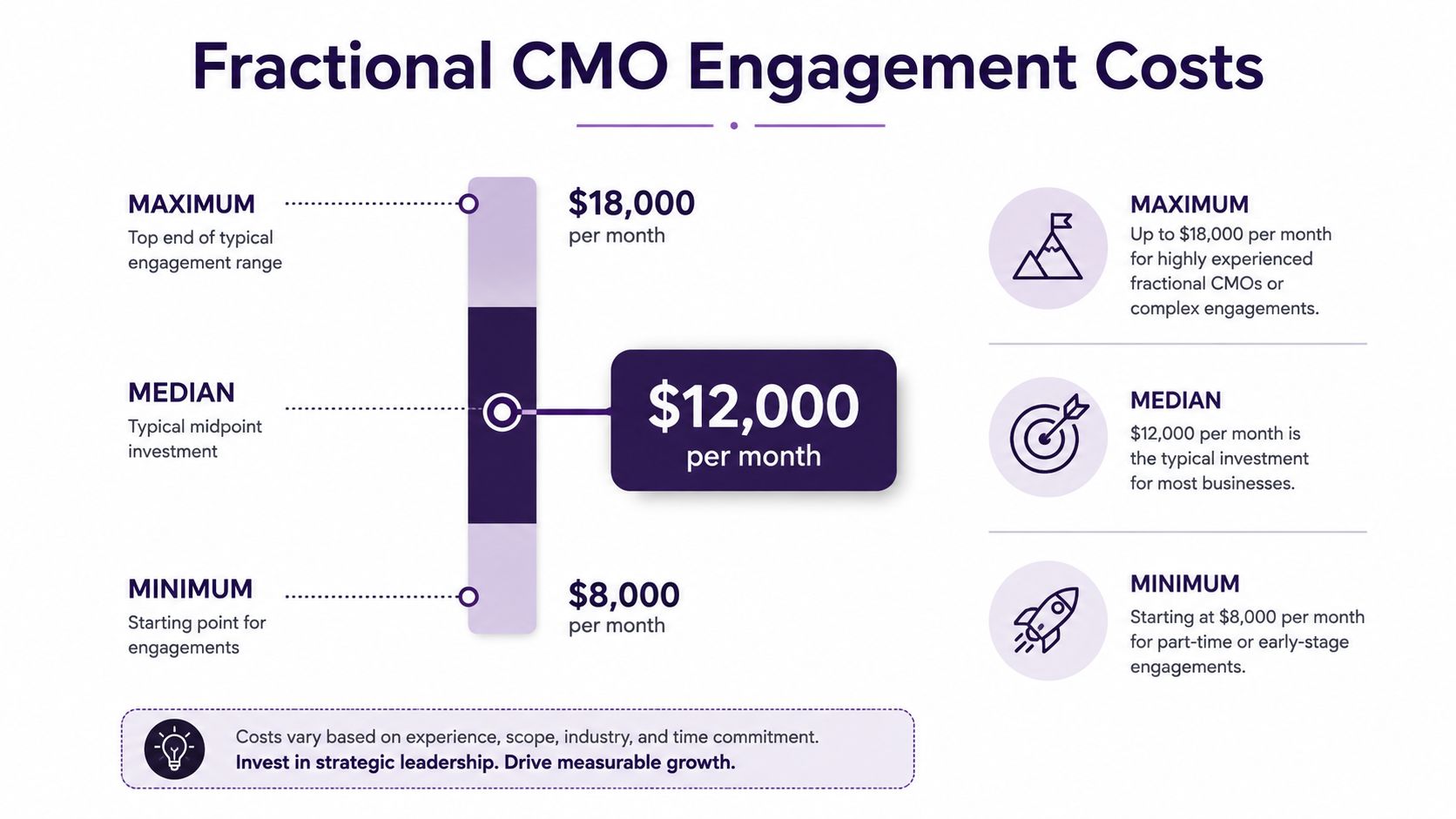
Set the budget against the operating problem, not an hourly substitute for a full-time employee. Use the fractional CMO cost guide to compare engagement models, then price the work against the decisions and outcomes the role must own.
A lighter engagement may suit a company that needs positioning, measurement, or channel priorities. Intensive interim leadership can require a larger commitment, particularly during a launch, leadership transition, or growth reset. Interim CMO pricing guidance provides broader market context, but the contract should follow the mandate rather than a generic rate card.
Match the contract to the problem
Typical interim engagements last three to twelve months, while another source describes a 90-to-180-day engagement, according to interim CMO service guidance. Treat those ranges as planning references, not automatic terms. A short contract needs a narrow mandate, such as rebuilding attribution or defining the go-to-market sequence. A longer engagement can cover team hiring, vendor management, channel development, and preparation for a full-time leadership transition.
Write the deliverables into the agreement. Specify the decisions the CMO owns, the access required, the review cadence, and the conditions for renewal or termination. Clarify intellectual property ownership, confidentiality, conversion terms, and any non-compete limitations before work begins.
Pricing is shifting toward AI-augmented and outcome-based work. Ask which AI tools the CMO uses, what they produce, how human review works, and whether the fee reflects pipeline progress rather than hours logged. AI should raise the standard for deliverables. It does not replace clear accountability, reliable data, or a marketing operating system that lets the leader move pipeline.
What the First 90 Days With a Fractional CMO Should Look Like
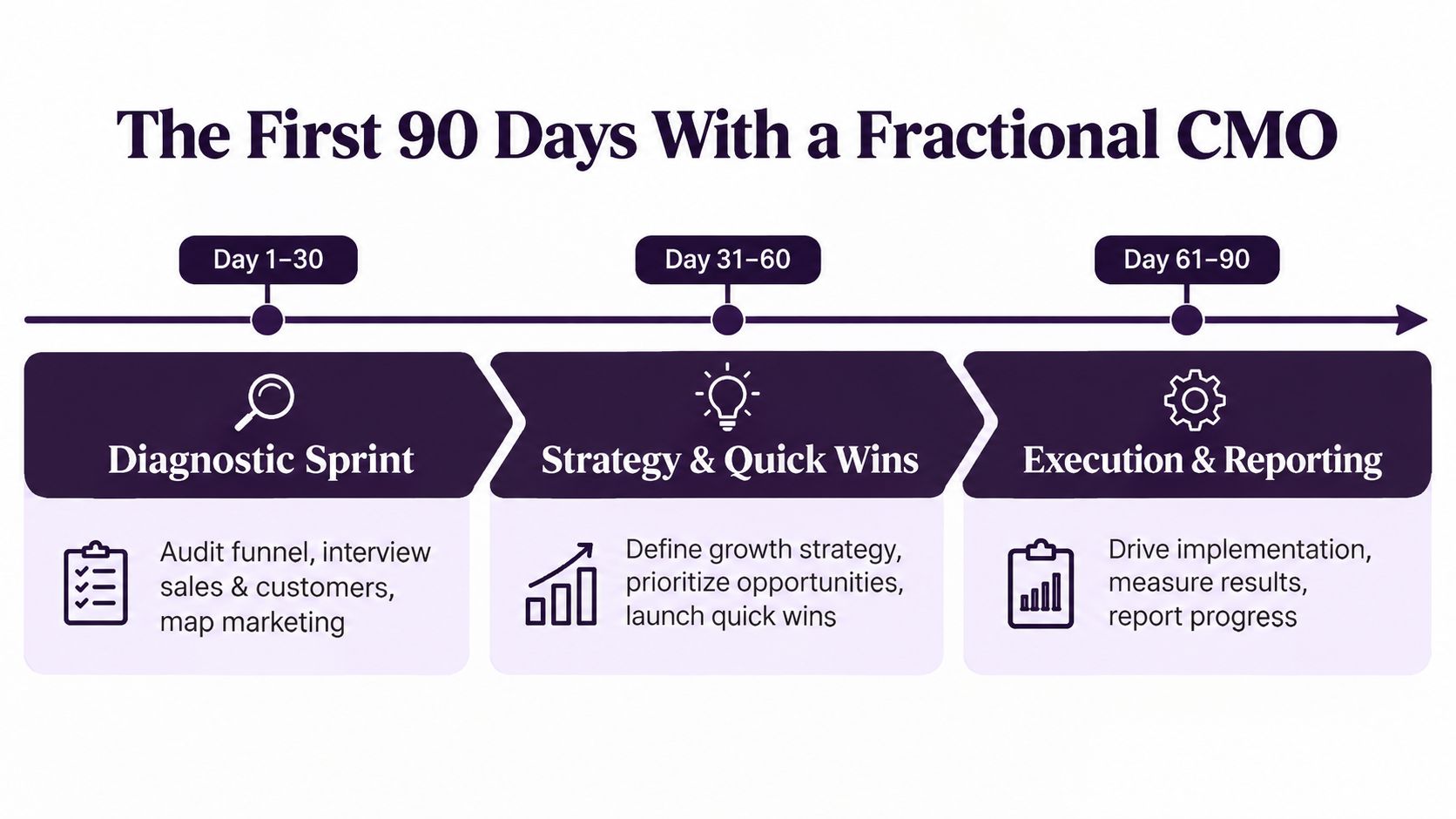
The first 90 days should produce a diagnosis, a visible improvement, and an operating rhythm. If the engagement only produces a deck, it's failing.
Days 1 to 30 should expose the leaks
The CMO should audit the funnel, interview sales and customers, review campaign history, inspect CRM fields, and map how decisions move through the company. They should identify the two or three revenue leaks that deserve immediate attention.
By day 30, you should have a written roadmap. It should state what the company will stop doing, what it will prioritize, who owns each action, and how pipeline performance will be reviewed.
Days 31 to 60 should create a visible win
The first win might be a sharper position, a rebuilt paid acquisition loop, a corrected handoff between marketing and sales, or a new qualification standard. The specific choice depends on the diagnosis.
Don't accept activity as evidence of progress. A new content calendar isn't a win by itself. A campaign launch isn't a win by itself. The CMO should connect the intervention to a measurable movement in the funnel, with conversion criteria agreed before the work begins.
Days 61 to 90 should install the rhythm
The final block should make the function less dependent on founder intervention. That usually means weekly pipeline reviews, a quarterly planning cadence, hiring scorecards for internal marketing roles, and a clear plan for handoff or conversion to a full-time leader.
By the end of the first 90 days, you should know whether the CMO improved decision quality, clarified ownership, and created a credible path to pipeline improvement.
Agree on the conversion criteria at the start. Decide whether success means extending the fractional engagement, hiring a full-time leader, retaining the executive as an advisor, or ending the relationship after the operating system is stable.
Two Founder Stories That Show What Happens When You Get the Timing Wrong
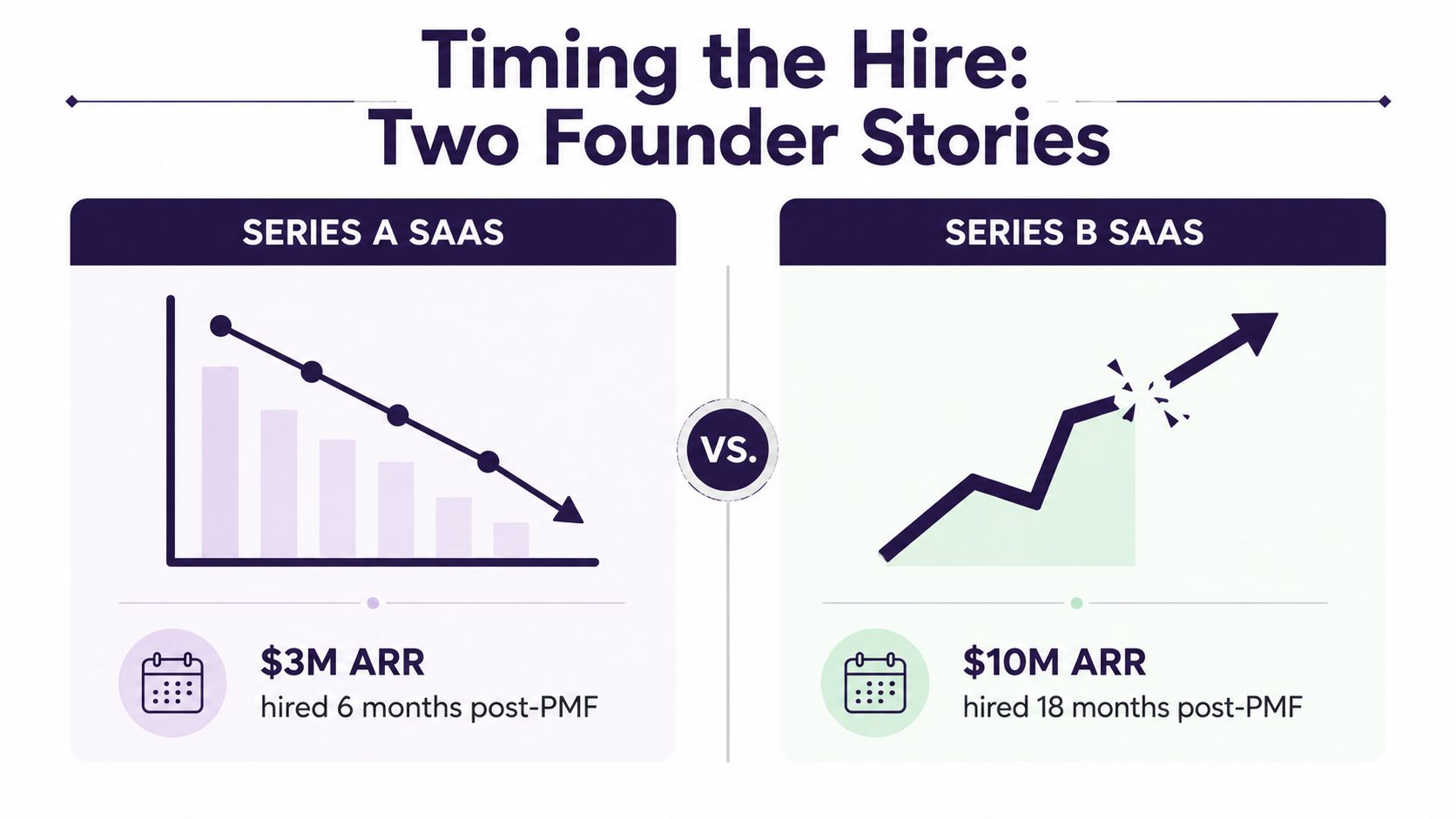
Consider a representative Series A pattern. A $3M ARR SaaS founder hires a fractional CMO six months after product-market fit. The company has no attribution stack, no documented ideal customer profile, and no internal marketing operations owner.
The CMO is capable, but the first part of the engagement goes into customer research, CRM cleanup, positioning work, and basic ownership decisions. By the time the company is ready to run a coordinated growth program, most of the six-month mandate is gone. The business exits with better documentation but no durable pipeline engine.
The mistake wasn't hiring a fractional CMO. The mistake was hiring senior leadership before creating the conditions that let senior leadership operate.
Now take the opposite pattern. A $22M ARR company waits until two consecutive quarters of net new logo decline before engaging fractional leadership. Sales has stopped trusting marketing-sourced leads, channel decisions are being made at the campaign level, and the budget remains flat while revenue contracts.
The fractional CMO can help, but the work is now a recovery program. The company needs to rebuild trust, revisit positioning, repair measurement, and make organizational changes under pressure. Waiting didn't eliminate the need for leadership. It made the intervention more disruptive.
Use these warning signs as a quick diagnostic:
- Measurement is missing: You can't trace opportunities to meaningful marketing sources.
- The founder still chooses channels: Senior leadership remains trapped in campaign approvals.
- Sales and marketing disagree: Neither team trusts the other team's definitions or reports.
- Revenue is contracting while budget stays flat: The business needs a strategic reset, not more routine output.
If the first story sounds like your company, build the operating system before hiring. If the second sounds familiar, hire before the next reporting cycle creates another avoidable delay.
Your Next Step and How to Start the Search
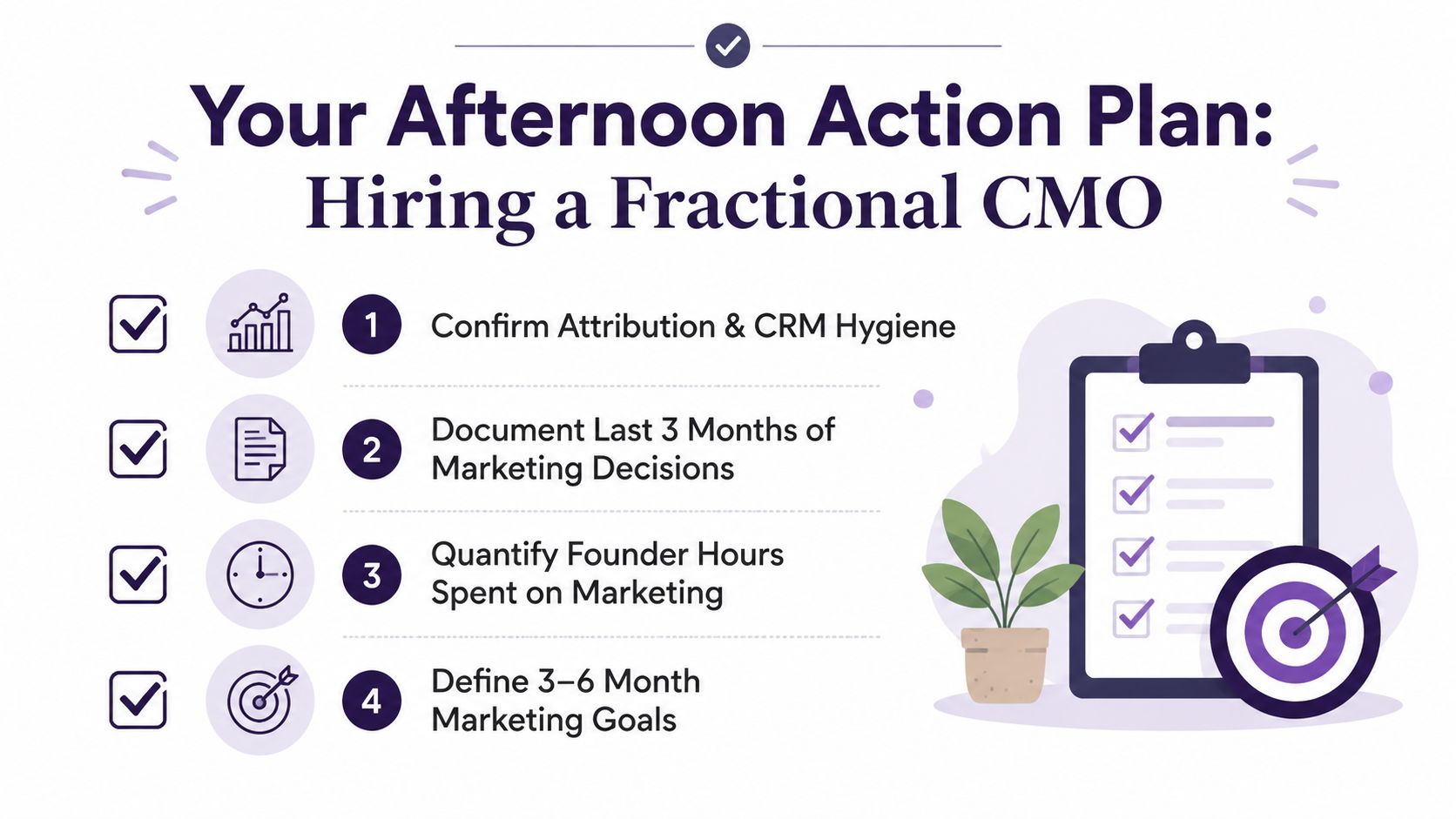
Run this checklist in one afternoon. Don't start by browsing executive profiles.
- Confirm attribution and CRM hygiene: Verify that your funnel stages, source data, opportunity ownership, and revenue reporting are usable.
- Document the last three months of marketing decisions: Record what was funded, paused, launched, rejected, and approved, including who made each call.
- Quantify founder time: Track how much time the CEO or leadership team spends on marketing decisions and vendor management.
- Write a one-paragraph growth thesis: State which customer segment, problem, offer, and channel combination should create the next stage of pipeline.
Then run a disciplined search. Shortlist two to four fractional leaders with experience in your category, sales motion, and growth stage. Ask each candidate to scope a 90-day engagement around pipeline metrics, not content volume or meeting attendance. Agree on a conversion-to-full-time option at the beginning, including how the transition will work and how fees will be handled.
Set a 30-day checkpoint with clear reasons to continue, adjust, or stop. If expectations aren't aligned by then, ending the engagement is cheaper than protecting a poor fit.
A marketplace can save time when you don't have a warm executive network because it gives you a structured way to compare relevant operators instead of relying on one referral. Shiny's guide to hiring a fractional CMO is a useful starting point for defining the role, scope, and selection process.
Shiny connects startups and growth-stage companies with vetted fractional executives, including marketing leaders who can work part-time against a defined operating mandate. Visit Shiny to explore fractional CMO support or schedule a consultation around your pipeline, budget, and readiness.