A Practical Guide to the New Product Development Gate Process
The new product development gate process isn't about adding bureaucracy or slowing things down. It’s a battle-tested roadmap that brings order to the chaos of innovation, breaking the product journey into clear stages of work, each separated by a "gate" where you make a hard go/kill decision.
It’s a strategic framework for turning ambitious ideas into market-winning products, ensuring that your best resources are always focused on your biggest opportunities.
Turning Ideas into Revenue with a Structured Roadmap
Think of building a new product like planning a major expedition. You wouldn’t just start walking without a map and checkpoints. At each checkpoint, you’d stop, check your supplies, assess the terrain ahead, and decide if the next leg of the journey still makes sense.
That’s the gate process in a nutshell. It acts as a strategic filter, ensuring only the most promising ideas get the fuel they need to make it to market. This isn't about red tape; it's about injecting financial and strategic discipline into the creative process to systematically de-risk innovation. By forcing tough decisions at specific moments, you stop "zombie projects"—those ideas that shamble along, eating up resources with no real chance of success.
The Proven Impact of a Disciplined Process
This isn't just theory; the numbers back it up. The Stage-Gate model, pioneered by Dr. Robert G. Cooper, has become a gold standard for a reason. Companies that adopt a disciplined process like this one see new product success rates about 2.5 times higher than those flying by the seat of their pants.
These organizations also tend to get products to market 30–50% faster and slash development failures by an average of 25%. You can dig into the details of these findings on the official Stage-Gate website.
A structured approach is the difference between hoping for a successful launch and engineering one. It ensures every dollar and hour is a calculated investment toward a product your customers actually want and that fits your company's big-picture goals.
The Two Core Components: Stages and Gates
To understand how this works, you need to grasp its two building blocks: the Stages where work gets done, and the Gates where decisions get made. They have different, but equally important, jobs.
This table gives a quick rundown of how they fit together.
| Component | Purpose | Primary Activity |
|---|---|---|
| Stages | Where the team executes the plan and gathers critical data. | Research, analysis, design, development, testing—the hands-on work of building a product. |
| Gates | Where leadership makes a formal go/kill decision based on that data. | Reviewing deliverables against set criteria to decide if the project should continue. |
By separating the work (Stages) from the decisions (Gates), the process creates a powerful rhythm of execution followed by evaluation.
For many growing companies, having an experienced leader to run this playbook is a game-changer. A fractional executive can step in as that seasoned, objective gatekeeper, making the tough calls that protect your resources and keep the product engine humming. If you're ready to build a more predictable path to market, schedule a consultation to see how fractional leadership can help.
Navigating the Five Stages of Innovation
The new product development gate process is built around a series of distinct stages. Think of each stage as a leg in a relay race. The team carries the baton—the idea—and completes a specific set of tasks before passing it through the next gate for a thumbs-up or thumbs-down.
This structure ensures every project builds momentum on a solid foundation of data and real progress, not just wishful thinking. The process usually unfolds across five core stages, taking a project from a rough concept all the way to a market-ready product.
The infographic below gives you a clear visual of how these stages and their gates work together, creating a well-defined path for your ideas to follow.
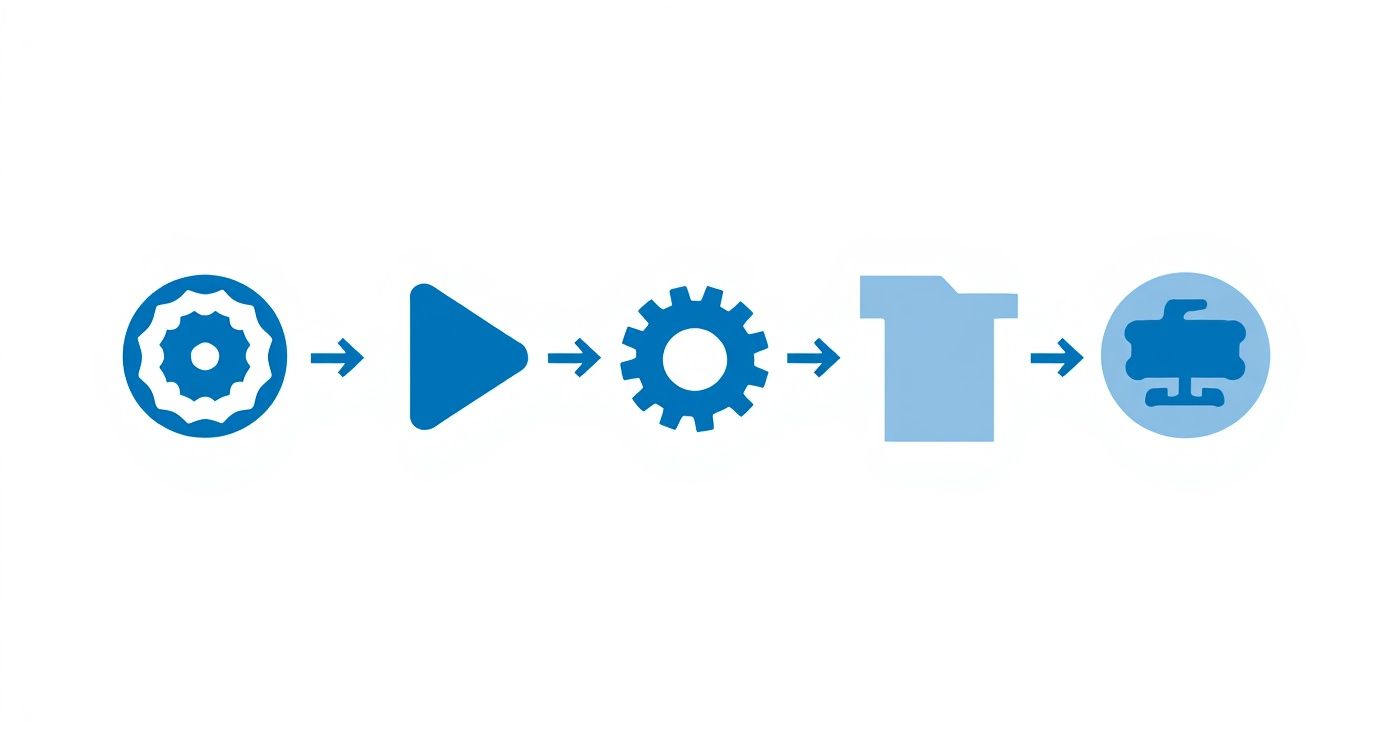
As you can see, each stage is a period of focused work that produces the deliverables the gatekeepers need to make a smart call at the next decision point.
Stage 1: Scoping
Every journey starts somewhere, and in product development, it's the Scoping stage. Sometimes called the Discovery phase, this is where a promising idea gets its first real stress test. The goal isn't to build anything yet; it’s about doing quick, preliminary homework to see if the concept deserves a deeper look.
The activities here are fast and cheap:
- Initial Market Assessment: Is there actually a market for this? Who’s already playing in this space?
- Technical Feasibility Check: Can we even build this with the tools and talent we have?
- Strategic Fit Analysis: Does this product idea line up with where we're trying to take the company?
The team is small and nimble at this point—maybe a product manager, a senior engineer, and a marketing specialist. Their job is to produce a concise document that lays out the opportunity, flags the obvious risks, and gets it ready for Gate 1.
Stage 2: Business Case Development
If an idea makes it past the first gate, it graduates to the Business Case Development stage. This is a much deeper dive where the team justifies a real investment of time and money. The whole point is to build a rock-solid business plan that proves the project is worth pursuing.
Key activities include:
- In-depth Market Research: Talking to potential customers through interviews and surveys, plus deep-diving on competitor strategies.
- Product Definition: Hammering out a detailed definition of the product—its features, benefits, and what makes it special.
- Financial Modeling: Running the numbers on development costs, sales forecasts, pricing, and potential ROI.
- Project Planning: Sketching out a realistic timeline, figuring out who you'll need, and putting together a preliminary launch plan.
The final business case is the main event for Gate 2, where the project competes for serious funding.
Stage 3: Development
Once the business case gets the green light, the project officially enters the Development stage. This is where the concept finally starts to become a tangible reality. The team gets to work designing, building, and engineering the actual product based on the specs they just spent all that time defining.
This is often the longest and most expensive part of the process. The focus shifts entirely to execution, turning blueprints into a working prototype or a minimum viable product (MVP). Applying principles from the Lean Startup methodology here can be a game-changer, as it focuses on rapid iteration and learning what works without wasting resources.
Stage 4: Testing and Validation
With a prototype in hand, it's time for the Testing and Validation stage. The goal here is to de-risk the launch by making sure the product not only works but, more importantly, actually resonates with customers.
A product that works perfectly but fails to solve a customer's problem is still a failure. This stage is the final reality check before a full-scale market launch.
Testing is a multi-layered process:
- Internal Testing (Alpha): The team and other internal folks test the product to find bugs and spot usability problems.
- Customer Validation (Beta): A small group of real-world users gets their hands on the product to provide unfiltered feedback.
- Market Testing: Sometimes, a company will do a trial run in a limited market to test out pricing, messaging, and the go-to-market plan before going all-in.
The feedback gathered here is gold. It’s what allows the team to make those final, critical tweaks before the big show.
Stage 5: Launch
Finally, we arrive at the Launch stage. This phase covers everything required to get the product out the door and into the hands of customers. The focus pivots completely from building the product to building the business around it.
The go-to-market plan that was drafted way back in the business case stage is now executed. This means coordinating a symphony between marketing, sales, and customer support to ensure a smooth rollout. But the work doesn't stop on launch day. This stage also includes obsessively monitoring early sales, collecting customer feedback, and tracking KPIs to figure out what's working and what's not.
Making Critical Go or Kill Decisions at Each Gate
While the stages are where all the hands-on work gets done, the gates are where your strategy truly comes to life. These aren't just status updates. Think of them as high-stakes investment meetings where a project’s future hangs in the balance.
A well-run new product development gate process injects the discipline needed to kill bad ideas early, preventing costly mistakes and ensuring your best resources are aimed at genuine opportunities.
It helps to view each gate review as a formal hearing. The project team presents their case, armed with concrete deliverables and data. Their goal is to convince a group of senior leaders—the gatekeepers—that the project still makes sense and deserves more funding to move forward.
This structure is designed to pull emotion and personal bias out of the equation. Projects live or die based on objective evidence, not on who has the loudest voice. This data-first mindset is the bedrock of good choices, a concept we explore in our guide to building a strategic decision-making framework.
Who Are the Gatekeepers?
Gatekeepers are the guardians of your company's time, money, and focus. They’re typically a cross-functional group of senior leaders with the authority to allocate budgets and assign people to projects.
This group often includes the heads of:
- Product: To ensure the project still fits the overall product vision.
- Engineering/R&D: To confirm technical feasibility and resource estimates.
- Marketing & Sales: To validate the market opportunity and go-to-market plan.
- Finance: To scrutinize the numbers and ensure the business case holds up.
In a smaller company, the gatekeepers might be the founding team or a single C-suite executive. What matters most is that they have a holistic view of the business and are empowered to make tough calls.
Inputs, Criteria, and Outputs of a Gate Meeting
For gate meetings to be effective, they need a simple, repeatable structure: inputs, criteria, and outputs. This forces every project to be judged by the same standards.
The inputs are the deliverables from the stage the team just completed. For instance, at Gate 2, the team will present the detailed business case.
The project is then judged against a pre-defined set of criteria. These are the sharp, pointed questions that get to the heart of a project's viability.
To ensure consistency, it's helpful to use a standard checklist for these evaluations.
Gate Decision Criteria Checklist
This table provides a simple framework that gatekeepers can use at every review.
| Evaluation Category | Key Questions to Ask | Example Metric |
|---|---|---|
| Strategic Fit | Does this project still align with our company's overall strategy and goals? | Strategic Alignment Score |
| Market Attractiveness | Is the target market large enough? Is the competitive landscape favorable? | Total Addressable Market (TAM) |
| Product Advantage | Does our proposed solution have a clear, sustainable competitive advantage? | Customer Value Proposition |
| Technical Feasibility | Can we actually build this? Do we have the right skills and technology? | Technical Risk Assessment |
| Financial Reward | Do the financial projections (NPV, ROI, payback period) justify the investment and risk? | Net Present Value (NPV) |
| Go-to-Market Plan | Is there a clear and realistic plan to launch, market, and sell this product? | Customer Acquisition Cost (CAC) |
Using a consistent checklist like this helps remove subjective bias and focuses the conversation on what truly matters.
A gate isn't a test the project team has to pass. It's a joint decision the business makes about whether an investment still makes strategic sense. The goal isn't to approve projects; it's to build a winning portfolio.
Based on this evaluation, the gatekeepers make one clear decision, which becomes the meeting's output.
The Four Potential Gate Outcomes
The decision made at a gate dictates exactly what happens next. This clarity is what gives the process its power.
- Go: The project gets the green light. The budget is approved for the next stage, and the team is cleared to move forward.
- Kill: The project is shut down for good. It fails to meet a critical standard or no longer aligns with company direction. Its resources are immediately freed up for more promising ideas.
- Hold: The project is put on ice. It still has potential, but critical questions remain unanswered. The project is paused until the team can come back with more information.
- Recycle: The project is sent back for more work. The core idea is still valuable, but deliverables from the last stage had serious flaws. The team must fix the issues and present again at the same gate.
How Fractional Leadership Drives a Better Gate Process
Implementing a gate process is one thing. Running it effectively is another. For many startups and growing companies, the real missing piece is seasoned executive leadership. This is the precise gap that fractional leadership fills, turning a good process into a powerful growth engine.
A fractional executive, like a Chief Product Officer (CPO), brings years of hard-won expertise to your team without the full-time cost. Think of them as a veteran navigator you bring on board to steer your product portfolio through unfamiliar waters. They’ve built these frameworks before, trained teams to use them, and—most importantly—have experience being an objective gatekeeper.

This outside perspective is one of their biggest strengths. They aren’t attached to a project's history or swayed by internal politics, which lets them make unbiased, data-driven calls that are truly in the business's best interest.
The Power of an Unbiased Gatekeeper
One of the toughest parts of any gate process is making the difficult "Kill" decisions. Internal teams, especially founders, can get emotionally invested in their projects, making it hard to pull the plug even when the data says they should. This is how "pet projects" are born, sucking up resources that could be put to much better use.
A fractional leader adds a crucial layer of objectivity. Their main loyalty is to the health of the entire product portfolio, not to any single idea.
Because a fractional executive’s success is measured by the overall health of your product pipeline, they are uniquely positioned to be the impartial judge your gate process needs. They can ask the tough questions and make the unpopular calls that protect your company's focus and capital.
This unbiased oversight ensures every project is judged purely on its merits, fostering a culture of accountability.
Mentorship and Process Ownership
Beyond making hard calls, a fractional CPO also acts as a mentor for your internal team. They don't just run the process; they teach your people how to run it. This knowledge transfer is a huge long-term win, leveling up the strategic skills of your entire organization.
Their role often includes:
- Designing the Framework: Tailoring the stages, gates, and criteria to fit your company’s specific industry, size, and culture.
- Training Your Team: Showing your product managers how to prepare the right deliverables and build a solid business case at each gate.
- Establishing Metrics: Helping you define the key performance indicators (KPIs) that will be used to measure a project's success.
This hands-on guidance builds a sustainable product development muscle inside your company. To learn more about how this role works day-to-day, check out the responsibilities of a fractional product manager in our detailed guide.
Accelerating Innovation, Not Stifling It
A common worry is that a gate process will bog down innovation with red tape. When run by an inexperienced leader, that can happen. But a seasoned fractional executive knows how to strike the right balance between discipline and agility.
They understand the goal isn't to create rigid hurdles but to bring clarity and focus. By weeding out weak ideas early, they ensure your best people are aimed at the projects with the highest chance of making a real market impact. That focus is what truly speeds up innovation.
Instead of ten projects crawling along, you have three or four high-priority initiatives moving at full steam. A fractional leader ensures the new product development gate process does what it's supposed to: de-risk innovation and create a predictable path to revenue.
Avoiding Common Pitfalls in Your Gate System
Just drawing stages and gates on a whiteboard isn't enough. Even the most well-designed new product development gate process can stumble when it meets the real world. Success comes from anticipating the traps that turn a disciplined framework into a source of frustration.
Knowing what to look for helps you build a resilient system that balances tight execution with creative freedom.
Pitfall 1: The Rubber-Stamping Gate
One of the most common failures is when gates become a rubber-stamping exercise. Instead of being tough decision points, they turn into ceremonial meetings where projects are pushed through without real scrutiny. This happens when gatekeepers are unprepared, biased, or afraid to kill a pet project.
To fix this, you must treat gate meetings like serious investment decisions.
- Mandate Pre-Meeting Prep: Send all project deliverables at least 48 hours in advance. Gatekeepers must show up having reviewed the material.
- Use a Standardized Scorecard: Give gatekeepers a consistent checklist. This forces everyone to evaluate every project against the same objective criteria.
- Empower Objective Voices: An experienced, unbiased leader—like a fractional CPO—can chair the meeting to keep the conversation focused on data, not politics.
Pitfall 2: The Process Becomes Too Rigid
Another huge risk is creating a process so rigid it stifles creativity. Innovation is rarely a straight line; it’s messy and requires learning on the fly. If your stages are too long and inflexible, teams can't adapt to new customer feedback or market intel.
The solution is to build in flexibility. A 2022 survey of product managers revealed that 68% of companies had modified their gate criteria to better fit agile and lean methods. You can find more insights on how companies are modernizing their gate processes.
The best gate systems provide guardrails, not a cage. They create focus while giving teams the freedom to iterate and innovate within each stage.
To get this right, integrate agile sprints inside your longer development stages. This lets teams build, test, and learn in rapid cycles, gathering hard data to bring to the next gate.
Pitfall 3: Lack of Clear Ownership
When accountability is fuzzy, the whole process grinds to a halt. Who owns the deliverables for each gate? Who is on the hook for the project's success or failure? Without a single, designated project leader, projects just drift along without a champion.
Every single project must have one empowered owner. This person is responsible for guiding the project from one stage to the next, making the business case at each gate, and steering the ship.
Building Your Own World-Class Product Engine
A stage-gate process is more than a corporate checklist. It’s a powerful system for turning the unpredictable nature of innovation into reliable growth. Done right, it's how ambitious ideas become market-winning realities.
But success hinges on making the framework your own. A generic, one-size-fits-all approach won't cut it. It needs to fit your company culture, and just as importantly, you need the right leaders steering the ship.
From Theory to Reality
For many businesses, there’s a gap between understanding the process and making it work. If you see the need for a more structured innovation system but aren't sure where to start, you're not alone.
A well-run gate process doesn’t just kill bad ideas; it creates the focus and momentum needed to make good ideas great. It’s the engine that powers sustainable, long-term growth.
This is where having an experienced hand on the tiller makes all the difference. An expert can help you design a process that fits your unique needs, get your team up to speed, and provide the objective oversight needed to make those tough, data-driven calls at each gate.
If you’re ready to build the product development engine your business deserves, let's talk. We connect businesses like yours with vetted fractional executives who can refine your process and accelerate your journey from idea to launch.
Schedule a consultation to learn more.
Frequently Asked Questions
Even with a perfect plan, questions always pop up when you start putting a gate process into practice. Let's tackle some of the most common ones.
Getting ahead of these concerns can make the whole transition smoother and get your team bought into the system.
How Do You Adapt the Gate Process for Software vs Hardware Products?
While the core idea is universal, the execution looks totally different for software and hardware.
For software, you're moving much faster. Stages often align with agile sprints, and the process is built for quick iteration. Gates are all about user feedback from beta tests, product usage metrics, and progress toward a Minimum Viable Product (MVP).
Hardware is a different beast. Stages are longer because the capital investment is bigger. Gates for a physical product must be incredibly rigorous, scrutinizing supply chain readiness, manufacturing tolerances, regulatory hurdles, and tooling costs. The "cost of change" in hardware is astronomically higher, so those gates are your last line of defense against million-dollar mistakes.
What Is the Ideal Number of Stages for a Small Business?
If you're a startup, don't try to implement a complex, seven-stage process. Over-engineering the framework will just create bureaucracy.
A simplified three-stage process is usually the perfect starting point:
- Concept and Business Case: Combine the initial idea, scoping, and a serious business analysis into one focused push.
- Development and Testing: Cover the entire build-test-learn cycle, from the first prototype to a validated product.
- Launch and Commercialization: Focus on the market launch and the crucial post-launch period of monitoring and optimizing.
The magic isn't in the number of stages. It's in the discipline of making firm Go/Kill decisions at the gates between them.
How Do You Keep the Gate Process from Slowing Down Innovation?
This is the big one—the fear that holds most companies back. The answer comes down to two things: empowerment and flexibility. The gate process should be the guardrails on the highway, not a cage.
A well-run gate process doesn't stifle innovation; it fuels it by killing low-value projects and channeling all your best resources toward the true winners. It creates focus, which is the ultimate accelerator.
To keep the pace up, you have to empower your project teams. Give them clear authority and autonomy within each stage. Make the gate meetings themselves lean, data-driven, and decisive.
Most importantly, run agile sprints inside the stages. This allows for iteration and quick pivots when you learn something new. The process has to serve innovation, not the other way around.
A structured process is vital, but expert leadership is what makes it truly effective. At Shiny, we connect you with vetted fractional executives who have the experience to build and run a world-class new product development gate process tailored to your business.
Ready to turn your innovation engine into a predictable source of growth? Explore our network of fractional executives today.