
A Practical Guide: How to Run Effective Meetings
Let’s be honest: the phrase "I have a meeting" rarely sparks joy. For most people, it triggers a quiet sense of dread, signaling an unwelcome interruption to real, focused work.
This isn’t just a feeling; it’s a massive, quantifiable problem that silently bleeds money and productivity from businesses every day. The cost is genuinely staggering.
In the US alone, ineffective meetings chew up an estimated $37 billion annually. Worse, organizations lose a collective 24 billion hours to them each year. A whopping 71% of professionals lose valuable time every week to meetings that go nowhere, killing their ability to do deep, meaningful work. You can explore more sobering meeting statistics to see the full impact.
Why Mastering Meetings Is a Leadership Superpower
For business leaders, getting meetings right is non-negotiable. Your time is your most precious asset. Every hour wasted in a rambling, pointless session is an hour you didn't spend driving growth, solving a critical problem, or mentoring your team.
How you run a meeting is a direct reflection of your leadership. It sends a powerful signal to your team about what you value: clarity, decisiveness, and respect for their time.
A well-run meeting is where strategy becomes action. It’s the forum where a leader aligns the team, clarifies direction, and builds the momentum needed to hit ambitious goals.
The solution isn't to just have fewer meetings. The fix is to fundamentally change how you approach them. Stop seeing them as a chore and start viewing them as the powerful leadership tool they are. This requires a disciplined, systematic approach—the kind an experienced fractional executive installs to build an efficient operating rhythm.
The Three Pillars of an Effective Meeting
Transforming your meetings from time-sinks into strategic assets boils down to nailing three distinct phases. Each one builds on the last, creating a system that guarantees clarity, focus, and—most importantly—accountability.
-
Meticulous Preparation: The work you do before anyone enters the room determines 90% of the outcome. This is about defining a single, crystal-clear objective, building a purpose-driven agenda, and inviting only those who absolutely need to be there.
-
Confident Facilitation: During the meeting, your job is to be the guide. You steer the conversation, keep the energy up, and ensure every voice is heard. This means shutting down tangents, pushing for concrete decisions, and watching the clock like a hawk.
-
Decisive Follow-Up: A meeting's value is only realized when decisions turn into action. The session isn't over until you've sent a clear, concise summary with assigned action items and firm deadlines. After that, it's about a system to track progress and ensure things get done.
Your Pre-Meeting Success Playbook
A great meeting is won long before anyone logs into Zoom or walks into the conference room. Preparation isn't just a box to check; it's the entire foundation. Without it, you’re scheduling time for people to ramble—a recipe for ambiguous outcomes and wasted payroll.
Doing the disciplined, upfront work is a hallmark of an effective fractional executive. It brings a level of structure that forces focus and cuts out the fluff from the very beginning. The whole process really boils down to three core pieces: preparation, facilitation, and follow-up.
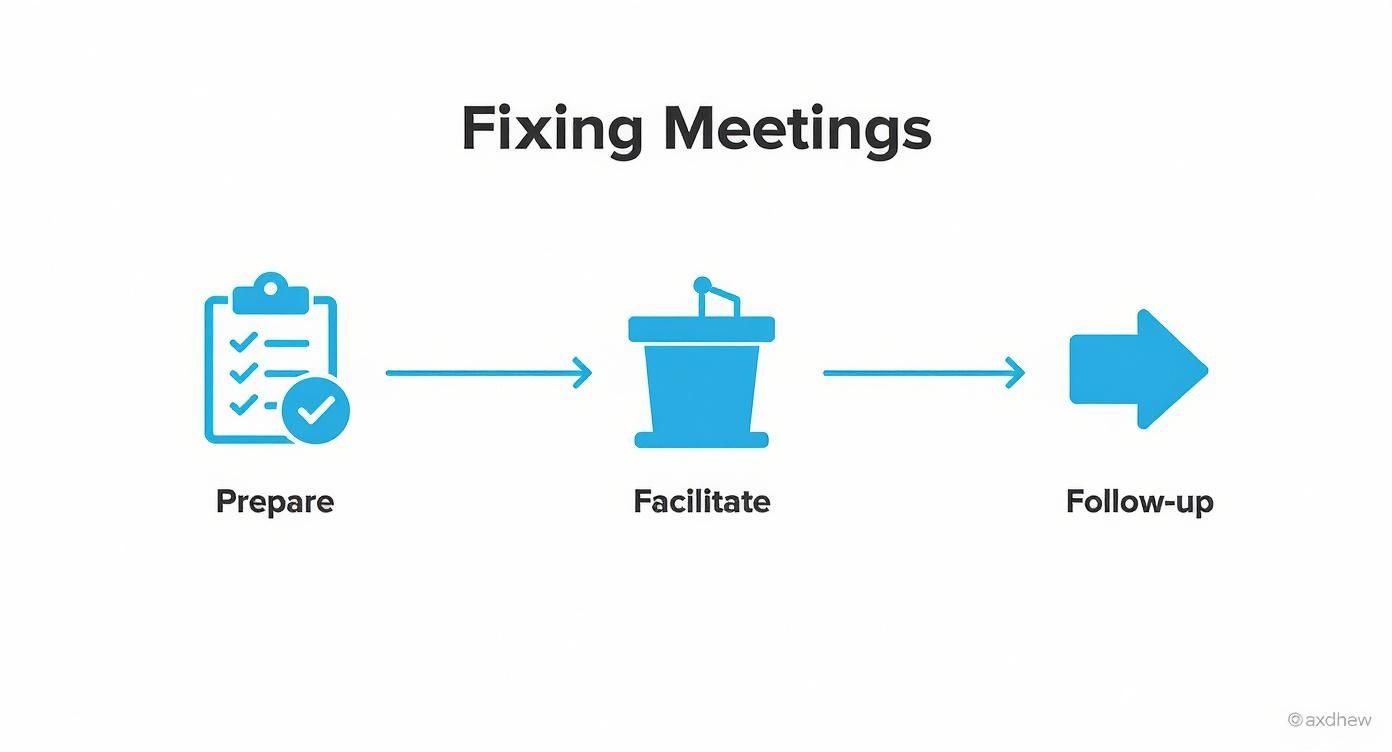
This simple loop shows how the real work starts with meticulous prep. That preparation empowers you to facilitate with confidence, which then leads directly to decisive, actionable follow-up.
Define a Single, Razor-Sharp Objective
Before you even think about calendar invites, you need a crystal-clear answer to one question: Why are we meeting? If you can't nail down a single, specific purpose, you should probably just cancel.
Vague goals like "discuss the Q3 marketing plan" are an open invitation for a meandering conversation. A sharp objective, on the other hand, acts as a north star, guiding every part of the discussion.
Let’s get specific. Instead of a general topic, define a tangible outcome:
- Weak Objective: "Review the latest sales numbers."
- Strong Objective: "Decide on the top three strategies to address the 15% drop in enterprise sales, based on last month's performance data."
See the difference? This level of clarity immediately proves the meeting’s value and sets a clear benchmark for what "success" looks like. A successful meeting ends with that decision locked in.
Craft a Purpose-Driven Agenda
The agenda is your roadmap, not just a list of topics. A well-designed agenda can single-handedly transform a meeting from a passive status update into an active, decision-making work session.
Unfortunately, this is where most meetings fall apart. An analysis of millions of meetings found that a shocking 37% don't even have an agenda. It's no surprise, then, that only 37% of those meetings result in a concrete decision. You can read the full analysis on meeting effectiveness to see just how deep this problem runs.
A great agenda does more than just list what you'll talk about. It assigns ownership and—crucially—allocates time.
An agenda is a strategic document. It tells participants not just what will be discussed, but why it matters, who is responsible for leading each part, and how long they have to do it.
Here’s a simple structure for an agenda that actually works:
- State the objective at the top. Remind everyone why they’re there.
- Frame topics as questions. Instead of "Customer Churn," try "How can we reduce customer churn by 5% this quarter?" This primes everyone for problem-solving, not just reporting.
- Assign an owner to each item. Every topic needs a designated owner responsible for prepping materials and guiding that specific discussion. No owner, no agenda item.
- Timebox everything. Be realistic but firm with timing. Timeboxing creates urgency and prevents one topic from hijacking the entire meeting.
- Send it out 24 hours in advance. This is non-negotiable. It shows respect for everyone's time and allows them to come prepared. Thoughtful preparation and clear communication are fundamental steps you can take to improve team collaboration on any project.
Assign Clear Roles for Accountability
For a meeting to run like a well-oiled machine, people need to know their jobs. Assigning roles ensures that someone is always steering the ship, someone is capturing the important details, and everyone knows their part. It eliminates confusion and keeps the focus on the objective.
Here are the essential roles I've found make the biggest difference, especially in a fast-moving environment.
Essential Meeting Roles and Responsibilities
| Role | Primary Responsibility | Key Action |
|---|---|---|
| Facilitator | Keep the meeting on track and on time. | Guides the discussion, enforces the agenda, and ensures all voices are heard. |
| Note-Taker | Capture key decisions and action items. | Documents who is responsible for what and by when. Distributes summary after. |
| Timekeeper | Monitor the clock against the agenda. | Gives warnings when time for an agenda item is running out to keep things moving. |
| Contributor | Actively participate and provide input. | Comes prepared to share insights, data, and perspectives relevant to the objective. |
Making these roles explicit before the meeting starts is a simple trick that dramatically improves outcomes. Everyone knows what's expected of them, which naturally leads to more engagement and accountability.
Curate the Invite List Ruthlessly
One of the quickest ways to torpedo a meeting’s effectiveness is to invite too many people—or worse, the wrong people. Every single person in that room (or on that call) should have a clear and vital reason for being there.
They should be a key decision-maker, an essential contributor with unique knowledge, or someone directly responsible for executing the plan. That's it.
A great rule of thumb is Amazon's famous "Two-Pizza Rule." If you can't feed everyone in the meeting with two large pizzas, you've invited too many people. This isn't just a quirky startup mantra; it's a practical constraint that forces you to be selective and keep the group small enough for an agile, decisive conversation.
When you're building your invite list, be ruthless. Ask yourself these questions for each person:
- Is their specific input essential to achieving the objective?
- Are they a final decision-maker on this topic?
- Will they be directly responsible for the action items that come out of this meeting?
If the answer to all of these is "no," that person can almost certainly be updated with a summary later. Keeping the group tight and focused isn't about being exclusive; it’s about respecting everyone's time and creating an environment where a real decision can be made efficiently. Nail this, and you're already halfway to a productive meeting.
Mastering Real-Time Meeting Facilitation
Preparation gets you to the starting line, but real-time facilitation is where the magic happens. This is where leadership stops being a concept and starts being an action. A great facilitator is like an orchestra conductor, skillfully guiding the conversation so every person contributes to a productive outcome.
This active guidance is critical in the modern workplace. Data from Microsoft shows a staggering 57% of meetings are now ad-hoc calls, and one in ten scheduled meetings don't even have a clear purpose. The result? Constant interruptions and derailed workdays. A skilled facilitator, like a fractional executive, brings much-needed structure to this environment, turning potential chaos into focused progress.
Kicking Off with Purpose and Energy
How you start the meeting sets the entire tone. Don't just jump into the first agenda item. Take 60 seconds to anchor the room and create a shared sense of mission.
Start by clearly restating the meeting's one and only objective. Then, do a quick walkthrough of the agenda, confirming the key discussion points and how much time you've blocked for each.
"Good morning, everyone. The goal for the next 45 minutes is to decide on our top three Q3 growth experiments. We'll spend 15 minutes reviewing the data, 20 minutes debating the options, and the final 10 minutes locking in a decision. Let’s get started."
This simple, confident opening shows you respect everyone's time and signals that this isn't just another chat—it's a work session with a clear destination.
Keeping the Conversation on Track
One of the biggest meeting derailers is the inevitable tangent. A team member brings up a valid but unrelated point, and suddenly the whole conversation has veered off-course. A great facilitator knows how to handle these moments without shutting down good ideas.
The trick is to use a "Parking Lot." This is simply a designated space—a corner of the whiteboard, a section in the shared notes—where you can "park" important but off-topic ideas to be dealt with later.
Here’s how you do it:
- Acknowledge the value of the idea. This shows you're listening.
- Gently explain that it's outside the scope of the current objective.
- Promise to capture it in the parking lot and follow up on it separately.
You could say, "That's a fantastic point about our long-term branding, Sarah. It deserves a proper discussion. I'm adding it to our parking lot to make sure we circle back, but for now, let's stay focused on the Q3 experiments." This keeps the momentum going while making sure no good idea gets lost.
Managing Personalities and Driving Participation
Every team is a mix of personalities. You've got the dominant talkers who monopolize the airtime and the quiet thinkers who have brilliant ideas but are hesitant to speak up. Your job as a facilitator is to balance these dynamics to get the best from everyone.
To manage the over-contributors, use gentle redirection. Phrases like, "Thank you, David, that's a clear perspective. I'd love to hear what others think. Maria, what's your take on this?" work wonders without being confrontational.
For your quieter team members, create a low-pressure way for them to contribute. Instead of a direct "What do you think?", try a more inviting approach: "Alex, I know you've done a lot of work on the user data. Does anything you've seen support or challenge this idea?" This plays to their expertise and gives them a specific entry point into the conversation. Honing your ability to read the room is one of the most powerful executive communication skills you can build.
Driving Toward a Clear Decision
The whole point of most meetings is to make a decision or define next steps. As the time for an agenda item winds down, it's on you to pivot the group from discussion to decision. Don't just let the conversation fizzle out.
You need to actively summarize the key points you've heard and frame the decision that needs to be made.
- "Okay, we're at time for this topic. It sounds like we've landed on two main options: Option A is lower cost but slower, and Option B is faster but needs more resources. Are we ready to make a call between these two?"
If the group is stuck, force the issue. Ask for a quick consensus or call for a vote. The key is to never leave an agenda item with an ambiguous outcome. This disciplined, in-the-moment guidance is exactly what a seasoned fractional executive brings to the table—turning conversations into concrete actions that move the business forward.
Turning Meeting Outcomes into Action
A meeting without clear follow-up is just a conversation. The real value gets created after everyone leaves the room, but this is exactly where momentum dies. For a fractional executive, turning discussion into documented action isn't just a best practice—it's how you drive accountability and get measurable results.
The window to do this effectively is surprisingly short. To make sure decisions stick and keep the urgency high, the meeting summary needs to land in everyone’s inbox within 24 hours. Any longer, and the details start to get fuzzy, letting ambiguity creep back in.
Crafting the Actionable Summary
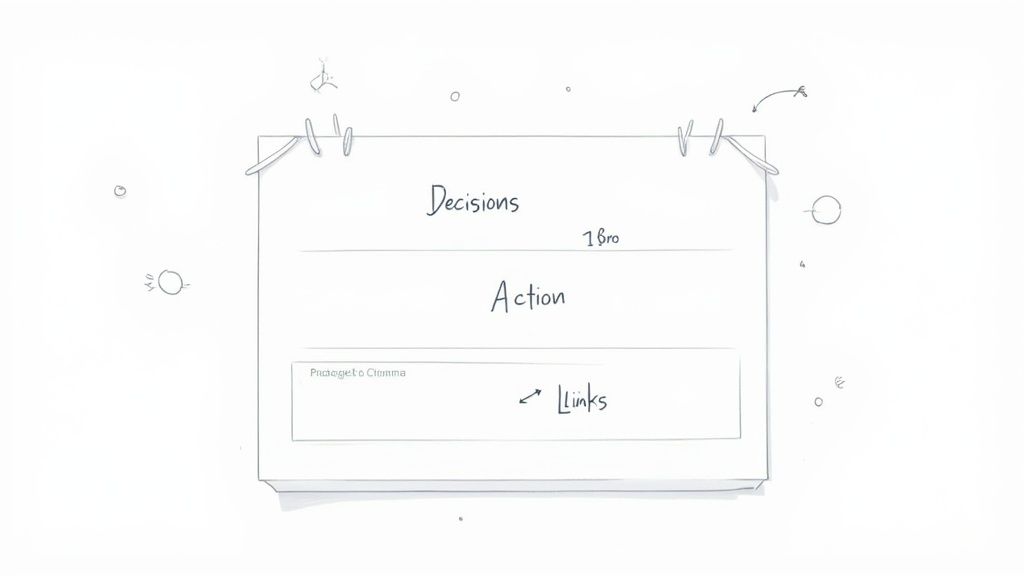
Your meeting summary should never be a transcript. No one will read it. Instead, think of it as a concise, scannable document that answers three critical questions at a glance: What did we decide? Who is doing what? And where can I find the related info?
This summary becomes the single source of truth that keeps the entire team aligned.
A great summary really only needs three things:
- Decisions Made: State every final decision in plain, unambiguous language. Kill the corporate jargon. Instead of "Synergized on Q4 marketing direction," get specific: "Decision: We will reallocate $15,000 of the paid social budget to creator-led video content for the holiday campaign."
- Action Items (with Owners & Deadlines): This is the most crucial part. List every single task, assign it to one owner (never a group), and give it a firm, specific due date. There is no room for vagueness here.
- Key Links & Resources: Drop in direct links to any documents, dashboards, or presentations that were discussed. This simple step saves everyone from digging through emails or shared drives later.
From Summary to Workflow Integration
Sending the email is just the start. To ensure nothing falls through the cracks, those action items have to move from the summary into your team’s project management system—whether that's Asana, Jira, Trello, or something else.
This is the bridge between talking and doing. Manually creating those tasks in your PM tool right after sending the summary is a small bit of admin work that pays off massively. It puts the work directly into the team’s daily flow, making it visible, trackable, and much harder to forget.
The ultimate goal is to make accountability effortless. When action items live alongside all other project tasks, follow-up becomes a natural part of the team's weekly rhythm, not an extra chore for the manager.
This consistent, disciplined follow-through builds a powerful culture of execution. People quickly learn that meetings produce real work with real deadlines. This is a primary benefit of bringing in seasoned fractional leadership—they install the systems that turn good intentions into tangible progress. To take this a step further, you can refine your team's execution by exploring our guide on how to make decisions faster and build momentum.
How to Run Meetings That Don't Suck
One of the fastest ways to kill momentum is to treat every meeting the same. The rapid-fire energy of a daily stand-up has a completely different DNA than a deep, forward-looking strategic review. Applying the same rigid structure to every gathering is just asking for frustration.
If you don't adapt, team members get whiplash. They feel micromanaged in creative sessions or lost when a tactical check-in spirals into an abstract debate about the five-year vision. For a fractional executive, mastering the art of matching the meeting's design to its purpose isn't just a nice-to-have—it's how you drive results without wasting a single minute.
Let's break down the core meeting types and how to run them effectively.
The Daily Stand-Up or Huddle
This meeting is all about speed and alignment. It’s a quick sync to clear roadblocks and get everyone pointed in the same direction for the next 24 hours. Think of it as a momentum-builder, not a deep problem-solving session.
A daily stand-up should never last longer than 15 minutes. To keep it that tight, everyone comes prepared to answer three simple questions:
- What did I accomplish yesterday?
- What am I focusing on today?
- What's standing in my way?
The biggest trap is letting the stand-up devolve into a status report for the manager. If a real blocker comes up, the right move is to acknowledge it, identify the people needed to solve it, and say, "Let's sync up on that right after this." Don't let the whole team get bogged down in a problem only two people can solve.
The Weekly Tactical Meeting
This is your team’s operating rhythm. It’s where you review progress against key metrics, tackle tactical hurdles, and ensure everyone is clear on priorities for the week ahead. It’s more detailed than a stand-up but still firmly focused on the here and now.
An effective tactical meeting runs for 30 to 60 minutes and lives by its agenda. For a marketing team, that might look something like this:
- Metrics Review (10 mins): Quick pass over the weekly KPI dashboard. How are leads, conversion rates, and ad spend looking?
- Priority Updates (15 mins): Brief updates from each person on their key projects.
- Roadblock Triage (15 mins): Discuss and solve the most pressing issues holding the team back.
- Confirm Next Steps (10 mins): Lock in action items and owners for the coming week.
The danger zone? Getting sidetracked by big, strategic "what if" questions. A good facilitator acts as the guardian of the agenda, gently steering the conversation back to the current week's execution.
The Monthly Strategic Review
Time to zoom out. This meeting is for stepping back from the daily grind to assess progress against the big picture—your quarterly or annual goals. It’s a forward-looking session meant for course corrections, not getting stuck in the tactical weeds.
As a fractional CMO, this is the meeting where I ensure our marketing efforts are still driving the company's main business objectives. These sessions need more breathing room, usually 60 to 90 minutes, and a different kind of prep.
The moment a strategic meeting gets pulled into tactical debates, it has failed. The facilitator's number one job is to protect that 30,000-foot view and stop the team from debating minor execution details.
The agenda should reflect this high-level focus. You should be discussing market trends, competitive moves, progress on OKRs, and high-level resource allocation. The conversation needs to stay centered on the "why" and the "what," leaving the "how" for other forums.
The Brainstorming Session
This meeting is a completely different beast. Its only job is to generate new ideas—not to make decisions. The entire structure must be built around fostering creativity and psychological safety.
A great brainstorming session can run for 45 to 60 minutes and often follows this flow:
- Frame the Problem (5 mins): Get super clear on the specific challenge you're trying to solve.
- Silent Idea Generation (10 mins): Everyone quietly writes down their own ideas. This is crucial—it prevents groupthink and gives introverts a chance to contribute.
- Share and Cluster (20 mins): Go around the room and have each person share their top ideas while someone groups similar concepts on a whiteboard.
- Prioritize and Refine (15 mins): Have a quick chat to spot the most promising ideas that deserve more exploration later.
The absolute worst thing you can do is shoot down ideas as they're shared. It kills creativity on the spot. A facilitator has to be ruthless in enforcing a "no bad ideas" rule during the ideation phase.
This nuanced understanding of how to run different meetings is a core skill an experienced fractional leader brings to the table. It’s how you guarantee that every hour your team spends together actually moves the needle.
To make it even clearer, here’s a quick comparison of these common meeting types. Thinking about your meetings through this lens can help you spot mismatches between a meeting’s purpose and how it’s actually being run.
Meeting Type Comparison
| Meeting Type | Primary Purpose | Ideal Length | Key Success Factor |
|---|---|---|---|
| Daily Stand-Up | Rapid alignment & roadblock removal | 10-15 mins | Strict timeboxing and focus on the "three questions." |
| Weekly Tactical | Review progress & solve immediate issues | 30-60 mins | A tight, recurring agenda focused on weekly execution. |
| Monthly Strategic | Assess long-term goals & course-correct | 60-90 mins | Protecting the high-level view from tactical weeds. |
| Brainstorming | Generate new ideas without judgment | 45-60 mins | Psychological safety and separating idea generation from evaluation. |
Getting this right isn't just about efficiency; it's about building a culture where people feel their time is respected and their contributions matter. It ensures every conversation has a clear purpose and drives a tangible outcome.
If you feel like your key meetings are spinning their wheels, it might be a sign that you need a leader with the experience to install these effective operating rhythms. Explore how our fractional executives can bring this level of strategic clarity and execution to your team.
Common Questions About Running Effective Meetings
Even with a great playbook, shifting your company’s meeting culture runs into real-world challenges. I’ve helped dozens of founders build better operating rhythms, and the same tricky questions pop up again and again.
Here are my go-to answers for the most common ones.
How Do I Handle a Senior Leader Who Constantly Derails Meetings?
This one is delicate but critical. When a senior person—or even the founder—consistently goes on tangents, it kills momentum and undermines the entire process you're trying to build. The only way to handle it is respectfully but directly, using the established system as your shield.
Don't call them out in the middle of a meeting. Instead, pull them aside for a private chat before the next one.
You can frame it like this: "To make our strategic meetings more decisive, I'm being really disciplined with the agenda and timeboxing. I know we both have a ton of great ideas, but to keep us on track, I'm going to start using a 'parking lot' for topics that fall outside our main objective. It'll help me make sure we hit our goal for the session, and we won’t lose those important thoughts."
This approach depersonalizes the issue. You aren’t criticizing them; you're upholding a new, agreed-upon process designed to make everyone more effective. It reframes your role from enforcer to a guardian of the team's time.
What’s the Best Way to Manage Hybrid Meetings Fairly?
Hybrid meetings are notoriously hard to get right. It's too easy for remote attendees to feel like second-class citizens, tuning into a conversation they can't fully participate in.
There's one single rule that makes all the difference: default to the remote experience.
This means if even one person is dialing in, everyone else in the office should join from their own laptop, with their own camera on. This simple move puts everyone on an equal digital footing. No more huddles around a single conference phone.
A hybrid meeting succeeds or fails based on one simple principle: creating a level playing field for participation. When in-person attendees cluster together, remote participants are immediately at a disadvantage.
The facilitator also needs to be extra vigilant. You have to make a conscious effort to bring remote voices into the conversation. Call on them by name. Use digital tools like polls or virtual whiteboards where everyone can contribute at the same time.
How Do We Stop Recurring Meetings from Becoming Stale Status Updates?
This is a classic. The weekly team meeting that was once a vital sync slowly devolves into a low-energy, rote check-in that everyone secretly dreads. We call this a "zombie meeting."
The fix is to treat every recurring meeting like a product that needs regular iteration.
At least once a quarter, ask the team point-blank: "Is this meeting still the best way to achieve its original goal?" You'll often find that the "status update" portion can be handled asynchronously in a Slack channel or a shared document, freeing up valuable time.
If you decide the meeting is still necessary, find ways to inject new energy:
- Rotate the facilitator role among different team members.
- Start with a quick "win of the week" to kick things off with positive energy.
- Dedicate half the time to a deep dive on one specific challenge instead of a shallow review of everything.
Treating every recurring meeting as an evolving tool, not a fixed appointment, keeps it valuable. This is the kind of proactive management an experienced fractional executive brings—instilling a culture of continuous improvement and deep respect for everyone's time.
Transforming your meeting culture is one of the highest-leverage changes a leader can make. It takes discipline, but the payoff in clarity, accountability, and speed is immense. If you’re ready to bring this level of operational excellence to your team, we can connect you with a vetted fractional executive who knows how to implement these systems and drive real results.
Schedule a consultation to find the right leader for your business.