
A Complete Go To Market Strategy Framework for Scalable Growth
Launching a product without a plan is just a glorified wish. A go-to-market (GTM) strategy framework is what turns that wish into a deliberate, calculated plan for winning your market. It’s the blueprint that gets your product, marketing, and sales teams rowing in the same direction.
This framework is your detailed action plan for launching a new product, entering a new market, finding your ideal customers, and carving out a competitive advantage. It’s about moving from guesswork to a data-backed strategy that captures market share.
Your Blueprint for Market Success
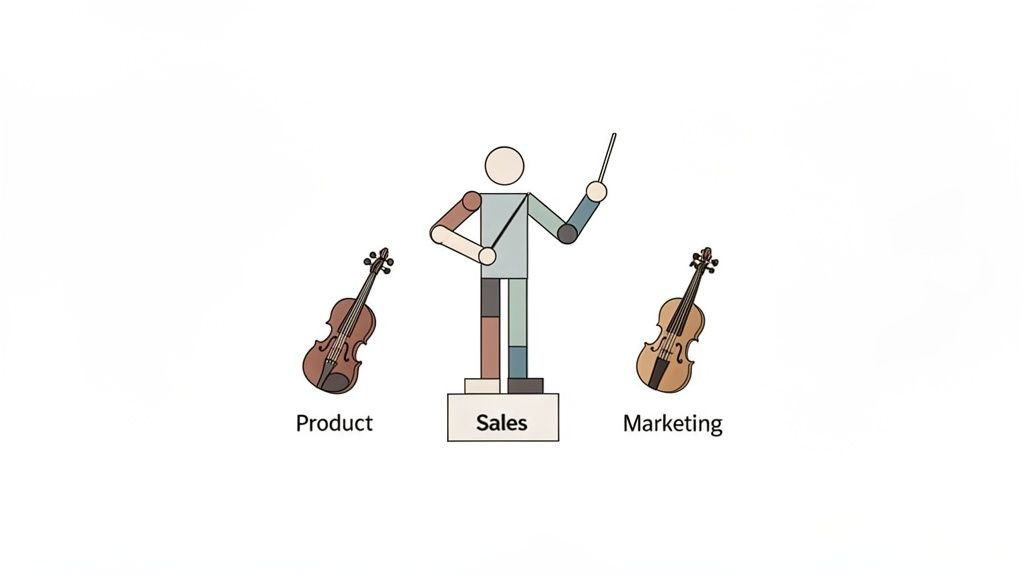
Think of your business as an orchestra. Your product team has composed a beautiful symphony, but without a conductor, the musicians—sales and marketing—might play from different sheet music. You’d get noise, not a masterpiece.
Your GTM strategy framework is that conductor. It ensures every department plays in harmony to deliver a performance that resonates with your audience.
In short, it’s the master plan that answers the most critical questions before you spend a dime on launching:
- Who are we actually selling to?
- What problem are we uniquely solving for them?
- How are we going to find them and convince them to buy?
- Where will we compete—and how will we win?
Why a Framework Is Non-Negotiable
Trying to launch without a GTM framework is like setting sail without a map and compass. You might have a great ship (your product), but you’re just hoping the currents take you somewhere profitable.
This structured approach forces you to get crystal clear on your plan and align the entire organization. It’s how you turn lofty business goals into a concrete, executable strategy everyone can follow.
The data backs this up. According to market analysis, companies with a well-defined GTM strategy achieve 10% higher success rates than competitors who just wing it. Even more telling, these organized businesses can see up to three times more revenue growth. You can dig into more data on GTM effectiveness and revenue growth to see the impact.
The Core Pillars of a Go To Market Framework
So, what goes into this master plan? A solid GTM framework is built on a few essential pillars. Each one forces you to make critical decisions that, when combined, create a clear path to predictable and scalable revenue. Getting these pillars right is the first step toward turning your product vision into a market reality.
This table gives you a sneak peek at the core components we’ll be breaking down.
| Pillar | Core Question It Answers |
|---|---|
| Target Market | Who is our ideal customer and what do they really care about? |
| Value Proposition | Why should they choose us over everyone else? |
| Channels | Where do our customers hang out and how will we reach them? |
| Pricing | What is our product worth and how will we charge for it? |
| Sales Motions | How will we actively sell and close deals? |
| Enablement | What do our teams need to successfully execute the plan? |
| Metrics | How will we measure success and know if this is working? |
Each of these pillars is interconnected, forming a complete strategy for growth.
A GTM strategy is not a document you create once and file away. It's a living blueprint that guides your team’s decisions, making sure every dollar spent and every hour worked pushes you closer to your revenue goals.
In the sections that follow, we'll dive deep into each of these components. We’ll look at how they fit together to create a cohesive strategy that doesn’t just launch your product but builds a sustainable engine for growth.
The Seven Core Components of a Winning GTM Framework
A powerful go-to-market strategy isn’t some monolithic document you write once and forget. It’s a high-performance engine, built from seven distinct but interconnected parts. When every component is dialed in and working in sync, you get a powerful machine for growth.
Think about it like building a race car. You need a skilled driver who knows the track (target market), a powerful engine (value proposition), the right kind of fuel (pricing), and a clear roadmap (channels). Miss any one of these, and the whole thing sputters to a halt.
Let’s pop the hood and look at each essential piece of your GTM machine.
Your Target Market and Ideal Customer Profile
Before you sell anything, you must know exactly who you're selling to. This goes way beyond surface-level demographics. Defining your Ideal Customer Profile (ICP) is like a detective building a detailed profile—you need to understand their habits, motivations, and deepest pain points.
Your ICP answers the make-or-break questions:
- What industry are they in? (e.g., B2B SaaS, FinTech, Ecommerce)
- What is their company size? (e.g., 50-200 employees, <$10M ARR)
- What keeps them up at night professionally? (e.g., inefficient workflows, high customer churn)
- What's the trigger event that makes them look for a solution now? (e.g., a failed audit, a new compliance rule)
Without this laser focus, your marketing and sales efforts are just shots in the dark. A sharp ICP is the absolute foundation of your entire go to market strategy framework.
Your Value Proposition and Messaging
Okay, you know your "who." Now it's time to nail your "what" and "why." Your value proposition is a simple, punchy statement that spells out the unique benefit you deliver to your ICP. It’s the dead-simple reason a customer should pick you over everyone else.
This is not a feature list. It’s about the outcome. For instance, instead of saying, "our software has an AI-powered dashboard," you say, "our software cuts your reporting time by 50%, so you can focus on strategic decisions." This value-first message needs to be everywhere—your website, sales decks, and ads.
Your Pricing Strategy
Pricing isn't just about picking a number. It’s a powerful signal that communicates your product's value, your position in the market, and your core business goals. It directly shapes your revenue, profit, and how customers perceive you.
You have a few common models to consider:
- Value-Based Pricing: You charge based on the tangible ROI your product delivers.
- Competition-Based Pricing: You set your prices based on what direct competitors are charging.
- Cost-Plus Pricing: You calculate your costs and add a standard markup.
The right model must align with your ICP’s buying habits and how much value they get from your solution. Mess this up, and you’ll either leave money on the table or price yourself out of the market.
Your Distribution Channels
How will you actually get your product to your customers? Your distribution channels are the highways you use to reach your target market. You can go direct—selling through your own website or sales team—or indirect, using partners, resellers, or marketplaces.
The right channels depend entirely on where your ICP hangs out. Selling complex enterprise software? A direct sales team is non-negotiable. Building a DTC brand? Social commerce and a killer e-commerce site are your bread and butter.
A classic startup mistake is trying to be everywhere at once. A winning GTM framework masters the one or two channels where your ideal customers are already active and waiting for a solution.
Your Sales and Marketing Motions
This is the playbook. It defines the specific tactics your teams will run to attract, engage, and close customers. It’s where strategy turns into action. We’re seeing a big shift here, with market research showing that 37% of companies are now building their entire motion around the product itself, while 26% remain sales-led. You can learn more about how modern startups are structuring their GTM strategies on Stripe.com.
This playbook needs to cover:
- Marketing Funnel: The journey from awareness to purchase, with the right content for each step.
- Sales Process: The specific stages from qualifying a lead to demoing, sending a proposal, and closing the deal.
- Lead Generation Tactics: Are you going all-in on inbound content, paid ads, outbound prospecting, or a mix of all three?
Your Customer Success Plan
Getting the signature is just the start. A real customer success plan ensures that new clients get up and running smoothly, see value fast, and stick around for the long haul. This part of the framework is your best defense against churn and your secret weapon for increasing lifetime value.
Your plan should map out the entire post-sale experience, from the first onboarding call and training session to ongoing support and proactive check-ins. A solid customer success motion turns happy clients into your best marketing channel through referrals and glowing case studies.
Your Key Metrics and Analytics
Finally, you need a dashboard. How do you know if any of this is actually working? This is where you define the Key Performance Indicators (KPIs) that tell you whether you're winning or losing. This isn't about vanity metrics; it's about data that drives decisions.
Your must-track metrics usually include:
- Customer Acquisition Cost (CAC)
- Lifetime Value (LTV)
- Conversion Rates (at every stage of the funnel)
- Sales Cycle Length
- Customer Churn Rate
Without these numbers, you’re flying blind. They create the feedback loop you need to constantly tweak and optimize your GTM strategy.
Each of these seven components demands serious strategic thought. The problem is, many growing companies lack the senior-level experience in-house to build them out properly. This is the exact gap a fractional executive fills—giving you seasoned guidance to nail each component without the six-figure salary of a full-time hire.
Building Your GTM Strategy Step By Step
Knowing the components of a go-to-market strategy is one thing; assembling them into a coherent plan is another. This is where theory meets the road.
Building a solid GTM plan isn't about creating a massive document nobody reads. It's about making a series of smart, deliberate choices that connect your product to your ideal customer in the most direct way possible. You're turning abstract goals into an actionable playbook for your entire organization.
Instead of launching with your fingers crossed, you move forward with a clear guide that gets every team marching in the same direction. Think of it less like writing a business plan and more like building a high-performance engine, piece by piece.
The basic flow is simple: define your market, clarify your value, and then select the channels to reach them.
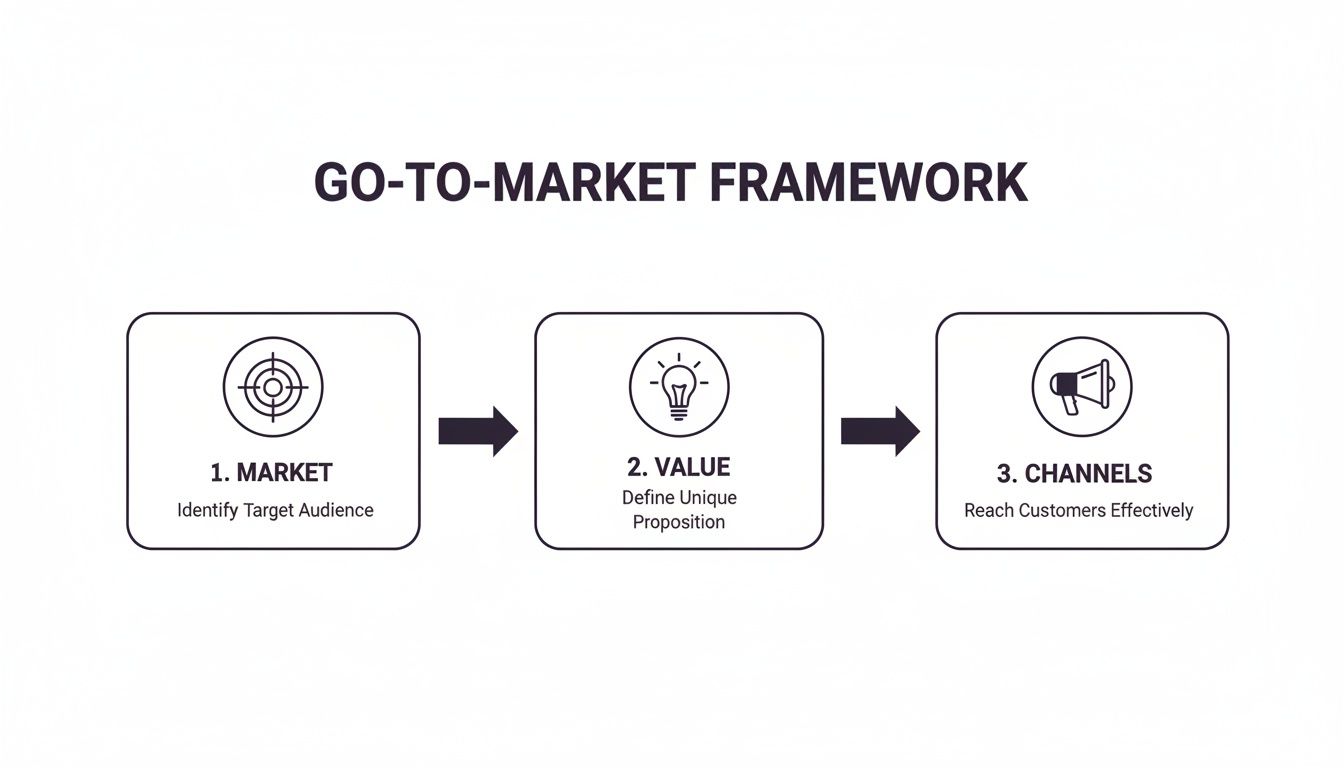
This process visualizes the core progression: from identifying your market and customers, to clarifying your unique value, and finally selecting the channels to deliver that value.
Step 1: Define Your Market Battleground
First, get hyper-specific about who you are serving and what you're trying to achieve. Vague goals like "increase revenue" lead to generic, ineffective strategies that burn cash and morale. You need to define your objectives and your audience with precision.
Start by answering these core questions:
- What’s the primary objective of this launch? Are you trying to capture new market share, expand within your existing customer base, or go head-to-head with a key competitor?
- Who is your Ideal Customer Profile (ICP)? Define the specific industry, company size, and geographic location you are going after first. Don't boil the ocean.
- What are their most urgent pain points? What problems are they actively trying to solve right now that your product is uniquely built to fix?
Getting these answers right prevents you from trying to be everything to everyone—a classic startup killer. A razor-sharp focus on a specific market segment is the bedrock of a successful GTM.
Step 2: Map The Customer's Path To Purchase
Once you know who you’re targeting, you need to understand how they buy. The customer journey isn’t a straight line; it’s a winding path with multiple touchpoints. Mapping this journey lets you show up with the right message at the right time.
A go-to-market plan that ignores the customer's actual buying process is doomed from the start. You have to build your strategy around their world, not force them into yours.
To get this map right, think through each stage:
- Awareness: How will potential customers even find out you exist? Will they find you through a Google search, see you on social media, or hear about you at an industry event?
- Consideration: What information do they need to evaluate your solution? This is where case studies, webinars, and detailed product pages do the heavy lifting.
- Decision: What finally makes them choose you over a competitor? This is where customer testimonials, crystal-clear pricing, and a frictionless demo or trial experience make all the difference.
A well-defined GTM is a non-negotiable part of a broader growth strategy framework that guides a company's long-term expansion.
Step 3: Align Your Revenue Teams
Finally, your go-to-market strategy is useless if your teams aren't aligned to execute it. Sales, marketing, and customer success must operate as a single, unified revenue team with shared goals and a clear understanding of who does what.
This alignment demands:
- A Single Source of Truth: All teams need to work from the same ICP definitions, messaging documents, and performance dashboards. No competing spreadsheets.
- Clear Handoffs: Define the exact criteria for when a lead moves from marketing to sales, and again from sales to customer success. Eliminate the "I thought you were handling that" problem.
- Shared KPIs: While each team will have its own metrics, they must all roll up to shared revenue goals. Everyone needs to be pulling the rope in the same direction.
This operational harmony ensures the customer experience is seamless, from the first ad they see to their one-year renewal. Building this cross-functional plan can be tough, which is why many businesses bring in a fractional leader to orchestrate the process and get every team perfectly in sync.
GTM Framework Examples for Different Business Models
A good go-to-market strategy framework isn’t a one-size-fits-all template. Think of it as a flexible blueprint you must mold to fit your specific business model and market. The core components—market, value prop, channels—are always there, but how you execute them changes everything.
It’s like cooking. The ingredients are universal, but the method for making a delicate soufflé is entirely different from grilling a steak. In the same way, the GTM motion for a high-volume ecommerce brand will look nothing like one for a complex enterprise AI solution.
Let's walk through three distinct playbooks to see how a B2B SaaS company, a direct-to-consumer (DTC) brand, and an enterprise AI startup would each approach their GTM to win.
The Product-Led Growth Playbook for B2B SaaS
For a B2B SaaS company selling to small and medium-sized businesses, the game is all about volume, speed, and a killer user experience. The entire go-to-market strategy is built around product-led growth (PLG), where the product itself does the heavy lifting for customer acquisition and conversion.
The goal here is a low-friction, self-serve motion.
- Target Market: High-growth tech startups and digital marketing agencies with 20-100 employees.
- Value Proposition: "Save 10 hours a week on project management with our intuitive, automated platform."
- Channels: Content marketing that dominates search results (SEO-driven blog posts), paid search ads hitting specific pain points, and deep integrations with other popular SaaS tools.
- Pricing: A freemium model gets users in the door. From there, tiered pricing based on features and user seats encourages upgrades once they see the value.
The Social Commerce Playbook for DTC Ecommerce
A DTC ecommerce brand selling a trendy consumer good plays in a totally different sandbox. Here, the GTM framework is all about brand, community, and impulse buys. The strategy is to show up where customers are already hanging out and making purchasing decisions—on social media.
This approach is about building a powerful brand presence and letting social proof do the talking.
- Target Market: Millennials and Gen Z (ages 18-35) who live on platforms like Instagram and TikTok.
- Value Proposition: "Join a community of style-setters with our ethically-made, limited-edition apparel."
- Channels: Partnerships with influencers, targeted video ads on TikTok and Instagram Reels, and campaigns that encourage user-generated content.
- Pricing: A simple, transparent pricing model with free shipping incentives and "buy now, pay later" options to make clicking "buy" as easy as possible.
When GTM execution is sharp, the revenue impact is undeniable. One study of a multi-category company showed that a focused strategy delivered sales growth exceeding 15% in pilot markets alone. This is also a critical piece of a broader market entry strategy framework.
The High-Touch Sales Playbook for Enterprise AI
Finally, let's look at an enterprise AI startup selling a complex, high-ticket solution to Fortune 500 companies. This GTM framework is the complete opposite of our last two examples. It's 100% sales-led, focused on building deep relationships and navigating complex buying committees over long sales cycles.
For enterprise sales, the GTM strategy isn’t about generating thousands of leads; it’s about identifying and winning a handful of high-value accounts that can transform the business.
This motion is slow, methodical, and incredibly resource-intensive.
- Target Market: Chief Information Officers and Heads of Innovation at financial services and healthcare companies with over $1 billion in revenue.
- Value Proposition: "Reduce operational risk and unlock new revenue streams with our predictive AI engine."
- Channels: Account-based marketing (ABM), exclusive executive networking events, and direct outreach from a senior sales team.
- Pricing: Custom enterprise-level pricing is created after a detailed needs analysis and a successful proof-of-concept (POC) trial.
To bring these differences into sharper focus, let's compare them side-by-side.
GTM Framework Comparison SaaS vs Ecommerce vs AI
This table breaks down how the core components of a GTM strategy shift depending on the business model. Notice how the tactics for reaching customers and closing deals are tailored to the product's complexity and the buyer's journey.
| GTM Component | B2B SaaS Example | DTC Ecommerce Example | Enterprise AI Example |
|---|---|---|---|
| Target Market | SMBs, Tech Startups (20-100 employees) | Consumers (Ages 18-35) | Fortune 500 (>$1B revenue) |
| Value Prop | Efficiency & Automation | Brand & Community | Risk Reduction & Revenue Growth |
| Channels | SEO, PPC, Integrations | Social Media, Influencers | ABM, Executive Events, Direct Sales |
| Pricing Model | Freemium, Tiered Subscriptions | One-time Purchase, BNPL | Custom Enterprise Contracts, POCs |
| Sales Motion | Self-Serve, Product-Led | Impulse-Driven, Social Commerce | Relationship-Based, High-Touch Sales |
As you can see, what works for one company would be a complete disaster for another.
Successfully navigating these different paths often requires specialized leadership—the kind of seasoned expertise that’s tough for a growing company to find or afford. This is exactly where a fractional executive can be a game-changer, bringing the specific playbook you need to execute your plan perfectly.
The Leadership Gap in Go-to-Market Execution
Let's be honest: a brilliant go-to-market strategy on paper is worthless without expert execution.
This is a painful truth many growing businesses discover too late. They craft the perfect plan—identifying their ideal customer and nailing the value proposition—only to watch it fall flat.
The problem often isn't the strategy itself, but a critical gap in leadership. A well-designed GTM plan is a complex machine with dozens of moving parts. Without seasoned, senior leadership at the helm, that machine sputters and stalls, burning through cash and morale in the process.
This leadership vacuum typically shows up in three areas that directly impact revenue and growth.
The Need for Strategic Marketing Leadership
Effective marketing for a GTM launch is about more than running a few ads. It demands high-level strategic thinking. A real marketing leader is responsible for positioning the product in a crowded market, crafting a compelling narrative that connects with your audience, and building a brand that customers trust.
Without that senior oversight, marketing efforts quickly dissolve into a series of disconnected, ineffective tactics. You need a leader who can own:
- Brand Positioning: Carving out a unique and defensible spot in the customer's mind.
- Messaging Architecture: Creating a consistent story that sales, marketing, and product teams can all tell effectively.
- Demand Generation Engine: Building a predictable system for attracting qualified leads, not just generating random clicks.
When this leadership is missing, even a fantastic product can feel invisible or completely misunderstood in the market.
The Requirement for Experienced Sales Leadership
Similarly, building a revenue engine requires more than just hiring a few salespeople and hoping for the best. An experienced sales leader, like a Chief Revenue Officer (CRO), designs the entire sales motion. They are the architect of the process that turns qualified leads into closed deals—repeatably and scalably.
This involves making critical, high-level decisions that a junior team isn't equipped to handle:
- Sales Process Design: Defining the exact stages of the sales cycle, from first touch to signed contract.
- Team Building and Training: Hiring the right talent and giving them the playbooks, tools, and skills they need to win.
- Compensation Plans: Structuring incentives that drive the right behaviors and align with the company's financial goals.
Without this expertise, sales efforts are often chaotic and inconsistent. The result? Unpredictable revenue and painfully missed forecasts.
A GTM plan without strong sales and marketing leadership is like an orchestra without a conductor. The individual musicians might be talented, but without someone to guide the tempo and execution, the result is noise, not music.
The Solution: Fractional Leadership
For most startups and SMBs, hiring full-time, C-suite executives like a CMO or CRO is a non-starter. A six-figure salary, plus benefits and equity, can cripple a lean budget before the GTM plan even has a chance to prove itself. This creates a painful catch-22: you need senior expertise to grow, but you need to grow to afford that expertise.
This is precisely where fractional leadership comes in as a powerful, elegant solution.
By hiring a fractional executive, you get access to the same C-suite expertise that drives success at massive corporations, but on a part-time, flexible basis. A fractional CMO or CRO can join your team for 10-20 hours a week to provide the strategic direction, mentorship, and hands-on execution needed to bring your GTM framework to life.
This model makes top-tier talent both accessible and affordable. It allows you to de-risk your launch by bringing in a proven leader who has built successful GTM playbooks before. You get the strategic guidance to navigate inevitable challenges and the operational chops to build scalable systems, all at a fraction of the cost of a full-time hire.
If you have a solid plan but lack the senior leadership to execute it, exploring a fractional executive isn't just a good idea—it's the strategic move that can turn your GTM framework from a document into a reality.
How Fractional Executives Drive Your GTM Plan
A go-to-market strategy framework is a fantastic tool, but its real power is unlocked in the execution. This is where many businesses stumble—they have a perfect blueprint but no experienced architect to build the house. Bringing in a fractional executive provides that senior leadership, turning your plan into real-world results.
Hiring an on-demand leader isn’t about filling a seat; it’s a strategic move to inject targeted, high-impact expertise right where you need it. This lets you bring your GTM framework to life with speed and confidence.

Defining Clear Objectives and Scope
The first step with any fractional executive is to define exactly what you need them to do. This isn’t about writing a fuzzy job description. It’s about creating a mission-oriented scope of work tied directly to your GTM plan. Think specific, measurable, and time-bound objectives so they can make an impact from day one.
A fractional engagement works best when it's laser-focused on clear deliverables:
- For a product launch: You might task a fractional CMO with finalizing messaging, building the launch day marketing plan, and managing the initial campaign budget for six months.
- For sales acceleration: A fractional CRO could refine the sales process, implement a new CRM, and train the junior sales team to crush their first-quarter quotas.
This clarity ensures the executive’s time is spent on the highest-value activities that move your go to market strategy framework forward. They become an accountable driver of key results. That’s a massive part of reducing time to market and grabbing opportunities before your competitors do.
Structuring the Engagement for Maximum Impact
Once you know the what, structuring the how becomes much simpler. The beauty of the fractional model is its flexibility—you can tailor the commitment to your exact needs and budget. It gives you the strategic horsepower of a full-time hire without all the overhead.
A fractional executive is like a specialist surgeon. You don't hire them to be on call 24/7; you bring them in to perform a critical operation with precision and expertise, then step back once the patient is on the path to recovery.
Let's use an analogy. A FinTech startup is ready to launch a new mobile app. The product is solid and they have a small marketing team, but they lack the senior leadership to pull off a high-stakes launch.
- The Challenge: They need a VP of Marketing's experience to build the plan, manage a complex budget, and mentor the junior team, but they can’t swing a full-time executive salary.
- The Solution: They bring on a fractional CMO for 15 hours a week for six months. The CMO has one clear mission: execute the product launch playbook, set up the core marketing metrics, and level up the in-house team.
This setup allows the startup to hit critical milestones—like a successful launch and their initial user acquisition goals—without the long-term financial weight. It's a pragmatic, results-first approach to leadership.
Common Questions About GTM Strategy Frameworks
Even the best-laid plans come with a few lingering questions. As you start turning your go-to-market strategy framework from a document into real-world action, a handful of common queries always seem to pop up. Let's tackle them head-on.
Think of it like learning the rules of a new sport. You can read the rulebook, but it’s the weird, situational questions that really show you how to win the game.
How Often Should a Go-to-Market Strategy Framework Be Updated?
Your GTM framework is a living document, not a "set it and forget it" project. Markets change, customers find new ways to buy, and competitors pop up. Your strategy has to keep up.
A good rule of thumb is to check up on it quarterly. This is your chance to make small tweaks based on what the data is telling you.
You’ll need a major overhaul at least annually, or whenever something big happens, like:
- A major shift in customer behavior or a new market trend takes hold.
- A new competitor shows up and starts making waves.
- You make a fundamental change to your product or business model.
This keeps your strategy sharp and relevant.
What Is the Biggest Mistake Companies Make With GTM Strategy?
The single most common—and most expensive—mistake is building the strategy around the product’s features instead of the customer’s problems. It’s an inside-out approach that just doesn’t work. A great GTM framework is always built from the outside-in, starting with an obsessive focus on the customer.
A GTM plan that starts with "here's what our product does" is already on the wrong track. A winning plan starts with "here's the problem our customer has, and here's why we're the best solution for them."
This means you absolutely have to start with a deep, nuanced understanding of your Ideal Customer Profile (ICP). What are their biggest headaches? What does their buying journey actually look like? Without that customer-centric foundation, even the most amazing product will struggle to find an audience.
Can a Small Startup Build an Effective GTM Framework?
Absolutely. In fact, for a startup, a go-to-market strategy framework is even more critical. It forces discipline when you have none to spare. When your budget is tight and your team is small, every dollar and every hour has to count.
A startup’s GTM framework might be hyper-focused on a tiny niche with just one or two marketing channels. That’s fine. The strategic principles are exactly the same. It’s not about building some massive, 50-page document; it’s about making smart, deliberate choices that maximize your impact.
What Is the Difference Between a Business Plan and a Go-to-Market Strategy?
This is a really common point of confusion, but the distinction is pretty simple.
Think of a business plan as the complete architectural blueprint for a new house. It covers everything—the foundation, the plumbing, the electrical, the financials, operations, and legal structure.
Your go-to-market strategy is one specific, highly-detailed section of that blueprint: the part that explains exactly how you're going to sell the house. It nails down who you're selling to (the ICP), what makes your house special (the value prop), how you'll price it, and the specific channels you'll use to find buyers. Simply put, the GTM strategy is the action plan for making money.
Executing a GTM framework, especially when you're navigating it for the first time, can feel like a massive undertaking. The difference between a plan that sits on a shelf and one that drives real growth often comes down to having the right leadership guiding the process. If your GTM plan is ready but you lack the leadership to execute it, Schedule a consultation to see how a vetted fractional leader can fill your leadership gap and drive your growth.