Entrepreneur Operating System: Your Blueprint for Scalable Growth
An Entrepreneur Operating System (EOS) is a simple, no-nonsense toolkit designed to help you get a real grip on your business. It's not academic theory; it's a field-tested framework for getting your entire team aligned on your vision, creating discipline, and building a healthy company where everyone is rowing in the same direction.
What Is an Entrepreneur Operating System Really?
Think of your business as a high-performance car. You might have all the best parts—a great product, talented people, a solid market. But without a well-tuned engine and transmission, all that potential just spins its wheels. An entrepreneur operating system is what connects everything, making sure the power gets to the pavement.
It’s a practical framework that gives you a consistent way to define your vision, manage your people, track your numbers, solve tough problems, and lock in your core processes. At its core, it's about gaining traction on what matters most.
Moving From Chaos to Clarity
For too many founders, running a business feels like constant firefighting. You’re lurching from one crisis to the next, your team members seem to have different ideas about the top priorities, and accountability is a fuzzy concept at best. Hitting a growth ceiling is the most common—and frustrating—symptom of this operational chaos.
This is exactly the pain an entrepreneur operating system is built to fix. It installs a structure for:
- Defining a Crystal-Clear Vision: Making sure every single person in the company knows exactly where you’re going and how you plan to get there.
- Building True Accountability: Creating a culture where responsibilities are clear and people own their results, period.
- Making Data-Driven Decisions: Moving away from gut feelings to objective numbers that tell you the real story of your business.
- Solving Problems for Good: Putting a system in place to identify, discuss, and permanently solve issues at their root, so you're not having the same frustrating conversations over and over.
An operating system turns a business from a collection of individuals working near each other into a truly unified team executing a shared plan. It replaces complexity with simplicity and subjective arguments with objective data.
Instead of being trapped working in your business, an EOS gives you the structure to finally work on your business. It channels the wild energy of a startup into the focused execution needed to scale sustainably. This is how you break through frustrating growth plateaus and build a company that can actually run without you.
The Six Core Components of a Powerful Business OS
An entrepreneur operating system isn't a single piece of software or a magic bullet. It’s a holistic framework built on six interconnected components. Think of them like the vital systems in a living organism—each one has a unique job, but they all have to work together for the business to be healthy. Mastering these components is what moves a company from reactive chaos to proactive control.
This visual illustrates how a system built on vision, data, and real progress can bring order to the chaos of running a business.
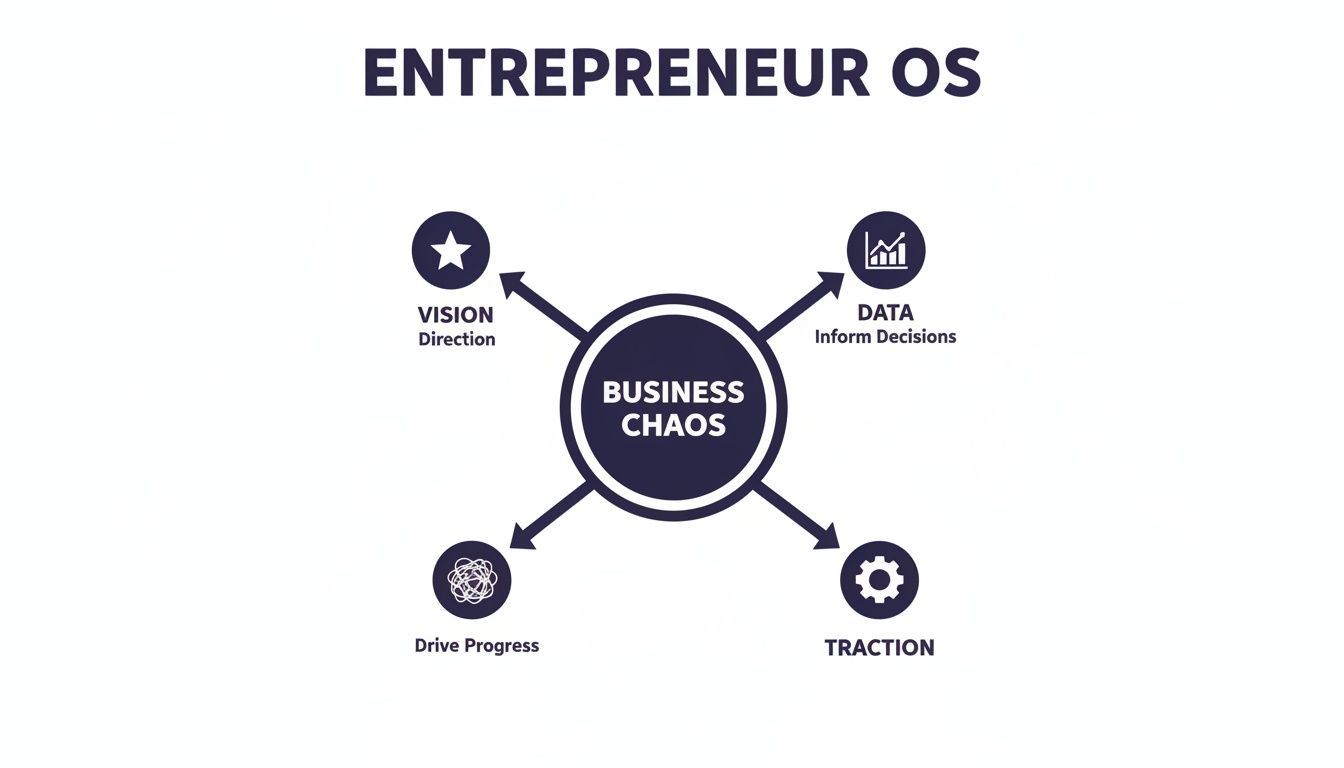
By focusing on these key pillars, a company can transform tangled problems into a clear path forward.
Let's break down exactly what makes this system tick.
| Component | Core Function | Business Impact |
|---|---|---|
| Vision | Get everyone 100% on the same page. | Aligns the entire team on where the company is going and how to get there. |
| People | Surround yourself with great people. | Ensures you have the right individuals in roles that fit their unique skills. |
| Data | Run the business on facts, not feelings. | Creates objective transparency and an early warning system for problems. |
| Issues | Identify, discuss, and solve problems for good. | Builds a culture of proactive problem-solving, preventing recurring issues. |
| Process | Systemize and document your core workflows. | Creates consistency, scalability, and frees up leadership from micromanagement. |
| Traction | Bring the vision down to the ground with execution. | Instills discipline and accountability to make the company's vision a reality. |
Each of these components is crucial. Let's dig deeper into what each one means for your business.
Vision: The Company’s North Star
The Vision component is all about getting every single person in your organization crystal clear on where you're going. This isn't a vague mission statement framed on the wall; it’s a documented, shared understanding of your company's purpose, values, and long-term goals.
This means nailing down your Core Values, defining your Core Focus (what you truly do best), and setting a big, hairy, audacious 10-Year Target. When your vision is this clear, every decision becomes simpler because you have a North Star to guide the way.
People: Getting the Right Individuals in the Right Seats
A brilliant vision is worthless without the right people to make it happen. The People component centers on two critical elements: having the Right People who genuinely share your core values and putting them in the Right Seats where their unique talents can truly shine.
An organization can only be as strong as its team. This component ensures you have a structure where talent thrives, accountability is clear, and everyone is positioned to contribute their best work.
To pull this off, you need a clear structure that maps out every key role and its responsibilities. This process is the foundation of good organizational design, making sure your company's structure actually serves its strategic goals. It cuts through the confusion and ensures every function is owned by someone who has the capacity and desire to excel.
Data: Moving from Gut Feel to Objective Facts
Most founders are drowning in metrics but starving for real insight. The Data component cuts through the noise by focusing on a small handful of objective numbers that give you an absolute pulse on the business. Forget complex dashboards; this is about a simple weekly Scorecard with just 5-15 key metrics.
These numbers act as your early warning system. If a number is off track, you can jump on the issue long before it snowballs into a crisis. This immediately shifts decision-making from subjective opinions and emotions to objective reality.
Issues: Solving Problems for Good
Every business has problems. The difference between successful companies and struggling ones is how they deal with them. The Issues component provides a disciplined process to identify, discuss, and permanently solve problems at their root cause.
Instead of letting challenges fester or having the same frustrating conversations over and over, this system forces you to tackle them head-on. The goal is to build a culture where problems are seen as opportunities for improvement.
Process: Systemizing Your Way of Doing Business
The Process component is about identifying and documenting the core processes that make your business run. This isn't about creating restrictive, bureaucratic manuals. It's about simplifying and capturing the handful of essential workflows that define your company's unique way of delivering results.
By documenting your "secret sauce" for marketing, sales, and operations, you create consistency and scalability. This ensures key tasks are performed the right way, every time, freeing up leadership to focus on the future instead of micromanaging the present.
Traction: Bringing Vision Down to the Ground
Vision without execution is just hallucination. The Traction component is where the rubber meets the road, translating your long-term vision into disciplined, focused action. It's all about establishing a powerful rhythm of accountability throughout the organization.
This is achieved through two primary disciplines:
- Rocks: These are the 3-7 most important priorities for the company (and each individual) that must be accomplished in the next 90 days. Rocks create laser focus on what truly matters right now.
- Meeting Pulse™: This is a series of regular, structured meetings—including a weekly "Level 10 Meeting"—that keeps everyone aligned, accountable, and focused on solving issues and crushing their Rocks.
Traction is the component that instills discipline and makes sure your grand vision becomes a reality, one quarter at a time. By mastering it, your entrepreneur operating system becomes a powerful engine for predictable growth.
Real-World Benefits of Running on an Operating System
Bringing an entrepreneurial operating system into your business isn't an abstract exercise. It delivers real, tangible results that change how the company runs. It's the difference between a garage band making noise and an orchestra playing a symphony.
Imagine every person on your team knowing the company’s top three priorities for the next 90 days. That’s the radical clarity an OS provides. It ends that frustrating cycle where it feels like marketing, sales, and operations are all working for different companies. When the vision is clear and communicated systematically, team alignment becomes the default setting, not an uphill battle.
A Culture of Profound Accountability
This newfound clarity fuels a culture of profound accountability. In a business without an OS, blame is a common defense mechanism. When goals are missed, fingers start pointing because nobody truly owns the outcome. An operating system replaces that ambiguity with real ownership.
With tools like a clear accountability chart and a weekly scorecard, there’s simply nowhere to hide. Responsibilities are defined, and key metrics are tracked openly. This structure builds an environment where people take responsibility not just for their tasks, but for their results.
The shift is palpable. Conversations move from "Whose fault is this?" to "How do we solve this?" This builds a resilient, proactive culture where team members are empowered to take initiative.
This isn't about creating a high-pressure environment; it's about providing the structure for high performance. People thrive when they know what's expected of them and can see how their work contributes to the bigger picture.
Driving Operational Efficiency and Focus
One of the most immediate benefits is a huge jump in operational efficiency. Standardizing your core processes means your team isn't constantly reinventing the wheel. The "right way" to handle key activities—from sales follow-ups to project management—gets documented and followed.
This consistency frees up leadership from the daily grind of putting out fires. Instead of being pulled into every minor operational hiccup, founders and executives can finally dedicate their time to high-value activities:
- Strategic Planning: Focusing on long-term growth and market opportunities.
- Team Development: Mentoring key leaders and strengthening the organization.
- Innovation: Exploring new products, services, and business models.
Think about a small manufacturing firm constantly plagued by inconsistent product quality and missed deadlines. After implementing an operating system, they documented their core production process and established weekly metrics. Within six months, their defect rate dropped by 40%, and on-time delivery shot up to 98%. The owner was no longer stuck on the factory floor and could finally focus on securing larger contracts.
This is the practical return on investment: more time, higher profits, and invaluable peace of mind.
Ultimately, an entrepreneur operating system transforms a chaotic, personality-driven business into a disciplined, scalable enterprise. If your team is struggling to execute a clear vision, finding the right leadership to guide this transformation is essential. Explore how our vetted fractional executives can provide the expertise needed to install and master your new OS.
Your Step-By-Step EOS Implementation Guide
Getting EOS up and running is a journey, not a destination. It demands real discipline and commitment from everyone involved. Think of it like building a custom home: you don't just start throwing up walls. You need a rock-solid foundation and a detailed plan to make sure the final structure is strong and functional.
This guide will walk you through that process, step by step.

Before you even think about the tools, you have to nail the most important step: getting 100% buy-in from your leadership team. An operating system can't just be a mandate from the top; it has to be a shared belief. If even one key leader is dragging their feet, the whole system will eventually wobble.
Phase 1: Solidify Your Foundation
Before you roll out new processes to the entire company, your leadership team needs to be in lockstep. This is where you get brutally honest about who you are, where you're going, and how you're going to get there.
Your first big task is to answer the eight core questions that define your company's DNA. This means getting crystal clear on your core values, your core focus, your 10-year target, and your marketing strategy. The answers get distilled into your Vision/Traction Organizer (V/TO), a simple document that becomes your company’s north star.
Next, it's time to build your Accountability Chart. This isn't your grandma's org chart. Forget who reports to whom; this is all about function and ownership. You define the major functions of the business and put one name in each box—the single person who is ultimately accountable for that area. No more ambiguity.
The V/TO and Accountability Chart are the constitution and structural blueprint for your company. Getting them right isn't just a step; it's the bedrock upon which all future success is built.
Phase 2: Establish Your 90-Day World
With your foundation set, you can bring that big vision down to earth. Welcome to the “90-Day World,” the operational heartbeat of EOS. This is where you break your long-term goals into focused, manageable sprints.
This phase kicks off with setting your first quarterly Rocks. These are the three to seven most important priorities that absolutely must get done in the next 90 days. Rocks provide laser focus and are the ultimate defense against "shiny object syndrome."
At the same time, you'll create your weekly Scorecard. This is a dead-simple report with 5-15 key numbers that give you an objective, at-a-glance pulse on the business. Every number is owned by someone on the leadership team, hardwiring data-driven accountability into your culture.
For entrepreneurs looking to dial in their workflows, these tools are game-changers. If you're struggling to identify the right metrics, check out our guide on process improvement steps to help you pinpoint what truly drives your business forward.
Phase 3: Master The Meeting Pulse
The final piece of the puzzle is mastering the Meeting Pulse—a series of disciplined meetings that keep the entire system humming. The linchpin of this structure is the weekly Level 10 Meeting.
This isn't just another meeting; it's a highly structured, 90-minute session with the exact same agenda every single week. Its purpose is not to share updates but to solve problems. The agenda forces you to review your Scorecard, check in on Rocks, and—most importantly—spend the majority of your time identifying, discussing, and solving the company’s biggest issues.
Getting this meeting right is non-negotiable for success. It takes real discipline:
- Strict Adherence: The meeting happens on the same day, at the same time, every single week. No exceptions.
- Rigid Agenda: You follow the Level 10 agenda to the letter. This keeps conversations on track and brutally effective.
- IDS™ Discipline: You must use the Identify, Discuss, Solve framework to get to the root of every issue, ensuring problems are solved for good.
Once your leadership team has this rhythm down for a quarter or two, you can start cascading the same tools and disciplines throughout the rest of the organization. This methodical rollout ensures your new operating system sticks.
How Fractional Leadership Accelerates Your EOS Success
So, you've decided to implement an Entrepreneurial Operating System. You have the blueprint for success—the ‘what’ needed for clarity and traction. But then reality hits. Many businesses discover a huge gap when it comes to the ‘who.’
Simply put, they don’t have the senior-level expertise or sheer bandwidth on their leadership team to drive EOS implementation. It’s a common and frustrating roadblock.
This is where fractional leadership becomes your secret weapon. The model is built for targeted impact, letting you plug a seasoned executive into your team to own a specific part of your EOS framework—all without the cost of a full-time hire.
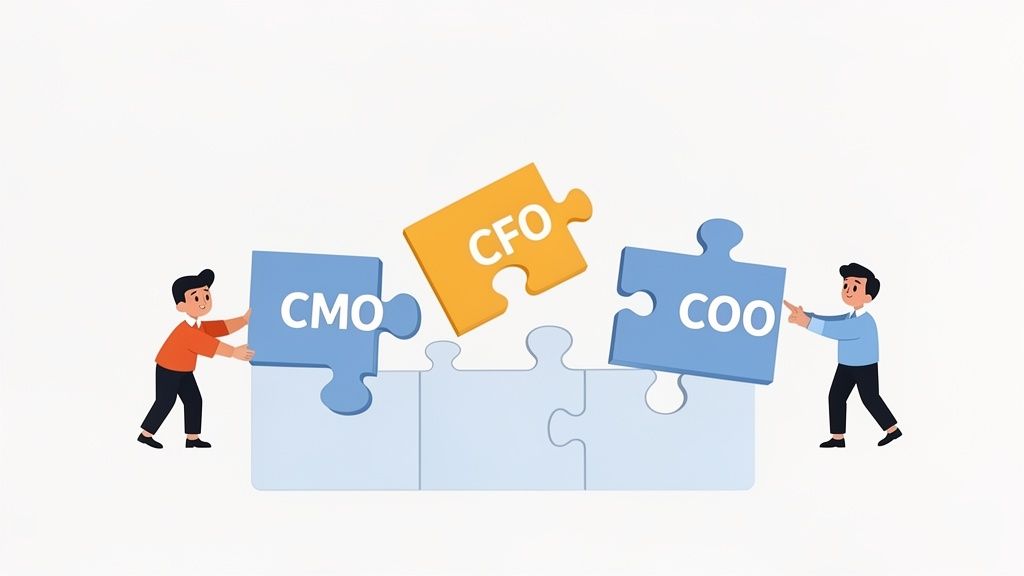
This strategic approach bridges the execution gap that so often stalls an EOS rollout. A fractional leader doesn’t just give advice; they embed directly into your leadership team, take full ownership of their function, and start driving results on day one.
Plugging Directly into Your Operating System
Think of your EOS components as sockets on a power strip, waiting for the right plug. A fractional executive is the specialized adapter designed to fit perfectly and power up a specific area of your business immediately.
They bring years of pattern recognition, having solved similar challenges in dozens of other companies. This experience is invaluable for an entrepreneur operating system because it demands such specific disciplines.
- A Fractional CMO can take complete ownership of your Marketing Strategy, nail down your core messaging, and drive the Rocks needed to smash revenue targets.
- A Fractional CFO brings serious discipline to the Data component, building a Scorecard that actually means something and instilling financial rigor.
- A Fractional COO is a master of the Process component, documenting your core workflows and making sure the entire organization actually follows them.
These leaders aren't learning on the job. They arrive with a playbook ready to be adapted to your business, dramatically shortening the time it takes to see a real return on your EOS investment.
Gaining Decades of Experience on Demand
The fractional model is filling a critical leadership gap for companies at every stage of growth. The demand for fractional executives is exploding as more businesses see the value of on-demand talent. A recent analysis showed that 72.8% of fractionals have over 15 years of experience, bringing serious strategic depth to startups (57.2%) and scale-ups (73.2%) that need it most.
This depth of experience is exactly what’s needed to navigate the challenges of implementing a new operating system. A fractional leader has seen what works—and just as importantly, what doesn’t. They can anticipate roadblocks, mentor your current team members, and ensure the new disciplines stick for the long haul.
A fractional executive acts as both a player and a coach. They execute on critical quarterly Rocks while simultaneously upskilling your team, leaving your organization stronger than they found it.
This dual role is one of the biggest advantages of the model. You get immediate, hands-on execution from an expert who is also committed to building your company’s long-term capabilities.
This makes fractional leadership an ideal solution for companies that are serious about not just installing EOS, but truly mastering it. By connecting with the right expert, you can make your vision for a smooth-running, scalable business a reality—much faster than you thought possible.
Common EOS Implementation Mistakes to Avoid
Putting an operating system like EOS in place is a serious commitment. It’s all about discipline. But even with the best intentions, a few common mistakes can completely derail your progress. Sidestepping these traps is just as important as mastering the tools themselves.
A big one we see all the time is a lack of real leadership commitment. EOS isn't something you can delegate; it has to be championed from the very top. If the CEO isn’t living and breathing the disciplines—like religiously holding the Level 10 Meeting or hitting their Rocks—nobody else will take it seriously. It creates a "do as I say, not as I do" vibe that poisons the whole effort.
Going Deeper Than the Surface
Another major pitfall is treating the Issues List like a complaint box instead of a problem-solving engine. Some teams get good at identifying problems, but they never quite master the "Solve" part of Identify, Discuss, and Solve (IDS™). They just dance around the tough issues, especially if they involve people or long-held beliefs.
A core tenet of a successful operating system is confronting the brutal facts. If your team avoids the hard conversations, you're only pretending to run on EOS, and the same root problems will continue to fester.
Getting this right means having the courage to tackle uncomfortable truths head-on. That’s how you build a resilient culture where problems become opportunities, not just something to sweep under the rug.
The Grind of Staying Consistent
But maybe the most common mistake is treating EOS like a short-term project instead of a permanent way of operating. Enthusiasm is always high for the first few quarters, but then old habits creep back in. Level 10 Meetings get pushed, Scorecards aren't updated, and Rocks are forgotten.
- Losing the Meeting Pulse: Canceling or rescheduling the weekly Level 10 Meeting breaks the rhythm of the entire business. This meeting should be non-negotiable. Protect it at all costs.
- Ignoring Your Numbers: When the team stops paying attention to the Scorecard, decision-making slides back into being based on gut feelings and opinions.
- "Set it and Forget it" Vision: Your Vision/Traction Organizer (V/TO™) is a living document, not a plaque on the wall. If you aren't reviewing it quarterly, your team is flying without a North Star.
Successfully installing an operating system is about building habits that stick, not just launching another initiative. It demands focus and a refusal to compromise on the core disciplines, week in and week out.
Is Your Business Ready for a New Operating System?
So, after all this talk about structure, benefits, and common mistakes, we land on the big question: do you actually need an entrepreneurial operating system?
The core idea of a system like EOS is to bring structure, clarity, and scalability to your vision. It's designed to replace daily chaos with a predictable, focused rhythm of execution.
To figure out if it's right for you, let's do a quick gut check. Take a look at your day-to-day reality and see if any of the following symptoms sound painfully familiar.
A Quick Self-Diagnosis
If you find yourself nodding along to these common business pain points, it’s a massive signal that you need a more robust system under the hood.
- Constant Firefighting: Does your leadership team spend more time putting out urgent fires than moving strategic projects forward?
- Team Misalignment: Do different departments feel like they’re running in different directions, creating internal friction?
- Lack of Accountability: When key metrics get missed, is it a mystery who owns the problem? Does it devolve into a culture of blame instead of solutions?
- Growth Plateaus: Have you slammed into a revenue ceiling you just can't seem to break through, no matter how hard everyone works?
If these challenges hit close to home, you haven't just spotted a few minor issues—you've diagnosed a systemic problem. Your business isn't broken, but its underlying operating system is sputtering.
Realizing this is the first crucial step. The next is getting the right leadership in place to guide the installation of a new, more powerful OS.
Putting an entrepreneur operating system in place requires dedicated expertise and focus. This is precisely what a fractional executive brings to the table. They’ve done this before and have the experience needed to install these disciplines correctly, unlocking your company’s real potential.
If you're ready to upgrade your business's operating system and move from chaos to clarity, having the right leadership is critical. Shiny connects you with a network of vetted fractional executives who can provide the specialized expertise to implement and master your new OS. Explore our executive marketplace or schedule a consultation to discuss how the right fractional leader can accelerate your growth.