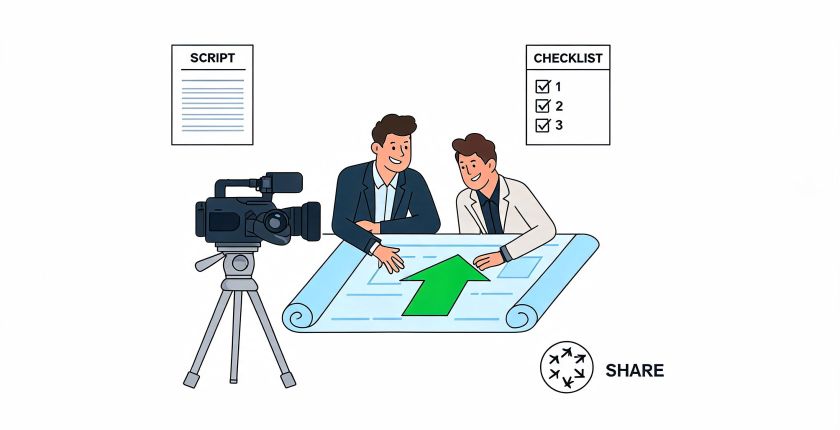
How to Create a Marketing Strategy Video That Drives Growth
You know you need video. You've probably said it in a planning meeting, put it on a quarterly roadmap, and then watched it slide because nobody on the team had the time to own it well.
That's the trap. Founders often treat video as a production problem when it's really a strategy problem. Cameras, editing, scripts, and freelancers aren't the hard part. The hard part is deciding what the video needs to do for the business, who it needs to persuade, and how you'll know if it worked.
A good marketing strategy video doesn't start with gear. It starts with focus. Once that's in place, a lean team can produce something sharp, useful, and conversion-oriented without turning it into a side project that eats a month.
Why Your Startup Needs a Marketing Video Strategy Now
A founder spends weeks refining a homepage, only to watch prospects bounce because the offer still takes too long to understand. Sales calls repeat the same explanation. Product screenshots help a little. The message still feels heavier than it should.
That is usually when video moves from a nice idea to a revenue tool.
Startups often delay video for two common reasons. The team assumes it will require a large production budget, or they assume the first effort has to be a polished brand piece. Both assumptions slow down progress. Buyers are not asking for cinema. They are asking for clarity, proof, and a faster path to confidence.

A marketing strategy video earns its keep when it shortens the distance between interest and action. It helps a prospect understand the problem, see why your approach is credible, and decide whether to take the next step. For an early-stage company, that can mean fewer confused demos, stronger landing pages, and less dependence on a founder repeating the same pitch.
Authentic constraint is rarely equipment. It is senior judgment.
Someone has to decide what message matters most, which audience segment the video is meant to move, and what action counts as success. Startups often have capable marketers and content teams, but not always a senior operator who can connect video to pipeline, positioning, and sales process. That is where fractional leadership becomes practical. A fractional CMO or video strategy lead can set direction, tighten the brief, and keep the team from spending five figures on an asset that looks good but does not convert.
This work also gets easier when video fits into a broader plan. If your team has not mapped audience priorities, channels, and business goals, start with a content strategy framework for startups before adding more assets.
Strategy beats production value
I have seen simple founder-led videos outperform expensive shoots because the message was sharper and the call to action was clear. I have also seen strong creative work stall because nobody made the hard decisions up front.
Use a practical test before approving any concept:
Practical rule: If the team cannot answer “who is this for?” and “what should they do next?” in one sentence each, the video is not ready to produce.
What founders usually get wrong
- They optimize for appearance: Professional visuals help, but a clear promise and useful explanation usually matter more.
- They chase reach instead of revenue: Broad views look good in a report. Qualified responses matter more.
- They hand strategy to production vendors: A production partner can make the asset. Your leadership team still has to define the job the asset needs to do.
The upside is straightforward. With the right strategy, video stops being a one-off creative project and starts working like part of the sales system. That is a manageable shift for a startup, especially with fractional executive support guiding the decisions that junior teams and freelancers should not have to make alone.
Building Your Video Blueprint Before You Hit Record
A strong video is usually won before anyone presses record. The planning work feels slower, but it saves money, prevents rework, and keeps the final asset tied to a business outcome.

That matters because viewers retain 95% of a message when they watch it in a video, compared to 10% when reading it in text, as noted in Film Division's 2025 video marketing statistics. If retention is that strong, the message itself has to be precise.
Start with the business goal
Don't begin with “we need a company video.” That's too vague to guide decisions.
Pick one job for the asset:
- Generate qualified leads from a landing page
- Improve conversion on a product or demo page
- Shorten sales calls by answering common objections early
- Support outbound outreach with a concise founder or product introduction
- Educate buyers on a complex offer before they speak to sales
One video can support several outcomes, but it needs one primary goal. If not, the script becomes crowded and the call to action gets weak.
Define the audience with uncomfortable honesty
Many marketing departments write for an abstract “target customer.” That produces mush. A useful brief names a real buyer in a real situation.
Ask questions like:
- What problem pushed them to start looking?
- What are they skeptical about?
- What language do they already use to describe the issue?
- What would make them ignore the video within the first few seconds?
If you need a structured way to tighten that thinking, this guide on how to create a content strategy is a practical companion to video planning.
A good audience profile reads like notes from a sales call, not a demographic worksheet.
Build a one-page creative brief
Before scripting, create a short brief the whole team can align around. It doesn't need to be fancy. A shared Google Doc is enough.
| Brief element | What to write |
|---|---|
| Primary goal | The one business result the video should support |
| Ideal viewer | The buyer, user, or stakeholder you want to move |
| Core problem | The pain point or friction they already feel |
| Key message | The single idea they should remember after watching |
| Proof points | Product details, customer outcomes, or process advantages |
| CTA | The exact next action you want them to take |
| Distribution | Landing page, LinkedIn, email, sales follow-up, or all three |
| Success signals | What the team will review after launch |
Where fractional leadership helps most
This planning stage is where senior judgment earns its keep. Founders usually know the product thoroughly, but they're often too close to the story. A seasoned part-time marketing leader can pressure-test the positioning, simplify the message, and keep the video aligned with pipeline goals instead of internal preferences.
That's the difference between “make something that looks good” and “build an asset sales will use.”
Scripting a Story That Connects and Converts
Most startup videos fail in the script, not in the edit. The opening is slow, the message is crowded, and the call to action sounds like an afterthought.
That's not surprising. A HubSpot report notes that 78% of startups cite a leadership expertise shortage as their top barrier to achieving video ROI, referenced in Lets Backflip's discussion of video strategy. You feel that shortage most when the team has to turn strategy into a clear narrative.
Use a three-part script
A practical marketing strategy video usually follows a simple structure.
Hook
The first lines need to earn attention. Don't open with your company name, founding story, or generic mission statement.
Open with the buyer's problem.
Examples of stronger openings:
- The operational issue your prospect is dealing with
- The costly mistake teams keep making
- The frustrating gap between effort and results
If your audience has heard the same claim from five competitors, your hook needs sharper language. Specific pain beats broad ambition.
Value
Once you have attention, explain the change you create. Many startups mistakenly over-explain features in this phase instead of clarifying outcomes.
Keep it conversational. Write the way a smart account executive speaks on a good discovery call. Short sentences. Direct claims. Plain language.
Use this sequence:
- Name the problem.
- Explain why it persists.
- Show how your approach solves it.
- Support the claim with credible detail.
Call to action
The CTA should tell the viewer exactly what to do next. Not “learn more” unless that's the right next step.
Better options include:
- Book a demo
- Request an audit
- Watch the full walkthrough
- Reply for a customized plan
- Download the implementation checklist
If the CTA asks for too much too early, viewers leave. If it asks for nothing, the video becomes expensive wallpaper.
Storyboarding without overcomplicating it
Storyboarding sounds more intimidating than it is. Treat it like a comic strip for the video. One box per scene. What the viewer sees, what they hear, and what action that scene should create.
A basic storyboard can live in Google Slides, Notion, Figma, or even a spreadsheet. The point isn't artistic polish. The point is reducing ambiguity before filming starts.
What to avoid
- Corporate throat-clearing: “In today's fast-paced environment” tells the viewer nothing.
- Feature dumping: Don't make the audience sort out why your details matter.
- Founder monologues: If a founder speaks, give them a sharp script and a clear role.
- Multiple CTAs: One primary action wins.
Good scripting feels simple when you watch the finished video. It rarely feels simple while writing it. That's why experienced strategic input matters so much here. The team needs someone who can hear weak messaging before it reaches the camera.
Lean Production for High-Impact Video
Production is where startup teams burn money fast. The usual pattern is familiar. A founder buys gear, blocks half a day for filming, and ends up with footage that looks acceptable but does not explain the offer clearly enough to drive action.
A lean production plan fixes that by putting strategy in front of equipment. Resource-strapped teams do not need a studio setup. They need clear direction, a controlled shoot, and someone senior enough to decide what belongs in the frame and what does not. That is often where fractional marketing leadership earns its keep. It keeps the team from treating production like a creative side project instead of a revenue asset.
What a startup actually needs
For most marketing videos, the baseline is simple: a quiet room, steady framing, clean audio, consistent lighting, and a speaker who knows the message.
A practical setup often includes:
- Natural light or one key light: Window light works if it stays consistent through the shoot.
- A strong microphone: Viewers forgive average visuals faster than muddy audio.
- One camera angle: Extra angles add time in filming and editing. Use them only if they improve comprehension.
- B-roll with a job to do: Show the product, workflow, customer context, or service delivery. Skip filler shots.
- Editing software the team can use: Descript, Adobe Premiere Pro, Final Cut Pro, and CapCut are all reasonable choices depending on skill level and turnaround needs.
That trade-off matters. A simpler setup usually produces a better business video than an ambitious setup the team cannot execute well.
DIY versus guided execution
Production should be treated like any other marketing investment. The question is whether the team can produce a credible asset without wasting time, creating revision cycles, or missing the message.
Some startups should film in-house. That works well when the message is already sharp, the offer is proven, and someone on the team can manage the process with discipline. Other startups need guided execution because the expensive mistake is rarely the camera choice. It is filming the wrong story, burying the CTA, or approving a final cut that sales cannot use.
I have seen early-stage teams save thousands on production and lose far more in poor conversion because no one senior owned the strategic decisions. A fractional CMO or video-savvy marketing lead closes that gap without adding a full-time executive salary. The result is usually a tighter shoot, fewer retakes, and a video the company can use across acquisition channels. That efficiency also matters when you are watching customer acquisition cost by channel and campaign.
| Phase | Timeline | Key responsibilities | Est. Fractional Support Budget |
|---|---|---|---|
| Planning | Week 1 | Fractional CMO: define objective, audience, message, CTA. Founder: approve priorities, share customer insight. | Varies by scope |
| Scripting | Week 1 to 2 | Fractional CMO: write brief, shape script, tighten positioning. Founder: review for accuracy and voice. | Varies by scope |
| Production prep | Week 2 | Fractional CMO: shot list, talent prep, vendor coordination if needed. Founder: confirm locations, participants, logistics. | Varies by scope |
| Filming | Week 2 to 3 | Fractional CMO: direct for message and performance. Founder: appear on camera if relevant, keep content accurate. | Varies by scope |
| Editing | Week 3 | Fractional CMO: review cuts, enforce messaging and CTA clarity. Founder: approve final version. | Varies by scope |
| Launch | Week 4 | Fractional CMO: distribution plan and measurement setup. Founder: align sales and internal rollout. | Varies by scope |
A quick production checklist
Before filming, run through this list:
- Check audio first: Record a test and listen with headphones.
- Frame the shot carefully: Headroom, eye line, and background shape perceived quality.
- Remove distractions: Cluttered desks, glare, and background noise lower trust.
- Prepare B-roll in advance: Do not decide your supporting visuals on shoot day.
- Use a printed script or teleprompter: Confidence on camera usually comes from preparation.
- Capture multiple takes: Small wording changes give the editor better options.
The cheapest production mistake is the one caught before filming. The most expensive mistake shows up in editing, when the team realizes the message never came through.
Founders should stay involved. They should not have to do every job themselves.
Distributing Your Video and Measuring True ROI
A founder approves a solid video, posts it once on LinkedIn, uploads it to YouTube, and waits for traction. A month later, the team has a few views, no clear sales impact, and no idea whether the asset worked. That is usually a distribution problem, not a production problem.
Distribution is where video starts paying for itself. Startups do not need more content sitting in folders. They need one strong asset used across the places buyers already evaluate, compare, and decide. That takes planning, but it does not require a full in-house marketing department. With the right senior guidance, even a lean team can turn one video into a working revenue asset.

Put the video in decision paths, not just content channels
The best-performing startup videos show up where a buyer is trying to answer a real question. What does this product do? Why should I trust this team? What happens next?
Use the same core video differently across channels:
- Landing pages: Place the video near the headline or offer so it clarifies value before the form.
- Product and service pages: Help buyers compare options without making them dig through paragraphs.
- Email nurture and outbound follow-up: Give prospects a faster explanation than another long email.
- Sales follow-up: Arm reps with a concise asset they can send after calls to reinforce the pitch.
- LinkedIn distribution: Cut the core video into short native clips, then pair each with a specific point of view or objection.
Experienced judgment matters in this scenario. A junior team can post everywhere. A senior marketer decides which version belongs on which page, what CTA fits the buying stage, and where not to spend time.
Measure business movement
Views matter only as an early signal. They show whether people saw the asset. They do not show whether the asset improved pipeline.
Track the metrics that tie video to commercial results:
- Play rate on key pages
- Average watch time and drop-off points
- Click-through rate on the video CTA
- Conversion rate on pages with video versus pages without it
- Lead quality from video-influenced visits
- Sales team usage and feedback
- Time to move from first meeting to next step
A useful test is simple. Did the video reduce friction enough to improve conversion, shorten sales cycles, or save your team explanation time?
If you want to connect that answer to efficiency, use a clear customer acquisition cost calculation framework so video performance is judged against acquisition economics, not content activity.
Use a simple weekly review cadence
Early-stage teams do not need an elaborate reporting stack. They need a consistent review process.
Start with four questions each week:
- Are the right people starting the video?
- Where are they dropping off?
- Are viewers taking the next step?
- Is sales using the asset?
The fourth question exposes a lot. If reps ignore the video, the problem usually sits in one of three places. The message is too broad, the CTA does not fit the moment, or the video is being placed where buyers are not asking that question.
I have seen startups improve results without changing the edit at all. They changed the thumbnail, moved the video higher on a page, shortened the CTA, and gave sales a better send path. That is the kind of optimization a fractional marketing leader can run quickly. The team gets senior-level decision making without adding full-time executive overhead too early.
Scaling Your Success with Fractional Expertise
A reliable marketing strategy video isn't a one-off creative win. It's a repeatable operating system.
The pattern is straightforward. Build the blueprint. Write a script that sounds like your buyer's reality. Produce lean. Distribute with intent. Measure against pipeline, not applause. Then repeat with the next message, audience segment, or funnel stage.
Why this model fits growing companies
Startups and smaller growth companies usually don't lack ambition. They lack spare senior bandwidth. That's why video stalls. The founder owns too much, the junior team needs direction, and freelancers can execute tasks without owning outcomes.
Fractional leadership closes that gap. A seasoned marketing executive can shape strategy, guide production decisions, and keep the work tied to revenue without the cost and commitment of a full-time hire. For many teams, that's the practical middle ground between guessing and overbuilding.
If you're weighing that option, this overview of fractional marketing services is a useful place to compare how part-time leadership fits into a broader growth plan.
A good video can help you explain the business. A good system helps you scale that explanation across campaigns, channels, and stages of the customer journey.
If you want to build that system without hiring a full-time executive too early, Shiny can help you connect with experienced fractional leaders who know how to turn strategy into execution. Explore the platform or schedule a conversation to find the right fit for your stage, team, and growth goals.