
Startup Sales Strategy: A Practical Framework for Growth
The most popular startup sales advice is wrong for an uncomfortable reason, it treats early revenue like a volume problem. More calls, more emails, more demos, more tools. That mindset burns time fast, because the bottleneck is usually whether the right accounts exist, whether they're clearly defined, and whether the team can prove the motion works before it scales.
Modern buyers make that mistake expensive. 96% of prospects research a company or product before engaging sales, 79% of B2B buyers complete more than half of their research before contacting a sales representative, and 84% of B2B purchases are made by committees rather than individuals, so a startup sales strategy has to win with proof points, content, and multi-stakeholder messaging, not just first-call persuasion (HubSpot's sales statistics). If your qualification is loose, all that outreach just creates a bigger pile of bad-fit meetings.
Why Most Startup Sales Strategies Fail Before the First Hire
The first failure mode isn't weak messaging. It's a fuzzy ICP that makes every other decision noisy. Founders often say they need more leads, but what they really need is a sharper answer to a simpler question, which accounts are worth selling to and why.
That's why founder-led sales often stalls before a first hire ever joins. If you don't know who fits, the founder becomes the default filter for every call, every objection, and every edge case. The sales motion never gets clean enough to hand off.
Practical rule: if a founder can't explain why a prospect is a fit in one sentence, the team probably isn't ready to scale outreach yet.
The buyer side makes this even more unforgiving. People show up informed, opinions are spread across a committee, and personal persuasion matters less than the evidence you bring into the conversation. That means the earliest startup sales strategy has to be built around what buyers can evaluate without a rep sitting on the phone with them, not around hope that a charismatic intro call will close the gap.
Many teams overbuild outbound before they've proved demand. They buy sequencing tools, write more templates, and expand lists, but the core issue is still selection. A better move is to pause and ask whether the market definition is narrow enough to produce repeatable wins. For a useful founder lens on this handoff problem, see why founders need better sales hires, not heroic selling.
A strong startup sales strategy starts by rejecting the flattering idea that broad reach equals progress. It usually doesn't. Broad reach mostly hides weak qualification.
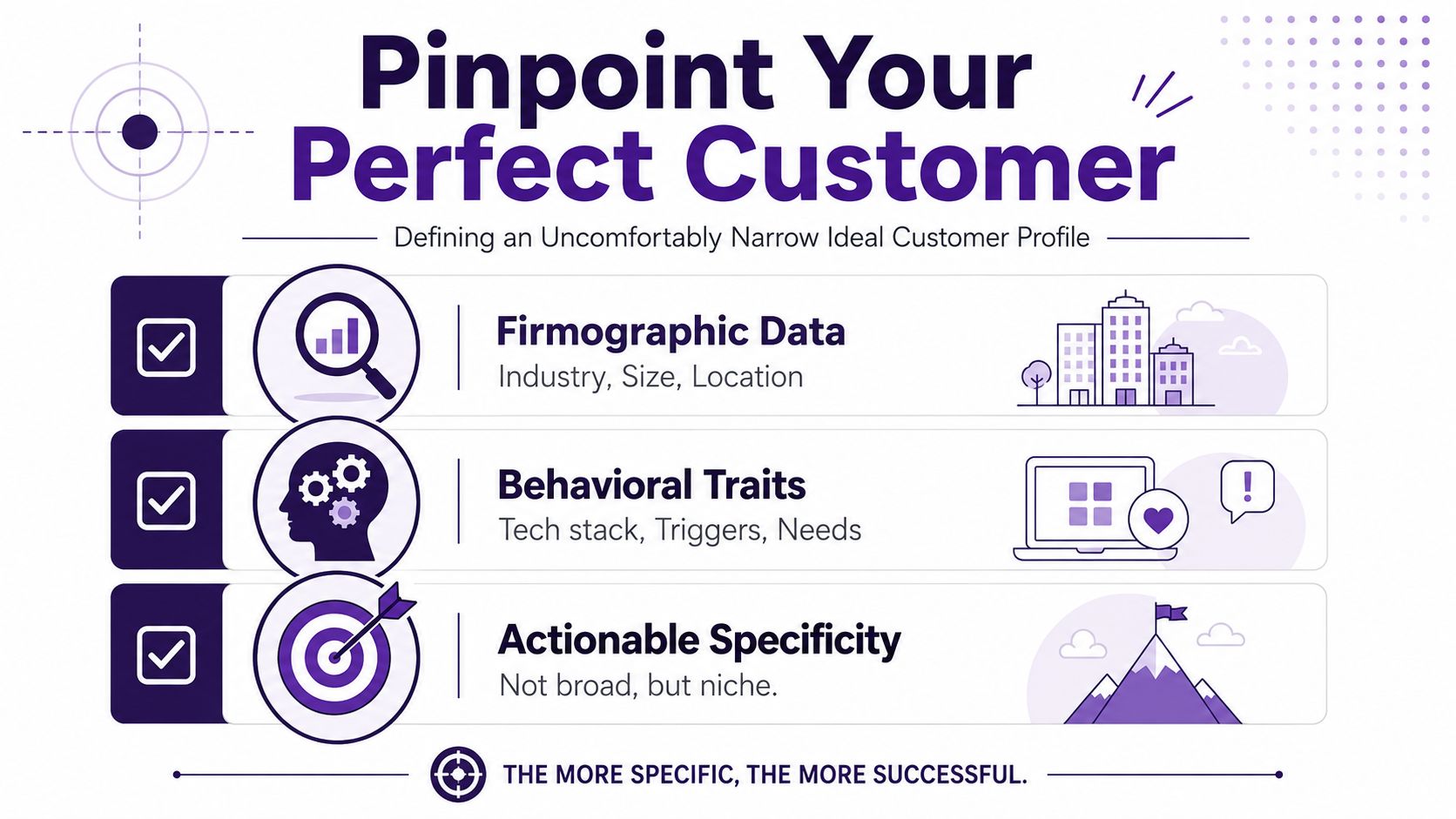
Defining an Uncomfortably Narrow Ideal Customer Profile
The best ICP work feels restrictive at first, because it should. Bessemer Venture Partners advises founders to focus on an “uncomfortably narrow” ICP and land the first dozen customers through cold outreach, which is a practical test of real demand, not a branding exercise (BVP's founder playbook). That narrowness is the point. It forces the market to answer back quickly.
Start with firmographics, then layer in triggers
A workable ICP usually starts with firmographics, then gets narrower through behavior and timing. Industry, company size, and geography matter, but they're only the shell. The sharper filter is whether the company has a reason to buy now, such as recent funding, a hiring push, or expansion into a new market.
The operational trick is to preserve that timing signal inside the CRM. A practical playbook recommends using a funding-date window, often the last 90 days for active prospecting and 30 days for top-priority accounts, then filtering by round type, industry, headcount, and geography before loading the record with round type and announcement date tags (Zendesk's startup sales process guide). If you strip out the trigger data, you lose the whole reason the lead was valuable.
A few fields that usually belong in the working ICP:
- Firmographic fit: industry, company size, and location
- Trigger evidence: funding, hiring, expansion, or product launch activity
- Behavioral fit: tech stack, workflow pain, or usage pattern
- Buyer reality: who feels the pain and who signs the check
Validate the ICP before you build a machine
The quickest validation is direct outreach. Not because cold outreach is glamorous, but because it is honest. If a narrow list responds, books meetings, and advances, the ICP is probably real. If the list looks good on paper but stalls in practice, the issue is either the segment or the message.
Bain's point on small businesses is useful here. Underserved doesn't automatically mean attractive. You still have to look at gross margin and operating expense to serve, because an interesting segment can still be a bad business if it takes too much service effort to keep alive (Bain on underserved small businesses). That economic filter belongs in ICP design, not after the team has already hired around the segment.
A tight ICP isn't a constraint on growth. It's what makes growth legible.
Choosing the Right Go-To-Market Motion for Your Deal Size
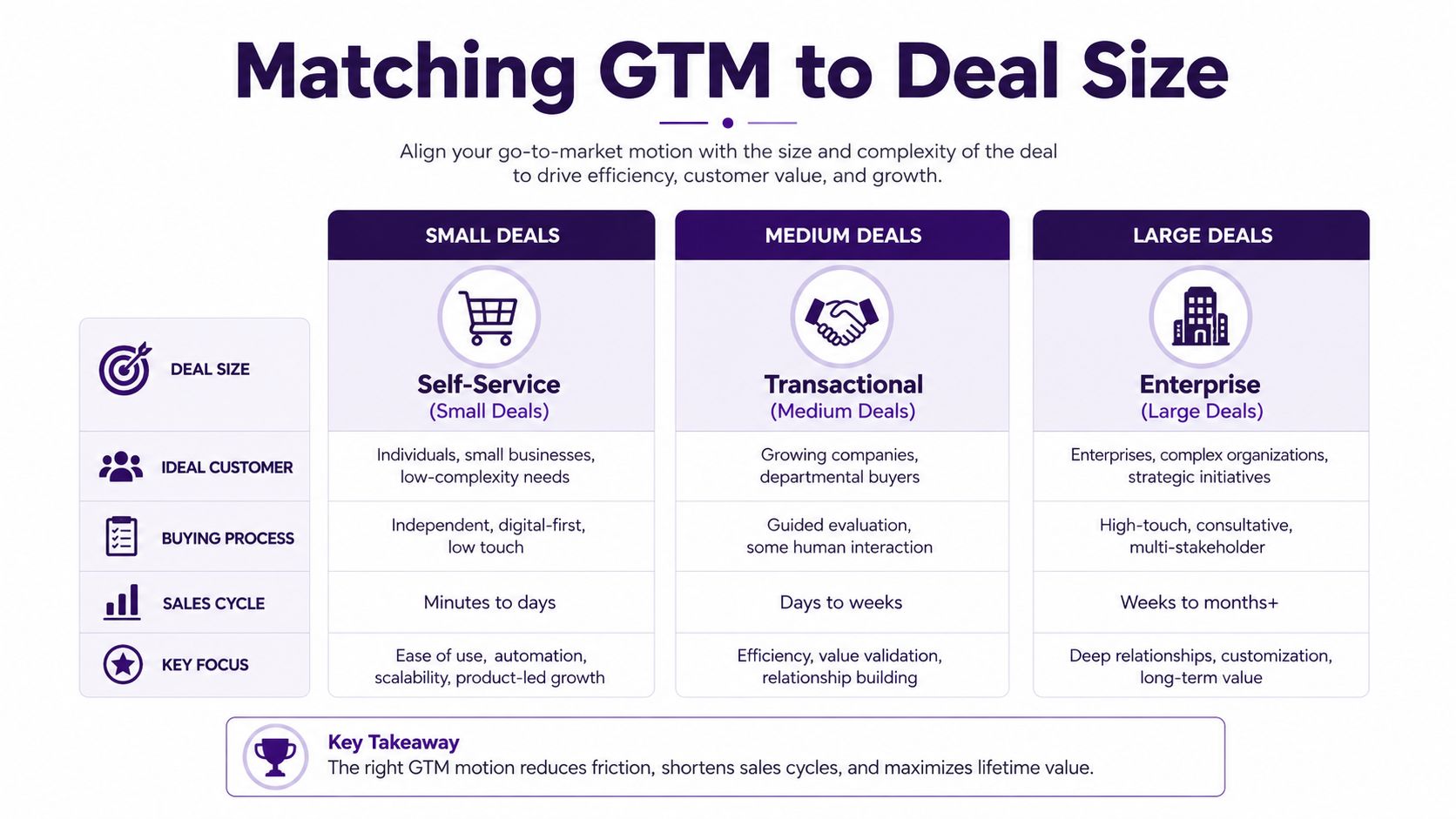
The motion has to fit the economics. A strong product can still underperform if you force the wrong sales shape onto the wrong deal size. Low-friction, lower-ACV deals usually work best with a product-led motion, while more complex, higher-value deals need a sales-led approach that can handle more stakeholders and a longer path to purchase. One framework recommends product-led growth below about $5k ACV and outbound-led motion above about $15k ACV (Startup Sales Hacker framework). That is a guide, not a law, but it gives founders a useful line for deciding how much human selling the business really needs.
Small deals need product proof, not long sales cycles
At the low end, the product has to carry most of the weight. Buyers want a quick way to see value, low setup friction, and enough confidence to move without sitting through a heavy rep-driven process. Sales still matters, but the motion should help the buyer adopt the product, not force the buyer through a process that feels larger than the deal.
The best teams in this band make the product and content do more of the work. In-product cues, pricing clarity, comparison pages, and simple proof points matter more than a polished deck. If the prospect has already done most of the research, the rep should connect the dots and remove doubt, not restart the conversation from scratch. Buyer behavior research from HubSpot's sales statistics shows why this matters, since buyers expect personal relevance based on what they have already done.
Larger deals reward repeatable enterprise discipline
As deal size and buying complexity rise, the motion changes with it. The enterprise side of the market rewards process discipline because more people get involved, more internal alignment is required, and the cost of a bad qualification decision goes up fast. In its 2024 Startup Enterprise GTM Report, Salesforce Ventures report reported that enterprise client annual contract value rose 19% over the prior 12 months, enterprise sales rep headcount grew 18%, and 60% of respondents saw sales productivity increase. The report also found that 48% of organizations said annual quota per account executive was between $1M and $1.5M, which shows how much startup selling has shifted toward fewer, larger, quota-driven enterprise motions.
That does not mean every startup should chase enterprise too early. It means the teams that succeed there build a repeatable sales system instead of just adding more activity. If the buyer is researching before the first call and a committee is making the decision, the motion has to match that reality with content, multi-threaded outreach, and enough internal coordination to keep the deal from stalling.
A strong startup sales strategy matches motion to friction. If the buyer can educate themselves and convert quickly, keep the motion light. If the deal needs consensus, design for depth.
Building a Stage-Gated Funnel with Real Pipeline Math
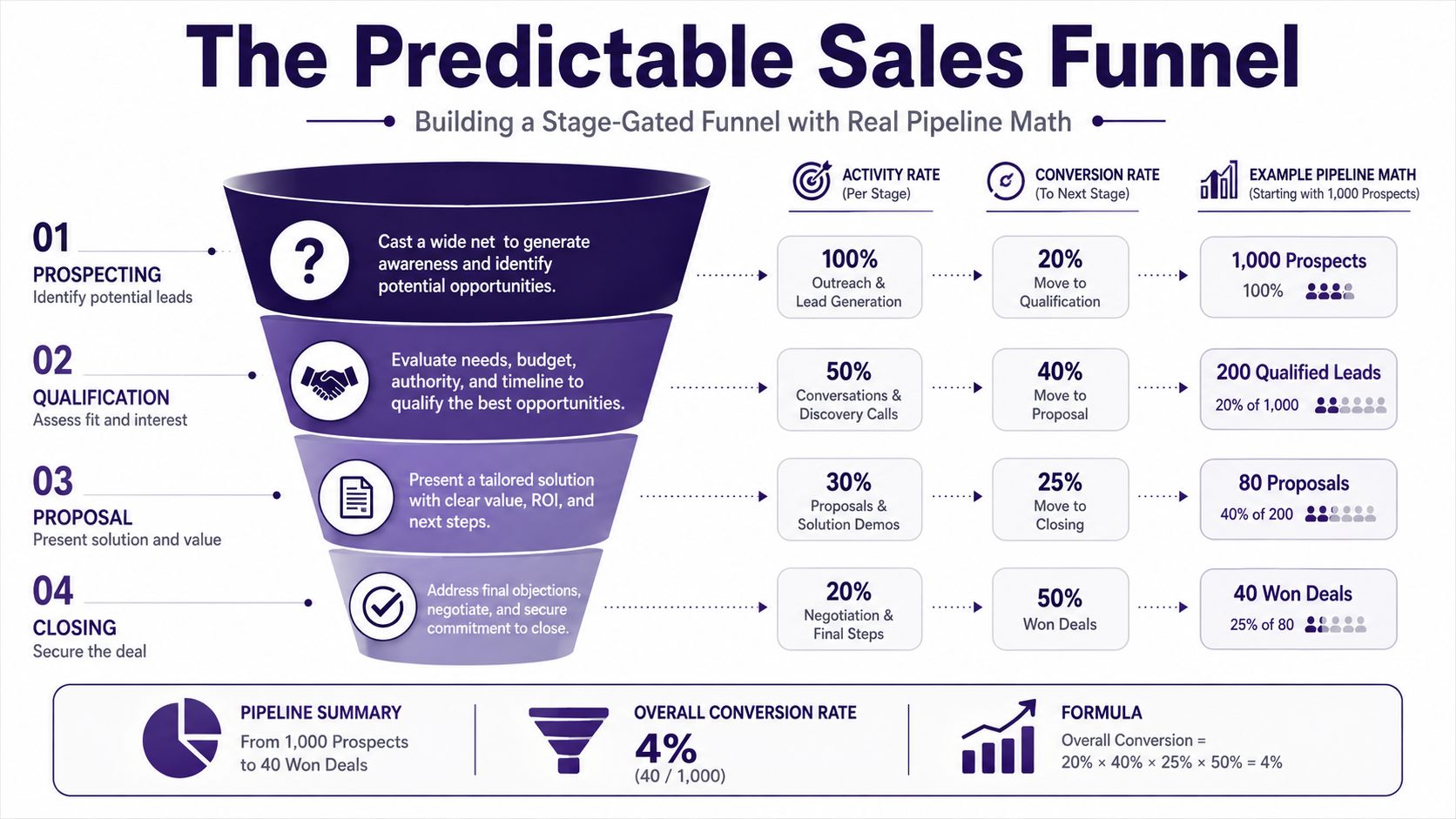
A useful funnel is not a hope stack. It's a set of gates with exit criteria, so the team knows exactly where deals are moving and where they're stalling. LaunchingMax breaks the process into lead generation, qualification, demo or presentation, negotiation, close, and onboarding, and the important part is that onboarding is treated as part of the sales system, not a post-sale afterthought (LaunchingMax).
Use stage gates to keep bad deals from polluting the pipeline
Each stage should answer a different question. Prospecting asks whether the account fits. Qualification asks whether the pain is real and the buyer is engaged. Proposal asks whether the value is credible. Closing asks whether the path to signature is open.
A pipeline review should not be a temperature check. It should tell you whether the next stage is justified.
This is why early-stage teams should track signal quality, not just meeting volume. Dock's framing is useful here, because win rate tells you whether people care about the problem, while average selling price tells you how much they care (Dock's startup sales guidance). Those two metrics are far more informative than raw activity counts when the business is still trying to prove fit.
Convert goals into thresholds
Startup sales teams work better when goals are specific enough to inspect weekly. Activated Scale gives concrete examples such as converting 15% of qualified leads into paying customers, raising average deal size from $2,000 to $3,000, or shortening the sales cycle from 45 days to 30 days (Activated Scale). Those figures are useful because they turn “grow faster” into something a manager can review with the team.
A simple weekly pipeline rhythm should ask:
- Are qualified deals entering the funnel?
- Where are deals stalling by stage?
- Which objections repeat often enough to need a playbook update?
- Does the current mix of opportunities still match the ICP?
If you want a deeper structure for the numbers side, this pipeline-building guide is a useful companion. The point is not to quantify everything for its own sake. The point is to make the next decision obvious.
When to Bring in Fractional Sales Leadership
The gap between founder-led selling and a full sales organization is where many startups stall. Founders keep closing deals because the business is not ready for a broad hire, but they also cannot carry every discovery call, objection, and forecast forever. Fractional leadership fits that gap because it gives the company senior judgment before the org chart catches up.
Fractional CROs and VPs of Sales are useful when the company needs experienced decision-making more than another full-time seat. They build the playbook, coach the founder, clean up qualification, and help hire the first reps, often on a 5 to 25 hours a week basis. That setup gives early teams strategic leadership without forcing a permanent executive commitment before the motion is proven. Learn more about fractional sales leadership if you want a closer look at how that model works in practice.
Compare the three real options
Founder-led sales works best while the company still needs direct learning from the market. The founder hears objections firsthand, sharpens the message, and spots patterns fast. The trade-off is obvious, it breaks down once deal flow, hiring, and management all compete for the same calendar.
Full-time sales hires make sense after the playbook is visible and the company can support the ramp. If the motion is still unclear, a rep inherits ambiguity and spends time creating structure that should already exist.
Fractional leadership sits in the middle. It is often the better fit when the company needs a senior operator to turn founder instincts into a repeatable system, but does not yet need, or cannot yet justify, a full executive on payroll.
That matters financially. The briefed benchmark for a full-time executive is a $250k+ annual commitment, which is exactly why many startups should test the fractional model first. If the company needs architecture more than a permanent seat, fractional leadership is the lower-risk bridge.
Practical rule: bring in fractional sales leadership when the team needs a repeatable process, not just more activity.
Shiny's marketplace model fits that gap because it connects startups with vetted executives across SaaS, FinTech, HealthTech, Ecommerce, AI, Manufacturing, Professional Services, and Energy. That matters when the right background is industry-specific rather than generic. The best fractional leader is usually the one who has already solved your version of the problem.
Your 90-Day Sales Strategy Execution Roadmap
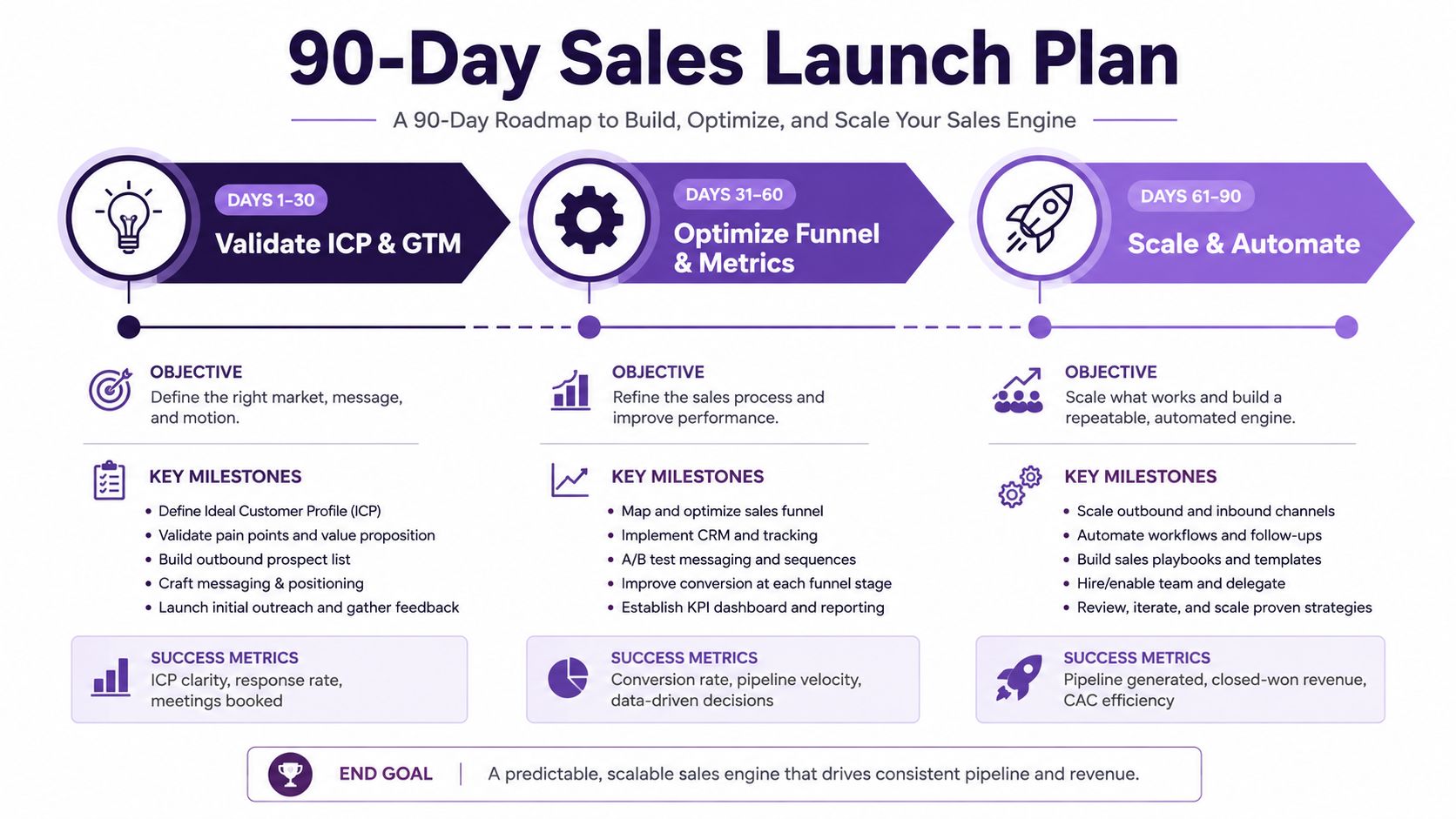
The first 90 days should prove one thing at a time. Not everything at once. The sequence matters because each phase should lead to the next, and skipping ahead usually hides the same problems under a more expensive tool stack.
Days 1 to 30, prove the market is narrow enough
The first month is for validation. Pick the ICP, write the message, and test it against live accounts. If the right people do not respond, the segment or the angle is off, and no amount of software will fix it.
Useful exit criteria at this stage are simple:
- Clear ICP definition
- Evidence that outreach reaches the right buyers
- Early conversations that confirm the pain is real
- A reason to keep the segment instead of broadening it
Days 31 to 60, make the motion repeatable
The second month is for systematization. Build the stage-gated funnel, tighten qualification criteria, and run the first serious pipeline review. At this point, the team should stop mistaking activity for progress.
The team starts measuring whether the motion survives contact with real buyers. The goal is not a perfect forecast. The goal is a process that a second person can follow without recreating the founder's intuition from scratch.
Days 61 to 90, decide how to scale
The last month is for acceleration. If the motion is working, the team can decide whether to hire, keep founder-led selling in place longer, or bring in fractional leadership to bridge into a larger org. If the motion still isn't working, scaling it faster only makes the mistakes more expensive.
That's the hard truth most startup sales strategy content skips. You don't scale because you want growth. You scale because the ICP, motion, and economics have already earned it.
If you're at the point where the sales motion is real but the leadership gap is slowing it down, Shiny can help you connect with the right fractional sales executive for your stage and industry. Visit Shiny to explore how a vetted part-time leader can help you tighten qualification, build the playbook, and turn founder-led selling into a repeatable revenue engine.