
Startup Executive Search: A Practical Founder’s Guide
You're probably staring at a pipeline that won't move, a board that wants answers, and a leadership gap that's starting to slow real work. That's the moment startup executive search stops being a theory exercise and becomes a business decision. If you get it right, you buy speed, judgment, and focus. If you get it wrong, you burn months hiring the wrong senior person and then pay again to fix it.
When a Startup Actually Needs an Executive Search
The founder panic usually starts in a small, boring place. Revenue isn't moving the way it should, the board wants a better read on the sales pipeline, and suddenly the question is whether the company needs a VP now or a cleanup plan first. That's the right question, because speed is a structural advantage in startup executive search, and delay is expensive. Majhi Group's 2026 analysis says the median time-to-fill for a VP-level role at a Series A-C technology company is 65-90 days through conventional channels, while its own placement average is 41 days. The same report says 68% of VP-level searches stall beyond week 10 without a compelling shortlist, and 70-80% of the strongest VP and C-suite candidates are passive rather than actively job-seeking, which is why this is a reach problem, not a posting problem. Majhi Group's 2026 startup hiring analysis
A search is justified when a real business event forces the issue. A co-founder leaves, a finance leader is missing before a fundraise, or the go-to-market motion has stalled and nobody inside the company can own the fix. The wrong move is to pretend every senior gap is a hiring gap. Sometimes the company needs a clearer mandate, not a recruiter.
Practical rule: if the company can't explain who owns the decision, who will onboard the hire, and what outcome the person must deliver, the search is too early.
Before you open a retained search, check whether you're ready. If the budget isn't approved, the reporting line is fuzzy, or the rest of the team can't support the new leader, you're not buying leverage, you're buying confusion. That's why a role like a CFO, for example, needs a business case before the search even starts, not after the offer is out. Use Shiny's CFO hiring guide as a reality check
The clean takeaway is simple. Run the search now if the role is tied to a near-term milestone and the company can support the hire. Pause if the mandate is muddy, the onboarding owner doesn't exist, or the search is really a substitute for executive clarity.
Defining the Role by Outcome Before the Title
Most startup job briefs are lazy. They read like a copied Series D template, full of title language and empty requirements, which is exactly how companies end up interviewing for prestige instead of impact. Start with the business result, then work backward to the person.
Build the intake around outcomes
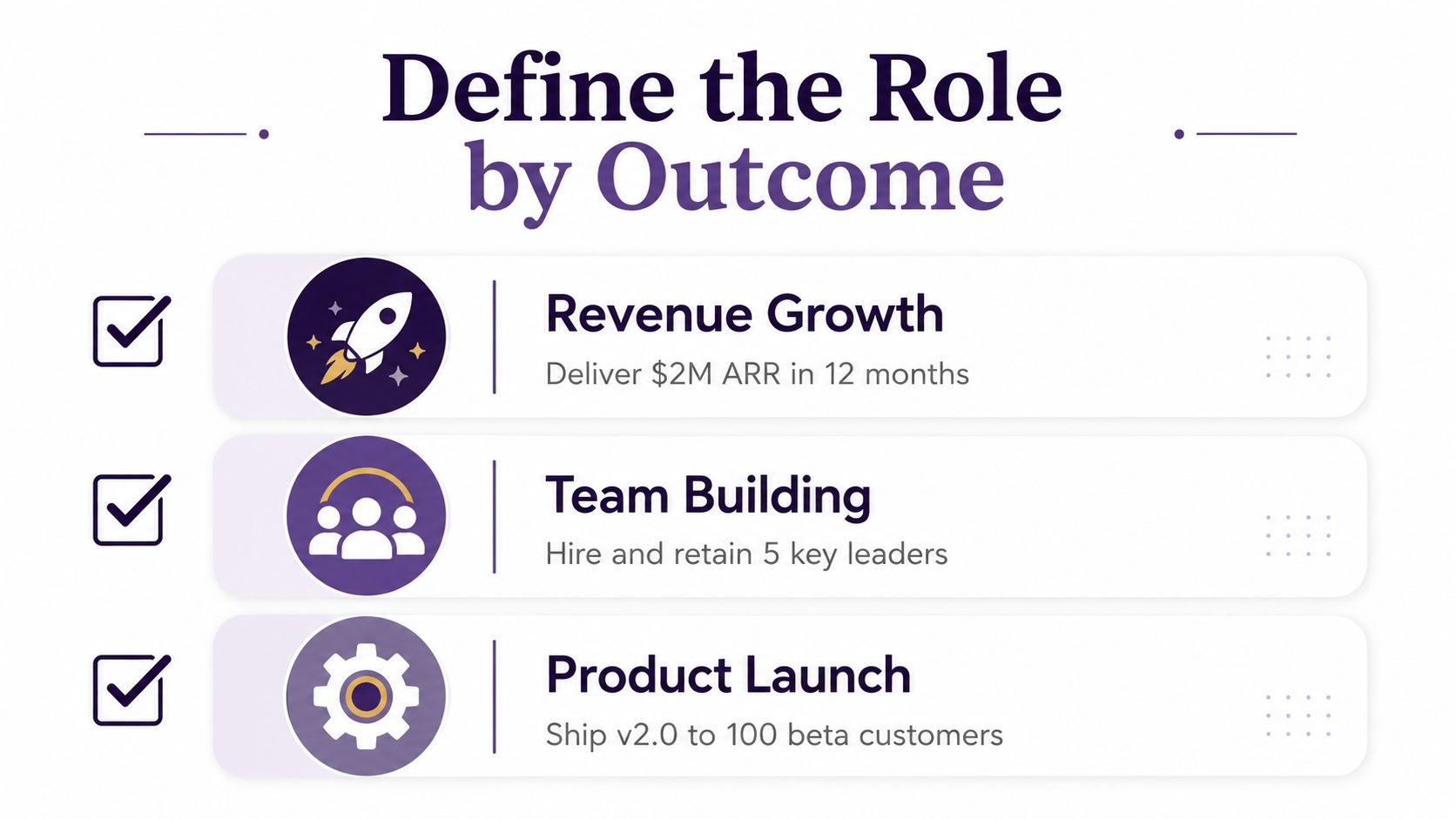
Write the three outcomes the executive must deliver in the first 12 months, the constraints they'll inherit, and the decisions they own on day one. That's the cleanest way to avoid hiring a beautiful résumé for the wrong job. A strong guide for startup leadership search says to define the business outcome before sourcing and to turn that into a leadership scorecard with structured, job-related interviews. Valuable Recruitment's executive hiring framework
Use this format:
- Outcome 1: What changes in the business if this hire succeeds?
- Outcome 2: What must they fix, launch, or stabilize?
- Outcome 3: What proof will the board accept at month 12?
- Constraints: Budget, headcount, technical debt, market pressure, or timing.
- Owns on day one: The decisions nobody else should keep making for them.
A simple sample block for a founder to copy looks like this:
12-month outcomes
- Build a repeatable pipeline for the company's core growth motion.
- Hire and retain the first layer of functional managers.
- Create a reporting cadence the board can trust without extra explanation.
That's not paperwork. That's the brief.
Turn the brief into a scorecard
Once the outcomes are written, translate them into a scorecard. Weight the top three signals most relevant to the role, then use them in every interview. If a candidate can't explain a decision they owned end-to-end, move on. If they can talk only in team nouns and not business results, move on faster.
A title tells you where someone has worked. Outcomes tell you whether they can do the job you actually need done.
This also helps you choose the right model. If the mandate is narrow and the company needs senior judgment quickly, a full-time hire may be overkill. If the role has to live in the business every day, full-time is the answer. If the problem is specific and bounded, fractional leadership deserves to be treated as a first-class option, not a consolation prize.
Full-Time, Fractional, or Advisor
Founders love to default to full-time because it feels decisive. It isn't always smart. The decision is how much leadership bandwidth the company needs, how fast, and with how much execution responsibility.
Use the model that matches the job
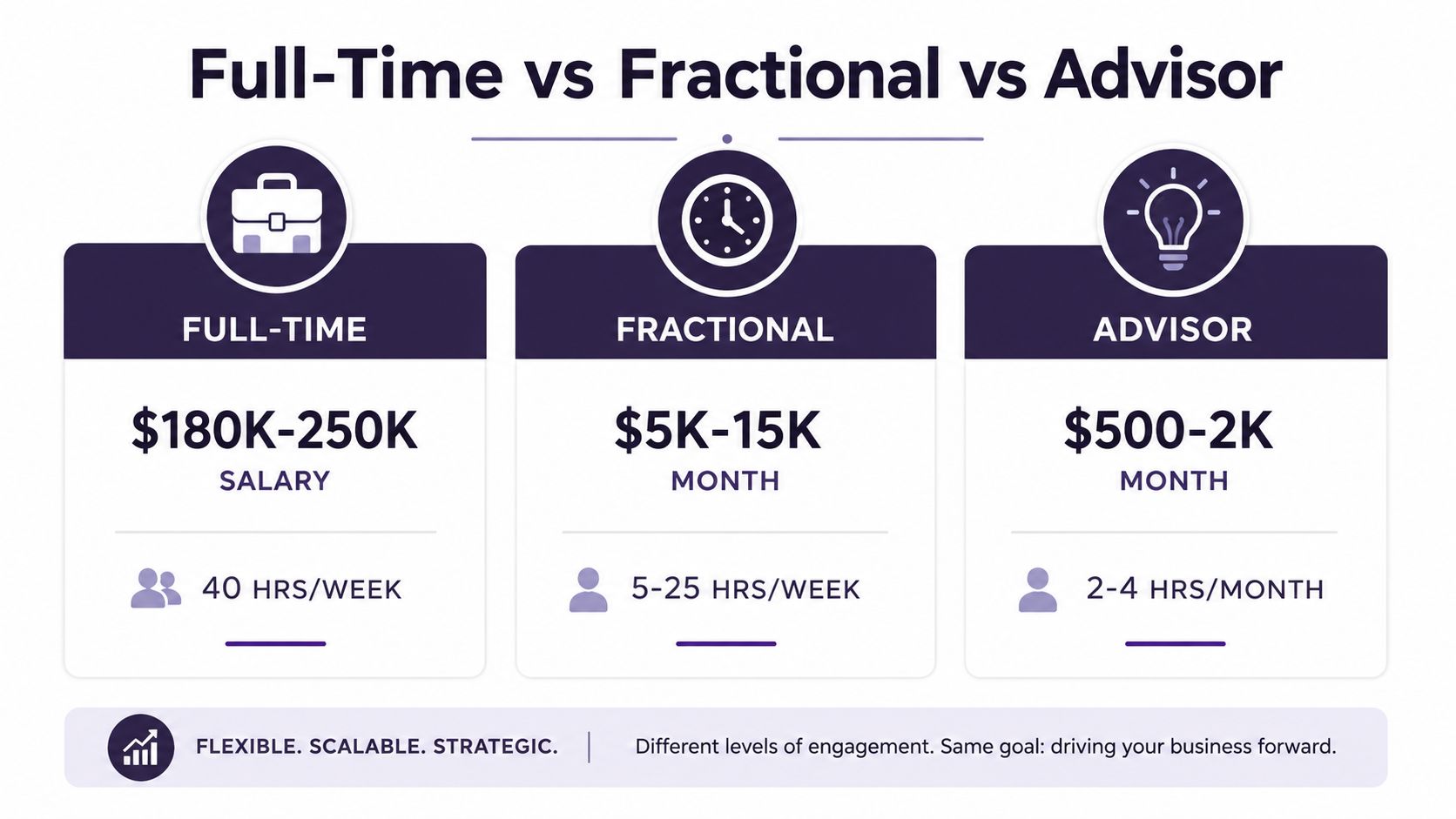
A full-time executive makes sense when the function owns revenue, carries daily operating pressure, and needs to be present in the room every day. Fractional leadership is the better call when you need senior judgment on a specific problem without locking the company into a large fixed cost. Advisors are for pattern recognition, not ownership.
Shiny operates a fractional executive marketplace built around 5 to 25 hours a week, so this model isn't theoretical. It fits the common startup problem where the company needs experienced leadership, but not a full-time seat with full-time cost and commitment. Shiny's fractional hiring overview
Here's the blunt comparison:
- Full-time: Highest decision rights, highest commitment, highest cost, best for functions that must run daily.
- Fractional: Moderate commitment, faster ramp, lower cash burn, best when the founder needs senior execution on one or two priorities.
- Advisor: Lowest cost, lowest time demand, useful when the company needs perspective more than ownership.
Match the model to stage and risk
If you're early and cash-tight, don't force a full-time hire just to look serious. If the role is strategy-heavy, comes with ambiguity, and doesn't need constant management, fractional is often the cleanest path. If the company already has operators in place and just needs judgment at the edges, an advisor can be enough.
Use this rule: hire full-time for ongoing operating ownership, fractional for targeted leadership, advisor for selective guidance.
A retained search firm is still the right tool for some searches, but founders should stop treating it as the only credible option. The point is not ideology, it's fit. For many startups, the best answer is a senior operator who comes in part-time, solves the problem, and leaves the company with more clarity than they found.
Sourcing Channels and What Each One Actually Returns
Don't treat sourcing as one channel. Treat it as a portfolio of access points, each with a different return. If you understand what each one gives you, you stop wasting time on the wrong lane.
Know the four paths
Founder and investor networks are the fastest when the network is real and warm. You get referrals, context, and trust, which matters because executives don't usually answer generic outreach from strangers.
Retained search firms buy you reach into passive candidates, plus the discipline of a structured search. In startup work, that matters because the strongest candidates are often already employed and not browsing listings. A practical workflow from executive-search guides usually follows seven stages, intake brief, position specification, market research and talent mapping, candidate outreach, competency assessment, client presentation, and offer negotiation, with end-to-end cycles in the 9-14 week range. Pin's executive search strategy guide
Fractional marketplaces return pre-vetted operators matched to the mandate. That's useful when the founder wants speed and seniority without building a whole sourcing engine. Inbound pipelines are the weakest at the executive level because they're noisy, unfiltered, and usually full of people who are available, not necessarily qualified.
Use the channel for the job
Here's the trade-off in plain English. If you already know the kind of person you want and your network is deep, start with people you trust. If the role is specialized, confidential, or passive-heavy, use retained search. If you need a fast fit for a bounded leadership problem, use a fractional marketplace. If you're relying on inbound alone, you're gambling.
A good retained firm should do more than toss you résumés. The better ones begin with market mapping, then use warm, personalized outreach, structured interviews, and validated leadership frameworks before they present a shortlist. That's what separates executive search from normal recruiting. Spectraforce's startup C-suite search explainer
Read the channel against the stage
- Founder and investor networks: Best when the founders know the market and can name the players.
- Retained search: Best when the role is critical, hard to fill, and worth paying for access.
- Fractional marketplace: Best when speed and flexibility matter more than a permanent seat.
- Inbound: Best as a supplement, not as the plan.
Use the channel that reduces your biggest risk. Don't pay for reach you already have. Don't expect a public job post to solve an executive problem. And don't confuse activity with access.
Screening and Interview Frameworks That Reduce Bias
Once you have candidates, the job shifts from sourcing to judgment. A lot of founders bluff. They run casual conversations, rely on chemistry, then act surprised when the hire can't execute. The fix is structure.
Screen against evidence, not confidence
Start with a structured intake call. Every candidate should be evaluated against the same outcome-based scorecard, not whatever question came to mind that morning. Then use competency interviews that force the candidate to show how they've solved real problems, not just what they believe about leadership.
A strong retained-search process usually uses warm, personalized outreach and validated leadership frameworks before a shortlist is built. That's important because the process itself filters for fit, rather than hoping the interview panel can improvise its way to truth. Interviewing executives with structure
Use work samples where they make sense. For revenue roles, ask for a written plan or a pipeline strategy. For operations, ask how they'd stabilize a broken process. For finance, ask how they'd diagnose cash pressure and reporting gaps. The point isn't to make candidates work for free. The point is to see whether they can think in the actual shape of the job.
Run the panel like a decision room
Panel interviews should reduce groupthink, not amplify it. Give each interviewer one or two signals to own, then collect feedback separately before anyone starts debating. If the same concern appears twice, that's signal. If one person hates a candidate because of style, ignore the noise unless style breaks the job.
Use this simple filter:
- Top signal 1: Can they explain a business outcome they personally owned?
- Top signal 2: Can they show how they made a hard decision?
- Top signal 3: Can they operate in the constraints this startup has?
Drop a candidate quickly if they can't connect past work to current responsibility. Seniority without accountability is just expensive theater.
That approach keeps founders from over-indexing on charisma. It also makes the process defendable to the board, which matters when an executive hire is one of the most consequential decisions the company makes.
Reference Checks and Compensation Benchmarking
Reference checks are not a formality. They're primary research. Most founders ask polite questions and get polite answers, which is useless. You want the parts of the story the candidate didn't lead with.
Ask bluntly:
- What did this person own that didn't work, and why?
- Who pushed back on them most, and what did they do with that friction?
- Would you re-hire them at full equity?
Those questions surface judgment, accountability, and resilience. They also expose whether the candidate is a builder, a caretaker, or someone who only looks good when the environment is already stable.
Comp matters too, and it should be tied to stage. In early-stage startup work, founders often need to choose between more cash, more equity, or a more flexible model entirely. If cash is tight, the clean approach is to offer more equity, add performance-based vesting, and consider a second-tranche cliff so both sides stay aligned. The exact package depends on role scope and company stage, not on what some peer company did last month.
| Role | Seed | Series A | Series B |
|---|---|---|---|
| VP Sales | Qualitatively higher equity, lighter cash, milestone-based upside | Balanced cash and equity | More cash, narrower equity range |
| CMO | Qualitatively higher equity, lean cash | Balanced package | More cash, performance-linked equity |
| CFO | Higher equity if scope is broad and cash is tight | Balanced package | More cash, more formal structure |
| COO | Higher equity for build-heavy scope | Balanced package | More cash, clearer operating mandate |
Use the table as a decision frame, not a universal rate card. The right package is the one that matches urgency, scope, and downside risk. If the person is coming in to build the function from scratch, equity should reflect that. If the role is mainly oversight, don't overpay for a scope you don't need.
Contracting, Closing, and the First 90 Days
The search doesn't end at verbal yes. It ends when the executive is set up to win. That's where a lot of startup hires fall apart, because the offer looks fine and the operating terms are a mess.
Get the contract right
For full-time hires, founders routinely mishandle four clauses. IP assignment has to be clean. Non-compete enforceability needs legal review by jurisdiction. Equity vesting acceleration should be explicit. Termination-for-cause definitions should be tight, not vague.
For fractional hires, the contract should spell out scope of work, hours cap, decision rights, and the off-ramp. Fractional only works when the boundaries are clear. If you want unlimited availability, you're not buying fractional leadership, you're disguising a full-time need as a part-time one.
Lock the first 90 days
The first week should produce one named decision the executive owns. In week one, don't ask for a grand strategy deck. Ask for the decision that only they can make. By day 30, they should deliver a concrete plan tied to the original scorecard. By day 60, you should see operating motion. By day 90, there should be evidence that the role is changing the business, not just attending meetings.
That's how the handoff should look in practice:
- Week 1: Define the single decision they own.
- Day 30: Deliver the first measurable output.
- Day 60: Show traction against the original mandate.
- Day 90: Review the scorecard and decide whether to scale, adjust, or exit.
The broader 30-day action plan is straightforward. Week 1, write the mandate and outcomes doc. Week 2, choose the channel and set the shortlist target. Week 3, run the sourcing sprint and first screen. Week 4, finish interviews, references, and offer. If the founder can't name 10 specific people who could do the role, the requirements are probably too vague or unrealistic, and some timeline guides say that points to a 6+ month search. They also say compensation at the 75th percentile plus three other readiness factors can move a search toward a 4-month timeline, while two or fewer positive answers again point to 6+ months. Altios on executive search timeline readiness
If the company can't answer the readiness questions, pause. Don't drag a weak brief into a long search and call it diligence.
The readiness check is simple. Can the founder name 10 people who could do the role? Is the budget defensible? Are decision rights written down? If any of those answers is no, the company should slow down and fix the setup before it starts spending political capital on interviews.
For founders who want senior leadership in place in weeks rather than quarters, Shiny's marketplace connects startups with vetted fractional executives and handles the matching workflow after the role is defined. If that's the more realistic path for your company, start there instead of forcing a full-time search that doesn't fit the stage.
If you're weighing a full-time hire against a fractional leader and you want a cleaner way to move fast, explore Shiny. It's built for founders who need senior judgment without dragging the company through a long search cycle. Schedule a conversation, define the outcome, and get the right executive into the seat before the next milestone slips.