
Startup Marketing Consulting: A Founder’s Guide to Hiring
You're probably staring at a dashboard that hasn't moved the way you hoped. Traffic is flat, paid spend feels expensive, the team can build product but can't quite tell a clean growth story, and someone on the board wants next quarter's go-to-market plan to look more certain than it really is. That's the moment founders start looking for startup marketing consulting, not because they want another vendor, but because they need a senior brain in the room who can turn scattered activity into a measurable plan.
The problem is that most founders shop for “marketing help” like it's one category. It isn't. A fractional CMO, an independent consultant, and an agency solve different problems, and if you pick the wrong one you'll burn time, money, and focus. The right choice depends on stage, budget, and whether you need leadership, diagnosis, or execution.
A decent consultant should leave you with clarity, not just slides. A good one should change how your team measures progress, and a great one should make the next hire easier because the gap is finally defined. If you're trying to decide what to buy, what to avoid, and how to measure whether it's working, this is the practical version.
Why Most Founders Hit a Marketing Wall Before They Hit Product-Market Fit
A founder gets the product out the door, picks up a first wave of interest, then runs into a wall where every channel starts sending mixed signals. Paid numbers look bad, organic growth feels slow, and nobody in the room has enough senior marketing experience to say whether the core issue is positioning, channel choice, or timing.
That is when bad advice gets expensive. Teams tell junior marketers to “do more social,” or they hand the problem to a generalist agency that produces content nobody can connect to revenue. Founders still need to fix the right constraint early, because analyses cited in the startup marketing budget roundup at GTM 80/20 place poor marketing among the top reasons startups fail, with one cited figure at 29%.
The founder moment is rarely a traffic problem
It is usually a decision problem. You have builders, maybe a product lead, maybe one scrappy marketer, but no one whose job is to own the full go-to-market system. That gap matters because the broader marketing consulting market keeps expanding, with one estimate putting it at USD 35.10 billion in 2025 and forecasting USD 45.52 billion by 2031 at a 4.42% CAGR from 2026 to 2031, according to Mordor Intelligence. Companies keep buying outside expertise because internal teams are often too lean to solve every problem alone.
Founders also underestimate how often marketing only gets formalized after the first pain spike. Budgets have been moving toward more measurable activity, and the source material in the startup marketing budget roundup at GTM 80/20 says marketing budgets rose from 7.7% to 9.4% of revenue in 2025, a 22% jump from 2024. That does not mean every startup should spend more. It means founders are under more pressure to prove that every dollar buys something tangible.
Practical rule: If you cannot explain whether the bottleneck is positioning, acquisition, or conversion, do not hire for tactics yet. Hire for diagnosis.
This is why founders need a sharper lens on product-market fit and validation before they put budget into the wrong channel. A useful companion read is this product-market-fit validation guide, because strong marketing consultants do not start with ads, they start with the market.
The wall shows up before product-market fit because the company is trying to scale a message that has not been fully proven. The answer is not more activity. It is choosing the right engagement model, setting the right KPI gate, and making sure the consultant's work is tied to business decisions, not vanity deliverables.
What Startup Marketing Consulting Covers
A consultant is the person you bring in before you start moving walls. They do not run the campaign machine for you, but they do catch the bad assumptions that waste budget and distort the plan. That is the value of startup marketing consulting, it helps you shape the go-to-market system before you spend money trying to force growth.
In practice, startup consulting should cover the gap between where the company is today and what it needs to do next. For one founder, that means positioning and ICP definition. For another, it means channel strategy, measurement, and conversion work. The point is not to collect generic marketing advice. The point is to turn marketing into a system you can manage.
The core deliverables founders should expect
A real consulting engagement should touch a few specific areas:
- Positioning and ICP definition: Who you sell to, what problem you solve, and why you are different.
- Channel strategy: Which acquisition channels deserve attention now, and which ones should wait.
- Paid acquisition planning: Where budget goes, what good performance looks like, and what to stop if it is not working.
- Content and SEO direction: What content matters, what should rank, and what should be written for buyers rather than applause.
- Lifecycle and retention strategy: How leads become users, and how users become customers who stay.
- Measurement setup: Which metrics belong on the dashboard, and which ones are just noise.
Scope matters. A strategy-only consultant helps you diagnose and plan. A strategy-plus-execution consultant helps you build and run pieces of the motion. A full-stack engagement is closer to bringing in an outside marketing operator who can direct and execute against your goals.
That difference should be clear before anyone starts. If you want help defining your ICP, do not ask for vague “growth help.” If you want a channel plan, do not ask for a brand refresh. If you want execution, do not buy a deck and expect momentum to show up on its own.
For a plain-language breakdown of the role, read What Is a Marketing Consultant. It is useful because the market constantly blurs the line between consultant, operator, and strategist.
What to ask before you sign
Ask for three things up front. First, what problem they think you have. Second, what evidence they need before they recommend action. Third, how they will know if the engagement is working. If they cannot answer those in plain English, they are selling confidence, not judgment.
If the consultant cannot connect strategy to measurement, they are decorating the problem.
That is the level of clarity founders need. You are buying a clearer path through uncertainty, not marketing theater.
Fractional CMO, Independent Consultant, or Agency, Which Model Fits
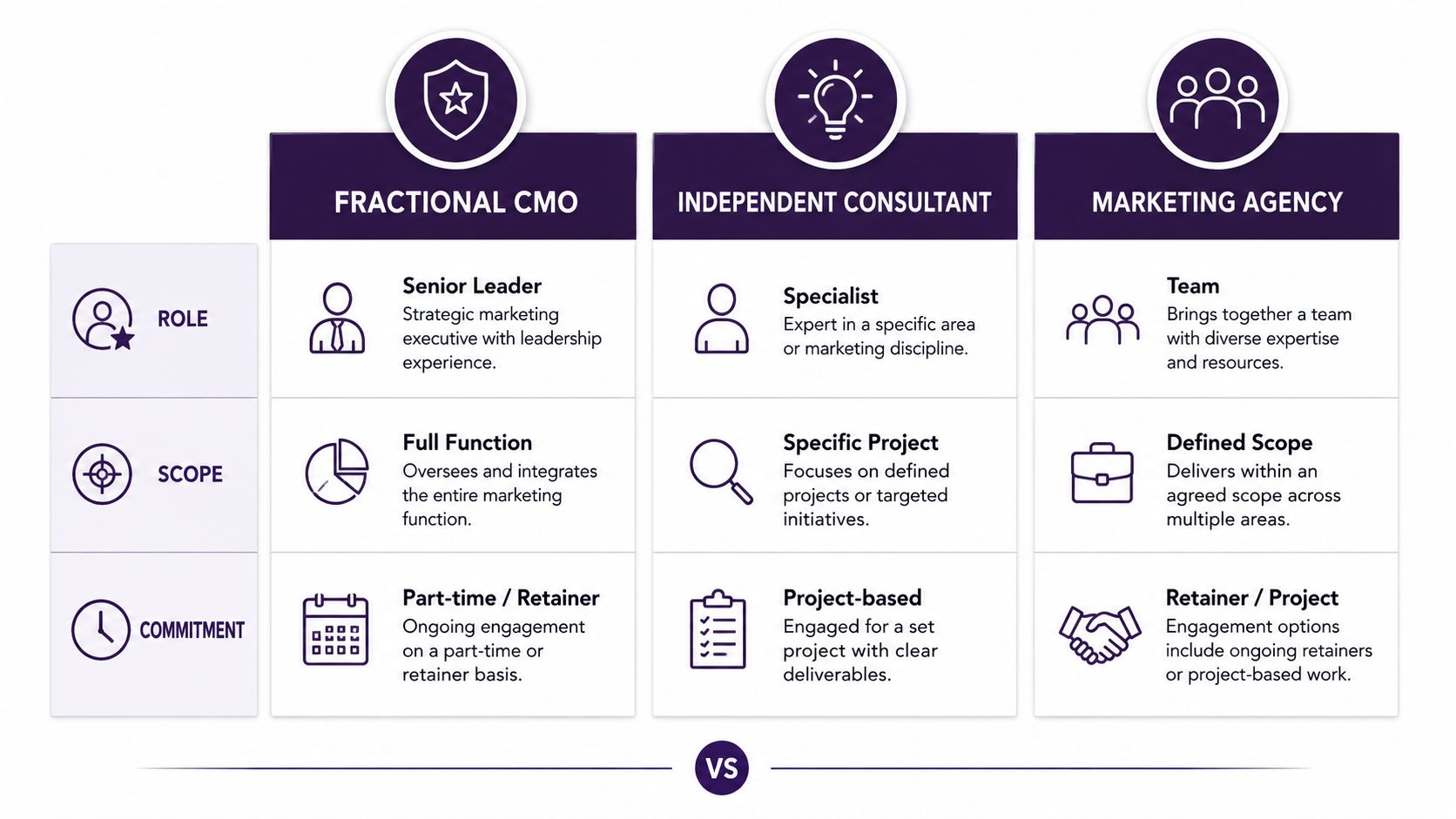
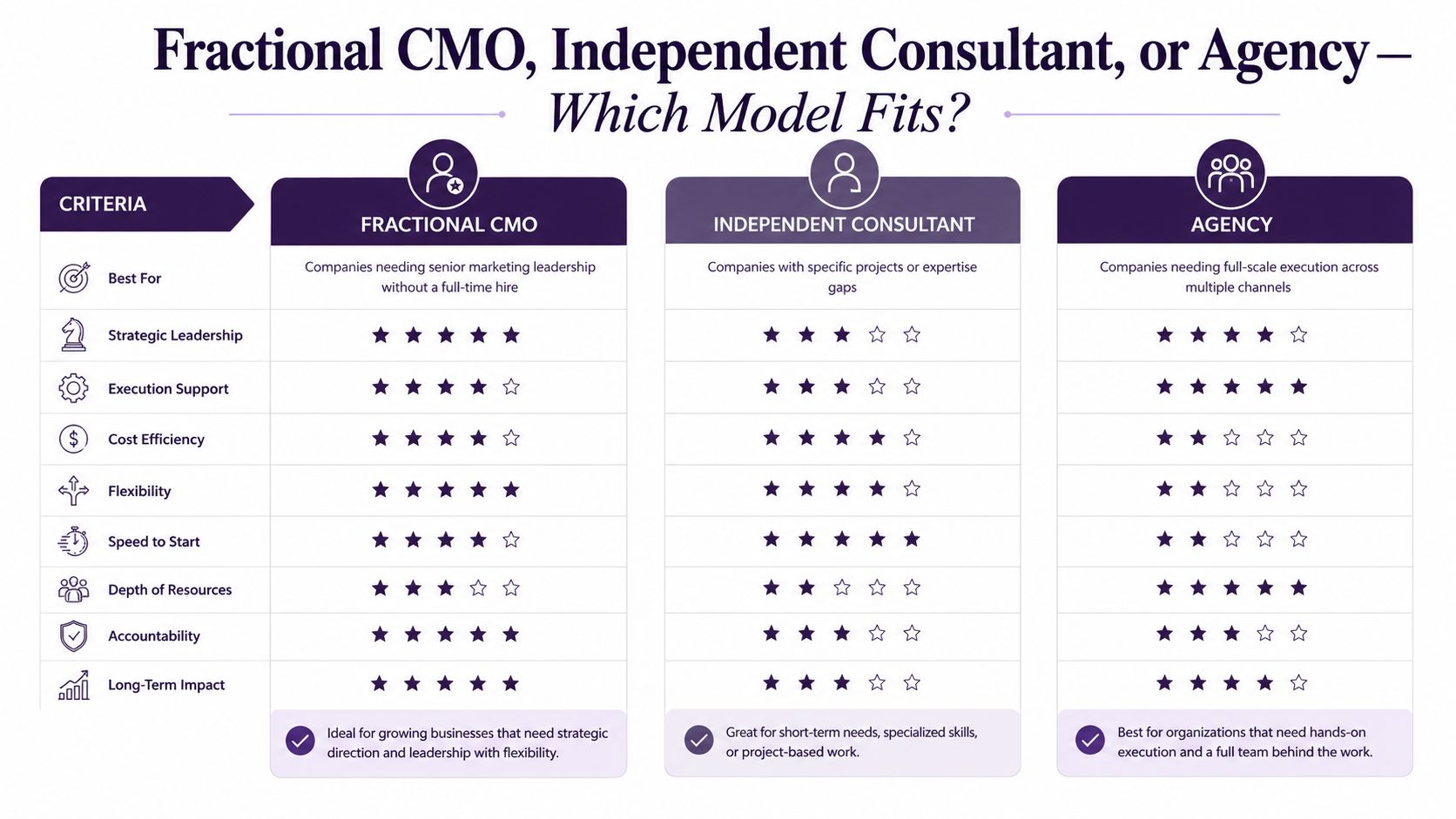
Founders who lump these models together usually end up paying for the wrong bottleneck. A fractional CMO gives you senior leadership, an independent consultant gives you focused diagnosis or project support, and an agency gives you execution capacity. A useful primer on the role is Fractional CMO Meaning, which separates real leadership from advisory work.
The wrong choice usually starts with buying for the symptom instead of the constraint. If you need someone to own the marketing function, a project-based consultant will not solve that. If you need a landing page rebuilt, a fractional executive may be too much horsepower. If you need output across multiple channels, a single specialist will not replace a team.
Fractional CMO
A fractional CMO is a part-time senior marketing leader. Use this model when you need ownership of strategy, team direction, and KPI accountability without hiring a full-time executive. It fits companies where marketing decisions affect product, sales, and retention, not just campaign output.
Founders often misunderstand this role. A fractional CMO does not just deliver a deck. They make decisions, set priorities, and keep the team focused on the metrics that matter. They sit between execution detail and executive accountability, which is why the role matters once marketing stops being a side function.
Independent consultant
An independent consultant fits a narrower problem. You might need positioning work, a channel audit, a conversion review, or help launching a specific campaign. The upside is focus. The downside is that you still own execution unless the scope says otherwise.
This model works best when the founder already knows the outcome. If you want a homepage rewritten, a paid account cleaned up, or a lifecycle sequence mapped, this is efficient. If you need someone to own the whole motion, it is not enough.
Agency
An agency is a team model. Use it when you need multiple hands on execution across paid, content, design, or web. Agencies can move faster on production, but they also become expensive if you buy a broad retainer without a tight operating brief.
The mistake founders make is hiring an agency before defining what good means. That produces busy reports, lots of activity, and no clear link to revenue. Agencies are strongest when strategy is already set, or when a senior internal leader keeps them pointed at measurable outcomes.
The decision shortcut
Use this rule:
- Need senior leadership? Hire a fractional CMO.
- Need a defined project or diagnosis? Hire an independent consultant.
- Need execution capacity? Hire an agency.
Stage matters too. Pre-launch and early validation usually need sharper consulting. Early growth often needs fractional leadership. Scale usually needs a mix of leadership and execution. Once you pick the wrong model, everything downstream gets harder.
Pricing, Engagement Length, and How to Budget Honestly
Founders hate vague pricing because vague pricing usually hides mismatched expectations. So let's be direct. The cost shape should match the job shape, and if it doesn't, you're paying for the wrong kind of attention.
Independent consultants commonly charge $150 to $400 per hour or a flat project fee in the $5K to $25K range. Fractional CMOs usually sit in the $6K to $15K monthly range for 1 to 3 days a week. Agencies typically require a $5K to $20K monthly retainer plus media spend. Those are the figures to use when you're deciding how much senior attention you can afford.
Budget by outcome, not by vanity
A founder should budget around three questions. How much senior thinking do we need? What should change in the next 90 days? What happens if we do nothing? That last question matters because inaction also has a cost, especially when the team is already spending time on channels that aren't compounding.
Here's the honest way to think about it. If you need a few sharp decisions and a clear roadmap, a project consultant may be enough. If you need ownership and coaching across the function, fractional leadership is usually the cleaner buy. If you need consistent production, don't pretend a strategist can also be your whole execution team.
Engagement length should match proof, not hope
Don't lock into a long contract before the consultant has shown signal. A 30-day diagnostic sprint is enough to find the obvious problems. A 90-day strategy and execution plan is enough to test whether the motion is working. Ongoing retainers only make sense after the first outcomes are visible.
| Marketing Consulting Engagement Models Compared | |||
|---|---|---|---|
| Model | Typical Cost | Best For | Strategy Owner |
| Independent Consultant | Hourly or flat project fee | Defined projects, audits, positioning work | Founder or consultant, depending on scope |
| Fractional CMO | Monthly retainer | Senior leadership, KPI ownership, team direction | Fractional executive |
| Agency | Monthly retainer plus media spend | Execution across channels | Agency with founder oversight |
The biggest budgeting mistake is buying sophistication before you've bought clarity. A founder doesn't need the most expensive option. They need the option that solves the current bottleneck with the least wasted motion.
KPIs and Outcomes a Good Consultant Should Be Measured On
If a consultant can't tell you what success looks like, don't hire them. That's not harsh, it's operational hygiene. The first thing a serious consultant should do is define the numbers that connect marketing activity to business outcomes.
The core metrics are customer acquisition cost (CAC), customer lifetime value (CLV or LTV), conversion rate, and return on ad spend (ROAS). These are the metrics that make marketing legible to a founder because they show whether growth is efficient or just loud. The dashboard should also roll into payback period and CLV:CAC ratio, because those are the decisions you make when you're scaling or pausing spend, as outlined in the KPI guidance at StoryChief.
The scorecard that matters
CAC tells you what it costs to win a customer. If it's climbing without a corresponding improvement in retention or deal quality, the channel is probably getting worse, not better. CLV/LTV tells you what a customer is worth over time, which is why weak retention makes any acquisition channel look more expensive than it should.
Conversion rate matters because it often gives you the fastest win. If more of your traffic or leads convert, you can lower CAC without spending more. ROAS matters when you're buying attention directly, because it forces the consultant to tie media spend back to revenue instead of impressions.
Leading indicators should come first
A good consultant won't wait six months to tell you whether the work is working. They should instrument leading indicators early, especially qualified pipeline, activation rate, organic traffic growth, and assisted conversions. Those signals tell you whether the motion is moving in the right direction before full revenue results show up.
Measure the funnel end to end, or you'll end up optimizing the wrong part of it.
That's why early-stage and later-stage teams need different dashboards. For pre-launch or validation, the focus is on demand signals and landing-page behavior. For revenue-stage startups, the emphasis shifts toward CAC, churn, burn rate, runway, gross margin, and net revenue retention, as described in the pitch-deck metrics guide at White Page Studio.
What to put in the contract
Put the KPI list directly into the engagement agreement. Include the reporting cadence, the definition of each metric, and which metrics decide whether the work continues. If the consultant pushes back, that's useful information. It usually means they'd rather stay abstract than be held accountable.
How to Evaluate, Vet, and Hire the Right Consultant
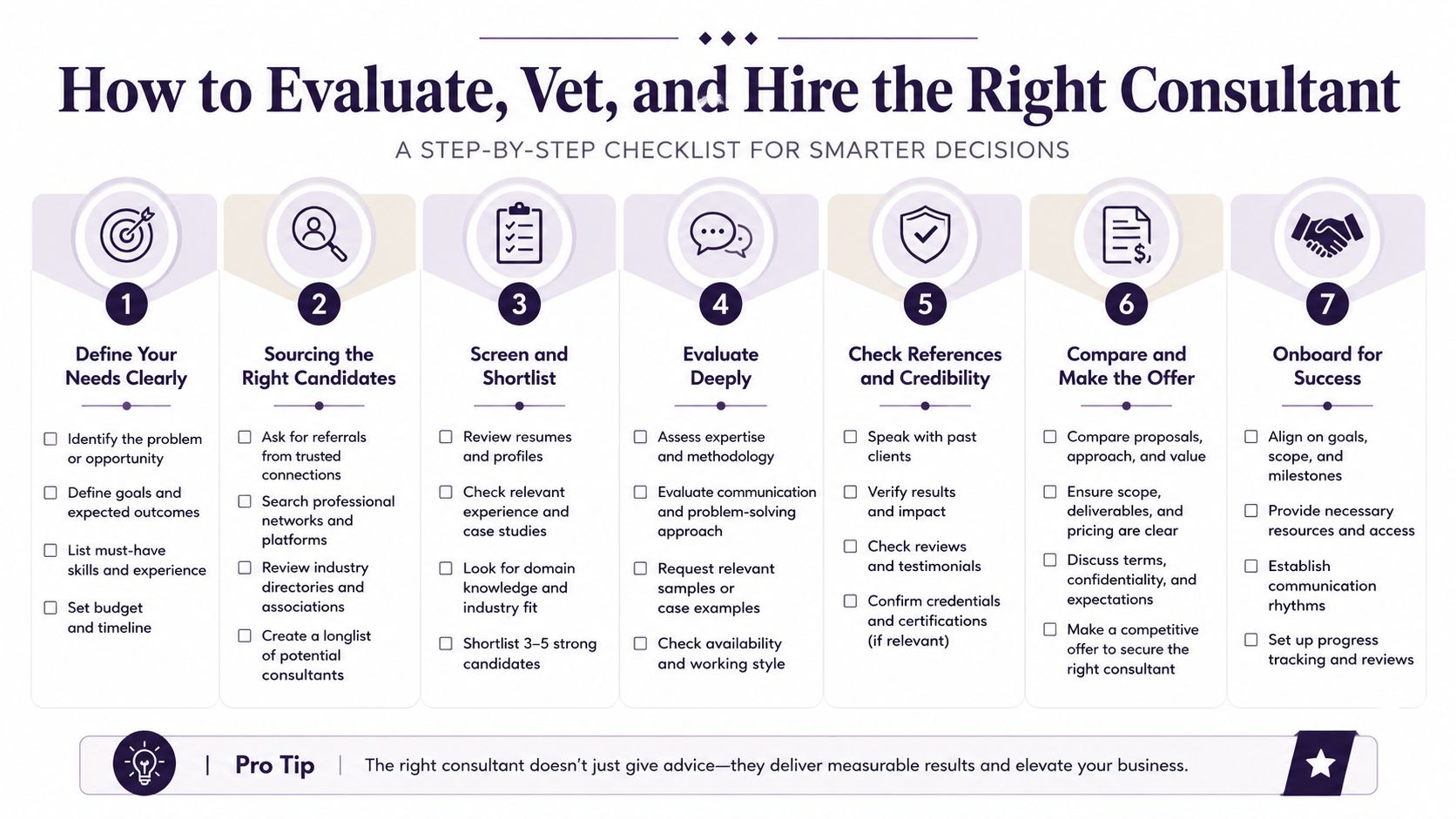
Start with a one-page brief. Name the stage, the gap, and the budget. If you can't do that in a page, you're not ready to hire, because the wrong brief attracts the wrong people.
Then source candidates from three places. Referrals are good for trust. Curated LinkedIn outreach is good for specificity. Fractional marketplaces are useful when you need a broader pool of experienced operators. If you want an example of that model in practice, Shiny connects startups with part-time executives for leadership gaps, which is useful when the need is more than a project and less than a full-time hire.
Vet for signal, not style
A polished deck doesn't prove competence. Neither does a big follower count. Look for direct evidence that they've solved the problem you have, at your stage, in a similar operating environment.
Use this checklist:
- Ask for relevant case work: Look for work that matches your stage, not just your industry.
- Run a paid diagnostic: Two weeks is enough to see how they think before you commit longer.
- Reference-check recent clients: Speak to at least two clients from the last 18 months.
- Demand plain-English methodology: If they can't explain the approach clearly, they probably don't own it.
- Define KPIs before kickoff: No KPI, no shared definition of success.
The red flags are usually obvious. Vague deliverables. No willingness to talk about metrics up front. Heavy upfront fees without a diagnostic phase. Overly theatrical language that hides the actual method. Those are all signs that the consultant is selling confidence instead of operating discipline.
Hire the person who can name the problem, show the method, and accept the scoreboard.
That's the standard. If you're evaluating agencies, consultants, or fractional leaders against anything softer than that, you'll probably end up paying for momentum theater.
A good interview question is simple: “What would you do in the first 14 days, and what would you need from us to make that work?” A real operator answers with assumptions, sequence, and measurement. A weak one answers with buzzwords.
Onboarding, First 90 Days, and Adapting to the AI Search Era
The first 90 days should feel boring in the right way. Everyone knows the KPIs, everyone sees the same dashboard, and nobody is guessing what the consultant is responsible for. A weekly reporting cadence and a simple 30/60/90 milestone plan keep the engagement from drifting into vague activity.
The execution pattern should be tight. One channel, one sprint, one measurement loop. The 2-week test model works because it forces a decision fast, the team can see traffic, signups, or leads, and you don't waste months pretending a dead channel might wake up later. That kind of discipline matters even more as search changes.
Google's AI Overviews are reducing clicks to publisher sites in many query types, which means classic SEO alone isn't enough for startup marketing consulting anymore, as noted in the underserved-angle brief at Luth Research. Founders now need consultants who think about brand mentions, zero-click visibility, and assisted traffic, not just rankings.
If your consultant only optimizes for the old search model, you're already behind.
If you need a sharper marketing leader but don't want to make a rushed full-time hire, explore how Shiny connects founders with fractional executives who can own the function part-time and keep KPIs tied to real business outcomes. If you're ready to compare a fractional CMO, an independent consultant, or an agency for your stage, visit Shiny and schedule a consultation.