
Branding in Service Marketing: Your Guide to Building Unshakable Trust
Branding a service isn't about selling a physical thing; it's the art of making an intangible promise feel concrete, reliable, and deeply valuable. For a growing business, it’s about building such a powerful perception of trust and expertise that clients choose you before they’ve even seen the final result.
This is a critical pain point for founders. How do you convince someone to invest in your expertise when they can't see, touch, or test the outcome beforehand? This guide offers actionable insights to solve that exact problem.
Why Service Branding Is Your Most Valuable Asset
Selling a service is a world away from selling a product. Your customers can't hold it, test it out, or see it sitting on a shelf. They’re buying a promise—an expectation of a future outcome. This is the central challenge for any service-based business: How do you build unshakable confidence in something your client can't even see?
Your brand is the answer. It’s far more than a logo or a color palette. It’s the entire feeling people get about your company's reliability, your depth of knowledge, and the tangible value you deliver. For a growing business, a strong brand is the bridge that carries a potential client over the chasm of uncertainty.
The Architect Analogy
Imagine you’re hiring an architect to design your dream home. You don't get to walk through the finished house before signing on the dotted line. What do you base your decision on? Their brand.
- Their portfolio of stunning homes they've already built.
- Their reputation for creativity, precision, and hitting deadlines.
- The trust they build with you in those first few conversations.
You’re investing purely on the strength of their promise, which is all wrapped up in their brand. In exactly the same way, your brand is the portfolio your clients study before they decide to work with you. Good branding makes your invisible service feel like a tangible, trustworthy investment.
For founders who need specialized expertise—like that of a fractional executive—investing in a powerful brand is the first step toward attracting high-value clients. If you want to dive deeper, you can learn more about how to build brand awareness in our complete guide. A well-crafted brand stakes your claim in the market and builds trust long before the final invoice is sent.
The Four Pillars of a Powerful Service Brand
Building a brand for a service-based business is a whole different ball game than branding a product. You’re not selling a box on a shelf; you're selling expertise, trust, and a promised outcome. Getting it right comes down to mastering four foundational pillars. These aren't just abstract concepts—they are the support beams that create real value and lasting client loyalty.
This is all about turning an idea into something tangible. Your brand is built on your promise, the trust you earn, and the value clients feel they receive.

Ultimately, every single action your company takes has to reinforce these ideas. That's how you build a rock-solid reputation in the market.
1. Conquer Intangibility
The single biggest challenge in service marketing is making the invisible feel real. Clients can’t touch your strategic advice or see your operational improvements before they buy. Your brand has to do the heavy lifting by providing concrete proof of value.
For instance, a fractional CFO can't just show up with a shiny new product. Instead, they build a brand that feels solid by:
- Publishing detailed case studies that walk through specific financial turnarounds.
- Developing proprietary financial frameworks that showcase a unique, structured methodology.
- Creating a clear, tiered service menu that outlines exactly what clients get, leaving no room for guesswork.
2. Forge Real Relationships
A product sale can be a one-and-done transaction. A service is almost always a relationship. Every single email, phone call, and progress meeting is a moment that either builds or breaks your brand. In fact, research shows that 81% of consumers need to trust a brand before buying from them—and in the service world, that trust is earned one positive interaction at a time.
This means every touchpoint has to reflect your brand's personality and live up to its promise. Each interaction is a deposit into—or a withdrawal from—your brand equity bank account.
Your brand isn’t what you say it is. It's what every client experiences when they interact with your team, from the initial sales call to the final project report.
3. Architect the Service Experience
The service experience is your product. It’s the entire journey a client takes with your company, and it needs to be designed with intention. From a smooth, streamlined onboarding process to proactive communication and crystal-clear reporting, the whole engagement should feel seamless and professional.
A clunky, disorganized experience screams "disorganized brand," no matter how brilliant the final deliverable is. Think of it like a restaurant: a chaotic experience ruins even the best food. The ambiance, the service, and the attention to detail define the brand and justify the price.
4. Activate Your Team as Brand Champions
In a service business, your people are the brand. They are its living, breathing embodiment. Their expertise, their attitude, and their communication style directly shape how clients perceive your entire company. One disengaged team member can single-handedly undo years of careful brand building.
Empowering your team means giving them clear standards, fostering a supportive culture, and granting them the autonomy to deliver on the brand promise. When your people genuinely believe in and live the brand, clients feel that authenticity. It's that feeling that turns them into your most passionate advocates.
For founders ready to build a brand that commands respect, a fractional executive can embed this high-level strategic thinking into your team. Explore our services or schedule a consultation to see how our vetted network can help you build the powerful brand you envision.
Defining Your Unique Position in the Market
Trying to be everything to everyone is a classic business pain point, and it's a surefire way to sink a service brand. In a crowded marketplace, a generic message is an invisible one. The brands that break through don't just shout into the void; they know exactly who they're talking to and what problem they solve.
Carving out your unique, profitable niche isn't just a smart strategy—it's about survival.
This all starts by getting laser-focused on your ideal customer. It’s not enough to say you target "startups." Get more granular. Picture a Series A fintech founder desperately prepping for their next funding round. They need a fractional CFO yesterday but are balking at the six-figure salary of a full-time hire. That level of detail turns your marketing from a shotgun blast into a sniper shot.
From Profile to Promise
Once you know exactly who you're talking to, you can build a value proposition that speaks directly to their biggest headaches. A vague promise like "we offer financial expertise" is completely forgettable.
But what about this? "We deliver board-ready financial models and instant investor credibility, all without the six-figure salary commitment." Now that gets a founder's attention.
This is the absolute core of branding in service marketing. It’s all about translating what you do into a direct, tangible solution for a very specific problem.
Think of it like medicine. A general practitioner is great for a check-up, but you don't go to them for open-heart surgery. For complex, high-stakes problems, you seek out a specialist. A sharply defined service brand positions you as that specialist, attracting clients who not only need your targeted expertise but are more than willing to pay a premium for it.
The market is already rewarding this kind of focus. The global branding services market is on track to jump from $25.7 billion to $43.2 billion by 2033. This growth is fueled by companies in competitive fields pouring money into differentiation. You can discover more insights on the growing branding services market to see just how critical a strong position has become.
Building Your Positioning Framework
To pull this all together, use a simple but solid framework. It ensures every piece of your messaging hammers home the same core idea.
- Target Audience: Who is the one person you help better than anyone else? (e.g., The Series A fintech founder).
- Pain Point: What is their single most urgent, costly problem? (e.g., They need top-tier financial strategy but can’t justify the burn rate of a full-time C-suite hire).
- Brand Promise: What is the clear, tangible outcome you guarantee? (e.g., Investor-grade financial leadership on a flexible, part-time basis).
- Unique Differentiator: Why are you the only real choice? (e.g., Our network is made up exclusively of vetted CFOs who have direct experience raising capital in the fintech space).
This focused approach is how you build a brand that doesn’t just get noticed, but gets respect. It's how you go from being just another option to being the only logical solution.
Turning Your Brand Into an Unforgettable Experience
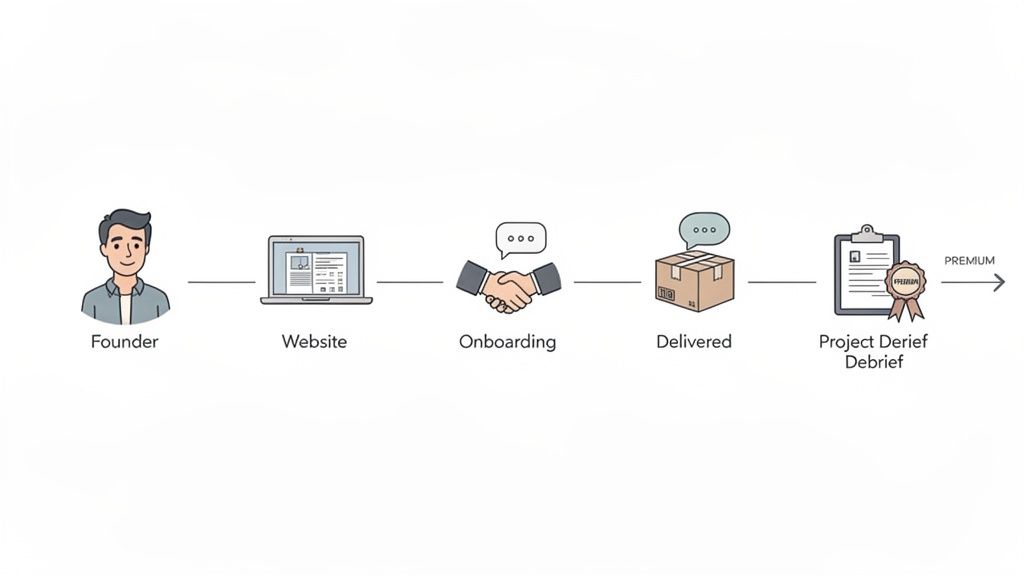
A powerful brand promise is just an idea until a client actually lives it. This is where your strategy hits the pavement. The entire journey a customer takes with your company—from their first click on your website to the final project debrief—is where your brand is truly built or broken.
This process of architecting the client’s journey is known as customer experience (CX) mapping. It’s the essential tool that service businesses use to turn abstract promises into tangible, memorable interactions. Instead of just hoping for a good experience, you design one from the ground up, ensuring every single step reinforces the value you promised.
Mapping the Journey from Prospect to Partner
To design a seamless experience, you must first identify every single point where a client interacts with your brand. These are your brand touchpoints, and each one is an opportunity to either build trust or create friction. Neglecting even one can undermine the entire relationship.
Think about the journey of a founder hiring a fractional executive. The touchpoints might look something like this:
- Discovery: They find your firm through a sharp blog post or a LinkedIn recommendation. Is your content insightful and professional?
- Initial Inquiry: They fill out a contact form on your website. Is the form simple, and is your response time impressively fast?
- Consultation: They hop on an initial call with you. Is the conversation laser-focused on their pain points, demonstrating immediate expertise?
- Onboarding: They sign the contract and kick things off. Is it a streamlined, white-glove experience or a confusing mess of paperwork?
- Engagement: They get weekly updates from their fractional leader. Are these communications proactive, clear, and genuinely valuable?
- Offboarding: The initial project wraps up. Is there a structured debrief to review successes and plan what's next?
Each of these moments is a real-world test of your brand promise. A smooth, professional process validates their decision to hire you, while a clunky, disorganized one plants seeds of doubt.
A great service brand doesn’t just deliver a final result; it curates an exceptional journey. The feeling of being expertly guided and cared for from start to finish is the product.
By mapping this entire journey, you can spot the weak links and hidden opportunities. Maybe you realize your onboarding is slow, creating anxiety for new clients. By simplifying it with a digital welcome kit and a clear timeline, you instantly reinforce a brand promise of efficiency and professionalism.
This is how a simple service becomes a premium, trust-building partnership. If you're ready to design an experience that turns clients into advocates, it might be time to bring in leadership that has done it before.
Unlocking Your Team as Brand Ambassadors
In a service business, your brand isn't something you can hold in your hand. It's the expertise, professionalism, and genuine care your people bring to every single interaction. Each client call, every email, and every project kickoff is a live demonstration of your brand promise.
This makes your team the single most powerful asset you have. When your people truly live the brand, clients don't just see it—they feel it. They trust it. And they keep coming back.

Investing in your team's ability to represent the brand is one of the highest-ROI moves a founder can make. This goes way beyond a dusty training manual. It’s about creating an environment where brand values aren't just memorized, but are actively demonstrated in everything they do.
Cultivating a Brand-Centric Culture
A brand-centric culture is the soil where your ambassadors grow. It’s a shared understanding of what the company stands for and a collective commitment to delivering on that promise, time and time again. When your team is aligned, they become a cohesive force that builds your brand's credibility.
This internal alignment is absolutely critical because branding in service marketing is all about trust. Research shows 86% of consumers say brand reputation is a major factor in their buying decisions, and 87% say the same for high-quality customer service. When your team delivers a consistently great experience, you're directly giving modern buyers what they demand most. You can read the full research about branding's impact on consumers to see just how vital this has become.
To get there, you have to be intentional about designing your internal operations around your brand. If you want to go deeper, you can learn how to build company culture that genuinely empowers your team to become brand champions.
Empowering Leaders to Amplify Your Message
Your key leaders, especially fractional executives, have a massive role to play here. Their established professional reputations and deep expertise act as an immediate credibility boost for your entire company. When a seasoned fractional CMO or CFO represents your firm, their personal brand amplifies your corporate brand.
Empowering them means setting clear standards but also giving them the autonomy to lead by example. Their actions set the tone for everyone else.
- Establish Clear Service Standards: Define what "exceptional service" actually looks like in practical, everyday terms.
- Encourage Professional Development: Invest in their personal brands through things like speaking opportunities or content creation.
- Recognize Brand-Aligned Behavior: Celebrate team members who go above and beyond to live out the brand values.
Ultimately, when your team becomes your best brand ambassador, your marketing feels more authentic, your client relationships deepen, and your growth becomes far more sustainable.
Elevating Your Brand with Fractional Leadership
Putting all these principles into practice takes more than just good intentions. It demands seasoned strategic guidance. This is exactly where branding in service marketing collides with the real-world impact of fractional leadership.
Hiring a fractional executive isn't just a staffing decision—it’s a powerful branding move. It's how you accelerate your journey from an unknown startup to a respected player in your market.
Bringing a seasoned executive onto your team, even part-time, sends an immediate and powerful signal. It screams commitment to excellence and injects a level of credibility that can take years to build on your own. For investors, it shows you’re serious about scalable growth. For clients, it proves you have the expertise to deliver on your promises.
Fast-Tracking Trust and Authority
A fractional leader’s established reputation becomes a direct asset to your brand. Their experience and professional network act as an instant validator, opening doors and building confidence with key stakeholders.
Think of it as borrowing authority to build your own.
Hiring a fractional executive is the strategic shortcut to embedding deep industry credibility directly into your brand’s DNA. It’s a decisive action that says, "We're not just playing the game; we're here to lead it."
This approach is especially powerful for founders who need specialized expertise to navigate critical growth stages. For instance, if you're trying to build a commanding market presence, exploring the role of a fractional CMO can give you the high-level marketing strategy needed to define your brand and start capturing attention.
Ultimately, fractional leadership is about more than just filling a gap on the org chart. It's about making a strategic investment in your brand's future, ensuring you have the proven leadership required to build a company that commands respect.
Frequently Asked Questions
Knowing the principles of service branding is one thing, but actually putting them to work? That’s where the real questions pop up, especially when you're growing fast. Here are some straightforward answers to the queries we hear most often from founders.
How Can a Startup Build a Strong Brand on a Limited Budget?
Building a brand that resonates doesn't mean you need a massive budget. For startups, it’s all about being focused and relentlessly consistent. Concentrate on high-impact, low-cost moves that build trust directly with your ideal audience.
- Content That Actually Helps: Write articles or case studies that solve a real problem for your ideal customer. This proves your expertise and naturally pulls in the right kind of leads.
- An Unforgettable Customer Experience: Word-of-mouth is still the most powerful branding tool. A smooth onboarding process or a proactive check-in call costs next to nothing but creates loyalty.
- The Founder's Voice: Get active on platforms like LinkedIn. When a founder shares genuine insights, they build a personal connection that people are far more likely to trust than a faceless company logo.
The game here is to trade cash for focused effort and authenticity.
What Are the First Practical Steps to Take?
It’s easy to feel overwhelmed. Start small. Nail down these foundational steps to build clarity and get momentum.
- Define Your Niche: Get painfully specific about who you help. Don’t sell to "businesses." Sell to "Series A fintech founders who need investor-ready financials." The tighter the niche, the stronger the brand.
- Craft Your Brand Promise: In one simple sentence, what tangible result do you deliver for that specific audience? Write it down. This is your north star for every decision.
- Map the Customer Journey: Walk through every single touchpoint a client has with your company. Is every step professional, consistent, and reflective of your brand?
How Do I Measure the ROI of Branding Efforts?
Measuring the ROI of a service brand isn't as simple as tracking e-commerce sales, but it's absolutely doable. You just need to look at a mix of metrics that show your brand's health and influence are growing.
The ROI of a strong service brand often shows up in leading indicators: shorter sales cycles, higher close rates, and the ability to command premium pricing without pushback. These are signs that trust was built long before you even sent the proposal.
Keep an eye on key metrics like website traffic from branded searches, your social media engagement rates, customer lifetime value (CLV), and the quality of your inbound leads. Over time, the data will paint a clear picture of how your brand-building efforts are creating real business value.
Building a brand that people respect is a journey, and you don’t have to go it alone. The right senior leadership can accelerate your growth and build a brand that commands attention. If you're ready to connect with vetted, top-tier fractional executives who can provide the strategic leadership you need, we can help. Explore our services or schedule a consultation today to find the right expert for your team.