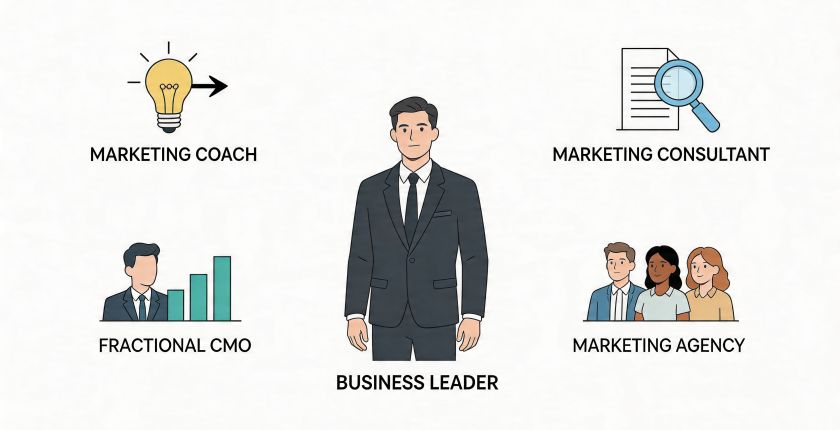
Business Marketing Coach: Compare & Choose Your Partner
Your product works. Early customers said yes. A few channels clicked. Then growth got uneven.
One month, referrals carry the pipeline. The next month, paid campaigns stall, content slips, and nobody can say which message is landing. The founder steps back into marketing, the team gets busier, and results don't improve.
That moment usually gets framed the wrong way. Founders ask, “Who should we hire for marketing?” The better question is, what kind of marketing leadership model fits the business you have right now?
A startup with no marketing team needs something very different from a company with junior marketers, an outside agency, and rising pressure from investors or the board. Some need a coach. Some need a consultant. Some need an agency. Many need part-time executive leadership.
The Growth Ceiling Why Your Marketing Needs a Leader
A familiar pattern shows up in growing companies.
The founder wrote the first website copy, handled early demos, posted on LinkedIn, approved every campaign, and stitched together a decent motion from instinct and hustle. That worked when the company was small. It stops working when the company adds products, segments, channels, and people.

At that point, the issue usually isn't effort. It's complexity.
A junior marketer can send campaigns. A freelancer can redesign landing pages. An agency can buy media. But if no one is setting priorities, defining the message, aligning marketing with sales, and deciding what not to do, activity expands while clarity shrinks.
Signs you've hit the ceiling
A business often needs marketing leadership when these problems start stacking up:
- Too many tactics, no system. Your team is posting, emailing, testing ads, and attending events, but nobody can explain how those actions connect to revenue.
- Founder bottlenecks. Every important decision still lands on your desk, from messaging to budget approval.
- Channel confusion. You're not sure whether the core problem is positioning, demand generation, conversion, or follow-up.
- Execution without direction. People are busy, but the work feels reactive.
You don't solve a leadership gap by adding more tasks. You solve it by giving the business a clearer brain.
Many founders start looking into support models such as fractional leadership for growing companies. The appeal isn't just lower commitment. It's fit. You get access to senior thinking without forcing the company into a full-time hire before it's ready.
Why this matters financially
Good coaching and leadership support can change outcomes, not just morale. Organizations with effective business coaching report 27% year-over-year revenue growth and 225% revenue growth over a five-year period compared with non-coached counterparts, according to business coaching statistics compiled by Growth Idea.
That doesn't mean every company needs the same answer. It means the leadership layer matters.
Some founders need help sharpening their own thinking. Others need someone embedded in the business who can lead the function. That's the primary decision in front of you.
What Exactly Is a Business Marketing Coach
A business marketing coach is a strategic guide for the founder, CEO, or marketing lead. They help you think better, decide faster, and stay accountable to a marketing plan.
They usually do not act as your day-to-day marketing operator.
That distinction matters because many founders use the word “coach” when they mean consultant, agency, or fractional executive. Those are different jobs.
The simplest way to think about it
A sports coach improves the player's game from the sideline. They study performance, spot patterns, build drills, and push accountability. They don't run onto the field and take the shot.
A business marketing coach works the same way. They help you:
- Clarify strategy. Who are you targeting, what do you stand for, and what message should lead?
- Prioritize channels. Where should the team focus first, and which activities are noise?
- Improve decision-making. What should you measure, what should you ignore, and what needs to change now?
- Stay accountable. Are you doing the work you said mattered?
What a coach is, and what a coach isn't
A coach is often a strong fit when the founder is still close to marketing and wants a thinking partner.
They are not typically the person who will:
- run your weekly standups
- manage an internal team
- rewrite every campaign
- own the marketing budget
- build the department
If you need those outcomes, you're moving beyond coaching and into leadership or execution support.
Practical rule: Hire a coach when the main constraint is your thinking. Hire an operator or executive when the main constraint is team execution.
The distinction gets clearer when you compare a coach with adjacent roles like a consultant. If you're sorting through that difference, this explanation of what a marketing consultant does is a useful companion.
Why coaching is so common
Coaching isn't a niche idea. The U.S. business coaching market reached $20.0 billion in 2025, with approximately 232,000 coaching businesses operating, according to IBISWorld's U.S. business coaching market data.
That scale tells you something important. Leaders don't just buy execution. They buy perspective.
But popularity doesn't answer the fit question. A business marketing coach can be a high-value partner when you're capable of execution internally and need sharper strategy, accountability, and pattern recognition. If the business needs someone to lead the function itself, coaching alone can leave a gap.
The Marketing Leadership Spectrum A Comparison
Most founders don't need a dictionary definition. They need a practical way to compare options.
The best way to do that is to line up the most common models side by side and ask five simple questions:
- What does this person or team own?
- Do they advise, execute, or lead?
- How close are they to the business each week?
- How flexible is the engagement?
- What kind of company gets the most value from them?
Here is the short version.
| Model | Primary Focus | Best For | Typical Engagement | Cost Model |
|---|---|---|---|---|
| Business Marketing Coach | Strategy guidance and accountability | Founders or small teams that need direction | Recurring advisory sessions | Hourly or retainer |
| Marketing Consultant | Analysis and recommendations for a specific problem | Companies facing a defined challenge | Project-based or short-term advisory | Project fee or hourly |
| Marketing Agency | Channel execution and campaign delivery | Teams that need outsourced production and execution | Ongoing service scope or campaign scope | Monthly retainer or project fee |
| Fractional CMO | Executive-level marketing leadership | Growth-stage companies that need senior oversight without a full-time hire | Part-time ongoing leadership engagement | Monthly retainer |

Business marketing coach
A business marketing coach helps the founder or leader improve judgment. This model is strongest when the company already has enough hands to do the work, but lacks confidence, consistency, or strategic discipline.
A coach often works well if:
- The founder still leads marketing. You want a sounding board who can challenge assumptions and improve focus.
- The team is capable but underdirected. They don't need a boss as much as they need sharper priorities.
- The business needs accountability. Decisions keep getting delayed, or important initiatives never make it past planning.
The limitation is simple. A coach can tell you what should happen. They usually won't own whether it does.
Marketing consultant
A consultant is usually hired to solve a particular problem. You might need a positioning refresh, an audit of your funnel, a go-to-market plan for a new product, or a diagnosis of why pipeline quality dropped.
Consultants are useful because they bring concentrated expertise. They can move quickly, offer an external view, and leave you with a roadmap.
They are less useful when the challenge isn't a single project but an ongoing leadership vacuum.
Typical consultant strengths include:
- Diagnostic work. They can identify where the system is breaking.
- Specialized expertise. They often go deep in one area such as pricing, messaging, or launch strategy.
- Finite scope. You know what you're buying and when it ends.
Consultants tend to create clarity. They don't always provide the management structure to carry the plan forward.
Marketing agency
An agency is the right answer when you need output. That might mean paid media management, SEO content production, email campaigns, creative design, video, web development, or marketing automation support in platforms like HubSpot or GA4.
Agencies are often excellent at execution within a defined lane.
They become a poor fit when the business expects them to act like the internal head of marketing. Most agencies can run campaigns. Fewer can align those campaigns to company strategy, sales process, team capability, and budget tradeoffs.
A founder should think carefully before expecting an agency to do executive work by default.
An agency can help you drive the car faster. It may not decide where the car should go.
Fractional CMO
A fractional CMO sits closer to the business than a coach or consultant. They operate as a part-time executive leader. They shape strategy, manage priorities, coordinate teams and vendors, and often own the marketing roadmap.
This is the hybrid many growth-stage companies need.
The appeal is practical. A full-time CMO can cost over $250,000 annually, while a fractional executive typically costs 20% to 30% of that, according to this analysis of traditional coaching and the fractional model.
That difference matters when you need senior leadership but don't yet need, or can't yet justify, a permanent executive hire.
A fractional CMO is often the best fit when:
- You have people but no leader. The team, freelancers, and agency all need coordination.
- Growth has become uneven. You need stronger strategic oversight and tighter decision-making.
- You need executive judgment without full-time overhead. The business isn't ready for a permanent CMO, but it is ready for senior ownership of the function.
Full-time marketing leader
A full-time head of marketing or CMO makes sense when the company has enough scale, complexity, and sustained demand to justify a permanent executive.
This person should build the team, own planning cycles, hire and develop talent, manage budgets, and represent marketing in the leadership group.
That role is powerful. It's also the hardest one to hire prematurely. If the business isn't ready, the executive can end up underutilized, frustrated, or miscast as a high-cost doer.
The practical difference founders care about
If you strip away titles, the comparison comes down to this:
- Coach. Helps you think.
- Consultant. Solves a defined problem.
- Agency. Produces and executes.
- Fractional CMO. Leads the function part-time.
- Full-time leader. Builds and runs the function permanently.
The right answer isn't the most impressive title. It's the model that closes your biggest gap without creating a new one.
Choosing Your Growth Partner at Every Stage
A founder doesn't hire in theory. A founder hires in context.
The same company can need a coach one year, a consultant the next, then a fractional CMO after that. The key is to match the partner to the bottleneck that's slowing growth right now.

Early stage and founder-led marketing
You're still the main marketer. You know the customer well enough to sell, but you don't have a repeatable system yet. Marketing gets done in bursts, usually when pipeline feels thin.
This is often where a business marketing coach helps most.
A coach can help you sharpen the message, pick a few sensible channels, and stop changing direction every few weeks. If you're willing to implement and learn, coaching can be efficient and clarifying.
A consultant can also fit here, but only if you have a specific issue. For example, a homepage that doesn't convert, a product launch that needs structure, or a pricing story that's confusing buyers.
Mid-stage with a team but no leader
This is the most uncomfortable stage.
You may have one or two marketers, an agency, a freelance designer, maybe a RevOps contractor, and a founder who still approves everything. There are enough resources to create motion, but not enough leadership to create coherence.
In that situation, a fractional CMO is often the cleanest answer.
Why? Because the issue isn't lack of effort. It's lack of orchestration.
A part-time executive can set priorities, define the roadmap, manage agencies, tighten reporting, work across sales and product, and decide what the team should stop doing. That role amplifies the impact for everyone else.
The moment you have multiple marketing resources pulling in different directions, leadership usually matters more than adding another specialist.
When an agency is the right call
Some businesses don't need leadership first. They need production capacity.
If strategy is clear, internal ownership is strong, and you only need campaigns built and run, an agency can be the right partner. This is common when a company already knows its audience, offer, and channels but lacks internal time or specialist execution.
Agency support works best when:
- The brief is clear. You know what success looks like.
- Someone internal owns outcomes. The agency isn't being asked to invent company strategy.
- The business needs throughput. More assets, more testing, more campaign management.
When a consultant is the sharpest tool
Consultants shine when the problem is important but contained.
Think of them like a specialist surgeon, not a primary care doctor. If your funnel is broken, your positioning is muddy, or a market entry plan needs expert design, a consultant can diagnose and fix that specific problem faster than a broader partner.
This path is especially useful when the rest of the business is stable and you're not trying to redesign how marketing operates every week.
A simple self-diagnosis
Ask these questions in order:
- Do I need better decisions from myself? A coach may fit.
- Do I need a one-time solution to a clear problem? Look at a consultant.
- Do I need more output from a known playbook? Consider an agency.
- Do I need someone to lead marketing without hiring full-time? That's usually fractional executive territory.
Many founders get stuck because they hire for symptoms. They hire an agency because leads are down, when the core problem is positioning. They hire a coach when the team needs management. They hire a full-time leader before the business can support one.
The right partner isn't the most qualified person on paper. It's the one whose operating model matches your stage, team, and decision bottleneck.
How to Vet and Interview Your Marketing Partner
A bad marketing hire rarely fails because the person lacked vocabulary. It fails because the scope, expectations, and operating style didn't match the business.
Interviewing well means testing for fit, not charisma.
A coach should be vetted differently from an agency. A fractional CMO should be vetted differently from a consultant. If you use the same questions for all of them, you'll miss the critical risks.
For a broader hiring framework, these marketing executive interview questions can help sharpen your process.
Questions for a business marketing coach
A coach should improve your judgment. So ask questions that reveal how they think.
Try these:
- How do you help founders prioritize when everything feels urgent?
- What does your coaching process look like over the first few months?
- How do you handle a client who keeps avoiding the hard strategic decision?
- What kind of founder gets the most value from your style of coaching?
Listen for frameworks, pattern recognition, and honesty. If they mainly talk about generic motivation or broad inspiration, that's a weak sign.
Questions for a marketing consultant
Consultants need to define problems well and produce focused recommendations.
Ask things like:
- How do you scope a project when the root issue isn't fully clear yet?
- What inputs do you need from us before you can make a recommendation?
- What does a successful deliverable look like in your process?
- What happens after you hand over the strategy?
Good consultants make boundaries clear. They should say what they will answer, what they won't own, and what internal support you'll need after the work is done.
Questions for an agency
Agency interviews should focus on execution, communication, and accountability.
Use prompts such as:
- Who will work on our account day to day?
- How do you report results and flag underperformance?
- What do you need from an internal owner on our side?
- How do you handle strategy shifts when campaigns aren't landing?
Ask for process clarity, not polished slides. You want to know how they run meetings, escalate issues, and make decisions inside platforms like HubSpot, GA4, ad managers, or your CRM.
If an agency can't explain who owns what each week, you'll end up paying for confusion.
Questions for a fractional CMO
This interview is different because you're evaluating executive judgment.
Ask:
- How would you assess our marketing function in the first month?
- How do you decide what to stop, not just what to start?
- How have you led internal teams, agencies, and cross-functional stakeholders at the same time?
- What metrics would you put in front of the leadership team first?
A strong fractional CMO should speak fluently about tradeoffs. They should be able to discuss strategy, team design, budget allocation, messaging, reporting, and leadership cadence without sounding theoretical.
Red flags across all models
Some warning signs are universal:
- They promise certainty too early. Serious operators ask smart questions before making big claims.
- They can't define scope cleanly. Fuzzy ownership creates expensive frustration.
- They avoid tradeoffs. Good leaders say no often.
- They rely on jargon. Clear thinkers use plain language.
The interview should leave you with a clear answer to one question: will this person make the business more focused, more effective, and easier to run?
Onboarding and Measuring True Marketing ROI
A smart hire can still fail in a messy environment.
Most marketing partnerships underperform because onboarding is loose, reporting is shallow, and nobody agrees on what success means. If you want useful outcomes, you need a clean operating system from the start.

Start with access and context
Your new partner needs the same basics, whether they're a coach, consultant, agency, or fractional executive.
Give them access to:
- Your numbers. CRM, pipeline reporting, campaign history, and conversion data.
- Your tools. HubSpot, GA4, ad platforms, email systems, dashboards, and sales notes.
- Your context. Product roadmap, customer segments, pricing, board pressure, and current constraints.
Without that, they can only give generic advice.
A founder should also name one clear internal owner. Even if the partner is senior, someone in the company has to move blockers, confirm priorities, and keep information flowing.
Set a rhythm early
Cadence matters more than founders expect.
A healthy engagement usually needs a regular decision rhythm, a place for open workstreams, and one source of truth for metrics. That might be a weekly leadership check-in, a shared dashboard, and a monthly review tied to revenue and pipeline quality.
The exact format can vary. The principle shouldn't.
Marketing support becomes expensive when feedback is casual, priorities shift midweek, and nobody closes the loop on decisions.
Measure business impact, not just activity
At this stage, many teams drift into vanity metrics.
Open rates, clicks, traffic, and impressions can be useful diagnostics. They are not enough to judge strategic marketing leadership. A real leader should help the company improve commercial outcomes.
One important benchmark is LTV/CAC ratio. A key performance indicator for a high-margin coaching or fractional business is achieving an LTV/CAC ratio of 3:1 or higher, according to this KPI guide for business coaching models. In plain terms, customer lifetime value should be at least triple the cost to acquire that customer.
That metric matters because it connects marketing quality to business sustainability.
KPIs that actually help
The best scorecard depends on your business model, but strong marketing oversight usually tracks outcomes like these:
- Marketing-sourced revenue. How much pipeline or closed revenue originated from marketing efforts.
- LTV/CAC ratio. Are customer economics improving as the system matures.
- Sales cycle quality. Are leads moving faster or arriving better qualified.
- Conversion by stage. Are the right prospects progressing through demo, proposal, or trial.
- Message performance. Which segments, offers, or value propositions consistently pull response.
If you're working with a coach, some measures may be indirect at first because the coach is improving decision quality and team discipline. If you're working with a fractional CMO, accountability should move closer to business outcomes because that role owns more of the system.
Know what success looks like before month one ends
A good onboarding conversation should answer these questions:
- What will be diagnosed first?
- Which metrics matter most right now?
- What decisions belong to the partner, and which still belong to the founder?
- When will you review progress?
- What would make you expand, narrow, or end the engagement?
Those answers prevent a common failure mode. Everyone feels busy, but nobody can say whether the partnership is working.
Your Next Step to Strategic Marketing Leadership
Most founders don't need more marketing opinions. They need a better fit.
A business marketing coach can be powerful when you're the main decision-maker and want sharper strategy, better accountability, and a steadier hand. A consultant works when a specific problem needs expert diagnosis. An agency works when strategy is settled and execution capacity is the gap.
The model that often fits growth-stage companies best is part-time executive leadership. It gives the business a senior operator who can set direction, manage moving parts, and create structure without forcing an early full-time hire.
That's especially useful when your team sits in the middle zone. You have enough activity to justify leadership, but not enough scale to justify a permanent CMO. In that situation, flexible executive support usually beats a patchwork of disconnected vendors.
What good looks like over time
The best marketing partnership doesn't just produce work. It creates trust, consistency, and measurable progress.
One benchmark worth keeping in mind is that top-tier coaching and fractional engagements aim for client retention rates of 80% to 90% annually, often correlated with Net Promoter Score above 50, according to this guide to coaching growth metrics.
Those numbers matter because they point to something deeper than satisfaction. They suggest the engagement is valuable enough that clients stay and strong enough that they recommend it.
The decision that matters now
You don't need the perfect marketing org chart today. You need the next right layer of leadership.
Ask yourself:
- Is the core issue my own need for guidance?
- Do I have a specific problem to solve?
- Do I need output?
- Or do I need someone to lead marketing with executive judgment?
Answer that truthfully, and the hiring path gets much clearer.
If your company needs flexible senior leadership instead of another expensive full-time gamble, it's worth exploring a model built for that reality.
If you're weighing whether a coach, consultant, agency, or fractional executive is the right fit, Shiny can help you find the right level of marketing leadership for your stage. Their marketplace connects growing companies with vetted part-time executives who can step in for a few hours a week or take on broader strategic responsibility. If you want a practical conversation about your options, schedule a consultation and map the role before you hire.