Crafting the Ultimate CFO Job Description
At its core, a Chief Financial Officer (CFO) job description is a blueprint. It outlines the strategic duties, core responsibilities, and must-have qualifications for the executive who will manage financial planning, oversee risk, and act as the CEO’s most trusted partner. Getting it right is the first step in finding a leader who can truly shape your company's future.
But what if you need that high-level guidance before you're ready for a full-time executive salary? This is a common pain point for growing businesses, and it's where a more flexible approach to leadership comes in.
The Evolution of the Modern CFO

The CFO role has undergone a massive transformation. Gone are the days when the finance chief was a back-office accountant focused solely on historical reporting. Today’s CFO is a strategic powerhouse who sits at the center of the action, driving growth and shaping the company's trajectory.
Think of it like this: a traditional finance leader was like a historian, carefully recording what happened in the past. The modern CFO is an architect of the future. They are the strategic co-pilot to the CEO, using financial insights to dodge risks, seize opportunities, and steer the entire organization toward long-term value creation.
From Gatekeeper to Growth Driver
This evolution means the responsibilities in a CFO job description have expanded significantly. While keeping the books clean and ensuring compliance are still table stakes, the real focus has shifted to forward-looking strategy. We're talking about everything from smart capital allocation and M&A due diligence to investor relations and leading digital transformation.
A modern CFO is expected to:
- Drive Strategic Planning: They don’t just report the numbers; they interpret them, turning complex financial data into actionable strategies that fuel sustainable growth.
- Manage Capital and Risk: This involves securing the right funding, managing cash flow, and building robust systems to protect the company from financial threats.
- Communicate the Financial Narrative: A great CFO can tell the company's financial story in a way that resonates with the board, investors, and internal teams.
The Rise of Fractional Leadership
For growing businesses, the cost of a seasoned, full-time CFO can seem prohibitive. This is where fractional leadership becomes a game-changer. A fractional CFO delivers the exact same high-level strategic guidance you'd expect from a top-tier executive, but on a part-time, as-needed basis.
This model makes world-class financial leadership accessible without the massive executive salary. It allows startups and scale-ups to tap into elite financial oversight right when it matters most—like during a fundraise or market expansion. If you're wondering if your business is ready, our guide on when to hire a CFO can help you decide.
Core CFO Responsibilities and Duties
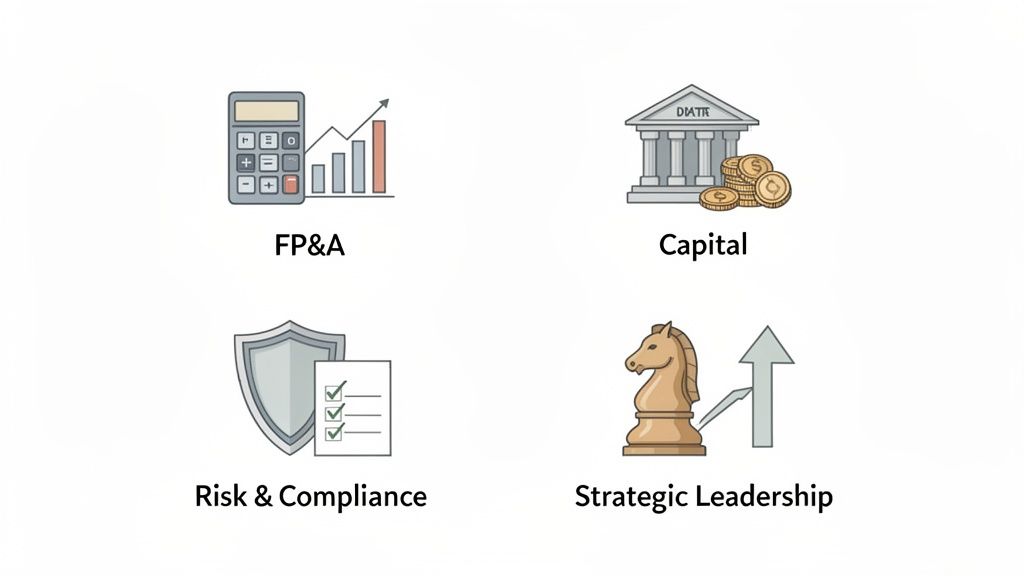
A Chief Financial Officer wears many hats, but their job boils down to four critical pillars. Think of these as the core functions a CFO manages to steer the company toward sustainable growth. Defining these pillars clearly is the first step to crafting a CFO job description that attracts top talent.
Financial Planning and Analysis (FP&A)
This is the forward-looking heart of the finance department. FP&A is all about turning historical data into a strategic roadmap. A great CFO leads this function to give the CEO and leadership team the clear insights they need to make smart, informed decisions.
A CFO's core FP&A duties include:
- Budgeting and Forecasting: Building annual budgets and rolling financial forecasts tied directly to company goals.
- Performance Analysis: Digging into financial results, KPIs, and operational metrics to spot trends, flag risks, and uncover opportunities.
- Financial Modeling: Creating sophisticated models to game out different scenarios, like entering a new market or launching a product.
- Reporting: Preparing and presenting clear, accurate financial reports that tell a story to the executive team, board, and investors.
Capital Management and Treasury
Simply put, this means having the right amount of cash at the right time to fund operations and growth. The CFO acts as the steward of the company's money, balancing the need for liquidity with smart investment opportunities.
Key responsibilities here involve:
- Cash Flow Management: Overseeing all aspects of cash flow, from daily operations to long-term forecasting, to ensure the company remains stable.
- Fundraising and Capital Structure: Leading the charge to raise capital—whether through debt or equity—and determining the optimal capital structure for the business.
- Investor Relations: Acting as the main point of contact for investors, banks, and other financial partners.
Risk Management and Compliance
In an increasingly complex business world, protecting the company from financial and operational risks is a massive part of the job. The CFO is responsible for creating a strong internal control environment and ensuring the company adheres to all regulations.
A great CFO doesn’t just manage risk; they build a resilient financial framework that allows the organization to confidently pursue opportunities while being protected from potential threats.
Specific tasks under this pillar include:
- Internal Controls: Designing policies and procedures that safeguard company assets and ensure financial reports are rock-solid.
- Regulatory Compliance: Making sure the company adheres to all financial regulations, tax laws, and industry-specific standards.
- Audit Management: Overseeing internal and external audits and working with auditors to address any findings.
Strategic Leadership and Partnership
Beyond the numbers, the CFO is a vital strategic partner to the CEO and the entire leadership team. They bring the financial discipline needed to guide the biggest decisions, from M&A to long-term planning. This is where a CFO’s value truly compounds.
The Anatomy of a Great CFO: Skills and Qualifications
When hiring a CFO, you aren't just filling a seat; you're bringing on a strategic partner. A truly great CFO is a unique blend of technical mastery, sharp strategic vision, and genuine leadership. While responsibilities tell you what a CFO does, their skills determine how well they do it.
The ideal candidate brings a powerful combination of hard and soft skills. The hard skills are the technical foundation—the non-negotiable expertise needed to manage a company's finances. But it’s the soft skills that separate a good accountant from a game-changing strategic ally.
Technical Prowess and Hard Skills
These are the bedrock skills of financial management. They're quantifiable abilities that are often easy to verify through certifications and a proven track record.
- Deep GAAP Expertise: A rock-solid understanding of Generally Accepted Accounting Principles (GAAP) is non-negotiable for accurate, compliant financial reporting.
- Advanced Financial Modeling: The ability to build complex financial models is critical for forecasting, scenario analysis, and data-backed decision-making.
- ERP Systems Proficiency: Hands-on experience with Enterprise Resource Planning (ERP) systems like NetSuite, SAP, or Oracle is essential for scaling financial operations.
- Capital Raising and Debt Management: A proven history of securing funding, whether through equity rounds or debt financing, is a key skill for any growth-stage company.
- Treasury and Cash Management: True expertise in managing liquidity and optimizing working capital keeps the company stable and solvent.
Strategic Acumen and Soft Skills
Technical skills get a candidate in the door, but soft skills make a CFO an executive leader. These interpersonal abilities allow them to influence company-wide strategy and guide the organization through complex challenges.
A top-tier CFO doesn't just present data; they translate it into a compelling narrative that inspires confidence and drives action across the entire organization.
Key soft skills include:
- Strategic Thinking: The ability to see the big picture, connecting financial metrics to overarching business goals and actively contributing to long-term planning.
- Exceptional Communication: The skill to articulate complex financial information clearly and persuasively to different audiences—investors, board members, and non-financial managers.
- Leadership and Team Building: The capacity to inspire and mentor a finance team while collaborating effectively with C-suite peers.
Experience and Educational Benchmarks
Top candidates almost always have a robust educational background and years of hands-on experience. Most companies look for a CFO with at least 10 years of finance experience, with five or more years in a management role.
Common credentials like a CPA or MBA are often table stakes. Deep GAAP knowledge is also a must-have—and it's precisely this level of expertise that fractional models make accessible without the full-time cost. You can find out more about typical CFO job requirements on RobertHalf.com.
CFO Job Description Template for Full-Time Roles
Your job description is your most powerful tool for grabbing the attention of top-tier talent. A great one acts as a clear signal, communicating your company’s vision, the strategic weight of the role, and exactly what it takes to succeed. A vague, cookie-cutter description will only attract mediocrity.
To help you kick off your executive search with confidence, we put together a complete, copy-and-paste-ready template. This is designed for a full-time CFO and covers all the crucial bases. Just swap out the bracketed text with your company's info.
Job Title
Chief Financial Officer (CFO)
Job Summary
We're looking for a strategic and results-driven Chief Financial Officer (CFO) to join our executive team at [Company Name]. Reporting directly to the CEO, the CFO will be a key partner in steering the company’s financial strategy and fueling our long-term growth. You'll be responsible for overseeing all fiscal and fiduciary responsibilities for the organization, working closely with the board of directors.
Responsibilities
- Direct and oversee all aspects of the company's Finance & Accounting functions.
- Provide strategic financial leadership and work with the executive team to set long-range goals, strategies, and plans.
- Lead the entire financial planning and analysis (FP&A) process, including the annual budget, forecasting, and long-term strategic modeling.
- Manage the company's capital structure, lead fundraising efforts (debt and equity), and maintain strong relationships with investors and banking partners.
- Ensure timely and accurate financial reporting for the CEO, board of directors, and external stakeholders.
- Develop and implement robust internal controls to safeguard company assets and ensure compliance with GAAP and other regulatory requirements.
- Perform ongoing risk management by analyzing liabilities and investments and ensuring adequate insurance coverage.
- Oversee treasury, cash management, and tax optimization strategies to support operational efficiency and growth.
- Lead, mentor, and build the finance and accounting team, fostering a culture of high performance.
Qualifications and Skills
- Bachelor’s degree in Accounting, Finance, or a related field; an MBA or CPA is strongly preferred.
- A minimum of 10+ years of progressive financial leadership experience, with at least 5 years in a senior management role (e.g., VP of Finance, Controller).
- Proven experience in a high-growth environment, with a clear track record of scaling finance operations.
- Deep expertise in financial modeling, budgeting, and corporate finance.
- Strong, in-depth knowledge of GAAP, risk management, and regulatory compliance.
- Excellent leadership, communication, and interpersonal skills, especially the ability to explain complex financial concepts to non-financial stakeholders.
- Proficiency with ERP systems (like NetSuite or SAP) and other modern financial software.
This template gives you a solid foundation. For more pointers on attracting the best candidates, check out our article on how to write effective executive job descriptions.
Fractional CFO Job Description Template for Growth Companies
For startups and growing businesses, the hefty salary of a full-time executive is often out of reach. But the need for sharp financial strategy is non-negotiable. This is exactly where a fractional CFO steps in, offering the same high-level guidance as a full-time leader but on a flexible, part-time basis.
When writing a job description for this role, you must think differently. Unlike a full-time post, a fractional CFO JD should focus less on day-to-day management and more on specific, high-impact projects. You're bringing in a seasoned advisor to tackle key challenges—like fundraising or building a financial model—and unlock your next stage of growth.
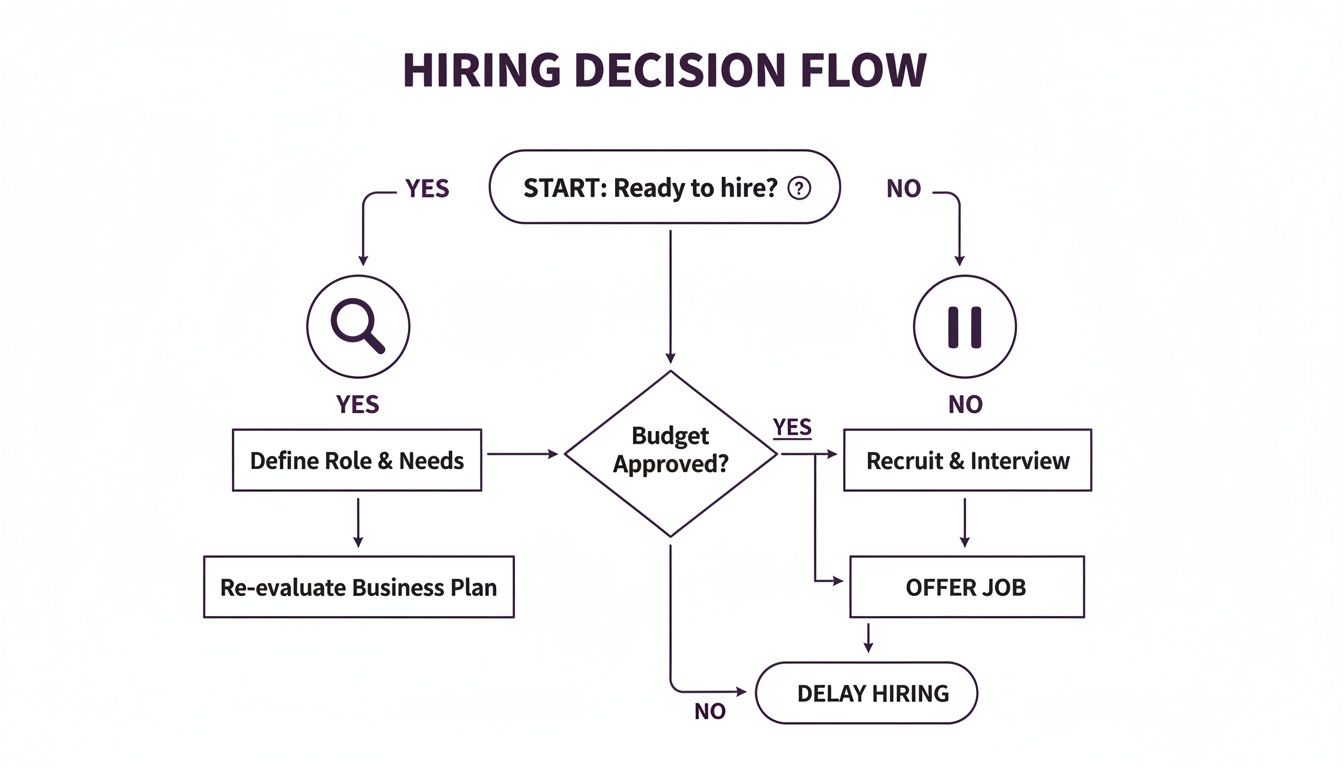
This flowchart breaks down the hiring journey, helping you move from the initial thought of "Do we need a CFO?" all the way to making the final offer.
Full-Time vs. Fractional CFO Focus Areas
The biggest difference between a full-time and fractional CFO comes down to focus: one is deep in daily operations, the other is zeroed in on strategic goals. A fractional leader is brought in to hit specific, game-changing milestones. Making this distinction clear in your job description is crucial for attracting the right kind of executive.
Here’s how their focus shifts across key responsibility areas.
| Responsibility Area | Full-Time CFO (Operational Focus) | Fractional CFO (Strategic Focus) |
|---|---|---|
| Financial Reporting | Manages the entire monthly close process. | Oversees high-level financial health and board reporting. |
| Team Management | Leads, hires, and develops the entire finance team. | Mentors the CEO and key finance personnel. |
| Capital Strategy | Manages ongoing banking and lender relationships. | Leads a specific fundraising round (Seed, Series A, etc.). |
| FP&A | Owns the detailed annual budgeting and forecasting process. | Builds the investor-ready financial model and long-term plan. |
| Risk Management | Implements and monitors company-wide internal controls. | Assesses and advises on major financial and strategic risks. |
This comparison highlights that you're hiring a fractional CFO for their strategic firepower, not to manage routine accounting tasks.
Sample Fractional CFO Job Description
Job Title: Fractional Chief Financial Officer (CFO)
Company: [Your Company Name]
Engagement: Part-time, Contract (approx. 10-20 hours/week)
About Us
[Keep this short and punchy. Briefly describe your company, its mission, and your current growth stage. Highlight the exciting challenges a new leader can tackle.]
The Role
We're looking for a seasoned Fractional CFO to provide strategic financial leadership as we scale. You'll be a key advisor to our CEO, focusing on high-impact projects like our upcoming funding round, financial modeling, and cash flow optimization. This is a hands-on, strategic role for an expert who can drive immediate value.
Key Deliverables
- Develop a comprehensive, investor-ready financial model to prepare the company for its next funding round.
- Strengthen cash flow forecasting and implement strategies to extend our runway.
- Establish key financial KPIs and create a dashboard for tracking performance against strategic goals.
- Provide strategic guidance on pricing models, M&A opportunities, and long-term financial planning.
Qualifications
- Proven experience as a CFO or VP of Finance in a high-growth startup environment.
- A track record of successfully raising capital (Seed, Series A, etc.).
- Expert-level financial modeling and strategic planning skills.
Finding an executive with this specialized, high-growth experience can be challenging. We connect companies with pre-vetted fractional leaders, cutting the search from months to weeks. If you're ready to explore this flexible leadership model, consider scheduling a consultation to find the perfect fractional CFO for your team.
How to Vet and Interview CFO Candidates
Crafting the perfect CFO job description is only half the battle. A resume can tick the boxes on technical skills, but it’s the interview that uncovers strategic thinking, leadership style, and cultural fit. You have to dig deeper to tell the difference between a competent accountant and a true financial leader.
A solid interview process should test candidates across three core pillars: high-level strategic thinking, deep technical expertise, and proven leadership. This way, you’re evaluating the whole person, not just their qualifications on paper.
Strategic Thinking and Vision
These questions gauge a candidate's ability to see the bigger picture and connect financial strategy to company goals.
"Walk me through how you would prepare our company for a Series A funding round within the next 12 months." A strong answer goes beyond "cleaning up the books." Look for specifics: building a data room, creating an investor-ready financial model, and outlining the key metrics VCs will focus on.
"Based on what you know about our business, what do you see as our biggest financial risk and our greatest opportunity?" This tests their preparation and analytical skills. A top candidate will have done their homework and offer a thoughtful, data-supported perspective.
Technical and Functional Expertise
Here, you need to confirm they have the hands-on financial acumen to manage the company's financial engine.
- "Describe your direct experience with M&A due diligence. What was your role, and what was a key finding that impacted the deal?" You're looking for answers that show they command the entire process, from analyzing financial statements to identifying hidden liabilities. A specific, impactful example is a sign of genuine expertise.
Leadership and Cultural Fit
Finally, you need to see if they can lead a team, collaborate with other executives, and handle difficult situations.
- "Tell me about a time you had to guide a company through a period of economic uncertainty. What steps did you take?" A powerful response will focus on proactive measures like cash flow preservation, scenario planning, and transparent communication with the board and team.
For a more exhaustive list, check out our guide on the top CFO interview questions to ask.
Finding Your Next CFO with Fractional Leadership
Crafting the perfect CFO job description highlights the challenges of traditional executive hiring. The process is often slow, expensive, and carries the massive risk of a bad fit that can set a growing company back months. For many businesses, the commitment to a full-time executive salary just isn't feasible.
This is where fractional leadership offers a smarter path. Instead of a lengthy, high-stakes search, you can tap into a marketplace of pre-vetted, top-tier financial leaders ready to make an impact from day one. This model transforms hiring from a huge overhead cost into a flexible, strategic investment.
The Strategic Advantage of a Fractional Partner
A fractional CFO delivers the exact same high-level strategic guidance as a full-time executive but on a part-time basis—typically for 5-25 hours a week. This allows you to secure world-class financial leadership precisely when you need it, without the long-term financial burden. You get immediate access to an expert who can build your financial model, prepare you for a fundraise, or optimize cash flow right now.
A fractional CFO isn't a temporary fix; they are a long-term strategic asset. This approach enables growing companies to operate with the financial discipline of a large corporation, making them more resilient, scalable, and attractive to investors.
For businesses with revenues between $1M and $50M, the numbers highlight why fractional CFOs are a game-changer. Full-time hires demand hefty commitments, but a part-time expert can deliver the same strategic value, slashing costs by up to 70% while sidestepping turnover risks. You can get a better sense of industry benchmarks by exploring the latest CFO hiring data.
By using the fractional CFO template we provided, you can find an executive with the exact skills to tackle your most pressing challenges. It's the most cost-effective way for ambitious companies to get the elite financial guidance needed to scale successfully.
If you’re ready to bypass traditional hiring headaches and connect with a vetted financial expert who can drive immediate impact, we can help. Our network of seasoned fractional executives is ready to fuel your growth.
Common Questions About Hiring a CFO
Bringing on a financial leader is a big step. A solid job description is your starting point, but knowing when to hire and what to expect is just as critical for making the right move. Here are quick answers to the most common questions founders ask.
When is the Right Time to Hire a CFO?
Most founders start looking for a full-time CFO when annual revenue hits the $5M-$10M range, or when gearing up for a major funding round like a Series A. At that point, financial complexity usually requires a dedicated executive.
However, the need for strategic financial guidance arises much earlier. A fractional CFO can be a game-changer for businesses with as little as $1M in revenue. Bringing in a part-time expert early establishes the right financial controls and forecasting from the get-go, building a strong foundation for growth.
What's the Real Difference Between a Controller and a CFO?
This is a big one. The difference boils down to focus: the past versus the future.
A Controller is fundamentally backward-looking. Their world is about historical accuracy. They manage day-to-day accounting, close the books, and ensure compliance. They record what has happened.
A CFO, on the other hand, is entirely forward-looking. They use historical data to build the strategy for what's next. They are the CEO’s strategic partner, focused on managing future risk, modeling scenarios, and driving long-term growth.
How Long Does It Usually Take to Find a CFO?
The traditional route with an executive search firm can take four to six months. That’s a long time to have a leadership vacuum in a fast-growing company.
This is where fractional marketplaces completely change the game. Because the executives are already vetted and experienced in adapting quickly, you can often find and onboard a top-tier fractional CFO in just a few weeks, getting crucial strategic guidance almost immediately.
Ready to find the strategic financial partner who will help you scale? Shiny connects you with a curated network of over 3,000 vetted, part-time executives ready to make an immediate impact. Explore our fractional talent and find the perfect CFO for your team.