
How to Write a Job Description for a CMO that Attracts Top Talent
When you’re writing a job description for a Chief Marketing Officer, you need to understand one crucial thing: the role has completely transformed. It’s no longer about dreaming up clever brand campaigns. Today's CMO is a revenue-focused strategist, a data analyst, and a customer experience champion all rolled into one.
That means your job description must attract candidates who can draw a straight line from marketing spend to tangible business growth. This guide will show you how to craft a compelling description that sets clear expectations and attracts the right leader, whether you need a full-time executive or a fractional expert.
What a Modern CMO Actually Does
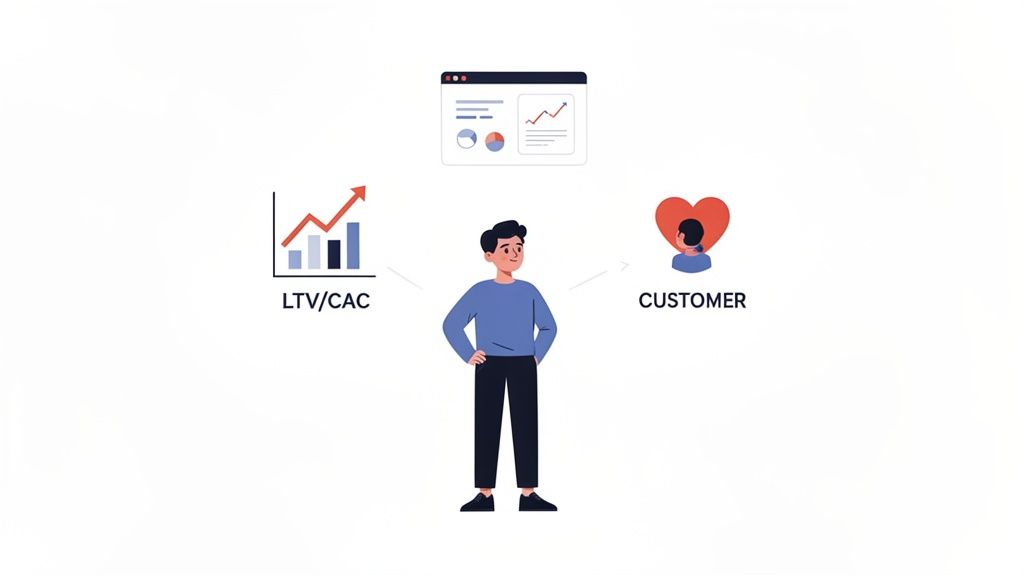
Before writing a single word, grasp how much the CMO role has evolved. The days of marketing leaders focusing solely on ad budgets and creative direction are gone. Today’s CMO is a C-suite growth driver, expected to operate with the financial discipline of a CFO and the customer obsession of a Head of Product.
This is especially true in high-growth startups and lean companies, where every dollar must pull its weight. A modern CMO doesn’t just manage a budget; they build a scalable, predictable growth engine.
From Brand Guardian to Revenue Architect
The biggest shift is from brand stewardship to owning revenue. Of course, brand is still vital, but it’s now a means to a commercial end. A modern CMO is relentlessly focused on the numbers that prove marketing’s contribution to the bottom line.
Their daily conversation is peppered with terms like:
- Customer Acquisition Cost (CAC): How much does it really cost us to land a new paying customer?
- Lifetime Value (LTV): What’s the total revenue we can expect from a single customer?
- LTV:CAC Ratio: The single most important metric for marketing profitability and the long-term health of the business model.
- Sales Pipeline Velocity: How quickly are we turning leads into paying customers?
This data-first mindset is non-negotiable. If a candidate talks more about brand sentiment than conversion rates, they might be stuck in the past. To dive deeper, you can explore the core Chief Marketing Officer responsibilities that define the role today.
The CMO as a Strategic Leader
The CMO position is a cornerstone of the leadership team. Decades ago, they were glorified advertising heads. Now, they are C-suite powerhouses. Recent data shows that of CMOs who left their roles, 62% were promotions, with 9% moving up to the CEO position. This highlights the role’s strategic importance.
The best CMOs I’ve worked with don't just ask for a budget; they present a business case. They clearly articulate how investing in a specific channel will impact lead generation, sales opportunities, and, ultimately, company revenue.
This shift means your job description needs to attract someone who can confidently sit at the executive table. You're looking for a leader who can contribute to high-level business strategy, not just marketing tactics, and translate those goals into a plan that delivers measurable results.
Defining Responsibilities and Measurable KPIs
Vague job descriptions attract vague candidates. To land a true marketing leader, you must move beyond generic phrases like "oversee marketing" and define what success actually looks like.
This is where you connect every responsibility to a tangible business result. Think of it as building a performance contract directly into the job post. This clarity attracts top performers who thrive on accountability and weeds out those who prefer ambiguity.
From Tasks to Business Outcomes
Every responsibility you list should answer one question: "What is the business outcome of this activity?"
This small shift in framing transforms a mundane task list into a strategic mandate. For example, "manage social media" is a task. A strategic responsibility sounds more like, "Develop and execute a social media strategy to increase inbound MQLs from key channels by 25% quarter-over-quarter."
See the difference? The first asks for a manager; the second demands a growth driver. A-players are drawn to the latter.
Here are a few more examples:
- Instead of "manage brand," try: "Refine and evangelize our brand positioning to achieve a 15% increase in unaided brand awareness within our target ICP over 12 months."
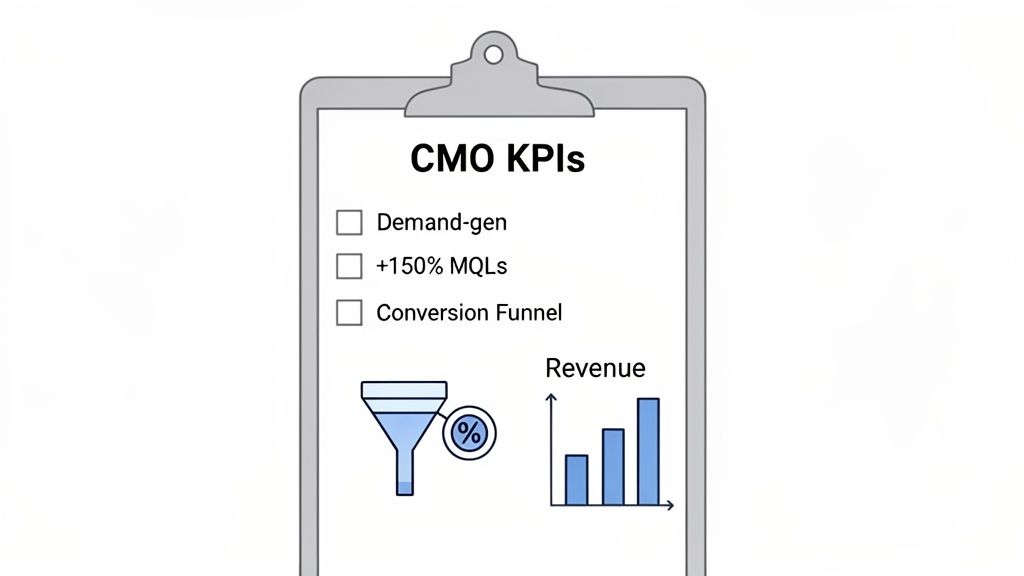
- Move from "run campaigns" to: "Build a multi-channel demand generation engine to deliver a 150% year-over-year increase in marketing qualified leads (MQLs)."
- Replace "support product launches" with: "Lead go-to-market strategy for all new product releases, aiming to achieve $1M in new ARR within the first six months post-launch."
Linking Responsibilities to Measurable KPIs
Connecting every responsibility to a measurable Key Performance Indicator (KPI) is the most critical step. This defines the metrics your new CMO will live and breathe, providing a data-driven framework for objective performance evaluation.
This table shows how core responsibilities translate directly into the metrics that matter.
| Core Responsibility Area | Example Actionable Task | Primary KPI |
|---|---|---|
| Demand Generation | Build and scale a multi-channel lead acquisition engine. | Cost Per Acquisition (CPA), Marketing Qualified Leads (MQLs) |
| Brand & Positioning | Increase market presence and brand recognition in key verticals. | Unaided Brand Awareness, Share of Voice (SOV) |
| Product Marketing | Drive successful go-to-market strategies for new features. | Feature Adoption Rate, Revenue from New Products |
| Revenue Growth | Align marketing efforts directly with sales and business goals. | Customer Lifetime Value (LTV), Marketing-Sourced Revenue |
| Team Leadership | Develop and mentor a high-performing marketing team. | Team eNPS, Employee Retention Rate |
This table connects the what (the responsibility) to the how we'll measure it (the KPI), removing guesswork for you and the candidate.
A job description without clear KPIs is like a map without a destination. It shows you the roads but gives no indication of where you're supposed to go or how you'll know when you've arrived.
Be specific enough that a candidate immediately sees how their success will be measured. For more metrics, explore these key performance indicators examples to find the right fit.
This level of detail in the job description for a CMO does more than attract talent—it aligns your entire organization. When marketing’s goals are clearly tied to revenue, it builds trust with sales, finance, and the C-suite. You're not just hiring a marketer; you're setting your new leader up for success from day one.
Defining the Ideal Candidate Profile
Once you’ve nailed down responsibilities and KPIs, it’s time to filter for the perfect candidate. The playbook for a B2B SaaS startup CMO is worlds apart from one for a D2C apparel brand. Your goal is to attract executives with the precise experience to solve your specific growth problems.
Get granular about what truly matters, thinking less about a generic wish list and more about a strategic blueprint for your company's next chapter.
Must-Haves vs. Nice-to-Haves
One of the biggest traps is writing a "unicorn" job description with an impossibly demanding list of qualifications. This shrinks your talent pool and scares off great candidates.
To avoid this, separate your requirements into two buckets:
- Must-Haves: These are non-negotiables. For an early-stage company, this could be a "proven track record scaling a company from $5M to $20M ARR." It’s the core competency you're hiring them to execute.
- Nice-to-Haves: These are valuable but not essential, like experience in a secondary market or familiarity with a specific tool. They can be tie-breakers, not deal-breakers.
Making this distinction in your job description for a CMO shows candidates you have realistic expectations and are focused on what drives results.
Balancing Hard and Soft Skills
A fantastic CMO is a blend of artist and scientist. Your job description needs to reflect this duality by outlining both technical chops (hard skills) and leadership qualities (soft skills).
Hard skills might get a candidate the interview, but soft skills land them the job—and determine if they'll succeed. Leadership, communication, and strategic thinking are as critical as technical knowledge.
Think about your company's current challenges. A turnaround demands resilience and change management skills. Hyper-growth requires someone who can build systems and scale teams. An in-depth executive skills assessment can provide a structured framework for identifying these mission-critical competencies.
Here’s a practical breakdown:
- Hard Skills: Be specific. Instead of "digital marketing," list "deep expertise in SEO, PPC, marketing automation (e.g., HubSpot, Marketo), and data analytics (e.g., Google Analytics, Mixpanel)."
- Soft Skills: List leadership and interpersonal qualities, like strategic thinking, inspirational leadership, and exceptional communication.
- Vital Experience: Connect their skills to past wins. Use concrete examples like "experience taking a company through a Series B funding round" or "a history of building and managing a high-performing marketing team of 10+."
Full-Time vs. Fractional: A Smarter Way to Hire
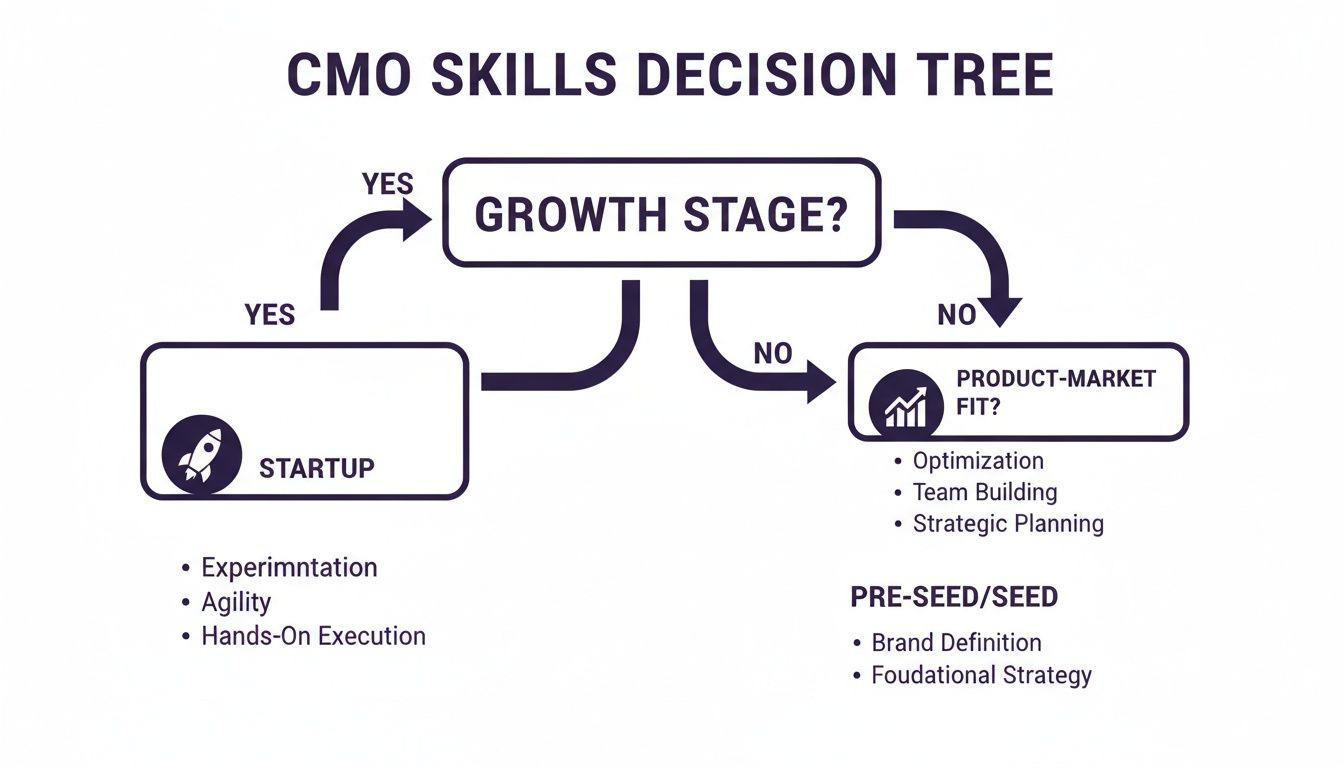
One of the biggest decisions you'll make isn't just who to hire, but how. Landing a true marketing executive is a major investment. For many growing companies, the commitment of a full-time hire can be overwhelming. It's time to get honest about your budget, growth stage, and immediate strategic needs.
The Financial Reality of a Full-Time CMO
A full-time CMO comes with a hefty financial footprint beyond a base salary. You're also funding benefits, equity, bonuses, and the sky-high costs of a months-long executive search. Let's get real about the numbers. The average base salary for a full-time CMO can range from $150,198 to over $790,000 annually in major tech hubs. You can see more detailed salary breakdowns to understand the range.
This stark financial reality is why a more flexible, cost-effective model has taken off: fractional leadership.
The Power of a Fractional CMO
A fractional CMO brings the same C-suite strategic thinking to the table but at a fraction of the cost, usually engaged for a set number of hours per week or month. This approach massively de-risks one of the most important hires you can make.
Think of a fractional CMO as the seasoned director you hire for a blockbuster film. They don't operate the camera or edit every scene, but they provide the vision, strategy, and leadership to ensure the entire crew produces a masterpiece. You get world-class expertise without adding a full-time executive to the payroll.
This gives you instant access to veteran talent, letting you sidestep a hiring process that can drag on for months. Instead of waiting half a year to see an impact, you can get moving in just a few weeks.
Full-Time CMO vs. Fractional CMO: A Cost and Impact Comparison
Here’s a direct comparison to help you decide which model best fits your business needs.
| Factor | Full-Time CMO | Fractional CMO |
|---|---|---|
| Total Cost | $300k – $800k+ annually (incl. salary, bonus, benefits, equity) | $60k – $180k annually (retainer-based, no overhead) |
| Hiring Time | 3-9 months for executive search, interviews, and notice period | 2-4 weeks from initial call to onboarding |
| Onboarding | 3-6 months to fully integrate and see strategic impact | 2-4 weeks to get up to speed and start delivering value |
| Expertise Level | Variable; often a "generalist" CMO for the long-term | Highly specialized; matched to your specific stage, industry, and goals |
| Commitment | Long-term, high-risk commitment with significant severance costs | Flexible, low-risk engagement that can be scaled or ended as needed |
| Focus | Deeply embedded in one company's culture and operations | Broad perspective from working across multiple companies and industries |
For growing businesses, the fractional model offers a much more agile and capital-efficient way to bring in top-tier marketing leadership right when you need it most.
When to Choose a Fractional CMO
How do you know if a fractional leader is the right move? This model is often a perfect fit for companies hitting specific growth inflection points.
Consider a fractional CMO if you:
- Need C-Suite Strategy on a Startup Budget: You know you need executive-level thinking to break through a growth plateau but can't justify a full-time executive salary.
- Are Preparing for a Major Transition: This could be a new product launch, entering a new market, or gearing up for a funding round.
- Have a Capable Team That Lacks Senior Leadership: Your marketing team is full of talented doers, but they need a seasoned leader to provide direction, mentorship, and a unified strategy.
- Want to "Try Before You Buy": Engaging a fractional leader allows you to validate the need for a full-time role before making a long-term commitment.
The real beauty of the fractional model is its flexibility. It gives you immediate access to top-tier strategic minds without the full-time financial handcuffs.
Assembling Your Job Posting
Once you've done the strategic heavy lifting, it's time to pull all the pieces together into a job posting that gets the right people excited. A great post is more than a list of duties; it’s a sales pitch for your company, your vision, and the opportunity.
How you frame this document directly impacts who applies. You want to draw candidates in with a compelling story before hitting them with the details.
Start with Your Company Vision
Before listing a single responsibility, tell a story. Top-tier executives are looking for a mission they can get behind. Your company summary needs to be a crisp, engaging pitch that sells them on your vision.
What big problem are you solving? What makes your culture special? This is your one shot to stand out from dozens of generic postings.
Sample Structure for Your CMO Job Posting
Whether hiring full-time or fractional, the core elements of the job post are similar. The key is tailoring the language to fit the engagement.
Here’s a simple blueprint you can adapt:
- About [Your Company Name]: A compelling 2-3 sentence summary of your mission. What are you building and why should they care?
- The Opportunity: Give a high-level overview of the role. Explain why you’re hiring a CMO right now and the strategic impact they'll have.
- What You’ll Do (Core Responsibilities): Plug in the outcome-driven responsibilities and KPIs you defined. Use bullet points.
- What You’ll Bring (Skills & Experience): List your non-negotiables first, followed by "nice-to-haves." Be specific (e.g., "proven experience scaling ARR from $5M to $20M").
- Compensation & Benefits: Be transparent. For a full-time role, list the salary range and equity. For a fractional role, frame it as a retainer-based contract.
Think of your job posting as the very first touchpoint in the candidate experience. It sets the tone for your company's professionalism, clarity, and ambition. A rushed, vague description signals a disorganized company.
Using a structured approach ensures your job description for a CMO is both comprehensive and persuasive. It communicates not just what you need, but why a top candidate should be thrilled to join your team.
Finding Your Next Growth Leader
Crafting the perfect job description is the first step. The next is finding the right leader to fill the role. Whether you're ready for the commitment of a full-time executive or need the strategic flexibility of a fractional expert, the choice will define your company's growth trajectory.
If you've recognized the need for top-tier marketing strategy but aren't ready for the financial burden of a full-time hire, fractional leadership offers a powerful solution. It provides the expert guidance necessary to scale your business, mentor your team, and achieve your most ambitious goals in a capital-efficient way.
Ready to explore how a fractional executive can accelerate your growth? Let's talk about what's possible. To learn more, schedule a consultation to discuss your specific goals. Explore our executive talent and find your perfect match.