Definition Interim Management: Key Insights
Understanding the Definition of Interim Management
Interim management is often misunderstood. Some confuse it with consulting, temporary staffing, or even permanent executive roles. But it’s a distinct leadership approach. This specialized field offers organizations a blend of experience, objectivity, and focused execution, especially during transitions, transformations, or crises. Understanding its precise definition is key to unlocking its full potential.
What Is Interim Management?
Interim management is the temporary provision of management resources and skills to organizations navigating transitions, crises, or change initiatives. It involves hiring seasoned managers for short-term assignments to address specific needs. These needs can include:
- Crisis management
- Sudden leadership gaps
- Business transformations
- Mergers and acquisitions
- Scaling operations
While originating in the UK, Germany, and Belgium, the concept has spread globally to markets like Australia, the US, France, and Ireland. Spain, for example, saw a 68% rise in interim management recruitment in 2011. Institutional support exists as well, such as Nigeria’s Institute of Corporate and Interim Management, founded in 1990 to promote these practices across Africa.
The profession has a global network through organizations like INIMA, representing over 2,500 interim managers across nine countries. Founded in 2020, INIMA encourages cross-border collaboration and upholds industry standards and knowledge sharing. This structured network highlights interim management’s growing recognition within global business management. You can also find further information about the definition of interim management here.
Distinguishing Interim Management From Other Approaches
Interim management differs from other resourcing strategies. Unlike consultants who primarily advise, interim managers execute. They step into operational roles, leading teams and driving change directly. They also differ from temporary staff. Temporary staff typically fill operational gaps. Interim managers, however, focus on high-level strategic initiatives and leadership.
Finally, interim managers contrast with permanent executives. Permanent executives offer long-term stability, while interim managers provide targeted expertise for a defined period. This is usually during crucial transition or transformation periods. This allows organizations to access specialized skills tailored to specific needs without a long-term commitment.
The Value Proposition of Interim Management
This flexible leadership model offers several benefits. Interim managers bring extensive experience across various industries, offering fast solutions without lengthy onboarding. Their objectivity, free from internal politics, allows them to make tough decisions and implement needed change.

But interim management isn’t just about filling a temporary position. It’s about achieving specific, measurable results within a set timeframe. This focused approach makes it a valuable tool for tackling complex business challenges and achieving strategic goals.
The DNA of Exceptional Interim Leaders
What separates truly exceptional interim managers from traditional executives? It comes down to a specific set of skills and traits that allow them to achieve significant results quickly. These leaders aren’t simply filling a temporary role; they actively drive change.
Key Traits of High-Performing Interim Managers
Effective interim managers combine strategic vision with tactical execution. They swiftly assess organizational challenges, create action plans, and implement them decisively. For instance, an interim CFO might be hired to manage a financial restructuring, which requires both high-level financial strategy and hands-on management of daily operations. This differs from a consultant, who may offer advice but doesn’t directly oversee the execution.
Their independence from internal politics offers a major advantage. This allows them to make unbiased, and sometimes difficult, decisions that permanent leaders might shy away from. This objectivity is especially valuable during times of organizational change or crisis.
A critical aspect of successful interim management is knowledge transfer. Before leaving, exceptional interim leaders ensure their insights and processes are integrated into the organization. This creates a lasting positive impact beyond their tenure. They empower existing teams to maintain progress and continue building upon the improvements made.
To better understand the unique position of interim management, let’s examine a comparison of various leadership approaches. The following table, “Interim Management vs. Traditional Leadership Approaches,” highlights the key differences between interim management and other leadership approaches, including permanent executives, management consultants, and temporary staffing.
| Characteristic | Interim Management | Permanent Executive | Management Consultant | Temporary Staffing |
|---|---|---|---|---|
| Objective | Drive specific change, manage transitions, fill critical gaps | Long-term leadership and organizational development | Provide expert advice and recommendations | Fill short-term operational needs |
| Duration | Short-term, project-based | Long-term, indefinite | Project-based, variable length | Short-term, as needed |
| Decision-Making | Independent, objective | Influenced by internal politics | Advisory, non-executive | Operational, limited scope |
| Implementation | Directly manages execution | Delegates and oversees execution | Typically doesn’t manage execution | Executes assigned tasks |
| Knowledge Transfer | Prioritized, ensures sustainability | Ongoing, part of role | May or may not include knowledge transfer | Minimal, focus on task completion |
As this table clearly shows, interim management offers a distinct combination of targeted expertise, direct implementation, and a focus on knowledge transfer, setting it apart from other leadership approaches.
The Benefits of Interim Management
The infographic below visualizes the primary benefits organizations gain from engaging interim management professionals.
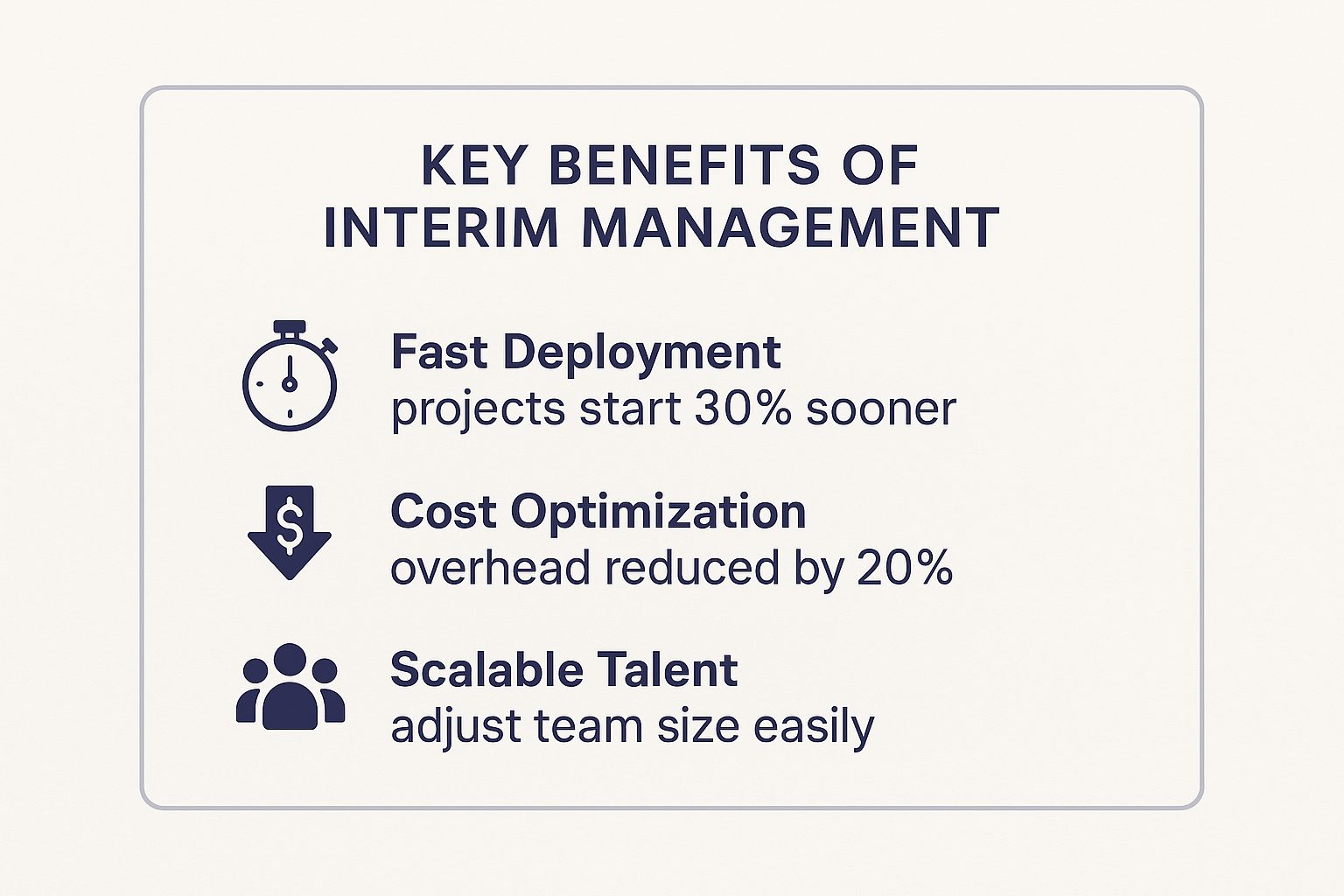
As shown above, interim management offers substantial advantages. These include 30% faster project starts, a 20% reduction in overhead, and the adaptability to easily scale teams as needed. This blend of speed, cost-effectiveness, and scalability makes it a powerful tool for organizations aiming for swift and efficient growth.
Real-World Impact of Interim Leadership
Real-world examples demonstrate the effectiveness of this leadership style. An interim CEO managing a merger might implement a more efficient integration process, minimizing disruption and speeding up synergy realization. An interim COO could optimize production processes, resulting in significant efficiency gains and increased profitability. These examples showcase how interim leaders generate significant value, contributing not just to short-term needs but also to the organization’s long-term success. This focused approach solidifies the evolving definition of interim management as a strategic solution for leadership needs.
When Your Business Needs Interim Management Solutions
Knowing when to implement interim management is just as crucial as understanding its definition. This section explores the specific situations where interim leadership offers exceptional value, empowering you to recognize when this approach is the optimal solution for your business.
Identifying the Right Time for Interim Management
Certain triggers signal a strong need for interim management. For example, an unexpected executive departure can create a leadership vacuum. Rather than rushing a permanent hire, interim management provides immediate stability and leadership continuity. This allows for a thorough search for a suitable long-term replacement without sacrificing momentum.
Additionally, mergers and acquisitions often require specialized expertise to manage the complex integration process. An interim executive can steer this transition, ensuring a smooth and efficient merging of operations, cultures, and teams.
Compliance emergencies present another scenario where interim management shines. Should your company face sudden regulatory challenges or require rapid remediation, an interim leader with specialized compliance experience can quickly address the situation. Minimizing damage and ensuring adherence to evolving regulations are key benefits.
Furthermore, major transformation initiatives, such as digital transformations or large-scale restructuring, often benefit from interim leadership. Interim executives bring focused experience and objective perspectives to guide these complex projects. This ensures successful implementation and lasting organizational change. Exceptional interim leaders understand how to foster a positive environment.
Interim Management as a Strategic Tool
Forward-thinking organizations don’t just react to crises; they proactively utilize interim management as a strategic tool. During periods of rapid growth, for instance, an interim executive can provide the necessary leadership and expertise to scale operations efficiently and manage growing pains. You might be interested in: How to master interim CFO engagements.
According to the Interim Management Report 2023, based on a survey of 2,145 interim managers, companies primarily engage these executives for change management, filling capability gaps, and crisis management. The report highlights how interim managers provide value through not only rapid availability, but also strategic leadership and execution, especially during significant transformation projects.
The current business environment faces numerous challenges—geopolitical issues, economic fluctuations, and evolving technologies—requiring flexible management solutions. Interim management offers a direct, high-impact response to these complex and ever-shifting business demands.
Timing and Impact of Interim Engagements
The timing of interim management engagements is critical. Engaging an interim leader too early can create confusion and disrupt existing teams. Waiting too long, however, can exacerbate existing problems and hinder progress.
Effective planning and a clear understanding of the organization’s needs are essential for maximizing the impact of interim management. This strategic approach ensures the interim leader’s expertise aligns perfectly with the company’s challenges and goals, delivering optimal value. This allows organizations to leverage the specialized skills of interim managers for targeted, efficient problem-solving and change implementation.
This proactive utilization of interim management underscores its evolution from a reactive solution to a strategic business imperative.
The Rising Demand for Interim Leadership Excellence
Interim management is no longer a niche solution. It’s becoming a key part of strategic business planning. Several factors are converging to reshape the business world and push interim management into the mainstream.
The Forces Driving Demand
A primary driver is increasing business volatility. Rapid technological advancements, shifting market dynamics, and unexpected global events all demand agile responses. Interim managers, with their specialized expertise and ability to quickly integrate, provide the flexibility needed to navigate uncertainty.
Furthermore, accelerated change cycles require companies to adapt quickly. Digital transformation, for example, often requires specialized skills not readily available in-house. Interim leaders give on-demand access to this expertise, allowing organizations to implement changes efficiently.
Evolving workforce dynamics also contribute. The rise of the gig economy and a greater focus on work-life balance create a pool of skilled professionals looking for project-based work. This gives organizations access to top talent for specific projects without the commitment of permanent roles. As the demand for interim leadership grows, explore various staffing models.
The Growing Professionalization of Interim Management
Interim management has gained significant credibility. Professional associations and specialized search firms now provide structure and industry standards. This has further legitimized interim management as a valuable leadership solution.
These organizations offer resources, training, and networking for interim managers, ensuring professionalism and expertise. They also connect businesses with qualified candidates, simplifying the search process.
The Impact of Global Disruptions
Recent global events, especially the COVID-19 pandemic, have dramatically increased the need for interim leaders. The demand for interim management services has seen a significant jump, with a 24% global increase in demand for interim executives since the start of the pandemic. COVID-19 disrupted business continuity and operational models, forcing companies to find more agile leadership solutions. Interim managers have helped guide companies through this challenging period, providing immediate leadership, strategic foresight, and crisis management skills.
Interim Management as a Strategic Imperative
Forward-thinking organizations are incorporating interim management into their long-term strategies. They recognize the value of readily available expert leaders who can address challenges and seize opportunities. This proactive approach lets them adapt to changing markets and stay competitive. This shift marks a move away from reactive interim management towards a proactive, strategic tool for achieving business objectives.
Implementing Successful Interim Management Engagements
Transforming interim leadership from concept to reality requires a structured, well-defined approach. This section explores the crucial steps involved in implementing a successful interim management engagement, offering insights from experienced interim managers and the organizations that utilize them.
Defining Engagement Parameters and Objectives
The first step towards a successful interim management engagement is defining its parameters. This begins with identifying the specific business need the interim manager will address. Is it to manage a transition, fill a sudden vacancy, or lead a critical project?
Next, establish clear, measurable objectives with defined outcomes. This might involve targets for revenue growth, cost reduction, or project completion within a specified timeframe. These objectives provide the interim manager with a roadmap and enable accurate performance assessment. For more insights on interim leadership, see our guide on how to master interim executive management.
Selecting the Ideal Interim Leader
Choosing the right interim manager is paramount. Seek candidates with proven experience in your specific area of need and a track record of success in similar situations. Their expertise must align directly with the challenges at hand.
Also, assess their adaptability to new environments and their ability to collaborate effectively with existing teams. A strong cultural fit can greatly enhance the interim manager’s effectiveness.
Structuring Contracts and Reporting
Contracts should clearly define the scope of work, deliverables, timelines, and compensation. Consider incentivizing results by linking a portion of the compensation to achieving specific milestones. This fosters motivation and alignment with organizational goals.
Establish transparent reporting from the start. Determine who the interim manager reports to, reporting frequency, and key performance indicators (KPIs). This accountability system facilitates the early identification of potential issues.
Onboarding for Immediate Contribution
Effective onboarding is key for a swift integration and immediate contribution. Provide the interim manager with comprehensive information about the company culture, their specific responsibilities, and available resources.
A well-structured onboarding ensures a smooth transition and maximizes the interim manager’s impact from day one.
Measuring Success and Ensuring Knowledge Transfer
Evaluating interim management should extend beyond deliverables. Assess the overall impact on the organization, including improvements in processes, team performance, and achievement of strategic goals.
A crucial, often overlooked aspect is knowledge transfer. Establish a system for capturing the interim manager’s valuable insights and lessons learned. This preserves valuable knowledge and sustains progress after their departure.
To illustrate the typical progression of an interim engagement, the following table provides a detailed timeline.
Interim Management Engagement Timeline
This timeline breaks down the typical phases of an interim management engagement, from initial need assessment through final knowledge transfer and exit.
| Phase | Timeframe | Key Activities | Success Metrics |
|---|---|---|---|
| Needs Assessment | 1-2 weeks | Identifying business needs, defining objectives | Clearly defined scope and objectives |
| Interim Manager Selection | 2-4 weeks | Candidate sourcing, interviewing, selection | Candidate’s experience and cultural fit |
| Contracting & Onboarding | 1-2 weeks | Contract negotiation, onboarding process | Clearly defined contract terms and smooth onboarding |
| Execution & Management | Variable (weeks to months) | Project execution, reporting, performance monitoring | Progress against defined milestones and KPIs |
| Knowledge Transfer & Exit | 1-2 weeks | Documentation of processes, insights, and best practices | Comprehensive knowledge transfer plan executed |
This table provides a general framework. Specific timelines and activities may vary based on the nature and complexity of the engagement.
This final step solidifies the long-term value of interim management and contributes to the organization’s ongoing success.
Maximizing ROI While Minimizing Interim Management Risks
Interim management offers significant advantages, especially for startups and businesses undergoing change. Organizations use interim leadership to gain access to specialized skills, facilitate objective change, and implement tough decisions without the long-term commitment of permanent hires. However, like any strategic move, interim management has potential downsides. This section explores the potential and the inherent risks of interim management solutions, offering practical strategies for maximizing ROI while mitigating those risks.
Leveraging the Advantages of Interim Management
Interim leaders bring several key benefits to the table. Their specialized knowledge allows them to quickly pinpoint problems and implement effective solutions in specific areas, such as finance or operations. This focused approach can speed up projects and deliver faster results compared to developing internal expertise.
Interim managers also offer an objective perspective, free from internal office politics. This independence allows them to make difficult decisions, challenge the status quo, and implement changes that permanent employees might avoid.
This objectivity is also valuable for facilitating change within an organization. Interim managers can spearhead transformations, restructure departments, or manage mergers and acquisitions, prioritizing efficiency and achieving desired outcomes.
Addressing the Challenges of Interim Management
Despite the benefits, implementing interim management has its challenges. One common concern is resistance to temporary leadership. Existing teams may be hesitant to embrace a leader they know is temporary. Clear communication regarding the interim manager’s role, objectives, and the temporary nature of their position is crucial for overcoming this resistance.
Knowledge transfer is another important consideration. Ensuring a smooth transition of knowledge and processes when the interim manager departs is essential for continued progress. Solid knowledge transfer procedures are key to minimizing this risk.
Finally, aligning interim management with the organization’s long-term strategic goals is vital. The interim manager’s work must contribute to the organization’s overall objectives. Consistent communication and regular performance reviews are essential to maintaining alignment and maximizing the value of the engagement.
Practical Strategies for Maximizing ROI
To maximize ROI from interim management, organizations should focus on several important areas:
- Precise Scope Definition: Clearly outlining the interim manager’s scope of work and deliverables sets clear expectations and facilitates performance assessment.
- Measurable Objectives: Establishing quantifiable objectives linked to the interim manager’s role enables assessment of their impact and contribution.
- Effective Onboarding: A thorough onboarding process quickly integrates the interim manager into the organization, allowing them to contribute immediately.
Measuring True ROI and Evaluating Alternatives
Calculating ROI involves more than simply comparing costs; it’s about evaluating the overall impact on the organization. Factors like improved efficiency, revenue growth, cost savings, and progress toward strategic goals should all be considered. A comprehensive evaluation framework that includes both quantitative and qualitative factors is crucial for accurately gauging the true ROI of interim management.
Before choosing interim management, explore other options. Consider whether permanent hires, consultants, or internal promotions might be more effective or cost-efficient in the long term. This analysis will help you select the best solution for your needs.
Ready to explore how interim management can benefit your startup? Shiny offers a fractional executive marketplace connecting startups with seasoned executives for part-time roles.