
Mastering Enterprise Value to Revenue: A Practical Guide for Founders
What is your company really worth? The Enterprise Value to Revenue (EV/Revenue) multiple is your "market price tag." It cuts through the noise of simple sales figures, factoring in your full financial picture—debt and cash included—to give you a true sense of your company's total value.
For founders, getting a handle on this metric isn't just a good idea; it's non-negotiable. It shapes your valuation, guides your growth strategy, and can make or break your next funding round. Understanding it is the first step. The next is having the right leadership in place to improve it.
What Enterprise Value to Revenue Really Means
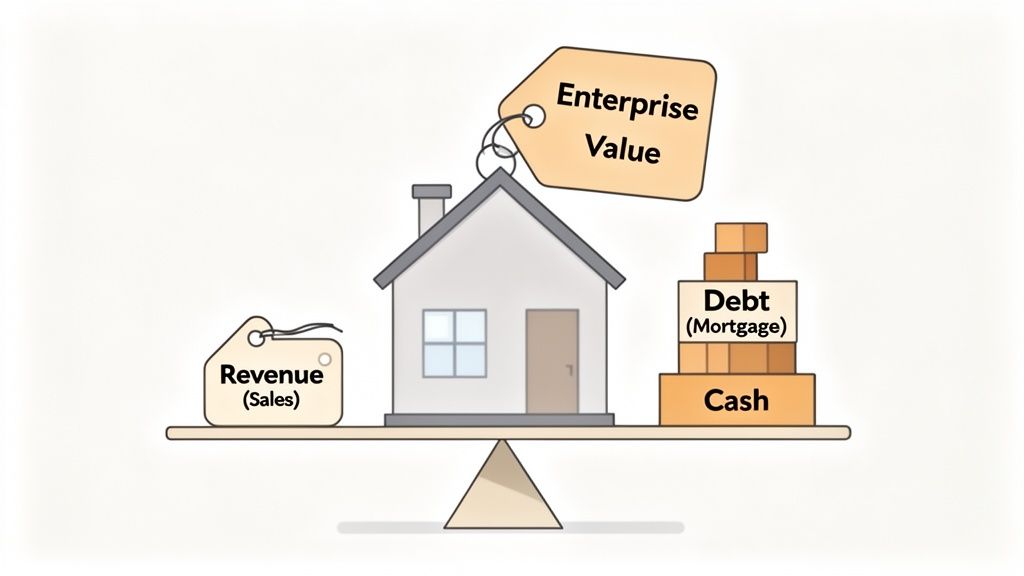
Imagine you're buying a house. The asking price is just the starting point—that’s like your company's revenue. It's the big, obvious number everyone sees first, but it doesn't tell the whole story.
A smart buyer digs deeper. They look at the outstanding mortgage (your company's debt) and any cash reserves the seller has on hand. The real cost to own that house isn't just the sticker price; it's the price plus the mortgage you have to take over, minus the cash you get.
The EV/Revenue multiple applies this exact logic to a business. It calculates the true, all-in cost for an acquirer to buy your company, lock, stock, and barrel, including all its financial baggage.
A More Complete Picture of Value
Unlike metrics that fixate on stock price or sales alone, EV/Revenue gives you a capital structure-neutral valuation. In simple terms, it doesn't care how you've funded your business (debt vs. equity). This is precisely why it's a favorite among investors, especially when looking at companies where profits aren't yet the main event.
Think about high-growth SaaS startups. They're often pouring cash into product development and customer acquisition, which means profits are suppressed, sometimes for years. A classic Price-to-Earnings (P/E) ratio would make them look worthless. But the EV/Revenue multiple bypasses this, showing exactly how the market values every single dollar of their sales.
Why This Metric Is Crucial for Founders
Once you master this metric, you're holding a powerful tool. It directly influences how venture capitalists, private equity firms, and potential acquirers will size up your business. A strong EV/Revenue multiple can completely change the game in a fundraising round or an exit negotiation.
Understanding your enterprise value is the first step toward strategically increasing it. It reveals how investors perceive your company's potential and financial health, independent of temporary profitability figures.
This one number helps you answer the big questions:
- Are we valued fairly compared to our peers?
- How will taking on new debt impact our overall valuation?
- What's a realistic sale price for our company?
Effectively managing the drivers behind your enterprise value to revenue ratio is fundamental to steering your company toward a successful future. To dig deeper into the core component of this calculation, explore our detailed guide on what is enterprise value and its key components.
How to Calculate Your EV to Revenue Multiple
Knowing the theory is one thing, but calculating the EV to Revenue multiple for your own business is where the magic happens. It's less intimidating than it sounds and boils down to two main parts: figuring out your Enterprise Value (EV), then dividing it by your revenue.
Let’s walk through the math, step-by-step.
Step 1: Calculate Your Enterprise Value
Enterprise Value gives you the total value of your company, wrapping in both its equity and debt, then subtracting any cash sitting in the bank. Think of it as the real "takeover" price—what someone would actually have to shell out to buy your entire business outright.
The formula is pretty direct:
Enterprise Value = Market Capitalization + Total Debt – Cash & Cash Equivalents
To nail this down, you’ll need three key numbers from your company’s financials. To calculate enterprise value, we need a few key inputs that paint a full picture of the company's worth beyond just its public share price.
Breaking Down the Enterprise Value Formula
| Component | What It Measures | Why It's Included in the Calculation |
|---|---|---|
| Market Capitalization | The total value of a company's shares. | This is the starting point, representing the value of the company's equity that the market has agreed upon. |
| Total Debt | All short-term and long-term debt obligations. | An acquirer doesn't just buy the assets; they also inherit the company's debts, so this must be added to the price. |
| Cash & Equivalents | All cash and highly liquid assets the company owns. | This cash can be used to pay down debt or fund operations, so it effectively reduces the net cost of the acquisition. |
Each component tells a crucial part of the story, giving you a more holistic view than market cap alone.
Here’s where you’ll find those numbers:
- Market Capitalization: For public companies, it’s the share price times the number of shares. For a private startup, this is typically the valuation from your last funding round.
- Total Debt: This covers all your short-term and long-term debt. You'll find it on your balance sheet.
- Cash & Cash Equivalents: This is all the cash and super liquid assets your company holds.
Pulling these figures means getting comfortable with your financials. If you're still getting your feet wet, now’s a great time to learn. Our guide on how to analyze financial statements is a perfect place to start.
Step 2: Determine Your Revenue
The second piece of the puzzle is your revenue. To make sure your EV/Revenue multiple is accurate and useful for comparing against other companies, you should always use your Trailing Twelve Months (TTM) revenue.
Why TTM? It smooths out any weird seasonal blips or one-off monster months, giving you a much more stable and honest view of your company's recent performance. It’s a true reflection of what your business has generated over a full year.
Putting It All Together: A Worked Example
Alright, let's run the numbers for a fictional SaaS startup, "InnovateTech Inc."
- Valuation (Market Cap): $40 million from its last funding round.
- Total Debt: $5 million on its balance sheet.
- Cash Reserves: $10 million in the bank.
- TTM Revenue: $7 million in Annual Recurring Revenue (ARR).
First, let's get its Enterprise Value:
- EV = $40,000,000 (Market Cap) + $5,000,000 (Debt) – $10,000,000 (Cash)
- EV = $35,000,000
Next, we calculate the EV/Revenue multiple:
- EV/Revenue = $35,000,000 (Enterprise Value) / $7,000,000 (TTM Revenue)
- EV/Revenue = 5.0x
So, InnovateTech is valued at 5 times its annual revenue. This one number is incredibly powerful. It’s a benchmark that investors, potential buyers, and your board will use to size you up. Having an experienced financial leader on your team, even a fractional one, ensures these calculations are not only precise but also framed strategically for whatever comes next.
Interpreting Your EV to Revenue Ratio
So you've calculated your enterprise value to revenue multiple. Great. But that's just the starting point. The real magic happens when you understand what that number—whether it’s 3x, 8x, or 12x—is actually telling you about your business.
Think of it like a car's 0-to-60 time. A 3-second sprint is incredible for a sports car, but totally irrelevant for a cargo van. In the same way, a "good" EV/Revenue multiple for a high-growth SaaS company would be astronomical for a stable manufacturing firm. Your industry, growth rate, and business model set the stage for what investors are willing to pay for each dollar of your revenue.
This simple diagram breaks down how Market Cap, Debt, and Cash come together to give you the full picture of Enterprise Value.
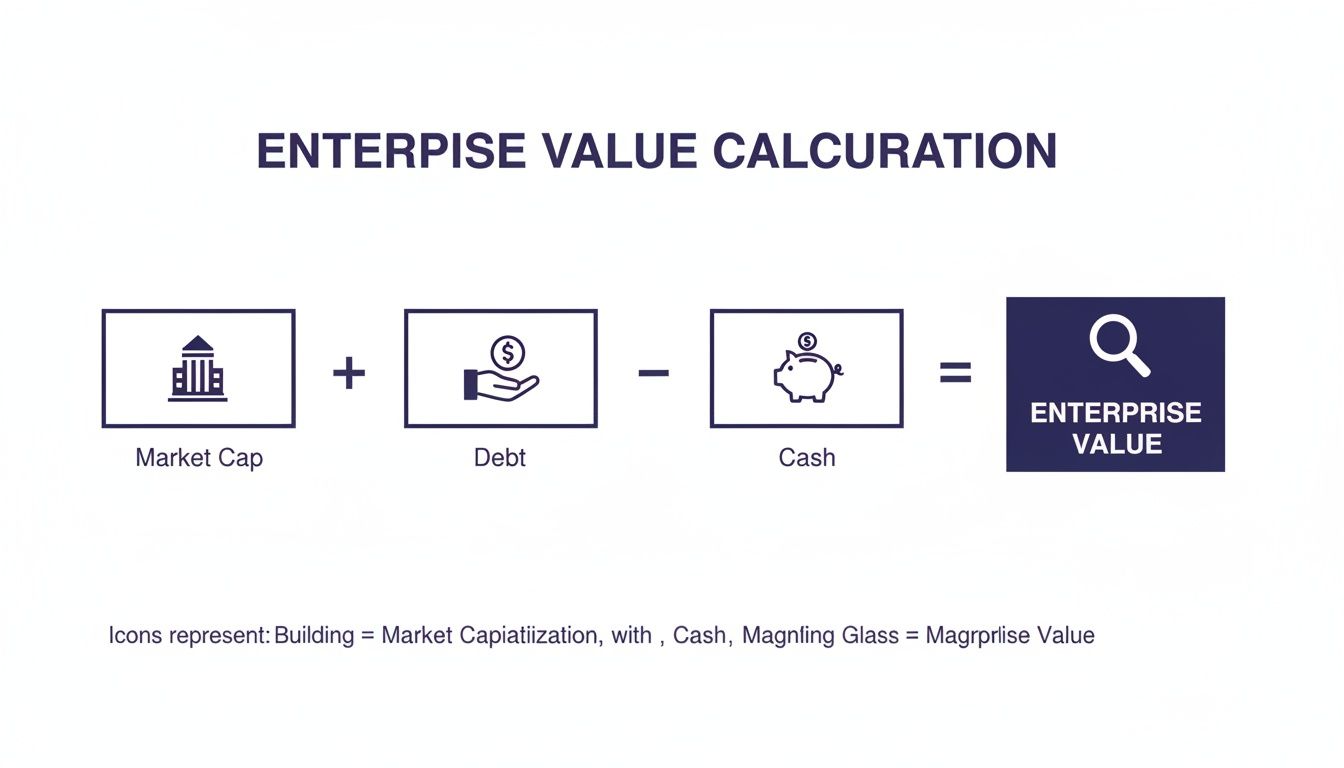
It’s a good reminder that EV gives you a much more holistic view of your company’s value than market cap alone.
What Drives a Higher Multiple
So, what’s the difference between a company pulling a 3x multiple and one commanding a 10x multiple, even with identical revenues? It's simple: investors aren't just buying your past performance; they're betting on your future potential.
Several key drivers signal a high-quality, scalable business that justifies a premium valuation.
- Rapid and Sustainable Growth: A track record of strong, predictable year-over-year growth is the single most powerful driver. Investors pay for momentum.
- High Gross Margins: Healthy margins prove your core business is profitable and can scale efficiently without costs spiraling. It’s a sign of strong underlying health.
- Recurring Revenue Streams: Predictable, subscription-based revenue is far more valuable than one-off sales. It offers stability and a clear view into future cash flows.
- Strong Customer Retention: High net revenue retention (NRR) proves your product is sticky and that customers are spending more over time. It's the ultimate sign of a deep product-market fit.
Improving these metrics isn't accidental; it requires sharp strategic execution. To really get a handle on the financial health of your customer acquisition and retention, you need to understand your company’s financial engine. You can learn more about unit economics in our article and see how it directly impacts these valuation drivers.
Benchmarking Across Industries
Context is everything. An EV/Revenue multiple only becomes meaningful when you stack it up against industry benchmarks. A software company with high recurring revenue and few physical assets will naturally command a higher multiple than a capital-intensive manufacturing business.
For example, data from over 1,200 software deals shows a median multiple of 3.7x, a huge leap from the ~2x median across all sectors. During the 2020–2021 boom, top-tier SaaS companies often traded at 8–15x EV/Revenue. But as markets tightened, those multiples reset, stabilizing closer to 2.8x.
For a company with $5 million in annual recurring revenue, that’s the difference between a $40 million valuation and a $15 million one. To navigate this, boards often bring in experienced fractional executives—like a CRO or CFO—to sharpen the metrics that justify a premium multiple.
A higher EV/Revenue multiple isn't just a vanity metric; it's a direct reflection of the quality and predictability of your revenue. Investors reward companies that have built a scalable, efficient, and defensible business model.
Comparing EV to Revenue Multiples by Industry
This table offers a comparative look at average EV/Revenue multiples across various sectors to help you benchmark your company's valuation.
| Industry | Typical EV/Revenue Range | Primary Drivers of Value |
|---|---|---|
| SaaS/Software | 5.0x – 12.0x+ | High growth, recurring revenue, net retention, and strong gross margins. |
| Manufacturing | 0.8x – 2.5x | Asset efficiency, supply chain stability, and profit margins. |
| Professional Services | 1.0x – 2.0x | Brand reputation, client relationships, and billable hour utilization. |
| Retail & Ecommerce | 0.5x – 1.5x | Brand strength, customer loyalty, and inventory management. |
The takeaway here is clear: your business model dictates your valuation potential. A services firm and a SaaS company with identical revenues are simply not valued the same way. Understanding where you stand is the first step toward strategically improving your position.
Common Pitfalls When Using EV to Revenue
The EV/Revenue multiple is a powerful tool, but like any tool, it can be misused. Getting seduced by a high multiple can create a dangerous sense of security, masking deeper issues that threaten your company's long-term health. Knowing its limitations is critical.
Think of the EV/Revenue multiple like a car's horsepower rating. It’s an impressive number that speaks to raw potential. But it tells you nothing about fuel efficiency, braking power, or how reliable the engine is on a long trip. Relying on it alone is like buying a muscle car for a cross-country drive; you might look great off the line, but you could run into serious trouble down the road.
This is where many founders stumble. They get so focused on that top-line revenue multiple that they overlook the fundamentals that actually create a sustainable, valuable business.
Overlooking Profitability and Cash Flow
The single biggest pitfall of the EV/Revenue metric is its blindness to profitability and cash flow. A company can have a stellar multiple while burning through cash at an absolutely terrifying rate. This "growth at all costs" mindset often leads to a business that's fundamentally broken.
Chasing revenue without understanding the cost of getting it is a classic mistake. If your Customer Acquisition Cost (CAC) is higher than your Customer Lifetime Value (LTV), you're literally paying people to use your product. A flashy EV/Revenue multiple won't save you.
This is where seasoned financial leadership becomes indispensable. An experienced fractional CFO provides the critical oversight needed to balance growth ambitions with financial discipline. They make sure your pursuit of a higher valuation is built on a foundation of healthy unit economics, not just vanity metrics.
Comparing Apples to Oranges
Another common trap is making lazy comparisons. You can't just benchmark your EV/Revenue multiple against a company with a totally different business model and expect to get a meaningful insight. For example:
- Subscription vs. One-Time Sales: A SaaS company with 90% predictable, recurring revenue will naturally command a much higher multiple than a services firm that relies on one-off projects, even if their total revenue is identical.
- High-Margin vs. Low-Margin Industries: A software business with 80% gross margins operates in a different universe than a retail business scraping by with 30% margins. Their multiples just aren't comparable.
A myopic focus on a single metric can lead to poor strategic choices. The goal isn't just to increase revenue; it's to build a high-quality business that investors will value for its long-term potential, not just its current sales figures.
Misinterpreting the Signal
At the end of the day, a high EV/Revenue multiple is just a reflection of investor expectations for future growth and profitability. It's not a report card on your current success. If market sentiment shifts or your company fails to live up to those lofty expectations, your valuation can plummet, even if your revenue keeps climbing.
Navigating these complexities requires a level of strategic experience that many founding teams simply don't have yet. By bringing in a fractional executive, you get immediate access to the expertise needed to interpret these signals correctly, avoid common pitfalls, and build a business that is as resilient as it is valuable.
Actionable Strategies to Improve Your EV to Revenue Multiple
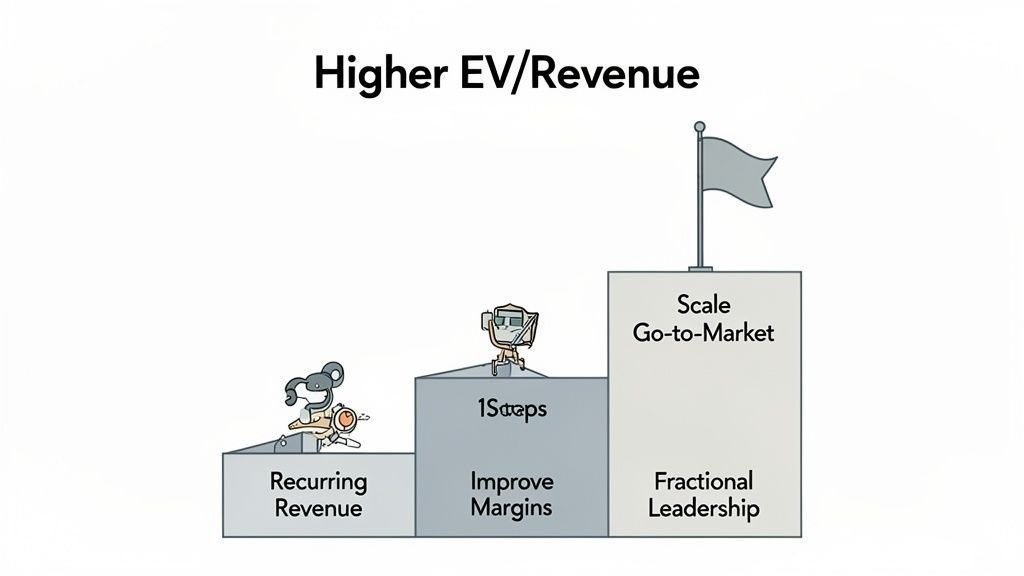
Knowing your enterprise value to revenue multiple is just the starting line. The real work is in making that number bigger. A higher multiple doesn't just happen; it's the direct result of smart, strategic decisions that create a fundamentally healthier company.
Think of it like renovating a house to boost its resale value. You wouldn't just add rooms at random. You'd invest in high-return upgrades: a modern kitchen, updated plumbing, better curb appeal. In the same way, improving your company's EV/Revenue multiple means making targeted improvements in a few key areas—accelerating scalable growth, locking in high-quality revenue, and boosting your gross margins.
These aren't simple check-the-box tasks; they demand senior-level expertise. This is exactly where fractional leadership shines, giving you access to the strategic firepower needed to execute these changes without the hefty price tag of a full-time C-suite hire.
Accelerate Scalable Revenue Growth
Investors will always pay a premium for growth, but they're looking for a specific kind: a scalable, repeatable go-to-market engine. This is where a fractional Chief Revenue Officer (CRO) can be a game-changer, professionalizing your sales process, nailing your pricing, and building a predictable pipeline.
A fractional CRO might spearhead initiatives like:
- Implementing a Repeatable Sales Playbook: This is your recipe for success, ensuring new hires ramp up quickly and the entire team follows a consistent, effective process.
- Optimizing Your Pricing Strategy: A seasoned executive can analyze the market and your unique value to find that pricing sweet spot that maximizes revenue without scaring off customers.
- Building a Data-Driven Sales Forecast: Nothing builds investor confidence like a solid forecast. It shows you have a firm grip on the future and helps justify a higher multiple.
By professionalizing your sales function, you’re proving your growth isn't a fluke—it’s the product of a well-oiled machine.
Enhance the Quality of Your Revenue
Here’s a hard truth: not all revenue is created equal. Investors place a much higher value on predictable, recurring revenue than on choppy, one-time project fees. Shifting your model toward subscriptions or long-term contracts can dramatically lift your enterprise value to revenue multiple.
This is a classic challenge for a fractional Chief Financial Officer (CFO), who can provide the strategic guidance to improve your revenue mix.
Improving your revenue mix is one of the most powerful levers for increasing your company's valuation. High-quality, recurring revenue signals stability, predictability, and a sticky customer base—all qualities that investors reward with a higher multiple.
A fractional CFO will help you zero in on:
- Increasing Annual Recurring Revenue (ARR): The goal is to convert project-based clients into long-term partners on retainers or subscriptions, creating a stable foundation for growth.
- Improving Net Revenue Retention (NRR): This metric proves you're not just keeping customers but growing their value over time. An NRR over 100% is a massive green flag for investors.
- Diversifying Your Customer Base: Over-reliance on a few big clients is a major risk. A fractional CFO can help you develop strategies to broaden your market appeal and create a more resilient business.
Boost Your Gross Margins
Strong gross margins are a crystal-clear indicator of a healthy, efficient business. They prove you can scale your revenue without your costs scaling right alongside it. This is another area where an experienced fractional executive, whether a CFO or COO, can make a huge impact by spotting inefficiencies and implementing changes that flow straight to your bottom line—and, in turn, your valuation.
Even small market shifts can have a massive impact. Research on M&A deals from 2018 to late 2023 showed that median EV/Revenue multiples swung from a high of 2.1x down to 1.5x as the economy changed. You can read the full research on how M&A multiples change with market conditions.
Companies that prove they have high-quality revenue and disciplined operations can push their valuation toward the higher end of that range. Working with experienced part-time executives is the fastest way to get there.
Build a More Valuable Business with Fractional Leadership
Lifting your company's valuation takes a level of strategic execution that goes far beyond day-to-day operations. It requires senior leadership laser-focused on the metrics that investors care about most. Fractional executives offer a smart, flexible way to bring that expertise into your business right when you need it.
Are you ready to build a more valuable company? The right leader can help you analyze your current valuation, identify key levers for growth, and execute a plan that delivers results.
Schedule a consultation to explore our network of vetted fractional executives today and find the right partner to guide your next phase of growth.
Got Questions About EV to Revenue?
Let's dig into a few of the most common questions founders have about this powerful metric. Think of this as a quick-fire round to lock in the core concepts.
What's the Difference Between EV to Revenue and Price to Sales?
It’s a classic question. The easiest way to think about it is like buying a house. The Price-to-Sales (P/S) ratio is just the sticker price on the listing. But the EV/Revenue multiple is the all-in cost—it includes the mortgage (debt) you have to take on.
P/S only compares a company’s equity value against its sales. EV/Revenue gives you the full story by factoring in debt and backing out cash, which makes it a much better tool for comparing companies with different ways of financing their operations.
Can a Company Actually Have a Negative Enterprise Value?
Yep, it can happen, though it's not common. A negative EV pops up when a company's cash balance is bigger than its market cap and total debt combined.
While it might sound great to have that much cash, the market often sees it as a red flag. It can signal deep-seated problems, suggesting the business might be worth more if it were just shut down and its assets sold off.
How Often Should I Calculate My EV to Revenue Multiple?
For your own strategic planning, running the numbers on a quarterly basis is a great habit to get into. It keeps you in sync with your financial reporting cycle and lets you see how your big moves—like taking on new debt or boosting your margins—are impacting your valuation in near real-time.
And of course, you absolutely should recalculate it before any major financial event, like heading into a fundraising round or exploring an M&A conversation.
Navigating these financial complexities is where real expertise makes a difference. At Shiny, we connect founders with vetted, fractional executives who bring the strategic firepower needed to dial in your valuation and drive real, sustainable growth. Explore our network of fractional leaders today.