

Executive Search Process Steps for Leadership Success
Navigating the Executive Search Timeline
Understanding the executive search process is crucial for any organization seeking top-tier leadership. This process is a significant investment, typically spanning 3-5 months. The following timeline outlines the key phases and milestones:
This timeline infographic visualizes the typical duration and key steps involved in a standard executive search.
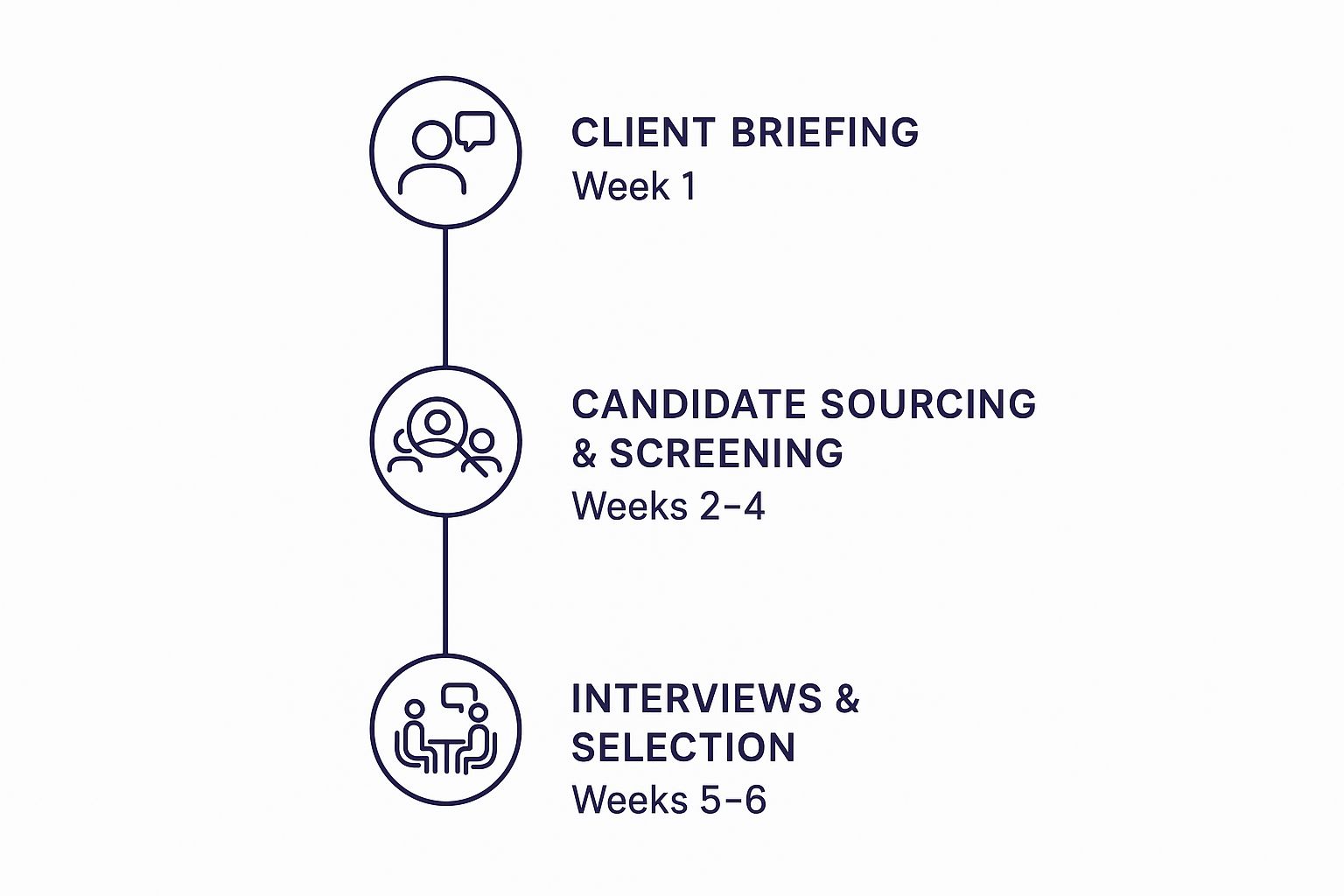
The infographic highlights the four main phases, from initial research and planning to the final offer and onboarding stages, emphasizing the time investment required for each step.
Phase 1: Research and Planning (Months 1-2)
This initial phase sets the foundation for a successful search. It begins with a deep dive into the client’s organization, culture, and specific needs. Search firms conduct stakeholder interviews to understand leadership requirements and organizational goals.
Market research is also essential to identify potential candidates and assess the competitive landscape. This typically involves analyzing 15-20 comparable companies. Firms often leverage resources like LinkedIn to map out potential candidates. This research helps create a clear profile of the ideal candidate.
Phase 2: Candidate Identification and Outreach (Month 2-3)
Building on the research phase, the search firm actively targets potential candidates. This involves using proprietary databases, professional networks, and direct outreach. The search goes beyond simply finding candidates with the right qualifications. It’s about identifying individuals who fit the organization’s culture and strategic direction.
For example, LeaveWizard offers insights into their hiring process and how they prioritize cultural fit. Search firms often use tiered candidate pools, categorizing prospects based on how well they align with the position’s needs.
Phase 3: Assessment and Evaluation (Month 3-4)
This phase involves rigorous screening and assessment to narrow the candidate pool. Candidates undergo multiple interviews, behavioral assessments, and sometimes psychometric testing. Intensive research and candidate mapping are vital in the initial months.
Firms analyze comparable companies, utilize databases and networks like LinkedIn to identify passive candidates (70-80% of top prospects). The executive search industry is projected to reach a global value of $20.6 billion by 2025, highlighting its significance. Advanced firms use tiered candidate pools, narrowing prospects through assessments and interviews. To learn more about executive search, see this article from Dimensional Search.
Phase 4: Offer and Onboarding (Month 4-5)
The final phase focuses on negotiating the offer with the selected candidate and facilitating a smooth onboarding experience. This includes discussions about compensation, benefits packages, and start dates.
Successfully navigating this phase is crucial for securing the chosen candidate and ensuring a positive start to their tenure. A well-structured onboarding program is essential for setting the new executive up for long-term success within the organization.
The Foundation: Consultation and Needs Assessment
The success of an executive search often depends heavily on the initial phase: Consultation and Needs Assessment. This is where top-tier search firms truly shine, digging deeper than a simple job description to perform a thorough evaluation of the organization. This vital groundwork prevents wasted time and lays the foundation for attracting top-notch talent.
Understanding the Organization’s Needs
Effective consultation involves understanding the organization’s present situation, future aspirations, and the specific leadership qualities required to connect the two. It’s more than just filling a vacant position. Skilled consultants uncover hidden requirements and potential conflicts, making sure the search aligns with the overall strategic vision.
For instance, a rapidly expanding company might need a leader experienced in scaling operations. Meanwhile, a company undergoing restructuring might prioritize a leader skilled in change management.
The Power of Stakeholder Interviews
Stakeholder interviews are essential to needs assessment. These conversations bring hidden priorities to light and provide diverse perspectives on the ideal candidate. They help create a comprehensive understanding of the organizational culture and reveal what truly drives success within the company. This collaborative approach ensures everyone’s needs are considered. Often, this process reveals crucial details that wouldn’t be apparent from a job description alone.
Developing a Nuanced Position Specification
This initial phase concludes with a detailed position specification that goes beyond a simple list of duties. It clearly defines the necessary competencies, preferred background, and crucial soft skills. This document serves as a guide for the entire search, maintaining focus and preventing costly deviations. It attracts candidates who are not just qualified, but also aligned with the company’s values and vision. Check out our guide on How to identify potential leaders.
Frameworks for Evaluating Search Firms
Assessing a search firm’s dedication to this foundational phase is paramount. Look for firms that:
- Invest significant time upfront: A thorough needs assessment requires time and effort. Be wary of firms that rush this critical step.
- Conduct comprehensive stakeholder interviews: These discussions are essential for understanding the unique dynamics within the organization.
- Develop a detailed position specification: This document should demonstrate a deep understanding of the organization and the specific role.
- Ask probing questions: Effective consultants ask questions that reveal the organization’s culture and unspoken requirements.
Investing time and resources in this initial phase is crucial for a successful executive search. This careful preparation ensures a smoother, more efficient process and a higher probability of finding the perfect leadership fit. This strategic approach results in a stronger organization poised for long-term success.
Before diving into the details of an effective executive search brief, let’s review the key components for success. The table below outlines the essential elements and provides guiding questions to address for each.
Key Components of an Effective Executive Search Brief
| Component | Purpose | Key Questions to Address |
|---|---|---|
| Company Overview | Provides context and background on the organization | What is the company’s mission and vision? What are its core values? What is the current market position and competitive landscape? |
| Role Definition | Clearly defines the scope and responsibilities of the position | What are the key responsibilities and accountabilities? What are the reporting lines and organizational structure? What are the key performance indicators (KPIs)? |
| Ideal Candidate Profile | Outlines the desired skills, experience, and characteristics of the ideal candidate | What are the essential technical skills and experience? What are the desired leadership qualities and soft skills? What cultural fit is important? |
| Compensation and Benefits | Specifies the salary range and benefits package for the position | What is the competitive salary range for this role? What benefits are offered (e.g., health insurance, retirement plan, equity)? |
| Search Process and Timeline | Outlines the steps involved in the search and the expected timeframe | What is the search strategy and methodology? What are the key milestones and deadlines? |
This table emphasizes the importance of a detailed brief. By addressing these key components and questions, organizations can ensure alignment between expectations and execution, leading to a more efficient and successful search process. A well-crafted brief acts as a roadmap, guiding the search firm and ensuring everyone is on the same page.

Beyond LinkedIn: Advanced Candidate Identification

The days of simply posting a job and waiting are over. Executive search now requires a proactive, strategic approach to finding the right candidates. This involves looking beyond standard platforms like LinkedIn and exploring the hidden talent market. Let’s delve into the methodologies that distinguish top executive search firms.
Mapping Organizational Structures and Identifying Feeder Companies
Leading search firms meticulously map the organizational charts of top companies in a given industry. This helps them identify individuals with the specific skills and experience a role requires. They also focus on feeder companies, organizations known for cultivating talent in particular niches. This targeted approach yields a list of potential candidates who might not be actively job hunting.
Furthermore, these firms leverage industry knowledge to understand current trends and predict future talent needs. By staying ahead of the curve, they can identify promising individuals before other companies even know they exist. This proactive strategy is crucial for securing the best talent in a competitive market.
The Power of Human Networks and Technology
Expert search professionals combine advanced technology with the strength of human networks. They utilize sophisticated search strategies across various databases and social platforms, expanding their reach significantly. This allows them to access a broader talent pool and discover individuals who may not be actively seeking new opportunities. This combination of human insight and technological capability is key to finding hidden gems.
These modern executive search teams use Boolean search techniques across more than 10 professional databases and social networks. They map the organizational structures of 20-30 target companies per search. Research indicates that 60% of successful placements come from proactive outreach to passive candidates. These figures underscore the effectiveness of a multi-faceted approach to candidate identification.
Leveraging Market Mapping and Industry Triggers
Market mapping offers valuable competitive intelligence, allowing firms to understand the overall talent landscape and anticipate potential recruiting challenges. This insight is essential for advising clients on attracting and retaining top-tier professionals. This strategic foresight sets effective executive search firms apart.
Furthermore, specific industry events, such as mergers, acquisitions, or leadership changes, present unique opportunities. Search firms are skilled at recognizing these triggers and using them to identify promising individuals who might be open to a career move. For instance, a merger might result in redundancies at the senior level, creating a pool of experienced executives looking for new roles.
The Importance of Preliminary Screenings and Psychometric Testing
The executive search process includes thorough preliminary screenings and psychometric testing. This critical step helps refine the candidate pool and identify individuals who possess the right skills, experience, and cultural fit. This guarantees that only the most qualified candidates are presented to the client.
Executive search firms dedicate 25-30% of the search timeline to this crucial assessment phase. They often start with a broad pool of 50-100 candidates, but typically only 3-5 reach the client interview stage. The use of virtual assessment centers has further improved efficiency, leading to a 15-20% reduction in time-to-hire without sacrificing the quality of placements. These improvements are vital in today’s dynamic business environment. This rigorous process ensures that the final candidates are truly exceptional.
The Science of Executive Assessment
The executive search process involves crucial steps for making informed hiring decisions. Going beyond resumes and LinkedIn profiles, this phase delves into the qualities, both tangible and intangible, that predict leadership success. This rigorous evaluation ensures organizations find executives with the right skills and alignment with company culture and strategic objectives.
From Gut Feeling to Evidence-Based Assessment
Historically, executive hiring often relied on intuition. However, leading search firms now utilize evidence-based assessments for objective evaluation. This involves a combination of behavioral interviews, psychometric tools, and simulation exercises. This multifaceted approach provides a comprehensive understanding of a candidate’s potential and mitigates risks associated with subjective hiring.
Behavioral interviews focus on past experiences and how candidates handled specific situations, providing insights into problem-solving skills, leadership style, and adaptability. Psychometric tools assess personality, cognitive abilities, and emotional intelligence, revealing a candidate’s strengths and weaknesses.
The Role of Reference Checks and Unconscious Bias
Despite advancements, reference checks remain vital, offering third-party perspectives on past performance and leadership. However, it’s essential to address potential biases. Search firms must mitigate unconscious bias during evaluation, ensuring a fair and objective assessment for each candidate.
Leading firms now conduct 40-50 reference checks per search, incorporating AI-powered sentiment analysis alongside traditional interviews. The candidate evaluation phase comprises 35-40% of total search costs, largely due to leadership simulations and 360-degree feedback tools. Market mapping identifies 5-8 ‘feeder organizations’ per search, while also tracking 10-15 industry-specific triggers.
Compensation benchmarking covers 15-20 comparable roles globally. 2024 data reveals C-suite packages often require a 20-25% premium over internal candidates in 80% of cross-industry placements. For more on strategic planning, see Strategic Planning Examples. Learn more about executive search solutions here.
Assessment Approaches for Different Leadership Roles
Different leadership roles necessitate distinct assessment approaches. Assessing a CEO requires a focus on strategic thinking and vision, while evaluating a CFO demands an emphasis on financial acumen and risk management. Search firms tailor methods to each role’s specific requirements, identifying candidates with the most relevant experience and skills. This tailored approach helps ensure the best fit for each position.
Identifying Poor Fits: Real-World Examples
Comprehensive assessment is crucial for identifying candidates who may appear ideal on paper but are ultimately unsuitable. A candidate with stellar credentials might lack the cultural fit or interpersonal skills needed to succeed within a specific organization. Thorough assessment uncovers such potential issues early, saving the organization from costly mistakes. This careful evaluation contributes to a successful and long-term placement. Finding the right executive is like finding the right puzzle piece – the perfect fit for the bigger picture.
Mastering the Executive Interview Process

The executive interview process is a crucial element in any successful executive search. Even candidates with stellar qualifications can falter in poorly planned interviews. This section explores how effective search firms transform the often-stressful interview experience into a strategic evaluation of true leadership potential.
Preparing Comprehensive Candidate Profiles
A well-structured interview process hinges on detailed candidate profiles. These profiles provide more than just a summary of a resume. They highlight relevant experiences, achievements, and potential areas for further exploration. This allows interviewers to focus their questions strategically, delving into areas of particular interest or uncertainty. Essentially, it provides interviewers with a roadmap for a more productive conversation.
To understand how comprehensive profiles enhance interview effectiveness, consider the following:
- Deeper Insights: Detailed profiles enable interviewers to go beyond surface-level discussions.
- Targeted Questions: Interviewers can craft specific questions based on the candidate’s background.
- Efficient Use of Time: Focusing on key areas maximizes the value of the interview.
Structuring Interview Panels For Balanced Assessment
A balanced assessment relies heavily on effective interview panels. Search consultants carefully assemble these panels, selecting interviewers with diverse perspectives and expertise. This multifaceted approach provides a holistic evaluation of a candidate’s skills, experience, and potential fit within the organization.
Here are some ways that diverse interview panels improve the assessment process:
- Broader Perspectives: Including representatives from different departments provides a more well-rounded view.
- Targeted Skill Assessment: Subject matter experts can delve into specific technical or functional skills.
- Cultural Fit Evaluation: Team members can assess how well the candidate aligns with the organization’s values.
Creating Revealing Interview Experiences
The interview experience itself should be designed to uncover authentic leadership capabilities. Rather than relying solely on standard interview questions, search consultants often employ a variety of assessment techniques. These might include behavioral questions, case studies, and even role-playing exercises. This approach provides a more realistic glimpse into how a candidate thinks critically, solves complex problems, and reacts under pressure.
Objective Candidate Comparison and Feedback Management
Objectively comparing candidates, especially those with diverse backgrounds, can be a complex task. Experienced search consultants employ structured evaluation frameworks and scoring systems to ensure fairness and consistency.
Efficient feedback management is also crucial. Timely communication keeps the process moving forward and ensures that both the client and the candidates remain engaged.
Here’s why objective comparison and feedback management are so important:
- Fair Evaluation: Structured frameworks minimize bias and ensure a level playing field.
- Efficient Process: Timely feedback keeps the search on track and avoids unnecessary delays.
- Positive Candidate Experience: Regular communication demonstrates respect for the candidate’s time and interest.
To illustrate the various assessment methods and their efficacy, let’s examine the following table:
Executive Candidate Evaluation Framework
A comparison of different assessment approaches used in executive search and their effectiveness at predicting leadership success.
| Assessment Method | Predictive Value | Best Used For | Limitations |
|---|---|---|---|
| Behavioral Interviews | Moderate | Assessing past behavior and predicting future performance | Relies on candidate self-awareness and accurate recall |
| Case Studies | High | Evaluating problem-solving skills and strategic thinking | Can be time-consuming and may require specific industry knowledge |
| Role-Playing Exercises | High | Assessing interpersonal skills and leadership style in simulated situations | May not fully replicate real-world pressures |
| Psychometric Assessments | Moderate | Measuring personality traits and cognitive abilities | Results should be considered in conjunction with other assessment methods |
This table highlights the strengths and weaknesses of each assessment method, emphasizing the importance of a multi-faceted approach. Combining various methods provides a more comprehensive understanding of each candidate’s potential.
Maintaining Candidate Engagement During Extended Processes
Executive searches often involve extended decision-making processes. Maintaining candidate engagement throughout this period requires proactive communication and transparency. Regular updates and clearly defined expectations prevent candidates from losing interest or accepting other opportunities.
Addressing Stakeholder Objections
Stakeholders may sometimes raise objections about a specific candidate. Skilled search consultants address these concerns constructively. Providing additional information or facilitating further discussions can help resolve disagreements and keep the search aligned with the client’s goals. For startups looking for fractional executive talent, Shiny offers access to a network of experienced professionals.
Securing Yes: Negotiation and Onboarding Excellence
The culmination of months of effort in executive search hinges on the final stages: negotiation and onboarding. These critical steps can determine the success of the entire search. This section explores how expert search consultants navigate these crucial phases, ensuring a seamless transition for both the incoming executive and the organization.
Navigating the Art of Offer Negotiation
Negotiating an executive offer requires a delicate touch and a comprehensive understanding of the current market. Compensation benchmarking is essential. Experienced consultants conduct thorough research, analyzing comparable roles to guarantee a competitive offer that aligns with budgetary constraints. This typically involves evaluating 15-20 similar positions, factoring in industry, company size, and location, ensuring an attractive yet reasonable offer.
Handling counter-offers effectively is also paramount in today’s competitive talent landscape. Consultants act as intermediaries, facilitating sensitive conversations and seeking mutually agreeable solutions. This expertise helps secure top candidates and keeps the search on track.
Proactive communication is key. Skilled consultants anticipate potential roadblocks and address them preemptively. This might involve clarifying role expectations, company culture, or compensation details. This proactive approach fosters trust and minimizes misunderstandings. For interview preparation, understanding potential questions can be invaluable. Resources like AI Interview Questions can provide valuable insights.
The Importance of Onboarding: Setting Up for Success
Leading search firms recognize that onboarding is not an afterthought, but an integral part of the executive search process. A well-structured onboarding program sets the stage for long-term executive success. This goes beyond basic introductions and paperwork. It includes opportunities for the new leader to forge connections with key stakeholders, immerse themselves in the organization’s culture, and contribute strategically from the outset.
Resources like this article on executive onboarding checklists offer helpful guidance on creating a successful onboarding experience. A thoughtful onboarding process significantly impacts the new executive’s performance and tenure. It cultivates a sense of belonging, accelerates integration, and empowers them to make valuable contributions quickly. By prioritizing onboarding, firms maximize the return on investment for their clients.
For startups seeking experienced leadership, Shiny offers a unique solution. Our fractional executive marketplace connects startups with seasoned professionals for 5 to 25 hours a week. We provide access to over 650 vetted executives across diverse industries, offering a flexible and cost-effective approach to leadership. Learn more about Shiny and how we can help your startup scale.
