
Executive Staffing Solutions That Scale with Growth
Your pipeline has flattened, investors want a credible financial model, and your product team is waiting for someone to make the AI roadmap executable. You need senior leadership, but committing to another permanent salary feels premature. Meanwhile, you're doing the executive work yourself and neglecting the decisions only you can make.
Executive staffing solutions should solve that operating bottleneck, not just fill an org chart. The right choice depends on what must change, who needs authority to change it, and how much leadership capacity the work requires.
The Hiring Decision Most Founders Get Wrong
Founders often start with a title: CFO, CRO, COO. Then they approve a permanent search before deciding whether the business needs continuous leadership, a temporary operator, or a specialist who can own a narrower outcome.
That's backwards. Define the work before choosing the employment structure. A financing process, a product launch, and a post-acquisition integration can all require executive judgment without creating the same ongoing job.
The mistake isn't hiring someone experienced. It's buying the wrong amount of capacity, through the wrong channel, for a problem nobody has scoped.
Start with the bottleneck, not the vacancy
Write down what isn't happening today. Be specific enough that a candidate can challenge your diagnosis.
- Fundraise readiness: Finance can't produce a defensible forecast or reconcile the investor narrative with operating assumptions.
- Sales acceleration: Managers use inconsistent pipeline definitions, and the founder keeps intervening in deal reviews.
- Launch execution: Product, marketing, and customer success haven't agreed on ownership or readiness criteria.
- AI implementation: Teams have proposed tools, but nobody owns workflow redesign, risk controls, or commercial value.
Then ask whether the work requires a lasting executive seat. If the responsibility will remain substantial after the immediate problem is resolved, evaluate permanent hiring. If the demand has a clear endpoint or a limited weekly footprint, evaluate interim or fractional leadership.
If you only need an independent recommendation, buy consulting. Don't pay for operating leadership when you intend to retain every decision yourself.
Practical rule: Describe the result you need before naming the role you think you need.
Separate candidate access from leadership capacity
A retained search firm helps you find an executive. A fractional engagement determines how that executive works inside your business. Those are different decisions, and they can coexist.
For example, you can appoint a temporary revenue leader while conducting a permanent CRO search. You don't have to leave the team unsupported just because the eventual hire deserves careful selection.
Use strategic executive recruitment and leadership placement to frame the search around operating requirements rather than prestige.
Treat staffing as a portfolio decision. Decide which responsibilities belong with employees, which need transitional ownership, and which justify specialist capacity. A serious company doesn't need every serious problem solved through permanent employment.
Five Executive Staffing Models Explained
The main models aren't interchangeable. Some are recruitment channels, while others determine the executive's working relationship with your company. Mixing those categories makes proposals difficult to compare.
Think about legal capacity: hiring an internal general counsel, engaging a firm to recruit one, and buying outside counsel's time solve different problems. Executive staffing works the same way.
Executive Staffing Models at a Glance
These are planning judgments, not measured delivery guarantees. Candidate availability, diligence, and the clarity of your scope determine actual speed.
| Model | Payment Structure | Typical Speed | Best Fit |
|---|---|---|---|
| In-house direct hiring | Internal recruiting effort, then salary and benefits | Depends on internal sourcing and approvals | An enduring role with a clear mandate |
| Retained executive search | Search retainer under agreed terms, then employment compensation | Deliberate, research-led selection | Confidential or consequential permanent appointments |
| Contingency and staffing agencies | Placement fee upon hire, or contract staffing charges | Depends on available candidates and specialization | Defined vacancies or temporary coverage |
| Recruitment process outsourcing | Contracted recruiting service fees | Requires setup before ongoing delivery | Repeated hiring across multiple roles |
| Fractional or on-demand executives | Agreed time commitment, project fee, or retainer | Can begin promptly when scope and availability align | Targeted leadership or transitional execution |
How each model works in practice
In-house direct hiring means your own team runs sourcing, assessment, and negotiation. Choose it when you know the role well and can reach credible candidates. For example, a founder with an established finance team might recruit a permanent CFO internally once the ongoing workload is clear.
Retained executive search gives an external firm a dedicated search mandate. I'd use it for a confidential CEO succession or a senior appointment where stakeholder alignment matters as much as technical competence. The retainer buys a search process, not executive work inside your company.
A contingency recruiter generally earns a fee when a placement succeeds. A staffing agency may instead supply a contract worker under a staffing agreement. Ask which arrangement you're buying: finding a permanent operations director and supplying temporary operations coverage are materially different services.
Recruitment process outsourcing, or RPO, means an outside provider runs an agreed portion of your recruiting operation. It fits a company opening several functions or building a repeatable hiring engine. It isn't my first recommendation when the founder's problem is a single missing executive decision-maker.
Finally, fractional leadership gives an experienced executive recurring, limited capacity with defined accountability. An interim executive usually covers a transitional mandate and may work full-time; a consultant may diagnose a problem without owning implementation.
For a launch, that distinction matters. You might need a fractional CMO to coordinate execution, an interim CMO to replace a departing leader, or a consultant to assess positioning. Choose based on responsibility, not the label on the proposal.
Comparing Cost Speed and Fit Across Models
The cheapest proposal isn't necessarily the cheapest way to get useful leadership. An apparently modest fee can become expensive if the founder still has to make every decision, repair unclear work, and coordinate implementation.
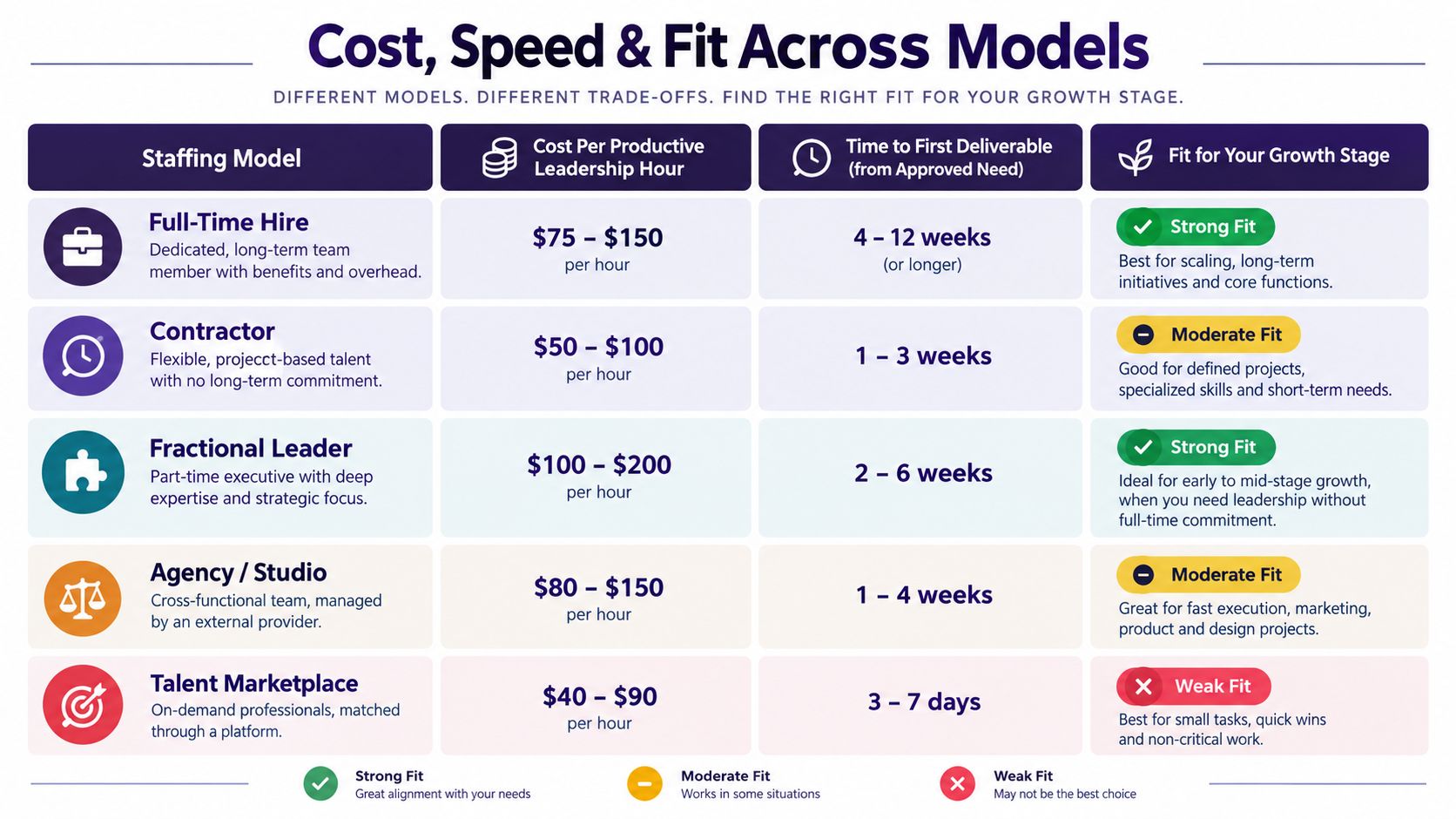
Compare proposals on productive leadership capacity, time to usable output, fit for the mandate, and exposure if the arrangement fails. The judgments below are a buyer's framework, not statistical rankings.
| Model | Cost per Productive Leadership Hour | Time to First Deliverable | Outcome Fit | Main Risk |
|---|---|---|---|---|
| In-house direct hiring | Attractive when ongoing workload is substantial | Recruiting and onboarding precede output | Strong for enduring ownership | Internal search stalls or role is mis-scoped |
| Retained search | Search expense sits alongside employment cost | Candidate selection precedes operating work | Strong for sensitive permanent appointments | Strong candidate, weak mandate |
| Contingency and staffing agencies | Depends on placement terms or staffing charges | Available candidates can help; diligence still matters | Useful for well-defined vacancies | Incentives favor placement over operating fit |
| RPO | Evaluate across the hiring program | Setup and recruiting precede leadership output | Strong for sustained hiring demand | Buying recruiting capacity instead of an operator |
| Fractional or on-demand | Favorable when purchased capacity is fully useful | Work can start after contracting and access | Strong for bounded executive mandates | Limited availability or fragmented authority |
Compare the full commitment
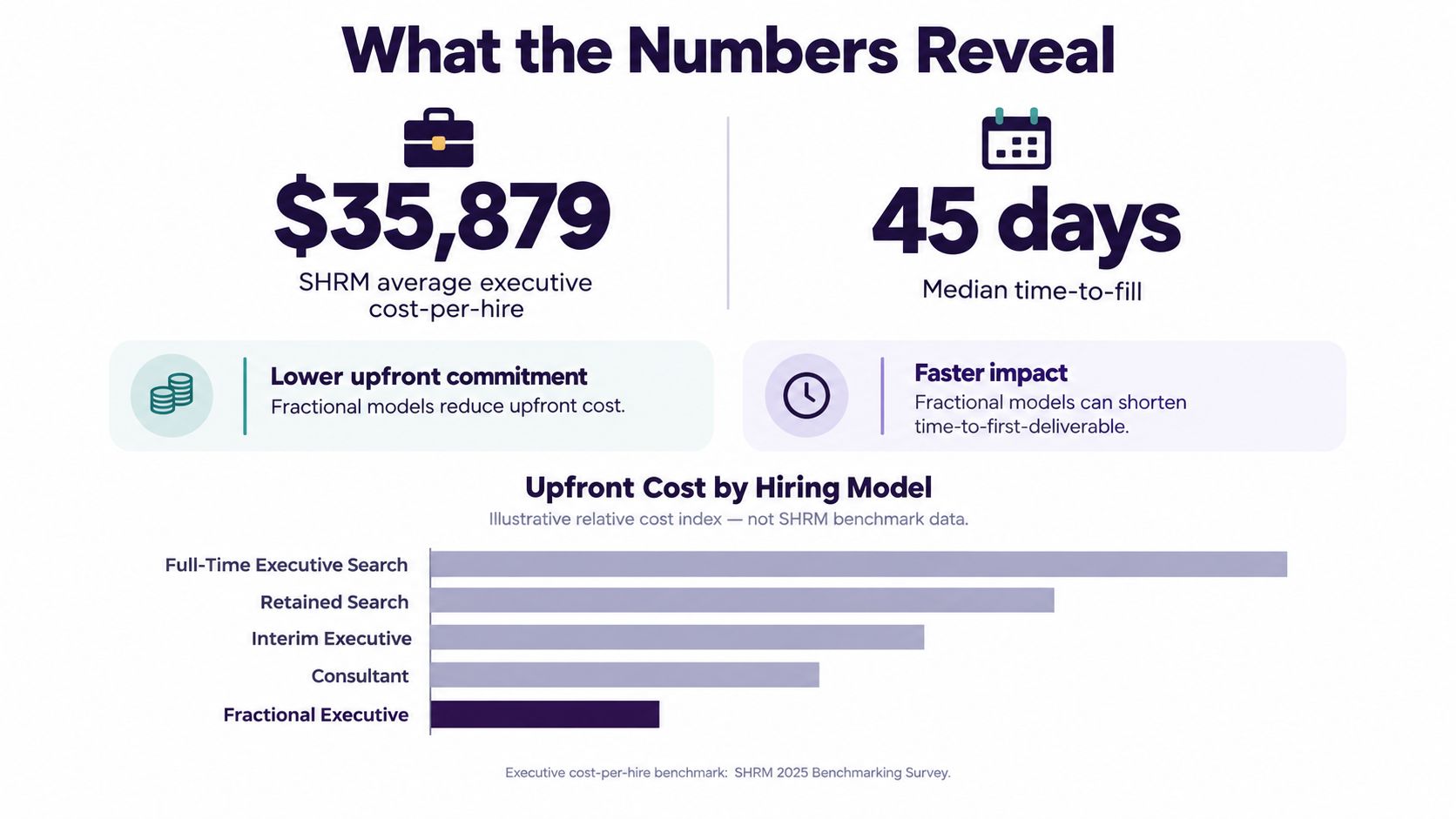
SHRM's 2025 recruiting benchmark reports average cost per hire of $35,879 for executive positions versus $5,475 for nonexecutive positions, with recruiting consuming an average of 26% of the HR budget. Those are recruiting benchmarks, not executive salaries or quoted fractional engagement fees.
Build your own comparison using the actual proposals. For permanent hiring, include search expense, compensation, benefits, onboarding, and the internal time required to support recruitment. For fractional work, include engagement fees, onboarding, coordination, and any additional execution resources.
Use this calculation:
Total committed cost ÷ expected productive leadership hours = planning cost per productive leadership hour.
Don't confuse scheduled hours with productive hours. A leader who lacks access to financial data or authority to change sales practices can spend their allocation attending meetings without resolving the bottleneck.
Pay for the risk that matters
Retained search can be the right purchase for confidential succession. A carefully assessed permanent appointment protects continuity and stakeholder confidence; rushing that decision to save a recruiting fee is poor judgment.
A fractional finance leader is a different purchase. If your immediate need is forecast ownership and financing preparation, evaluate whether the agreed capacity can deliver those outputs. Don't compare the engagement with a permanent CFO salary alone.
For every proposal, request:
- A delivery definition: What will the executive produce or change?
- A dependency list: What must your team provide?
- An exit mechanism: How will responsibilities transfer if the arrangement ends?
That's how you compare executive staffing solutions without confusing price with value.
What the Numbers Actually Reveal
The market evidence supports flexible executive leadership, but it doesn't justify promising automatic savings or instant results. Interim management and fractional leadership are related models, not identical datasets.
Traditional interim executives can take substantial assignments with broad operating responsibility. Fractional executives apply senior capability through smaller commitments. Evidence about the former demonstrates a mature supply of experienced operators, not a guaranteed outcome for every part-time engagement.
Senior leadership isn't synonymous with permanent employment
A 2026 INIMA European survey of approximately 850 interim managers reported 62% on assignment, 62% average utilization, more than 60% placed at C-level or above, and an average assignment duration of 10.8 months.
That matters because founders sometimes equate temporary leadership with junior coverage. These findings describe executive-level work over meaningful operating periods. However, practitioner utilization isn't the same as how effectively your company would use a permanent employee.
The historical foundation is also established. A 2021 summary of INIMA findings reported that personal networks accounted for 48% of placements. My takeaway is practical: trusted relationships matter, but a founder shouldn't limit the search to whoever happens to be in their contacts.
Translate benchmarks into your own economics
The recruiting cost benchmark above is a useful starting point, not a fractional pricing model. Public averages don't tell you a particular executive's rate, available capacity, or ability to deliver your mandate.
Before signing, create a worksheet with proposal-specific inputs:
- Leadership hours per dollar: Compare committed capacity after including setup and coordination costs.
- Days to first usable output: Specify the deliverable that makes the engagement operationally valuable.
- Outcome economics: Connect the work to revenue quality, margin, working capital, or risk reduction.
- Continuation cost: Identify what remains after the initial assignment and who will own it.
Use a fractional executive compensation framework to structure that analysis rather than assuming an hourly rate captures the entire commitment.
Technology and SaaS are prominent settings for fractional work, but industry relevance isn't proof of individual effectiveness. Validate the candidate against your business model, operating complexity, and immediate objective.
The defensible conclusion is narrower and more useful than a marketing promise: experienced executives already work through flexible arrangements. Your job is to establish whether a specific arrangement produces enough useful leadership for its total cost.
Matching the Model to Your Growth Inflection Point
A company preparing for financing needs different leadership from a company integrating an acquisition. Don't let revenue size become a shortcut for diagnosing the work.
The following are illustrative operating scenarios, not reported case studies. Each begins with a business trigger and ends with a staffing recommendation.

Fundraise preparation
Your financial statements exist, but investors can't trace the growth story back to cash requirements and operating assumptions. Engage a fractional CFO to own the forecast, financing scenarios, data-room readiness, and financial narrative.
Keep transaction accuracy with the controller or accounting team. Don't buy senior CFO time to compensate for unresolved bookkeeping. If the financing also creates a lasting board-adjacent leadership requirement, run a carefully scoped retained search separately.
Measure readiness through reconciled reporting, documented assumptions, and the team's ability to answer diligence questions consistently. Deprioritize a permanent appointment made solely to look credible to investors.
Post-acquisition integration
The deal has closed, but reporting lines, operating processes, and management expectations remain unsettled. Appoint an interim COO when the acquired organization needs continuous transitional leadership; choose a fractional COO when internal managers can execute between scheduled leadership blocks.
Outsource integration design and cross-functional coordination where specialist experience is valuable. Keep customer relationships, employee communication, and ongoing line management with accountable internal owners.
The test isn't whether the integration leader attends meetings. It's whether managers have a shared operating cadence, decisions get resolved, and essential services remain stable. Don't rush a permanent hire until you know the combined organization's enduring structure.
An AI capability gap
PwC's 2025 Global AI Jobs Barometer reports that jobs requiring AI skills grew 7.5% while total job postings fell 11.3%, and that skills sought by employers changed 66% faster in highly AI-exposed jobs than in less-exposed roles.
My recommendation is to buy leadership around implementation before assuming you need a permanent technical executive. A fractional CTO or chief AI officer can prioritize use cases, establish evaluation criteria, set governance, and coordinate technical and commercial teams.
- Outsource specialist judgment: Architecture review, vendor evaluation, and workflow design.
- Keep internal accountability: Data ownership, customer commitments, and operational approvals.
- Measure business value: Track work quality, process effort, exception handling, and user acceptance rather than tool adoption alone.
A stalled go-to-market motion
If the revenue team lacks direction while a permanent CRO search continues, appoint a fractional CRO to stabilize forecasting, manager expectations, and commercial priorities. Keep the search running if the enduring role warrants full-time ownership.
Use startup scaling challenges as a diagnostic lens. A sales problem may require leadership, but it may also require changes to positioning, delivery, or customer retention. Don't hire around a diagnosis nobody has tested.
Running a Fractional Engagement So It Actually Performs
Limited capacity requires stronger operating design, not looser expectations. The executive needs a clear mandate, timely access, and enough authority to execute without waiting for the founder to approve every move.
SHRM's 2025 recruiting analysis places median executive time-to-fill at approximately 45 days, with screening and interviewing each averaging 8–9 days. Use that as a hiring benchmark, then measure a fractional engagement's actual onboarding and delivery timeline rather than assuming it's faster.
Days 1–30 establish the foundation
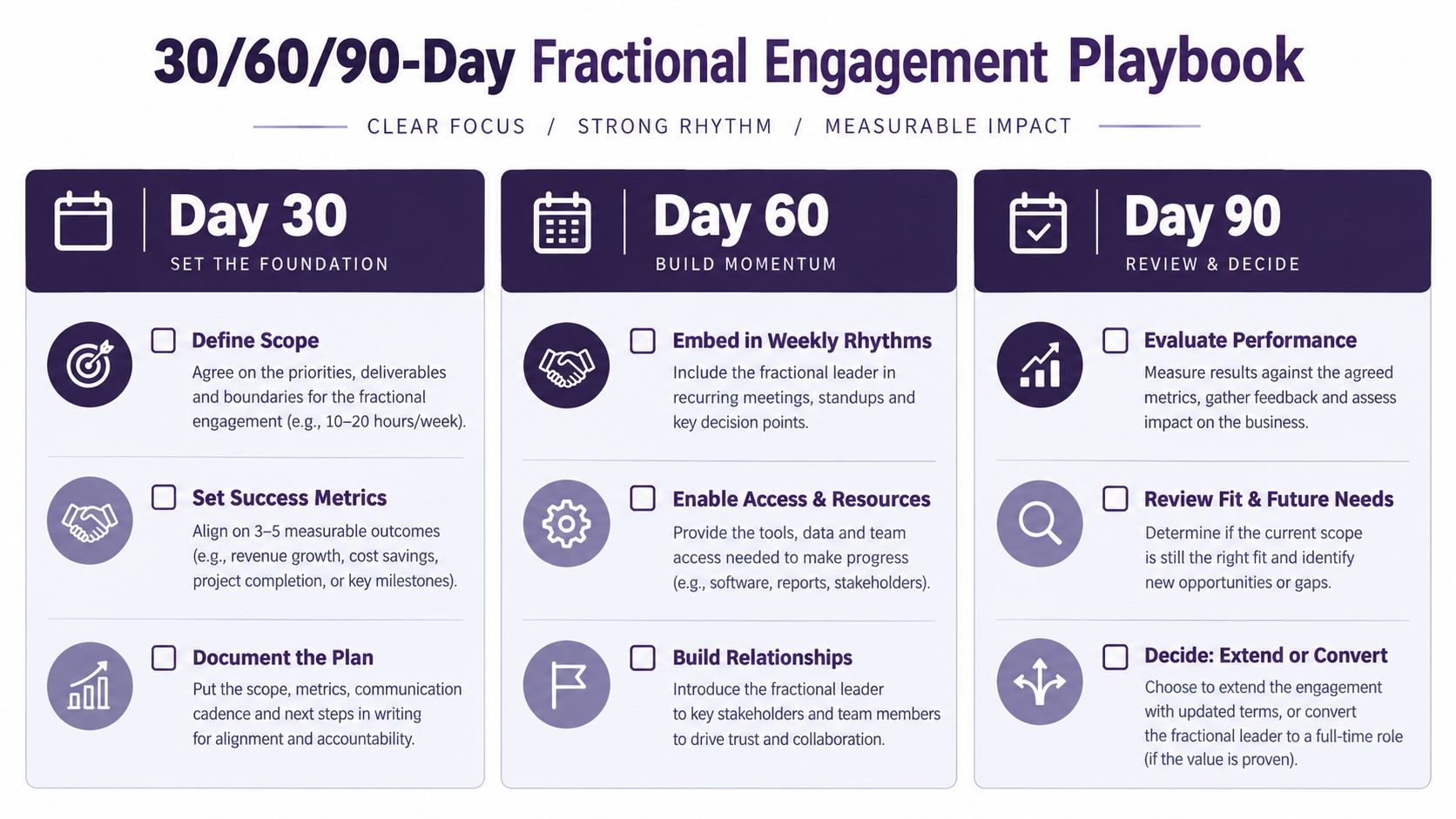
Use a 30/60/90-day operating plan as an engagement design, not a performance guarantee. Start with access to financial reports, CRM definitions, board materials, existing plans, and the managers who will execute changes.
Agree on measurable outcomes and record their starting condition. For a CFO, that might mean forecast reliability and investor-reporting readiness; for a revenue leader, pipeline consistency and manager adherence to deal-review standards.
Document weekly availability, response expectations, and reserved capacity for urgent work. Grant decision rights within a defined scope, including the budget and personnel decisions that require founder or board approval.
Days 31–60 put a change into operation
Require a usable operating change, not just a presentation. That might be a cash forecast maintained by the finance team, a pipeline review managers run, or an AI evaluation policy applied to a live use case.
Track leading indicators that reveal whether people are using the new process. Check data completeness, review attendance, unresolved exceptions, and whether managers make decisions without unnecessary escalation.
Treating an executive as an advisor while expecting executive execution produces recommendations without ownership.
Days 61–90 review and transfer
Evaluate outcomes against the starting condition. Distinguish executive performance from dependencies your company failed to supply.
Extend the engagement when the remaining mandate is clear. Reduce capacity when internal managers can sustain the work. Convert to full-time when ongoing responsibility requires continuous leadership rather than occasional peaks.
Include these terms in the engagement letter:
- Scope and deliverables: Named outputs, acceptance criteria, and exclusions.
- Capacity and authority: Weekly commitment, escalation rules, and approval boundaries.
- Confidentiality and conflicts: Data access, competing-client disclosures, and work-product ownership.
- Review and exit: Performance checkpoints, notice terms, documentation, and handoff obligations.
Compensation and equity also need explicit terms. Don't leave them as informal promises to revisit once the relationship is working.
Why Fractional Often Beats Full-Time at the Right Stage
A full-time executive isn't proof that your company has matured. A well-matched leadership structure is. Hire permanently when the enduring workload and accountability justify it, not when the title would make the org chart look complete.
A 2025 industry analysis of fractional executives estimated that technology was the leading industry for fractional work, roughly 25% of U.S. businesses used fractional hiring in some form, and fractional executive roles had grown 57% since 2020. Those estimates indicate adoption, not a guaranteed performance advantage.
Test the ongoing need
Use these questions before committing:
- Does the responsibility require daily presence? Continuous managerial coverage can make a permanent appointment the better choice.
- Will the workload remain substantial after this inflection point? Don't design a lasting role around a temporary peak.
- Can a bounded mandate work safely? Regulatory obligations, crisis exposure, and approval requirements may demand continuous ownership.
Full-time leadership is appropriate for substantial ongoing operations, regulated accountability, and transformations that require sustained organizational authority. Fractional leadership fits when a capable operator can own a defined mandate without being present for every working hour.
The point isn't to avoid hiring. It's to stop treating permanent employment as the default purchase. Buy the leadership your business needs, and change the arrangement when the work changes.
Shiny offers a fractional executive marketplace connecting companies with experienced, vetted leaders for part-time operating roles. Visit Shiny to explore executive profiles or schedule a consultation focused on your next fundraise, launch, or operational transition. Bring the outcome you need, the authority you can delegate, and the capacity you expect to require.