
On Demand CFO Guide: How to Hire, Scope, and Win
You're in the meeting with the bank, the controller is two days late on close, and your bookkeeper just sent three different cash numbers. That's the moment most founders start looking for an on demand CFO, not because they want another title on the org chart, but because the business needs someone who can make finance behave like an operating system instead of a pile of spreadsheets.
The mistake is treating the search like a hiring problem first. It's an operations problem first, then a staffing decision. If the numbers aren't reliable, the controls are loose, and nobody owns the handoff when the engagement ends, a fractional CFO becomes an expensive opinion instead of a force multiplier.
What an On Demand CFO Actually Does for a Growing Company
A founder usually hires too late, after cash visibility slips and decisions start getting made in the dark. The right on demand CFO doesn't start with lofty strategy decks. They start by making the company's financial facts trustworthy enough to run the business on.
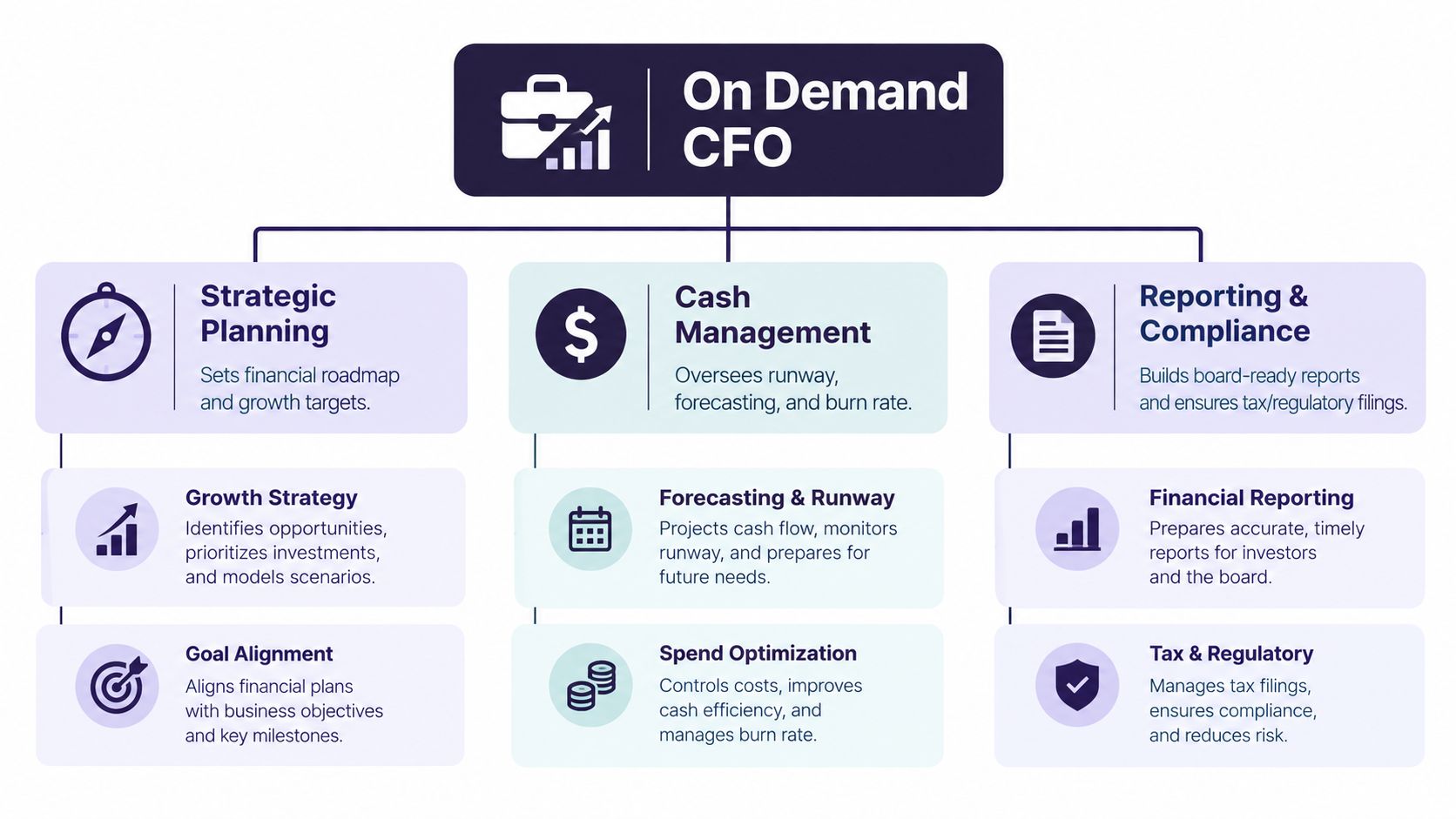
The real job is decision support
At a practical level, the CFO role covers forecasting, cash management, board support, fundraising prep, and finance team design. That means weekly cash reporting, a KPI dashboard the leadership team reads, and the judgment to tell you whether a pricing change, hiring plan, or lender conversation is sane.
Practical rule: if the CFO can't tie numbers back to bank balances, receivables, payables, payroll, debt, and tax obligations, they're not running finance. They're narrating it.
A good fractional CFO also turns messy finance work into operating cadence. They help define what needs to happen every week, what gets reviewed monthly, and what belongs in the board pack. In small and midsize companies, that often matters more than polished presentation, because the business needs fewer surprises and faster decisions.
The model fits shared capacity by design. A 2026 industry report found that 51% of fractional CFOs work with three to four clients simultaneously, 65% primarily serve companies with one to 50 employees, and 89% mainly serve businesses with fewer than 250 employees (Layerz statistics). That's not a boutique side hustle. It's a service model built for focused, amplified work.
What founders should expect on day one
A legitimate engagement should produce concrete outputs, not vague reassurance. Look for a weekly cash rhythm, management reporting that doesn't need heroic cleanup, and a finance function that knows who owns what.
- Cash visibility: one view of current balances, near-term inflows, and near-term outflows.
- Operating reports: a board-ready KPI pack with clear definitions.
- Leadership support: help with lender calls, investor decks, and financing materials.
- Finance structure: recommendations on which tasks stay with bookkeeping, which move to a controller, and which belong with the CFO.
If a candidate can't describe those deliverables clearly, keep moving.
When Hiring an On Demand CFO Actually Makes Sense
Bring in an on demand CFO before the finance mess turns into a public problem. If the company needs to raise capital, refinance debt, restructure, or explain a shaky forecast to a board, waiting months for a full-time hire is the wrong move.
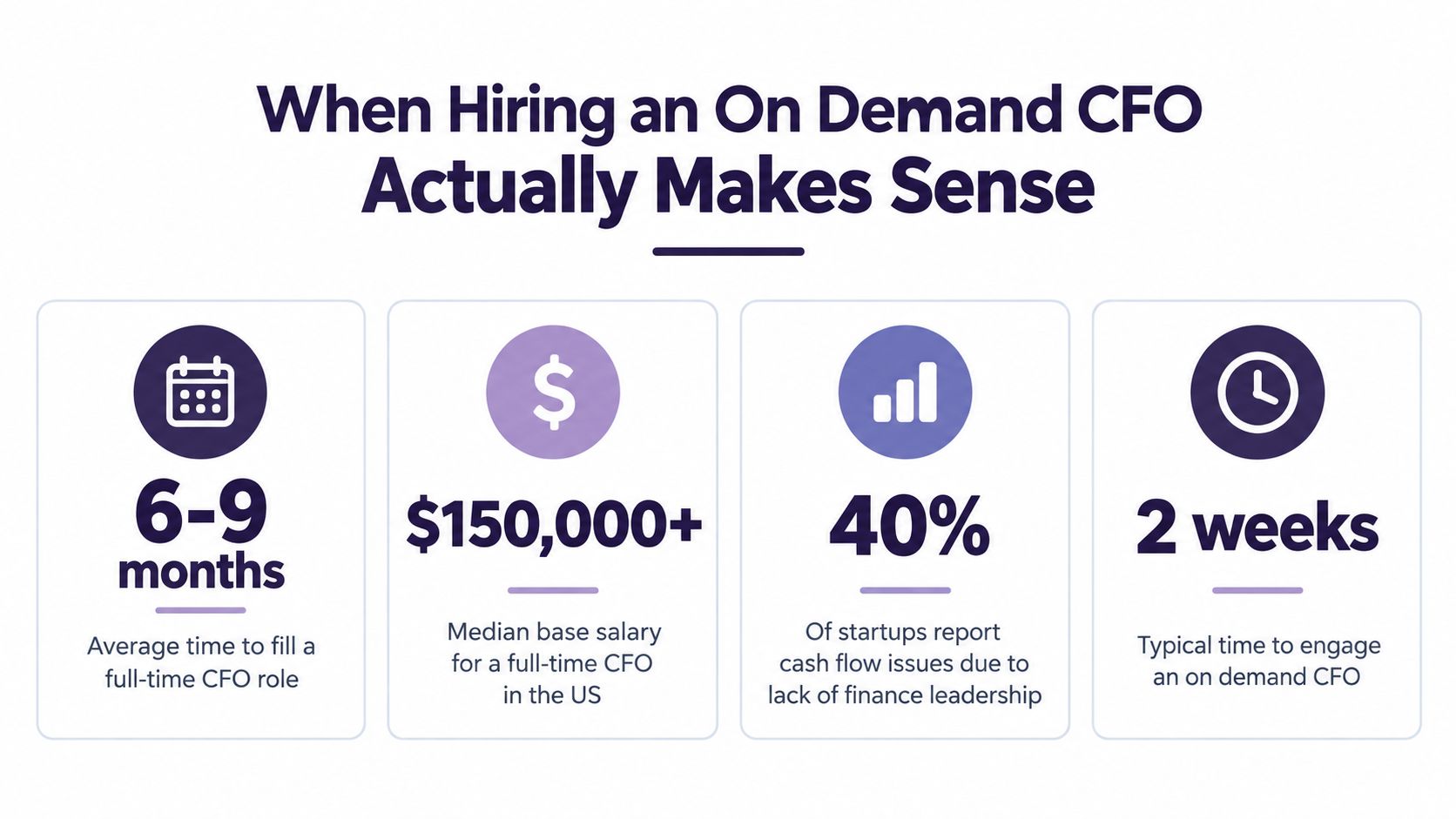
The hiring market slows companies down. A 2026 survey reported that 60% of finance professionals considered hiring finance and accounting personnel somewhat or much harder than in previous years, with 41% saying filling a finance role typically took three to six months and another 10% reporting a seven- to twelve-month hiring period (CFO Brew survey). For a growing company with cash pressure, that delay is a liability.
The market has already voted on the model. One 2026 estimate put the U.S. total addressable market for fractional CFO services above $3.2 billion, with a projected increase to $6.4 billion by 2028. The same estimate said more than 70% of North American companies generating between $5 million and $50 million in revenue were either using or considering fractional CFO services (market estimate).
That demand is not about status. It is about buying senior judgment for periods when the finance function needs speed, not a permanent executive seat.
Use the model when the work is temporary and high-stakes
The right trigger is usually a concentrated finance problem that cannot wait.
- Runway is shrinking: cash needs to be forecast now, not after a long search.
- Fundraising is close: the model, story, and diligence package need cleanup fast.
- Board pressure is rising: the numbers need to hold up under scrutiny.
- A deal is coming: acquisition, refinancing, or restructuring work has a start and an end.
- The company needs a reset: pricing, margin, and capital allocation all need attention together.
A full-time CFO is overkill when the work is intermittent and the need is specific. An on demand CFO fits when you need tight execution for a defined period, usually alongside bookkeeping, controller work, and leadership that still wants direct answers. Founders should demand clarity on data reliability, controls, and handoff before they sign anything. If the numbers are messy or the finance owner cannot explain how decisions get made, hire for that problem now.
Writing a Job Brief That Attracts the Right Fractional CFO
A weak brief gets you a polished generalist who nods a lot. A strong brief gets you candidates who understand the actual mess. If you want the right on demand CFO, write the job like you already know where the pain is.

Start with the business problem, not the title
Spell out the company stage, current finance stack, and the decision you're trying to improve. If you bury the issue under generic language, candidates can't tell whether you need turnaround help, fundraising support, or better management reporting.
Include these basics:
- Company context: revenue range, headcount, funding status, and growth pressure.
- Current stack: accounting system, payroll, billing, banking, and reporting tools.
- Scope: forecasting, board prep, margin analysis, lender support, or all of the above.
- Hours per week: be honest about the actual need.
- Decision rights: who approves payments, policies, and assumptions.
- First 90 days: define the outputs you'll measure.
The best briefs read like operating memos, not recruiting ads. Candidates with real experience will self-select faster, and the ones who don't fit will opt out before you waste time.
For a more detailed role outline, a useful reference is this CFO job description guide.
Set the first 90 days in writing
You don't need a romance, you need a contract that says what success looks like. The CFO should know whether the goal is forecasting discipline, board readiness, cash control, or investor confidence.
A strong brief usually names one or two hard outcomes, not ten fuzzy ones. That keeps the search focused and makes later evaluation much cleaner.
Don't ignore the cost of testing the wrong fit
Executive recruiting isn't cheap. The median cost per executive hire reached $15,000 in 2026, up from $10,600 in 2025 and $5,000 in 2017 (executive hire benchmark). A scoped fractional engagement lowers the risk of making a costly permanent mistake.
Vetting, Interviewing, and Picking the Right Match
A polished LinkedIn profile says very little about whether someone can steady a lender call, clean up a forecast, or catch a control failure before it becomes expensive. Hiring here is an operations decision first. The hiring decision comes second.
Screen for three things: prior fractional experience, the right operating context, and the discipline to work within your constraints. Someone who spent years inside a large finance team may sound impressive and still miss the pace, ambiguity, and blunt communication a growing company needs.
Ask for situations, not slogans
Skip the “tell me about yourself” routine. Scenario answers tell you how someone thinks.
Use questions that force practical judgment:
- Cash shock: what happens in the first week if cash visibility is incomplete?
- Board pressure: how do you answer when the board wants certainty the model cannot provide?
- Forecast miss: how do you explain a major variance without hiding behind accounting jargon?
- Systems mess: what do you handle yourself, and what gets handed to a controller, bookkeeper, or implementation partner?
Strong answers name the first moves, the person responsible for each one, and the reporting rhythm that follows. If the response stays polished but vague, move on.
Reference checks need the same discipline. Ask former clients whether the CFO made decisions clearer, improved visibility, and kept the engagement tight. Ask what broke after the CFO left. That question usually reveals more than praise ever will.
Judge fit before you sign
The right candidate should be comfortable explaining which structure fits your stage. If they push one setup for every company, they are selling habit, not fit.
You also need to know whether the candidate can work inside your current systems. If your books are messy, your controls are thin, or your data is unreliable, the person you hire has to deal with that reality on day one. Ask how they would clean up the inputs, who they would involve, and what they would refuse to own until the basics are fixed.
The interview should also surface how they treat exits and handoffs. A serious fractional CFO knows how to document decisions, leave a usable trail, and step away without leaving the company dependent on memory.
For interview structure ideas, this CFO interview questions guide is a useful checklist, but the practical test is whether the person can talk through your numbers without hand-waving.
Pricing Models and How to Negotiate the Engagement
Price is not the first decision. Scope is. A cheap engagement that leaves forecasting, controls, or cleanup undefined will cost more than a clear one with a higher monthly fee.
Match the model to the work
| Model | Best for | Typical structure | Trade-off |
|---|---|---|---|
| Monthly retainer | Ongoing finance leadership | Fixed monthly fee for a set scope of hours, meetings, and deliverables | Can drift if the scope is not reviewed |
| Hourly | Diagnostic work and short-term support | Billed time with no fixed commitment | Cost can climb fast, and priorities get messy |
| Project-based | Forecast rebuilds, financing prep, systems cleanup | Fixed fee tied to named deliverables | Works only when the scope is tight enough to hold up in practice |
| Equity-inclusive | Cash-tight startups with real upside potential | Smaller cash fee plus equity | Expectations can get fuzzy if the value exchange is not explicit |
Do not negotiate like you are buying a commodity. The levers are decision rights, deliverables, cadence, and how the work ends. If those are vague, the rate barely matters.
A short trial period is the right way to reduce risk. You are testing whether the CFO can clean up the numbers, improve decision-making, and tighten control without becoming a drain on the team.
Set the trial up with hard boundaries:
- Clear deliverables: cash forecast, close timing, board pack, and reporting cadence.
- Defined access: who can see systems, sign payments, and approve policy changes.
- Review timing: a check-in after the first cycle, not after months of drift.
If you want market context before you set a fee, this part-time CFO cost overview is a useful benchmark.
One company I've seen negotiate badly paid a premium retainer for “full support,” then found out the CFO expected the controller to build the forecast and the founder to chase missing data. That is not a pricing problem. It is a scope failure. The retainer should have named the forecast owner and the data supplier in writing before the first invoice.
Controls, Access, and Cybersecurity You Cannot Outsource
A fractional CFO can raise the quality of your finance function, but the company still owns the keys. If a founder hands over bank access, payment authority, and policy decisions without guardrails, the finance stack gets weaker, not stronger.
Data reliability comes first. A SMB finance survey of 1,003 financial decision-makers found that nearly two-thirds could not see current cash across all accounts, and 20% were dealing with delays of days or weeks, with multiple banking relationships and system integration problems among the main blockers. That is the starting point for most engagements.
The fix is plain, but it takes discipline. The CFO should pick a single source of truth, reconcile the critical accounts, document assumptions, and set a weekly cash cadence the team can sustain. If the numbers are fragmented, the forecast is noise.
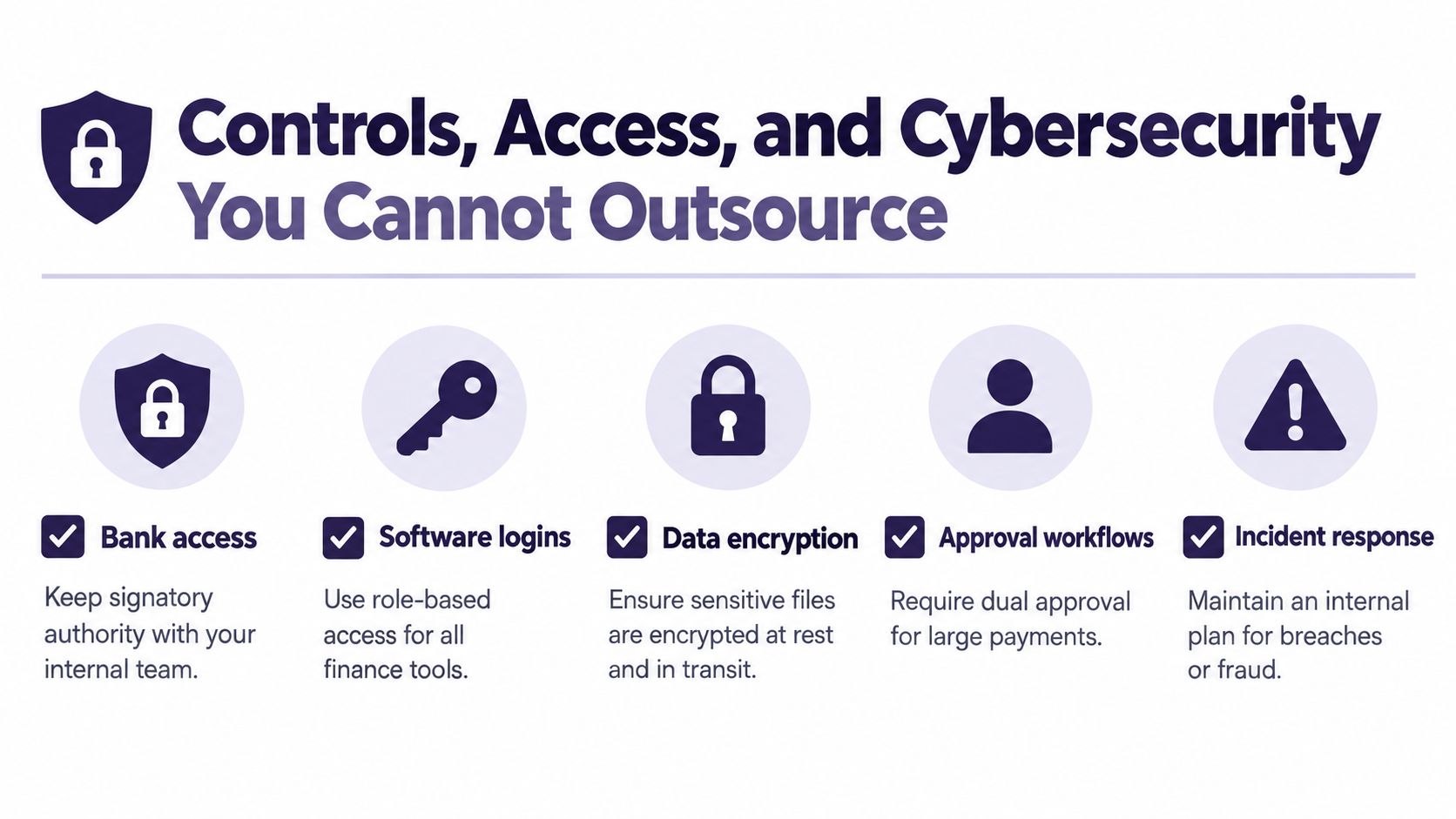
Keep the controls inside the business.
- Bank access: keep signatory authority with the internal team.
- Software logins: use role-based access for finance tools.
- Data encryption: protect sensitive files at rest and in transit.
- Approval workflows: require dual approval for large payments.
- Incident response: keep an internal plan for breaches or fraud.
The CFO can design the process. The company should own the keys. That includes approval rights for payments, material journal entries, accounting policies, and major forecast assumptions.
Blunt truth: if the external CFO is the only person who can move money, change systems, or explain the close, you do not have a finance function. You have a dependency.
The model also breaks down when no internal operator can execute the controls, when regulatory reporting is too complex for part-time oversight, or when the company could not recover if the relationship ended tomorrow. Offboarding is part of the control environment. If you cannot hand the work back cleanly, you never owned it in the first place.
Onboarding and the First 90 Days That Set the Tone
The first 90 days decide whether the engagement becomes a real finance operating system or just another external voice in the room. The CFO should arrive with a plan that turns uncertainty into a sequence the team can follow.
Days 1 to 30
The first month is about stabilizing cash visibility and cleaning up the inputs. The immediate job is not a fancy board presentation, it's a usable 13-week rolling cash model that reconciles bank, card, receivables, payables, payroll, debt, and tax balances.
The CFO should also define weekly ownership. Who updates collections? Who checks open payables? Who confirms payroll timing? Without those assignments, the forecast is theater.
Days 31 to 60
By the second month, the forecast should become a working tool, not a document. Receipts and disbursements should be classified by week, assumptions should have owners, and the company should have base, downside, and upside cases it can discuss.
This is also the time to set the operating dashboard. The practical set usually includes ending cash, net burn, runway, accounts-receivable days, accounts-payable days, gross margin, and forecast error. You do not need a dashboard with twenty widgets. You need a short list that drives action.
Days 61 to 90
By the end of the third month, the company should be able to close on a predictable cadence and produce a board or investor update without a rescue mission. If the forecast keeps missing, the CFO should explain whether the misses come from timing, volume, price, or collection performance.
The reason this matters is simple. Running out of cash is the leading reason startups fail, and the CFO is often brought in to install cash-flow projections, track inflows and outflows, budget properly, and maintain reserves (Rydoo summary of CB Insights research).
A strong engagement ends with one of three outcomes: expand the scope, convert the role to full-time, or wind it down cleanly. If nobody can say which outcome is likely by day 90, the engagement wasn't run tightly enough.
What good looks like at the end
Use this checklist at the first quarterly review:
- Forecast discipline: the 13-week model is updated weekly and variance is explained clearly.
- Close cadence: the books are closing on time enough to support decisions.
- Leadership confidence: the founder and board trust the numbers more than they did before.
- Control maturity: approvals, access, and handoffs are documented.
- Exit readiness: if the CFO left next month, the company would still know how to run finance.
Shiny is one place to find vetted fractional executives, including finance leaders who work part time with growth businesses and can be matched through a structured search process. If you want outside help finding the right on demand CFO and want the search handled with more rigor than a LinkedIn scramble, explore Shiny.