

Fractional CFO Companies: Your Guide to Expert Financial Strategy
Is your business growing faster than your financial systems can handle? You know you need high-level financial strategy, but the six-figure salary of a full-time Chief Financial Officer feels out of reach. This is a classic growth-stage dilemma, and it’s precisely where fractional CFO companies provide a powerful solution.
So, what is a fractional CFO company?
Think of it as gaining a strategic co-pilot for your business. You get all the wisdom, foresight, and financial leadership of a seasoned CFO, but on a flexible, part-time basis. It's the ideal model for ambitious companies that need executive-level guidance for critical tasks like fundraising, managing cash flow, or long-term financial planning, without the hefty price tag.
This smart, cost-effective approach allows you to build a resilient financial foundation and make data-driven decisions with confidence.
Why Fractional CFO Companies Are Reshaping Business Finance
The modern business landscape is complex and fast-moving. To navigate it successfully, companies need agile, expert financial leadership. Many growing businesses hit a common pain point: they require sophisticated financial strategy to scale, but can't justify the $400,000+ annual cost of a full-time CFO. This is the gap fractional CFO companies are built to fill.
Imagine you're captaining a ship across the ocean. You don't need a world-class navigator for every calm, sunny day, but you absolutely need one to chart the course through treacherous storms or complex currents. A fractional CFO is that expert navigator. Their guidance during make-or-break moments—like securing funding, managing rapid growth, or preparing for an exit—is indispensable.
The Forces Driving On-Demand Financial Leadership
Several market shifts have propelled this model from a niche service to a strategic necessity. Economic uncertainty and high executive turnover have made flexibility a top priority for businesses. This has created a surge in demand for on-demand executive talent, a trend we explore in our guide to the fractional C-suite advantage.
The data tells a clear story. The fractional CFO industry has seen explosive growth, with demand in the U.S. shooting up by 103% year-over-year. A key driver is CFO turnover hitting 22%—its highest point in three years. This churn leaves critical leadership gaps that fractional providers can fill almost instantly, ensuring business continuity and strategic oversight.
For a growing business, engaging a fractional CFO company isn't just a cost-saving measure; it's a strategic investment in sustainable growth and financial resilience.
Ultimately, partnering with a fractional CFO company gives founders and CEOs a powerful ally. You can get back to focusing on your product, customers, and vision, knowing an expert is steering the financial ship. They ensure you’re capitalized, compliant, and positioned for long-term success.
What a Fractional CFO Delivers Day to Day
So, what does a fractional CFO actually do?
It’s easy to get lost in the title, but their true value emerges in the tangible, day-to-day impact they have on a business. Their role isn’t just about crunching numbers; it’s about transforming financial data into a clear roadmap for growth. Think of them as a strategic co-pilot for the CEO, providing the financial intelligence needed to navigate tough decisions with confidence.
Their responsibilities are dynamic, but they typically focus on three core pillars to build a resilient and scalable financial foundation.
Building Your Financial Strategy
A fractional CFO's primary job is to look forward. They shift your company from reactive financial management to proactive, strategic planning. They don’t just report on the past; they model what’s possible for the future.
Key strategic activities include:
- Financial Forecasting and Modeling: They build sophisticated models to predict future revenue, expenses, and cash flow, allowing you to game out different scenarios.
- KPI Development: They help you define and track the key performance indicators (KPIs) that truly matter for your business, like Customer Acquisition Cost (CAC) and Lifetime Value (LTV).
- Strategic Planning: They work with the leadership team to create long-term financial plans and annual budgets that align with your strategic goals.
Optimizing Financial Operations
A brilliant strategy is useless without solid execution. That's why fractional CFOs roll up their sleeves and dive into daily financial operations to find efficiencies, plug leaks, and build scalable systems. They bring order to the financial chaos that often plagues growing companies.
For example, a fast-growing e-commerce brand struggling with unpredictable cash flow is a classic business pain point. A fractional CFO would step in to analyze inventory turnover, negotiate better payment terms with suppliers, and set up a cash management system that smooths out the nerve-wracking peaks and valleys.
An experienced fractional CFO acts as an operational architect. They design the financial systems and processes that allow a business to grow without breaking, turning the finance function from a cost center into a strategic asset.
Managing Stakeholder Relationships
A fractional CFO is also your company's chief financial storyteller. They play a critical role in communicating your financial health and vision to the people who matter most—investors, board members, and lenders. This is one of the most important duties of a fractional CFO.
Their work in this area includes:
- Investor Reporting: Creating clear, professional financial reports and dashboards that build investor confidence.
- Fundraising Support: Leading financial due diligence during fundraising rounds, building the data room, and crafting the financial narrative that gets investors excited.
- Board Meeting Preparation: Presenting financial updates at board meetings, translating dense data into actionable insights.
The right executive from one of today's top fractional CFO companies does more than manage money; they empower leadership with clarity and foresight, paving the way for smarter, faster growth.
The Real ROI of a Fractional CFO
When founders consider a fractional CFO, the most obvious benefit is saving money on salary. While the savings are significant, they are just the tip of the iceberg. The true financial victory becomes clear when you compare the total cost of a full-time executive to the flexible retainer of a top-tier fractional CFO.
A full-time hire involves much more than a base salary. You have to factor in recruitment fees, annual bonuses, equity, benefits, and payroll taxes. The fully-loaded cost can easily be 50-75% higher than the salary alone, representing a massive, long-term financial commitment.
Quantifying the Six-Figure Savings
Let's look at a real-world example. A Series B tech company needs to level up its financial leadership. Hiring a full-time CFO at this stage is a long and expensive process. A fractional model provides immediate access to elite talent without the crippling overhead.
The cost difference is staggering. We've seen Series B SaaS startups save 79-90% on their finance leadership costs. A full-time CFO's total annual package could approach $801,250. In contrast, a fractional CFO retainer might total $167,000 for the year. That's over $634,000 back in your budget. You can see a detailed breakdown of how this value is created.
This isn't just about abstract numbers; it's about channeling resources where they make the most impact.
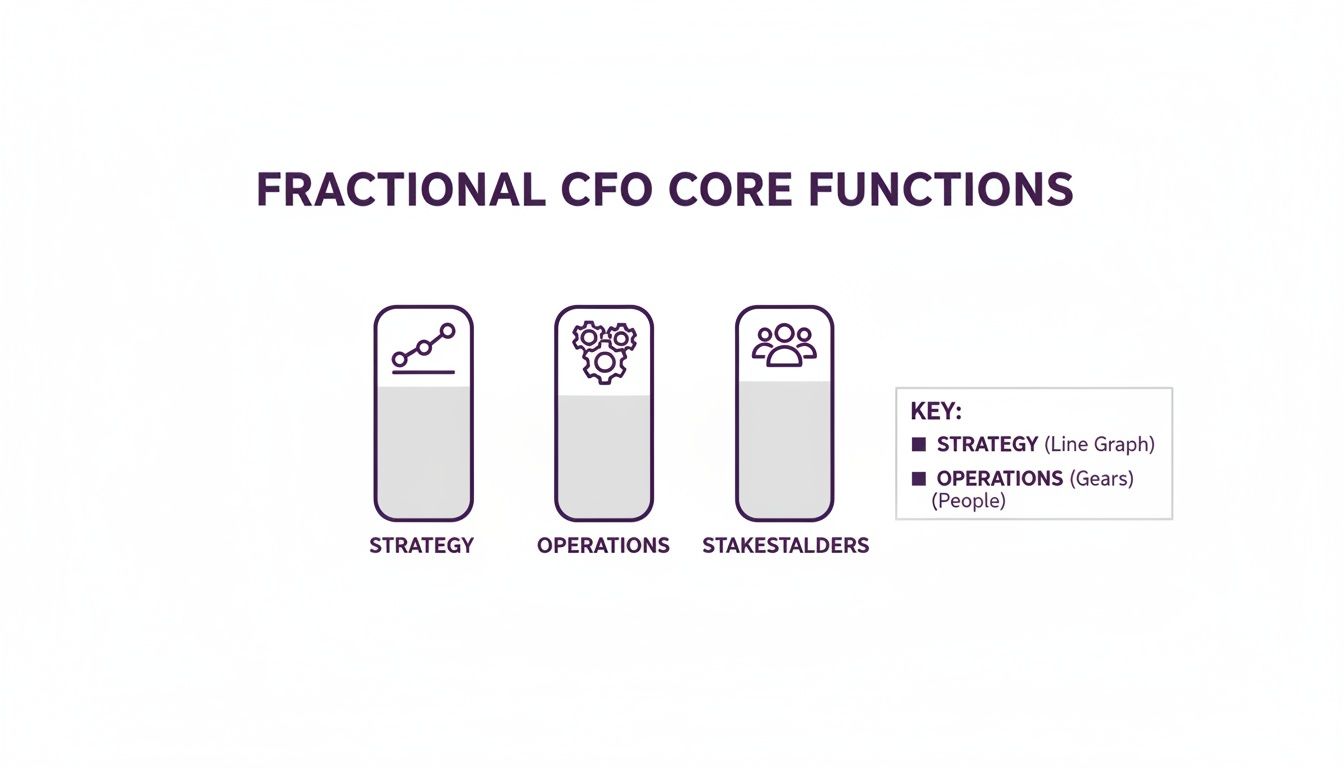
As this illustrates, their value comes from driving high-level strategy, fixing operational bottlenecks, and managing crucial stakeholder relationships.
The Flywheel Effect of Reinvested Capital
The most powerful part isn’t just the money you save, but what you do with it. When you redirect hundreds of thousands of dollars from executive overhead into your core business, you create a powerful growth flywheel.
By reallocating capital, you can directly accelerate product development, expand marketing campaigns, or hire key sales talent. This strategic reinvestment transforms cost savings into a tangible competitive advantage.
This is how you shorten your path to profitability and gain market share. The ROI isn't just a line item on a spreadsheet; it’s faster growth, a stronger market position, and the ability to walk into a board meeting with hard data backing every strategic move.
If you're ready to see how this model could change your company's trajectory, the best first step is to connect with a network of vetted financial executives and start a conversation.
Key Signals Your Business Needs a Fractional CFO
Knowing when to bring in strategic financial leadership is a game-changer. Too many founders wait until they’re in a crisis. Smart leaders, however, recognize the early warning signs—the nagging questions and operational bottlenecks that signal growing complexity.
If you’re making critical decisions based on gut feelings instead of solid numbers, you’re flying blind. A fractional CFO replaces guesswork with confident, data-driven strategy.
You Are Preparing for a Fundraise
Are investors asking tough financial questions you can't answer on the spot? When raising capital, a compelling story isn't enough; you need rock-solid financials to back it up. Investors will scrutinize every number, and any hesitation can kill a deal.
A fractional CFO becomes your fundraising co-pilot. They build the data room, sharpen your financial narrative, and field investor questions with an authority that builds trust and gets term sheets signed.
Cash Flow Is Becoming Unpredictable
Rapid growth is exciting, but it often throws cash flow into chaos. You might be closing deals left and right, but if cash isn't managed properly, you can go broke while being "profitable" on paper.
A seasoned fractional CFO thrives in this environment. They implement cash flow forecasting, optimize working capital, and establish credit facilities to smooth out the bumps. This ensures you have the cash to pay your team, your vendors, and seize new opportunities without sleepless nights.
When your financial reports create more questions than they answer, it's a huge red flag. You've outgrown your current setup.
You Need to Professionalize Operations
As you grow, simple accounting spreadsheets break down. You lack formal budgets, your financial reporting is slow and inaccurate, and you're not tracking meaningful Key Performance Indicators (KPIs). These operational cracks create risk and slow down decision-making.
A great fractional CFO is also an operational architect. They implement robust financial systems, establish internal controls, and build a culture of financial discipline. Getting your financial house in order is essential for sustainable scaling.
The table below shows how a fractional CFO’s role evolves to meet the challenges at each business stage.
Business Stage and Fractional CFO Needs
| Business Stage | Key Financial Challenge | How a Fractional CFO Helps |
|---|---|---|
| Early Stage (Seed) | Basic financial hygiene and forecasting. | Sets up accounting systems, builds the first financial model, and manages cash burn. |
| Growth Stage (Series A) | Scaling operations and preparing for diligence. | Implements KPIs, manages investor reporting, and optimizes working capital. |
| Scale-Up (Series B+) | Complex financial strategy and risk management. | Leads future fundraising rounds, explores debt financing, and builds departmental budgets. |
| Mature / Pre-Exit | Exit readiness and maximizing valuation. | Manages M&A due diligence, prepares for an IPO, and ensures clean, auditable financials. |
If these challenges sound familiar, it might be time to explore how targeted financial expertise can bring clarity and direction to your business.
How to Choose the Right Fractional CFO Company
Choosing the right financial partner is as critical as the decision to hire one. Not all fractional CFO companies are the same—what works for a consumer brand could be a poor fit for a SaaS startup. This isn't just about finding a service provider; it's about finding a strategic ally who understands your vision.
Think of it like choosing a co-pilot. You need someone who has flown your exact type of plane through the specific weather you’re about to face. The right choice depends on industry knowledge, stage-specific experience, and an engagement model that fits your needs.
Matching Expertise to Your Business Needs
Your first filter should always be industry and stage-specific experience. A CFO who has scaled ten SaaS companies understands metrics like ARR and churn instinctively. An e-commerce expert will have a deep grasp of inventory management and supply chain logistics.
The fractional work ecosystem is booming, and client profiles for fractional CFOs lean heavily toward scale-ups (73.2%) and startups (57.2%). This surge underscores the importance of vetting partners on stage-relevant experience. You can see more on how this impacts cost by exploring the fractional CFO cost benchmark.
The right fractional CFO doesn't just bring financial knowledge; they bring a playbook. They've already solved the challenges you're about to face at companies just like yours.
Critical Questions to Ask Potential Partners
Once you've shortlisted firms with the right background, it's time to dig deeper. You need to understand their process, communication style, and how they define success.
Here are a few questions to guide your conversation:
- Past Performance: "Can you walk me through a case study of a company similar to ours? What were the challenges, and what measurable results did you deliver?"
- Technology Proficiency: "What is your preferred financial tech stack? How do you use technology to provide real-time insights?"
- Communication Cadence: "What does your typical communication rhythm look like? How will you keep our leadership team aligned?"
- Team Integration: "How do you integrate with an existing team? What do you need from us on day one to be effective?"
These questions help you assess more than just technical skill; you’re looking for a cultural fit, which is essential for a successful partnership. Our guide to top fractional CFO firms offers more insights on what separates the good from the great.
Integrating Your Fractional CFO for Maximum Impact

You’ve hired a fractional CFO—a fantastic step. But the real value is unlocked when they are seamlessly integrated into your leadership team. The most successful partnerships treat their fractional CFO not as an outside consultant, but as a core executive from day one.
This means providing the access, context, and authority they need to make a real difference. You wouldn't hire a world-class surgeon and then hide the patient's medical history. Your new financial leader needs the same thing: complete information and open lines of communication.
Setting the Stage for Success
To get the most value from your new hire, create a clear framework for how you will work together. This aligns everyone and empowers your executive to add value immediately.
Key onboarding priorities include:
- Define Clear Goals and KPIs: Collaboratively set specific, measurable goals for the first 90 days, such as improving cash flow forecast accuracy or preparing for a funding round.
- Establish Communication Rhythms: Set up a regular cadence for check-ins and strategy sessions to ensure information flows freely.
- Grant Necessary Access: Provide full access to accounting software, bank accounts, and other relevant data so they can see the complete financial picture.
True partnership is built on trust and transparency. Empowering your fractional CFO with the right tools and information from the start is the fastest way to see a significant return on your investment.
Finding elite talent is only half the battle. At Shiny, we connect you with vetted executives and provide guidance to ensure they integrate perfectly, helping you build a lasting and impactful relationship.
Common Questions About Fractional CFOs
Even after seeing the benefits, you might still have a few questions. That's normal. Bringing on a fractional CFO is a major strategic decision, and it’s smart to have all the facts.
Let's address some of the most common questions founders ask about this flexible leadership model.
How Much Does a Fractional CFO Cost?
This is usually the first question on everyone's mind. While costs vary based on the executive's experience and your specific needs, most retainers fall between $3,000 to $15,000 per month.
Compared to a full-time CFO, whose total compensation can easily exceed $400,000 a year, the value is clear. You pay only for the strategic expertise you need, when you need it.
What Is the Difference Between a Fractional CFO and a Controller?
This is a crucial distinction. A controller is focused on the past. They manage the books, ensure financial reports are accurate, and maintain compliance. Their job is to tell you what happened.
A fractional CFO, on the other hand, is your forward-looking strategist. They use the data from the controller to steer the company, build financial models, communicate with investors, and act as a strategic partner to the CEO.
How Much Time Does a Fractional CFO Commit?
The beauty of the fractional model is its flexibility. The time commitment is tailored to your company's needs and can be adjusted as your priorities change.
A typical engagement might involve:
- A few hours a week for high-level guidance and board meetings.
- Several days a week during intensive periods like a fundraise, an acquisition, or a major system implementation.
You get access to a top-tier strategic mind without the full-time cost, ensuring your resources are always deployed effectively.
Finding the right executive talent is the first step toward unlocking sustainable growth. We specialize in connecting growing companies with a network of over 3,000 vetted fractional executives ready to make an immediate impact. If you're ready to find a partner who can truly move the needle, schedule a consultation with our team to discuss your needs.
