
Fractional CMO for Small Business: A Practical Guide
You're running marketing between client calls. An agency manages paid ads, a freelancer publishes content, and your sales team follows up when someone remembers. Leads arrive inconsistently, nobody owns the positioning, and every growth decision still comes back to you.
That's the marketing leadership gap. It isn't a personal failure. Small-business owners rarely lack effort. They lack a senior operator who can turn scattered activity into a focused growth system without forcing the company into a costly full-time executive hire.
A fractional CMO for small business can fill that gap. The right leader brings executive judgment, channel discipline, team accountability, and commercial focus for a defined portion of the week. The wrong one becomes another expensive advisor with a polished slide deck and no ownership of results.
The Marketing Leadership Gap Most Small Businesses Hit
A service company at $1.4 million in annual revenue can have plenty of marketing activity and still lack a person responsible for growth. Referrals are slowing, paid advertising produces mixed results, and the website does not explain why prospects should choose the company. An agency buys ads, an employee posts on social media, and the owner approves messaging late at night.
No one owns the marketing function.
That gap creates predictable problems. The agency optimizes campaigns, the employee completes assigned tasks, and the owner makes disconnected decisions. No one sets the market position, decides which channels deserve investment, connects activity to pipeline, or holds the function accountable for commercial results.
The practical diagnosis: If every marketing decision still requires the founder, the company does not have marketing leadership. It has founder-dependent marketing.
The symptoms owners notice first
Owners usually see the consequences before they identify the operating problem:
- Inconsistent lead flow: Some weeks are busy, while others produce little qualified demand.
- Scattered channels: Search, paid social, email, content, referrals, and events run without a clear priority.
- Agency confusion: Vendors report clicks, impressions, and campaign activity, but no one explains the effect on revenue.
- Founder dependency: The owner approves copy, selects campaigns, reviews creative, and resolves disagreements between providers.
- Unclear positioning: Prospects cannot quickly understand who the company serves or why its offer is different.
For a sub-$2M business, those symptoms do not automatically justify hiring a full-time CMO. A fully loaded full-time CMO can commonly cost $275,000 to $500,000 or more annually, according to fractional executive cost guidance from O-CMO. That commitment can force the business to keep an executive occupied instead of concentrating on the few decisions most likely to improve growth.
A fractional CMO supplies senior leadership for the growth phase that needs it, without permanently filling a C-suite seat. The model also limits the risk of making a costly long-term hire before revenue, attribution, and the marketing team are mature enough to support it.
The average CMO tenure has remained about four years, including 4.1 years in 2025, after 4.2 to 4.3 years in 2023 and 2024, as summarized in Spencer Stuart CMO tenure research. Full-time CMOs can be excellent hires. The recommendation is narrower: small-business owners should first test whether focused leadership can clarify positioning, prioritize channels, and establish accountable execution before committing to a permanent executive role.
What a Fractional CMO Actually Does
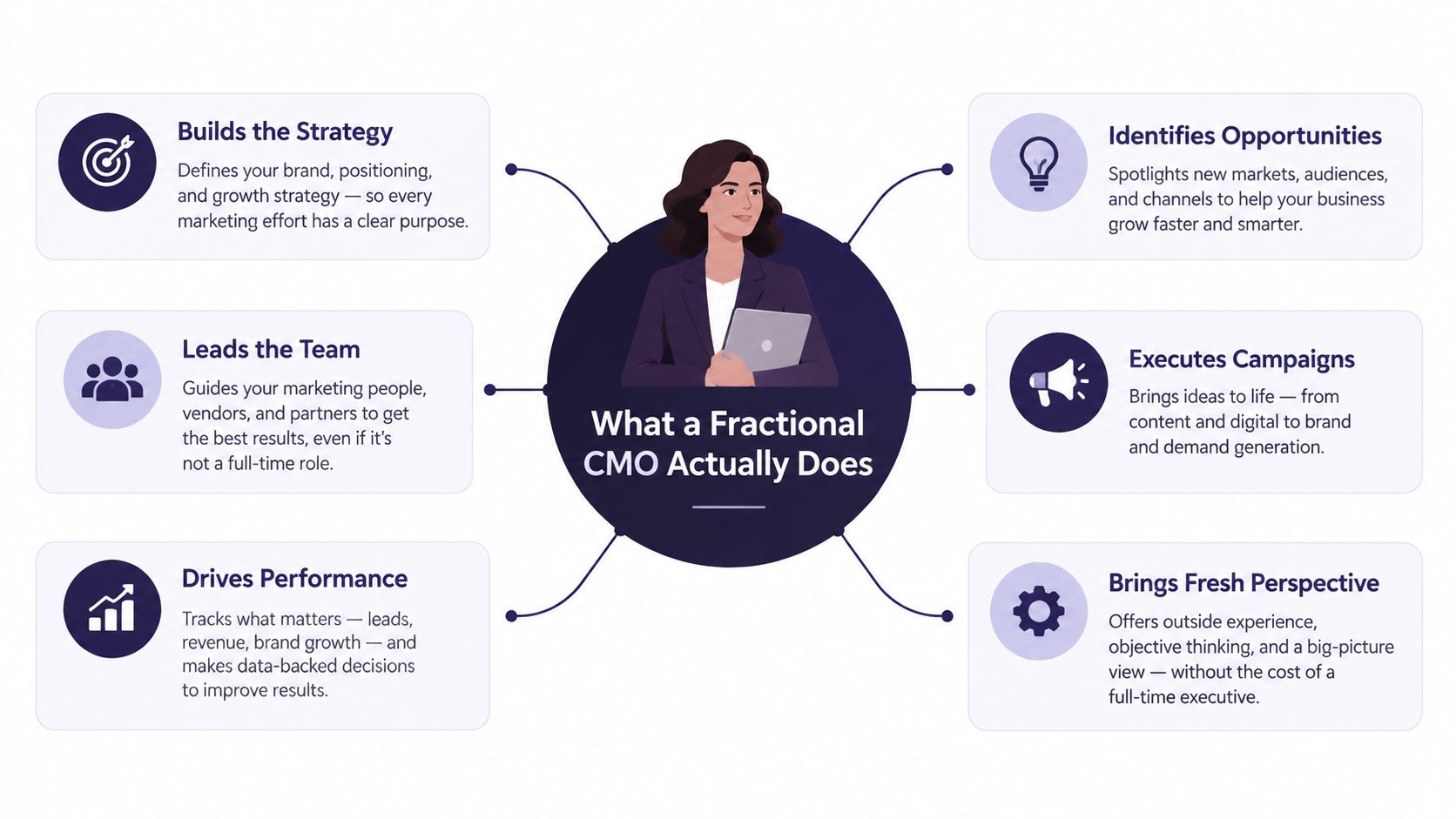
A fractional CMO is a senior marketing executive working inside your business on a part-time or flexible basis. Their job is to diagnose the growth problem, set priorities, direct the people doing the work, and connect marketing decisions to commercial outcomes. They bring senior judgment without requiring a permanent executive role.
The role sits between consulting, agency execution, and full-time marketing leadership. A consultant usually provides advice, research, or a defined project, then steps away. An agency executes agreed services such as paid media, SEO, creative, or content. A full-time CMO permanently owns the marketing function. A fractional CMO leads that function with enough authority to make decisions, while the commitment matches the company's current needs. This plain-language guide to what a fractional CMO is explains the distinction clearly.
The work that belongs in the engagement
A capable fractional CMO should create clarity across the marketing function:
- Strategic direction: Define the ideal customer profile, positioning, offer structure, growth priorities, and marketing goals.
- Channel allocation: Decide which channels deserve attention and which should pause, instead of letting each vendor defend its own budget.
- Execution oversight: Manage agencies, internal marketers, freelancers, and technology partners against one shared plan.
- Pipeline visibility: Establish reporting that connects campaigns and lead sources to qualified opportunities and revenue conversations.
- Team design: Identify missing capabilities, clarify responsibilities, and support hiring when the business needs internal ownership.
- Executive communication: Turn marketing performance into decisions that the founder, leadership team, or board can act on.
The schedule must match the work. Some SME-focused engagements operate around one or two days per week, as described in The Marketing Centre's fractional CMO guidance. Hours alone do not define a useful engagement. The executive needs enough access to the business, authority to make decisions, and time to follow through. A leader who only reviews reports cannot fix a marketing system.
What you aren't buying
A fractional CMO isn't a replacement for every marketer. They won't personally write every blog post, manage every campaign, design every ad, or answer every sales email. If execution is missing, the CMO can source or organize the right support, but the agreement must name who owns each task before work begins.
The strongest arrangement gives the fractional leader ownership of the marketing system while internal staff, agencies, or specialists handle production. That division keeps the executive focused on priorities, accountability, and decisions rather than routine delivery. For a sub-$2M business, this distinction also makes the first 30, 60, and 90 days easier to evaluate. Owners can judge whether the leader is creating focus, improving execution, and producing commercially useful visibility before mature attribution exists.
Fractional CMO vs Full-Time CMO
The choice isn't “cheap option versus serious option.” It's a question of capacity, complexity, and risk.
A fractional CMO works well when the company needs experienced leadership but doesn't yet have enough organizational complexity to fill a full-time executive role. A full-time CMO becomes more logical when the business has multiple product lines, a large internal marketing department, complex board expectations, or sustained cross-functional demands.
Typical fractional small-business retainers range from $5,000 to $20,000 per month, with many senior engagements clustering around $8,000 to $15,000 per month, according to Geisheker's fractional marketing executive benchmarks. Other guidance places small-business and startup engagements at $2,000 to $6,000 per month for about 5 to 20 hours, so scope and seniority matter considerably. Review fractional CMO cost considerations before comparing proposals.
| Dimension | Fractional CMO | Full-Time CMO |
|---|---|---|
| Cost structure | Flexible retainer or hourly arrangement | Salary, benefits, recruiting, and executive overhead |
| Speed to impact | Can begin with a focused diagnostic and priority plan | Requires a longer search, hiring process, and onboarding period |
| Accountability | Owns agreed marketing outcomes for a defined scope | Owns the entire permanent marketing organization |
| Best fit | Variable demand, channel complexity, repositioning, or missing leadership | Multiple product lines, large teams, and sustained executive workload |
| Risk | Lower long-term commitment, but capacity is limited | Deeper organizational ownership, but greater fixed cost and hiring risk |
| Operating model | Often part-time, commonly around one to two days weekly | Full-time executive presence |
Where the trade-off usually changes
Market commentary often places the full-time-versus-fractional decision around $3 million to $5 million in ARR or $5 million to $10 million in revenue, but those figures are directional rather than a rule. A company below that range may still need a full-time CMO if marketing complexity is unusually high. A larger company may remain better served by a fractional leader if its growth challenge is narrow and temporary.
Use the threshold as a prompt, not a verdict. Ask whether the executive would have enough meaningful work every week to justify a permanent seat. If the answer is no, fractional leadership is usually the more disciplined choice.
Hiring also carries more than compensation. SHRM's recruiting benchmarking report reports that executive cost-per-hire increased substantially in 2026, strengthening the case for avoiding a permanent search when the company hasn't yet validated the need.
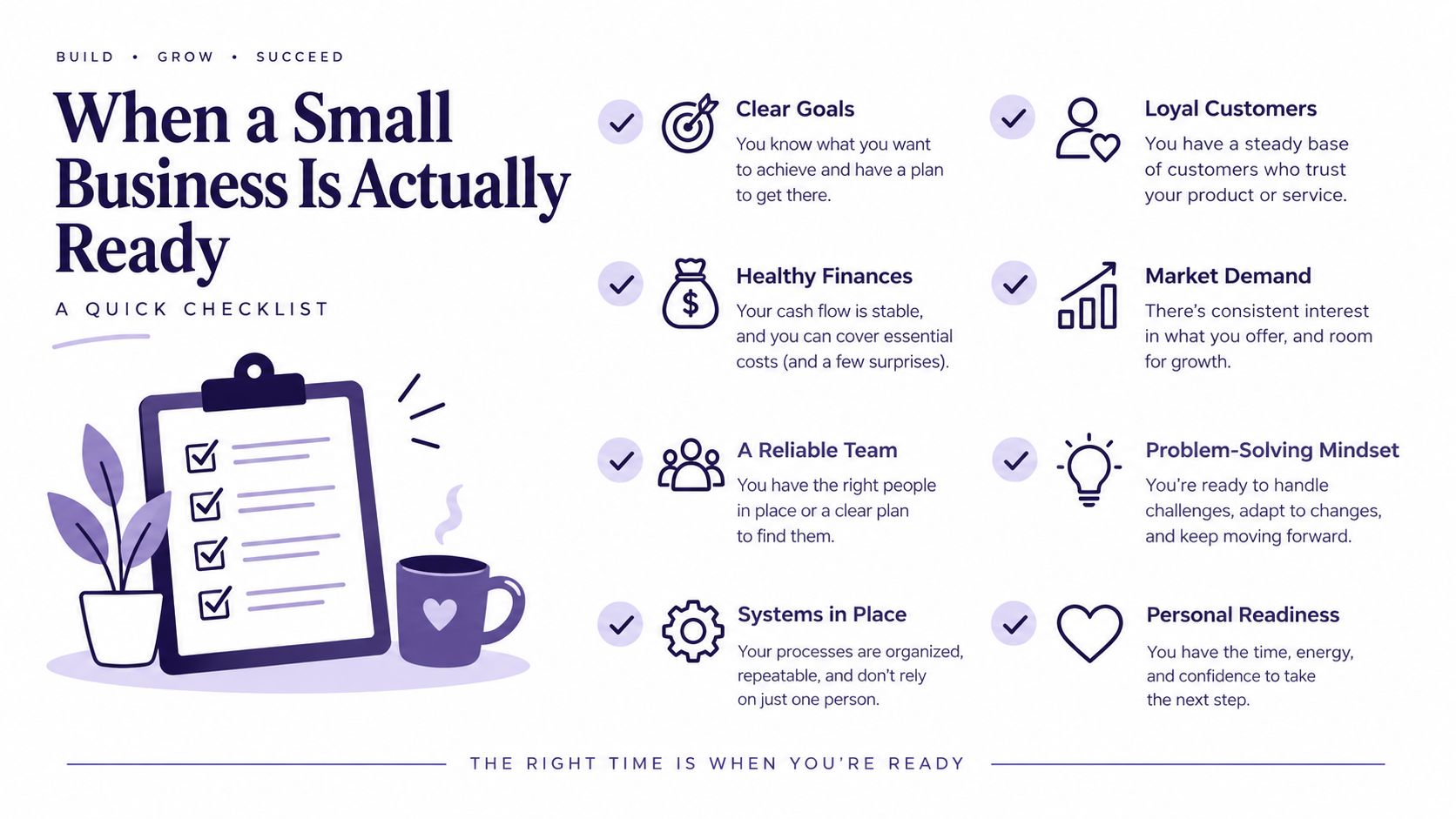
When a Small Business Is Actually Ready
Revenue alone is a poor readiness test. A smaller company with complex channels, meaningful marketing spend, and a capable execution team may need senior leadership sooner than a larger company with a simple referral model.
Start with operational triggers.
Four questions worth answering
1. Is marketing spend large enough to require governance?
If the business is committing roughly $5,000 to $10,000 per month to marketing, can the owner explain which activities create qualified demand, which only create attention, and what should change next month? The spend itself isn't proof of readiness. The inability to govern it is.
2. Are three or more channels competing for attention?
If search, paid social, email, content, partnerships, and outbound are all active, does one person decide how they fit together? More channels create more coordination work, not automatically more growth.
3. Is execution happening without strategic direction?
Does an internal employee or agency deliver tasks while nobody defines the audience, offer, message, funnel, or measurement standard? A fractional CMO can be useful when execution already exists but leadership is missing.
4. Is the founder spending more than 20% of the week on marketing decisions?
If the owner spends over 20% of the working week approving campaigns, resolving vendor questions, and choosing priorities, calculate the opportunity cost. The fractional executive should reduce that dependency, not become another person asking the founder to approve every detail.
When hiring one is premature
A pre-revenue startup usually doesn't need a CMO. Neither does a company below $500,000 that hasn't validated product-market fit. At that stage, the priority is customer discovery, offer testing, direct selling, and basic execution. Strategy without traction becomes theater.
Hire a growth marketer or specialist agency when the immediate need is hands-on campaign production. Consider a fractional CMO when the business has enough demand, spend, people, or channel complexity for leadership to create an impact.
Readiness test: Can your team execute a clear marketing plan once someone sets it? If not, you may need execution first, not executive strategy.
Your checklist should focus on operating signals:
- Demand exists: Customers are buying, but growth is inconsistent.
- Work is happening: People or vendors execute marketing, but priorities conflict.
- Decisions are expensive: The founder spends meaningful time managing the function.
- Measurement is possible: Even if attribution is incomplete, the company can track leads, opportunities, and sales conversations.
- Ownership is available: The fractional leader will have access to data, staff, vendors, and decision-makers.
Finding and Evaluating the Right Candidate
Don't source a fractional CMO through a referral lottery. Treat the search as a funnel with a defined scorecard.
Begin with three channels. Search LinkedIn for leaders who explicitly work in fractional or interim roles. Review niche marketplaces such as Shiny and Chief. Ask current advisors, investors, accountants, and operating partners for introductions to executives who've worked at a similar stage.
Then screen for evidence, not charisma.
The interview scorecard
Vertical experience comes first. Ask the candidate to walk through two small-business engagements, including the starting problem, decisions made, resources available, and measurable commercial result. If they can't discuss performance data because of confidentiality, they should still explain the measurement system and their personal contribution.
Operating style reveals more than credentials. Ask, “What happens during your discovery week?” A strong answer includes interviews, account review, funnel analysis, vendor assessment, and a written prioritization process. A weak answer starts with a list of tactics they want to deploy.
Technical range matters. The executive doesn't need to perform every task, but they should understand SEO, paid acquisition, lifecycle marketing, analytics, brand positioning, conversion optimization, and sales alignment well enough to challenge specialists.
Commercial fit prevents friction. Clarify the retainer, hourly assumptions, minimum commitment, meeting cadence, response expectations, and out-of-scope work. Use these CMO interview questions to structure the conversation.
Three engagement models
| Dimension | Retainer | Sprint | Equity-Plus-Cash |
|---|---|---|---|
| Structure | Ongoing monthly leadership | Defined project with a specific endpoint | Reduced cash fee paired with an equity component |
| Best use | Continuous strategy, oversight, and accountability | Audit, repositioning, launch, or channel reset | Cash-constrained companies with strong alignment |
| Main risk | Scope expands without clear boundaries | No ongoing owner after the project ends | Misaligned expectations about value and control |
| Buyer question | What decisions must this leader own each month? | What tangible deliverables define completion? | What does each party believe the equity represents? |
Red flags are straightforward. Walk away from candidates who refuse to share any past performance evidence, promise instant results without a diagnostic, blame every prior client, or insist on controlling execution without explaining how they'll measure it.
Measuring ROI in the First 90 Days
Early attribution will be imperfect. That doesn't excuse vague evaluation.
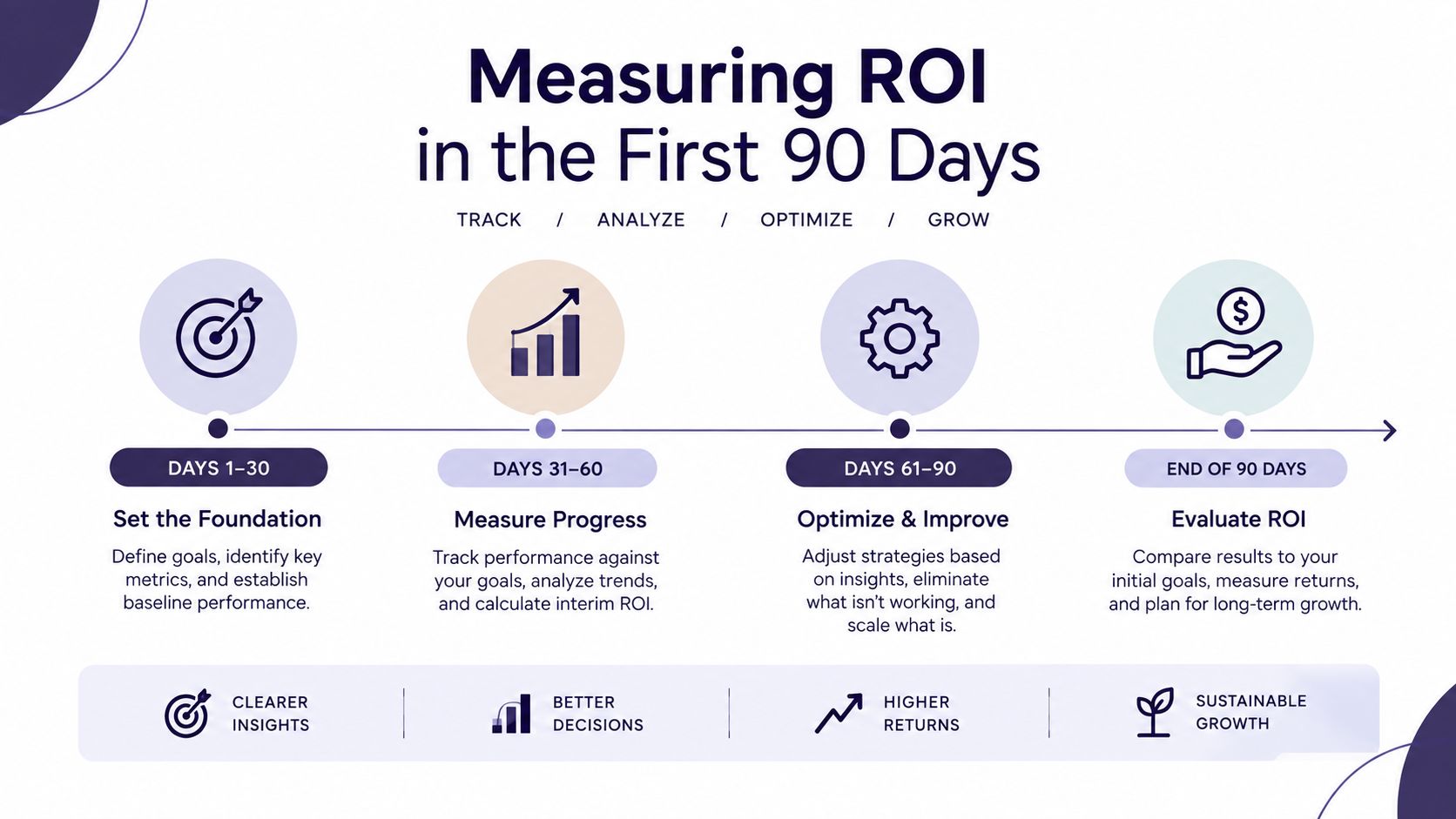
You can judge a fractional CMO in 90 days by separating diagnostic quality, execution lift, pipeline movement, and founder time savings. Don't demand revenue miracles before the system has been repaired. Do demand visible progress in the work that should create future commercial results.
Days 1 through 30 measure diagnosis
The first phase tests whether the executive understands the business and can make choices. Require three outputs:
- Written marketing audit: Current positioning, funnel, channels, vendors, analytics, and major constraints.
- Prioritized channel roadmap: What the company will invest in, test, pause, or remove, with reasons.
- Team and agency plan: Clear ownership, missing capabilities, reporting expectations, and immediate changes.
Score the work on usefulness. A long document isn't automatically a good one. The audit should help the owner decide where to spend time and money.
Days 31 through 60 measure execution lift
The second phase examines whether the leader can turn strategy into operating improvement. Track:
- Campaign cycle time: Are campaigns moving from idea to launch faster?
- Cost per lead: Is performance improving on the two most important paid channels?
- Landing-page conversion: Are primary pages converting more of the traffic they already receive?
- Reporting quality: Can the team explain what changed and why?
These indicators don't prove final ROI, but they expose whether the executive can coordinate people and remove bottlenecks.
Days 61 through 90 measure pipeline and time
The final phase connects the work to commercial progress. Monitor marketing-qualified-lead volume, sales-accepted-lead rate, and the founder's weekly hours spent making marketing decisions. Define each metric before work begins so the CMO can't redefine success after seeing the results.
Use a weighted scorecard:
- 30% diagnostics: Audit quality, roadmap clarity, and operating plan.
- 40% execution: Campaign speed, paid-channel efficiency, landing-page conversion, and reporting discipline.
- 30% pipeline and time savings: Qualified demand, sales acceptance, and reduced founder involvement.
A usable dashboard
| Phase | Metric | Owner question |
|---|---|---|
| Days 1 to 30 | Audit and roadmap delivered | Do we know what to stop, start, and prioritize? |
| Days 31 to 60 | Campaign cycle time | Is the team executing with less friction? |
| Days 31 to 60 | Cost per lead and landing-page conversion | Are the priority channels and pages improving? |
| Days 61 to 90 | MQL volume and sales acceptance | Is marketing creating demand sales can use? |
| Days 61 to 90 | Founder marketing hours | Is leadership dependency falling? |
Set a hard decision rule before renewal. If the top three agreed metrics haven't moved by day 60, escalate the issue, change the operating plan, or exit before the engagement renews. A fractional CMO doesn't control every market outcome, but they do control the quality of diagnosis, prioritization, accountability, and communication.
Real Scenarios and What Comes Next
Two founders can hire the same type of executive and get opposite results because readiness determines whether strategy can become execution.
A SaaS founder at $1.4 million ARR hired a fractional CMO after growth became fragmented across several channels. The executive narrowed the funnel around one ideal customer profile, shut down two underperforming channels, and built a six-month demand-generation plan. Qualified pipeline increased threefold, while MQL-to-customer conversion rose from 1.8% to 4.1% across two quarters.
That outcome wasn't caused by a magic campaign. The company had an existing product, a sales process, usable customer data, and enough execution capacity to act on strategic direction. The fractional CMO created focus and made the existing resources work together.
The second scenario involved a regional home-services owner at $680,000. The owner hired a fractional CMO before defining the ideal customer profile, adopting a CRM, or transferring creative decisions. After 90 days, movement remained negligible and the engagement was paused.
The executive wasn't necessarily the problem. The business lacked the operating substrate required to absorb the strategy. The owner still approved every creative asset, the team couldn't track the funnel reliably, and nobody had settled on the customer segment the marketing should prioritize.
| Dimension | SaaS Founder ($1.4M ARR) | Services Owner ($680K) |
|---|---|---|
| Core problem | Fragmented demand generation | Unvalidated audience and weak operating basics |
| Team readiness | Existing sales and execution capacity | Owner remained the approval bottleneck |
| Fractional CMO action | Focused the ICP, removed weak channels, built a demand plan | Attempted to create direction before fundamentals existed |
| Evaluation result | Qualified pipeline and conversion improved | Engagement paused after 90 days |
| Main lesson | Leadership amplified an operating system | Strategy couldn't compensate for missing foundations |
Both founders could have completed the same pre-hire diagnostic. Only one had enough traction, data, execution capacity, and decision access for fractional leadership to create a decisive advantage.
Fractional leadership demand is moving beyond startup experimentation. One 2024 commentary reported that 9% of respondents were already working with a fractional CMO or planned to do so within the next 12 months, compared with 5% the prior year, as described in SaaS Hero's small-business fractional CMO analysis. The model is also part of a wider fractional executive market, with a 2025 dissertation describing fractional C-suite leadership as a rising trend across small and medium enterprises, startups, and nonprofits, documented in the University of Denver digital repository.
For owners who pass the readiness test, a marketplace can be a practical way to review candidates without relying only on personal networks. Shiny connects businesses with fractional executives working 5 to 25 hours per week and supports workflows for posting a need, reviewing candidates, interviewing, and onboarding.
Shiny helps small businesses find part-time marketing leadership for strategy, demand generation, positioning, and team oversight without committing immediately to a full-time CMO. Visit Shiny to review fractional executive options and schedule a consultation around your marketing readiness.