
Marketing Strategy for Growth: A Practical Playbook
Your growth plan is probably sitting in a document nobody opens. The founder wants more pipeline, the sales team wants better-qualified conversations, and marketing is busy comparing ad platforms, content formats, and attribution tools without agreeing on what success means. Meanwhile, the next campaign keeps getting delayed because no one owns the decision.
A useful marketing strategy for growth isn't a list of channels. It's an operating system that connects commercial goals, customer understanding, positioning, experiments, activation, retention, budget, and measurement. The fastest way to build that system isn't always hiring a full-time CMO. In many startups and small businesses, a fractional executive can turn an unshipped strategy into a working growth cadence while the company preserves the flexibility to make a permanent hire later.
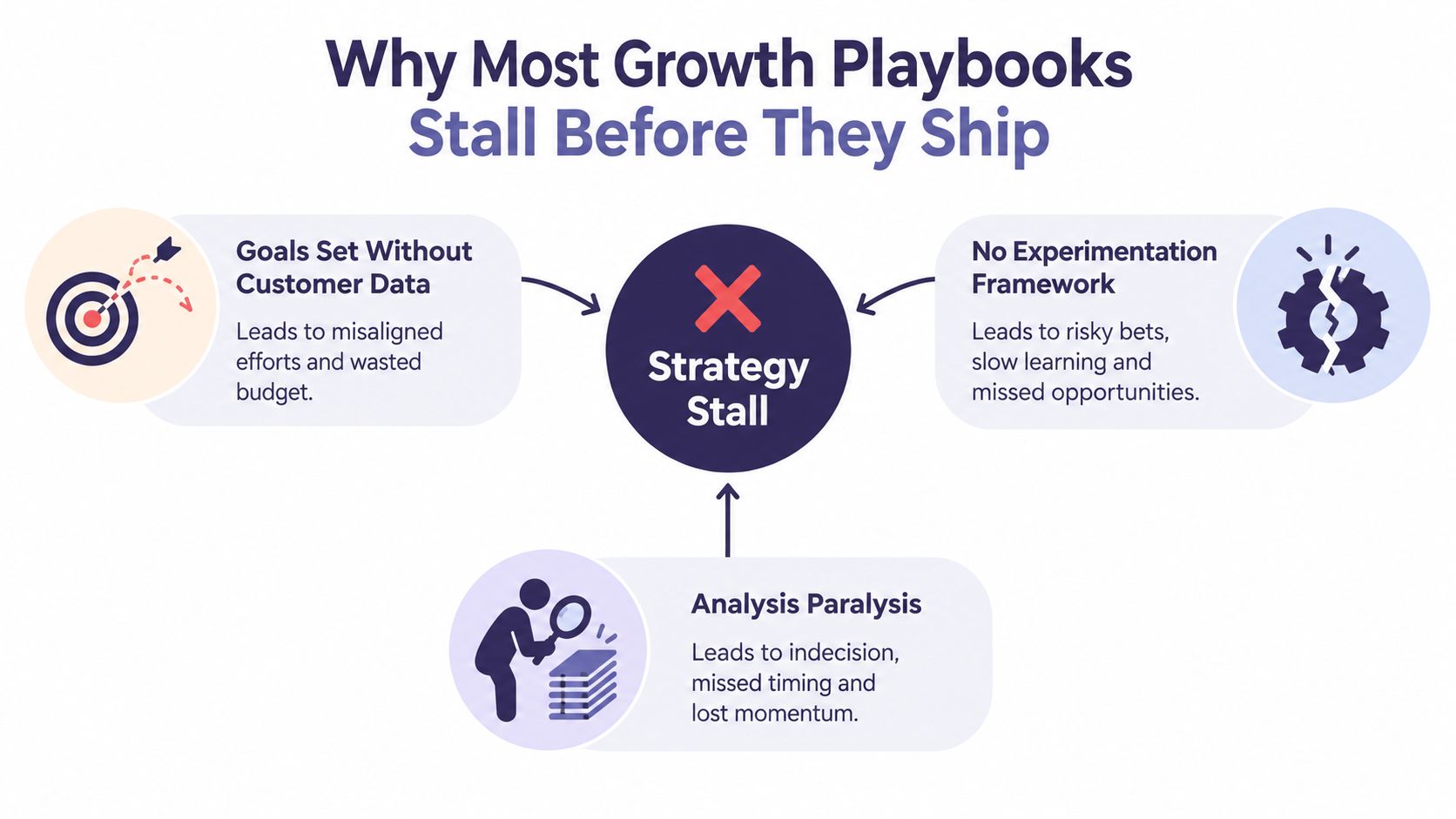
Why Most Growth Playbooks Stall Before They Ship
A Series A founder spends three months commissioning a polished, 40-page growth strategy. The deck includes customer personas, competitor maps, channel recommendations, funnel diagrams, and a forecast. On launch day, nobody can answer a basic question: what should the team test this week, who owns it, and which result would justify more investment?
That failure pattern repeats because teams treat strategy as a document instead of a connected system. They set revenue goals without a baseline metric, describe an ideal customer as a persona wishlist, choose channels before checking unit economics, assign no clear owner to measurement, and review performance only after the team has already made its next set of decisions.
A documented go-to-market strategy is associated with a 3.4x higher chance of a successful launch, while alignment between product, marketing, and sales is associated with 36% faster growth, according to go-to-market strategy benchmarks. The same benchmark source connects 68% of GTM failures to positioning and messaging gaps and reports that 77% of B2B product launches miss first-year revenue targets. Those figures point to an execution problem, not a shortage of ideas.
Turn the plan into a connected chain
Build the first version in this order:
- Goal: Define the business outcome, not just marketing activity.
- Audience: Specify who has the problem, urgency, authority, and budget.
- Message: State why this customer should choose your solution now.
- Channel: Select the places where that customer already investigates options.
- Loop: Design how one customer, visit, or usage event creates another opportunity.
- Budget: Fund the next learning cycle, not an untested annual forecast.
- KPI: Choose a small set of measures that expose progress and waste.
- Reporting: Put the decision meeting before the next experiment, not after it.
Your first ship matters more than your first perfect plan. A focused 30-day loop with one clear hypothesis, one accountable owner, and a defined readout will teach the business more than another round of slides. If the team can't launch a test quickly, the strategy is still too abstract.
Set the Goals, ICP, and Positioning Before You Pick a Channel
Founders often run separate workshops for goals, customer segments, and positioning. That creates three disconnected outputs. Make them one decision: which customer will produce the most valuable growth, why will they buy, and what evidence will prove the strategy is working?
Start with a North Star metric tied to customer value. Then choose two or three supporting KPIs that explain movement in that metric. Give each measure a long-range target and a near-term target. The longer view keeps the team commercially honest. The shorter view tells people what they need to change now.
Define the ICP with more discipline than industry, company size, and job title. For a B2B SaaS product, a useful ICP might be operations leaders at companies with 50 to 500 employees who are actively replacing spreadsheet-based reporting. Enterprise RevOps teams may look attractive, but if they require extensive integrations, procurement support, and customization, they belong on the excluded list until the business can serve them profitably.
Use positioning to sharpen the buying problem
Segmentation describes who the customer is. Positioning explains why the product matters to that customer in a specific situation.
“We help RevOps teams automate reporting” identifies a category and a broad audience. “We replace the Monday morning spreadsheet ritual for operations leaders” identifies a recurring pain, a recognizable moment, and a more concrete outcome. That distinction changes the landing page, the sales conversation, the content topics, and the channels worth testing.
Use this template before approving channel spend:
| Dimension | Definition | Example | Watch For |
|---|---|---|---|
| Firmographics | Company traits that narrow the market | 50 to 500 employees | Treating size as proof of fit |
| Pain intensity | The costly or frustrating problem | Manual weekly reporting | Describing mild inconvenience as urgency |
| Buying trigger | The event that creates action | A new operations leader inherits broken reporting | Targeting people with no immediate reason to change |
| Excluded segment | Customers you won't prioritize yet | Large enterprise RevOps teams | Allowing attractive outliers to derail focus |
| Positioning | The specific value promise | Replace the recurring spreadsheet ritual | Using category language competitors already own |
Before finalizing the statement, pressure-test it against unit economics fundamentals. A channel can generate leads and still be wrong if the sales effort, onboarding cost, or retention profile makes those customers unprofitable.
Choose Channels and Experiments That Fit the Business Model
Channel selection should follow buying behavior and economic tolerance, not competitor budgets or founder preference. Paid search can capture existing intent, organic content can compound around recurring questions, lifecycle marketing can increase activation and retention, and partnerships can transfer trust from a complementary company. None of those channels is automatically right.
Use the business model as the filter:
| Business Profile | Best-Fit Channels | Risky Default | Fit Reason |
|---|---|---|---|
| Deal size below $1,000, sales cycle under 14 days | Lifecycle, product-led onboarding, referral loops | Broad paid demand generation | Fast decisions favor low-friction conversion and owned follow-up |
| Deal size above $25,000, sales cycle of 60 to 180 days | LinkedIn account-based marketing, partnerships, sales enablement | Broad paid search | High-consideration purchases need trust, relevance, and coordinated outreach |
| Search-led problem with clear buyer intent | SEO, paid search, comparison content | Unfocused social expansion | Existing demand can be captured more directly |
| Narrow industry with trusted intermediaries | Partnerships, events, account-based content | General awareness campaigns | Distribution through credible relationships can outperform reach without fit |
These decision rules aren't substitutes for testing. They're a way to avoid spending a quarter proving what the economics already suggest. Use demand generation planning to connect acquisition activity with the rest of the funnel instead of treating lead volume as the finish line.
Run a small, explicit test pipeline
A practical cadence is one new channel test every two weeks. Each test needs five fields:
- Hypothesis: “If we publish comparison content for operations leaders, qualified demo requests will increase.”
- Audience: The exact ICP slice receiving the message.
- Success threshold: The result required to continue.
- Kill criteria: The evidence that ends the test.
- Retro date: A written decision within five days of the result.
A four-week plan could pair one paid search test with an SEO cluster, a lifecycle trigger for trial users, and a partner co-marketing conversation. Keep the motions connected. Paid traffic should reveal objections that improve content. Content should feed email capture. Lifecycle messages should surface activation friction that product and sales can address.
Growth experiments have high variance. One benchmark says successful growth teams see significant positive results from one in five experiments, while a separate dataset of 1,392 tests reported a 43% success rate, as summarized by growth experimentation research. The lesson isn't to chase a particular win rate. It's to run enough well-designed tests that one exciting result doesn't control the entire budget.
Build the Growth Loops and Activation Funnel
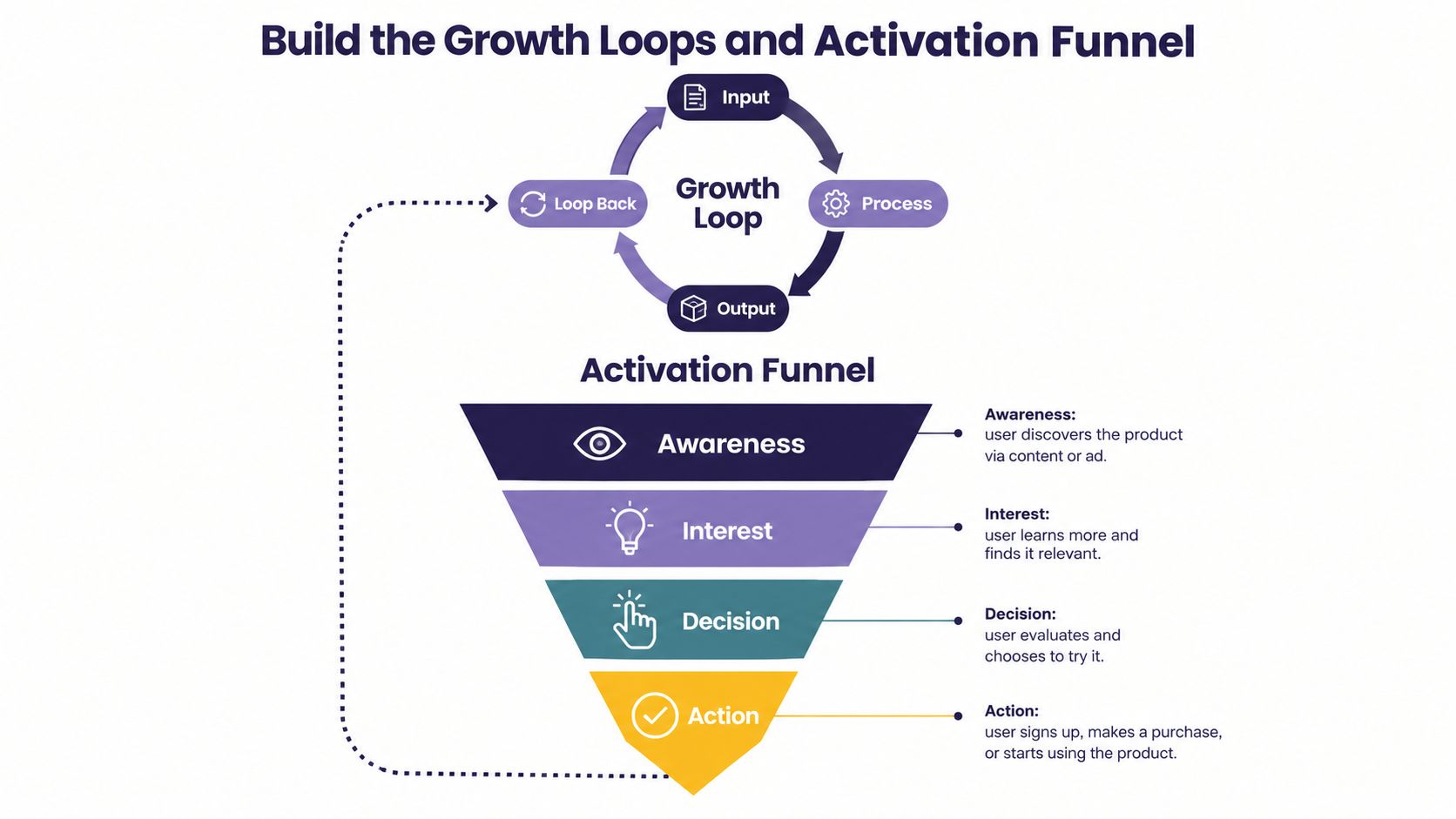
A funnel describes movement from discovery to action. A loop explains how the output of one customer interaction creates the next input. You need both. A paid campaign can fill the top of a funnel, but only a strong activation experience and a repeatable loop can turn that traffic into durable growth.
Start with an acquisition loop that uses the product and content together:
- Content piece: Publish a useful guide that solves a problem your ICP already recognizes.
- SEO entry: A prospect finds the guide through a relevant search.
- In-product invite: The user reaches a valuable workflow and invites a colleague.
- New sign-up: The colleague joins through a product-generated invitation.
- Loop back: The new user creates another usage or sharing opportunity.
Assign one owner and one metric to every step. If the SEO entry produces visits but no qualified sign-ups, fix intent or the landing page. If users sign up but don't invite colleagues, investigate the product moment rather than buying more traffic.
Map the first moment of value
An activation funnel should make the user's progress visible:
- Sign-up: The user creates an account.
- First action: They complete the behavior that exposes the product's value.
- Habit trigger: A reminder, workflow, or team event gives them a reason to return.
- Habit action: They repeat the behavior in a useful context.
- Habit reward: They experience a measurable improvement, saved effort, or shared outcome.
Don't scale paid acquisition into an activation gap. More visitors only make the leak larger. Review session replays, ask new users what they expected to happen, and inspect Day-1 retention data. Then document the intervention beside the metric and owner, so every friction point becomes an accountable experiment rather than an anecdote in a meeting.
Practical rule: If you can't name the first valuable action, you aren't ready to optimize acquisition.
Budget, Martech, and Measurement Come Before More Spend
The next marketing dollar often belongs in measurement and martech, not another campaign. Clean attribution, lifecycle automation, and reliable data plumbing improve decisions across every channel. Extra ad spend improves only the channel receiving that spend, and it can hide a weak funnel behind a larger volume of activity.
Deloitte's 2025 marketing investment findings report that organizations investing more in martech than working media see an 18% greater sales lift and 7% greater revenue growth overall. The same source says 61% of marketing budgets are still set from enterprise revenue or prior spend. That gap explains why many teams ask for more budget when the actual problem is weak measurement and poor allocation.
A startup with a quarterly marketing budget of $50,000 can test the principle without rebuilding the whole department:
| Workstream | Current Spend | Proposed Spend | Owner |
|---|---|---|---|
| Paid acquisition | $30,000 | $21,000 | Demand generation lead |
| CDP and attribution rebuild | $5,000 | $12,000 | Marketing operations |
| Lifecycle automation | $5,000 | $8,000 | Lifecycle marketer |
| Experimentation reserve | $5,000 | $6,000 | Fractional growth executive |
| Content and partnerships | $5,000 | $3,000 | Content or partnerships owner |
The exact allocation should follow your baseline, but the operating logic is sound. Your minimum measurement model should map each channel to acquisition cost, payback, activation, retention, and revenue contribution. Put those measures in the weekly review, alongside experiment status, pipeline quality, funnel friction, and the next budget decision.
Prioritize the stack in this order:
- CRM: One source of truth for accounts, opportunities, ownership, and stage movement.
- Analytics: Event and funnel tracking that reflects the customer's actual journey.
- Attribution: A useful directional model rather than a promise of perfect certainty.
- Experimentation: A backlog, test owner, threshold, and decision log.
- Lifecycle: Segmentation and automated actions based on behavior and customer stage.
Use marketing automation practices to remove repetitive follow-up only after the underlying customer journey and data definitions are clear.
Run the Playbook With a Fractional Marketing Executive
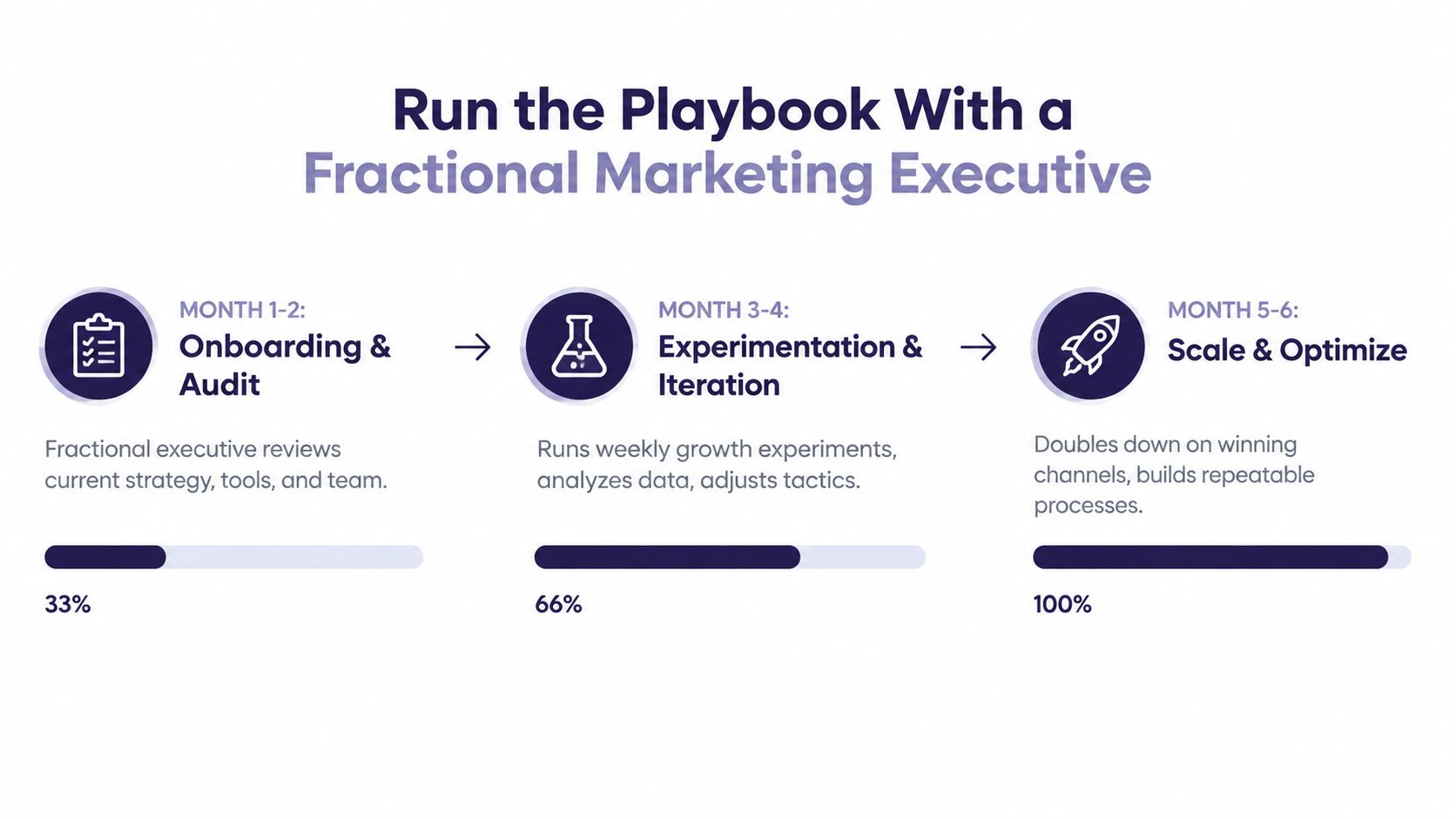
A full-time CMO can be the right hire, but not every growth-stage company needs one immediately. The business still needs senior ownership of positioning, budget, measurement, and cross-functional decisions. A fractional CMO, growth lead, or marketing operations executive can own that work for 5 to 25 hours per week, with the scope adjusted to the company's complexity.
Choose the role based on the bottleneck:
- Fractional CMO: Owns market focus, positioning, channel mix, budget, and executive reporting.
- Fractional growth lead: Owns the experiment backlog, funnel improvements, activation, and growth loops.
- Fractional marketing operations executive: Owns CRM structure, attribution, lifecycle tooling, dashboards, and process.
A fractional arrangement gives a small business senior expertise without committing to a permanent executive package that can include salary, employer contributions, bonuses, and long notice periods, as described in this guide to fractional leaders for small businesses. It also lets the company increase support during a launch and reduce it when the operating system is stable. Fractional leadership is especially relevant for businesses in the $1M to $50M revenue range, where growth complexity can outpace the case for a full-time executive, according to this guide to fractional leadership.
Buy a defined operating sprint
A strong onboarding sequence has four parts:
- Diagnostic interview: Review revenue goals, customer evidence, pipeline quality, team capacity, and current reporting.
- 30-day plan: Choose the ICP, positioning decision, baseline KPIs, and first experiment.
- Stack audit: Check CRM hygiene, tracking, attribution, lifecycle triggers, and dashboard ownership.
- Experiment sprint: Launch the first tests, read the evidence, and reallocate effort.
A 90-day engagement might produce an ICP refresh in the first weeks, a positioning workshop soon after, a channel-mix recommendation, two growth loops in market, and a leadership KPI review at the end of the cycle. The executive shouldn't become another source of strategy documents. They should create decisions, assign owners, clear blockers, and leave behind a repeatable cadence.
Fractional retainers are commonly packaged as defined part-time engagements, with top-tier retainers listed at $5,000 to $10,000 per client per month in this fractional work market report. Treat that as a scope and packaging reference, not a universal price.
Your First 30 Days and How to Get Help This Week
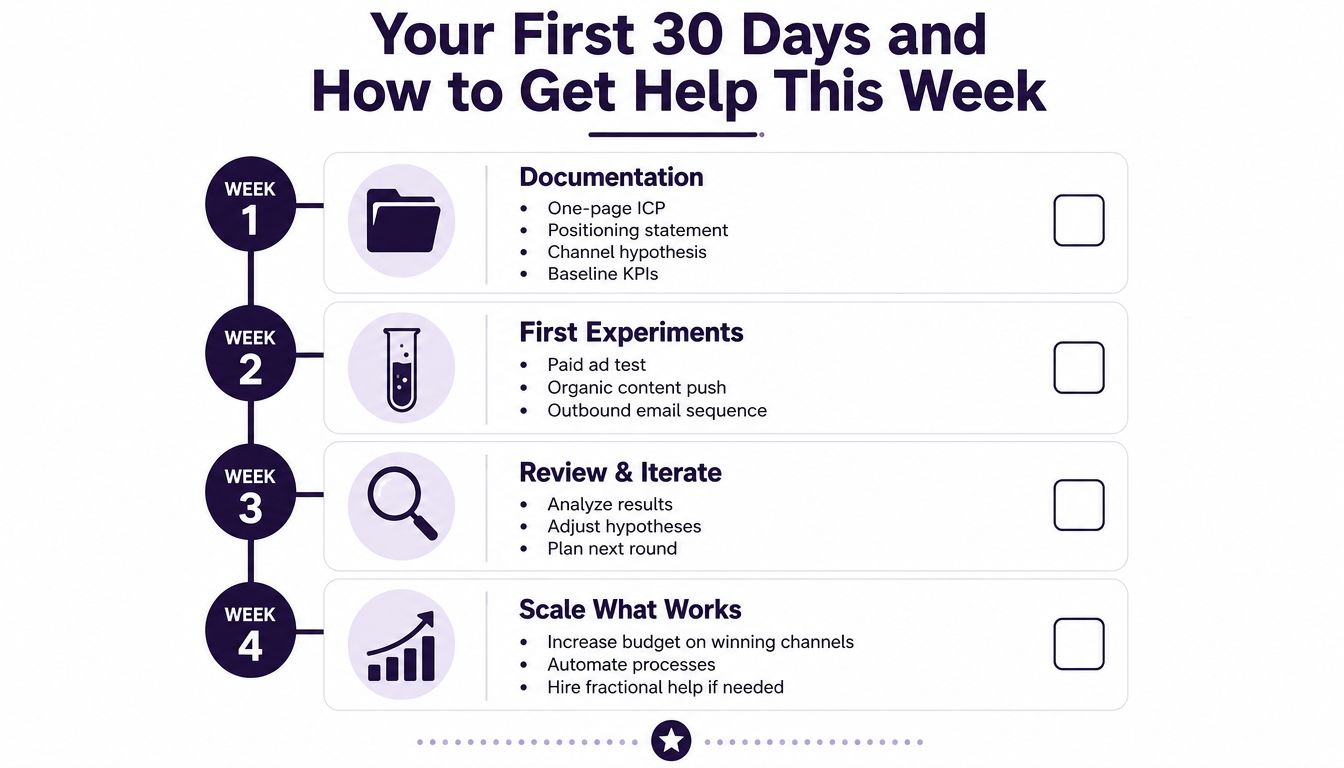
Don't wait for a complete annual strategy. Use the next 30 days to create a working baseline, launch controlled tests, and make one informed reallocation decision.
Week one is documentation. Produce a one-page ICP, a positioning statement, a channel hypothesis, and baseline KPIs. Interview customers, salespeople, and the person responsible for onboarding. A founder or marketing lead can absorb this work by protecting focused working sessions instead of trying to complete it between meetings.
Week two is experimentation. Launch a paid test, publish an organic content cluster, and add one lifecycle trigger tied to a meaningful user action. Give each motion a clear owner and a stop condition. Don't add another channel until the team can explain what the current tests are teaching.
Week three is measurement and instrumentation. Check event tracking, inspect the first results, and document the acquisition and activation loops. Look for friction in session replays, onboarding responses, and retention behavior. A fractional growth lead can compress this work by owning the diagnostic, test design, and first readout while the internal team contributes customer context.
Week four is review and reallocation. Decide what to stop, what to improve, and what deserves more attention. Move resources toward evidence, not enthusiasm. Keep the next experiment small enough to launch quickly and meaningful enough to influence a business decision.
This week's assignment: Book one working session, bring your current funnel and last reporting view, and write down the single customer segment you believe can produce the most profitable next stage of growth.
If you need senior help without committing to a full-time C-suite hire, Shiny connects growth-stage companies with vetted fractional executives who can own marketing strategy, execution, and measurement on a part-time basis. Visit Shiny to explore the marketplace and start a low-pressure conversation about your growth stage, ICP, and current funnel.