How to Hire a CFO and Find the Right Financial Leader
Knowing when to hire a CFO isn’t about hitting a magic revenue number. It’s about recognizing the moment your business outgrows your own financial expertise. It's the strategic inflection point where true financial leadership becomes non-negotiable for growth—and even survival.
When to Hire a CFO for Your Growing Business
Many founders pride themselves on wearing every hat. Managing the books is practical at the start, but you'll hit a point where that hands-on approach creates more risk than it saves.
Trying to manage complex finances without an expert is like a brilliant architect designing a skyscraper without consulting a structural engineer. The design might look incredible, but without specialized knowledge of load-bearing capacities and material stress, the entire structure is vulnerable. A Chief Financial Officer provides that essential integrity for your business, ensuring it can handle the pressures of scaling and market shifts.
Their role is far more than bookkeeping; it’s about building a resilient financial framework for whatever comes next.
The Shift from Bookkeeping to Strategic Forecasting
The clearest sign you need a CFO is when your focus must shift from historical reporting to forward-looking strategy. A bookkeeper tells you where your money went. A CFO tells you where your money should go to make your long-term vision a reality.
This shift is often triggered by high-stakes events that demand sophisticated financial modeling and sharp strategic guidance.
Consider these pivotal moments:
- You've Just Secured a Seed or Series A Round: Once you take on investment, you're not just managing your own money. Investors expect rigorous financial reporting, accurate forecasts, and a clear path to profitability. A CFO builds the models and tells the financial story that builds investor confidence.
- You're Planning International Expansion: New markets mean navigating a maze of tax laws, currency fluctuations, and compliance headaches. One misstep can be incredibly expensive. A strategic CFO charts a course through that complexity, ensuring your expansion is both profitable and compliant.
- You're Facing Complex Compliance Needs: As you scale, you might encounter industry-specific regulations or need to prepare for audits like SOC 2. A CFO implements the internal controls and financial systems to meet these standards without derailing operations.
The real value of a CFO isn't just in managing the balance sheet. It's their ability to translate financial data into a strategic roadmap. They connect the numbers to your operational decisions, ensuring every dollar spent is an investment in sustainable growth.
If you spend more than 20% of your time on financial tasks instead of focusing on product, sales, and your team, you've likely waited too long. This is often the point where founders start exploring fractional leadership—gaining access to top-tier strategic advice without the immediate cost of a full-time executive salary.
To dig deeper into this crucial decision, check out our guide on when to hire a CFO. Taking this step proactively ensures your financial foundation is strong enough to support your ambitions.
2. Choosing Your Model: Fractional vs. Full-Time CFO
You've decided you need a CFO. The next question is just as critical: do you hire a full-time executive or adopt a more flexible, fractional model? This isn't just about salary; it's a strategic decision that impacts your company’s agility, cash flow, and access to top-tier expertise.
The traditional path—hiring a full-time CFO—comes with a serious financial commitment. Beyond the base salary, you have to factor in bonuses, equity, benefits, and recruiting fees. That heavy financial load can be a major drag on a growing company’s runway.
The True Cost of a Full-Time Hire
For most startups and growth-stage companies, a full-time CFO is a massive financial strain, often landing between $300,000 and $450,000 annually. A seed-stage SaaS startup might see an entry-level CFO command a base of $200,000-$250,000, but with total compensation, that number can quickly balloon past $400,000. That kind of cash burn eats into a precious 12-18 month runway.
This is where fractional leadership changes the game.
It unlocks access to the same caliber of talent—executives with decades of experience at Fortune 500s or unicorn startups—without the crushing overhead. A fractional CFO works with you on a part-time basis, laser-focused on high-impact strategic initiatives.
You get the strategic mind you need, precisely when you need it, for a fraction of the cost. It’s the perfect solution for businesses that need sophisticated financial guidance but aren't ready for a full-time executive payroll. You can learn more about what a fractional CFO does in our detailed guide.
Full-Time CFO vs. Fractional CFO: A Head-to-Head Comparison
To make the right call, weigh the pros and cons based on your company's immediate needs and long-term goals. The table below breaks down the key differences to help you decide which model is the best fit.
| Factor | Full-Time CFO | Fractional CFO |
|---|---|---|
| Cost & Runway | $300k – $450k+ annually, a major drain on runway. | $60k – $120k annually, preserving cash for growth. |
| Commitment | Long-term hire, often with significant equity and severance packages. | Flexible, contract-based engagement. Scale up or down as needed. |
| Expertise | Deep knowledge of your company, but potentially limited industry exposure. | Broad experience across multiple industries and growth stages. |
| Strategic Focus | Manages day-to-day finance and long-term strategy. | Focuses on high-impact projects like fundraising, M&A, and system implementation. |
| Best For | Scaling companies ($15M+ ARR) needing dedicated, daily leadership. | Early-stage startups needing targeted expertise for specific milestones. |
While a full-time CFO is essential for a mature organization, the fractional model offers unparalleled flexibility and cost-efficiency for businesses on the rise. It allows you to access world-class strategic talent without the financial burden, making it the smarter choice for most early-stage companies.
Aligning the Model with Your Business Needs
The right choice comes down to your company's current stage and immediate goals. There's no one-size-fits-all answer, but a couple of real-world scenarios can make the path forward clearer.
Scenario A: The Seed-Stage Fundraiser. A tech startup closes a $2 million seed round. Their top priority is prepping for a Series A in 18 months. They need a killer financial narrative and rock-solid forecasting models. A full-time CFO is overkill. A fractional CFO with deep fundraising experience is the perfect strategic hire to guide them through this specific challenge.
Scenario B: The Scaling E-commerce Business. An e-commerce brand hits $15 million in annual recurring revenue. Operations are getting complicated—supply chain hurdles, international sales, and a growing team. They need a dedicated leader for daily financial management. In this case, a full-time CFO is the right move to provide constant oversight.
The decision to hire a CFO isn’t about filling a seat; it’s about acquiring the right skills for your current growth stage. Fractional leadership lets you match world-class expertise to your most critical business challenges, right when you need it most.
The infographic below highlights key milestones where high-level financial leadership becomes non-negotiable.
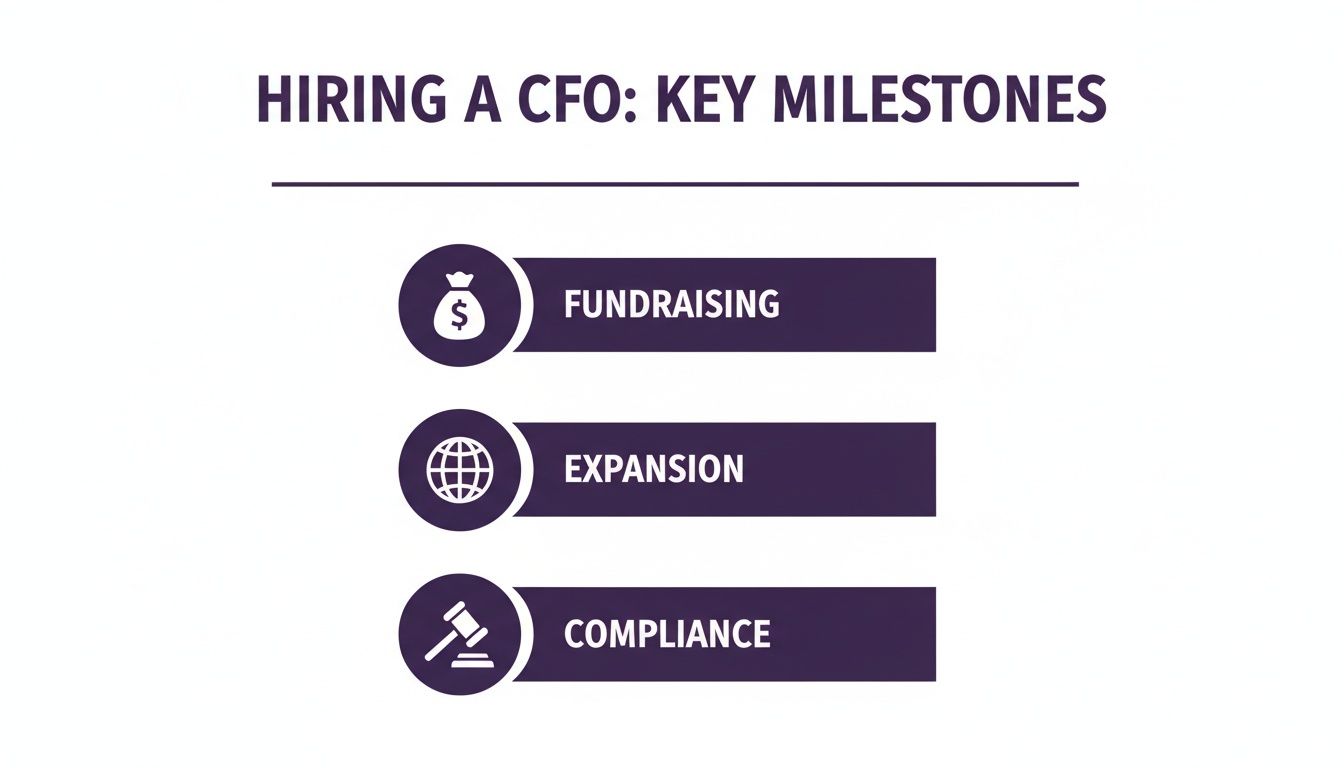
As you can see, critical moments like fundraising and global expansion are perfect opportunities for a fractional CFO to deliver targeted, high-impact value.
Ultimately, choosing between fractional and full-time is a strategic decision rooted in financial pragmatism. For most growing businesses, the fractional model offers a powerful advantage by preserving cash while delivering an immediate strategic punch.
By opting for a fractional hire, seed-stage companies can save $180,000 to $280,000 per year. That's an extra 6-12 months of precious runway. This isn't just about saving money; it's about being smart with your capital, allowing you to reinvest in core growth drivers like product development and customer acquisition.
Crafting a Job Brief That Attracts Top Talent
A generic job description is a magnet for generic candidates. When you hire a CFO, your goal isn’t just to fill a seat; it’s to find a strategic partner who can accelerate your growth. A compelling job brief frames the role as a critical leadership position, not just a back-office numbers job. Think of it as your first and best filter for excellence.

The best financial leaders are drawn to impact and challenge, not a long laundry list of mundane responsibilities. Your brief needs to immediately signal that you’re looking for a builder and a strategist. This starts by ditching vague language and getting specific with outcome-driven goals.
From Vague Responsibilities to Clear Outcomes
Top-tier CFOs—especially fractional ones—get excited by tangible achievements. They want to know what success looks like in the first 90 days and beyond.
Let's look at the difference:
- Weak: "Manage budgets."
- Strong: "Develop and implement a dynamic forecasting model to improve capital allocation and extend our cash runway by at least six months."
The first is a task; the second is a mission. The strong version attracts someone who thinks strategically about capital efficiency, not just someone who can track expenses.
A powerful job brief doesn’t just list what the CFO will do; it paints a clear picture of what they will achieve. This shift in focus is what separates a job description that gets scrolled past from one that captures the attention of a true financial leader.
To make your brief pop, define clear, measurable outcomes for the first quarter. For a deeper dive into what to include, you might be interested in our guide on creating an effective CFO job description.
Tailoring the Brief for a Fractional CFO
When searching for a fractional leader, the job brief needs a slightly different angle. Elite fractional executives are not looking for a "part-time job"—they're looking for a high-impact engagement. They evaluate opportunities based on the strategic challenge and potential for measurable results.
Structure your brief around projects and deliverables:
- Focus on Project-Based Deliverables: Instead of "oversee financial operations," get specific. Try, "Lead our Series A fundraising process from data room preparation to term sheet negotiation."
- Highlight Strategic Impact: Articulate the core business problem you need them to solve. For example, "Our current financial reporting takes 15 days to close. We need an expert to streamline the monthly close process to five days."
- Define Success Metrics Clearly: Be explicit about what a win looks like. This could be building the next three-year financial model, cutting customer acquisition costs by 15%, or rolling out a new FP&A system within six months.
This project-based approach speaks directly to the mindset of a seasoned fractional executive. It shows them you value their expertise and are ready to empower them to make a real difference.
Finding and Vetting Your Next Financial Leader
You’ve mapped out the mission. Now for the hard part: finding the right executive to lead it. When you decide to hire a cfo, the process can feel overwhelming. Many founders default to traditional methods, but today's talent market calls for a smarter approach.
Traditional sourcing—tapping your personal network or using expensive executive recruiters—has its limits. Your network is only so big, and recruiters can be slow and costly, especially when you need specialized expertise immediately. This is where modern solutions like fractional executive marketplaces change the game.
These platforms provide a direct line to a deep pool of pre-vetted financial leaders, solving the classic founder dilemma of too little time and not enough connections. Instead of drowning in résumés, you get a curated shortlist of professionals with the right industry chops and strategic mindset.
Why Modern Sourcing Is No Longer Optional
The market for top financial talent is incredibly tight. Today's CFOs are grappling with major retention headaches—18% name it as a top concern. The problem is compounded by the fact that 45% of finance departments are short on skilled talent and 50% struggle to keep their teams engaged.
This talent crunch has stretched the average time-to-hire by 20%. For a growing company, building an entire finance team is often out of the question, which is why fractional executives have become essential. You can get more of the inside scoop on how CFOs are navigating today's talent and economic hurdles here.
A curated marketplace cuts through the noise. It fast-tracks the entire hiring process, from matching you with industry-specific experts to simplifying interviews and contracting. This means you can connect with a strategic partner in days, not months.
Vet for Strategic Impact, Not Just Technical Chops
Finding someone who looks good on paper is just the first filter. The real test is vetting for strategic thinking, problem-solving ability, and cultural fit. You need a leader who can read the numbers, tell the story behind them, and use that story to steer the business.
To get there, move beyond the standard interview script. Your goal is to understand how a candidate thinks under pressure.
Here are a few questions that cut to the heart of strategic depth:
- Past Strategic Wins: "Walk me through a time you spotted a financial opportunity or risk that nobody else saw. What was the situation, what did you do, and what was the measurable business impact?"
- Problem-Solving Approach: "Tell me about the most complex financial model you've ever built. What problem did it solve, and how did it directly influence a major business decision?"
- Communication Style: "Imagine our board is questioning our cash runway forecast. How would you prepare and present your analysis to get them back on board?"
- Leadership and Team Building: "Describe a time you had to build or rebuild a finance function. What were your first three priorities, and how did you get the team aligned?"
These questions force candidates to provide concrete, metric-driven examples of what they've actually accomplished.
Spotting Red Flags and Making Reference Checks Count
As you vet candidates, keep your radar up for potential red flags. The biggest one? A lack of specific, quantifiable achievements. If a candidate talks vaguely about "improving efficiency" without giving you hard numbers, it's a sign they weren't the one driving those results.
A top-tier CFO speaks in metrics. They don't just say they helped raise a funding round. They say they built the model that secured a $15 million Series A by demonstrating a 35% reduction in Customer Acquisition Cost. Specificity is the hallmark of a results-oriented leader.
Finally, don't treat reference checks as a box-ticking exercise. This is your chance to validate everything you've been told.
Get specific with your questions:
- "Can you confirm the role [Candidate's Name] played in the acquisition of Company X? What was their specific contribution?"
- "How did their financial forecasting impact the company's ability to manage cash flow during the 2022 market downturn?"
By pairing modern sourcing tools with a tough vetting process, you can find a financial leader who will be a true partner in growth. This is where a trusted partner can simplify your search and save you valuable time.
Onboarding Your New CFO for Immediate Impact
Finding the perfect financial leader is only half the battle. A great hire can stumble without a clear plan, and when you hire a CFO—especially a fractional one—their ability to deliver immediate value depends on effective onboarding.
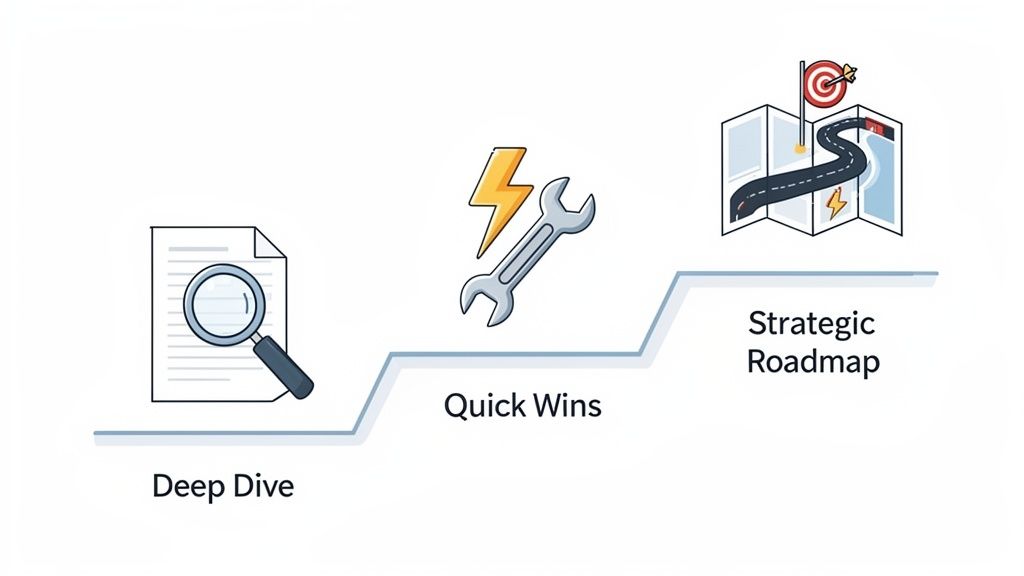
A well-designed 90-day plan acts as a roadmap, transforming initial momentum into tangible results. It removes ambiguity, aligns expectations, and gives your new leader the context to make strategic contributions right away. This is especially true for a fractional executive who needs to get up to speed quickly.
The First Week: The Deep Dive
The first five days are about immersion. The goal isn't to solve problems but to absorb information. Your new CFO should conduct a deep dive into your company's financial and operational health.
Here’s what that initial phase should include:
- Financial Review: Grant full access to your accounting systems, historical financials, board decks, and existing models.
- Stakeholder Meetings: Schedule one-on-ones with the leadership team, key investors, and direct reports to gain crucial context.
- System Assessment: Give them a firsthand look at your current financial stack to understand workflows and potential bottlenecks.
The First Month: Identifying Quick Wins
In the first 30 days, the focus shifts to identifying and executing low-hanging fruit. These "quick wins" build trust, demonstrate immediate value, and create momentum for bigger strategic moves.
A strong CFO will:
- Diagnose Inefficiencies: They should identify a critical process to improve, like streamlining the monthly close from 15 days down to five.
- Enhance Reporting: They might build a new cash flow forecast or a KPI dashboard that gives leadership much-needed visibility.
- Assess the Team: For a full-time hire, this means evaluating the current finance team's skills. For a fractional leader, it's understanding who owns what financially.
The First Quarter: Delivering a Strategic Roadmap
By the end of 90 days, your new CFO should transition from analysis to long-term strategic planning. This is where they present a comprehensive financial roadmap that aligns with your company's growth objectives.
The ultimate goal of the first quarter is for the CFO to deliver a forward-looking financial strategy. This isn't just about managing the books; it's about using financial intelligence to drive smarter, faster business decisions.
Key deliverables by day 90 often include:
- A fully operational three-year financial model.
- A detailed budget and forecasting process.
- A presentation to the board outlining key financial priorities and risks.
For a fractional CFO, success hinges on feeling like a core part of the team. Integrate them fully—include them in leadership meetings, give them access to communication channels like Slack, and treat them as the strategic partner you hired them to be.
Your CFO Hiring Questions, Answered
Deciding to hire a CFO is a big step that brings up many questions. Getting it right is crucial, but the path isn't always clear. Let's tackle the most common concerns founders have with direct answers to help you make the best choice.
At What Stage Should I Hire My First CFO?
Forget a magic revenue number. The real answer comes down to specific business triggers. The need for financial leadership often appears long before you think you can afford a full-time executive.
This is where a fractional CFO comes in. Consider hiring one when you hit milestones like these:
- You're gearing up for (or just closed) a Seed or Series A round.
- The founder is sinking more than 20% of their week into financial tasks.
- Operations are getting complex, such as international expansion or new industry regulations.
A full-time hire usually makes sense once you cross the $10-$15 million ARR mark. At that point, financial operations need dedicated, daily attention. Until then, the fractional model gives you high-level strategy without the heavy overhead.
What Are the Most Important Qualities in a Startup CFO?
Technical accounting skills are table stakes. A great startup CFO brings a unique mix of three other core qualities. They are a strategic partner who builds the business right alongside you.
Look for:
- Strategic Foresight: Can they build a financial model that tells a compelling story to investors? It needs to be a roadmap that guides your biggest decisions.
- An Operational Mindset: A startup CFO must be hands-on, willing to dig into broken processes and implement systems that can scale.
- Deep Industry Experience: Find someone who already speaks your language. A CFO who understands key metrics in your sector (like LTV:CAC for SaaS) will add value from day one.
For fractional hires, top-notch communication skills and the ability to plug in quickly are non-negotiable.
How Do I Measure the ROI of a Fractional CFO?
The return from a fractional CFO shows up in both hard numbers and strategic leaps forward. It’s about more than saving money on a salary; it's about unlocking growth and building a more resilient company.
The real value of a great fractional CFO isn’t just in saving you money—it’s in making you money. They extend your runway, sharpen your strategy, and give you back your most precious asset: your time.
To see their impact clearly, track these areas:
- Quantitative Gains: Look for a longer cash runway, better gross margins, lower customer acquisition costs, or direct savings from smarter contracts and optimized systems.
- Qualitative Gains: How much of your time did you get back? Are your strategic decisions faster and more confident? Did investor trust increase during your last fundraise?
What Is the Difference Between a Controller and a CFO?
This is a critical distinction. A Controller is backward-looking. Their world is about historical accuracy—closing the books cleanly, maintaining compliance, and ensuring the numbers are right. It’s an essential tactical role.
A CFO, on the other hand, is forward-looking and strategic. They take the clean data from the Controller and use it to partner with the CEO on where the company is going next. Their job is to lead fundraising, model acquisitions, and manage investor relations.
Growing businesses often bring in a fractional CFO precisely because a Controller’s role doesn’t cover this high-level strategy. It’s that strategic leadership that drives long-term value.
Finding the right financial leader can feel like a tall order. CFO turnover is surging, and with 59% of new Q1 appointments being first-timers, the talent shortage is real. This uncertainty makes the proven, flexible expertise of a fractional executive more valuable than ever. You can read the full analysis of CFO turnover rates to get a better sense of the trends.
Ready to find the strategic partner who can help you navigate these challenges and accelerate your growth? We connect companies with a curated network of vetted fractional executives who can make an immediate impact.
Explore our talent marketplace and schedule a consultation today.