How to Hire a Fractional Chief Marketing Officer in 2026
You're three weeks into the engagement, the dashboard is up, pipeline looks better, and you still can't tell if marketing changed anything or if the market just woke up. That's the trap with a fractional chief marketing officer hire. The rate is rarely the problem, the missing decision framework is.
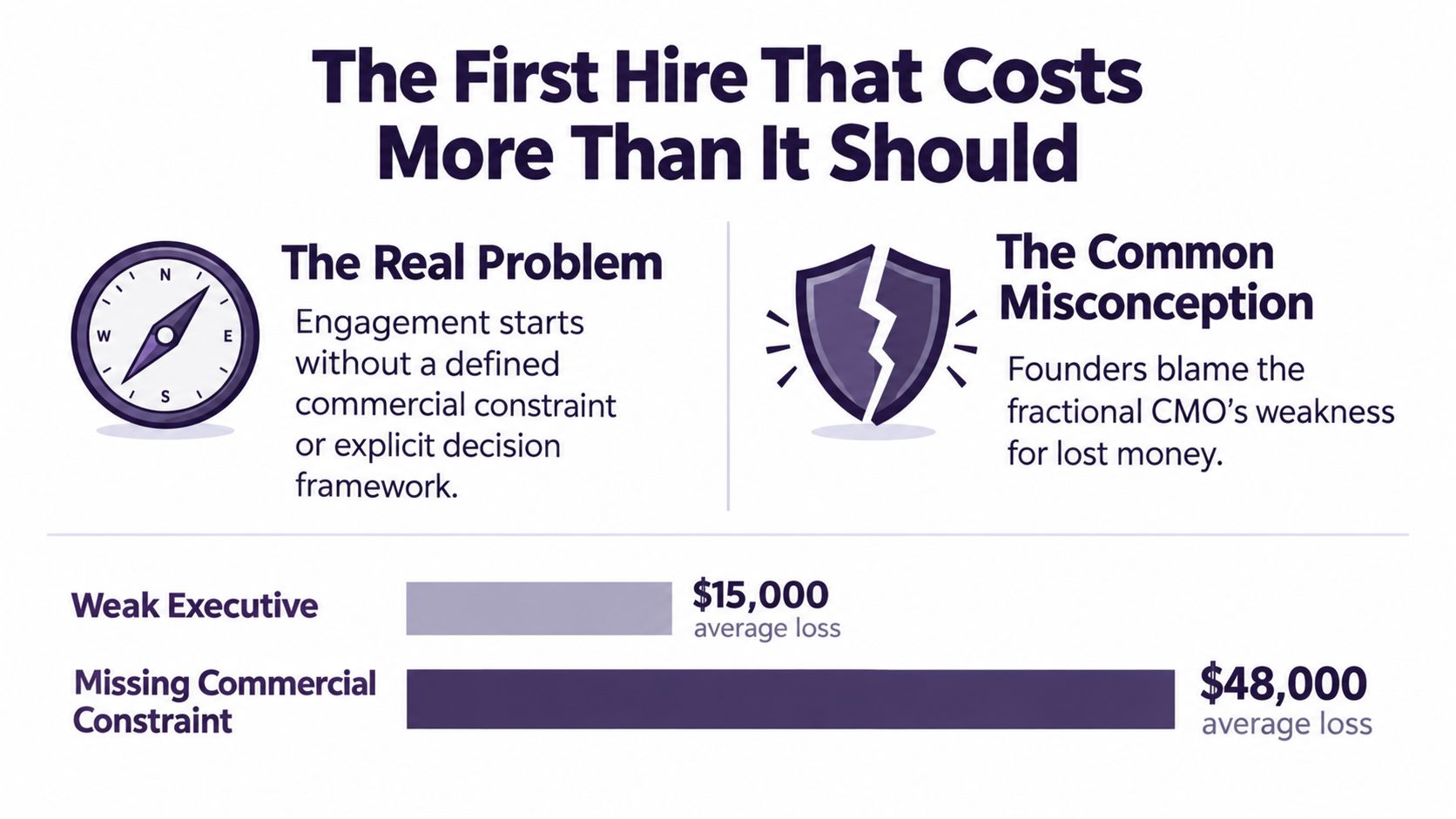
Most founders don't lose money because the executive is weak. They lose money because they hired senior marketing leadership without defining the commercial constraint, the decision rights, or the evidence needed to keep going. That mistake is expensive because senior marketing talent is a scarce resource. The U.S. Bureau of Labor Statistics reported a median annual wage of $161,030 for marketing managers in May 2024, and industry hiring data showed CMO job postings up 22% in 2025 while compensation rose 30.8%. The average CMO tenure was 4.3 years, shorter than the broader C-suite at 4.9 years, which tells you exactly how hard this seat is to fill and keep filled. BLS wage data, CMO hiring and tenure data
A fractional CMO is not a content producer, not an agency substitute, and not a part-time assistant with a strategy deck. The role owns positioning, measurement, budget calls, and revenue accountability from marketing. If you hire one, you're not buying hours. You're buying judgment, sequencing, and the ability to turn marketing into a managed system.
The First Hire That Costs More Than It Should
Three weeks into a fractional engagement, a founder gets nervous because the pipeline is moving but the story doesn't add up. Sales is closing more than last month. The campaign calendar is full. The board is asking what changed. She can't answer because she never forced the first question, which was simple, and unforgiving, and absolutely essential. What commercial constraint are we trying to fix?
What you're actually buying
A real fractional CMO sits above tactics. They decide what to bet on, what to stop funding, how to frame the market, and how to measure whether the function is helping the business. A consultant gives advice. An agency executes a channel. A full-time CMO is a permanent executive with all the overhead that comes with permanence. A fractional CMO is the executive layer without the full-time burn.
That distinction matters because the economics are different. You're not paying for forty hours of presence. You're paying for a few high-impact decisions each week that shape the next quarter. When the engagement works, it feels almost boring, because the function starts behaving like a system instead of a scramble.
Practical rule: if a candidate talks mostly about content, campaigns, or “being hands-on,” you're probably interviewing a senior tactician, not a CMO.
Why the cost of getting it wrong is bigger than the fee
The cost isn't the retainer. It's the opportunity cost of running senior marketing without a clear scope. A founder who hires too early, or with the wrong brief, spends months paying for motion that can't be tied back to business outcomes. That's how you end up with activity, not impact.
If you want the cleanest possible example of why scope matters, look at the economics of the seat itself. Experience is expensive, and the market knows it. Fractional hiring works because you're purchasing a slice of executive capacity instead of carrying the full load of a permanent hire. That's also why the first question shouldn't be “Who's available?” It should be “What decision do we need made?”
A useful internal test is whether the person can tell you what would make them unnecessary later. If they can't, they're probably selling you dependency, not leadership. For a practical framing of that cost conversation, see this breakdown of fractional CMO cost.
The Self-Diagnostic That Comes Before the Search
If you can't name the constraint, you can't judge the candidate. That's the whole game. Before you post the role, force yourself to answer four questions with a yes or no, not a maybe.
Start with the constraint
Choose one commercial problem, not five. It's usually one of these, insufficient qualified pipeline, weak conversion, excessive customer-acquisition cost, or unclear positioning. If your answer is “all of the above,” you're not ready to hire a CMO, you're ready to diagnose the business.
Check execution capacity
A fractional leader can't rescue a team that won't implement. Ask who owns the work, what the CRM already captures, and whether sales, marketing, and operations can coordinate. If the funnel isn't instrumented, the smartest executive in the room will still be guessing.
Test budget realism and authority
Budget needs to fit the company's stage and economics, not an enterprise benchmark copied from somewhere larger. The bigger issue is authority. Can the CMO redirect agencies, approve spend, and change the operating rhythm without waiting two weeks for permission? If not, you're hiring influence without power.
A founder who can't answer yes to those four questions should delay the search and repeat the exercise later. That's not hesitation. That's capital discipline. If you want a plain-language explanation of the role before you make those calls, this overview of what a fractional CMO is is the right reset.
If the organization can't execute, hire a director-level operator first. Strategy without implementation muscle just produces expensive clarity.
Writing the Brief That Replaces the Job Description
A fractional CMO brief should read like a scope of work, not a wish list. Most companies get this wrong by copying a full-time CMO posting and cutting the salary line. That's how you attract people who want a title but won't accept narrow decision rights.
Write the brief around outcomes and control
Put the single commercial constraint at the top. Then define the outcomes that will count, the weekly hours, the minimum engagement length, the decision rights, the budget ceiling, the CRM ownership, and the non-goals. Be specific about what the role is allowed to change, because a part-time executive with no authority is just an expensive observer.
A simple range often used in practice is 20 to 40 hours per month for many successful engagements, with weekly time budgets varying by stage and scope. Treat that as a planning band, not a guarantee. The point is to match the role to the business problem, not to fill a calendar.
| Engagement Model | Typical Hours / Month | Decision Rights | Best-Fit Stage |
|---|---|---|---|
| Scope-only | 5 to 10 | Limited, advisory, narrow approvals | Early diagnosis, founder still owns most decisions |
| Strategy-plus | 10 to 20 | Shared with founder, clear channel and message control | Growth stage with basic execution capacity |
| Full-transformation | 20 to 40 | Strong authority over budget, agencies, and measurement | Companies with active team and real revenue pressure |
Keep the brief short enough to enforce
One page is enough if it's written well. Anything longer usually means the founder hasn't decided what matters. The document should make it easy to say no to candidates who sell breadth instead of accountability.
The cleanest brief sounds almost blunt. “We need this one problem solved. Here is the baseline. Here are the decisions you can make. Here's what success looks like in 90 days.” That brevity protects both sides, because it stops the engagement from mutating into a vague rescue mission. For a useful template reference, this CMO job description guide helps anchor the scope.
Where to Find Fractional CMO Candidates
Founders usually start in three places, and each one solves a different problem. Inbound referrals are the lowest-cost path. Fractional marketplaces are the fastest way to get a vetted shortlist. Boutique search firms make sense when confidentiality or niche experience matters more than speed.
Compare speed, vetting depth and fit
| Source | Speed | Vetting Depth | Best Use Case |
|---|---|---|---|
| Inbound network | Slow | Uneven | You already know strong operators personally |
| Fractional marketplace | Fast | Structured | You need a shortlist without starting from zero |
| Boutique search firm | Moderate to slow | High | Confidential search or niche sector depth |
For companies between $1 million and $50 million in revenue, the marketplace route usually wins because it cuts search drag without forcing a long retained process. One option is Shiny, which operates a fractional executive marketplace with more than 3,000 vetted executives across SaaS, FinTech, HealthTech, Ecommerce, AI, Manufacturing, Professional Services, and Energy, plus tools for job posting, automatic matching, simplified interviews, and onboarding. Shiny's marketplace overview
Match the source to the risk
Urgency calls for speed. Confidentiality calls for a paid process. If you already know the profile and just need access, use the channel that gets you to a diagnostic fastest.
The wrong move is spending six weeks networking when you needed an operator next week. The equally wrong move is treating a marketplace like a hiring lottery and skipping the scoring discipline. Sourcing is only half the battle. Selection still has to be ruthless.
The Paid Diagnostic That Replaces the Pitch Deck
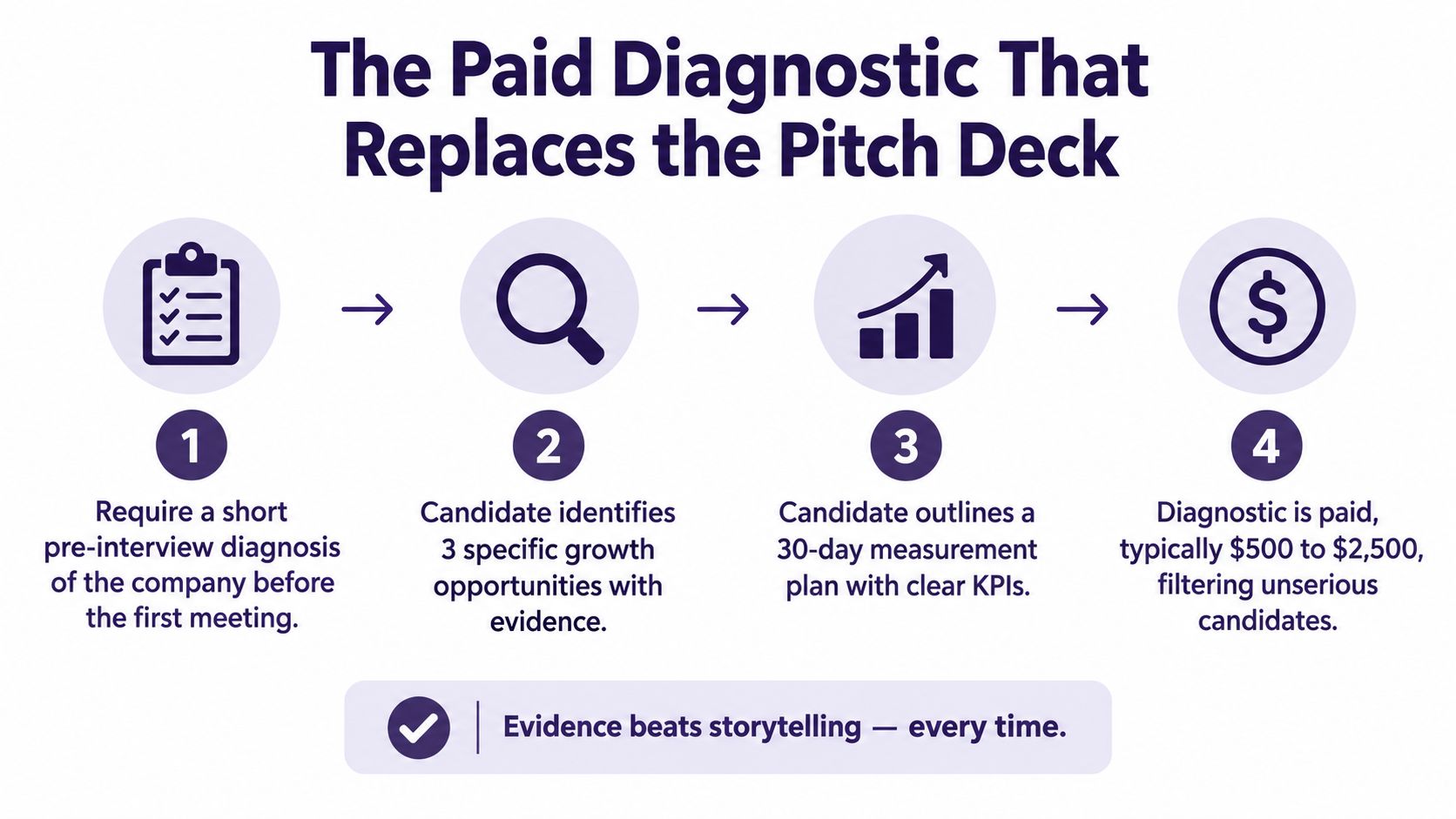
Most fractional CMO interviews reward charisma. That's a problem. Charisma doesn't build a measurement framework, and it won't save you from hiring a polished storyteller who can't connect positioning to pipeline.
Make them diagnose before they sell
Start with a short paid diagnostic. Before the first real interview, ask the candidate to review the company and come back with three specific growth opportunities, a measurement plan, and the first set of commercial tradeoffs they'd make. A paid diagnostic filters out people who are great at talking about growth and weak at doing the work.
That interview should test whether they can move through positioning, ICP, channel choice, funnel instrumentation, sales enablement, and forecastable pipeline without losing the thread. If they jump straight to tactics, that's a tell. If they avoid measurement because “brand takes time,” that's another tell.
Score the work, not the polish
Use a 1-to-10 rubric across ten dimensions, strategic depth, execution history, stage fit, measurement rigor, team-building, industry relevance, communication, engagement design, transition planning, and cultural fit. That gives you a 100-point comparison, and a score of 75 or higher is a sensible threshold before validation. The goal isn't to make hiring mechanical. The goal is to stop rewarding confidence over competence.
Ask for a pre-interview diagnosis in writing. Then challenge every assumption. If they can't tell you what they'd measure in the first month, they're not ready. If they can't name what they'd stop doing, they're probably too soft to lead.
Put the operating terms in writing
The rate matters, but it's the easy part. Protection comes from the contract.
- Weekly hours and availability: define the executive's time, plus response expectations during launches.
- Decision rights: state what the CMO can approve without founder sign-off.
- Budget authority: specify the ceiling for spend changes.
- Agency and vendor control: clarify who directs external partners.
- IP ownership and confidentiality: keep deliverables and data ownership unambiguous.
- Exit terms: include a termination-for-convenience clause with 30-day notice.
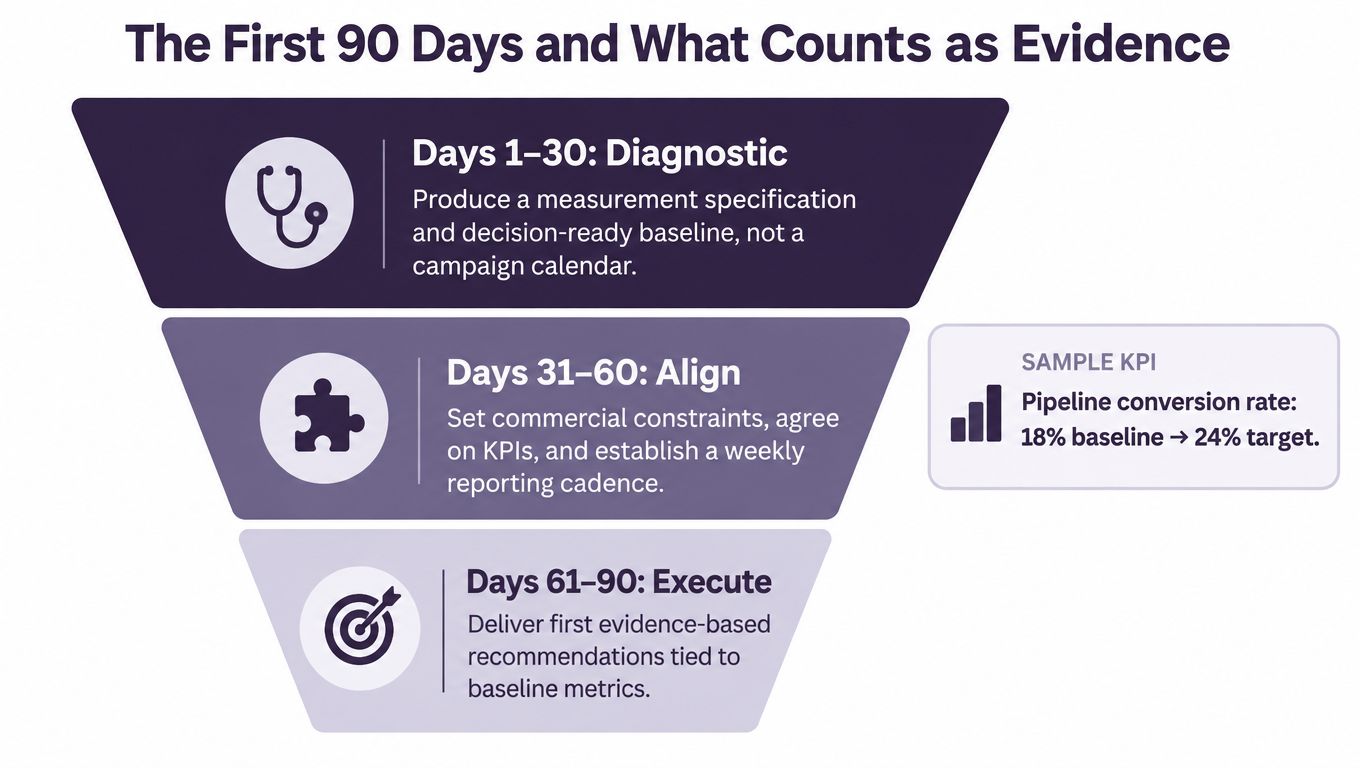
A good contract also includes 30-, 60-, and 90-day acceptance criteria. If the first sprint doesn't produce a decision-ready baseline, the relationship needs a reset, not polite optimism. For a practical checklist on candidate evaluation, this fractional CMO hiring guide is worth reading once, then ignoring the fluff.
Practical rule: if the candidate resists being measured, they're not ready to lead a measurable function.
The First 90 Days and What Counts as Evidence
The first deliverable should never be a campaign calendar. It should be a measurement specification and a baseline you'd trust in front of a founder, CFO, or board member. If the first month is fuzzy, the rest of the engagement will be too.
What the first month should produce
The CMO should quantify the baseline in the CRM and analytics stack, then audit tracking, lead-routing rules, ICP segmentation, channel economics, sales-marketing handoffs, and content performance. After that, they should produce a backlog with owner, effort, expected pipeline impact, dependencies, and the measurement method. That's the right order.
For B2B companies with sales cycles longer than 90 days, multi-touch attribution across the look-back window is more useful than last-touch attribution. Shorter cycles can often use direct attribution more practically. Either way, don't confuse influenced pipeline with incremental revenue. Influenced pipeline can include deals that would have closed anyway.
What to review every week and month
A serious scorecard should track marketing-sourced pipeline, marketing-influenced pipeline, CAC, LTV:CAC, CAC payback, pipeline velocity, win rate, and time to conversion. Weekly, look at leading indicators. Monthly, look at revenue outcomes. If the model changes after results appear, the numbers are decoration, not evidence.
A strong fractional CMO earns trust here. Sometimes the right move is to reduce reporting precision rather than pretend the data is cleaner than it is. Founder patience is better spent on decisions than dashboards.
Don't ask for certainty where the data can only support confidence ranges. Ask for the clearest possible decision.
When a Fractional CMO Is the Wrong Answer
A fractional CMO is the wrong hire when you need daily execution more than strategic direction. If the company cannot ship, the problem is not the marketing leader. It is the operating system around them.
A part-time executive also fails when the founder will not delegate authority, when agency management is the true bottleneck, or when the team lacks the capacity to act on the plan. In those cases, a strong director-level operator usually beats a senior strategist who only shows up a few days a month.
Missing product-market fit is another hard stop. So is a broken CRM or a data layer that cannot support basic measurement. A senior marketer can fix some plumbing, but if the first phase is infrastructure, call it infrastructure and staff for that job directly.
Use the exit signals early
Set a hard review at day 60 and day 90.
- No validated attribution by day 60: pause spend growth and fix measurement first.
- No ICP and messaging alignment by day 90: the strategy is still unstable.
- Persistent founder-executive misalignment: the relationship will keep burning time and trust.
Treat the hire like a small capital allocation decision. Scope it as a 90-day project. Pay for the diagnostic before you commit. Require an evidence hierarchy that can survive a board-level conversation, because attribution is rarely as clean as the pitch deck makes it look. If you do that, the role compounds. If you skip it, the setup fails and the hire gets blamed for the mistake.
If you want to test that framework against your own company, Shiny connects founders with vetted fractional executives, including marketing leaders, and makes it easier to compare options without turning the search into a month-long distraction. Visit vetted fractional executives if you want to review candidates, pressure-test your brief, or schedule a consultation before you post the role.