

How to Scale a Startup Without Breaking Your Business
Knowing how to scale a startup isn't just about getting bigger—it's about getting stronger. It’s about building a business that grows more efficient and profitable as it expands, not one that collapses under its own weight. This isn't about blind luck; it's about a deliberate strategy connecting your product, your operations, and your leadership. This guide will walk you through building that framework, one crucial piece at a time.
The Real Meaning of Scaling a Startup
Let’s get one thing straight: scaling is not the same as growth.
Growth is linear. You add resources at the same rate you add revenue—you hire one new salesperson for every ten new clients. Scaling, on the other hand, is about increasing revenue at an exponential rate while your resource costs only inch up incrementally. It’s about designing a system where your business can handle a massive wave of new customers without a proportional spike in costs or chaos.
Think of it like building a skyscraper. You can't just keep adding floors to a foundation designed for a single-story house. True scaling demands a rock-solid base before you aim for the clouds. Unfortunately, many founders skip this crucial groundwork, which is one of the most common startup scaling challenges that leads directly to operational burnout and financial strain.

Beyond the "Growth at All Costs" Mentality
The startup world loves to romanticize the "growth at all costs" mindset. But let's be honest—it's a trap. This approach prioritizes flashy vanity metrics over sustainable, profitable expansion. Chasing user numbers without a clear path to actually making money is like trying to fill a leaky bucket. You'll burn through your cash and energy without ever making real progress.
Sustainable scaling is a deliberate, methodical process, not a chaotic sprint. It requires a laser focus on three core pillars that hold up the entire structure of your business:
- People: Do you have the right team and leadership in place to handle what's next?
- Process: Are your internal systems repeatable and efficient enough to manage 10x the volume?
- Profit: Are your unit economics solid? Does each new customer actually add to your bottom line?
The launch of ChatGPT kicked off a growth curve like nothing we have ever seen—in our company, our industry, and the world broadly. Building up a company at such high velocity with so little training is a messy process.
This insight perfectly captures the immense pressure that comes with hyper-growth. When a company expands by orders of magnitude in just a few months, established processes shatter, and the team is pushed to its absolute limits. This is exactly why having a scalable foundation isn’t just a nice-to-have; it's essential for survival.
To truly scale without breaking, you need to understand how these pillars interact. Below is a quick breakdown to keep in mind as you build your strategy.
Core Pillars of Sustainable Startup Scaling
| Pillar | Primary Focus | Common Pitfall to Avoid |
|---|---|---|
| People | Building a high-performing team with the right skills and cultural alignment. | Hiring too quickly without proper vetting, leading to cultural dilution. |
| Process | Creating efficient, repeatable, and automated systems for all operations. | Neglecting to document processes, causing chaos as the team expands. |
| Profit | Ensuring a viable business model with strong unit economics and profitability. | Focusing on revenue growth while ignoring the actual cost of acquisition. |
Getting these three elements right is the key to building a business that's not just bigger, but fundamentally better.
Why Sustainable Scaling Matters
When you focus on these pillars, you ensure you're building a company that can last. It means you can deliver a consistent, high-quality customer experience, maintain a healthy and motivated company culture, and build a financially sound enterprise that attracts both top-tier investors and the best talent.
The rest of this guide will give you a practical, step-by-step framework to reinforce each of these pillars, preparing you to manage the incredible journey of scaling your startup the right way.
Validate Your Foundation Before Building Higher
Scaling a startup before you've truly validated your foundation is like trying to build a skyscraper on sand. It's a classic, and often fatal, mistake. Before you start pouring serious cash into marketing, sales, and hiring, you need absolute certainty that you have solid product-market fit (PMF).
This isn’t just about having a few happy customers. It's about proving your business model can withstand the intense pressure of rapid growth. Pouring money into a business with a weak foundation is a fast track to failure. The goal is to avoid scaling what we call a "leaky bucket"—a business that loses customers just as fast as it brings them in. Real validation means getting surgical about customer behavior, retention, and the profitability of every single transaction.

Go Beyond Basic Customer Feedback
Surveys and star ratings barely scratch the surface. To know if your product is truly essential, you have to dig into the why behind your customers' actions. This is where deeper frameworks for gathering feedback become non-negotiable.
One of the most powerful is the Jobs to be Done (JTBD) framework. Instead of asking what features people want, JTBD forces you to uncover the underlying "job" they are "hiring" your product to do. Think about it: people don't buy a drill because they want a drill; they buy it because they need a hole in the wall. Understanding this core motivation uncovers your real value proposition and who you're really competing against.
By focusing on the customer's desired outcome, you move from building features to solving fundamental problems. This is the bedrock of a product that customers can't live without.
Define Your Ideal Customer Profile with Data
As you gather these deeper insights, you can start to build out your Ideal Customer Profile (ICP). This isn't some vague, fluffy persona. It’s a razor-sharp, data-driven definition of the exact type of customer who gets the most value from your product and is most profitable for your business. A strong ICP is built on firmographic, technographic, and—most importantly—behavioral data.
To get this right, look for patterns among your absolute best customers:
- High Engagement: Who is using your product most frequently and most deeply?
- Low Churn: Which customer segments stick around the longest?
- High Lifetime Value (LTV): Who are your most profitable customers over time?
- Successful Onboarding: Which users "get it" and find value the fastest?
Once you have this crystal-clear picture, you can aim all your marketing and sales firepower at acquiring more customers just like them. This level of precision is the cornerstone of efficient scaling and a core tenet of the Lean Startup methodology, which is all about validated learning.
Prove Retention with Cohort Analysis
Getting users in the door is one thing. Keeping them is everything. Cohort analysis is your single best tool for proving your product has real staying power. The method is simple: group users by a shared trait (usually their sign-up date) and track their behavior over time.
By running cohort analysis, you get clear answers to critical questions:
- Are newer customers sticking around longer than older ones? (This shows your product is improving.)
- How long does it take for a typical customer to churn?
- Do certain marketing campaigns or channels bring in more loyal users?
What you're looking for is a "smiling curve"—where the retention line flattens out or even ticks back up over time. This is a powerful, undeniable signal that you've achieved true product-market fit. It proves your product delivers lasting value and is ready for a much bigger audience.
Confirm Your Unit Economics Are Scalable
Finally, you have to prove that your business model isn't just viable, but profitable at scale. This all comes down to your unit economics, specifically the ratio between your Customer Lifetime Value (LTV) and Customer Acquisition Cost (CAC).
A healthy LTV:CAC ratio is generally considered to be 3:1 or higher. In plain English, that means for every dollar you spend to get a customer, you make at least three dollars back over their lifetime with you.
If your ratio is 1:1, you’re just treading water. If it’s any lower, you're literally losing money with every new sale. Before you even think about hitting the accelerator, you must have a clear, repeatable path to acquiring customers profitably. This financial validation is the final, and most important, checkpoint.
Building a Team That Can Handle Hyperspeed
When your startup shifts gears from finding its footing to an all-out sprint, the team you need is fundamentally different from the one that got you there. Those passionate, scrappy generalists who wore a dozen hats to get your product off the ground? They were invaluable. But scaling demands a new layer of specialized expertise.
The real challenge is evolving your team without sacrificing the culture that made you successful in the first place. This isn’t just about hiring more people; it's a strategic overhaul, moving from a founder-led hustle to a structured, high-performance organization. Knowing how to scale a startup successfully is really about knowing how to build the right team for the right stage.

From Generalists to Specialists
In the early days, everyone does a bit of everything. Your lead engineer is probably dabbling in customer support, and your marketing person might be handling HR paperwork on the side. This "all hands on deck" mentality is perfect for nailing product-market fit.
But as you scale, that model shatters.
Suddenly, you need specialists. You need a performance marketer who lives and breathes acquisition funnels, a controller who can build a financial model that investors will actually believe, or a sales ops guru who can design a compensation plan that truly motivates a growing team. Trying to manage this new level of complexity with a team of generalists is a fast track to burnout and expensive mistakes.
The trick is to pinpoint which roles need deep, focused expertise right now. Ask yourself:
- Where are our biggest operational bottlenecks?
- Which functions, if professionalized, would have the biggest impact on revenue?
- What strategic knowledge gaps are holding us back from hitting that next milestone?
The answers will tell you whether you need to hire a specialist from the outside or if you can promote and train a high-potential person from within. We break down exactly how to create these roles in our guide on how to build high-performing teams.
The Fractional Leadership Advantage
Here’s the classic dilemma for scaling startups: you desperately need C-suite expertise, but you don't have a C-suite budget. A full-time Chief Financial Officer or Chief Marketing Officer can easily command a salary of $250,000+, a number that can absolutely cripple your cash flow.
This is where fractional leadership becomes a total game-changer.
Instead of hiring a full-time executive, you bring on a seasoned leader for a "fraction" of their time—usually somewhere between 5 to 25 hours a week. This gives you immediate access to top-tier strategic thinking without the massive commitment of a full-time salary, equity, and benefits package. It's the ultimate capital-efficient way to inject senior-level experience exactly where you need it most.
A fractional executive isn’t just a consultant who drops off a report and disappears. They become an integrated part of your leadership team, rolling up their sleeves to execute strategy, mentor your people, and build systems that can actually scale.
Imagine bringing on a fractional CFO who has already navigated three successful Series B rounds. They can professionalize your financial reporting, build a defensible forecast, and guide you through the minefield of investor due diligence. That's an incredible advantage when it's time to raise, and it’s a level of experience you’ll almost never find in a junior hire.
Building a Scalable Leadership Structure
As you grow, the founder can no longer be the hub for every single decision. You have to build a leadership layer that can operate with autonomy and drive results in their own departments. A fractional executive can be the perfect bridge to get you there.
Think about the common pain points that pop up during rapid growth:
- Marketing: Your early growth hacks have stopped working, and you need a sophisticated, multi-channel marketing engine. A fractional CMO can design the strategy and hire the right junior team to run it.
- Finance: You're gearing up for a funding round, but your books are a mess. A fractional CFO can implement proper controls, manage your cash flow, and build investor-ready financial models.
- Operations: Your processes are breaking under the weight of increased volume. A fractional COO can map your workflows, find the weak spots, and implement systems that won't crumble.
This approach is especially critical given the insane pressure to grow revenue. A recent analysis found that startups often forecast an average revenue growth of a staggering 522% in their first year. Trying to manage that kind of explosion without experienced leadership is a recipe for disaster.
Ultimately, building a team for hyperspeed is about surgical precision. By strategically blending your motivated internal talent with the focused expertise of fractional executives, you create a leadership structure that is powerful, flexible, and capital-efficient.
At Shiny, we connect founders with a vetted network of top-tier fractional executives ready to help you navigate your next growth spurt. If you’re staring down a leadership gap, we can help you find the perfect expert for your team.
Designing Systems and Processes That Do Not Break
A process that works for a team of ten will absolutely cripple a team of fifty. As you scale, the informal, "just-get-it-done" methods that defined your early days become serious liabilities. The key to navigating this transition is designing an operational infrastructure that can handle future volume without breaking.
Think of it like building a city’s road network. You don’t just pave a few dirt paths for today's cars; you have to anticipate future traffic, designing highways and interchanges that prevent gridlock. You need to create systems with just enough structure to ensure consistency without stifling the innovation that got you here. This means mapping your core business processes and spotting bottlenecks before they become full-blown crises.
Mapping Your Core Business Workflows
The first move is to make the implicit explicit. What are the critical paths that information and work travel through in your company? You need to get these out of people's heads and onto paper—visually, like a blueprint for your business.
Start by identifying the major processes that drive your startup forward:
- Customer Journey: From the first marketing touchpoint to final sale and onboarding.
- Product Development: From idea generation to bug fixes and feature releases.
- Financial Operations: From invoicing and accounts payable to monthly reporting.
- Hiring and Onboarding: From initial job posting to a new hire's first 90 days.
By mapping these out, you can immediately spot redundancies, manual tasks ripe for automation, and points where work gets stuck. This isn't about creating bureaucracy; it's about creating clarity so everyone knows how to get things done right, every single time.
Strong processes create freedom. When your team isn’t constantly reinventing the wheel for routine tasks, they have more mental bandwidth to focus on creative, high-impact work that actually moves the needle.
The hard reality of scaling is that most startups don't make it. About 1 in 5 startups fail within their first year, often due to running out of cash or poor market fit. Over ten years, that number jumps to more than two-thirds. Strong operational processes are a huge part of overcoming those odds. You can discover more about the challenges startups face on Exploding Topics.
Choosing a Tech Stack That Grows With You
Your technology stack is the engine of your operational infrastructure. The tools that served you well at the start—like basic spreadsheets and shared inboxes—will quickly become bottlenecks. Choosing the right tech is about anticipating your needs one to two years down the line, not just solving today’s problems.
Look for tools built for scalability. A good CRM, project management platform, or finance software should have tiered plans that let you add features and users as you grow. Migrating your entire company off a system because you've outgrown it is a painful, expensive, and disruptive process you want to avoid at all costs.
Deciding when to make the leap from a scrappy tool to an enterprise-grade platform can be tough. This table breaks down common triggers.
Scaling Your Tech Stack: When to Upgrade
| Business Function | Early-Stage Tool Example | Scaling Trigger | Scale-Up Tool Example |
|---|---|---|---|
| Sales & CRM | Spreadsheets, Trello | Lack of visibility into pipeline, manual follow-ups are being missed, need for sales automation. | HubSpot, Salesforce |
| Project Management | Notion, Asana (Free Tier) | Cross-functional projects become chaotic, resource planning is impossible, need for gantt charts and dependencies. | Jira, Monday.com |
| Finance & Accounting | QuickBooks Online | Need for multi-entity consolidation, complex revenue recognition rules (e.g., SaaS), preparing for an audit. | NetSuite, Sage Intacct |
| Customer Support | Shared Gmail Inbox | High ticket volume, no way to track resolution times, need for a knowledge base and self-service options. | Zendesk, Intercom |
Ultimately, the right time to upgrade is just before the pain of your current tool becomes unbearable. Waiting until it breaks completely means you're already behind.
The infographic below shows just how dramatic the improvements can be when you get your systems right.
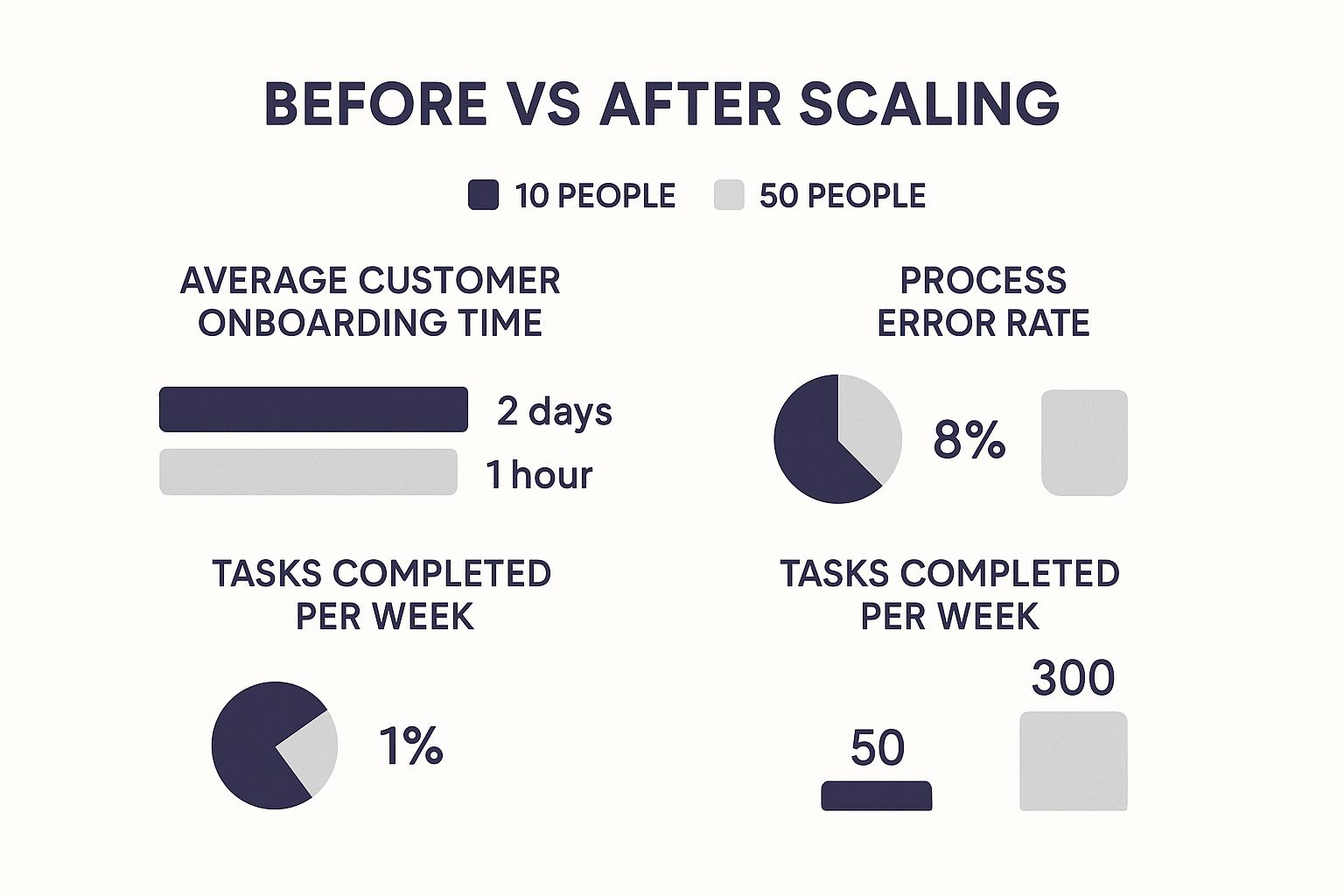
As you can see, implementing scalable processes can take customer onboarding from days to just an hour while slashing error rates and multiplying team productivity.
Create Repeatable Playbooks
Finally, you need to codify your best practices into repeatable playbooks. A playbook is a living document that outlines the step-by-step process for a critical function, like your sales discovery calls or your content marketing workflow.
These aren't meant to be rigid scripts. Think of them as guides that ensure quality and consistency. They empower new hires to get up to speed fast and enable your existing team to execute flawlessly, even as the company grows around them. By turning that "tribal knowledge" into documented systems, you build a company that can truly scale beyond its founders.
This level of operational excellence is often where startups need expert guidance. If you're struggling to build systems that can withstand the pressure of growth, connecting with a fractional COO or operations leader can provide the strategic blueprint you need. Explore our network of vetted executives to find the right partner to help you build a truly scalable foundation.
Securing the Right Fuel for Your Growth Engine
Growth costs money. But not all money is good money.
When you’re ready to scale, fundraising becomes less about just getting cash in the bank and more about finding a true strategic partner—someone who brings more to the table than just a check. The game changes completely after your seed round. Moving into Series A, B, and beyond demands a whole new level of rigor, a more sophisticated story, and absolutely pristine financials.
You have to convince investors that you don't just have a great idea anymore. You have a predictable, scalable growth engine. The narrative shifts from, "we have an idea," to "we have a machine, and we need fuel to make it run faster."
How Much Do You Actually Need?
Before you even think about building a pitch deck, you need a rock-solid answer to one question: how much capital do you really need? This isn't a number you just pull out of thin air. It has to come from a detailed, bottom-up financial model that maps out exactly how every single dollar will be used to hit specific, measurable milestones.
The goal is to raise enough for 18 to 24 months of runway. That gives you enough time to hit the key metrics that will make your next fundraising round a success.
Your model needs to account for everything:
- Team Expansion: Who are you hiring? How many engineers, salespeople, and marketers? What are their salaries?
- Go-to-Market Spend: What's your budget for customer acquisition? What’s your target Customer Acquisition Cost (CAC)?
- Operating Costs: Factor in new software, office space (if any), and all the other overhead that comes with growth.
- The "Oops" Fund: Things go wrong. Always build in a contingency buffer of at least 15-20% for the unexpected challenges—and opportunities—that will inevitably pop up.
This data-driven approach immediately signals to investors that you’re a disciplined, strategic operator, not just another founder with a dream.
Telling a Story That VCs Want to Hear
Investors see hundreds of pitches. Yours has to cut through the noise with a clear, data-backed story that proves your business is a rocket ship just waiting for launch. This isn’t just about your product; it's about demonstrating a deep, nuanced understanding of your market and your business model.
Let's be real, many startups rely on venture capital to scale long before they even have a huge customer base. The industry you're in also shapes the story. For example, fintech is a hot space with over 381 unicorns, but it comes with massive risks like cybersecurity breaches that cost an average of $4.88 million per incident. Acknowledging these realities shows you’ve done your homework. You can find more stats on the startup ecosystem over at Exploding Topics.
Your pitch needs to stand on a few core pillars:
- A Massive Market: Define your Total Addressable Market (TAM) and explain why your slice of the pie is ready to explode.
- A Defensible Moat: What's your unfair advantage? Is it proprietary tech, a powerful brand, network effects, or something else entirely?
- A Killer Team: Showcase your leadership and explain why you are the only team that can win this market.
- Real Traction: Back it all up with hard numbers. Show your progress with revenue growth, customer retention, LTV:CAC ratio, and other KPIs that prove you’re on the right track.
Surviving the Dreaded Due Diligence
Getting a term sheet feels like the finish line, but it’s really just the start of the race. The due diligence process is an intense, line-by-line audit of your entire business—financials, legal docs, customer contracts, tech stack, you name it. This is where deals go to die.
Due diligence is not the time to "get your books in order." If you're not prepared months in advance, you risk looking disorganized, which erodes investor confidence and can kill the deal or lead to much worse terms.
This is exactly where a seasoned financial leader proves their worth. The problem? Most scaling startups simply can’t afford the salary of a full-time, experienced CFO. It creates a critical gap.
A fractional CFO is the perfect answer. You get the senior-level expertise you need to professionalize your financials long before you ever start talking to investors. They’ll build your investor-ready models, clean up your accounting, and make sure you have clear, defensible answers for every tough question VCs throw your way.
Walking into a fundraise with a fractional executive on your team sends a powerful signal. It tells investors you’re serious about financial discipline and are building a business that’s meant to last.
If you're gearing up for your next funding round, having an expert in your corner can make all the difference. Explore our network of vetted fractional CFOs who specialize in guiding startups through the complexities of scaling and securing capital.
Burning Questions on How to Scale a Startup
As you get deeper into the scaling journey, you’ll inevitably run into some tough questions. I've been there. Here are some quick, no-nonsense answers to the most common concerns I hear from founders.
What's the Single Biggest Mistake Founders Make When Scaling?
Hands down, it's premature scaling. This is the classic trap of throwing money at marketing and hiring before you’ve actually nailed product-market fit or figured out your unit economics. It’s like pouring gasoline on a tiny flicker of a flame, hoping for a bonfire.
What usually happens is you burn through cash without acquiring customers in a sustainable way. You end up with a "leaky bucket," and pouring more money into it won't fix the holes. You have to validate your foundation before you step on the gas.
How Do I Actually Know if My Startup Is Ready to Scale?
You'll see clear signals when your business is built on solid ground. Don't guess—look for the data.
- Customers Stick Around: Your churn rate is low because your product is genuinely valuable to them. They aren't just trying it out; they're integrating it into their lives or workflows.
- The Math Works: Your unit economics are healthy and predictable. A lifetime value to customer acquisition cost (LTV:CAC) ratio of 3:1 or higher is a great sign you're on the right track.
- Demand Pulls You Forward: People are starting to find you on their own. You're not just relying on outbound sales; you have consistent inbound interest.
- You Have a Playbook That Works: Your sales process is repeatable. Your team knows how to close deals consistently because you've figured out a method that clicks.
If you can check these boxes, you’ve earned the right to grow.
When Is the Right Time to Bring in a Fractional Executive?
A fractional executive is your secret weapon when you need senior-level strategic thinking but can't justify—or afford—a full-time C-suite salary. It’s a capital-efficient move to get top-tier expertise right when you need it most.
We see founders pull the trigger on this when they're prepping for a fundraise (fractional CFO), trying to build a marketing engine that can scale (fractional CMO), or needing to overhaul their internal processes for efficiency (fractional COO).
This approach closes a massive leadership gap without the massive financial commitment. It’s one of the smartest scaling hacks out there.
Scaling a startup is all about having the right strategy and the right leaders in the room. If you're staring down a leadership gap but aren't ready to commit to a full-time hire, Shiny can connect you with a vetted, top-tier fractional executive to help you navigate your next stage of growth. Find your expert match today.
Article created using Outrank
