
Top Interview Questions for a Chief Operating Officer in 2025
Hiring a Chief Operating Officer (COO) is a pivotal moment for any organization, especially for startups aiming for scalable growth or small businesses needing seasoned leadership. The right COO translates the CEO’s vision into tangible, day-to-day execution, building the operational engine that drives the company forward. However, identifying a candidate with the right blend of strategic foresight, operational grit, and leadership acumen from a resume alone is nearly impossible. Generic interview questions often yield rehearsed, surface-level answers that fail to reveal true capability.
To truly vet a candidate, you need to go deeper. This requires specific, situational interview questions for a chief operating officer that probe their real-world experience, problem-solving methodologies, and leadership philosophy. Standard questions simply don’t cut it when the stakes are this high; you need a framework for uncovering how a candidate thinks and executes under pressure.
This comprehensive listicle provides precisely that. We will break down essential questions designed to peel back the layers and reveal the operational mastermind your company needs. For each question, we’ll explore:
- The Strategic Purpose: Why you are asking this specific question.
- What to Listen For: The key elements of a strong, impactful answer.
- Potential Red Flags: Warning signs that a candidate may lack the necessary experience or mindset.
This guide will equip you to move beyond the resume and hire a COO who will not just manage operations, but truly transform them. You’ll gain the tools to identify a leader who can build scalable systems, align cross-functional teams, and drive sustainable growth.
1. Describe your experience scaling operations and what frameworks you use to manage growth
This foundational question is one of the most critical interview questions for a chief operating officer because it directly probes their core competency: managing and optimizing an organization’s engine during periods of intense change. A COO’s primary role is to ensure the company’s operational infrastructure can support, and even accelerate, strategic growth without collapsing under the pressure. This question separates candidates who have merely overseen stable departments from those who have architected and executed scalable systems.

An exceptional candidate will not just recount growth stories; they will articulate the repeatable frameworks they used to manage it. These methodologies, popularized by operational powerhouses like Google and Amazon, provide a structured approach to a chaotic process. They demonstrate a candidate’s ability to move beyond reactive problem-solving to proactive, strategic planning.
Why This Question Is Crucial
- Tests Strategic Foresight: It reveals if the candidate can anticipate future bottlenecks, such as technological limitations, talent gaps, or process inefficiencies, before they derail growth.
- Measures Process-Oriented Thinking: Scaling isn’t about working harder; it’s about working smarter. This question assesses their ability to design and implement robust systems that can handle increased volume and complexity.
- Validates Experience with Hard Data: Strong answers will be rich with specific metrics. Look for candidates who speak in terms of revenue growth (e.g., from $10M to $100M), team expansion (e.g., from 50 to 500 employees), or efficiency gains (e.g., reducing customer onboarding time by 40% while doubling the client base).
What to Look for in an Answer
A compelling response should detail a specific challenge, the framework applied, and the measurable outcome. For instance, a candidate might describe using Objectives and Key Results (OKRs) to align a rapidly expanding cross-functional team, or implementing Lean Six Sigma principles to eliminate waste in a production process that was buckling under demand.
Probing further is key. If a candidate mentions a framework, ask them to elaborate on the specific challenges of its implementation and how they secured buy-in from key stakeholders. As you evaluate potential leaders, understanding their approach to scaling is paramount. You can find more comprehensive guidance on this topic by exploring this in-depth guide to interviewing COO candidates. Their ability to articulate a clear, battle-tested methodology for managing growth is a powerful indicator of their potential to be a transformative leader for your organization.
2. How do you align cross-functional teams and resolve conflicts between departments?
This question targets a COO’s diplomatic and strategic leadership capabilities. While scaling operations is about building the engine, aligning teams is about ensuring all parts of that engine work in harmony. Silos are the natural enemy of efficiency and innovation, and a COO’s ability to dismantle them and foster genuine collaboration is a direct measure of their effectiveness. This question assesses their ability to manage the inherent tensions that arise between departments with competing priorities, such as sales pushing for aggressive timelines and operations advocating for sustainable processes.
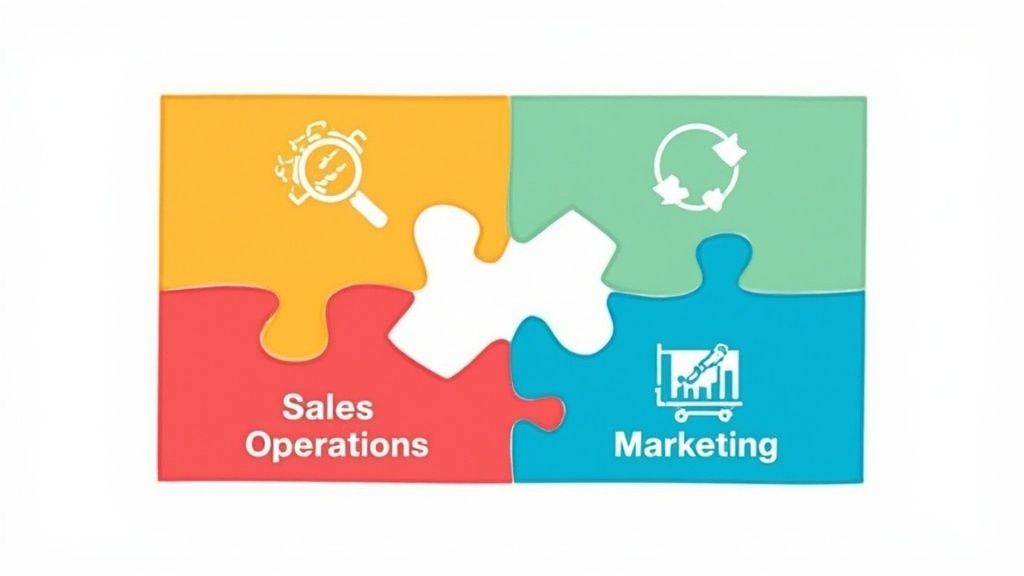
A top-tier candidate will go beyond platitudes about “open communication” and detail the specific mechanisms they use to create shared goals and resolve disputes. They will discuss frameworks inspired by methodologies like Toyota’s cross-functional team approach or the matrix structures used by companies like General Electric. These systems are designed to hardwire collaboration into the organization’s DNA, moving it from a hopeful ideal to a daily operational reality.
Why This Question Is Crucial
- Evaluates Political Acumen: It reveals how a candidate navigates complex organizational dynamics and interpersonal relationships to achieve business objectives. This is a core part of the job.
- Assesses Problem-Solving Style: Does the candidate impose top-down decisions, or do they facilitate a collaborative process to find a win-win solution? Their approach to conflict resolution speaks volumes about their leadership style.
- Tests for a Holistic Business View: A great COO understands that no department is an island. This question shows if they can connect the dots between sales, marketing, product, and operations to optimize for the company’s overall success, not just one department’s metrics.
What to Look for in an Answer
A strong response will feature a clear, real-world example of a conflict they successfully mediated. For instance, a candidate might describe resolving a classic sales and operations planning (S&OP) conflict by implementing an integrated forecasting model that both teams had to contribute to and be accountable for. Another powerful example would be creating shared KPIs between customer service and product development to ensure user feedback directly influenced the product roadmap.
Dig deeper into their methodology. Ask how they established the “rules of engagement” for these cross-functional teams and what they did when a consensus couldn’t be reached. Exploring their strategies for building trust and using data to depersonalize disagreements is vital. For those looking to build highly effective collaborative environments, you can gain more insights by exploring this guide to cross-functional team management. A candidate who can demonstrate a repeatable process for turning departmental friction into forward momentum is an invaluable asset.
3. What metrics do you use to measure operational performance and how do you drive continuous improvement?
This question cuts to the heart of a COO’s analytical acumen. A company without clear metrics is flying blind, and a COO who cannot define, track, and act on data is merely a manager, not an operational strategist. This question probes their ability to translate complex operational activities into a concise dashboard of Key Performance Indicators (KPIs) and, more importantly, use that data to foster a culture of relentless, incremental progress.

An outstanding answer moves beyond simply listing common metrics. It will showcase a sophisticated understanding of how to select the right metrics that align with strategic business goals. The candidate should be able to articulate their philosophy on creating a balanced view of performance, referencing established methodologies like the Balanced Scorecard or the data-driven principles of Lean Manufacturing to illustrate their systematic approach.
Why This Question Is Crucial
- Assesses Analytical Prowess: It reveals whether the candidate is data-driven or relies on intuition alone. Modern operations are too complex for guesswork; a top COO must be fluent in the language of data.
- Evaluates Strategic Alignment: The choice of metrics indicates whether the candidate can connect day-to-day operations to high-level company objectives. Are they measuring what truly matters for success?
- Probes for a Continuous Improvement Mindset: This question separates candidates who see metrics as a reporting exercise from those who see them as a catalyst for action and innovation. It uncovers their ability to build feedback loops that drive efficiency and quality.
What to Look for in an Answer
A strong response will be specific and contextual. The candidate should provide concrete examples of metrics they’ve implemented and the improvements that resulted. For instance, they might describe using Overall Equipment Effectiveness (OEE) to boost manufacturing output or implementing Net Promoter Score (NPS) and first-response time metrics to enhance customer service. They should be able to explain the difference between leading indicators (predictive of future outcomes) and lagging indicators (reporting past results).
Dig deeper with follow-up questions. If they mention a specific metric, ask how they established the baseline and set improvement targets. Inquire about how they communicated these metrics across different departments, from the boardroom to the front lines. One of the most insightful interview questions for a chief operating officer, this query reveals if a candidate can not only measure performance but also inspire the entire organization to improve it.
4. Describe a time when you had to implement a major operational change. How did you manage the change process?
This behavioral question is a cornerstone of effective interview questions for a chief operating officer, as it moves beyond theory into the messy reality of execution. A COO’s success often hinges on their ability to drive significant organizational shifts, whether it’s adopting a new technology platform, restructuring departments, or overhauling core processes. This question reveals a candidate’s aptitude for navigating the complex human and systemic dynamics inherent in any major transformation.

Top-tier candidates will respond not with a simple story, but with a structured narrative that showcases a deliberate and empathetic approach to change management. They will often reference established frameworks, such as Kotter’s 8-Step Change Model or the ADKAR model, demonstrating they rely on proven methodologies rather than improvisation. Their answer should illustrate a blend of strategic planning, clear communication, and emotional intelligence.
Why This Question Is Crucial
- Assesses Leadership Under Pressure: Major changes are fraught with resistance, uncertainty, and fear. This question uncovers how a candidate leads when the stakes are high and employee morale is fragile.
- Evaluates Communication and Empathy: Successful change requires more than a mandate; it requires buy-in. This probes the candidate’s ability to communicate the “why” behind the change, listen to concerns, and guide teams through the transition.
- Reveals Strategic Planning Skills: It highlights their capacity to plan a complex project from conception to completion, including risk assessment, stakeholder mapping, and resource allocation. A great answer will show they anticipate and mitigate resistance before it becomes a roadblock.
What to Look for in an Answer
A strong response will detail a specific initiative, like implementing a new ERP system or leading a post-merger integration. The candidate should articulate their step-by-step process, from building a coalition of supporters to anchoring the new changes in the company culture. They should speak to how they defined success and what metrics they used to track progress.
Listen for the “how.” If a candidate says they “communicated the vision,” ask for specific examples. How did they tailor the message for different audiences, from the board to the front-line staff? How did they create feedback loops to address concerns in real-time? Their ability to manage resistance and build momentum is a powerful predictor of their ability to drive lasting operational improvements and successfully lead your team through necessary evolution.
5. How do you balance cost optimization with maintaining quality and customer satisfaction?
This question cuts to the heart of the modern COO’s strategic challenge: finding the delicate equilibrium between financial discipline and delivering exceptional value. A candidate’s response reveals their business acumen and whether they view cost-cutting as a blunt instrument or a surgical tool. It separates operational leaders who chase short-term savings at the expense of long-term health from those who understand that true optimization enhances, rather than compromises, the customer experience.
A top-tier COO recognizes that these priorities are not mutually exclusive. They approach this challenge with a value-driven mindset, often grounded in principles from Lean Manufacturing or Value Engineering. Instead of simply asking “How can we spend less?” they ask, “How can we eliminate waste and non-value-added activities to deliver a better, more consistent product or service at a lower cost?” This strategic reframing is a hallmark of an elite operator.
Why This Question Is Crucial
- Reveals Strategic Trade-off Ability: It tests their judgment in navigating the inevitable conflicts between competing business goals. Can they make tough decisions that benefit the entire organization?
- Assesses Customer Centricity: A great COO never loses sight of the end customer. This question probes whether their cost-saving initiatives are implemented with a clear understanding of potential customer impact.
- Highlights Financial Acumen: It gauges their understanding of financial levers beyond simple budget cuts. Look for discussions around Total Cost of Ownership (TCO), process redesign, and technology investment for long-term efficiency.
What to Look for in an Answer
A strong answer will be rooted in specific, data-backed examples. The candidate should be able to articulate a situation where they were tasked with reducing costs and detail the analytical process they used to identify opportunities without sacrificing quality.
For example, a candidate might describe how they implemented automation in a customer support workflow. The goal was to reduce labor costs, but the outcome was also faster response times and higher consistency, which improved Net Promoter Score (NPS). Another example could be a supply chain overhaul that reduced logistics costs while also improving on-time delivery rates.
When evaluating responses, probe for the metrics used to measure success. Did they only track cost savings, or did they also monitor quality metrics, customer satisfaction scores, and employee morale? The best candidates among those answering interview questions for a chief operating officer will demonstrate a holistic, data-informed approach, proving they can build a leaner, more effective organization that keeps customers at its core.
6. What is your approach to building and developing high-performing operational teams?
This question shifts the focus from systems and processes to people, which is an equally vital part of a COO’s domain. A company’s operational strength is ultimately determined by the quality, cohesion, and motivation of its teams. This question is designed to assess a candidate’s abilities as a leader, mentor, and culture-builder, distinguishing those who can manage tasks from those who can truly lead and inspire people.
An exceptional COO understands that operational excellence is not achieved through top-down mandates alone. It is cultivated by building teams where individuals are empowered, accountable, and invested in continuous improvement. Their answer should reveal a clear philosophy on talent development, backed by concrete examples of how they’ve put that philosophy into action.
Why This Question Is Crucial
- Evaluates Leadership and Mentorship: It probes their ability to identify high-potential individuals, nurture their growth, and build effective succession plans. This is critical for long-term organizational stability.
- Assesses Culture-Building Skills: Operations can be a high-pressure environment. This question reveals if the candidate can foster a culture of resilience, collaboration, and accountability, rather than one of blame or burnout.
- Highlights Strategic HR Thinking: A great COO partners with HR to align talent strategy with business objectives. Look for answers that connect team development initiatives directly to operational goals like efficiency, quality, or customer satisfaction.
What to Look for in an Answer
A strong response will go beyond generic statements like “I hire good people.” It should detail specific, structured programs they have implemented. For example, a candidate might describe how they established a cross-training program that increased operational flexibility by 30% or implemented a performance management system rooted in principles like Google’s Project Oxygen that improved team productivity and reduced attrition.
Listen for specific methodologies. Did they create formal career development paths for operational staff to improve retention? Did they institute a recognition program that reinforced key behaviors tied to operational excellence? Ask them to differentiate between their approach to improving an existing, underperforming team versus building a new high-performing team from the ground up. Their ability to articulate a deliberate, people-centric strategy is a strong indicator of their leadership maturity. For a deeper dive into this topic, explore this leadership guide on how to build high-performing teams. A candidate who views their team as their most valuable asset is the kind of leader who can build a sustainable, world-class operations function.
7. How do you ensure operational resilience and business continuity in the face of disruptions?
While scaling growth is a primary focus, a world-class COO must also be a master of defense. This question probes their ability to protect the organization from the inevitable shocks and disruptions that can threaten its very existence. It moves beyond day-to-day efficiency to evaluate their strategic approach to risk management, crisis leadership, and building an organization that can bend without breaking. This is a critical interview question for a chief operating officer as it separates a fair-weather manager from a resilient, all-conditions leader.
A candidate’s answer reveals their foresight and preparedness. A COO who can’t articulate a clear business continuity plan (BCP) is a significant liability. They must demonstrate experience in proactively identifying vulnerabilities and implementing robust systems that ensure the company can maintain critical functions during a crisis, whether it’s a cyber-attack, a supply chain collapse, or a global pandemic.
Why This Question Is Crucial
- Tests Risk Management Acumen: It shows whether the candidate thinks proactively about potential threats or waits for disaster to strike. It assesses their ability to conduct risk assessments, scenario planning, and stress tests.
- Evaluates Crisis Leadership: A crisis is the ultimate test of leadership. This question explores their capacity to communicate clearly, make decisive judgments under pressure, and maintain team morale during turbulent times.
- Assesses Strategic Redundancy: True operational resilience isn’t just about having a backup server. It’s about building strategic redundancies in people, processes, and technology, such as diversifying suppliers or cross-training teams.
What to Look for in an Answer
A strong response will be grounded in established frameworks and real-world experience. For instance, a candidate might reference implementing plans aligned with ISO 22301, the international standard for business continuity management, or methodologies from the Business Continuity Institute. Their answer should detail specific scenarios they have managed.
Look for concrete examples, such as how they led their organization’s rapid transition to remote work during the COVID-19 pandemic, or how they mitigated the impact of a key supplier going bankrupt by having pre-vetted alternatives. They should be able to speak to the process of creating and testing a BCP, including identifying critical business functions and establishing Recovery Time Objectives (RTOs). A truly prepared candidate will also emphasize the importance of communication strategies, ensuring stakeholders are kept informed and confident throughout any disruption.
7 Key COO Interview Questions Comparison
| Item | Implementation Complexity 🔄 | Resource Requirements ⚡ | Expected Outcomes 📊 | Ideal Use Cases 💡 | Key Advantages ⭐ |
|---|---|---|---|---|---|
| Describe your experience scaling operations and what frameworks you use to manage growth | High: Requires broad planning & frameworks | High: Needs cross-functional resources & technology | Improved scalability and operational efficiency | Managing rapid organizational growth and complex expansions | Proven scalability, systematic growth management |
| How do you align cross-functional teams and resolve conflicts between departments? | Medium: Involves interpersonal processes | Medium: Requires leadership time and facilitation tools | Enhanced collaboration and reduced departmental friction | Complex organizations with multiple business units | Strong leadership, improved teamwork and communication |
| What metrics do you use to measure operational performance and how do you drive continuous improvement? | Medium: Data systems and KPI tracking | Medium: Analytical tools and data access | Data-driven insights, continuous operational improvements | Performance management and ongoing optimization | Data-driven decisions, measurable outcomes |
| Describe a time when you had to implement a major operational change. How did you manage the change process? | High: Complex change management steps | High: Broad stakeholder engagement and resources | Successful transition and transformation | Organizational transformation and major system rollouts | Effective change leadership, stakeholder buy-in |
| How do you balance cost optimization with maintaining quality and customer satisfaction? | Medium: Strategic trade-off evaluations | Medium: Cross-functional collaboration and analysis | Cost savings without compromising quality or satisfaction | Cost management initiatives with customer focus | Strategic cost control, balanced value delivery |
| What is your approach to building and developing high-performing operational teams? | Medium: HR and leadership focused | Medium: Investment in development programs | Strong teams, improved employee engagement | Talent development and culture building | Leadership excellence, sustainable team growth |
| How do you ensure operational resilience and business continuity in the face of disruptions? | High: Risk planning and contingency systems | High: Crisis management resources and redundancies | Stable operations during disruption | Crisis management, risk mitigation, and continuity planning | Robust risk management, operational stability |
Securing Your Next Operational Leader
Choosing the right Chief Operating Officer is arguably one of the most critical leadership decisions your organization will ever make. The COO is the strategic partner to the CEO, the engine driving daily execution, and the architect of the systems that enable sustainable growth. Simply asking generic questions is insufficient for a role of this magnitude. The curated list of interview questions for a chief operating officer provided in this article is designed to move your hiring process from a simple Q&A session to a deep, diagnostic evaluation of a candidate’s true operational capabilities.
By focusing on specific frameworks, past results, and forward-looking strategies, you equip yourself to distinguish between candidates who talk about operational theory and those who have lived it. The goal is not just to hear answers but to see evidence of a systematic, data-driven, and people-centric approach to leadership.
From Theory to Practice: What to Look For
As you conduct your interviews, remember that the how is just as important as the what. A truly exceptional COO candidate will not only answer your questions but will also demonstrate a distinct thought process. Look for these critical indicators:
- Framework-Driven Thinking: They don’t just solve problems; they build repeatable systems. Whether discussing scaling, team alignment, or change management, a top-tier candidate will reference specific methodologies (like OKRs, EOS, or Agile) and explain why they chose a particular framework for a given situation.
- Quantifiable Impact: Their success stories are not vague anecdotes. They are backed by hard data and specific metrics. Listen for quantifiable improvements in efficiency, cost reduction, revenue growth, employee retention, or customer satisfaction. For example, “I reduced operational costs by 18% in six months” is far more powerful than “I made things more efficient.”
- Proactive, Not Reactive, Mindset: A great COO anticipates challenges before they become crises. Their answers should reflect an ability to forecast operational needs, identify potential bottlenecks, and implement preemptive strategies for business continuity and resilience.
Key Takeaway: The ultimate goal of these interview questions is to uncover a candidate’s ability to translate high-level strategic vision into tangible, day-to-day operational reality. You are not just hiring a manager; you are onboarding a strategic builder who will construct the operational foundation for your company’s future.
The Strategic Advantage of Fractional Leadership
For many startups, scale-ups, and small to medium-sized businesses, the caliber of COO described here can seem financially out of reach. The commitment of a full-time, C-suite salary and equity package can be a significant barrier, forcing companies to compromise on experience. However, the modern talent landscape offers a powerful alternative: the fractional executive model.
This approach allows you to engage an elite, experienced COO on a part-time or project basis. You gain immediate access to the strategic guidance, operational frameworks, and leadership necessary to overcome your most pressing challenges, all without the financial burden of a full-time hire. This flexible model enables you to secure world-class operational expertise precisely when and where you need it, making it a game-changing strategy for companies poised for growth. By leveraging these targeted interview questions and exploring flexible talent solutions, you can confidently secure the operational leader who will not just manage your operations but transform them.
Ready to find the world-class operational leader who can scale your business without the full-time cost? Shiny connects you with a curated network of vetted, fractional COOs and other C-suite executives ready to drive growth. Find your perfect operational partner and build your company’s future today at Shiny.