Top Interview Questions for Chief Financial Officers in 2025
Hiring a Chief Financial Officer is one of the most critical decisions a company can make, directly impacting its trajectory and stability. The right CFO is more than a numbers expert; they are a strategic partner who drives growth, manages risk, and communicates a clear financial vision to the entire organization. But how do you separate truly exceptional candidates from the merely competent during the hiring process? The key is asking the right questions that probe beyond the resume to reveal their strategic thinking, operational prowess, and leadership under pressure.
This guide provides a curated list of essential interview questions for Chief Financial Officers, designed to help you evaluate candidates holistically. We won't just give you the questions. We will also break down what to look for in a strong answer, potential red flags to watch for, and insightful follow-ups to dig deeper. This framework ensures you can confidently assess a candidate's ability to handle complex financial challenges, from building budgets and managing cash flow to navigating mergers and communicating with investors. By using this structured approach, you can identify a financial leader equipped not just to manage your books, but to help steer your company toward lasting success.
1. Walk me through the key financial statements and how they're interconnected
This question is a cornerstone of any financial executive interview. It serves as a foundational test of a candidate's technical accounting knowledge and, more importantly, their ability to articulate complex concepts clearly and concisely. For a leadership role like a CFO, the ability to communicate financial health to non-finance stakeholders is just as crucial as understanding the numbers.
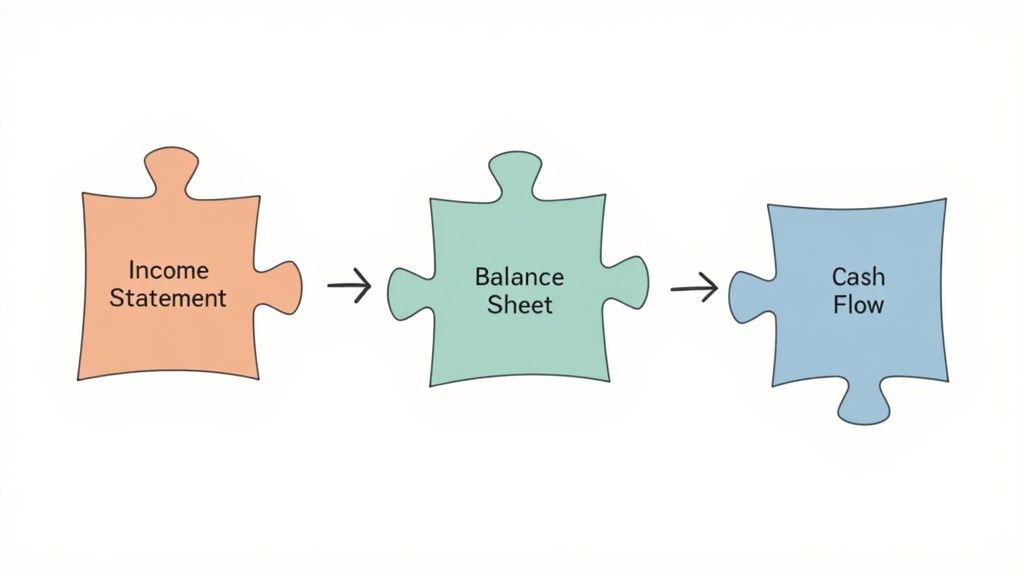
A strong candidate won't just define the income statement, balance sheet, and cash flow statement. They will narrate the story of how a single business transaction flows through all three, demonstrating a holistic understanding of the company's financial engine. This is one of the most revealing interview questions for Chief Financial Officers because it separates rote memorization from true strategic insight.
How to Evaluate the Answer
Look for a structured and logical explanation. The ideal response starts with the income statement, links net income to the balance sheet through retained earnings, and then reconciles net income to actual cash flow on the statement of cash flows.
- Clarity and Structure: Does the candidate define each statement’s purpose before linking them? A top-tier CFO can make these connections accessible to anyone, from the board of directors to junior employees.
- Specific Examples: Do they use a concrete example, like a sale on credit or the purchase of a new asset? A candidate who explains how a $100,000 equipment purchase (and its subsequent depreciation) impacts all three statements showcases practical application.
- Strategic Insight: Do they mention key metrics like working capital or EBITDA and explain how they bridge the gap between profitability and cash position? This highlights a deeper, more strategic level of thinking.
Key Takeaway: A CFO must be a master storyteller with numbers. This question reveals their ability to translate raw financial data into a coherent narrative about the business's performance and position. An articulate, logical, and example-driven answer is a strong indicator of a capable financial leader.
2. How would you approach building the annual budget and forecast for our company?
This question moves beyond technical accounting and into the realm of strategic financial planning and operational leadership. It's designed to gauge a candidate's ability to create a financial roadmap that aligns with the company's overarching goals. An effective CFO doesn't just dictate numbers; they facilitate a collaborative process that builds consensus and accountability across the entire organization.
A top-tier response will detail a clear, multi-stage process, not just a single methodology. They should articulate how they balance top-down strategic targets from leadership with bottom-up, reality-based input from department heads. This is one of the most critical interview questions for Chief Financial Officers because it reveals their experience in translating high-level strategy into an actionable financial plan. A candidate's answer here demonstrates their aptitude for collaboration, strategic thinking, and process management.
How to Evaluate the Answer
A strong answer will be a practical blueprint, not a theoretical lecture. It should show an understanding that a budget is a living document, not a static one.
- Process and Collaboration: Does the candidate outline a clear timeline and emphasize cross-departmental collaboration? They should speak about engaging sales, marketing, and operations to build realistic revenue projections and expense assumptions.
- Methodology and Tools: Do they discuss various budgeting approaches like zero-based, activity-based, or rolling forecasts and explain which might be suitable for your company? Mentioning specific FP&A software or advanced Excel modeling skills is a plus. For a deeper understanding of financial projections, you can learn more about startup financial modeling.
- Strategic Alignment: Can they articulate how the budgeting process supports strategic initiatives? For example, if growth is a key goal, the budget should reflect increased investment in sales and marketing. A candidate who talks about variance analysis and re-forecasting shows a proactive, agile mindset.
Key Takeaway: A CFO must be the architect of the company’s financial plan. Look for a candidate who describes a collaborative, transparent, and data-driven process that ties departmental budgets directly to the company's strategic objectives, ensuring the entire organization is pulling in the same financial direction.
3. Describe a time when you had to present bad financial news to the board or CEO. How did you handle it?
This behavioral question is one of the most critical interview questions for Chief Financial Officers because it moves beyond technical skills to assess leadership, emotional intelligence, and crisis management. A CFO’s role isn't just about celebrating wins; it's about navigating turbulence with transparency and strategic foresight. How a candidate answers reveals their integrity and their ability to maintain stakeholder confidence when it matters most.

Any seasoned executive has faced this scenario. A weak answer focuses on blame or defensiveness. A strong candidate demonstrates ownership, presents a clear-eyed view of the situation, and immediately pivots to a well-reasoned, data-backed action plan. They show they are a strategic partner who brings solutions, not just problems.
How to Evaluate the Answer
Listen for a response that balances candor with a forward-looking, problem-solving mindset. The STAR method (Situation, Task, Action, Result) is a useful framework for the candidate to structure their answer.
- Ownership and Transparency: Did the candidate present the news directly and without sugarcoating? Look for someone who takes responsibility for the finance function's role and is transparent about the root cause, whether it was a market downturn, an operational miss, or an forecasting error.
- Proactive Solution-Focus: Did they arrive at the meeting with the bad news and a proposed solution? A top-tier CFO anticipates questions and brings a detailed action plan, such as a cost-reduction strategy for a revenue shortfall or immediate financing options for a cash flow crunch.
- Emotional Composure: How did they manage the room and their own demeanor? A great CFO remains calm under pressure, answers tough questions factually, and guides the leadership team toward a constructive path forward, preventing panic.
Key Takeaway: A CFO must be a stabilizing force during difficult times. This question separates a mere accountant from a true strategic leader. The ideal candidate proves they can deliver tough messages with integrity, own the situation, and steer the company toward a solution, reinforcing trust in the process.
4. How do you evaluate and manage financial risk in an organization?
This question moves beyond historical reporting and into the realm of strategic foresight. A CFO's role isn't just about counting what has happened; it's about anticipating and mitigating what could happen. This question probes a candidate's ability to identify, assess, and control threats to the company's financial stability and strategic objectives, which is a core function of modern financial leadership.

A truly effective CFO acts as the organization's chief risk architect. They don't just react to market volatility or operational failures; they build a resilient framework that can withstand shocks. This is one of the most critical interview questions for Chief Financial Officers because it reveals their capacity for proactive, strategic thinking versus purely reactive, compliance-driven behavior. It shows whether they can protect the company's assets and enable sustainable growth.
How to Evaluate the Answer
A strong answer will be structured around a clear risk management framework. The candidate should be able to articulate a systematic process, not just a collection of disconnected tactics. They must demonstrate an understanding of the business's specific risk landscape.
- Systematic Approach: Does the candidate talk about a risk management cycle: identification, assessment (qualitative and quantitative), mitigation, monitoring, and reporting? This shows a structured, repeatable process.
- Specific Risk Categories: Do they categorize risks beyond the obvious? Look for mentions of market risk (interest rates, currency), credit risk (customer defaults), operational risk (internal process failures), and liquidity risk (cash flow shortfalls).
- Practical Tools and Examples: Does the candidate mention specific tools like Value at Risk (VaR), stress testing, or scenario analysis? Can they provide a real-world example, like implementing currency hedging for international sales or establishing a credit scoring model for new clients?
- Board-Level Communication: Do they discuss defining a "risk appetite" in collaboration with the board? This demonstrates senior-level strategic alignment and the ability to translate complex risk metrics into business policy. You can learn more about comprehensive risk management strategies.
Key Takeaway: A top-tier CFO doesn't aim to eliminate risk but to manage it intelligently. An answer that details a robust, proactive framework for identifying, measuring, and mitigating financial threats indicates a candidate who can safeguard the company's future while pursuing growth.
5. What metrics do you use to measure and improve working capital management?
This question shifts the focus from high-level financial reporting to operational effectiveness. It probes a candidate's ability to manage the lifeblood of the business: cash. Strong working capital management is critical for liquidity, profitability, and sustainable growth, and a potential CFO must demonstrate expertise in optimizing it.
A candidate's answer reveals their hands-on experience and their strategic approach to balancing efficiency with essential business relationships. It shows whether they can dive into the weeds of daily operations to unlock cash tied up in the business cycle. This is one of the more practical interview questions for Chief Financial Officers, as it directly relates to day-to-day financial health and operational control.
How to Evaluate the Answer
Listen for a response that goes beyond simply listing metrics. The best candidates will discuss the interplay between these metrics and provide concrete examples of how they've improved them in past roles. They should articulate a clear strategy, not just a list of KPIs.
- Comprehensive Framework: Does the candidate anchor their answer in the Cash Conversion Cycle (CCC)? Discussing its components, Days Sales Outstanding (DSO), Days Inventory Outstanding (DIO), and Days Payables Outstanding (DPO), shows a structured and holistic understanding.
- Actionable Examples: Do they provide specific instances of process improvement? For example, describing how they reduced DSO by renegotiating customer payment terms or implementing an automated invoicing system demonstrates practical problem-solving skills.
- Balanced Perspective: Does the candidate acknowledge the trade-offs? Aggressively extending DPO can damage supplier relationships, while slashing inventory could lead to stockouts. A strategic CFO will discuss how to optimize these levers without negatively impacting the business.
Key Takeaway: An effective CFO doesn't just monitor working capital; they actively manage it. Look for a candidate who can articulate a clear, multi-faceted strategy for improving the cash conversion cycle, supported by specific examples of initiatives they have led and the results they achieved.
6. How would you approach a potential merger or acquisition from a financial perspective?
This question moves beyond daily operations into the realm of strategic growth and corporate development. It's designed to evaluate a candidate's ability to not only analyze a complex transaction but also to lead the financial charge from initial assessment to post-merger integration. For a CFO, M&A is a high-stakes activity where financial rigor directly impacts long-term value creation or destruction.
A candidate's response reveals their strategic mindset, technical valuation skills, and practical experience in due diligence and integration. This is one of the most critical interview questions for Chief Financial Officers in growth-oriented companies, as it probes their capacity to act as a key architect of the company's future. A top-tier candidate will outline a clear, multi-stage process, demonstrating both caution and strategic vision.
How to Evaluate the Answer
Listen for a structured, phased approach that covers the entire M&A lifecycle. The best answers go beyond just valuation and touch upon strategic fit, risk mitigation, and the critical integration phase.
- Structured Framework: Does the candidate break down their approach into logical phases? Look for key stages like strategic alignment, valuation, due diligence, negotiation, and post-merger integration. This shows a methodical and disciplined mind.
- Valuation Acumen: Do they discuss multiple valuation methodologies, such as Discounted Cash Flow (DCF), comparable company analysis, and precedent transactions? Bonus points if they mention quantifying synergies and incorporating them into the valuation.
- Risk Awareness: A strong CFO is also a chief risk officer. Do they mention identifying and mitigating risks during due diligence, covering financial, tax, legal, and operational areas? Their answer should reflect a healthy skepticism and a focus on protecting the company.
- Integration Focus: Does the candidate talk about post-deal success? Mentioning the importance of planning for the integration of financial systems, teams, and processes shows they understand that the deal isn't "done" when the papers are signed.
Key Takeaway: A CFO must be the financial steward of any M&A activity, ensuring that the strategic rationale is backed by sound financial analysis and a realistic integration plan. An answer that methodically walks through the entire process, from strategy to synergy realization, signals a candidate ready for this high-level responsibility.
7. How do you stay current with accounting standards and regulatory changes?
This question moves beyond historical performance and technical skills to assess a candidate's proactive commitment to compliance and continuous learning. The financial landscape is in constant flux, with new regulations, tax laws, and accounting standards emerging regularly. A CFO who isn't actively staying informed poses a significant risk to the organization.
The answer reveals a candidate's personal discipline, their professional network, and the systems they have in place to not only absorb new information but also disseminate it effectively across their team. Among the many interview questions for Chief Financial Officers, this one specifically probes for foresight and risk management, crucial traits for navigating an ever-evolving regulatory environment.
How to Evaluate the Answer
A strong response will be specific and multi-faceted, demonstrating a blend of formal education, professional engagement, and practical application. Vague answers like "I read the news" are a major red flag.
- Specific Sources: Does the candidate name their sources? Look for mentions of subscriptions to publications from the FASB or SEC, and memberships in professional organizations like the AICPA or IMA.
- Systematic Approach: Do they describe a process? An ideal candidate might mention attending annual conferences, participating in webinars, or being part of a CFO peer group where regulatory changes are discussed. This shows a structured, rather than reactive, approach.
- Practical Application: Can they cite a recent example? A candidate who discusses how they prepared their previous company for a change like ASC 842 (lease accounting) or a new tax law demonstrates they don't just learn the rules, they implement them. This shows they can translate theory into action.
- Team Development: Do they mention how they cascade this knowledge to their finance team? This highlights their leadership and commitment to building a well-informed and compliant department.
Key Takeaway: A top-tier CFO must be a vigilant guardian of the company’s compliance. An answer that details specific resources, systematic processes, and recent examples of implementation proves the candidate is not just qualified for today's challenges but is also prepared for tomorrow's.
8. Describe your experience with fundraising and investor relations
For growth-stage companies, private equity-backed firms, and public corporations, this question cuts to the heart of a CFO's strategic value. A CFO isn't just a steward of existing capital; they are a primary driver in securing new capital to fuel growth, acquisitions, and innovation. This question probes their ability to navigate the complex world of capital markets and manage crucial external relationships.
A candidate's answer reveals their strategic acumen, network, and communication prowess. It's one of the most critical interview questions for Chief Financial Officers because it directly assesses their capacity to build the financial foundation for the company's future. The ability to articulate a compelling financial narrative to sophisticated investors is a non-negotiable skill for a modern CFO.
How to Evaluate the Answer
Listen for specifics regarding the type of capital raised, the process managed, and the outcomes achieved. A great answer will demonstrate a clear understanding of the company's capital needs and the best instruments to meet them.
- Breadth and Depth of Experience: Has the candidate managed different types of fundraising, such as a Series B venture round, issuing public debt, or securing a private credit facility? Their experience should align with your company's current stage and future ambitions. For instance, a candidate with deep experience in private equity fundraising can be invaluable for a company considering that path.
- Process Ownership: Do they describe their role as a leader in the process? Look for mentions of creating the investor deck, building the financial model, managing the due diligence data room, and negotiating term sheets. This shows they were in the driver's seat, not just a passenger.
- Investor Relations Finesse: Beyond the initial fundraise, how do they talk about ongoing investor relations? A strong CFO maintains proactive communication through quarterly updates, earnings calls, and annual reports, building trust and transparency. They should be able to discuss how they manage expectations and communicate both good and bad news effectively.
Key Takeaway: A top-tier CFO is a credible and persuasive ambassador to the financial community. Their ability to successfully raise capital and manage investor relationships is a direct reflection of their strategic influence and their capacity to secure the resources necessary for long-term success.
CFO Interview Questions Comparison
| Item Title | Implementation Complexity 🔄 | Resource Requirements ⚡ | Expected Outcomes 📊 | Ideal Use Cases 💡 | Key Advantages ⭐ |
|---|---|---|---|---|---|
| Walk me through the key financial statements and how they're interconnected | Medium – requires solid accounting knowledge | Moderate – knowledge and communication skills | Clear understanding of financial interdependencies | Assess foundational accounting and communication skills | Quickly identifies strong technical foundation |
| How would you approach building the annual budget and forecast for our company? | High – involves strategic planning and collaboration | High – cross-functional engagement and tools | Aligned financial goals with business strategy | Evaluate budgeting methodology and leadership style | Demonstrates practical CFO responsibilities and process improvement thinking |
| Describe a time when you had to present bad financial news to the board or CEO | Medium – behavioral, communication under pressure | Moderate – requires preparation and composure | Insight into crisis management and stakeholder handling | Test leadership, emotional intelligence, and problem-solving | Reveals solution-oriented thinking and transparency |
| How do you evaluate and manage financial risk in an organization? | High – requires strategic risk knowledge | High – quantitative tools and frameworks | Effective risk identification and mitigation | Evaluate enterprise risk management and strategic thinking | Demonstrates comprehensive financial and analytical skills |
| What metrics do you use to measure and improve working capital management? | Medium – operational finance focus | Moderate – KPI monitoring and process improvements | Improved cash flow and operational efficiency | Assess operational finance and cash flow optimization | Shows practical impact on cash flow and profitability |
| How would you approach a potential merger or acquisition from a financial perspective? | Very High – complex transaction experience | High – due diligence, valuation, integration | Successful M&A execution and value creation | Evaluate corporate development and strategic transactions | Demonstrates strategic analysis and project management |
| How do you stay current with accounting standards and regulatory changes? | Low to Medium – ongoing learning commitment | Low – access to resources and networks | Up-to-date compliance and adaptation to regulations | Assess commitment to continuous professional development | Shows professionalism and systematic knowledge update |
| Describe your experience with fundraising and investor relations | Medium to High – requires capital markets knowledge | Moderate to High – investor communication and networking | Successful capital raising and investor relationships | Evaluate fundraising experience and stakeholder management | Reveals network strength and strategic financing skills |
Finding Your Next Financial Leader: A Strategic Approach
Selecting the right Chief Financial Officer is one of the most consequential decisions your organization will make. It extends far beyond finding a candidate who can simply read a P&L statement. The comprehensive set of interview questions for chief financial officers detailed in this guide serves as your strategic framework for uncovering a true financial leader, not just a technical expert.
The goal is to move beyond rehearsed answers and probe into a candidate's core capabilities. You are looking for a partner who can translate complex financial data into a clear, actionable story for the entire leadership team and the board. Their ability to manage risk, optimize working capital, and guide the company through critical events like fundraising or an acquisition will directly shape your trajectory.
From Interview to Strategic Partnership
As you conduct your interviews, pay close attention to the how behind each answer. A great CFO candidate won’t just describe what they did; they will articulate why they chose a specific approach, what alternatives they considered, and what they learned from the outcome. Look for a consistent pattern of proactive leadership, data-centric decision-making, and transparent communication, especially when delivering difficult news.
Your evaluation should center on three core pillars that emerged from these questions:
- Strategic Vision: Can they see beyond the numbers on a spreadsheet and connect financial strategy to broader business objectives? Their approach to budgeting, forecasting, and M&A will reveal their capacity for forward-thinking leadership.
- Operational Excellence: How effectively can they manage the engine of the business? Questions about working capital, internal controls, and staying current with regulations will highlight their ability to build a resilient and efficient finance function.
- Stakeholder Influence: A CFO must inspire confidence. Their experience with investor relations, board presentations, and securing capital demonstrates their ability to act as a credible and compelling ambassador for your company's financial health.
The Modern Approach to Financial Leadership
Ultimately, the right CFO aligns with your company’s unique stage, culture, and strategic goals. For many startups, small businesses, and even established companies exploring new initiatives, the traditional full-time executive model can be a significant financial and operational burden. The modern business landscape demands agility and cost-efficiency without sacrificing expertise.
This is precisely where the fractional executive model provides a powerful advantage. By engaging a fractional CFO, you gain immediate access to top-tier strategic guidance when you need it most, whether for a fundraising round, a system implementation, or ongoing financial oversight. This approach allows you to secure the critical financial leadership necessary to scale effectively, manage capital wisely, and build a sustainable future, all while maintaining financial flexibility. Using this structured interview process will empower you to make a confident, strategic choice for this pivotal role, regardless of the engagement model you choose.
Ready to find the expert financial leadership your business needs without the full-time cost? Shiny connects you with a marketplace of vetted, world-class fractional executives who can drive growth and profitability. Explore our network of fractional CFOs and discover how you can gain top-tier strategic guidance on demand.