

Lifetime Value SaaS: Mastering lifetime value saas for Sustainable Growth
In the world of SaaS, Lifetime Value (LTV) is the total amount of money you can reasonably expect to earn from a single customer over their entire time with you. It's a forward-looking metric that cuts through the noise of short-term wins, like monthly recurring revenue, to measure the real, long-term health of your subscription business.
Why LTV Is Your SaaS Company's North Star Metric

Picture yourself flying a state-of-the-art jet at 30,000 feet. Your dashboard shows speed (MRR) and altitude (user count) are looking great. But if you have no idea how much fuel is in the tank, you're flying blind and heading for disaster.
That’s what running a SaaS company without a firm grip on Lifetime Value (LTV) is like. LTV is the fuel gauge for your growth engine.
Landing a new customer always feels like a win, but it’s just the opening chapter. If you only focus on acquisition without understanding LTV, you’ll end up with a classic "leaky bucket." You burn cash to bring new customers in, only to watch them—and their future revenue—walk out before you've even broken even on what you spent to get them.
The Strategic Importance of LTV
Getting your LTV calculation right isn't just a finance exercise; it gives you the strategic clarity to make smarter decisions across the entire business. Think of it less as a metric and more as a compass that guides your most critical functions.
A solid understanding of lifetime value saas helps you:
- Justify Marketing Spend: It tells you precisely how much you can afford to spend on acquiring a new customer (Customer Acquisition Cost, or CAC) and still turn a profit.
- Prioritize Product Development: When you know which customer segments have the highest LTV, you can confidently point your product roadmap toward features that serve and retain those high-value users.
- Refine Customer Retention Strategies: LTV puts a dollar amount on the impact of churn. Even a small improvement in retention can cause a massive jump in LTV.
- Attract Investors: For VCs and stakeholders, a healthy LTV is a clear sign of a strong business model, good product-market fit, and a scalable path to growth.
In short, LTV shifts your company’s entire mindset from chasing short-term gains to building long-term, sustainable value. Your goal becomes less about simply acquiring customers and more about building profitable, lasting relationships.
Ultimately, LTV is the North Star that aligns everyone—from marketing and sales to product and customer success—on a single, unified mission: building a resilient and profitable company. Without it, you’re just guessing. With it, you can navigate the path to sustainable growth with confidence. This is where seasoned leadership, like a fractional executive, becomes invaluable, guiding your teams to pull the right levers that directly boost this foundational metric.
How to Accurately Calculate SaaS LTV
Getting beyond a vague guess at your Customer Lifetime Value (LTV) is the first step toward making it a truly powerful strategic tool. A solid calculation turns a fuzzy concept into a hard number that can guide your marketing spend, product roadmap, and retention efforts.
While there are a few ways to slice it, let's start with the basics. The simplest formula gives you a quick snapshot by leaning on two core metrics you should already be tracking.
Simple LTV Formula:
LTV = Average Revenue Per Account (ARPA) / User Churn Rate
This approach estimates how long a customer will stick around (the inverse of your churn rate) and multiplies that by the average revenue they bring in. It's a great starting point for early-stage companies needing a baseline.
Breaking Down the Basic Formula
Let’s use an analogy. Imagine you run a coffee shop. You know the average customer spends $5 per visit (ARPA) and that 10% of your regulars stop coming each month (Churn Rate). Your LTV would tell you the total value of an average customer over their entire "subscription" to your coffee.
Here's how it works for a SaaS business, using a fictional project management tool, "SyncUp":
- Average Revenue Per Account (ARPA): If SyncUp has $50,000 in MRR from 500 customers, its ARPA is $100.
- User Churn Rate: If SyncUp loses 25 of its 500 customers in a month, its monthly churn rate is 5% (or 0.05).
Plugging these numbers into the formula, SyncUp's simple LTV is:
LTV = $100 / 0.05 = $2,000
This tells SyncUp that, on average, each new customer is worth $2,000. That single number is incredibly powerful, immediately helping answer critical questions about what's reasonable to spend on acquiring that customer.
A More Accurate Model: Factoring in Gross Margin
The simple formula is a decent start, but it has a major flaw: it treats all revenue as pure profit. It ignores the real costs of delivering your service—like hosting fees, third-party software licenses, and customer support salaries.
To get a truer picture of profitability, you must bring Gross Margin into the equation. This adjusts your LTV to reflect the actual value a customer generates after accounting for the direct costs of serving them.
The formula gets a simple but critical update:
Gross Margin LTV Formula:
LTV = (ARPA x Gross Margin %) / User Churn Rate
Let's go back to SyncUp. If its Cost of Goods Sold (COGS) is 20%, its Gross Margin is 80% (or 0.80).
Now, the calculation looks quite different:
LTV = ($100 x 0.80) / 0.05 = $80 / 0.05 = $1,600
This is a much more realistic number. By factoring in Gross Margin, SyncUp now understands that the profitable lifetime value of an average customer is $1,600, not $2,000. That 20% drop has huge implications for budgeting and setting a sustainable Customer Acquisition Cost (CAC).
For a deeper dive into the metrics that drive these calculations, our guide on key performance indicators for startups provides a solid foundation.
Advanced Calculation: Segmenting by Customer Plan
An even smarter approach acknowledges a simple truth: not all customers are created equal. Customers on an "Enterprise" plan will almost certainly have a higher ARPA and lower churn than those on a "Basic" plan. Lumping them all together hides crucial insights.
Segmenting LTV by customer plan gives you much more granular, actionable data. Let's imagine SyncUp offers two tiers with different profiles:
| Metric | Basic Plan | Enterprise Plan |
|---|---|---|
| ARPA | $50 | $300 |
| Churn Rate | 6% (0.06) | 2% (0.02) |
| Gross Margin | 80% (0.80) | 80% (0.80) |
Now, we calculate the LTV for each segment:
- Basic Plan LTV: ($50 x 0.80) / 0.06 = $667
- Enterprise Plan LTV: ($300 x 0.80) / 0.02 = $12,000
The difference is staggering. This analysis reveals an Enterprise customer is worth nearly 18 times more than a Basic customer. This insight is a game-changer, allowing SyncUp to confidently invest more in sales and marketing channels that attract high-value clients.
This granular approach is exactly where experienced fractional finance or growth leaders provide immense value. They can help you dissect the data to uncover your most profitable pathways to growth.
Comparing LTV Calculation Models
Choosing the right LTV model depends on your company's stage and the precision you need for strategic decisions.
| Calculation Model | Formula | Best For | Pros | Cons |
|---|---|---|---|---|
| Simple LTV | ARPA / Churn Rate | Early-stage startups needing a quick baseline. | Easy to calculate; provides a fast directional metric. | Overstates value by ignoring service costs (COGS). |
| Gross Margin LTV | (ARPA x Gross Margin %) / Churn Rate | Growth-stage companies focused on profitable unit economics. | More accurate reflection of profitability; better for CAC decisions. | Requires accurate COGS calculation, which can be tricky. |
| Segmented LTV | (ARPA x Gross Margin %) / Churn Rate, per segment | Mature businesses with multiple customer tiers or plans. | Reveals which customer segments are most valuable; highly actionable. | More complex to track and requires clean, segmented data. |
Ultimately, the goal is to move from simple averages to more nuanced models as your business grows. Each step up in complexity gives you a clearer, more actionable picture of your company's financial health.
Understanding the Critical LTV to CAC Ratio
Calculating your Lifetime Value (LTV) is only half the story. On its own, the number is interesting, but it becomes truly powerful when you pair it with another key metric: Customer Acquisition Cost (CAC).
The relationship between these two, expressed as the LTV to CAC ratio, is the ultimate health check for your SaaS business model.
Think of it this way: for every dollar you spend to win a new customer, how many dollars do you get back over their entire relationship with you? This simple ratio tells you if your growth engine is profitable—or if you're just burning cash on a hamster wheel.
This visual flow shows the core components that feed into your LTV calculation, starting with Average Revenue Per Account (ARPA) and factoring in customer Churn Rate.
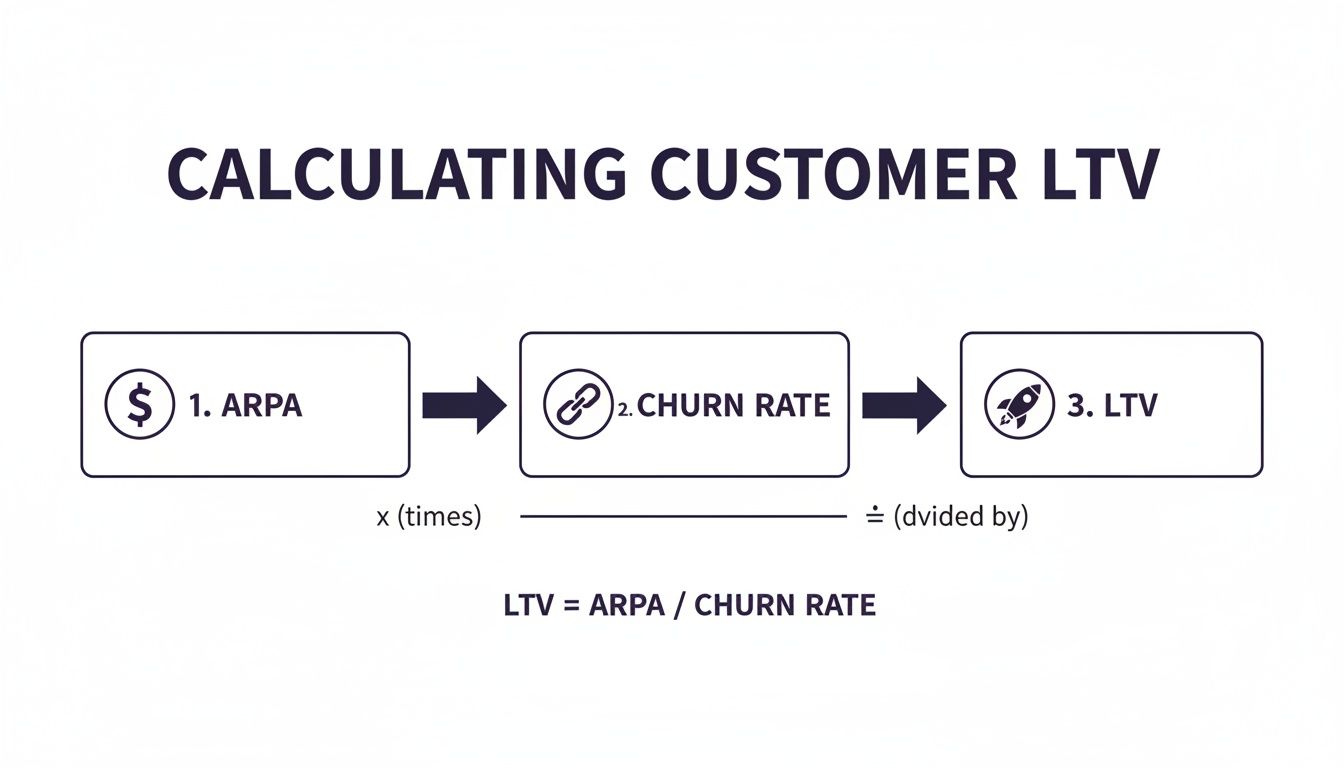
This process really highlights how revenue and retention are the two fundamental levers that determine the long-term value you can pull from each customer.
Decoding the Ratios
Knowing the numbers is one thing, but understanding what they mean is what drives smart decisions. A huge LTV doesn't mean much if it costs you even more to land that customer in the first place.
Here’s a quick breakdown of what you’re looking at:
- LTV:CAC below 1:1: This is a major red flag. You're losing money on every single customer you bring in. Your business model is fundamentally broken and won't survive without immediate, drastic changes.
- LTV:CAC at 1:1: You're breaking even. While it’s better than losing money, you have zero profit left over to reinvest in your product, team, or marketing. You’re essentially treading water.
- LTV:CAC of 3:1 or higher: Now we're talking. This is widely seen as the gold standard for a healthy, scalable SaaS business. It means for every dollar you invest in acquisition, you generate three dollars in value. That’s a strong foundation for profitable growth.
This ratio is a core pillar of your company's financial health. To get the full picture, you need a solid grasp of your business's core drivers, which you can dive into by exploring the fundamentals of unit economics in our detailed guide.
Why 3-to-1 Is the Magic Number
That 3:1 ratio isn't just an arbitrary benchmark; it represents a critical balance point for a SaaS company.
It proves you have enough margin to cover all your operational costs—like R&D, salaries, and G&A—and still have healthy profit left over to pour back into scaling the business. It’s the sign of a truly durable growth engine.
A golden benchmark in SaaS sustainability is the LTV to CAC ratio, where top-performing companies maintain at least a 3:1 ratio—meaning the lifetime value of a customer should be three times the cost to acquire them.
This isn't just theory. Recent industry reports show this metric is non-negotiable for healthy unit economics. Some sectors, like Adtech, are hitting an impressive 7:1, while others like Business Services are right around that crucial 3:1 mark.
This is exactly where an experienced fractional executive becomes a game-changer. A fractional CFO or CRO can analyze your LTV and CAC with a trained eye, quickly spotting opportunities to either lower acquisition costs or increase customer value. They bring the senior-level expertise needed to optimize this crucial ratio without the sticker shock of a full-time hire.
By truly understanding your LTV:CAC ratio, you gain the confidence to scale your marketing and sales efforts effectively, ensuring every dollar spent is a smart investment in sustainable, long-term success.
Four Proven Levers to Increase Your SaaS LTV
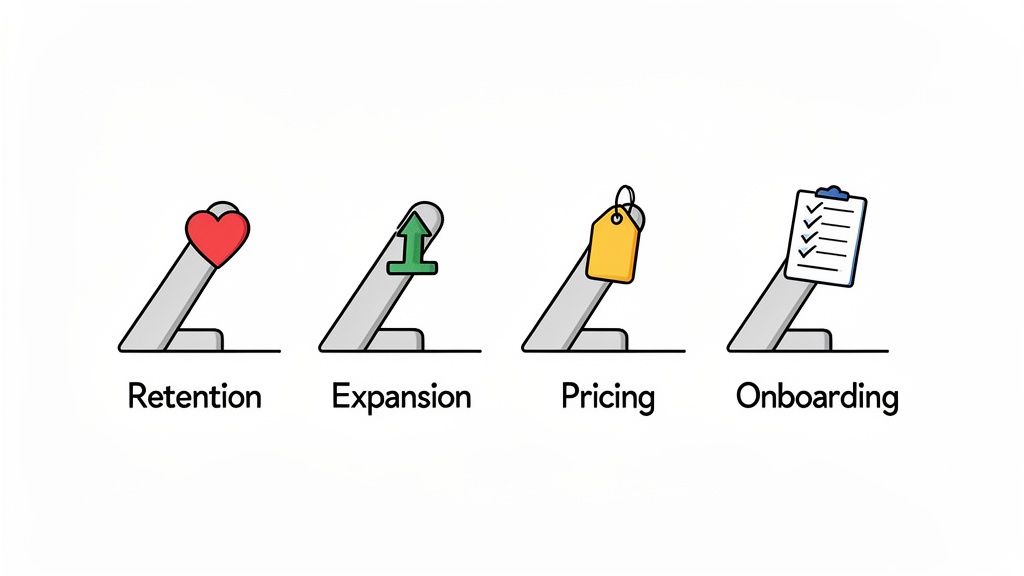
Knowing your LTV is just the starting line. The real race is won by actively improving it. The good news is that small, focused improvements in a few key areas can have a massive compounding effect on your bottom line.
Forget chasing every shiny new tactic. The most successful SaaS businesses concentrate their efforts on four primary levers. These are the areas where a little strategic muscle yields the biggest returns in LTV growth.
1. Boost Retention and Reduce Churn
This is it. The single most powerful thing you can do to increase LTV is to get better at keeping the customers you already have. When customers stay longer, they pay longer—directly driving up their lifetime value. Churn is the silent killer of LTV.
Retention is the bedrock of a healthy SaaS model. A modest 5% increase in customer retention can boost profits by 25% to a staggering 95%. This isn't just a catchy statistic; it’s a fundamental truth rooted in the simple math of customer lifespans. For example, dropping your churn from 5% to 4% extends the average customer relationship from 20 months to 25. That's a huge win. You can dig deeper into mastering customer lifetime value on Sparkco.ai.
Actionable Tactic: Implement a proactive customer success program. Use product usage data to spot accounts with low engagement—a classic warning sign of churn—and reach out with targeted training, helpful resources, or a strategic check-in call.
Primary KPI to Track: Net Revenue Churn. This metric tells you if the new revenue from your existing customers is outpacing the revenue you're losing from cancellations.
2. Drive Expansion Revenue
The second lever is all about increasing the "V" in LTV—the value. Expansion revenue, also known as Net Revenue Retention (NRR) or "negative churn," comes from getting your happy, existing customers to spend more with you over time. It's always cheaper and easier to sell more to a current customer than to acquire a brand new one.
There are two classic ways to make this happen:
- Upselling: Nudging customers to upgrade to a higher-tier plan that offers more features, higher usage limits, or premium support.
- Cross-selling: Offering complementary products or add-on features that solve another problem for the customer, right within your ecosystem.
Think of a project management tool. They could upsell a growing team from their "Standard" plan to a "Premium" plan with advanced reporting. At the same time, they could cross-sell a separate time-tracking module that plugs right into their main platform.
3. Optimize Your Pricing and Packaging
Pricing is one of the most neglected yet most powerful levers for LTV growth. So many founders set their prices early on and then never touch them again, leaving money on the table. Your pricing should be a living reflection of the value you deliver.
One of the best strategies here is value-based pricing. This means your pricing tiers are tied to a tangible outcome for your customer, not just a list of features. For example, a marketing automation platform might base its pricing on the number of contacts in a user's database, directly linking their cost to their own growth.
Actionable Tactic: Build a scaling value metric right into your pricing. Your pricing should have a natural escalator. As your customers grow and get more value, their subscription fee grows with them. This aligns your success directly with theirs.
Primary KPI to Track: Average Revenue Per Account (ARPA). As you nail your pricing and drive expansion, you should see a steady increase in the average amount you earn from each customer every month.
4. Perfect the Onboarding Experience
A customer's first 30 days are make-or-break. A confusing or frustrating onboarding process is a fast track to early churn. On the flip side, a seamless and effective onboarding experience lays the foundation for long-term loyalty and high LTV.
The goal isn't just to show users where the buttons are. It's about getting them to their first "Aha!" moment—that magical point where they truly feel the core value of your product—as quickly and painlessly as possible.
Actionable Onboarding Tactics:
- Personalized In-App Tours: Ditch the generic tour. Guide new users through the specific steps they need to take to solve their primary problem.
- Welcome Email Sequences: Set up a series of helpful, educational emails that reinforce key features and share tips for success over their first few weeks.
- Proactive Support: Offer live chat or a scheduled onboarding call. Make new customers feel like you've got their back from day one.
These four levers—retention, expansion, pricing, and onboarding—are all interconnected. Great onboarding leads to better retention. Better retention creates more opportunities for expansion. And a smart pricing strategy holds it all together.
Actionable LTV Growth Tactics and KPIs
| Lever | Actionable Tactic Example | Primary KPI to Track |
|---|---|---|
| Retention | Use engagement data to proactively reach out to at-risk accounts with targeted support. | Net Revenue Churn |
| Expansion | Introduce a higher-tier plan with premium features and create an upsell path for growing customers. | Net Revenue Retention (NRR) |
| Pricing | Tie pricing tiers to a value metric that scales with customer usage (e.g., contacts, projects, users). | Average Revenue Per Account (ARPA) |
| Onboarding | Develop personalized in-app guides that lead users to their first key value moment ("Aha!"). | Time to Value (TTV) & 30-Day Retention |
Focusing your strategic efforts here can systematically lift your LTV and build a far more profitable, durable business.
But finding the right expertise to pull these levers effectively can be tough. If you need to implement these strategies but lack the senior-level bandwidth, our fractional executive marketplace can connect you with the right growth, customer success, or finance leader to accelerate your results, quickly and cost-effectively.
Using Fractional Leadership to Accelerate LTV Growth
Knowing which levers to pull to increase your LTV is one thing. Actually having the senior-level firepower to execute is a completely different ballgame.
It’s a classic growth-stage dilemma. You know you need to overhaul your customer success motion or re-engineer your pricing, but you can't stomach the $400,000+ annual cost of a full-time C-suite executive. You need world-class strategic talent, but the budget simply isn’t there.
So, how do you get the right expertise, at the right time, without breaking the bank?
The Power of On-Demand Expertise
This is where fractional leadership becomes a game-changer for SaaS companies. Instead of a massive financial commitment, you can bring in a seasoned executive for a fraction of the time and cost—typically 5 to 25 hours a week. This model gives you immediate access to specialized, C-suite talent to solve specific, high-impact problems tied directly to your LTV.
Just imagine what you could accomplish:
- A Fractional Chief Revenue Officer (CRO) could spend a quarter overhauling your retention engine and implementing proactive strategies to get churn under control.
- A Fractional Chief Marketing Officer (CMO) can redesign pricing tiers, building in the value metrics that actually drive expansion revenue.
- A Fractional Chief Financial Officer (CFO) can build the sophisticated cohort models needed to pinpoint your most profitable customer segments, guiding smarter acquisition spending.
This approach offers a powerful, cost-effective way to execute the very LTV-boosting initiatives we've been talking about. You can learn more about how this flexible leadership model works in our detailed guide.
From Strategy to Execution, Fast
The real beauty of fractional leadership is the speed to impact. These aren't consultants who drop off a 100-page slide deck and disappear. A fractional executive rolls up their sleeves and becomes a part of your team, owning the execution and the results.
They’ve spent decades solving the exact LTV challenges you're staring down right now.
By engaging a fractional leader, you get to de-risk the entire hiring process. You bypass the long, expensive search for a full-time executive and get precisely the expertise you need, for as long as you need it, allowing you to jump on LTV growth opportunities immediately.
This isn't just about saving money; it’s about strategic agility. It lets you address critical growth areas with focused, senior-level attention without the long-term financial burden. Whether you need to fix a leaky customer bucket or unlock hidden revenue streams, a fractional leader provides the targeted firepower to make it happen.
Where Do You Go From Here?
This guide has laid out the roadmap: SaaS lifetime value is much more than a metric—it's the blueprint for building a resilient, profitable company. The big takeaways are simple: accurate calculations are your foundation, the LTV:CAC ratio is your North Star for growth, and laser-focusing on retention, expansion, pricing, and onboarding will pay off in spades.
Mastering LTV is what separates the SaaS companies that merely survive from those that truly thrive. When you have a deep understanding of your LTV, you can invest with confidence, prioritize the right product features, and build a growth engine that actually lasts. It shifts the entire team's mindset from just closing deals to building relationships.
Turning Knowledge Into Action
The Pareto principle is alive and well in software. It's not uncommon for 20% of a SaaS company's customers to drive a staggering 80% of its total revenue. This just hammers home how critical it is to find and nurture your best accounts. You can dig into more customer value statistics and learn about the 80/20 rule on Tipsonblogging.com.
For founders ready to turn these insights into real results, the next step is all about execution. Knowing what to do is one thing; having the right person to actually get it done is something else entirely.
This is where bringing in targeted leadership can be a game-changer. For founders looking to level up their strategy, the logical next step is exploring how a vetted fractional executive can inject the exact expertise needed to accelerate LTV growth—without the full-time cost.
A quick chat can help you pinpoint your company's unique challenges and map out a clear path forward, making sure you have the right talent in your corner to turn big growth ambitions into reality.
Questions We Hear All the Time About SaaS LTV
When you're in the weeds of running a SaaS business, navigating the specifics of Lifetime Value can feel tricky. Here are some of the most common questions we get from founders and leadership teams, along with practical, no-fluff answers.
What Is a Good LTV for a SaaS Company?
There isn't a single magic number here, but a healthy, widely-accepted benchmark is an LTV:CAC ratio of at least 3:1. This means you’re generating three dollars in lifetime value for every dollar you spend to acquire a customer. If you're dipping below that, it could be a red flag for your pricing, churn, or customer acquisition strategy.
The truly elite SaaS companies? They're often hitting a 5:1 ratio or even higher.
But remember, context is king. A "good" LTV depends heavily on who you're selling to (SMBs vs. Enterprise), your industry, and your specific business model. The most important thing is to track your LTV consistently and make sure it's always improving relative to your CAC.
How Often Should We Calculate LTV?
For most SaaS businesses, running the numbers on a monthly or quarterly basis is the sweet spot. This cadence is frequent enough to spot trends and see the real impact of changes you're making—like a new onboarding sequence or a price adjustment.
- Monthly calculations give you that immediate feedback loop, perfect for rapid iteration and course correction.
- Quarterly calculations smooth out the short-term noise and provide a more stable, big-picture view.
At a bare minimum, LTV and cohort analysis should be a core part of your quarterly business reviews. If you're an early-stage startup still dialing in product-market fit, you might even want to look at it more often as you tweak your go-to-market engine.
Can LTV Be Negative, and What Should I Do?
Technically, if you're calculating LTV based on gross margin, it could be negative if your cost of service is higher than your revenue. That's pretty rare, though. The far more common—and dangerous—scenario is having a positive LTV that's still lower than your Customer Acquisition Cost (CAC).
If your LTV:CAC ratio is less than 1:1, you are actively losing money on every single customer you bring on board. This is a five-alarm fire that requires immediate action.
You have to get to the root cause, and fast. Is churn out of control? Are your prices way too low? Are you burning cash on inefficient acquisition channels? Your immediate game plan should be a two-pronged attack: go all-in on improving retention and finding upsell opportunities, while simultaneously pulling every lever you can to lower your CAC.
Knowing is one thing, doing is another. Shiny connects you with a vetted, fractional executive who has the targeted expertise to turn these insights into a concrete action plan and accelerate your LTV growth.
Find out how the right leader can help you chart a path to sustainable success. Schedule a consultation today.
