8 Crucial Marketing Executive Interview Questions to Find a Growth Leader
Finding the right marketing executive can fundamentally change your company's growth trajectory. A great leader doesn't just manage campaigns; they are a strategic partner who builds revenue engines, crafts compelling brand narratives, and inspires high-performing teams. But how do you identify this person?
The stakes are incredibly high. A mis-hire at this level can cost millions in lost revenue, wasted marketing spend, and damaged team morale. This is especially true for scaling businesses where every dollar and every decision counts.
This guide moves beyond generic questions to provide a strategic framework for your interview process. We'll break down eight essential marketing executive interview questions designed to probe a candidate's strategic depth, leadership style, financial acumen, and adaptability. More importantly, we'll explain what to look for in their answers—the subtle cues that reveal a data-driven, growth-oriented mindset.
But what if you're not ready for the six-figure commitment of a full-time executive? The fractional leadership model offers a powerful alternative, giving you access to elite, pre-vetted talent without the full-time price tag. Think of it as hiring a world-class pilot for the most critical leg of your journey. Let’s dive into the questions that will help you find the transformative marketing leader your business needs.
1. Tell me about a successful marketing campaign you've managed from start to finish
This classic behavioral question is one of the most revealing marketing executive interview questions you can ask. It’s a direct request for proof of performance, moving beyond theory to gauge a candidate's real-world ability to strategize, execute, and deliver measurable business impact.
A strong answer demonstrates end-to-end project ownership and a results-oriented mindset.

You're not just looking for a good story. You're assessing their strategic thought process, their grasp of the complete marketing lifecycle, and their ability to connect activities directly to revenue. The best candidates won’t just talk about creative ideas; they’ll frame the campaign within a larger business context.
What to Listen For
A compelling answer will be structured, data-rich, and insightful. An executive-level candidate should be able to articulate not just what they did, but why they did it and what the ultimate business outcome was.
- Strategic Framework: Do they use a clear structure like the STAR method (Situation, Task, Action, Result)? This shows organized thinking.
- Quantifiable Results: Look for specific metrics. Instead of "it increased engagement," a great answer sounds like, "it increased our lead-to-customer conversion rate from 3% to 5.5% in six months, adding $250K in new pipeline."
- Problem-Solving: Do they mention challenges and how they navigated them? This reveals resilience and adaptability. A campaign that went perfectly is rare and less insightful.
- Cross-Functional Collaboration: Did they mention working with sales, product, or finance? This is critical for an executive role where alignment is key.
Analogy: A good manager describes the ingredients of a cake. A great executive explains how that cake drove sales at the bakery and why they chose chocolate instead of vanilla based on customer data.
For growing businesses, finding a leader with this proven track record is non-negotiable. Whether you're hiring full-time or considering a flexible fractional CMO, this question helps separate the strategists from the tacticians.
2. How do you measure marketing ROI and what metrics do you prioritize?
This is one of the most critical marketing executive interview questions because it cuts straight to the financial core of the role. An executive isn't just a creative leader; they are a business leader responsible for turning marketing spend into profitable growth.
This question separates candidates who focus on activity (vanity metrics) from those who focus on impact (business outcomes).

A strong answer reveals a candidate’s business acumen and ability to speak the language of the C-suite. They should demonstrate a clear understanding of how marketing investments connect directly to the company's P&L statement. For a growing business, a leader who can prove and optimize ROI is the key to sustainable, efficient scaling.
What to Listen For
A top-tier candidate will provide a nuanced answer that starts with high-level business goals and drills down into specific metrics.
- Business-First Approach: Do they begin with top-line business metrics like revenue growth, customer lifetime value (LTV), and customer acquisition cost (CAC)? This shows they align marketing with the company's financial health.
- Contextual Awareness: A great candidate explains that the "right" metrics depend on the business model (e.g., ROAS for e-commerce vs. pipeline contribution for B2B SaaS).
- Attribution Savvy: Do they acknowledge the complexities of attribution? Listen for mentions of different models (e.g., multi-touch) and a pragmatic approach to measuring influence.
- Tool Proficiency: The candidate should be able to name specific analytics, CRM, and marketing automation platforms they've used (like Salesforce, HubSpot, or Google Analytics).
Real-World Example: An impressive candidate might say, "In my last role, the CEO only cared about CAC payback period. So, I built a dashboard that tracked exactly that, showing how our content marketing efforts, while a longer-term play, were reducing our payback period from 12 months to 9."
Understanding these financial drivers is non-negotiable for a modern marketing leader. Whether you're hiring a full-time executive or a fractional CMO, this question helps you find a strategic partner who can justify their budget and deliver measurable results. Learn more about how to measure business growth with the right metrics.
3. How do you stay current with marketing trends and emerging technologies?
The marketing world changes at a breathtaking pace, driven by AI, new platforms, and shifting privacy expectations. This question probes a candidate's commitment to continuous learning and their ability to separate fleeting fads from foundational shifts.
A leader who isn’t proactively learning is a leader who will quickly become obsolete. You are looking for someone who doesn't just consume information but critically evaluates and applies it to drive business strategy forward.
What to Listen For
A strong answer goes beyond a generic "I read blogs." It should be specific and connect learning back to business value.
- Diverse and Specific Sources: Do they mention a mix of sources, like industry publications (e.g., MarketingProfs), podcasts (e.g., Marketing Over Coffee), conferences, and key thought leaders?
- A System for Learning: Do they have a process for filtering information? A great answer might describe how they dedicate time each week to learning.
- Application over Theory: The best candidates will provide a concrete example. "After learning about generative AI for ad copy, I ran a small-scale experiment that resulted in a 15% improvement in click-through rates."
- Forward-Looking Perspective: Do they talk about trends they are currently exploring, such as the cookieless future or creator-led marketing? This shows they are thinking ahead.
Key Insight: The most impressive candidates don't just consume trends; they contribute to the conversation. Listen for mentions of writing articles, speaking at events, or participating in industry communities. This indicates they are recognized as leaders.
For a growing business, this forward-thinking mindset is invaluable. Whether you're hiring a full-time executive or a fractional CMO, you need a leader who can anticipate change and position your company to capitalize on it.
4. Describe your experience with digital marketing channels and which you consider most effective
This is one of the most practical marketing executive interview questions because it cuts directly to a candidate's technical breadth and strategic depth. The question is designed to reveal not just what channels a candidate knows, but how they think about channel selection and optimization.

A top-tier executive understands that the "most effective" channel is entirely contextual. Their answer should pivot away from a single favorite platform and toward a strategic discussion about aligning channels with the target audience, product, and business objectives.
What to Listen For
A strong response will demonstrate a sophisticated understanding of the digital ecosystem and how to leverage it for growth.
- Contextual Rationale: Do they start by saying "it depends"? A great candidate will immediately qualify their answer by linking channel effectiveness to audience, goals, and budget.
- Breadth and Depth: The candidate should show familiarity with a range of channels (e.g., SEO, PPC, social, email) but go deep on 2-3 where they have significant expertise, providing specific performance metrics.
- Data-Driven Optimization: Look for mentions of testing and optimization. Do they talk about A/B testing ad creative, optimizing landing pages, or analyzing cost-per-acquisition (CPA)?
- Channel Integration: An executive should speak about creating a cohesive customer journey. How do their paid social efforts support their email nurture sequences?
Analogy: Hiring a marketing executive is like hiring a master chef. You don't want someone who only knows how to use the oven. You want someone who knows when to grill, when to sauté, and how to combine all the techniques to create a perfect meal.
Finding a leader who can architect and manage a complex digital strategy is crucial for scaling. Whether you're hiring a full-time executive or engaging a fractional CMO, this question helps verify they have the strategic vision needed to build a revenue-generating marketing function.
5. How would you approach marketing strategy for our company/product?
This situational question is a mini case study that shifts the conversation from past achievements to future potential. Their answer reveals how deeply they’ve researched your company and whether their strategic approach aligns with your business goals.
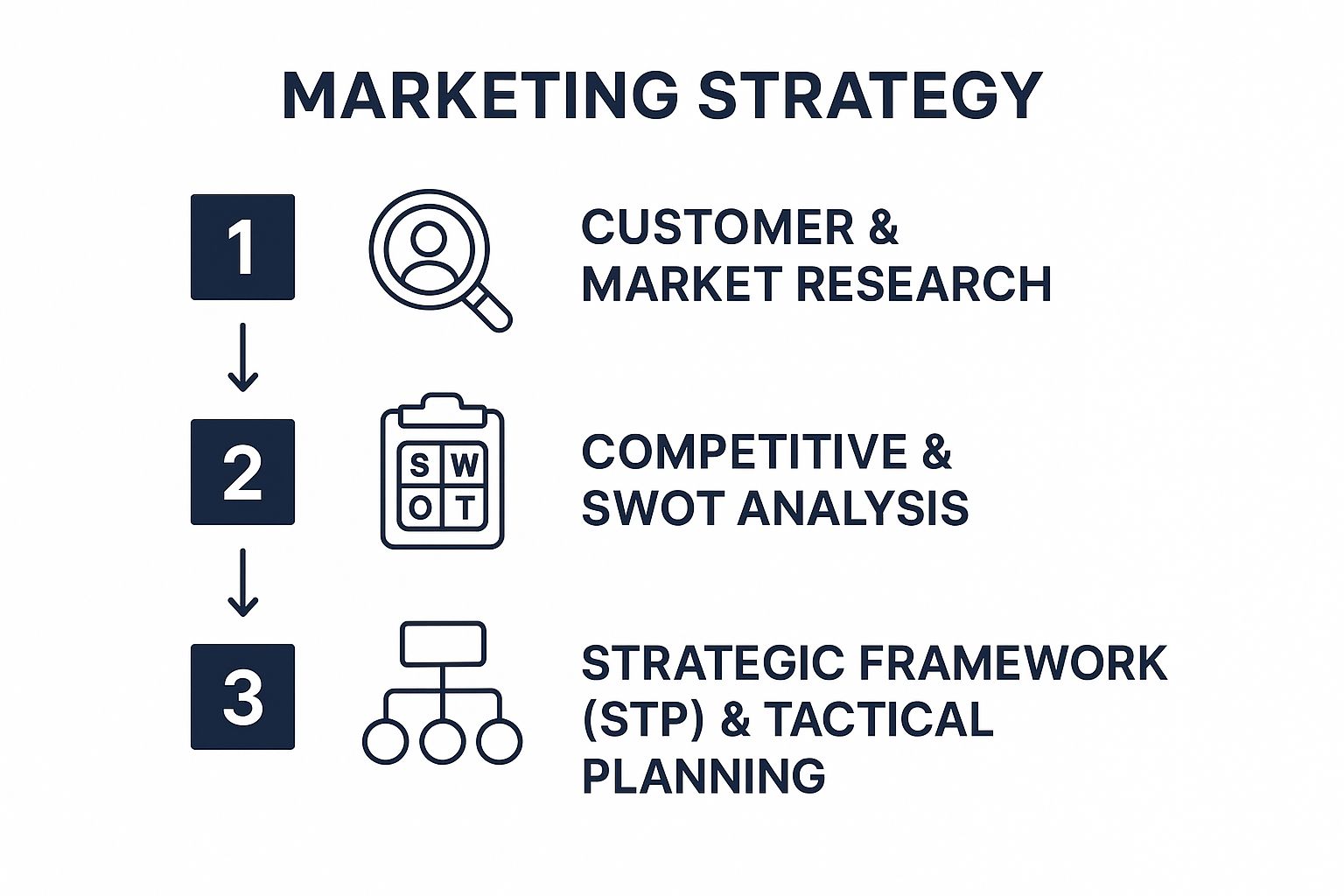
The best candidates won't present a rigid, final plan. Instead, they will outline a logical framework for developing a strategy, demonstrating a process-driven approach while acknowledging the need for more internal data.
What to Listen For
A strong answer will be thoughtful, structured, and customized to your company's context.
- Pre-Interview Research: Do they reference your specific products, recent campaigns, or known competitors? This indicates genuine interest.
- Strategic Frameworks: Does the candidate mention established models like SWOT analysis or the marketing funnel? This demonstrates structured, methodical thinking.
- Customer-Centricity: Is their proposed approach grounded in understanding the customer first? A top candidate will prioritize customer research as the foundation of any strategy.
- Clarifying Questions: A great candidate will ask insightful questions about business goals, budget, and team capabilities before offering solutions. This shows they don't make assumptions.
Key Insight: A top-tier marketing executive will frame their answer as a phased approach, starting with diagnosis before prescribing solutions. They will balance confidence in their methodology with the understanding that the best strategy comes from deep internal collaboration and data analysis.
This question is crucial for any business at a growth inflection point. Whether you’re hiring a full-time leader or a fractional CMO, you need a strategist who can build a data-informed plan tailored to your unique challenges.
6. Tell me about a time when a marketing campaign failed and what you learned from it
This question is a powerful test of a candidate’s self-awareness, accountability, and resilience. How a leader handles failure is often more revealing than how they handle success.
Every experienced executive has campaigns that didn't hit the mark. A strong response demonstrates humility and the ability to extract valuable lessons from setbacks, turning a negative outcome into a net positive for the organization.
What to Listen For
A great answer will be honest and structured, focusing more on the learning and subsequent improvements than the failure itself.
- Ownership and Accountability: Does the candidate take clear responsibility, or do they shift blame? True leaders own their results, good and bad.
- Analytical Depth: Can they clearly articulate why the campaign failed? Look for a diagnosis rooted in data, not surface-level excuses. For example, "our messaging missed the mark with the target persona."
- Actionable Learnings: What specific, concrete changes did they implement as a result? An example would be, "After that, we overhauled our market research process to include a mandatory pre-launch customer validation phase."
- Resilience and Recovery: How did they manage the situation in the moment? Did they pivot the strategy and communicate transparently with stakeholders?
Real-World Example: "We launched a B2B campaign on a new social platform that flopped. We burned $50k with almost zero qualified leads. We owned it, pulled the plug fast, and presented our learnings to the executive team. The key takeaway was that our audience wasn't there, and we reallocated the remaining budget to LinkedIn, which ended up exceeding our quarterly goal."
Hiring a leader who can navigate both wins and losses is crucial for sustainable growth. A fractional marketing leader can bring this battle-tested experience to your team, helping you avoid common pitfalls.
7. How do you align marketing strategy with overall business objectives and work with sales teams?
This is one of the most critical marketing executive interview questions because it probes the candidate's ability to operate as a true business leader, not just a marketing silo manager. A strong answer reveals a candidate who sees marketing as the primary engine for revenue and growth.
An executive-level marketer must be able to translate high-level business goals like "increase market share by 10%" into a concrete marketing plan. Their ability to foster a symbiotic relationship with sales is a direct indicator of their potential to drive meaningful results.
What to Listen For
A compelling answer will detail specific processes, frameworks, and a philosophy of shared accountability.
- Strategic Connection: Does the candidate explain how they translate business objectives into marketing KPIs? For example, linking a revenue target to a specific number of Marketing Qualified Leads (MQLs).
- Collaborative Frameworks: Do they mention establishing a Service Level Agreement (SLA) with sales? This defines lead quality, follow-up times, and shared goals.
- Communication Cadence: A strong candidate will describe a regular rhythm of communication, such as weekly pipeline reviews with sales leadership.
- Shared Metrics: Listen for a focus on shared dashboards and metrics like revenue, pipeline contribution, and customer acquisition cost (CAC).
Key Insight: A top-tier marketing executive doesn’t just "support" sales; they see themselves as a co-owner of the revenue number. They speak the language of business (revenue, profit, market share) and can articulate precisely how marketing contributes to those top-line goals.
For growing businesses, this alignment is the difference between stalled growth and scalable success. A fractional CMO can be instrumental in building this bridge between marketing and sales.
8. What is your approach to building and managing a marketing team?
An executive's ability to build and lead a high-performing team is paramount for scalable growth. This question probes their leadership philosophy, management style, and organizational design capabilities.
You are looking for a leader who is both a talent magnet and a culture builder. A great marketing executive understands that their success is a direct reflection of their team's success.
What to Listen For
A strong answer will demonstrate a thoughtful, structured approach to team leadership that has been tested and refined through experience.
- Hiring Philosophy: Do they have a clear methodology for identifying and assessing talent? A top candidate might describe how they evaluate candidates for a blend of hard skills, soft skills, and culture add.
- Team Structure and Scalability: Can they explain why they structure teams in a certain way (e.g., by function or customer journey)? Listen for how they have scaled a team from 5 to 20 people.
- Talent Development: Do they discuss specific examples of mentoring, coaching, or creating career paths for their direct reports?
- Performance Management: How do they handle accountability and underperformance? A mature leader will have a fair, direct, and consistent process.
Key Insight: The best answers blend strategic thinking with genuine people-centric leadership. An exceptional candidate will discuss creating a culture of psychological safety and continuous learning, balancing in-house talent with agency partners.
For businesses aiming to scale, this question is non-negotiable. Whether bringing on a permanent hire or a fractional leader who can mentor your current team, you need someone who can build the right structure for growth. For more insights, explore this guide on how to build high-performing teams.
Marketing Executive Interview Questions Comparison
| Question / Topic | Implementation Complexity 🔄 | Resource Requirements ⚡ | Expected Outcomes 📊 | Ideal Use Cases 💡 | Key Advantages ⭐ |
|---|---|---|---|---|---|
| Tell me about a successful marketing campaign you've managed from start to finish | Medium to High: Covers full campaign lifecycle | Moderate to High: Requires cross-functional resources | Demonstrates project management and ROI impact | Assess end-to-end campaign management experience | Validates strategic thinking and leadership |
| How do you measure marketing ROI and what metrics do you prioritize? | Medium: Involves analytical tools and attribution | Moderate: Requires marketing tech familiarity | Reveals data-driven decision making and accountability | Evaluate candidate's analytical and financial skills | Highlights strategic alignment with business goals |
| How do you stay current with marketing trends and emerging technologies? | Low to Medium: Continuous ongoing process | Low: Access to information sources | Shows learning agility and adaptability | Assess commitment to professional growth | Identifies proactive mindset and trend discernment |
| Describe your experience with digital marketing channels and which you consider most effective | Medium: Requires breadth and depth of channel knowledge | Moderate: Hands-on platform experience | Demonstrates strategic channel selection and optimization | Evaluate digital marketing expertise | Validates practical channel effectiveness understanding |
| How would you approach marketing strategy for our company/product? | High: Strategic analysis and planning needed | Moderate to High: Requires deep company knowledge | Demonstrates strategic thinking and business acumen | Test candidate’s ability to craft tailored marketing strategies | Reveals preparation and insight into business challenges |
| Tell me about a time when a marketing campaign failed and what you learned from it | Medium: Reflective and analytical | Low: Based on past experiences | Shows accountability, resilience, and learning mindset | Assess self-awareness and problem-solving skills | Highlights emotional intelligence and growth mindset |
| How do you align marketing strategy with overall business objectives and work with sales teams? | Medium to High: Requires cross-department collaboration | Moderate: Coordination with sales and CRM tools | Demonstrates strategic alignment and revenue focus | Evaluate executive-level collaboration and strategic thinking | Shows ability to bridge marketing and sales functions |
| What is your approach to building and managing a marketing team? | Medium: Leadership and organizational skills | Moderate to High: Involves hiring and development efforts | Demonstrates people management and scaling capability | Assess leadership style and talent development philosophy | Validates team-building and delegation effectiveness |
Beyond the Interview: A Smarter Path to Executive Expertise
Mastering these marketing executive interview questions provides a framework for identifying a leader who can truly transform your business. You can now confidently evaluate their strategic vision, their grasp of ROI, their leadership philosophy, and their resilience.
The goal is to find a partner who can align marketing efforts with your business objectives, build a high-performing team, and navigate the ever-changing digital landscape. This deeper level of inquiry ensures you're not just filling a seat, but investing in a catalyst for sustainable growth.
Key Takeaways for Your Hiring Process
As you move forward, keep these core principles in mind:
- Prioritize Strategic Alignment: The best candidates connect marketing directly to revenue goals. They build a growth engine, not just run campaigns.
- Balance Creativity with Accountability: Look for leaders who champion innovative ideas while remaining grounded in metrics. The ability to articulate the ROI of a campaign is non-negotiable.
- Evaluate Leadership and Mentorship: A top-tier executive elevates the entire organization. Their success is measured by the success of the people they lead.
- Embrace Failure as a Learning Tool: Candidates who openly discuss failures and articulate lessons learned demonstrate resilience, humility, and a commitment to continuous improvement.
The Fractional Advantage: Top-Tier Talent, On Your Terms
While the right questions are crucial, the traditional hiring process isn't always the right answer. The search for a C-suite executive can be a lengthy, expensive, and high-stakes endeavor. For many growing businesses, the commitment to a full-time executive salary is a major barrier, creating a leadership gap that stifles progress.
This is where fractional leadership offers a powerful advantage. Imagine gaining the strategic firepower of a seasoned CMO who has scaled businesses just like yours, but without the full-time financial commitment.
A fractional marketing executive can step in to:
- Develop and implement a scalable go-to-market strategy.
- Build a data-driven marketing foundation and establish key metrics.
- Mentor and upskill your existing marketing team.
- Navigate complex challenges like a rebrand, product launch, or market expansion.
This model provides the strategic guidance you need at a fraction of the cost and with greater flexibility than a traditional hire. It's the perfect solution for companies that need top-tier expertise to reach the next level but aren't yet ready for a full-time executive.
Ready to find the strategic marketing leader who can elevate your business without the cost and commitment of a full-time hire? Shiny connects you with a curated network of over 3,000 vetted fractional executives ready to drive immediate impact. Stop the endless search and find your perfect-fit marketing leader today at Shiny.
Article created using Outrank