Master Operational Decision Making: A Founder’s Guide
Your inbox is full. Slack is louder than your roadmap. A salesperson wants a discount approved, a hiring manager needs a compensation call, support is escalating a churn risk, and product wants a yes or no on a feature trade-off before the sprint starts.
Most founders don't have a strategy problem first. They have an operational decision making problem.
The damage isn't dramatic at the start. It shows up as context switching, slow approvals, repeated debates, and a team that keeps pulling the founder back into choices that should've been made lower in the org. Eventually, every small decision becomes expensive because it interrupts the people who should be thinking ahead.
A startup scales when routine decisions stop depending on founder mood, founder memory, or founder availability. It scales when the team knows what kind of decision they're making, who owns it, what data matters, and how fast a call needs to happen.
Why Your Startup Needs a Decision Making Operating System
A founder usually notices the problem in a familiar pattern. Monday starts with three "quick" approvals. By lunch, pricing is under review for one deal, a contractor is waiting on a scope decision, and marketing has paused a campaign because nobody knows who can reallocate spend. By Friday, nothing broke completely, but the week got spent on friction.
That's what ad hoc operating looks like.
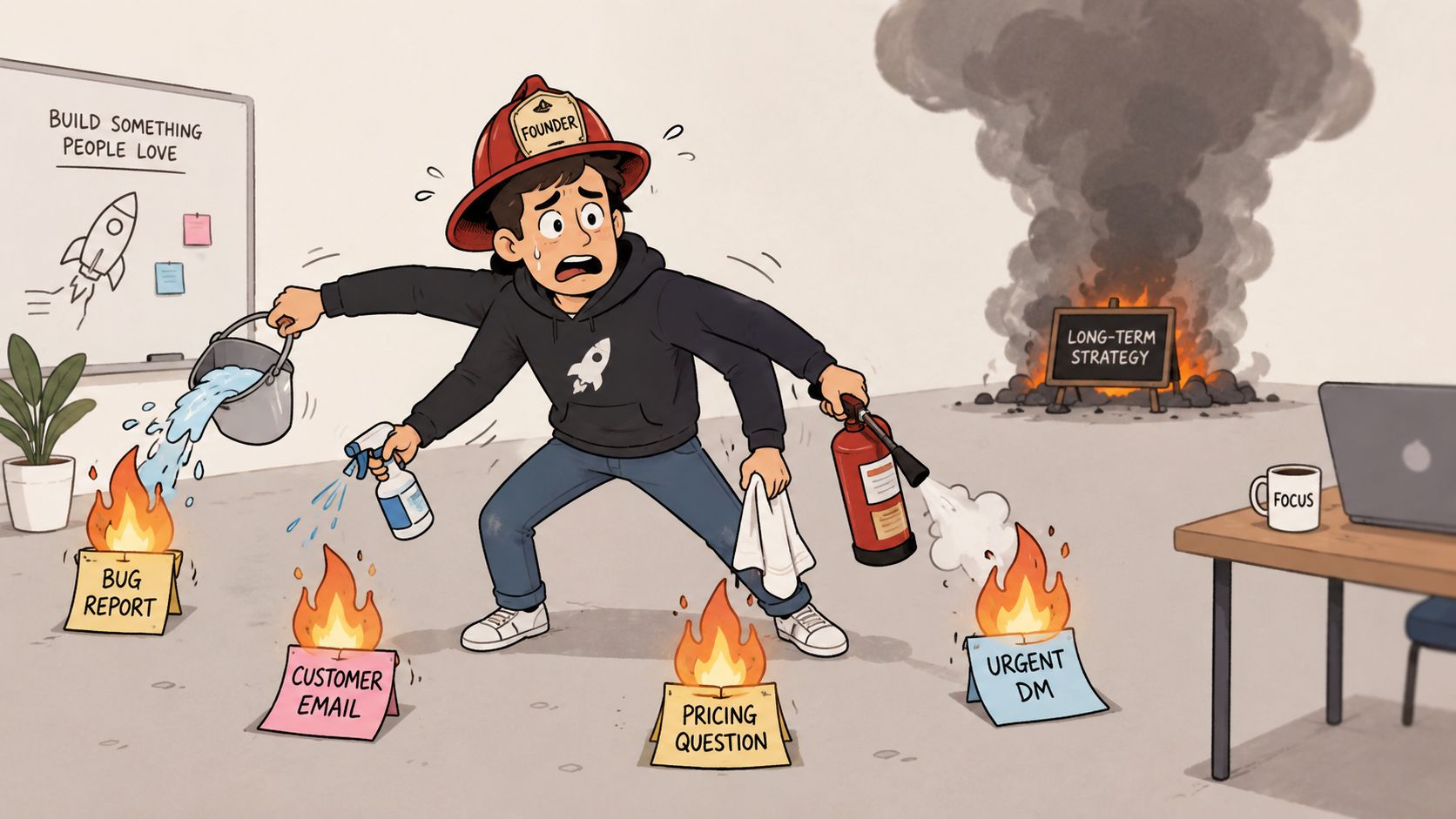
The fix isn't "be more decisive." The fix is to install a decision making operating system. If you're already working with an entrepreneur operating system, this is the practical layer that keeps daily execution from eating the company alive.
Separate strategic, tactical, and operational calls
Not every decision deserves the same room, the same people, or the same speed.
Strategic decisions set direction. These include market positioning, category focus, capital allocation, or whether to expand into a new segment.
Tactical decisions translate strategy into plans. Think quarterly campaign priorities, sales territory design, or implementation sequencing.
Operational decisions handle the day-to-day engine. They involve resource allocation, scheduling, approvals, exception handling, quality control, and workflow choices. Creately's guide to operational decisions describes them as routine, short-term choices tied to daily or weekly cycles, and that's exactly why they should be systematized.
Practical rule: If a decision happens often, touches a workflow, and doesn't change company direction, it should live in an operating system, not in the founder's head.
Why founders get trapped
Founders often keep owning operational calls because they're fast, familiar, and tied to customer outcomes. That works early. It fails later.
A founder who personally approves discounts, hiring exceptions, support escalations, and tool purchases doesn't stay close to the business. They become the bottleneck. The team learns to escalate by default because escalation is safer than ownership.
A good operating system changes that behavior. It answers four questions every time:
- What kind of decision is this
- Who owns it
- What input is required
- How fast does it need to be made
What changes when the system is working
You can feel the difference quickly.
- Teams stop waiting. Managers know where they have authority and where they don't.
- Meetings get shorter. Fewer people attend, and the right people decide.
- Founder time opens up. Strategic work gets protected instead of constantly interrupted.
- Execution gets steadier. The company becomes more predictable because routine choices follow a repeatable path.
Consider air traffic control. Planes still need human judgment, but nobody wants every pilot improvising runway rules in real time. Startups aren't that different. Speed matters, but consistent speed matters more.
From Chaos to Clarity with Decision Frameworks
Most confusion in startups isn't about intelligence. It's about ownership.
A team can have smart people, solid intent, and good data, then still stall because nobody knows who decides, who contributes, and who just needs the update. That's where lightweight frameworks earn their keep.
Use RACI when execution has many handoffs
RACI stands for Responsible, Accountable, Consulted, Informed. It's useful when work crosses functions and the main risk is dropped responsibilities.
- Responsible is the person doing the work.
- Accountable is the single owner who answers for the result.
- Consulted are the people whose input is needed before the call.
- Informed are the people who need visibility after the call.
RACI works well for operational processes like onboarding a new customer success manager, launching a billing change, or handling a renewal workflow that touches sales, finance, and support.
The strength of RACI is process clarity. It prevents the classic startup failure mode where five people are involved and nobody is accountable.
Use DACI when the issue is decision speed
DACI stands for Driver, Approver, Contributor, Informed. It fits choices that need a cleaner decision path and fewer circular debates.
- Driver moves the decision forward.
- Approver makes the final call.
- Contributor supplies input or analysis.
- Informed gets the outcome.
Use DACI for calls like selecting a CRM, approving a senior hire, choosing whether to sunset a low-usage feature, or deciding which market experiment runs next. It creates momentum because someone is explicitly responsible for driving the decision to closure.
A practical reference point for choosing between frameworks is this strategic decision-making framework guide, but operational teams usually need to start simpler than strategy teams do.
RACI vs. DACI Decision Frameworks
| Framework | Stands For | Best For | Key Benefit |
|---|---|---|---|
| RACI | Responsible, Accountable, Consulted, Informed | Repeatable workflows with multiple handoffs | Clarifies roles in execution |
| DACI | Driver, Approver, Contributor, Informed | Discrete decisions that need speed and closure | Prevents endless discussion |
How to pick the right one
Don't overcomplicate this.
Choose RACI when:
- The work repeats. Onboarding, invoicing approvals, content publishing, and escalation handling fit here.
- Teams hand work off. Marketing to sales, sales to success, product to support.
- The main failure is confusion. Tasks get delayed because nobody knows who owns what.
Choose DACI when:
- The decision is one-off or periodic. A pricing exception policy, a system migration, a territory change.
- The main failure is drift. Too many opinions, not enough closure.
- You need a clear decider. This matters when senior people all have partial authority.
If two executives keep revisiting the same issue, you don't have a communication problem. You have a decision-role problem.
A simple startup decision matrix
Use one line per decision category. Keep it visible in Notion, Coda, or your operating handbook.
- Discount approvals: Sales manager drives, CRO approves, finance contributes, RevOps informed.
- Headcount backfills: Hiring manager responsible, department lead accountable, finance consulted, recruiting informed.
- Customer escalations: Support lead responsible, head of operations accountable, product consulted, account team informed.
- Tool purchases: Functional owner drives, budget owner approves, IT or operations contributes, finance informed.
What doesn't work is letting every department invent its own decision style. One team uses consensus, another waits for the founder, another debates in Slack for three days. Standardizing the pattern matters more than choosing the perfect acronym.
Measure What Matters with Data and SLAs
Gut instinct is useful when the company is tiny. It becomes expensive once the same decision repeats across teams.
Operational decision making depends on two things. First, the team needs a small set of metrics that reflect the actual health of the workflow. Second, the team needs service levels for the decision itself. If no one knows how fast a pricing exception, support escalation, or hiring approval must move, the queue expands and everyone feels busy while customers feel delay.
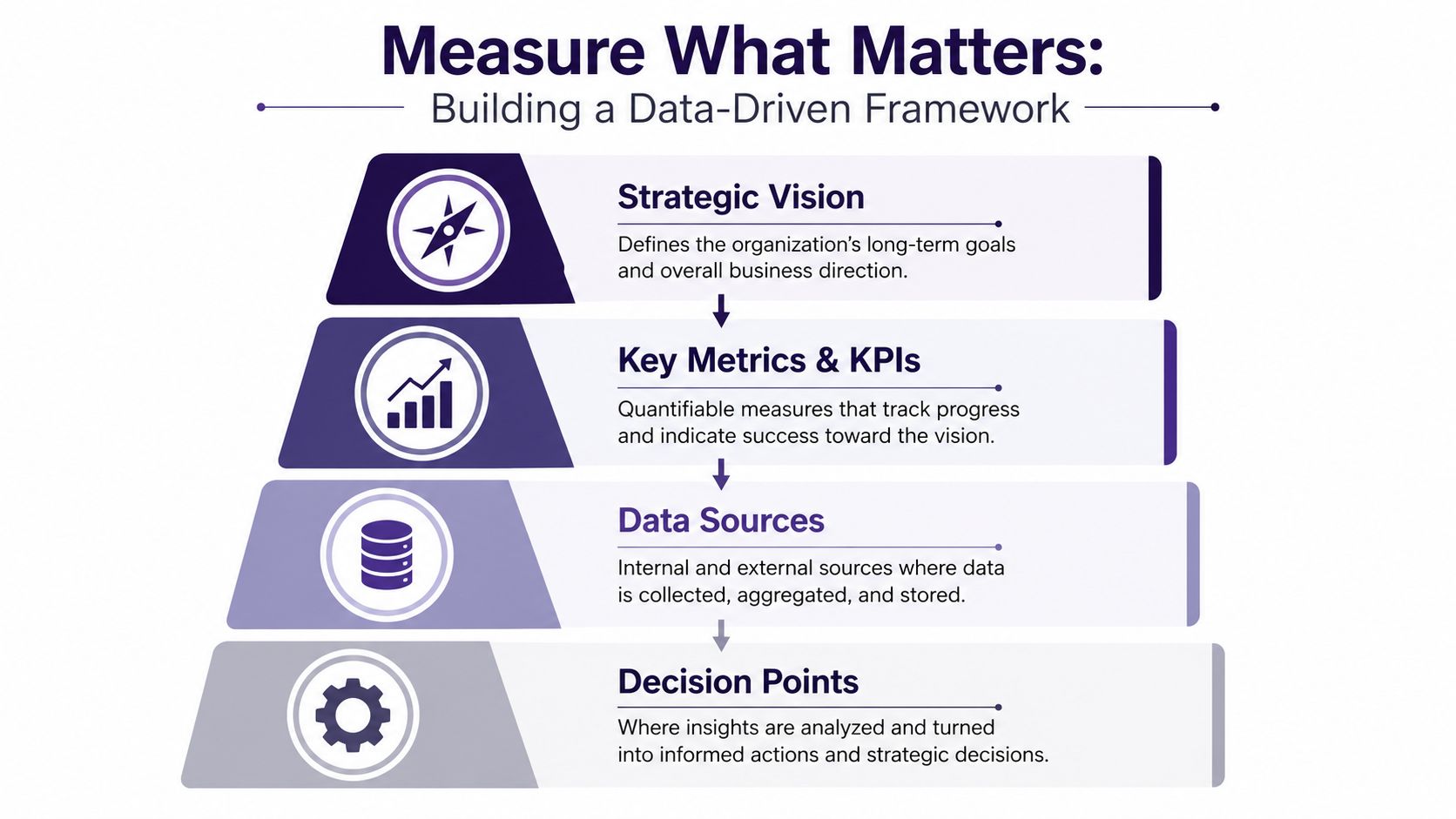
Start with the workflow, not the dashboard
A lot of startup dashboards are impressive and useless. They track what is easy to display, not what helps a frontline manager decide.
In high-volume environments, this matters immediately. Higson's analysis of operational decisions notes that some businesses make 80,000 to 120,000 operational decisions daily, and that 200 milliseconds of decision latency can block a customer interaction. Even if your startup operates at a smaller scale, the lesson holds. Delay on the hot path hurts customers fast.
A better sequence is:
- Map the workflow. Quote to close. Ticket to resolution. Trial to activation. Invoice to payment.
- Identify decision points. Approval, escalation, prioritization, routing, exception handling.
- Choose the few metrics that show if the workflow is healthy.
- Set a time expectation for each decision type.
For a deeper view on this discipline, see this practical take on data-driven decision making.
Examples of what to track
Different business models need different frontline metrics. The mistake is copying another company's KPI stack without asking what your operators can effectively act on.
For SaaS, useful operational metrics often include:
- Lead response speed. If inbound sits untouched, pipeline quality degrades.
- Trial-to-activation friction. Product, onboarding, and success all influence this.
- Support backlog by severity. Not total tickets. The team needs the queue split by urgency.
For e-commerce:
- Order exception volume. Returns, failed payments, inventory mismatches.
- Fulfillment cycle issues. Where the order gets stuck matters more than aggregate shipment counts.
- Customer contact drivers. Repeated "where is my order" contacts usually point to workflow gaps.
For service businesses:
- Utilization by role. Too low wastes margin. Too high burns out delivery.
- Time to proposal or scope approval. This often becomes the hidden growth limiter.
- Rework triggers. Missed requirements, unclear handoffs, or weak QA.
Put SLAs on decisions, not just service
Many teams define service SLAs for customer-facing work but never define how quickly internal decisions should happen.
That creates a common failure pattern. The support team has a response target, but escalation approvals sit in a manager's inbox. Recruiting moves candidates forward, but compensation approvals drag. Product ships quickly, but legal or finance sign-off arrives too late.
A simple operating rule helps:
- Fast path decisions get same-day treatment.
- Manager-level approvals need a published turnaround.
- Cross-functional exceptions require a named owner and deadline.
- Strategic calls go to a different forum entirely.
The metric isn't "do we have a dashboard." The metric is "can a manager make the next right decision without hunting for context."
What doesn't work is loading dashboards with vanity metrics, then calling the company data-driven. Good operational metrics shorten response time, improve consistency, and reduce argument. If they don't change behavior on the floor, they're decoration.
Establishing a Rhythm for Repeatable Decisions
A clean framework still fails if it lives in a slide deck.
Operational decision making becomes real when it has a cadence. Teams need a place where issues surface early, data gets reviewed in context, and owners leave with decisions, not vague alignment. That's why every growth-stage company benefits from a disciplined weekly operational review.
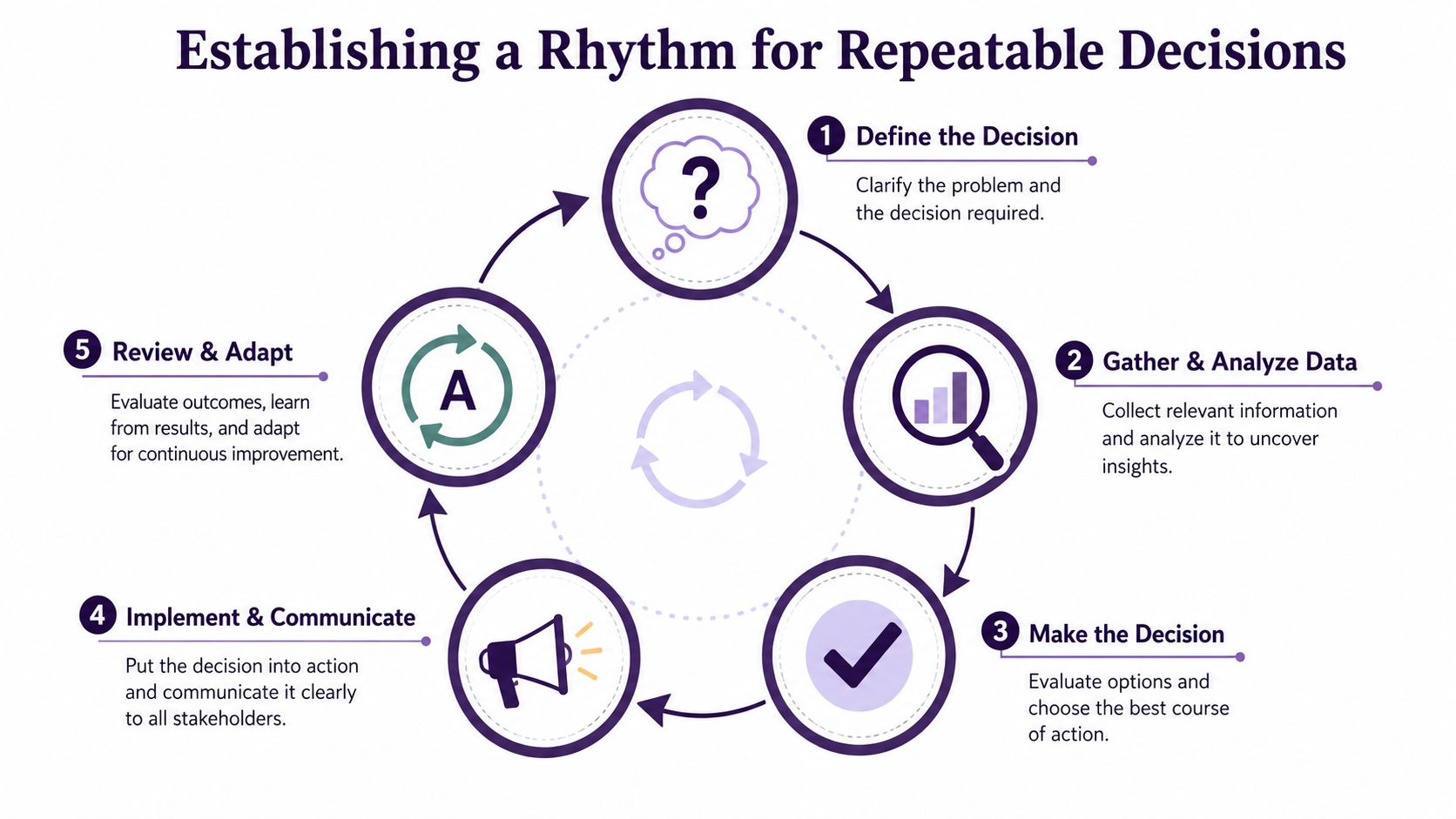
The weekly meeting that actually works
A strong weekly operational review is not a status meeting. The team should already know the status from the dashboard, scorecard, or written update.
The meeting exists to resolve exceptions, remove blockers, and make decisions that keep the business moving.
A practical agenda looks like this:
- Open with exceptions. Start with red metrics, missed commitments, and customer-impacting issues.
- Review key workflow signals. Look at the handful of metrics tied to the company's critical operating paths.
- Decide live where possible. If the room has the owner, the data, and the authority, make the call.
- Assign actions with one owner. Every action item needs a name and timing.
- Capture unresolved items separately. Don't let edge cases consume the full meeting.
What to document every week
Most companies record too much and still lose the important part. They save the discussion and forget the decision.
Keep a simple decision log with:
- Decision made
- Owner
- Why now
- Input considered
- Follow-up check date
That last item is often not fully appreciated. A recurring weakness in this area is failing to measure long-term effect. This framework discussion on operational decision making points out that organizations often miss sustainability and adaptability because dashboards focus on immediate metrics and don't close the loop on whether stakeholders understood options or whether the decision held up over time.
A meeting rhythm people will keep
The best cadence is boring in the right way. Same day. Same prep. Same metrics. Same decision log.
Here are the habits that make it stick:
- Pre-read before the meeting. Operators should enter ready to decide, not ready to explain the spreadsheet.
- Limit attendance. Invite decision owners and essential contributors, not everyone who might be interested.
- Escalate by rule. If an issue crosses budget, customer risk, or staffing thresholds, it moves up automatically.
- Review old decisions. Spend a few minutes checking whether last month's call solved the problem.
A company gets better at decisions when it reviews outcomes, not just intentions.
One more practical note. Slack is a terrible home for repeatable decision making. Use it for alerts and quick coordination. Use a meeting cadence and a written log for actual operating decisions. Otherwise, context disappears, and the same issue returns with new participants and old confusion.
Common Traps in Operational Decision Making
Teams don't fail because they lack frameworks. They fail because stress pushes them back into bad habits.
Under pressure, people chase speed without clarity, or analysis without action. Both create drag. The answer isn't more process. It's recognizing the trap early and using a countermeasure that fits the problem.
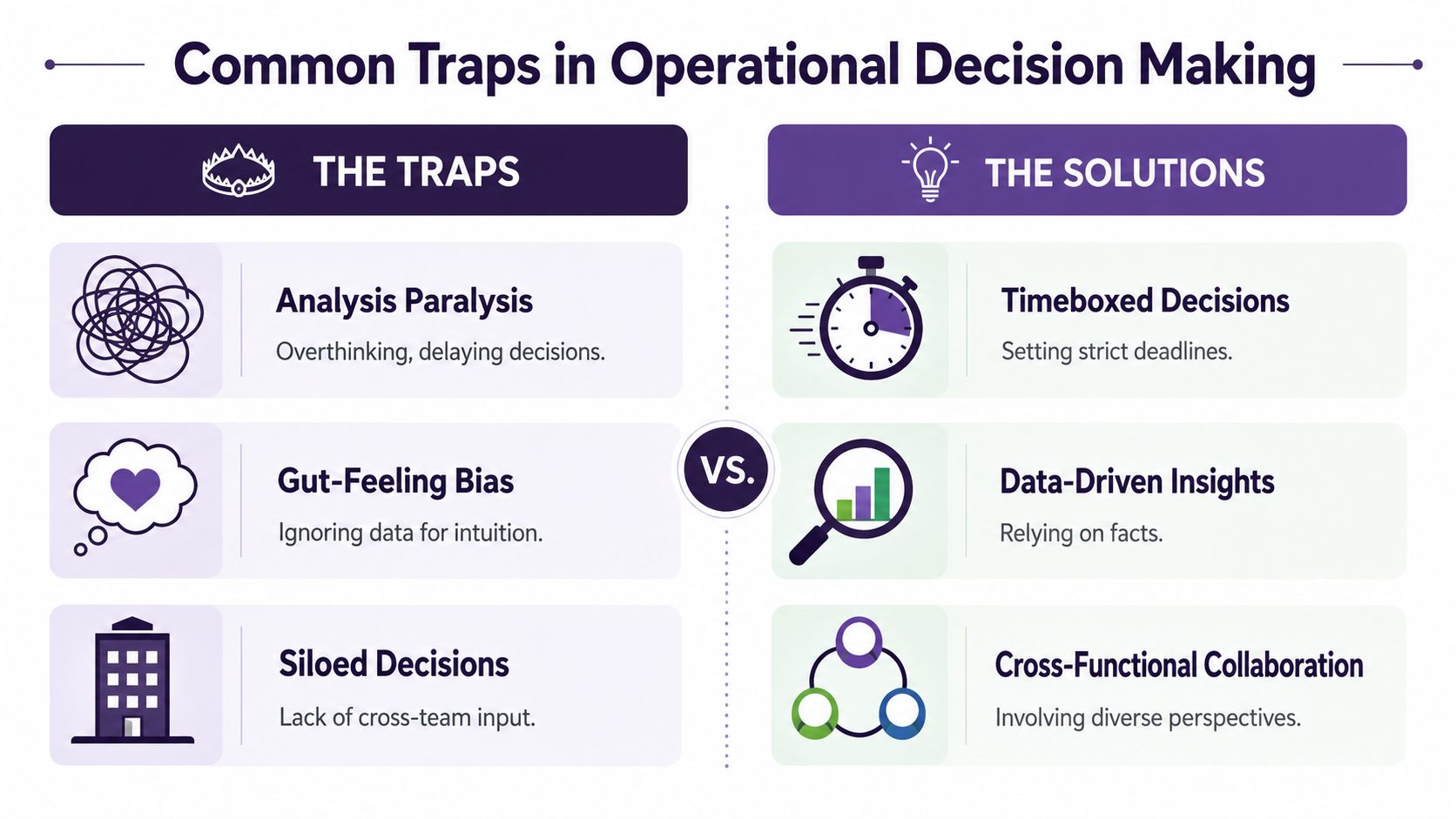
The trap-solution pairs worth watching
This summary of project decision outcomes reports that effectiveness is 2.5x higher with structured decision-making, while 48% of projects only deliver partial value due to inconsistent data practices. It also flags local optimization as a major issue tied to 32% of historical IT project failures attributed to misaligned goals. That lines up with what operators see in the field.
| Symptom | What's actually happening | Practical fix |
|---|---|---|
| A team keeps asking for more data before acting | Analysis paralysis | Set a decision deadline and define the minimum input required |
| One function improves its metric while customer experience worsens | Local optimization | Review end-to-end workflow impact before approving the change |
| Every important call turns into a group debate | Consensus addiction | Name one approver and separate input from ownership |
| People say "I thought someone else had it" | Ambiguous ownership | Use RACI or DACI on recurring decision types |
| Process gets ignored in crunch time | Pressure regression | Predefine fast-path rules for urgent cases |
Three bad habits that show up constantly
Analysis paralysis looks responsible, but often it's avoidance in nicer clothes. Teams keep expanding the question instead of deciding the issue in front of them. Timeboxing helps. So does writing down what would change the decision versus what is just interesting.
Local optimization is more dangerous because it can look like success. Sales pushes for discount flexibility and hits short-term conversion. Finance tightens approvals and protects margin. Support closes tickets faster by shortening responses. Each team can improve its own metric while degrading the customer journey across the whole business.
Consensus-only culture sounds collaborative, but it usually means nobody wants to own the trade-off. Input is valuable. Universal agreement is not the same thing as quality.
The standard isn't perfect certainty. The standard is a clear owner making a timely call with the best available evidence.
What actually holds under pressure
When a company is moving fast, the operating rules need to be simple enough to survive a rough week.
Use these tests:
- Can a new manager understand the decision path in one read?
- Can the team identify the approver without asking around?
- Can you explain why the metric matters to the customer or workflow?
- Can you revisit the decision later and see whether it worked?
If the answer is no, the system is too fragile. Startups don't need bureaucracy. They need guardrails that still work when hiring is messy, product is shifting, and the founder is in fundraising mode.
Scaling Your Decisions and Your Leadership
A decision system does more than improve daily execution. It changes what the founder can stop doing.
Once operational decision making is clear, repeatable, and tied to data, delegation gets safer. Managers can own more because the rules are visible. Cross-functional decisions move faster because approval paths are defined. The founder spends less time arbitrating routine choices and more time on market, capital, hiring, and major partnerships.
Why this is a leadership problem, not just an operations problem
Plenty of startups know they need more structure. They delay because they assume the next step is a full-time executive hire.
Often, that isn't the right move yet.
A growth-stage company may need senior operating discipline without needing, or being able to justify, a full-time COO, CFO, CTO, or CMO. The business needs someone who can install meeting cadence, decision rights, KPI discipline, escalation rules, and management accountability. It may not need that person in the seat every day.
That's where fractional leadership fits unusually well. The value isn't just lower cost. It's targeted senior judgment brought into the exact layer where young companies usually wobble.
What a fractional executive can do quickly
A seasoned fractional leader typically doesn't start with a giant reorg. They start with optimizing existing operations.
That often includes:
- Clarifying decision rights. Who owns hiring approvals, budget exceptions, customer escalations, vendor spend, and roadmap trade-offs.
- Installing a management cadence. Weekly operating review, monthly business review, and a written decision log.
- Cleaning up metrics. Fewer vanity numbers. Better frontline signals.
- Building manager confidence. Teaching leaders when to decide, when to escalate, and how to document trade-offs.
This is especially useful in startups where the founder has become the default approver for too many workflows. A good fractional operator creates a system that remains after the engagement matures.
Why the model is gaining traction
The broader market movement makes sense. The fractional executive model described by Umbrex notes that replacing a full-time executive with a fractional counterpart working two days per week can reduce fixed cash burn by 40–60% while preserving strategic impact, and that experienced leaders are often sourced and onboarded within weeks, not months.
That matters when you're between stages. Maybe revenue supports senior help but not another full executive salary. Maybe the company needs a strong operator to professionalize systems before making a permanent hire. Maybe the team needs a senior hand for six months while the founder regains strategic focus.
Each of those situations is common. None of them should force a binary choice between "do nothing" and "hire a permanent C-level executive immediately."
The founder's real win
The best outcome isn't more process. It's less founder dependency.
A startup becomes healthier when pricing exceptions don't wait on the founder's text reply, when support escalation rules are clear, when hiring approvals follow logic, and when department leads can make hard calls without performing confidence for the room.
That's when growth gets less chaotic. Not easy. But less chaotic.
If your company is at the point where decisions are multiplying faster than leadership bandwidth, operational discipline is usually the most effective fix. And if you need that discipline without the cost and commitment of a full-time executive hire, a fractional leader can be the right bridge.
If you're ready to bring experienced leadership into your startup without committing to a full-time executive hire, Shiny is worth a look. Shiny connects founders with vetted fractional executives who can help install the decision systems, operating cadence, and management discipline that growing companies need. If you want a practical second opinion on your current bottlenecks, scheduling a consultation is a smart place to start.