Part Time CFO Job Description: Duties and a Template
Your bookkeeper emails the P&L on the 19th. You read it on the 26th, notice gross margin slipped, and can't tell whether it's pricing, mix or a one-off supplier invoice. Meanwhile a lender wants a 13-week cash view, your board pack is due Friday, and the forecast lives in a spreadsheet only you understand. So you decide to hire a part time CFO, open a blank document, and type a list of duties copied from three job posts.
That list is where most fractional engagements go wrong. A part time CFO job description isn't a duties list, it's a scope contract: who decides, who prepares, what lands on your desk, and by when. Write it that way and you can hold someone accountable in week six. Write it as "strategic financial leadership" and you'll be doing the forecast yourself in month four.
Part Time CFO Responsibilities at a Glance
A part time CFO is both a financial operator and a strategic adviser, not an accountant working fewer hours. NetSuite's overview of the chief financial officer role centres the job on budgets and forecasts, cash balances and cash forecasts, actual-versus-plan analysis, KPI definition, advising the CEO, arranging debt or equity, overseeing outsourced finance providers, and reporting results and risks to the board.
The defining milestone isn't a number of weekly hours. It's the moment executive accountability for planning, reporting, risk, liquidity and decision support transfers to someone else. Until that transfer happens, you've bought advice, not leadership.
The four areas that carry the role
Most published frameworks split the work into four buckets. One responsibility model from CFO for My Business allocates time across strategic planning, monthly reporting, weekly cash management and stakeholder communication, which gives you a usable starting skeleton:
| Responsibility Area | Typical Time Share | Recurring Deliverable | Cadence |
|---|---|---|---|
| Strategic planning | 30-40% | Financial models, scenario analysis and recommendations | Quarterly |
| Monthly financial reporting | 20-30% | Management reporting package, dashboards and variance analysis | Monthly |
| Cash flow and working capital | 15-20% | Rolling 13-week cash forecast and working-capital actions | Weekly |
| Stakeholder communication | 10-15% | Board presentations, investor updates and lender reports | Monthly or as agreed |
Treat those shares as a starting frame, not a promise. A company eight weeks from a financing round will push planning and stakeholder work up and squeeze the rest. A stable business with a slow collections cycle should do the opposite.
Scale the framework, don't shrink the accountant
The same structure adapts down. A private company at your scale can ask a part time CFO to establish monthly reporting, build a rolling 12-month cash model, define management KPIs and create a financing plan without touching a single journal entry. The controller, bookkeeper or outsourced provider records transactions. The CFO interprets them and drives decisions.
If you're still weighing whether the arrangement fits your stage at all, our explainer on what a fractional CFO does covers the engagement model in more depth.
Use those four areas as the skeleton of your description. Everything below fills in the deliverables, the ownership lines and the measures that make each area enforceable.
Where the CFO Stops and the Controller Starts
The most common failure isn't a weak candidate. It's a description that lists forecasting, reporting and cash management without ever saying who signs off, who prepares, and who receives the output.
Two things happen when ownership stays undefined. Either the CFO drifts into bookkeeping because the books aren't clean enough to analyse, or the founder keeps building the forecast because nobody was told to stop. Both burn the hours you paid for. As Boardroom Advisors' breakdown of part time CFO responsibilities frames it, the controller ensures transactions are recorded correctly and reports close on schedule, while the CFO interprets those reports, builds forecasts, manages liquidity and recommends action.
Decision rights across finance roles
Settle each line before you post the role. This is the table I'd paste into the description and initial with the incoming CFO on day one:
| Task | Part Time CFO | Controller or Bookkeeper | Founder or Board |
|---|---|---|---|
| Monthly close and reconciliations | Reviews and explains results | Records transactions and closes the books | Receives the package |
| Annual budget | Builds and recommends | Supplies actuals | Approves |
| 13-week cash forecast | Owns and updates weekly | Supplies receipts and payables data | Acts on constrained-cash decisions |
| Fundraising or debt terms | Models options and leads negotiation | Supports data requests | Makes the final decision |
| Payments above threshold | Sets the approval matrix | Processes approved payments | Approves exceptions |
| Tax filings | Coordinates strategy | Prepares filings or manages the outside provider | Signs off where required |
| Finance staff hiring | Recommends structure | Consulted | Decides |
The pattern is consistent: the CFO owns judgment, the controller owns accuracy, and the founder keeps final approval on capital and structural decisions. That last column matters more than people expect. A fractional CFO who thinks they can commit to a term sheet will either overreach or stall.
Practical rule: every ownership line needs an escalation trigger attached. Name the cash balance and the covenant headroom level at which the CFO must call you, and the window in which that call happens.
Copy these rows into the description rather than paraphrasing them. Paraphrase is where "owns" becomes "supports", and six weeks later nobody can say who was responsible for the forecast that missed.
Reporting, Forecasting and Cash Duties to Write In
Start with the monthly package, because it's the deliverable everything else feeds. A complete pack contains seven things: income statement, balance sheet, cash-flow statement, budget-versus-actual analysis, working-capital movements, forecast changes, and short management commentary.
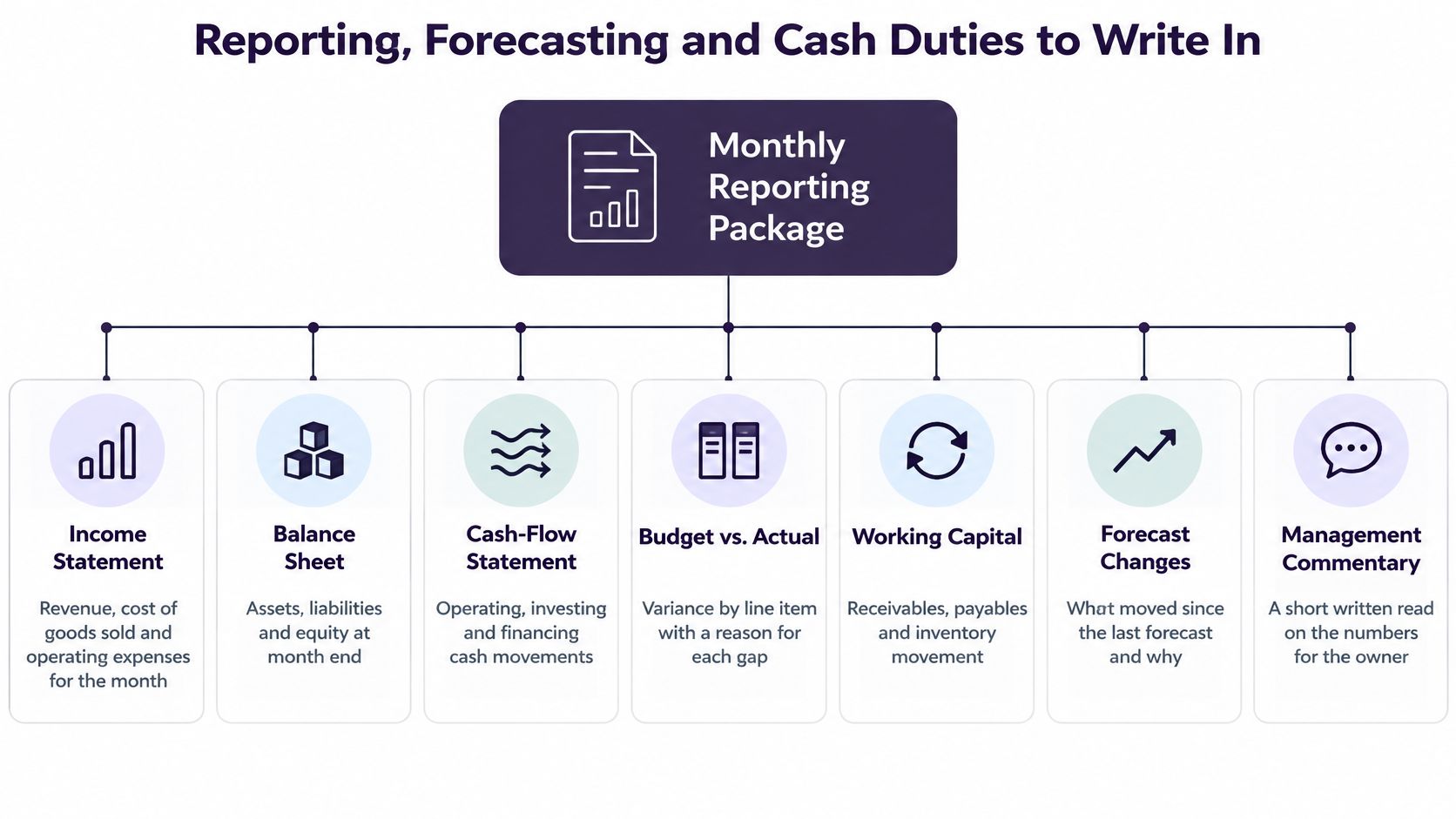
The commentary is the part most descriptions omit and the part you'll read. The SEC's management discussion and analysis rules require management to explain financial condition, results of operations, cash flows, liquidity sources, material trends and known uncertainties. You're not filing with the SEC, but borrow the standard: the CFO names what moved, what's unusual, and what could change next quarter.
Turn outputs into service levels
"Monthly reporting" isn't a commitment. These are:
- Close and reporting calendar: books closed by a stated business day, pack delivered by a stated day, with the CFO owning the review and the controller owning the close.
- Board and investor cadence: a named date each month or quarter, and a named author for the financial section.
- Cash forecast horizon and refresh: how many weeks forward, updated on which day, by whom.
- Named data owners: one person accountable for each source dataset, so a broken billing export has an owner rather than an excuse.
The 13-week forecast is the operating tool
A credible description explicitly requires a rolling 13-week cash-flow forecast and a defined minimum-cash threshold, as Shiny's guide to part time CFOs sets out. The forecast maps expected customer collections, supplier payments, payroll, debt service, taxes and capital expenditures week by week, which converts a report about the past into a tool that shows when cash gets tight and which payments need attention.
Set the threshold in dollars, not in sentiment. When projected cash dips below it in any week of the horizon, the CFO brings options, not observations.
Say a components distributor sees a shortfall in week nine. The CFO can compare three responses: delay the warehouse equipment purchase by a quarter, renegotiate supplier terms from 30 to 60 days, or start a facility conversation now while the balance sheet still looks strong. Each has a different cost and a different lead time, and the forecast is what makes the comparison possible. For the assumptions side of that work, EndureGo Tax's cashflow forecasting and pricing advice is a useful companion read on how pricing decisions feed collections.
Management reporting should connect revenue, gross margin, contribution margin, headcount and working capital in one view, so a margin question and a hiring question get answered from the same numbers. If you're building the forward model for the first time, our piece on financial forecasting for startups walks through the structure.
Write three deliverables into the description with an owner, a cadence and a date. Three you enforce beats ten you admire.
Controls, Governance and Systems Work to Specify
Controls are where a fractional arrangement either holds up or fails, because the person designing them isn't in the building most days. The description has to make the CFO accountable for the framework while leaving transaction processing with the people who do it daily.
Oversight duties, written as oversight
The SEC's interpretive guidance on management's discussion and analysis stresses effective controls and procedures supporting the accuracy and consistency of material key performance indicators. That principle applies well below public-company scale. If a metric drives a lender covenant or a board decision, someone owns its definition and its integrity.
Make the CFO accountable for designing and reviewing:
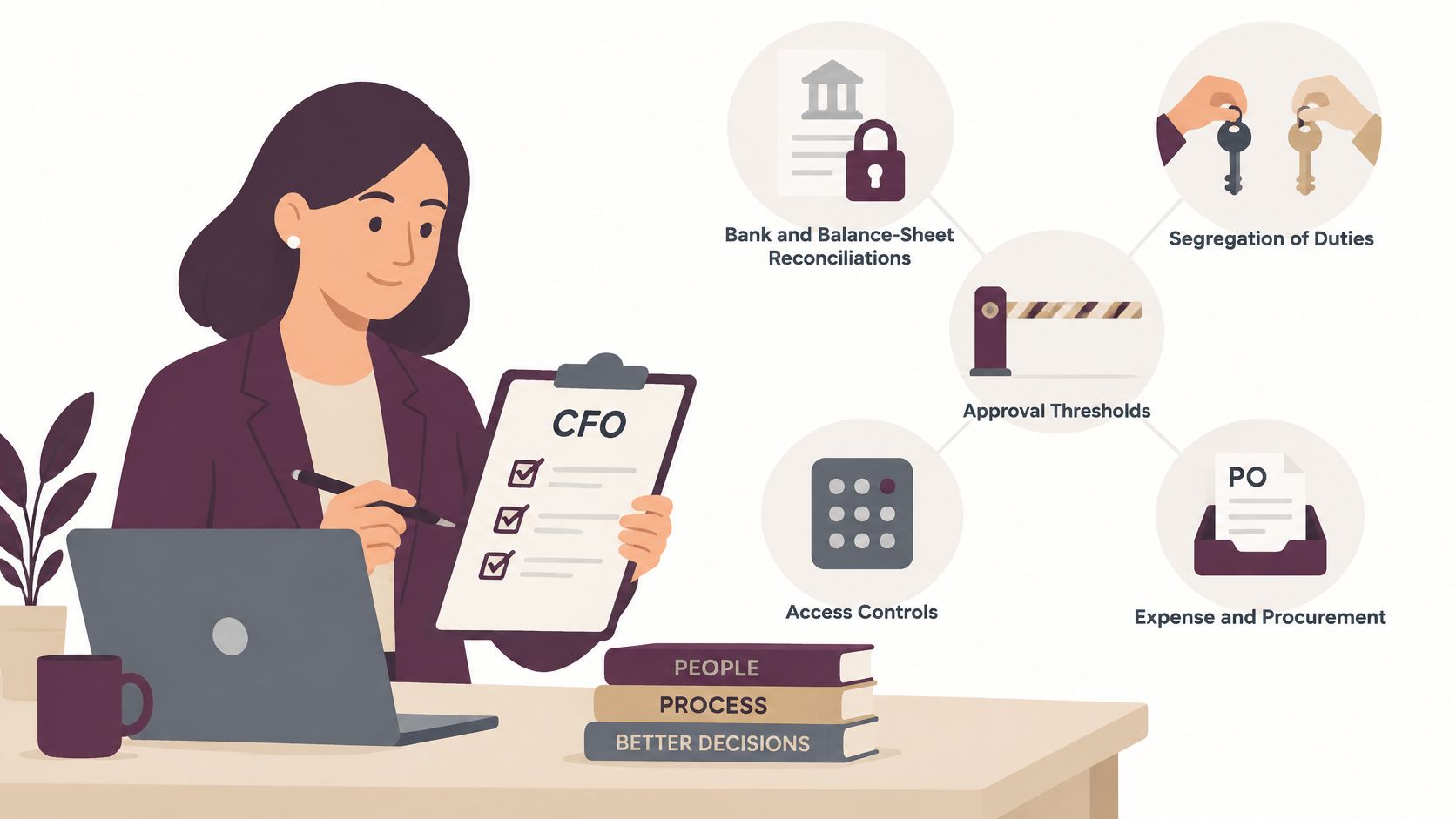
- Segregation of duties and approval thresholds: who can create a supplier, who can release a payment, and the amount at which a second signature appears. The CFO sets the matrix, the bookkeeper works within it.
- Reconciliations and access controls: bank and balance-sheet reconciliations reviewed monthly by the CFO, prepared by the controller, with system access reviewed on a schedule.
- Policy and close discipline: expense and procurement policy, revenue and cash controls, close review, audit readiness, and documented escalation of exceptions rather than a Slack message that scrolls away.
The written operating model
Require a one-page finance operating model naming who prepares, reviews and approves each process, what stays with the bookkeeper, controller, payroll provider or external accountant, which decisions need CEO or board approval, and how continuity works during the CFO's off-hours. That last clause is the one nobody writes and everybody needs when a payment runs on a Thursday and the CFO works Tuesdays.
Cross-border operations make the boundary harder, not different. Local filings often sit with a specialist outside the finance team, and this explainer on when expat freelancers need a gestor shows the kind of work you should route to a local provider rather than load onto your CFO.
Make the control work measurable with a controls-risk register, a quarterly control review, a documented close checklist, a cash authorization matrix and remediation tracking. Those artifacts distinguish oversight from processing in a way adjectives never do.
Say who fixes the systems
In a survey of North American companies with up to $100 million in revenue reported by CFO.com, 66% reported fragmented ERP setups with disconnected systems and manual reconciliation. Someone has to standardise the chart of accounts and reconcile CRM-to-billing data before a forecast means anything.
So state whether the CFO selects tools, manages implementation, supervises outsourced accounting, or only interprets existing reports. Then answer the buyer question directly in the description: how many hours go to fixing the finance stack versus advising management?
Qualifications and Experience to Require
Requirements lists fail when they describe a résumé instead of the work. Write each qualification with the reason it exists, and you'll filter better and interview faster.
Must-haves
- Advanced financial modelling: because the forecasts and scenarios you're buying are built by hand, not exported from a dashboard.
- Scenario analysis: because you need three costed options before you commit cash, not one recommendation with no alternatives.
- Accounting-system fluency: the CFO has to work directly in the ledger and reporting tools you already run, whether that's QuickBooks, Xero or NetSuite, rather than waiting for someone to send a CSV.
- KPI design for your business model: a SaaS company needs MRR, churn and CAC payback defined and owned; a distributor needs inventory turns and contribution margin. Generic dashboards don't survive contact with your operations.
- Presenting conclusions to non-financial executives: because a board pack your operations lead can't read has no decision value.
Stage-matched experience
Match the background to the next twelve months, not the last job title. A growth-stage business needs someone who has installed a monthly reporting cycle and a cash model from scratch. A company raising capital needs lender and investor conversations in their history. A business under pressure needs turnaround cash management, which is a different temperament entirely: faster decisions, harder conversations, less patience for elegant models.
For public companies, require working knowledge of Forms 8-K, 10-K and 10-Q and of U.S. GAAP and SEC reporting requirements. For everyone else, treat that as noise in the requirements list.
Nice-to-have, and proof to ask for
A CPA or comparable credential helps with technical accounting judgment, but it shouldn't substitute for evidence of forecasting and decision work. Put it under preferred.
Ask every finalist for three artifacts: an anonymised sample forecast, a past board pack, and a short written summary of a cash decision they recommended and what happened next. The third one separates operators from reporters more reliably than any interview question.
We screen candidates on paper and then by phone before they join our talent pool. After we match a CFO to you, you complete the final round of vetting and decide whether to hire, so build these proof requests into your own last round rather than assuming they've been covered.
30, 60 and 90 Day Success Measures for the Role
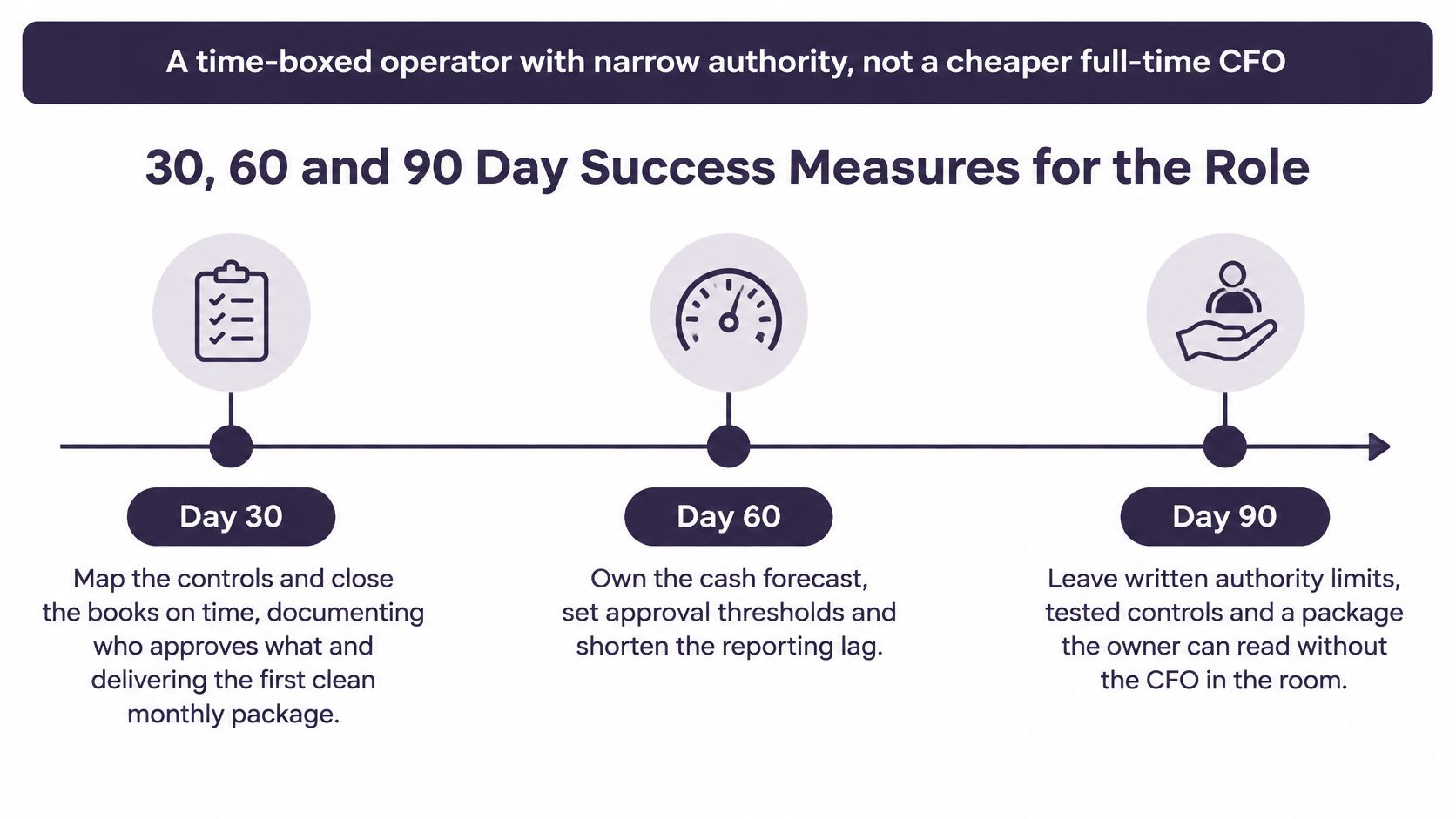
A part time CFO should be scoped as a time-boxed operator with explicit authority over a narrow problem, with deliverables and decision rights written into the description. Treated like a cheaper full-time CFO, the role sprawls into bookkeeping, overlaps with your accountant, and gets judged against a job nobody defined.
Collections often become the first test. Slow invoice-to-cash cycles and high DSO are common working-capital problems for growing companies, so give the CFO authority over the invoice-to-cash process and measure the days against a baseline. The point is not another status report. It is a named owner, a visible ageing view, escalation rules, and a trend the CEO can act on.
The mandate, written into the description
| Window | Expected Deliverable | Measure of Success |
|---|---|---|
| Days 1-30 | Baseline audit of the close, cash position and reporting data | Documented baseline and a named owner for each data source |
| Days 31-60 | Monthly reporting pack and 13-week cash forecast in live use | Pack delivered on the agreed calendar and forecast updated weekly |
| Days 61-90 | Working-capital plan and escalation thresholds set | DSO trend against baseline and forecast variance tracked |
| Ongoing | Monthly review of decision rights and KPIs | Client confirms scope at the quarterly review |
The first window is deliberately unglamorous. A CFO who spends month one rebuilding your chart of accounts and naming data owners is doing the work that makes month two possible. If you demand strategic recommendations in week two, you will get confident guesses built on numbers nobody has reconciled. That is the trade-off with part-time finance leadership: calendar time is limited, so the early work has to remove ambiguity fast.
A fractional executive who can't tell you what they own by day thirty doesn't own anything yet, and the engagement will drift until someone writes it down.
Pick one outcome and date it
Choose a single measurable outcome and put it in the description with a date. A DSO target fits a business with slow collections. Forecast variance within an agreed band fits a company whose plans keep missing. Audit readiness or a completed data room fits a company heading into a raise. One outcome, one number, one date, reviewed monthly.
The ongoing row matters as much as the first ninety days. Decision rights erode: the founder starts approving payments below the threshold again, the controller stops sending the payables ageing, and the forecast goes stale. A monthly review of who owns what keeps the scope visible. A quarterly confirmation keeps the contract alive when priorities shift.
For a longer view on sequencing the early work, SourceX's guide to the first 90 days as interim CFO is worth reading alongside your own mandate, particularly on how quickly to move from diagnosis to action. A related discussion of fractional work cited by CFO Brew can help frame the broader operating model, but the mandate still needs its own dates, owners and measures.
Customizable Part Time CFO Job Description Template
Paste these blocks into a document, fill the brackets, and delete anything that doesn't apply. Keep it under two pages so candidates read the whole thing.
1. Role summary
[Company] seeks a part time CFO to own financial planning, monthly reporting, cash management and financial controls for [hours or range] per week. The immediate mandate is [narrow business problem, stated in one sentence].
2. Reporting line and decision rights
Reports to [CEO or board]. Owns [listed tasks from the ownership table]. Escalates [liquidity or covenant threshold] to [role] within [time]. Approves spend up to [amount]; above that, [role] approves.
3. Core responsibilities
- Deliver a monthly reporting package reconciled to the general ledger, with variance explanations and management commentary, by [business day] each month.
- Maintain a rolling 13-week cash forecast, refreshed [day] weekly, with a minimum-cash threshold of [amount].
- Build the annual budget and refresh the forecast [monthly or quarterly], with scenario analysis on [named decisions].
- Define and own management KPIs covering revenue, gross margin, contribution margin, headcount and working capital.
- Design and review the control framework, including the approval matrix, reconciliation review and close checklist, and run a quarterly control review.
- Prepare board, investor and lender reporting on [cadence], and lead financing analysis when required.
- Supervise [bookkeeper, controller or outsourced provider], with transaction processing remaining with them.
- Own the finance systems roadmap for [scope: selection, implementation, or interpretation only].
4. Qualifications
Must-have: [modelling, scenario analysis, system fluency, KPI design for your model, executive communication, stage-matched experience]. Nice-to-have: [CPA or equivalent, sector background].
5. Success measures
Days 1-30: [baseline deliverable]. Days 31-60: [live deliverables]. Days 61-90: [working-capital or readiness outcome]. One measurable outcome: [metric] by [date].
6. Working arrangement
Availability [days or windows], [remote or on-site], handoffs to [controller or outside provider], and continuity cover during off-hours.
7. Evaluation
Work sample: build a 13-week cash forecast from [anonymised data set] and present three options for a projected shortfall in [time limit].
8. Compensation
[Hourly rate or monthly retainer], [expense reimbursement policy], [term and notice period].
Set the compensation figure last, after the weekly hours and the ownership lines are confirmed. A retainer priced against "strategic advice" and then spent on chart-of-accounts cleanup is the fastest way to sour a good engagement.
Two customisation notes. Match the cadence to your stage rather than copying a template built for a larger company, and cut any block you can't supervise. An unenforced clause is worse than no clause, because it teaches the CFO which parts of the document are real.
Confirm the Scope Before You Hire
Run this checklist before the role goes live. It takes an hour and saves a quarter.
- Confirm the hours and the ramp. Fractional executives can be hired for 2 to 40 hours per week with no minimum, and hours can ramp up or down as needs change. Decide the starting level and the trigger for increasing it.
- Confirm every ownership line. Read the decision-rights table aloud with your controller and your CFO candidate in the same call. Ambiguity surfaces fast when three people say the same sentence.
- Match the measures to your stage. DSO for a slow invoice-to-cash cycle, audit readiness for a company preparing a raise, forecast accuracy for a business whose plans keep missing.
- Confirm the work sample uses real data. Anonymise it, but keep the messiness. A clean textbook dataset tests modelling, not the judgment you're hiring.
- Confirm the reporting line and the escalation threshold. Name the cash level, the covenant headroom, the person called and the window.
Once the scope is written down, it becomes your interview scorecard, your onboarding plan and your ninety-day review, all from one document. Our guide to hiring a CFO covers the search process itself.
We match startups with pre-vetted CFOs from our talent pool, and you can interview and hire a matched CFO as quickly or as slowly as you like. There's no pressure to compress your own vetting to fit someone else's timeline.
Bring your draft scope to us and we'll match you with pre-vetted fractional CFOs who've run the exact mandate you've written, whether that's collections, a first clean close or a financing round. You keep the final vetting and the hiring decision, and you set the hours anywhere from 2 to 40 per week. Visit Shiny to post your role or book a consultation to talk the scope through before you post it.