
Part-Time CFO Services: What You Get and When to Hire
The board pack is due Friday. You have a P&L your accountant sent last week, a bank balance you checked this morning, and no confident answer to the key question: if you hire two account managers in Q3 and your biggest client pays 30 days late, does payroll still clear in November?
That gap, between owning financial statements and owning financial judgment, is where part-time CFO services earn their fee. Not because you need another accountant. Because nobody in the business currently owns the forward view.
Most owners assume two options exist: carry on as you are, or hire a full-time CFO at an executive salary plus benefits. There's a third, and it isn't a diluted version of the first two. It's a senior operator who takes decision rights over forecasting, cash controls and management reporting for a defined number of hours a week.
What a Part-Time CFO Actually Delivers
A company can have accurate books and still lack an owner for financial decisions. A part-time CFO takes responsibility for the senior finance work the business needs before it can justify a full-time executive: turning financial data into a forecast, setting a reporting rhythm, and giving leaders a clear basis for decisions about hiring, pricing, borrowing, and spending.
The practical test is not how many hours the CFO works. It is which decisions they own, what they deliver, and how often leaders use it.
| Service area | What you receive | Typical cadence |
|---|---|---|
| Cash-flow forecasting | 13-week rolling forecast and runway report | Weekly |
| Close oversight and management reporting | Monthly close review and KPI pack | Monthly |
| Board and investor reporting | Board pack and investor updates | Monthly or quarterly |
| Pricing and unit economics | Margin and pricing analysis by product or client | Quarterly |
| Fundraising and lender materials | Financial model, data room and lender reporting | Per project |
| Hiring and budget decisions | Annual budget and headcount plan with reviews | Quarterly |
| Finance systems and controls | Approval limits, reconciliations and reporting setup | Ongoing |
Treat these as decision tools, not a checklist of finance chores. Before renewing a credit line, a useful forecast shows when major customers are expected to pay, when payroll is due, and how debt service and tax payments affect available cash. That lets the company discuss the facility with a clear view of its needs rather than relying on a hopeful bank balance. Pricing analysis should answer an equally practical question: which products or clients remain profitable after delivery costs and support time are counted?
The operating cadence matters as much as the deliverables. Weekly cash work prevents surprises. Quarterly pricing reviews set direction. If the CFO only reviews completed statements once a month, the engagement may produce useful oversight but leave near-term decisions without a current financial view. A late receivable, for example, can change whether planned spending still fits the forecast.
The labels for this kind of work have shifted. “Fractional” has gained ground on “part-time,” but the title does not define the job. The useful distinction is the mandate: who owns the forecast, who can recommend or set cash controls, and who turns reporting into decisions. Agree on those rights and the reporting schedule before judging an engagement by hours alone.
Use a simple self-check. If statements arrive on time but nobody owns next quarter's forecast, nobody is responsible for recommending a pause to discretionary spending when cash tightens, and nobody can explain which product line makes money, the company has a finance ownership gap. The books may be accurate; the missing piece is a person accountable for using them to guide decisions. A part-time CFO's value depends on whether that ownership is explicit and whether the agreed reporting cadence gives leaders time to act.
Who Owns What Between a CFO, Controller and Bookkeeper
You already pay an accountant. Returns get filed, the P&L lands mid-month, payables go out. It's reasonable to assume finance is handled. It usually isn't, and the confusion gets expensive because three distinct roles get treated as one line item.
Think of a building. The bookkeeper records every transaction correctly, which is the bricks and mortar. The controller closes the books and keeps internal controls working, which is the frame and the inspection schedule. The part-time CFO decides what the finished building is for: whether to add a floor, sell it, or refinance it.

Split the work by output and the lines get clear.
| Role | Owns | Does not own |
|---|---|---|
| Bookkeeper | Recording every transaction correctly | Forecasting, pricing and financing decisions |
| Controller | Month-end close and internal controls | Cash forecasting and hiring budgets |
| Part-time CFO | Forecasting, cash controls, management reporting, pricing, financing and hiring budgets | Transaction-level accuracy and close quality |
The CFO's decision rights are specific: the forecast, the cash controls, the management reporting pack, pricing analysis, financing strategy and the hiring budget. Transaction accuracy stays with the bookkeeper. Close quality stays with the controller. When those boundaries blur, you get a senior person reconciling a bank account at a rate you can't justify.
The agenda has shifted upward anyway. Gartner's top finance priorities for 2025 puts metrics, analytics, efficient growth and AI adoption at the center of the CFO remit, not the production of financial statements. That's judgment work, and it needs someone with the standing to act on it.
Decision rights beat hours: the value of a part-time CFO comes from decision rights and cadence, not hours purchased.
A five-hour engagement with clear authority over forecasting, cash controls and management reporting outperforms a twenty-hour engagement spent producing ad hoc analysis nobody acts on. Judge yours on measurable things: forecast variance, close-cycle time, gross-margin visibility, decision turnaround. And set the expectation that the CFO is reachable when a lender calls on a Thursday, not only inside the scheduled slot.
If the transaction layer is weak, no CFO can fix it from above. Snyp's guide to small business accounting and bookkeeping services covers what a clean bookkeeping stack looks like before you hand numbers to anyone senior. A delayed close also compounds, as this account of what happens when you delay your bookkeeping makes plain.
How a Part-Time CFO Engagement Works Step by Step
A good engagement follows a fixed sequence, and most of the failures happen in the first three steps rather than in the work itself.
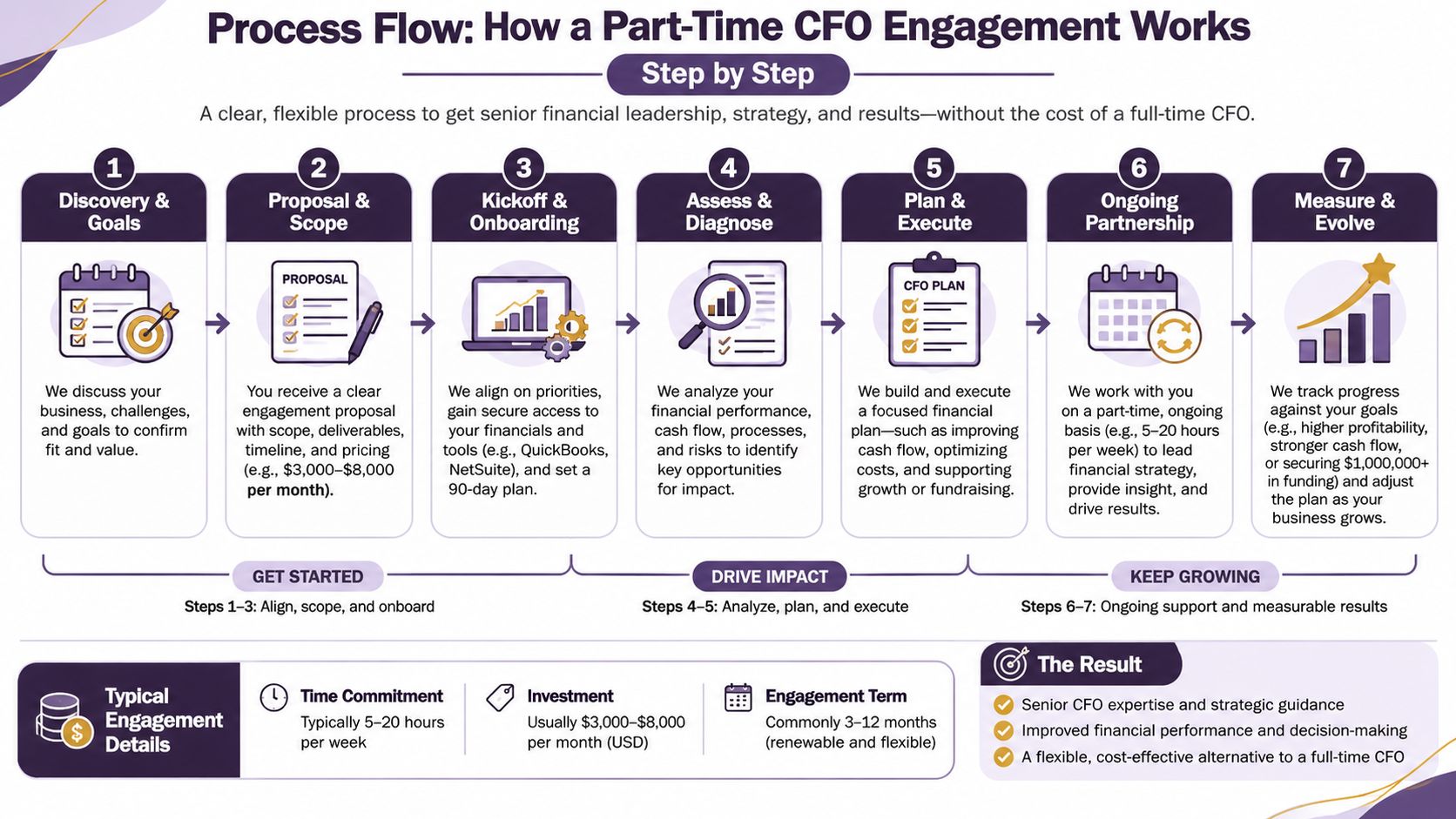
Define the decision problem. Name one or two outcomes to fix in the first 90 days, such as cash visibility before a hire or a lender-ready plan for a facility renewal. The slip: starting without one, which leaves the CFO reporting into a vacuum with no authority to change anything.
Review a shortlist, not a pile of résumés. Shiny matches a company with pre-vetted CFOs from its talent pool, so the first conversation is with candidates who have already cleared a screen. The slip: interviewing whoever a network introduction produced, with no consistent standard across candidates.
Interview on your own timeline. You can move as quickly or as slowly as you like, and the final round of vetting and the hiring decision stay with you. The slip: letting a self-imposed deadline push you into a mismatch you'll unwind in six months.
Set scope and hours in writing. Agree the weekly commitment, what it buys, and which decisions the CFO can make without asking you first. The slip: a verbal "let's start and see," which is how engagements drift into expensive reporting.
Open access in week one. Grant bank, accounting and reporting access immediately, then build the baseline cash model from your actual numbers rather than a template. The slip: three weeks lost waiting on a read-only accounting login.
Establish the operating cadence. A standing weekly cash review, a monthly close and management pack, and quarterly planning. The slip: scheduling a monthly call and calling it oversight.
Review at 90 days against the baseline. Compare forecast accuracy, close time and cash metrics with where you started, then decide whether to expand, reduce or end the engagement. The slip: never reviewing, so an arrangement that stopped paying for itself keeps running for another year.
The first month should leave you with three things: a weekly meeting that doesn't move, a forecast you actually trust, and a short list of decisions the CFO can make without asking.
If any of those are missing at day 30, the scope is wrong, not the person.
Cash Forecasting and Runway Reporting Your CFO Builds
Start with the number that makes the case. The median U.S. small business holds about 27 days of cash buffer, and the bottom quartile holds 13 days or fewer, according to Indinero's guide to CFO service models. Two weeks of delayed receivables is enough to turn a comfortable month into a payroll scramble.
That's why the core deliverable is a rolling 13-week cash-flow model rather than an annual budget with quarterly guesses bolted on.
What goes into the 13-week model
- Separate the three flows. Operating, investing and financing cash, kept distinct so a drawdown on a credit line doesn't look like trading performance.
- Build from real behavior. Use actual collection patterns by customer and actual payment timing by supplier, not contractual terms.
- Load the fixed obligations. Payroll dates, debt service, taxes, capital spending and confirmed hires, plus the seasonality your revenue already shows.
Then run the weekly routine in sequence. Update the model. Compare forecast against actual cash by category. Write down where each variance came from, because the reason matters more than the amount. Three scenarios sit alongside it: base, downside and upside, each tied to a decision rather than a mood.
The thresholds turn analysis into action:
- Liquidity floor. Freeze discretionary hiring when projected cash falls below a set minimum you've agreed in advance.
- Collections trigger. Accelerate collections, and tighten terms, when days sales outstanding starts climbing past its usual range.
- Financing window. Open lender conversations before a covenant or payroll risk appears, not after.
Say a services firm sees a large client payment slip three weeks in the forecast. The CFO moves two vendor payments and delays a software renewal, and the gap closes without a crisis meeting or a bridge loan.
The technical output is a schedule. The true product is a shorter warning period between a variance appearing and someone responding to it. For a deeper walkthrough of the mechanics, see this guide to financial forecasting for startups.
Business Situations Where a Part-Time CFO Pays Off
Your Tuesday looks like this: two client calls, a supplier dispute, a hiring decision you've deferred twice, and a spreadsheet you open at 9pm to answer a question your accountant can't.
The pattern isn't a personal failing. A Consumer Financial Protection Bureau analysis of small-business owner finances found owners were nearly twice as likely as non-owners to report month-to-month income variation, and more than 20 percentage points more likely to have experienced an income drop.
The situations that justify the fee look like this:
- Finance happens at night. You're closing the laptop at 11pm and still can't say what next quarter's cash looks like.
- A commitment is pending. A hire, a new market, a large inventory buy, each of which needs a cash check before you sign.
- A lender or investor is asking. The reporting you have won't survive due diligence without rebuilding.
- Complexity has outgrown the setup. Multiple entities, new revenue lines, a controller who needs direction rather than another checklist.
- Nobody owns the margin question. Pricing decisions are made on instinct because the unit economics live in three spreadsheets nobody reconciled.
Capital access is the most common trigger, and it's measurable rather than theoretical. The SBA's 2024 small business finance FAQ reports total outstanding small-business loan balances above $1.3 trillion in 2023, with about 70% of small employer firms carrying outstanding debt that year.
Volume matters as much as the trigger. A company with steady monthly revenue may need a quarterly review and little else. A company with lumpy receivables and two dominant customers needs weekly oversight, because a single late payment changes the whole quarter. Shiny's fractional executives work across more than 40 industries, including SaaS, FinTech, HealthTech, Ecommerce, Energy and Manufacturing, so the pattern isn't confined to one business model.
If you can't state today what cash you'll hold in 13 weeks, the situation already applies to you.
What a Part-Time CFO Costs and How to Judge Value
The honest answer starts with a benchmark rather than a rate card. APQC benchmarking, reported by CFO.com, puts finance-function spend at approximately 0.66% of revenue for top performers, 1.0% for median performers and 1.5% for bottom performers, covering forecasting, budgeting, payroll, receivables and related work.
| Performance tier | Finance spend (% of revenue) | Annual cost at $10M revenue |
|---|---|---|
| Top performers | 0.66% | $66,000 |
| Median performers | 1.0% | $100,000 |
| Bottom performers | 1.5% | $150,000 |
Read the gap between median and top-quartile spend carefully. It isn't automatic savings sitting on the table. Underinvesting in finance degrades data quality, controls, forecasting and working-capital management, and the cost shows up later as slower decisions and worse terms.
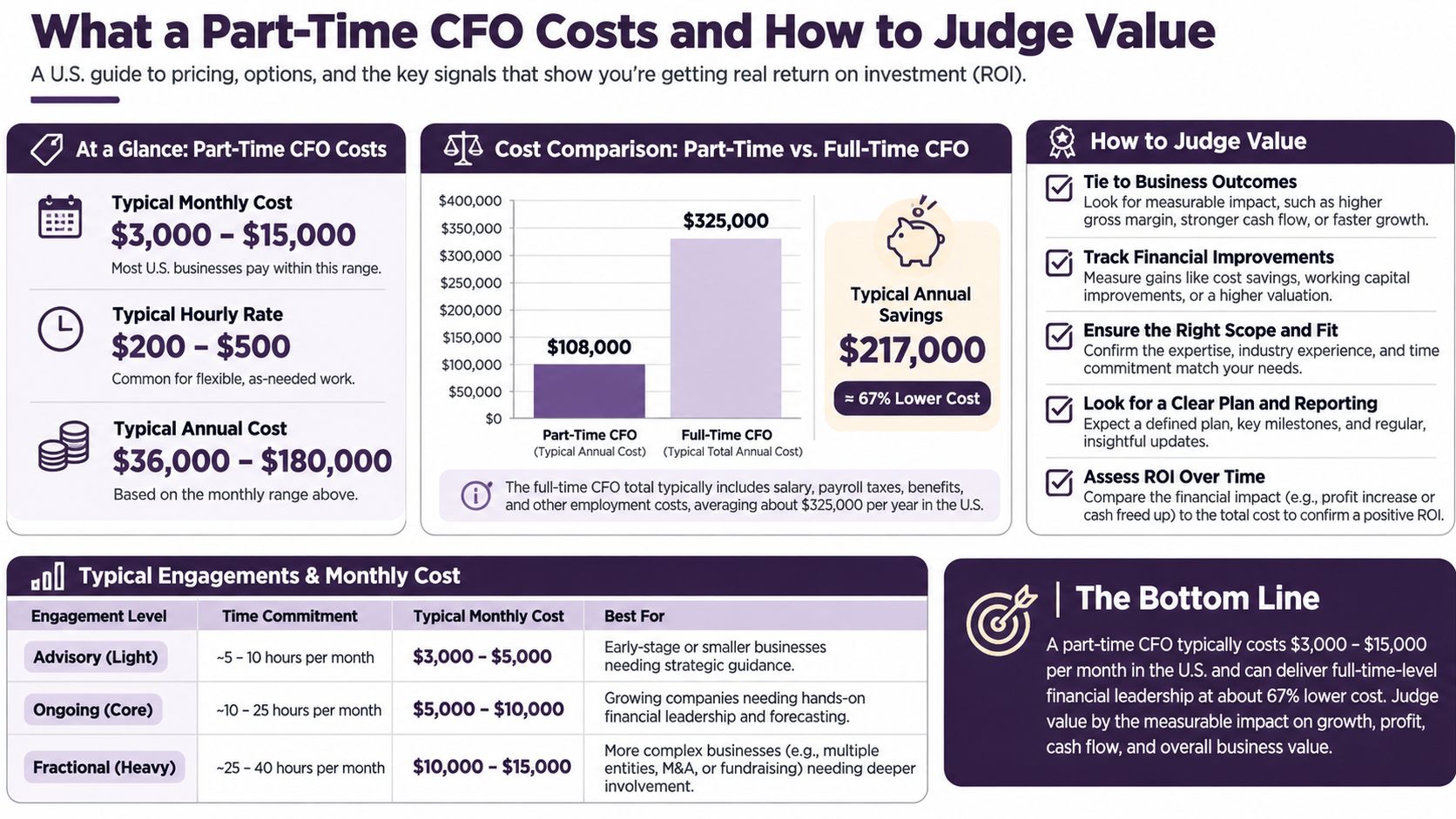
Engagements get sized in hours per week, agreed at intake and written into the scope. Fractional executives can be hired for 2 to 40 hours per week with no minimum, and hours can be ramped up or down as the business changes. Scope still matters more than the hours line, since two engagements can both say ten hours a week while one owns the forecast and the other produces decks.
Track six metrics from month one: monthly close duration, forecast error, gross-margin variance, accounts-receivable aging, cash-conversion cycle and finance cost as a percentage of revenue. Say a distributor cuts its close from two weeks to one and halves forecast error within two quarters. The return doesn't appear as a smaller finance bill. It appears as a pricing decision made three weeks earlier and a hire deferred that would have been wrong.
Watch the trade-off: the cheapest finance function this quarter is usually the most expensive one next year.
Prevalence helps here. Consero Global's 2024 CFO Survey reported that 79% of CFOs at North American, investor-backed growth companies with $10 million to $200 million in revenue worked with a third-party finance and accounting partner in 2024. For role-by-role rate context, this breakdown of fractional executive compensation is a useful benchmark.
Confirm Your Fit and Book a Consultation
Before any conversation, answer three questions.
- Which decision are you making in the next 90 days? A hire, a raise, a refinancing, a price change. If you can't name one, you're not ready.
- Which numbers do you already trust? Cash balance and gross margin are the minimum. If neither is reliable, fix bookkeeping first.
- How many hours of senior judgment can you use each week? Five focused hours with authority beats fifteen hours without it.
Then set a 90-day scope with two measurable outcomes and review candidates. A full-time hire or a controller is the better answer if the business needs a finance leader on site daily, or if there's no reliable close process for anyone senior to build on.
A part-time CFO works only when the owner grants authority over the numbers and protects a standing weekly hour to act on them.
That single condition predicts the outcome better than the CV does.
Shiny connects growing companies with pre-vetted fractional CFOs and other C-suite executives who work 2 to 40 hours a week across more than 40 industries. You can define a 90-day scope, interview candidates at your own pace, and adjust the hours as the business changes. Visit Shiny to see the finance leaders available at your stage and book a conversation about fit.