
VP of Sales and Marketing: Role, Skills and Growth Impact
Your marketing team says leads are up. Your sales team says the leads aren't ready to buy. Meanwhile, you're still approving discounts, chasing forecasts, and explaining to the board why a busy pipeline hasn't become predictable revenue.
A VP of Sales and Marketing can take ownership of that gap. But putting both functions under one title doesn't automatically fix it. Before you hire, decide whether you need a commercial leader to build the system, a hands-on manager to run it daily, or separate specialists with different responsibilities.
Where the VP Sits in a Growing Company
A VP of Sales and Marketing is a senior commercial executive who turns company strategy into measurable revenue growth. The scope covers sales leadership, market positioning, pricing, customer intelligence, forecasting, and coordination with other department heads.
Sales and marketing work like two engines feeding one pipeline. The VP reads both gauges and decides where the fuel goes. That dual ownership is also the role's biggest risk: the person is effectively doing two jobs, and whichever function they know less well tends to get neglected first.

A commercial seat beside the CEO
The VP typically reports to the CEO and works alongside finance, product, and customer success leaders. A clear startup organizational structure helps distinguish executive decisions from work that belongs to functional managers.
A CMO concentrates on marketing. A Chief Revenue Officer may hold broader responsibility across sales, partnerships, renewals, and customer success. Titles are not standardized across the industry: the Chief Marketing Officer Council's 2024 CMO Intentions research drew responses from senior marketing and revenue leaders, most of them holding VP-level titles or above.
The combined seat can suit businesses with roughly $1 million to $50 million in revenue, particularly when founders haven't established a repeatable sales process. Clarifying adjacent responsibilities matters too; RichAPI's explanation of how business development differs from sales helps separate relationship-building from closing ownership.
The role is not limited to technology startups. The U.S. Bureau of Labor Statistics occupational projections group this work under marketing and sales managers and project steady openings across the occupation.
If no one owns the connection between campaigns and closed revenue, your company is missing this leadership function, whether or not it has the title.
Core Responsibilities at a Glance
Use this responsibility map to distinguish what the VP must own from what the team executes.
VP of Sales and Marketing responsibilities by area
| Area | What the VP owns | Metric that proves it |
|---|---|---|
| Revenue strategy and go-to-market | Target segments, channels, positioning and budget priorities | Pipeline coverage and sourced pipeline |
| Sales leadership | Quotas, forecasting standards and sales-manager coaching | Forecast accuracy and quota attainment |
| Marketing and demand | Campaign priorities, messaging and channel economics | Marketing-sourced pipeline and cost per opportunity |
| Pricing and packaging | Price tiers, discount rules and contract terms | Average contract value and discount rate |
| Customer intelligence | Win and loss reviews, churn signals and feedback to product | Win rate by segment and retention |
| Revenue operations | CRM stage model, handoff rules and reporting cadence | Stage conversion and sales-cycle length |
Any area without an owner or a useful metric deserves investigation. A responsibility written in a job description isn't enough. Someone needs authority to make decisions, access to the necessary information, and a way to judge the result.
Ownership doesn't mean personal execution. The VP might approve campaign priorities while a demand-generation manager runs campaigns, or set forecasting standards while sales managers inspect individual opportunities.
Look for the missing handoff
Say a software company attracts strong demand but converts few inquiries into sales conversations. Marketing passes contacts into Salesforce, but sales representatives can't tell which contacts have buying intent. Qualified prospects wait days for a first call because neither team owns acceptance and routing.
Hiring more closers won't resolve that ambiguity. If you're evaluating closing capacity, LatHire's guide to the best place to hire closers is a useful hiring resource, but establish the qualification and handoff rules before adding people.
The VP also isn't automatically the owner of product delivery, financial controls, or customer support. They should bring commercial evidence into those departments without replacing their leaders. Pricing decisions, for example, need finance's margin constraints and product's delivery realities.
Run a simple ownership audit
Write a person's name beside each area:
- Revenue strategy and go-to-market: Who chooses the buyers and channels?
- Sales leadership: Who sets expectations and coaches managers?
- Marketing and demand: Who decides what campaigns deserve investment?
- Pricing and packaging: Who approves the offer and discount boundaries?
- Customer intelligence: Who turns buyer feedback into decisions?
- Revenue operations: Who maintains the process and reporting?
Then ask each named person what they can approve. A name without decision rights can conceal the same gap as an empty box.
Skills That Make a VP Effective
An impressive sales record doesn't prove someone can lead marketing. Likewise, a strong brand strategist may struggle with deal inspection, compensation design, or forecast accountability. Evaluate candidates against the work your company needs, not the most recognizable employer on their résumé.
Capabilities to test in interviews
Commercial judgment: An effective VP selects target segments and declines opportunities that would distract the company or strain delivery. Ask them to explain a deal they'd turn down. Warning sign: every lead looks equally attractive.
Forecasting discipline: They distinguish a buyer's enthusiasm from evidence of a purchase. Ask how they'd assess an opportunity without a confirmed decision process. Warning sign: confidence substitutes for documented next steps.
Data fluency: They can inspect Salesforce or HubSpot records, question stage definitions, and compare conversion across segments. Warning sign: anecdotes consistently outweigh the CRM, yet they have no plan to repair the CRM.
Coaching: They develop sales managers and campaign leads rather than becoming the permanent rescuer. Ask how they'd help a capable manager diagnose weak performance. Warning sign: top performers leave while the executive takes over their work.
Influence without authority: They negotiate workable commitments with product, finance, and customer success. Warning sign: departments agree in meetings, then return to incompatible priorities.
Executive communication: They explain pipeline risk, resource choices, and trade-offs in plain language. Warning sign: the CEO receives a presentation full of activity charts but no recommendation.
Pricing sense: They know when an objection requires better value communication and when the package itself needs changing. Warning sign: discounting becomes the automatic answer to every stalled deal.
Test reasoning, not presentation polish
Give a candidate an anonymized opportunity report and a campaign summary. Ask what they'd investigate before changing spending or headcount. A thoughtful candidate will separate what the evidence supports from what still needs checking.
The best VPs act as interpreters between sales talk and marketing talk. They help both teams describe buyer progress, commercial risk, and revenue in the same terms without pretending the disciplines are identical.
How Alignment Turns Sales and Marketing Into One Engine
A benchmark of 400 B2B organizations covering 2006–2014, described in Icaro Iasbeck's sales–marketing alignment analysis, associated sustained alignment with revenue growth up to 19% faster and profitability up to 15% higher than among less-aligned organizations. That's directional evidence, not a guaranteed uplift or proof that changing reporting lines causes growth.
The practical mechanism is less glamorous than the headline. Teams waste fewer opportunities when they agree on who they're pursuing, what qualifies a buyer, and what happens next.

Build a feedback loop around buyer progress
Start with a documented ideal customer profile, or ICP. It should describe the organizations that fit your offer, their relevant problems, and the conditions that make a purchase plausible.
Then agree on marketing-qualified leads, sales-qualified leads, opportunities, and attribution. These definitions establish what each team is handing over and what evidence the receiving team should expect.
The operating loop should be explicit:
- Marketing attracts and qualifies: Evaluate its contribution through pipeline progression and revenue, not lead volume alone.
- Sales records buyer evidence: Capture structured reasons why deals advance, stall, or are lost.
- Leaders review the patterns: Change targeting, qualification, messaging, or sales enablement when conversion evidence supports it.
Compensation and recognition need to support that cooperation. Grou's guide to shared incentives for sales and marketing offers useful context for avoiding competing definitions of success.
Diagnose before increasing the budget
Consider a hypothetical company generating 400 leads a month, with sales rejecting half because the buyers don't fit. The first question isn't whether the company should buy more advertising. It's whether marketing and sales mean the same thing by a suitable buyer.
The VP should inspect rejected contacts with both teams. Perhaps a campaign attracts students researching the category rather than managers evaluating a purchase. That calls for different targeting and qualification, not a larger budget.
Use demand-generation strategies to attract and develop the right demand, then test the resulting opportunities against shared criteria. The dashboard should make disagreements visible enough to resolve.
Write stage definitions with entry and exit criteria before buying another tool. Software can route records and enforce required fields, but it can't settle commercial definitions your leaders haven't agreed on.
Weekly Metrics the VP Should Track
The weekly dashboard should put commercial outcomes above activity counts.
Weekly metrics for a sales and marketing review
| Metric | Type | Why it matters |
|---|---|---|
| Leads and meetings booked | Activity | Shows effort but not whether it converts |
| Touches per rep or campaign | Activity | Reveals workload and can hide weak messaging |
| Sourced pipeline | Economic | Value marketing created that sales can work |
| Influenced pipeline | Economic | Value marketing supported in deals sourced elsewhere |
| Opportunity conversion by stage | Economic | Shows where deals stall and what to fix in qualification |
| Sales-cycle duration | Economic | Predicts capacity and the timing of cash |
| Win rate | Economic | Shows whether targeting and offers fit buyers |
| Average contract value | Economic | Shows whether pricing and packaging hold |
| Forecast accuracy | Economic | Tests whether the team can be trusted with commitments |
| Closed-won revenue | Economic | The outcome the rest of the system exists to produce |
A 2022 Demandbase survey of 224 senior B2B sales and marketing leaders identified improving alignment as the leading challenge, with inconsistent metrics, poor handoffs, and inadequate communication among recurring problems. A dashboard helps only when its definitions are consistent.
Read the economics behind the activity
A team can produce inexpensive leads and still leave sales without viable opportunities. Review economic measures first, then use activity measures to investigate the cause. Low pipeline creation with high outreach might indicate poor targeting or weak messaging rather than insufficient effort.
Define sourcing and influence carefully. An influenced opportunity isn't necessarily an opportunity marketing created, and the same deal shouldn't be counted repeatedly as incremental revenue.
Use cohort analysis to compare buyers grouped by channel, segment, industry, or acquisition month. Look beyond initial engagement: a channel may generate meetings while producing weak retention or unusually slow decisions.
For a smaller company, reliable CRM fields and automated reports are usually more useful than elaborate attribution machinery. Add complexity only when it helps someone make a better allocation decision.
Review rule: If a metric can't change a decision this week, remove it from the weekly discussion. Keep it available for longer-term analysis.
Should One Leader Own Both Functions?
Only 11% of surveyed B2B marketers reported full sales–marketing alignment, while 63% said their organization lacked a formal process for incorporating sales input into buyer identification; a separate 2025 benchmark found nearly half of go-to-market organizations lacked shared definitions of success, as summarized by MarTech.
The uncomfortable lesson is that a combined title can centralize accountability without fixing the way people work. One executive can't compensate indefinitely for incompatible data, unclear authority, or conflicting incentives.

When combining the functions makes sense
A combined seat is easier to manage when the business serves a coherent market through a shared revenue motion. The executive can make trade-offs across demand creation and closing without constantly switching between different businesses.
Check these conditions:
- Focused market: Buyers have similar problems, buying processes, and expectations.
- Manageable buying cycle: Deals don't require extensive regional, technical, or procurement specialization.
- Limited management capacity: The company needs executive judgment but can't support a large leadership layer.
- Capable functional leads: Someone can run campaigns and someone can manage sales execution without constant intervention.
For example, a professional-services firm selling a defined offer to a consistent buyer group may benefit from unified leadership. Messaging, qualification, proposals, and closing all belong to a closely connected process.
When specialization is safer
Separate leadership becomes more compelling when enterprise sales complexity, regional expansion, product-led growth, or customer-success coordination requires deep attention. A leader managing strategic-account negotiations may not also have capacity to oversee acquisition experiments and lifecycle marketing.
The risk isn't merely exhaustion. The executive may favor the discipline they know best, leaving the other function underdeveloped. A former sales leader might treat marketing as appointment-setting; a marketing specialist might underestimate the work required to coach a complex sales team.
A practical staged design is to give one executive ownership of the revenue system while functional leads retain explicit responsibility for pipeline generation, qualification, conversion, retention, and budget execution. Customer success should retain delivery ownership where appropriate, with agreed commercial interfaces.
A conductor can't make an orchestra play in tune if the instruments are tuned to different pitches. Equally, conducting doesn't mean personally playing every instrument.
Before creating the combined role, answer:
- What must this person decide across both functions that nobody can decide today?
- Who will execute each function when the executive is focused elsewhere?
Full-Time and Fractional Options Compared on Cost and Risk
| Factor | Full-time VP | Fractional VP |
|---|---|---|
| Cost basis | Salary.com's U.S. benchmark lists average salary of $299,602 as of November 1, 2026, before taxes, benefits and equity | Paid for a defined weekly commitment; compare with expected gains |
| Weekly time | Typically 40 or more hours, according to the same salary benchmark discussion | Defined schedule agreed up front |
| Time to start | Employers with fewer than 100 employees average 49 days to fill an open role, according to Rent a Recruiter's SME recruiting analysis | Match, availability and scope determine the start date |
| Recruiting cost | Average U.S. executive cost-per-hire is $35,879, according to the same recruiting analysis | Lower-commitment test of executive fit |
| Reversibility | 27% to 46% of executive transitions were viewed as failures or disappointments after two years, in research cited by McKinsey and discussed by Go Fractional | A limited mandate can be reviewed against milestones |
| Best fit | Continuous frontline management and team building | Strategy, system design and filling a leadership gap |
The salary benchmark's central 25th-to-75th-percentile range is $277,930 to $338,530. These are salary estimates, not a complete employer-cost calculation: payroll taxes, benefits, incentives, recruiting, and equity can add expense.
Recruiting also creates a waiting cost. The cited employer-size comparison concerns open roles generally, not VP searches specifically, so it shouldn't be treated as a promised executive-hiring timeline.
Buy the level of leadership you need
Fractional leadership isn't consulting with a more senior title. The executive should own defined decisions and outcomes, while the company supplies enough execution capacity to act on those decisions.
The model has become more visible: Harvard Business Review reported more than 110,000 LinkedIn members identifying as fractional leaders in 2024, compared with approximately 2,000 two years earlier. Visibility isn't proof of suitability, so assess the mandate rather than the label.
Our guide to a fractional VP of Sales can help distinguish sales-specific needs from a combined commercial remit. Keep the final hiring judgment with your company: in our CFO matching process, clients complete the final round of vetting and decide whether to hire the matched CFO.
Choose fractional when expertise and system design are the bottleneck. Choose full-time when daily management is the job. Either arrangement needs a defined commitment, decision rights, reporting lines, and escalation rules.
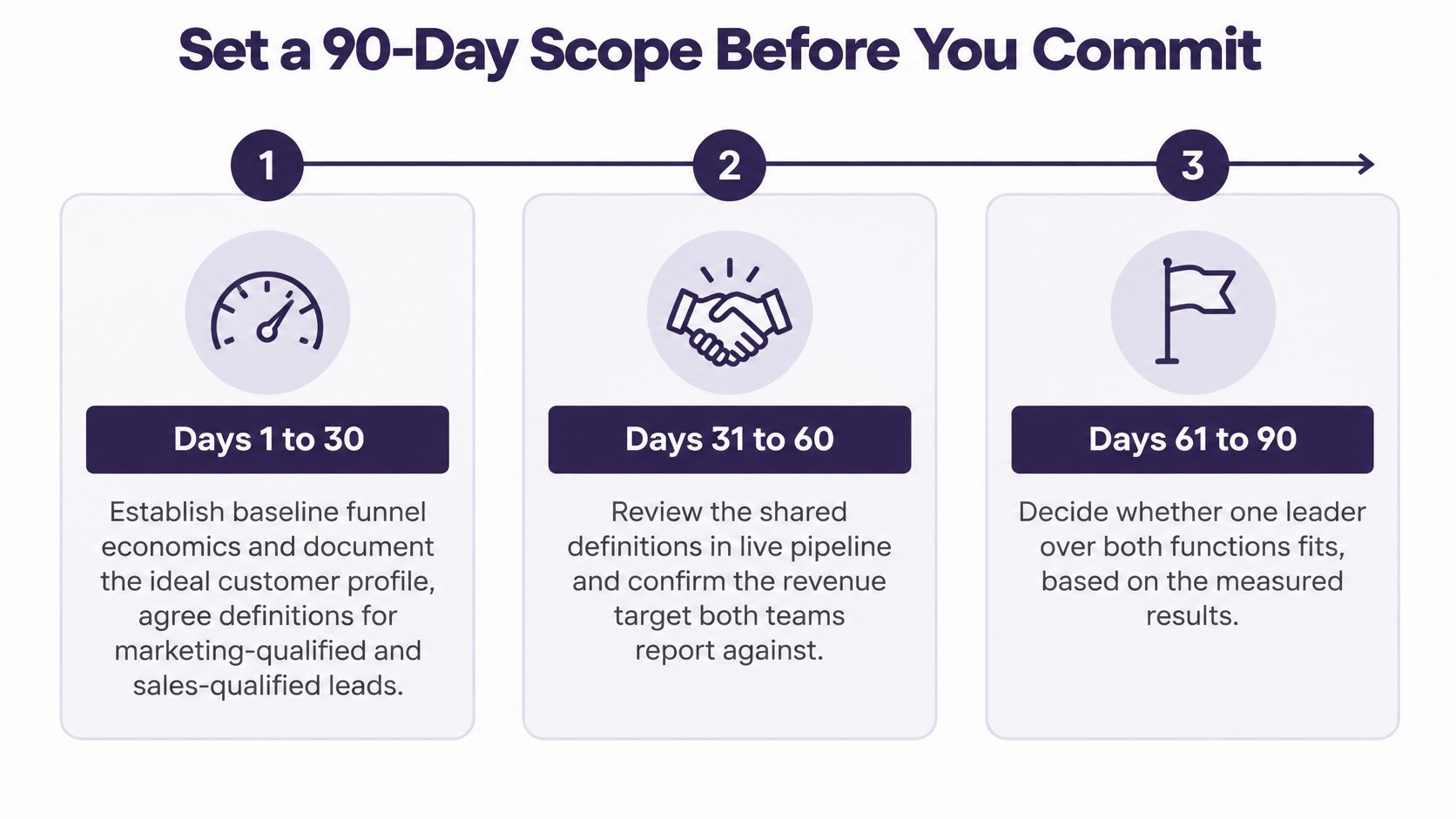
Set a 90-Day Scope Before You Commit
Days 1 to 30, establish the baseline. Document funnel economics, the ideal customer profile, and definitions for marketing-qualified and sales-qualified opportunities. Audit CRM records for missing fields, stale stages, duplicate accounts, and unsupported close dates. The deliverable is a diagnosis with priorities, not a sweeping promise to fix everything.
Days 31 to 60, install the operating rhythm. Start the weekly revenue review, agree lead-acceptance and follow-up service levels, and introduce a forecast method. Test the sales feedback loop against live opportunities. Confirm that managers can apply the rules without the executive interpreting every case.
Days 61 to 90, evaluate the leadership design. Report progress against agreed milestones and distinguish implementation progress from revenue outcomes that need more time. Recommend a full-time hire, a fractional extension, or a succession plan based on the work still required.
Agree authority before work begins
Write weekly hours, reporting lines to the CEO, access requirements, and escalation rules into the engagement. Specify authority over pipeline definitions and forecasts, and identify which hiring, pricing, or compensation decisions require CEO approval.
A University of Greenwich paper on fractional CEO arrangements_2026.pdf) emphasizes that limited executive presence depends on supporting governance. Applied here, that means you can't hold a leader accountable while withholding the people, information, or authority needed to deliver.
If milestones keep slipping after authority is clarified, investigate capacity rather than extending the arrangement automatically. A temporary bridge shouldn't become an indefinite substitute for the leadership the company needs.
If the business needs continuous frontline management, daily deal intervention, or team restructuring, a full-time leader is the better fit.
Shiny offers fractional executives in CFO, CTO, CMO, COO, CHRO, CSO, and CIO roles. Getting matched and introduced to our CFOs is free; that offer applies specifically to CFO introductions.
Before choosing a title or commitment, answer one question this week: which of the six responsibility areas has no owner today?
Shiny connects businesses with experienced fractional executives, helping founders explore the leadership scope that fits their stage. Visit Shiny to discuss your sales and marketing gaps in a consultation, explore a suitable executive match, and decide whether to proceed.