
Part Time Executive Director: A Complete Hiring Guide
A founder can often identify the problem before they can afford the solution. The board wants better reporting, the team needs operational direction, fundraising has become a leadership job, and the founder is still approving every meaningful decision. A full-time executive director may be premature, but leaving the gap open is already expensive.
A part time executive director can close that gap when the role is designed as an operating position, not a lightly structured consulting assignment. The right leader brings authority, accountability, and a defined capacity into the organization, then converts limited time into decisions that move the business forward. The wrong hire becomes another adviser with a recurring invoice.
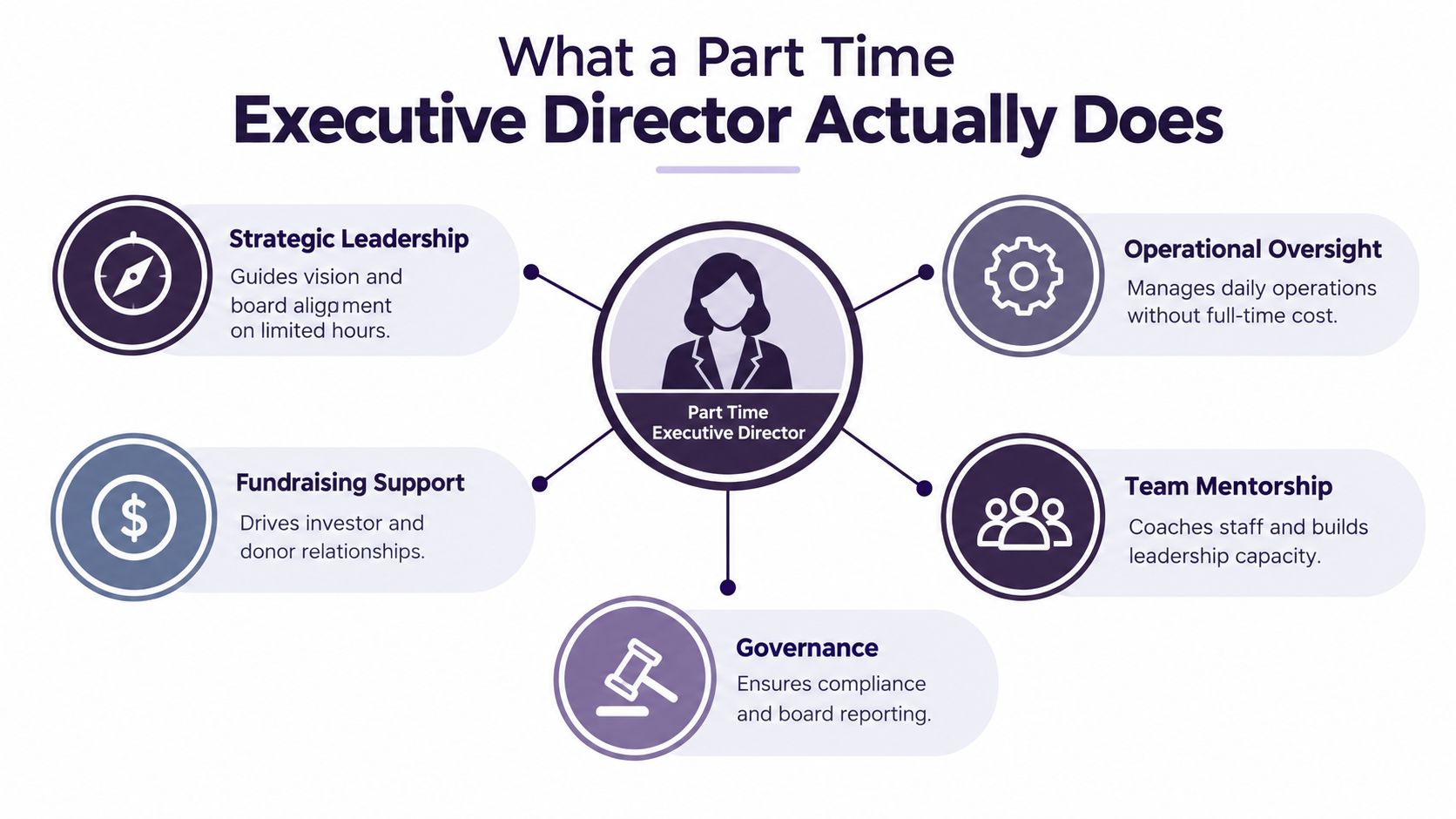
What a Part Time Executive Director Actually Does
A founder running a growing company might spend Monday resolving a cash issue, Tuesday preparing for a board meeting, and Wednesday trying to recruit a senior operator. None of those tasks gets the attention it deserves. The company doesn't necessarily need a permanent executive package yet, but it does need someone who can own the function.
A part time executive director is a senior operator who works a defined weekly schedule, often 10 to 20 hours per week, according to FractionUS's overview of fractional executive engagements. Some assignments require more capacity, but the principle remains consistent. The leader owns outcomes while serving one or more organizations.
That ownership separates the role from consulting. A consultant may assess a process, deliver recommendations, and leave implementation to the client. An adviser may offer judgment during occasional meetings. A part time executive director makes decisions within agreed boundaries, leads people, manages priorities, reports to the board or founder, and remains accountable for execution.
The operating difference
Consider a finance example. A consultant might review the company's forecast and recommend a reporting model. A part time finance executive would establish the forecast cadence, challenge assumptions, assign owners, present the numbers to leadership, and make sure the team acts on what the numbers reveal.
The same distinction applies to an executive director responsible for operations, fundraising, stakeholder relationships, or organizational development. The leader should be close enough to the work to see where execution fails, while senior enough to change the system causing the failure.
A useful overview of interim executive directors describes the broader value of bringing experienced leadership into an organization during a period of change. The arrangement works best when the organization needs judgment and accountability more than constant physical presence.
Practical rule: If the person can't make decisions, direct internal work, or be held responsible for results, you haven't hired an executive. You've hired an adviser.
Modern fractional leadership grew from interim management practices and later expanded through startup finance and operating roles. A historical overview of the fractional executive model traces modern part-time executive management to the mid-1970s in the Netherlands, with later adoption of part-time CFO leadership during the late 1990s dot-com era. The model has since become a practical option for organizations that need senior capability before they need, or can justify, a permanent executive.
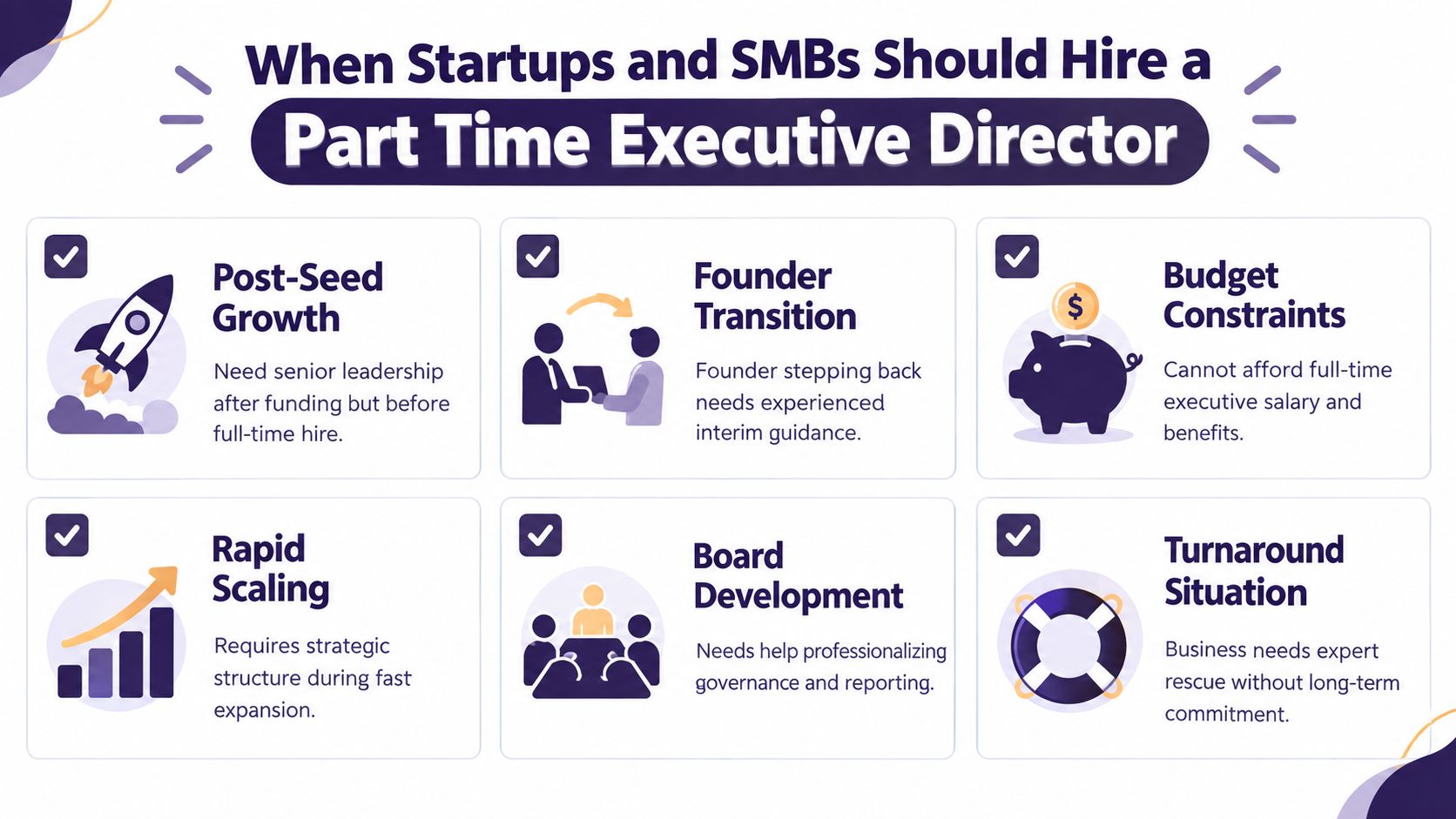
When Startups and SMBs Should Hire a Part Time Executive Director
The strongest case for a part time executive director appears when the organization has a senior leadership problem, not just a shortage of labor. Hiring another coordinator won't solve weak governance. Adding a consultant won't solve a decision bottleneck if nobody owns implementation.
The model fits several situations particularly well:
- Post-seed growth: Funding has created new expectations around reporting, hiring, and execution, but the company isn't ready for a permanent executive structure.
- Founder transition: The founder is stepping away from daily management and needs an experienced operator to stabilize the handoff.
- Budget constraints: A full-time executive package would consume resources better directed toward product, sales, or delivery.
- Rapid scaling: A department is growing faster than its management systems, creating inconsistent priorities and avoidable escalation.
- Board development: Investors, donors, or directors need clearer reporting, meeting discipline, and accountability.
- Turnaround conditions: The organization needs experienced intervention without committing to a long-term appointment before the situation is understood.
Use the problem to choose the structure
Start by naming the problem in operational terms. “We need a stronger leader” is too vague. “The board receives inconsistent financial reporting,” “the founder approves every customer escalation,” or “the sales team lacks a repeatable operating rhythm” gives a candidate something they can own.
A part time leader is usually the better fit when:
- The organization can identify a contained executive function.
- A board or founder can grant clear decision authority.
- Internal staff can execute work between executive touchpoints.
- The organization can measure progress through outcomes rather than presence.
- The leadership gap is urgent, but the long-term structure remains uncertain.
A full-time hire makes more sense when the organization needs constant crisis response, extensive daily management, or sustained relationship coverage that cannot be compressed into a focused schedule. A consultant is preferable when the company needs independent analysis but isn't ready to hand over operating authority.
For SMBs, the decision should also account for complexity, not just revenue. A business can have a manageable budget and still require full-time leadership if it operates across many locations, regulated workflows, or highly dependent teams. Conversely, a focused company may gain more from a senior specialist with a narrow mandate than from a generalist executive who spends time learning areas that aren't central to the problem.
A fractional appointment should solve a defined leadership constraint. It shouldn't become a vague response to anxiety about growth.
Core Responsibilities and How to Scope the Role
The first mistake boards make is writing a full-time job description and cutting the hours. That approach preserves every responsibility while removing the capacity required to perform it. Scope the role around decisions and outcomes instead.
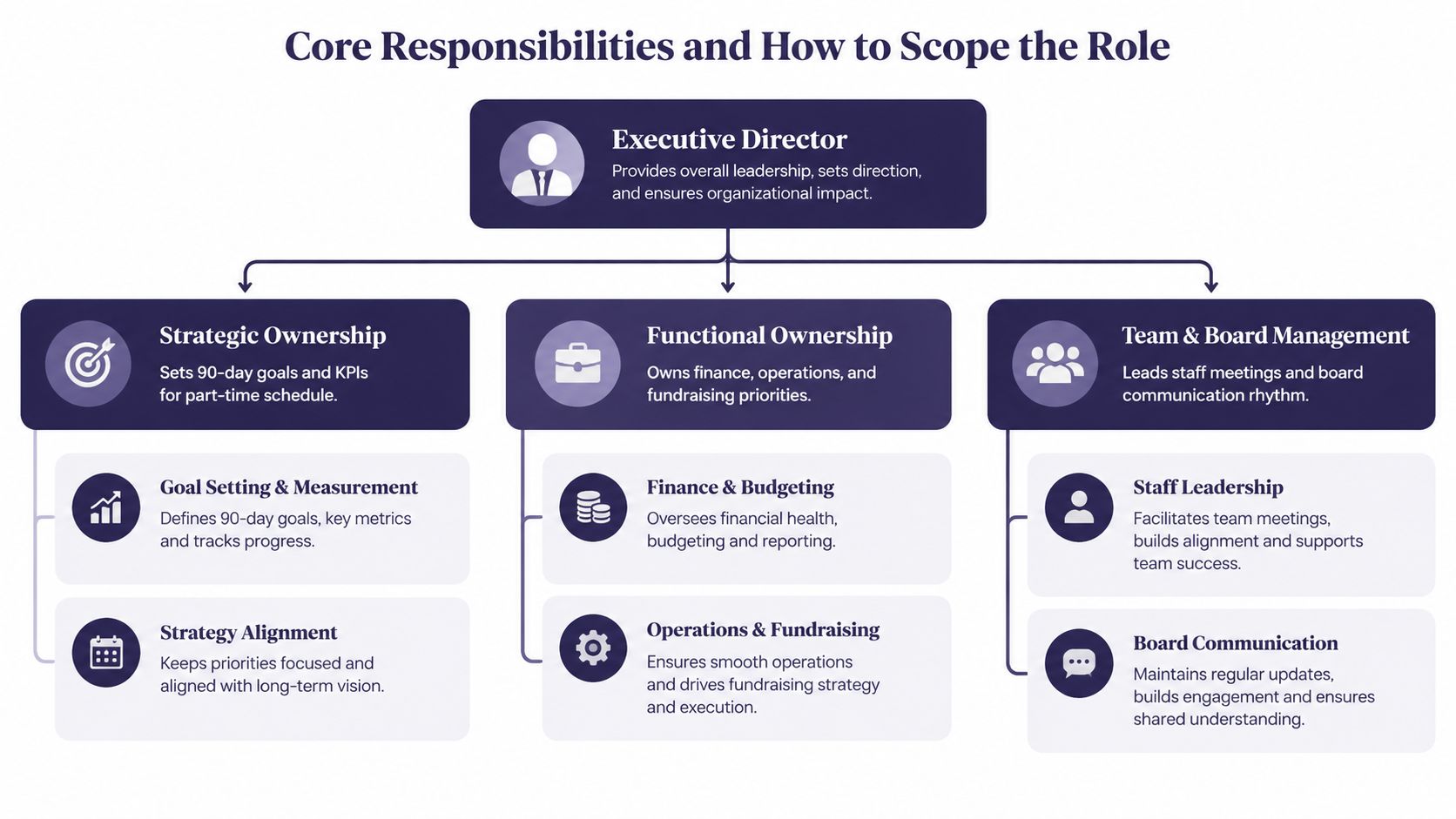
A sound mandate usually includes five elements:
- Strategic ownership: Set priorities, establish goals, and translate board direction into an operating plan.
- Functional ownership: Lead the assigned area, whether that includes finance, operations, fundraising, sales, marketing, or technology.
- People leadership: Clarify responsibilities, coach managers, and address performance issues within the agreed authority.
- Governance management: Prepare board materials, surface risks, document decisions, and maintain reporting discipline.
- Stakeholder management: Represent the organization with investors, donors, partners, customers, or other critical relationships.
The research on fractional executive role design supports a practical distinction here. Fractional leaders serve multiple clients, bring specialized capability, and operate with greater autonomy than traditional employees. That means the organization must define decision rights, deliverables, cadence, and authority boundaries rather than assume that a certain number of hours equals a reduced full-time job.
Build the operating agreement
Write the scope in a one-page operating agreement before interviews. Include:
- First priorities: The outcomes the executive must address immediately.
- Authority: Decisions the executive can make alone, decisions requiring founder approval, and decisions reserved for the board.
- Cadence: Weekly leadership meetings, team meetings, board updates, and one-on-one check-ins.
- Deliverables: Forecasts, operating plans, hiring decisions, fundraising materials, or process changes.
- Measures: Leading indicators and business outcomes that show whether the engagement is working.
- Handoff rules: What happens when the executive is unavailable, leaves, or transfers the function to a permanent hire.
A poorly scoped mandate says, “Improve operations and support the founder.” A useful mandate says, “Own the weekly operating review, establish department priorities, recommend the next management hire, and present a board-ready operating dashboard.”
The difference matters because part-time leaders can't spend their schedule discovering what the organization expects. Give them access to the information, people, and systems required to act. If the executive is accountable for cash planning but cannot access financial data, the board has created responsibility without authority.
Pros and Cons of Part Time Executive Leadership
Part time executive leadership isn't a cheaper version of full-time leadership in every circumstance. It changes the shape of the work. Organizations gain senior judgment and flexibility, but they must compensate for reduced availability through sharper planning and stronger internal ownership.
Where the model creates leverage
The main advantages are practical:
- Cost control: The organization buys focused executive capacity instead of carrying a permanent package before the workload supports it.
- Specialized expertise: A company can access an operator with experience in a function it couldn't reasonably staff internally.
- Flexible capacity: The engagement can expand during a fundraising cycle, transition, or turnaround and contract when the immediate need passes.
- Faster pattern recognition: Seasoned executives often recognize broken reporting, unclear accountability, and weak prioritization quickly because they've encountered similar operating problems elsewhere.
- Reduced hiring risk: The organization can test a leadership mandate and clarify its long-term needs before making a permanent appointment.
Compensation data illustrates why smaller organizations explore this route. A 2024 U.S. nonprofit compensation report found a median CEO or executive director base salary of $115,000 overall, with men at $130,000 and women at $104,500. The same report showed salaries ranging from under $2,500 for some part-time roles to more than $370,000 for full-time roles, highlighting how sharply scope and organizational size affect pay.
Where the model breaks down
The risks deserve equal attention:
- Limited availability: A fractional executive won't be present for every daily crisis, so managers need clear escalation paths.
- Cultural distance: A leader working limited hours may need deliberate rituals to understand team dynamics and build trust.
- Overlapping authority: Existing managers can resist a new executive if the board hasn't defined who decides what.
- Portfolio conflicts: A leader serving multiple clients must protect confidentiality and manage competing priorities.
- Continuity exposure: The organization may lose context if the engagement ends without documentation and a transition plan.
The model works poorly when the founder wants executive-level results but refuses to transfer authority. It also fails when the team expects the leader to perform every operational task personally. The executive should set direction, make decisions, and build internal capacity. They shouldn't become a highly paid substitute for missing middle management.
Board test: Before approving the hire, identify the decisions the executive can make without asking permission. If the list is empty, redesign the role.
Compensation Models and How to Benchmark ROI
Don't begin with an hourly rate. Begin with the economic value of the problem, the risk attached to it, and the capacity required to own it properly. A leader responsible for board reporting, cash visibility, and a sensitive transition carries a different burden from someone facilitating a weekly strategy meeting.
The main structures are straightforward:
- Hourly engagement: Useful for a tightly bounded assignment or an early diagnostic, but it can encourage the organization to buy activity instead of accountability.
- Monthly retainer: Better for ongoing ownership because it reserves capacity and creates a predictable operating relationship.
- Equity component: Possible in some startup arrangements, but it should supplement clear cash compensation rather than replace it casually.
- Hybrid structure: A base retainer can cover core leadership work, with defined additional fees for a fundraising push, restructuring, or special project.
Most fractional executives bill between 1,000 and 1,200 hours per year, according to Connectd's guide to U.S. fractional executive rates. That workload reflects a portfolio model, not a single-employer schedule, so buyers should assess reserved capacity and outcomes rather than compare an invoice mechanically with a full-time salary.
Part time versus full time
| Factor | Part Time Executive Director | Full Time Executive Director |
|---|---|---|
| Capacity | Defined weekly allocation focused on priority outcomes | Continuous organizational availability |
| Cost structure | Retainer, hourly, hybrid, or other negotiated arrangement | Salary plus benefits and employment costs |
| Best fit | Contained leadership gap, transition, or specialized function | Broad daily management and sustained operational complexity |
| Risk | Availability and continuity must be managed | Higher fixed commitment and longer hiring cycle |
| Governance need | Explicit authority and escalation rules | Still requires clear board oversight and reporting |
| ROI question | Did focused capacity solve the defined constraint? | Does ongoing executive presence justify the fully loaded cost? |
Benchmark compensation against workload, governance exposure, and authority. A nonprofit board should document how it reached a pay decision and use comparable roles, geography, responsibilities, and organizational budget. The nonprofit executive compensation guidance emphasizes that reasonable compensation depends on factors such as the actual job description, hours worked, experience, local comparisons, and the organization's overall budget.
Measure value in the first 90 days
Don't promise a dramatic transformation before the executive has access to the business. Set practical early outcomes instead:
- A reliable operating dashboard exists and reaches the right decision-makers.
- The board receives consistent reporting with risks clearly identified.
- Ownership for critical workflows is documented.
- The executive has established a decision and meeting cadence.
- The highest-impact bottleneck has an agreed intervention plan.
- The founder or board can see which work belongs to the executive, the internal team, and future hires.
For a deeper look at engagement structures, use this guide to fractional executive compensation. ROI isn't only cash saved. It also includes avoided hiring mistakes, faster decisions, better governance, and the capacity returned to founders and managers.
Hiring Checklist and Interview Framework
A strong search starts before a candidate enters the process. Write the operating problem, authority limits, and first outcomes before reviewing résumés. Otherwise, the most polished candidate will define the job for you.
Prepare the mandate
Use this checklist:
- Name the constraint. State what isn't working and who currently owns it.
- Define the outcome. Describe what should be different after the initial engagement.
- Set the capacity. Choose the schedule based on the work, not a default fractional package.
- Map authority. Separate executive decisions, founder decisions, and board decisions.
- Identify internal partners. List the managers and staff who will execute alongside the leader.
- Choose the scorecard. Select measures that reflect both progress and organizational health.
- Write transition terms. Include notice, documentation, availability, confidentiality, and handoff expectations.
A useful job description should prioritize results:
- Own the operating plan for the assigned function.
- Establish a repeatable reporting rhythm.
- Lead the relevant managers and external stakeholders.
- Present recommendations and risks to the founder or board.
- Deliver agreed priorities without assuming full-time availability.
- Build internal capability so the organization isn't permanently dependent on one person.
Interview for part-time execution
Ask questions that expose operating judgment rather than rehearsed leadership language:
- “Tell us about a time you entered an organization with unclear authority. What did you establish first?”
- “How do you decide which issues deserve your limited weekly capacity?”
- “What information must you receive before accepting responsibility for a function?”
- “Describe a decision you made with incomplete information. How did you communicate the risk?”
- “How do you prevent a client from turning a defined engagement into unlimited access?”
- “What would you expect to deliver during the first operating cycle?”
- “How do you document decisions and prepare a team for your eventual handoff?”
- “Which board or founder behaviors would make this engagement fail?”
Use a structured scorecard covering judgment, functional expertise, communication, governance maturity, and availability. Compare candidates against the mandate, not against each other.
The essential executive interview questions for hiring success can help the interview team broaden its evaluation beyond technical credentials. Check references with specific questions about authority, follow-through, conflict, and the candidate's ability to create clarity without taking over every task.
Finally, make the contract match the operating model. Include scope, capacity, meeting rhythm, confidentiality, conflicts, payment terms, termination, ownership of work product, and the process for adding work. A vague contract creates a vague executive relationship.
How Shiny Simplifies Finding Your Part Time Executive Director
The hardest part of this hire is rarely identifying that leadership is needed. It's finding someone whose experience matches the problem, whose availability matches the schedule, and whose operating style fits the board and internal team.
A marketplace can reduce that search friction by replacing a narrow personal network with a structured pool of candidates. Shiny connects startups and SMBs with over 3,000 vetted executives across SaaS, FinTech, HealthTech, Ecommerce, AI, Manufacturing, Professional Services, and Energy. Its marketplace supports part-time and fractional engagements for organizations that need experienced leadership without immediately creating a full-time position.
The platform's workflow addresses the practical stages of the search:
- Job posting: Describe the function, outcomes, capacity, and authority in one defined opportunity.
- Candidate matching: Review executives aligned with the organization's needs and industry context.
- Streamlined interviews: Move from initial matches into focused conversations about scope and fit.
- Seamless onboarding: Establish the information, access, cadence, and expectations needed for the executive to operate quickly.
That process doesn't remove the buyer's responsibility. The board and founder still need to define success, protect decision clarity, and make internal managers part of the engagement. What it can do is make it easier to find candidates who have already chosen a portfolio leadership model and understand how to create impact without full-time presence.
The right part time executive director should leave the organization clearer, not more dependent. They should improve decisions, strengthen the operating system, and create enough visibility for the board or founder to choose the next leadership step with confidence.
If your organization needs senior leadership but isn't ready for a full-time executive package, Shiny can help you define the role and connect with vetted fractional executives. Explore the marketplace or schedule a consultation to find a part time executive director matched to your function, capacity, and growth priorities.