Virtual Chief Marketing Officer Guide for Startups
You're probably not looking for “more marketing.” You're looking for someone who can decide which marketing deserves funding, connect it to revenue, and stop the team from confusing activity with progress.
That gap usually appears after a startup has enough traction to create complexity but not enough scale to justify a full-time executive. Paid campaigns run without a clear qualification model. Sales and marketing use different definitions of a good lead. A founder still approves positioning, landing pages, and blog topics because nobody owns the system.
A virtual chief marketing officer can fill that leadership gap without turning a strategic need into another permanent fixed cost. The model works when you define the decision rights, protect the executive's time for high-impact work, and measure the engagement against pipeline economics.
When Startups Hit the Marketing Leadership Gap
A seed-stage SaaS company has grown past thirty employees. The founders have hired a marketing generalist, brought in a paid media contractor, and approved several campaigns. Capital is leaving the bank account, but sales can't explain which leads deserve follow-up. The founder still reviews every blog post because the team has no consistent view of the company's positioning.
Nothing looks catastrophically broken. That's what makes the problem expensive.
The marketing generalist is stretched across content, events, email, analytics, and agency coordination. Channel experiments launch without a clear learning loop. The website says one thing, sales decks say another, and the board asks for a funnel forecast that nobody can defend.
The symptoms are operational, not cosmetic
Look for these signals:
- Positioning drift: Different team members describe the product for different buyers.
- Unowned funnel decisions: Marketing generates leads, sales rejects them, and neither team owns the handoff.
- Channel motion without learning: Campaigns continue because stopping them feels harder than explaining them.
- Founder dependency: The founder remains the final approver for routine marketing decisions.
- Unclear forecasts: Leadership can report activity, but not how activity should become qualified pipeline.
At this point, another executor won't solve the core issue. The business needs senior judgment about the ideal customer profile, channel mix, messaging, budget allocation, and measurement architecture.
The cost question changes the decision
A full-time CMO creates a fixed obligation before the company knows how much leadership capacity it needs. A virtual CMO converts part of that requirement into a variable cost. The company buys a defined amount of senior decision-making, then expands or reduces the engagement as the operating model becomes clearer.
That isn't a shortcut around leadership. It's a way to buy the right level of leadership for the company's present constraint.
The broader market supports this shift. The fractional CMO services market is projected to grow from USD 2.11 billion in 2025 to USD 2.28 billion in 2026 and USD 3.51 billion by 2031, implying a 9.01% CAGR from 2026 to 2031, with Asia-Pacific identified as the fastest-growing region in the fractional CMO market analysis. For founders, that trajectory signals a durable operating model, not a temporary workaround.
What a Virtual Chief Marketing Officer Actually Does
A virtual chief marketing officer is a part-time executive with responsibility for marketing decisions inside a defined scope. Think of the role as a CMO seat with a narrower time commitment, not a diluted title.
The executive should have authority to set direction, challenge assumptions, allocate attention, and report business results. The difference is that they aren't present as a full-time employee every day. Their involvement may be structured around a defined number of hours, recurring leadership meetings, planning cycles, and specific decision rights.
The role sits between advice and execution
A consultant typically diagnoses a problem, delivers recommendations, and leaves the client to implement them. A virtual CMO remains accountable for the operating system around those recommendations.
That may include:
- Setting the company's positioning and messaging architecture.
- Defining the ideal customer profile and go-to-market priorities.
- Approving marketing budget allocation.
- Hiring and directing internal marketers or external agencies.
- Establishing reporting standards for pipeline and conversion.
- Presenting marketing performance to founders, executives, or investors.
A fractional CMO is generally the same model under a different label. “Virtual” emphasizes remote delivery, while “fractional” emphasizes the shared allocation of executive time.
Practical rule: If the executive can recommend a strategy but can't influence the people, budget, or priorities required to execute it, you haven't hired a CMO. You've hired an advisor.
What the role is not
The role isn't a freelance strategist who writes a playbook in isolation. It also isn't a campaign contractor responsible for launching ads, producing social posts, or managing a single email sequence.
Those specialists can be valuable. They solve execution problems. A virtual CMO decides which execution problems matter, sets the quality bar, assigns ownership, and connects the work to commercial outcomes.
The distinction matters because startups often hire senior-sounding talent for junior-shaped work. If you need someone to manage a Google Ads account every day, hire for that capability. If you need someone to decide whether paid acquisition deserves budget at all, you need executive marketing judgment.
A strong virtual CMO makes the team less dependent on personal approval over time. They install priorities, reporting cadences, and decision rules that allow capable marketers to execute without waiting for the executive to review every asset.
Core Responsibilities and Deliverables That Matter
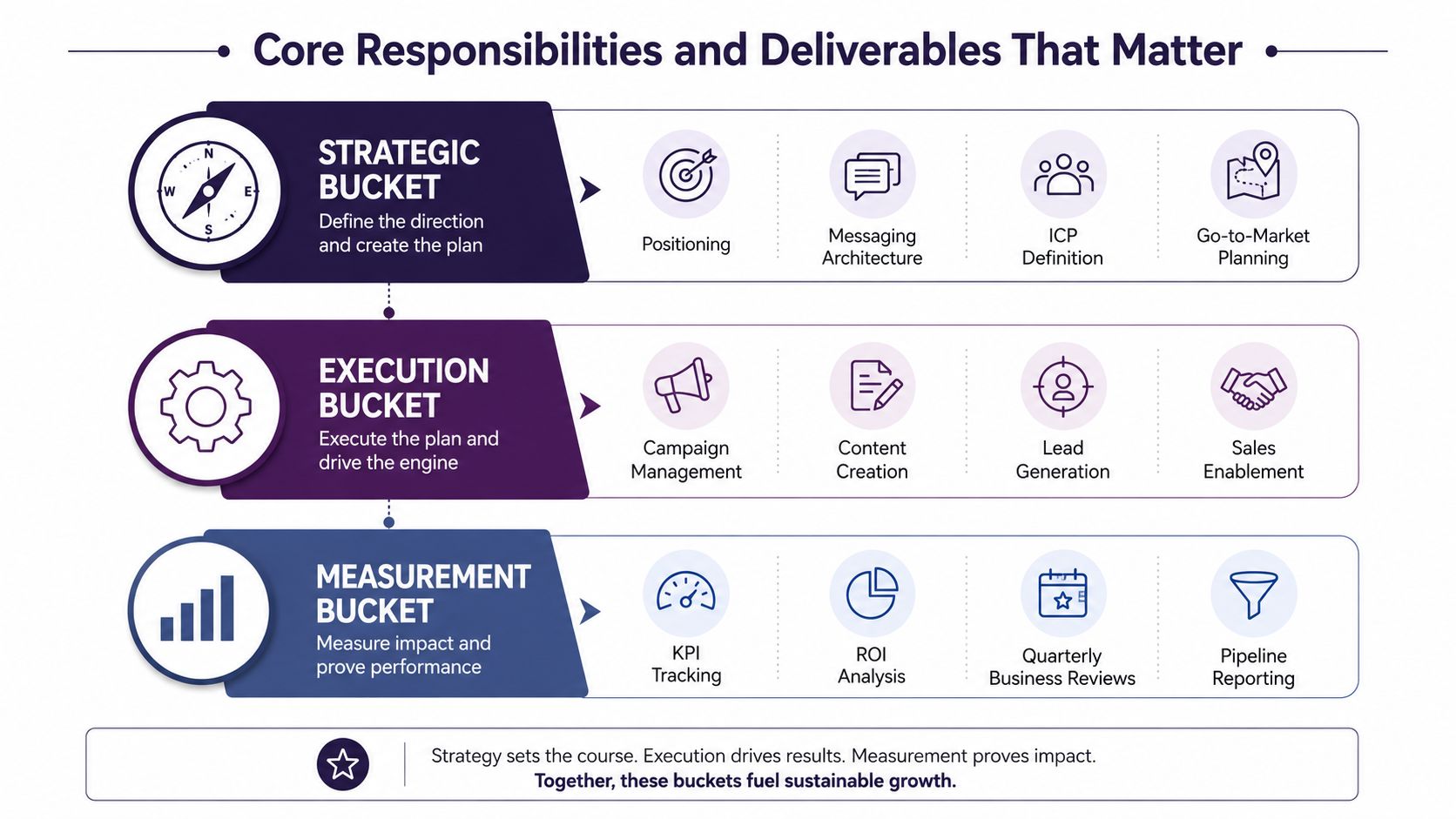
The cleanest way to scope a virtual CMO is to divide the work into strategic, operational, and team-shaping responsibilities. These categories prevent a common failure mode: paying for executive judgment while expecting unlimited production capacity.
Strategic responsibilities establish the direction
The strategic bucket answers, “Who are we targeting, why should they care, and what should the company do next?”
Typical deliverables include:
- Positioning and messaging architecture: A clear hierarchy from category narrative to product claims and proof points.
- ICP definition: A practical description of the accounts, buyers, triggers, and disqualifiers that shape prioritization.
- Go-to-market planning: A sequence for entering a segment, launching an offer, or improving the existing acquisition motion.
- Quarterly OKRs: Objectives connected to revenue targets, pipeline quality, and conversion economics.
A concrete output might be a 90-day go-to-market plan that names the priority segment, core message, channels, owners, budget assumptions, and review cadence. It shouldn't be a presentation that disappears into a shared drive.
Operational responsibilities turn strategy into controlled action
The operational bucket governs the machinery:
- Channel budget allocation and prioritization.
- Agency and vendor selection.
- Campaign oversight and launch readiness.
- Marketing technology decisions.
- Sales enablement and handoff standards.
- Reporting definitions across systems such as HubSpot, Salesforce, GA4, or Looker Studio.
A useful deliverable could be a channel mix model with CAC ceilings, approval rules, and conditions for increasing or reducing investment. The CMO doesn't need to personally operate every platform. They do need to ensure the team knows what each channel must prove before receiving more budget.
Team-shaping responsibilities create leverage
The third bucket makes the company less dependent on outside leadership. It may involve hiring the first demand-generation manager, mentoring a content lead, establishing weekly reporting, or documenting the playbook for campaign planning and review.
For example, a hire-and-ramp sequence might define which role comes first, what outcomes that person owns, which agencies remain necessary, and how responsibility transfers from the virtual CMO to the internal team.
Put every deliverable, decision right, meeting cadence, and exclusion in the statement of work. If content production, website management, or campaign operations aren't included, say so. Scope discovered after kickoff becomes friction, and friction consumes the executive time you intended to spend on high-value decisions.
Engagement Models and How They Fit Each Stage
There are three practical ways to structure a virtual CMO engagement. The right choice depends on whether your problem is a discrete strategic decision, a recurring leadership need, or a company-wide transition.
| Model | Typical Scope | Time Commitment | Best-Fit Stage | Key Trade-Off |
|---|---|---|---|---|
| Monthly retainer | Ongoing strategy, leadership, planning, reporting, and team direction | Recurring weekly access | Growth-stage startups through Series B | Consistent leadership, but requires disciplined monthly scope |
| Project-based sprint | Positioning, audit, go-to-market plan, or measurement rebuild | Defined start and finish | Pre-seed through early growth | Clear output, but limited accountability after delivery |
| Equity or hybrid | Reduced cash fee combined with equity or another performance-linked arrangement | Negotiated around priority and availability | Select early-stage situations | Preserves cash, but can create misaligned expectations and complex incentives |
Match the model to the operating problem
A project sprint fits when the company needs a focused reset. Examples include a messaging overhaul, a launch plan, or a funnel diagnostic. It doesn't fit when the business needs someone in weekly leadership meetings making decisions across marketing and sales.
A monthly retainer fits when pipeline targets recur each quarter and the executive must manage priorities over time. The company gets continuity, context, and a leader who can see whether the team is acting on the plan.
An equity or hybrid arrangement can help a cash-constrained company attract a senior operator, but equity shouldn't be used to hide an undefined scope. A fractional leader still needs decision rights, expected availability, and measurable outcomes.
Stage matters, but maturity matters more
Pre-seed teams often need strategic clarity before they need a recurring CMO cadence. A company moving toward repeatable acquisition needs operating leadership. By Series B, the question may shift toward team design, channel economics, and executive reporting.
The transition from sprint to retainer is straightforward: once strategic goals become recurring quarterly responsibilities, ongoing ownership usually creates more value than a one-time deliverable.
For a broader explanation of how part-time executives fit into startup operating models, see fractional leadership for growing companies.
Pricing Structures and What Drives the Cost
Virtual CMO pricing is often presented as a simple rate card. That's the wrong way to compare proposals.
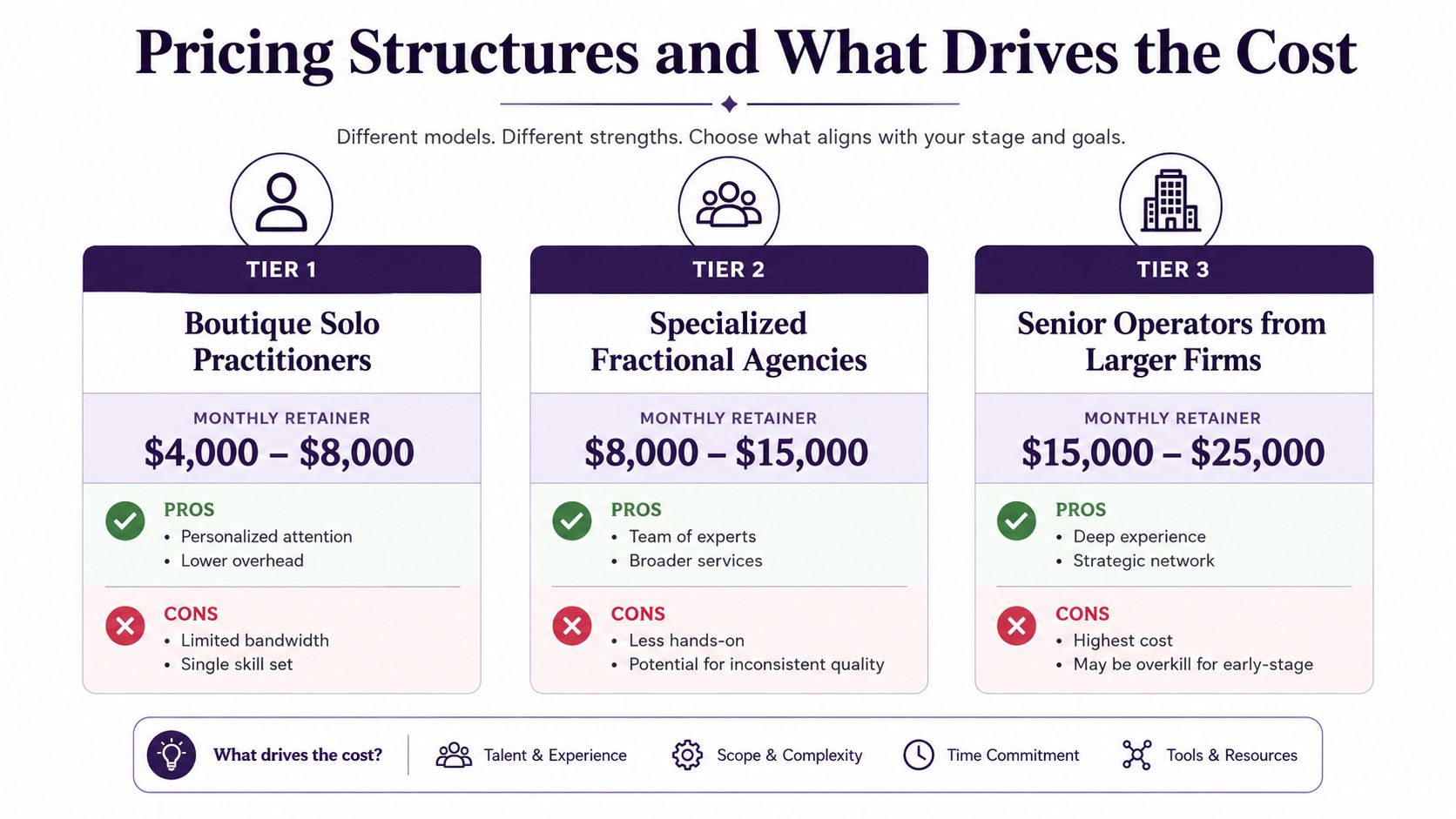
Benchmark data places the average rate near USD 180 per hour, the median near USD 175 per hour, and the middle range around USD 130 to USD 220 per hour. Monthly retainers commonly fall between USD 5,000 and USD 20,000, with USD 10,000 to USD 12,000 reported as a median band for 15 to 25 hours of work, according to fractional CMO cost and pricing benchmarks.
Read the quote by scope, not by headline
You may see boutique solo practitioners, specialized fractional agencies, and senior operators from larger firms priced differently. The important comparison is what the fee buys.
Ask whether the proposal includes:
- Channel ownership: Does the executive advise on channels or manage their performance?
- Team management: Are internal staff and agencies reporting to the CMO?
- Board reporting: Will the executive prepare investor updates and defend the funnel?
- Production: Is content, design, media buying, or marketing operations bundled in?
- Access: How often can founders reach the executive, and which meetings are included?
The range above differs from generic project-rate claims you may encounter online. Use this guide to fractional CMO cost to compare proposals against a defined scope rather than anchoring on an advertised tier.
The economic trade-off is clear. A variable executive cost can reduce fixed overhead and accelerate access to judgment, but the model only pays back when the executive spends time on channel mix, positioning, funnel ownership, and KPI governance. If the engagement turns into unlimited content review or daily campaign execution, the company is paying executive rates for work that should sit elsewhere.
How to Evaluate and Hire the Right Virtual CMO
A polished résumé tells you very little about how a virtual CMO will behave when priorities collide. You need to test judgment, operating discipline, and the ability to work inside constraints.
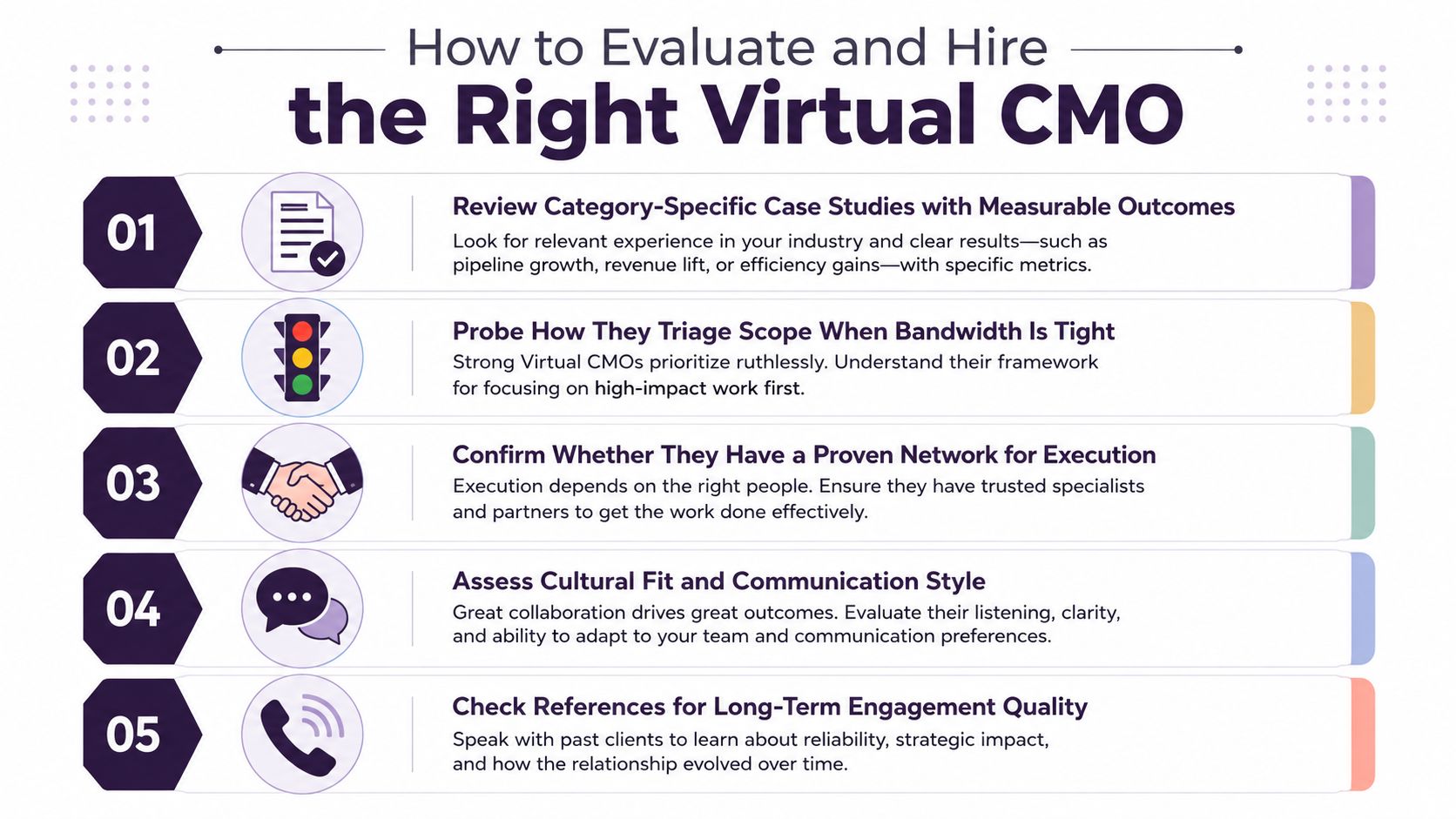
Start with category relevance, but don't reduce fit to logo recognition. A strong candidate should explain how they've handled a similar buyer, sales motion, pricing model, or growth constraint. Ask for case studies that show the starting problem, decisions made, responsibilities owned, and business outcomes measured.
Test scope discipline before signing
Give the candidate a realistic conflict. For example, ask what they'd do if the founder wants paid acquisition, sales wants enablement, and the team has capacity for only one priority.
Listen for a decision process, not a list of services. The candidate should explain what gets paused, which assumptions need validation, and how they'll communicate the trade-off.
Use this checklist:
- Request category-specific evidence: Look for measurable outcomes and a clear description of the candidate's role.
- Probe bandwidth triage: Ask how they prioritize when several executives want attention at once.
- Confirm execution access: Find out whether they have trusted specialists for design, content, analytics, and media.
- Check stage experience: A leader used to enterprise marketing may not understand a founder-led company with limited infrastructure.
- Test communication style: Establish how decisions, risks, and missed targets will be reported.
Negotiate the terms founders forget
References should cover working style, not just competence. Ask whether the executive challenged weak assumptions, met commitments, handled disagreement, and left the team more capable.
Red flags include vague deliverables, reluctance to define success metrics, constant reliance on personal heroics, and a promise to “do everything” without naming what gets deprioritized.
Your contract should address:
- Off-boarding notice and transition support.
- Ownership of strategy documents, research, dashboards, and playbooks.
- Confidentiality and access to company systems.
- Whether internal team members report to the CMO.
- Meeting cadence, response expectations, and escalation rules.
For a structured route to finding candidates, review how to hire a fractional CMO. The first conversation should be an operating diagnosis, not a sales performance.
Success Metrics That Prove the Engagement Worked
Judge a virtual CMO by business movement, not activity. Campaign counts, approved blog posts, and attended meetings show effort. Founders and boards need evidence that marketing creates qualified pipeline, improves conversion economics, and reduces friction between demand generation and revenue.
Set five to seven metrics before the engagement begins. A practical scorecard includes marketing-sourced pipeline value, CAC trend, lead-to-meeting rate, meeting-to-close rate, sales cycle length, and retention or expansion signals, as outlined in fractional CMO ROI benchmarks. The exact mix depends on the company's sales motion, but every metric needs a clear definition and owner.
Use three KPI families
Pipeline contribution measures whether marketing attracts and advances commercially relevant demand. Track marketing-sourced pipeline value, MQL-to-SQL conversion, and the win rate of marketing-sourced opportunities.
Unit economics measures whether growth is becoming more efficient. Monitor CAC, CAC payback period, and LTV:CAC. Define the calculation, reporting window, and attribution rules before anyone reviews performance.
Velocity measures whether the company is learning and executing faster. Sales cycle length, campaign launch time, and product adoption connected to launch motions show whether the operating system is improving.
A published benchmark recommends a 30% to 60% increase in marketing-sourced pipeline within six months, with the timeline extending to 9 to 12 months when no marketing function exists at the start. Treat that range as a reference point, not a promise. Attribution quality, sales execution, market conditions, and starting infrastructure determine the outcome. The engagement pays back only when the scope matches the available operating capacity and the dashboard separates genuine progress from inherited pipeline.
Set expectations by phase
| Phase | Metrics to Track | Why It Matters |
|---|---|---|
| Diagnostic phase | Attribution coverage, funnel definitions, ICP clarity, baseline conversion rates | Establishes whether the company can trust its starting data |
| Planning phase | Approved priorities, budget allocation, owners, launch readiness | Shows whether strategy has become executable |
| Early execution | Lead quality, lead-to-meeting rate, campaign learning, sales feedback | Reveals whether leading indicators are moving |
| Maturing engagement | Sourced pipeline, CAC trend, win rate, sales cycle length, retention signals | Connects marketing decisions to business outcomes |
The first 30 days should produce diagnostic clarity and a documented 90-day plan. The following 60 to 90 days should show leading indicators moving. By day 180, hard business metrics should be visible when the underlying sales cycle allows it.
Build the dashboard on day one in HubSpot, Salesforce, Looker Studio, or a maintained spreadsheet. Separate inherited pipeline from new activity, record each opportunity's source, and document attribution changes. A polished launch without pipeline movement is not a win.
Choosing the Right Partner for Fractional Leadership
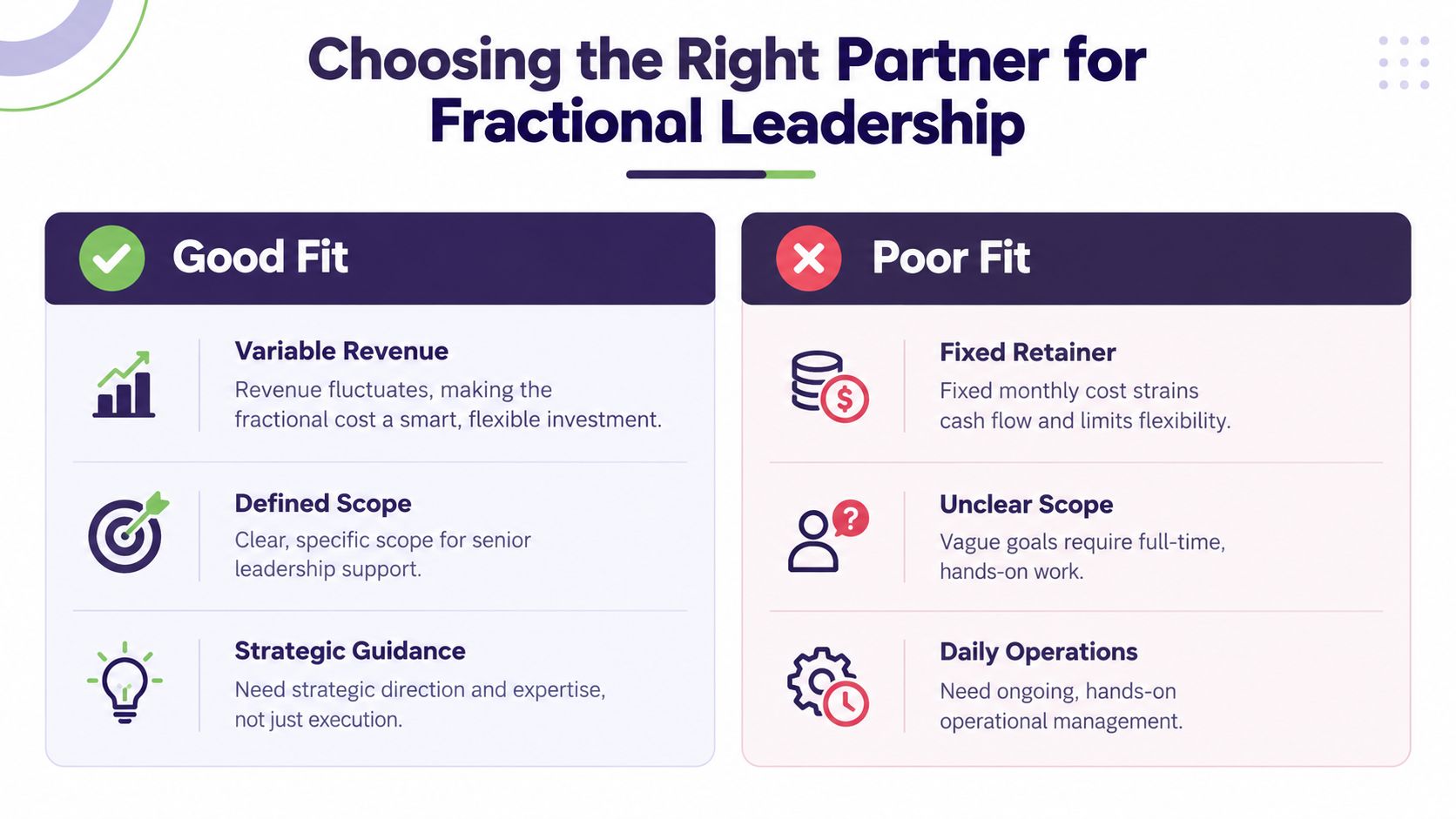
The virtual CMO model fits when three conditions are present. You have enough recurring revenue potential to justify senior marketing leadership, the scope can be moved by a senior operator working 8 to 20 hours per week, and someone inside the company can execute against the direction.
The model fails when founders expect a part-time executive to behave like a full-time department head. It also fails when the company has no clear customer signal and needs to discover product-market fit through constant hands-on experimentation. In that situation, a focused growth operator or founder-led learning cycle may be more appropriate.
Daily in-office management is another poor fit. If the company needs a leader physically present for constant approvals, team supervision, or crisis response, fractional coverage won't provide enough operating density.
Choose the sourcing channel deliberately
Specialist fractional marketplaces can simplify matching and provide a broader candidate pool, but founders should still inspect vetting standards and replacement procedures.
Boutique consulting firms may offer a coordinated team and deeper execution coverage. The trade-off is that the named executive may delegate more work than expected.
Independent practitioners found through network referrals can provide strong trust and direct access. They may also have limited backup if priorities change or the engagement ends unexpectedly.
Former in-house leaders transitioning to fractional work often bring valuable operating context. Confirm that they can adapt from one-company immersion to managing a narrower scope across multiple clients.
The broader fractional talent market is becoming more established. Independent market reporting says the fractional talent base grew from 60,000 professionals in 2022 to 120,000 in 2024, while LinkedIn fractional profiles rose from 2,000 to 110,000 in the same period. Demand for fractional CMOs, CFOs, and CTOs increased 68% year over year, and marketing and communications represented 30.4% of the fractional leader pool, the largest functional category, according to the State of the Fractional Work Market report.
That supply makes access easier, but it doesn't remove the need for scope discipline. Evaluate the partner, the contract, and the operating fit before you evaluate the résumé.
Shiny connects startups and growing companies with vetted fractional executives, including virtual CMOs, for defined part-time engagements. Visit Shiny to explore available marketing leadership and schedule a low-pressure consultation focused on whether the model fits your scope, stage, and economics.