

Build an Effective Performance Management System Today
For a startup, a performance management system isn’t just a process; it’s the engine for growth. It’s the continuous loop of setting goals, tracking what’s working (and what’s not), and giving feedback that keeps everyone pulling in the same direction. In the fast-paced startup world, this system needs to be dynamic and forward-looking, a far cry from the dusty old annual review.
We’re talking about a culture of ongoing dialogue and real-time development—not a once-a-year judgment day.
Why Annual Reviews No Longer Work for Startups
The traditional annual review is a relic from a different time. For a nimble startup, waiting 12 months to have a formal chat about performance is like trying to navigate a racetrack by only looking in the rearview mirror. It’s slow, backward-looking, and completely out of sync with the pace of your business.
This kind of delay creates massive misalignment. Challenges don’t get addressed until they’ve snowballed into critical problems, and wins aren’t celebrated when they matter most.
Startups live and die by their speed and adaptability. Your goals can pivot quarterly, monthly, or even weekly. An annual process just can’t keep up, leaving your team feeling disconnected from the company’s ever-changing mission.
The Shift to Continuous Dialogue
Modern work demands a fundamentally different approach. The rise of flexible work models has only put more pressure on outdated management styles. With hybrid and remote teams expected to make up 27.5% of the workforce by 2028, the old ways of overseeing people are officially obsolete.
It’s no wonder that a whopping 80% of employees now prefer ongoing feedback over traditional annual reviews. That’s a clear signal for any startup founder looking for an edge. You can find more performance management statistics that highlight just how dramatically workplaces are changing.
Before we dive into building a modern system, let’s look at what we’re leaving behind. The contrast between the old and new models is stark, and for a startup, choosing the right approach is non-negotiable.
Traditional vs Modern Performance Management
| Characteristic | Traditional Annual Review | Modern Continuous System |
|---|---|---|
| Frequency | Once a year | Ongoing (weekly, monthly, quarterly) |
| Focus | Backward-looking, evaluative | Forward-looking, developmental |
| Ownership | Manager-driven, top-down | Collaborative, employee-involved |
| Goal Setting | Annual, often rigid | Dynamic, adaptable (e.g., OKRs) |
| Feedback Style | Formal, documented, high-stakes | Informal, real-time, constructive |
| Outcome | Rating and ranking | Growth and skill development |
Seeing them side-by-side makes it obvious. The traditional model is built for stability and predictability—two things most startups simply don’t have. The modern approach is designed for the exact opposite: agility, growth, and constant improvement.
This shift isn’t just about tweaking a process; it’s about fundamentally changing how your team communicates and grows.
The goal isn’t just to scrap an old process. It’s to build a culture where feedback is the fuel for growth, not a source of fear. This constant loop of communication empowers your team, boosts morale, and drives tangible business results.
Instead of one high-stakes meeting, a modern system is built on multiple, lightweight touchpoints that fit right into your workflow:
- Weekly Check-ins: Quick, informal chats to clear roadblocks and align on immediate priorities. Think 15-minute syncs, not hour-long meetings.
- Monthly Goal Alignment: A chance to step back, review progress on bigger objectives, and make adjustments as the business evolves.
- Quarterly Development Talks: Truly forward-looking conversations focused on career paths, skill gaps, and growth opportunities.
By breaking it down like this, performance management stops being a dreaded annual event and becomes a natural, productive part of how your startup operates every single day.
Defining What Success Looks Like for Your Team

Let’s be honest. A performance management system without clear, meaningful goals is just an elaborate way to track busywork. To make any of this count, you first have to define what success actually looks like for your startup—and then show how each person fits into that picture.
It all starts by moving beyond vague ambitions and actually crafting goals that give your team a roadmap.
The best way I’ve found to get that clarity is by using a proven framework. While there are a few out there, the SMART criteria are a fantastic starting point for any startup. Why? Because they force you to get specific and intentional.
This visual breaks down how to turn a fuzzy idea into something tangible. Think of each letter in the acronym as a filter. A goal has to pass through every one of them to be considered complete.
The real insight here is that a goal isn’t finished until it answers the tough questions: What exactly are we doing? How will we measure this? Is it even possible? Why does it matter to the business? And when is it due? Nailing these down eliminates ambiguity and sets a clear bar for performance right from the start.
Cascading Goals From Vision to Individual Roles
Your company’s big-picture vision—like “become the market leader in B2B fintech”—is great for a pitch deck, but it’s not a daily to-do list for your junior developer. For goals to be effective, they have to cascade down from that broad mission into specific, connected objectives for each department, team, and individual.
This creates a powerful sense of alignment where everyone sees how their daily grind directly pushes the company forward.
Let’s walk through a real-world example. Imagine a SaaS startup’s main objective for the quarter is to increase monthly active users (MAUs) by 20%. Here’s how that single objective could trickle down across different teams:
- Marketing Team Goal: Generate 500 new Marketing Qualified Leads (MQLs) from the new content marketing campaign by the end of Q3.
- Sales Team Goal: Convert 25% of those MQLs into paying customers this quarter, aiming for a 30-day sales cycle.
- Product Team Goal: Ship two key feature improvements to reduce new user onboarding friction, with the goal of increasing the Week 1 retention rate from 30% to 40%.
See how that works? Each goal is distinct, yet they’re all working together to hit that primary MAU target. This interconnectedness is absolutely critical for building high-performing teams. It stops departments from operating in silos and builds a culture of shared ownership over the results.
By linking individual tasks to team objectives and team objectives to company goals, you create a clear line of sight for every employee. They aren’t just completing tasks; they are actively contributing to a shared mission they understand and believe in.
This completely transforms performance management from a top-down chore into a collaborative push toward a common destination. To dig deeper into this, check out our guide on https://useshiny.com/blog/how-to-build-high-performing-teams-leadership-guide/ for more leadership strategies.
Choosing the Right Performance Management Tools

Once your goals are crystal clear, you need a way to track, discuss, and manage them without drowning in admin work. This is where a performance management system comes into play, but let’s be honest—the software market is crowded, and it can feel like a maze for a lean startup.
The biggest mistake I see founders make is getting distracted by flashy, enterprise-level platforms that are loaded with features they’ll never touch. Your real goal is to find a tool that makes continuous feedback, goal tracking, and lightweight check-ins feel effortless, not like another chore for your team.
The shift to cloud-based tools has been massive. These systems are on track to grab 65% of the market share by 2025, with global enterprise adoption predicted to hit 78% in the same year. This isn’t just a fad; it’s a fundamental change in how modern companies operate. You can dig into more of the latest performance management trends to see just how essential these tools have become.
Must-Have vs. Nice-to-Have Features
For a startup, simplicity is everything. You need a tool that supports your process, not one that shoves you into a rigid, complicated workflow. The focus should always be on the core functionalities that will give you the most bang for your buck right now.
Here’s what I consider non-negotiable for an early-stage company:
- Goal & OKR Tracking: You absolutely need the ability to set, track, and see progress on company, team, and individual goals. This is the foundation of the alignment we talked about earlier.
- Continuous Feedback & Recognition: Look for a system that lets employees and managers give real-time feedback and public praise. The best tools integrate this directly with Slack or Microsoft Teams, meeting your team where they already are.
- One-on-One Meeting Agendas: A great tool will help structure one-on-ones with collaborative agendas, shared notes, and action items. This transforms routine catch-ups into genuinely productive coaching sessions.
- Lightweight Check-ins: This feature allows team members to share quick, regular updates on their progress and any roadblocks. It keeps everyone in the loop without needing to schedule yet another meeting.
Anything beyond these—like complex compensation modules or succession planning—is likely overkill at this stage. You can always upgrade later.
Your first tool shouldn’t be your forever tool. Choose a system that solves your immediate problems with a user experience that people will actually enjoy. If it’s clunky, it won’t get used, no matter how powerful it is.
Evaluating Your Options
When you start comparing tools, you need to look past the feature list. The right platform has to fit your culture, your budget, and where you plan to be in a year or two. Some popular options for startups include Lattice, 15Five, and Leapsome, but don’t rule out simpler integrations either.
Here’s a quick look at the kind of features that really matter for a growing team.
Essential Features in a Startup Performance Management Tool
| Feature | Why It’s Important for Startups | Example Tools |
|---|---|---|
| Goal/OKR Tracking | Creates transparency and aligns everyone’s efforts toward the same company objectives. Critical for focus. | Lattice, 15Five, Leapsome |
| Continuous Feedback | Fosters a culture of open communication and immediate coaching, moving away from dreaded annual reviews. | 15Five, Small Improvements |
| 1-on-1 Meeting Support | Provides structure for meaningful conversations between managers and their reports, ensuring they are productive. | Lattice, Fellow.app |
| Lightweight Check-ins | Keeps a pulse on progress and employee well-being without adding administrative overhead. | 15Five, Range.co |
| Slack/Teams Integration | Drives adoption by embedding performance management activities into the daily workflow. A must-have. | Leapsome, Lattice |
| Recognition & Praise | Boosts morale and reinforces positive behaviors by making it easy to celebrate wins publicly. | 15Five, Bonusly |
Ultimately, choosing the right software comes down to more than just a checklist. Consider these three factors above all else:
- User Experience (UX): Is the interface intuitive? If managers and employees need a week of training just to figure it out, adoption will plummet. Look for clean design and dead-simple navigation.
- Scalability: Will this tool grow with you? A system that works great for 15 people might start to creak at 50. Ask about their pricing tiers and the features they offer to support larger, more complex teams.
- Integrations: Does it play nicely with the tools you already live in every day? A seamless integration with your main communication platform (like Slack) is absolutely critical for making feedback a natural part of your workflow.
By zeroing in on these core needs and evaluation criteria, you can find a performance management tool that actually helps your team grow instead of just adding another layer of complexity to their work.
How to Run Reviews That Build Trust Not Fear
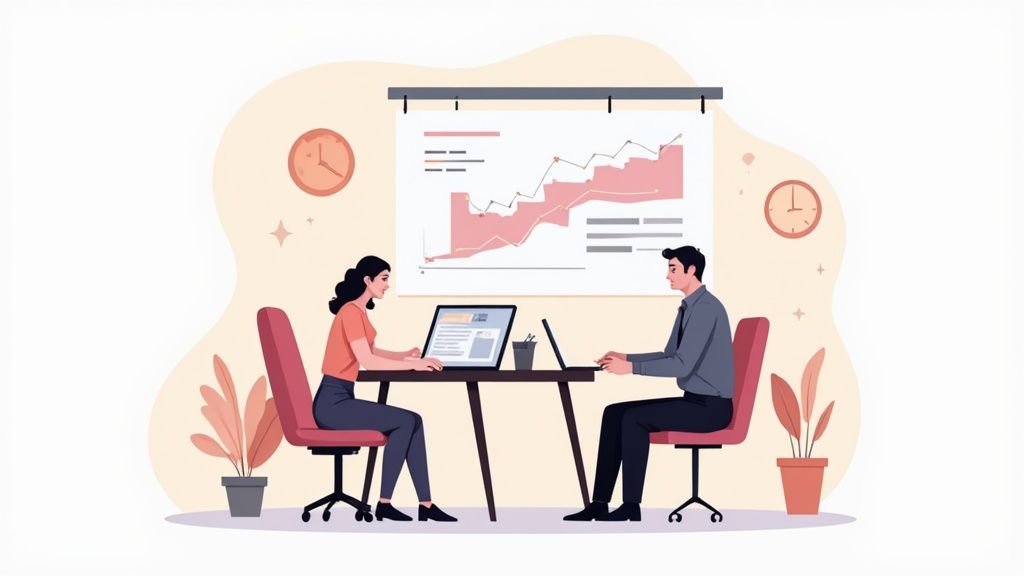
Let’s be honest: the words “performance review” can make even the most confident person’s stomach drop. But it doesn’t have to be that way. For a startup, turning these dreaded meetings into productive, trust-building conversations is non-negotiable if you want to keep your best people. The secret? Ditch the judgment and embrace coaching.
This shift starts by making these conversations a regular, forward-looking part of your culture. Forget the once-a-year, high-stakes review. Instead, think lightweight weekly or bi-weekly check-ins. These aren’t formal evaluations; they’re quick coaching sessions to clear roadblocks, celebrate wins, and make sure your team feels supported.
The anxiety around reviews isn’t just in our heads. It’s a real problem. Only 2% of Chief Human Resource Officers think their current systems actually drive improvement. And the feeling is mutual—a staggering 72% of employees don’t trust their company’s performance management process. You can learn more about the gaps in traditional performance management and see just how deep this trust deficit runs.
Structuring Coaching-Focused Check-Ins
To build a process that feels fair and genuinely helpful, you need a simple, repeatable structure. The goal is consistency—a predictable rhythm that both managers and their direct reports can rely on. A great one-on-one should feel like a partnership, not an interrogation.
A simple agenda can work wonders. Encourage your managers to build their check-ins around a few core questions:
- What are your top priorities this week? This keeps the chat focused on what matters right now.
- What progress have you made on your goals since we last spoke? This anchors the discussion in real outcomes, not just busywork.
- Are there any roadblocks I can help you remove? This frames the manager as a coach whose job is to enable success.
- What feedback do you have for me or the team? This simple question turns feedback into a two-way street and builds psychological safety.
This framework keeps the conversation proactive and solution-oriented. It’s about catching small issues before they snowball into big problems.
Delivering Feedback That Actually Helps
Giving constructive feedback is an art form. Get it wrong, and you’ll see people shut down. Get it right, and you can unlock someone’s full potential. The trick is to be specific, objective, and actionable—never personal.
So, instead of a vague comment like, “Your presentation wasn’t very engaging,” get specific. Try something like, “During the client presentation, I noticed that engagement seemed to dip during the data-heavy slides. Next time, let’s try adding more visuals and a quick summary upfront to keep the key takeaways crystal clear.”
The goal of feedback isn’t to criticize the past but to improve the future. Always tie your feedback to a specific behavior and offer a concrete suggestion for what to do differently. This transforms a potentially awkward moment into a clear path for growth.
To weave even more trust and fairness into your performance management system, bring in other perspectives. Two powerful ways to do this are:
- Employee Self-Assessments: Before a more formal review, ask the employee to reflect on their own performance. This gives them a voice in the process and often provides valuable context the manager might have missed.
- Lightweight Peer Feedback: Gather positive, constructive input from a few colleagues. This paints a much more complete picture of an employee’s contributions and reinforces a culture where everyone is invested in each other’s success.
By making reviews collaborative, forward-looking, and focused on coaching, you create a culture where feedback is seen for what it should be: a gift for growth, not a weapon for judgment.
Adapting Your System for Remote and Hybrid Teams
When your team isn’t sharing an office, managing performance requires a whole different mindset. Forget the old-school metrics like “time in seat” or how busy someone looks. In a distributed world, that stuff is not just irrelevant—it’s actively harmful.
Success is no longer about visibility; it’s about outcomes.
This pivot from presence to results is the absolute cornerstone of a modern performance management system built for today’s flexible work environment. It requires crystal-clear goals and a boatload of trust. When your team knows exactly what success looks like, you can give them the autonomy to do their best work, wherever that may be.
This isn’t just a niche idea anymore. Today, nearly 13% of full-time employees are fully remote, and another 28% have hybrid roles. It’s not a passing fad; it’s a proven productivity driver. In fact, 77% of workers report feeling more productive when working remotely. You can find more stats on the rise of flexible work arrangements on selectsoftwarereviews.com.
Fostering Connection Without Micromanagement
A common fear I see with managers leading remote teams is that they’ll lose connection and oversight, which often leads to the dreaded micromanagement trap. The key is to create intentional communication rhythms that build visibility around the work, not the people. This means getting smart with asynchronous tools and structured check-ins.
Here are a few practices that keep everyone aligned and supported, without the constant “just checking in” messages:
- Daily Asynchronous Stand-ups: Instead of a mandatory morning video call that breaks everyone’s focus, use a dedicated Slack channel. Team members can post their top priorities for the day and flag any blockers. It creates total transparency without derailing deep work.
- Weekly Written Updates: A short, structured summary of the week’s wins, progress toward big goals, and what’s on deck for next week. This gives managers a clean overview and builds a documented track record of contributions over time.
- Project Management Tools: Platforms like Asana, Trello, or Monday.com are non-negotiable. They make progress on key projects visible to everyone, shifting the focus from asking “What are you up to?” to seeing the work move forward in real-time.
When you build systems for asynchronous visibility, you empower your team with true autonomy. At the same time, you give leaders the confidence that key objectives are on track. It completely replaces the need for constant pings with a culture of documented progress and accountability.
Conducting Effective Virtual Reviews
Performance conversations in a remote setting need extra care to feel personal and impactful. Let’s be honest, a video call can feel cold and transactional if you’re not careful. To make virtual reviews genuinely meaningful, it all comes down to preparation.
Make sure both the manager and the employee have a shared agenda well ahead of time, packed with clear talking points and data. This should include progress on goals, key achievements, and snippets of peer feedback. Creating this shared context avoids any surprises and allows for a much richer, forward-looking conversation about growth.
This is where the right leadership really makes a difference. For startups bringing in seasoned leaders on a part-time basis, exploring interim management services can be a game-changer. By structuring virtual reviews with this level of thought, you reinforce that performance management is a tool for development, not just evaluation—no matter where your team is located.
Improving Your Performance Process Over Time
Here’s a hard truth: your first performance management system won’t be perfect. And it shouldn’t be. Think of your initial setup as version 1.0—a starting point, not a final destination.
Just like you iterate on your product based on customer feedback, your internal processes have to evolve with your team. The goal is to build a feedback loop for the process itself.
What’s working? What feels like a waste of time? What crucial conversations are falling through the cracks? Don’t be afraid to ask your team directly for their honest input.
Tracking System Effectiveness
To get beyond gut feelings, you need to watch a few core metrics. These data points will give you a clear signal on whether your system is genuinely helping or just creating more friction for everyone.
- Employee Engagement Scores: Are people feeling more motivated and connected, or is this new process draining morale?
- Voluntary Turnover Rates: A healthy system helps you keep your best people. If you see top talent heading for the door, your process might be part of the problem.
- Goal Achievement Rates: Is the system actually helping teams hit their targets more consistently? If achievement rates are low, it could point to issues with goal clarity or a lack of support.
The most effective performance management system is a living one. It adapts to the changing needs of your startup, ensuring it remains a valuable asset for growth instead of becoming outdated administrative baggage.
By continuously refining your approach, you’ll move beyond simply tracking performance to actively improving it, which boosts the entire company’s operational health. To learn more about this iterative mindset, check out our guide to improve operational efficiency across your startup.
Got Questions? We’ve Got Answers.
When you’re building a performance management system from scratch, you’re bound to hit a few snags. It’s totally normal. Founders and managers run into the same handful of problems time and time again.
Having a clear, consistent game plan for these common issues is what separates a fair, growth-oriented process from one that just feels like corporate busywork.
Let’s tackle some of the most frequent questions I hear.
How Often Should We Be Doing Performance Check-ins?
For startups, forget the heavy, once-a-year review. It’s a relic of a bygone era. What you need are frequent, lightweight conversations that actually move the needle.
A great rhythm to start with is bi-weekly or monthly one-on-ones between managers and their direct reports. Keep them focused: talk about goal progress, what’s blocking them right now, and any immediate coaching opportunities.
Then, layer in quarterly conversations that zoom out a bit. Use this time to discuss higher-level performance, career goals, and overall growth within the company. This constant rhythm makes feedback timely and actionable, which is exactly what you need to course-correct quickly in a fast-moving startup.
How Do We Handle Underperformance Without Making it Awkward?
The key is to address it early and directly, but always from a place of support. The moment you notice a key performance indicator (KPI) is consistently being missed, it’s time for a private chat to figure out why. Is it a skill gap? A lack of resources? Maybe a motivation issue?
Don’t jump to conclusions. Get curious.
Once you have a better understanding, you can create a simple Performance Improvement Plan (PIP). This isn’t a scary corporate document; it’s a roadmap back to success. It should clearly outline:
- Specific, measurable goals to get them back on track.
- A clear timeline, like 30 or 60 days.
- The support you’ll provide, whether it’s extra training, mentoring, or more frequent check-ins.
A PIP should always be about genuine improvement, not just a procedural step before letting someone go. Document everything and check in regularly. Show them you’re invested in their success.
A huge piece of advice: Decouple performance conversations from compensation discussions. When they happen in the same meeting, employees often just hear the salary number and tune out all the valuable feedback you’re trying to give. Have development-focused reviews, then use that data to inform compensation decisions in a separate conversation.
This one simple change makes feedback feel less transactional and more about real, genuine growth.
Finding the right leader to build and manage these systems is a game-changer for any startup. Shiny connects you with a marketplace of over 650 vetted, fractional executives who can run your performance management system for a fraction of what a full-time hire would cost. Explore top-tier talent and see how they can help you build a high-performing team.
